
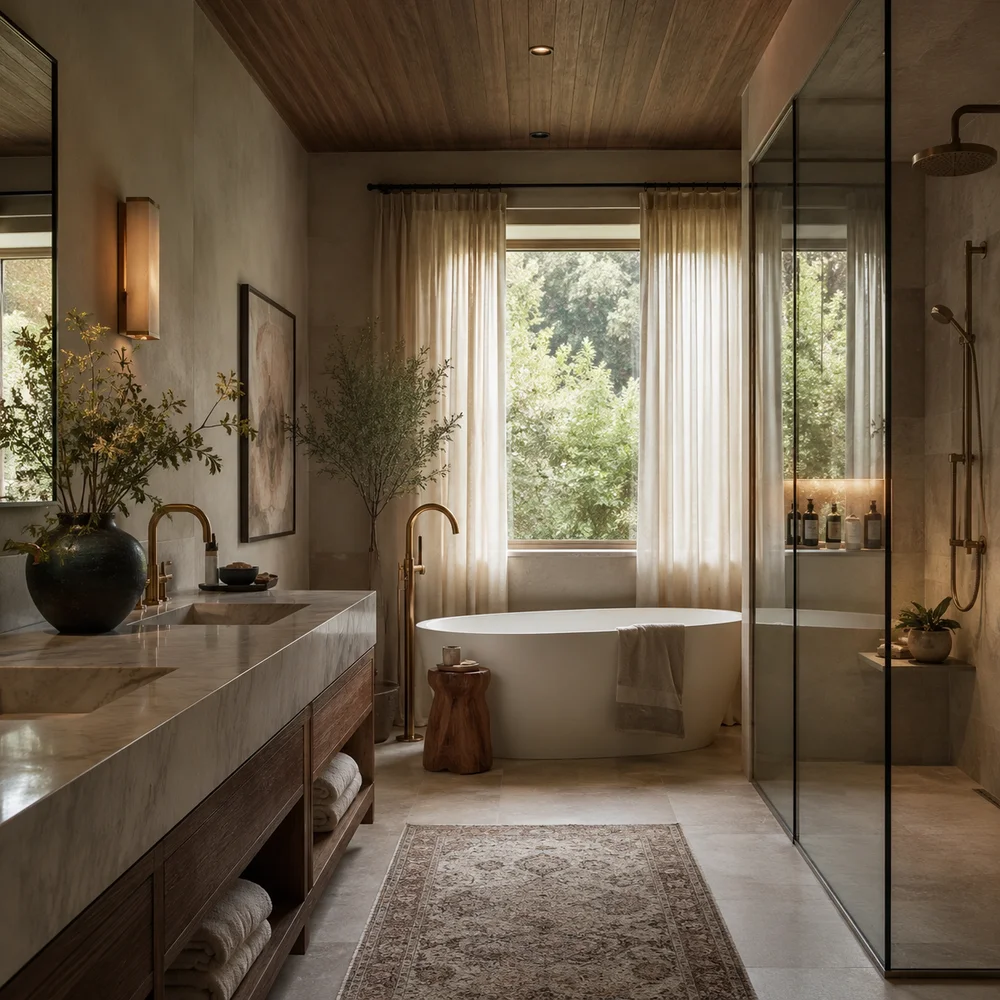
Best Guest Bathroom Styling Ideas That Will Impress Every Visitor
By Emily | June 6, 2026
There’s a particular kind of attention that goes into a guest bathroom — quieter than the spaces you live in daily, but somehow more revealing. It’s a room your visitors experience alone, in private, for just a few minutes. And those few minutes have a way of making a lasting impression.
The guest bathroom doesn’t need to be large. It doesn’t need marble floors or a soaking tub. What it needs is intention — the feeling that someone thought about this room, curated it with care, and wanted whoever walked in to feel genuinely welcomed rather than just accommodated.
Most guest bathrooms fail not because they lack budget, but because they lack a point of view. They’re functional but forgettable. A bar of soap, a basic towel, maybe a candle that’s been there since last year. Nothing wrong with any of it — but nothing that lingers either.
The bathrooms that people remember are the ones that feel complete. Where the lighting is soft and flattering. Where the towels are folded just so. Where something unexpected — a small plant, a sculptural soap dispenser, a single framed print — makes you pause and smile.
This guide is about building that kind of space. Whether your guest bathroom is a narrow powder room tucked under the stairs or a proper full bath off the hallway, every idea here is designed to work with what you have. You don’t need to renovate. You don’t need a designer. You need a clearer vision of what this room could feel like — and the confidence to follow through on it.
1. Start With the Right Foundation: Clean, Neutral, and Considered
 Save it
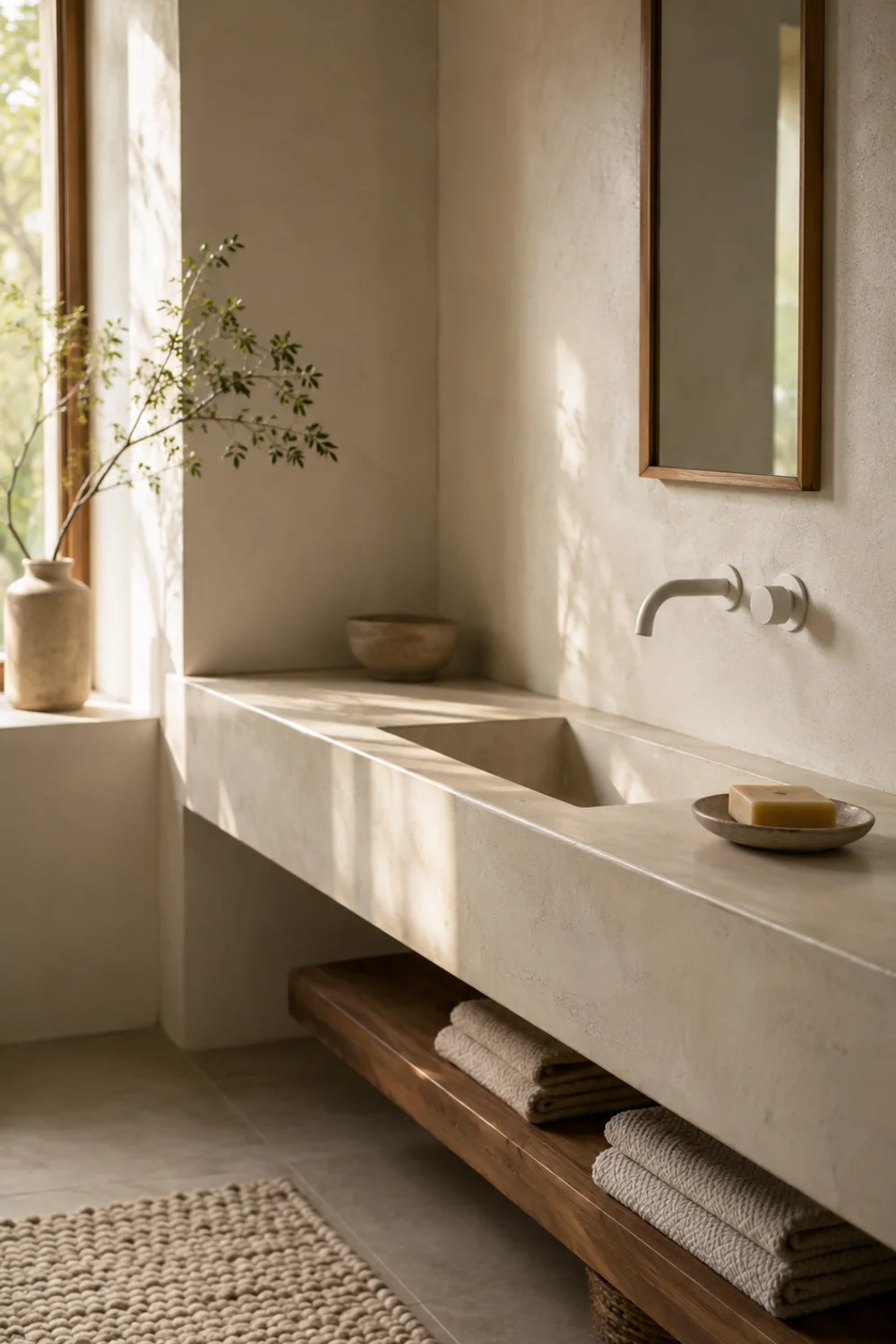
Before anything decorative lands in a guest bathroom, the base needs to be right. And the base is simpler than most people realize: clean, neutral surfaces with a clear visual hierarchy. This isn’t about bare minimalism — it’s about giving every decorative element room to breathe, to be seen, to do its job without competing for attention.
Neutral doesn’t mean boring. A warm white wall with soft undertones reads completely differently than a cold stark white. Creamy off-whites, warm greiges, and soft putty tones create a sense of warmth that pure white rarely achieves. If your guest bathroom has existing tile you can’t replace, work with it rather than against it — find the undertone and pull it into your textiles, accessories, and hardware instead.
The floor is often overlooked, but it sets the entire tone for how the room feels. If you have original tile that reads outdated, a simple bath mat in a quality material can visually ground the space and soften the harshness.
Think about the ceiling too. In a guest bathroom with lower ceilings, a lighter ceiling color or a warm white paint can visually lift the room in a way that no amount of styling will otherwise achieve. Conversely, in a powder room with higher ceilings and strong bones, a moody ceiling color — deep charcoal, forest green, or even a dark navy — can create extraordinary drama without touching a single wall.
Hardware is the jewelry of any bathroom. Swapping out builder-grade chrome hardware for something with warmth and weight — brushed brass, antique bronze, unlacquered brass — immediately elevates the perceived quality of the room. It’s one of the most affordable upgrades you can make with disproportionate visual impact. The faucet, the towel bar, the robe hook, the toilet paper holder — when they share the same finish, the room reads as designed rather than assembled.
If you’re starting from scratch with a color palette and need guidance on how neutral tones interact with light and material, the ideas in How to Achieve a Timeless Neutral Bathroom Decor Style offer a thoughtful, well-considered place to begin.
2. The Power of Soft, Layered Lighting
 Save it
Lighting is the single most underestimated element in a guest bathroom — and the single greatest opportunity to make the room feel genuinely luxurious. Most guest bathrooms rely on a single overhead fixture that casts a flat, shadowless light. Functional, yes. Flattering, almost never.
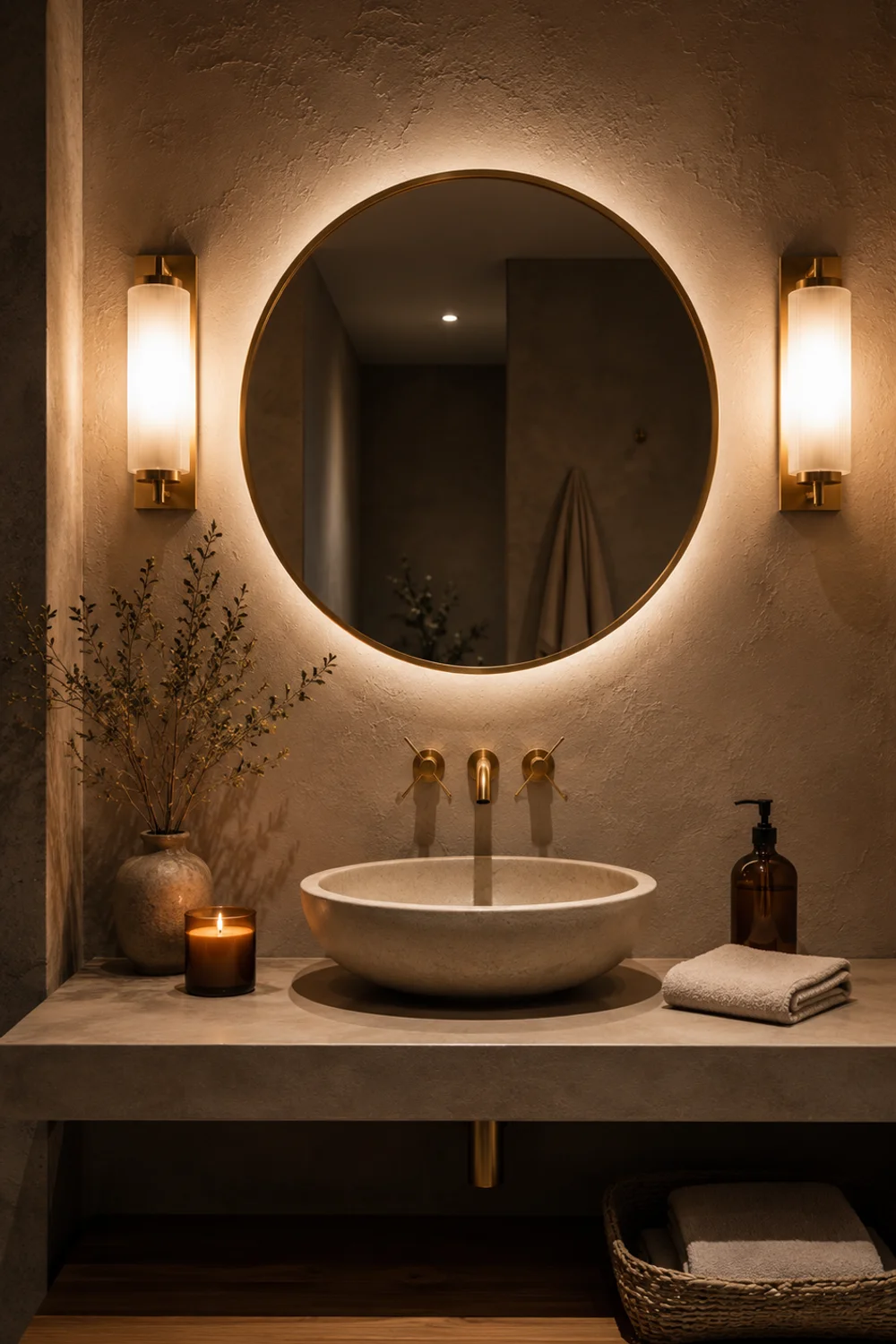
The goal is layered lighting — at least two sources that work together, creating depth rather than uniformity. The overhead fixture handles ambient light. A mirror-adjacent source, whether a backlit LED mirror or flanking wall sconces, handles task lighting at face level. And if there’s a third element — a small candle, a plug-in accent lamp, or even a LED-backlit shelf — it adds the kind of warm atmospheric layer that turns a bathroom into a retreat.
Wall sconces placed at eye level beside or just above the mirror are arguably the most flattering lighting setup available in any bathroom. They eliminate the harsh under-eye shadows created by overhead lighting and cast light downward and sideways across the face rather than from directly above. This isn’t just an aesthetic decision — it’s genuinely more pleasant to use, and your guests will feel it even if they can’t articulate why.
If you can’t rewire the room, a backlit LED mirror with a warm color temperature — ideally 2700K to 3000K — is the cleanest single-fixture solution. The glow it creates around the perimeter of the mirror gives both flattering task light and a subtle ambient wash that makes the whole room feel softer. Choose one with a dimmer function if possible, so the bathroom can shift from bright morning light to something quieter and more atmospheric in the evening.
Candles deserve their place in a guest bathroom, but choose them thoughtfully. A single high-quality candle in a beautiful vessel adds light, warmth, scent, and visual texture simultaneously. It’s one of the most efficient styling tools available. Light it before guests arrive, and the room immediately feels prepared, considered, and cared for.
Color temperature matters enormously. A guest bathroom with warm-toned lighting feels spa-like and sophisticated. The same room with cool, blue-white lighting feels institutional. If you’re choosing bulbs, always err toward warm white. The difference is dramatic.
3. Towels as a Design Element, Not an Afterthought
 Save it
Nothing communicates care quite like a beautifully folded towel. In a hotel, the folded towel is a visual cue — someone was here, someone prepared this for you. In a guest bathroom, it creates exactly the same feeling of welcome. And yet, most guest bathrooms have a towel hanging limply on a bar, wrinkled from the last use, communicating the exact opposite.
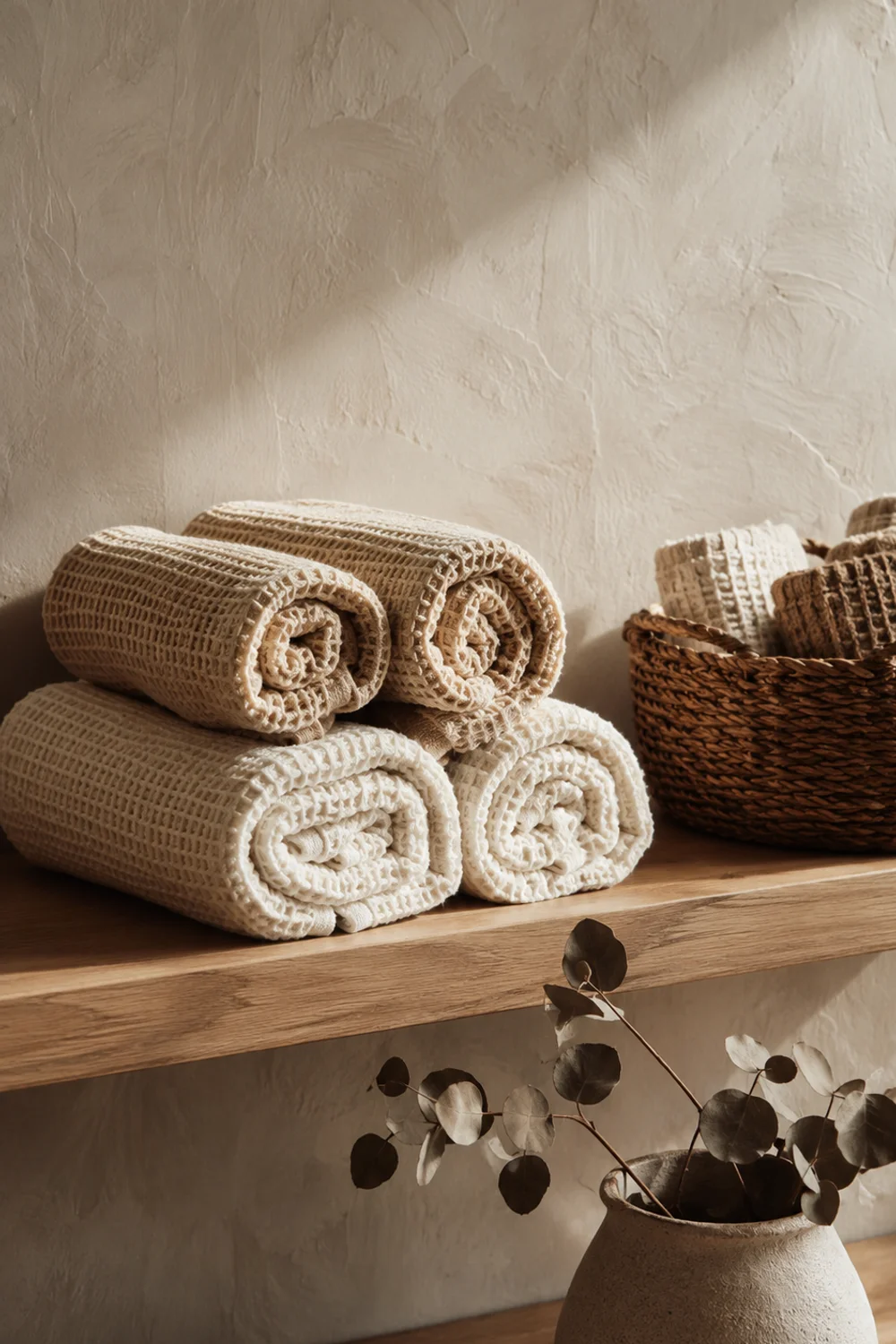
Start with quality. You don’t need an enormous collection — you need two to three towels per expected guest that feel genuinely good against the skin. Thick, tightly woven cotton with some weight to it. Waffle-weave towels have a wonderful quality of feeling both lightweight and textured. Turkish cotton bath towels have a flat-woven density that reads elevated without looking fussy.
Color is the next decision. White towels are the universally elegant choice for a reason — they photograph beautifully, read as clean, and work with any color scheme. But they’re not the only option. Warm ecru, oatmeal, and natural linen tones all feel sophisticated without the fussiness of white maintenance. Deep tones — terracotta, sage, charcoal — work beautifully in a bathroom with a stronger color palette and add visual warmth in a way that white towels simply can’t.
Folding technique matters more than most people realize. A simple spa fold — where the hand towels are folded in thirds and laid flat on the vanity edge, or rolled and placed in a basket beside the sink — immediately elevates the visual quality of the room. The effort required is minimal. The effect is considerable.
A small hand towel basket on the vanity, stocked with two or three folded hand towels available for guests to use and take without searching through cupboards, is one of the most hospitality-forward moves you can make in a guest bathroom. It communicates that you anticipated their needs before they arrived.
For smaller bathrooms where towel storage is limited, a simple wall hook or a single decorative towel ring positioned at an intentional height does far more than a standard towel bar — it makes the space look styled rather than strictly utilitarian.
4. Scent: The Invisible Layer That Changes Everything
 Save it
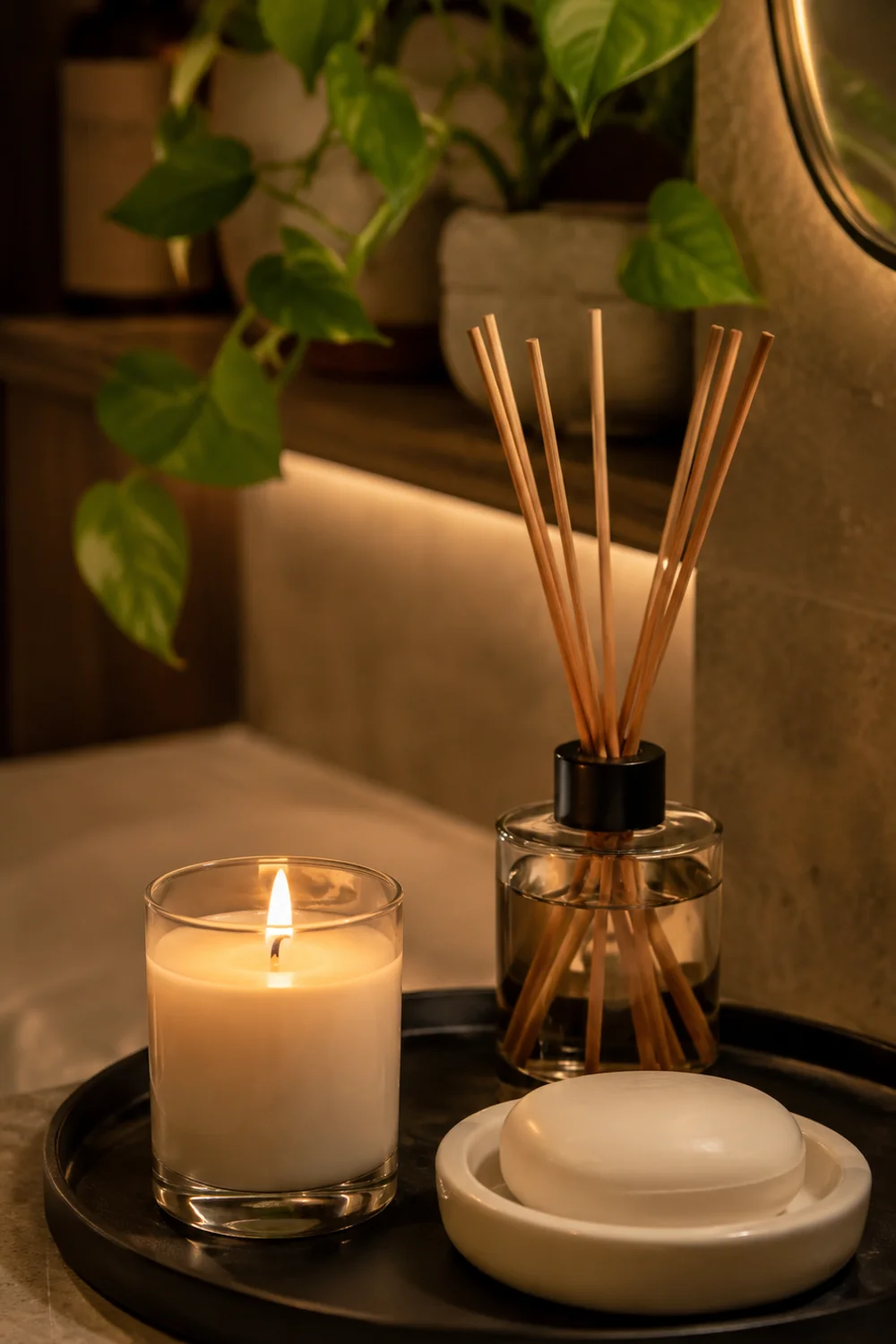
Scent is processed by the oldest part of the brain — the part responsible for memory and emotion. A guest bathroom that smells extraordinary will be remembered long after the visit ends, even if the person couldn’t tell you exactly why the room felt so special. This makes scent not just a nice extra, but one of the most powerful atmospheric tools available.
The approach to scent in a guest bathroom should be light-handed and layered. A single dominant fragrance is the foundation. A subtle complementary element deepens the atmosphere without creating olfactory chaos. The goal is a room that feels gently fragrant — welcoming rather than overwhelming.
Candles are the classic solution, and they work because they combine scent with warm, flickering light — two sensory experiences simultaneously. A good soy or beeswax candle in a quality vessel reads as a styling element when it isn’t burning and as an atmospheric element when it is.
Reed diffusers offer continuous fragrance without the maintenance of candles and work well in guest bathrooms that aren’t always occupied. Choose a diffuser with a clean, elevated scent — light woods, soft florals, white tea, eucalyptus, or citrus. Avoid anything that reads as synthetic or overly sweet, which can feel cheap regardless of price.
Fragrance in a guest bathroom should complement the visual palette, not conflict with it. A bathroom with warm, natural tones — wood accents, earthy textures, warm neutrals — feels harmonious with cedar, sandalwood, amber, or soft botanical scents. A cooler, more minimal bathroom reads beautifully with eucalyptus, mint, white tea, or clean linen.
Avoid plug-in air fresheners entirely. They tend to smell synthetic and feel impersonal in a way that conflicts with any elevated styling you’ve achieved elsewhere. The same bathroom that looks beautiful with a quality candle and a reed diffuser can feel like a roadside motel bathroom with a plug-in fragrance unit.
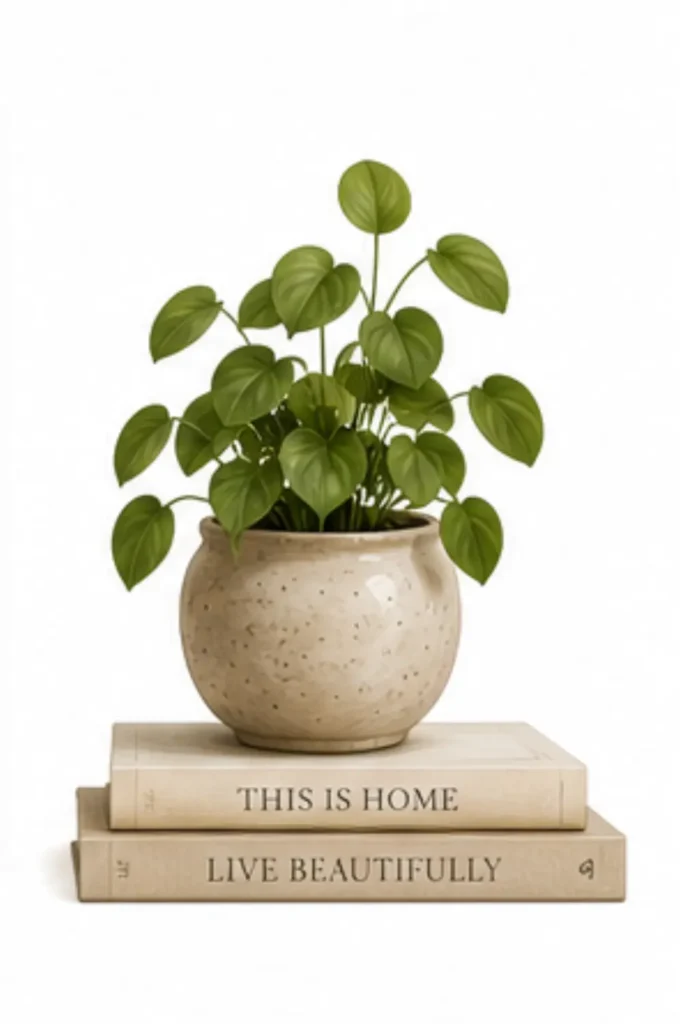
5. Greenery and the Living Element
 Save it
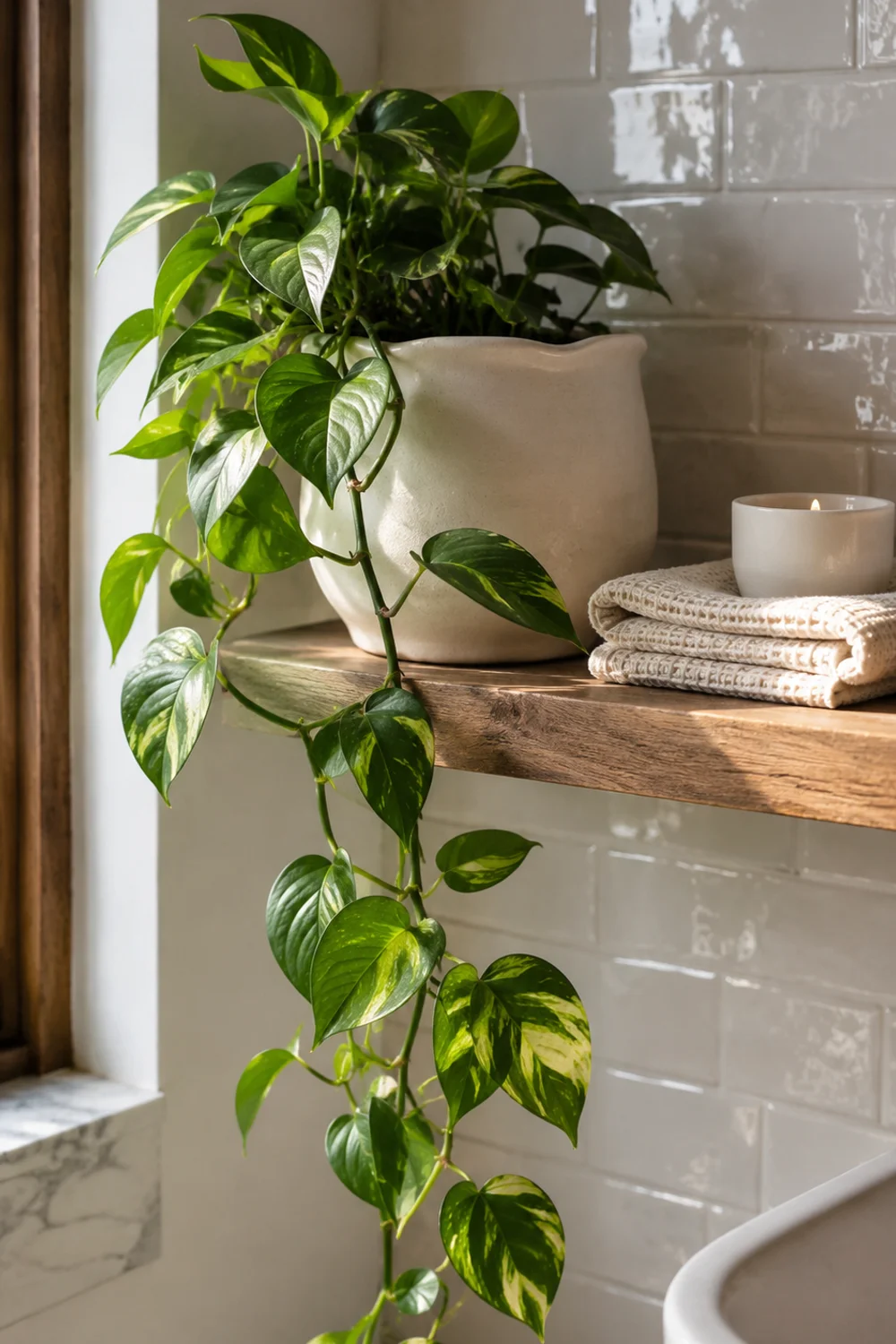
Plants in a bathroom feel intuitive — the humidity, the warmth, the proximity to water all suggest that something living belongs there. But more than just surviving, a well-placed plant in a guest bathroom does something no purely decorative object can: it brings a quality of life and freshness that feels both natural and considered.
The choice of plant matters as much as its placement. Not every plant thrives in a bathroom environment, and a struggling, yellowing plant communicates the opposite of the fresh, cared-for atmosphere you’re building. Choose plants that genuinely love humid, low-to-medium-light conditions — and then style them intentionally.
Pothos is perhaps the most forgiving bathroom plant that still photographs beautifully. Its trailing vines bring organic movement to a shelf or the edge of a vanity in a way that feels deeply natural. A golden pothos in a simple ceramic planter on a bathroom shelf is quietly gorgeous. Peace lilies thrive in humidity and produce elegant white blooms. Snake plants and ZZ plants manage low light conditions without complaint.
Scale matters enormously here. A single small succulent in the corner of a vanity is barely visible and does little for the room. One confident, properly sized plant in the right vessel in the right location does far more for the atmosphere than three undersized plants scattered around without intention. Think about the plant as an anchor element — something that draws the eye and contributes to the room’s visual story.
If live plants feel like too much maintenance in a guest bathroom that isn’t frequently used, a single high-quality preserved or dried botanical arrangement can achieve a similar organic quality with no care required. Pampas stems, dried eucalyptus, or a simple bundle of dried lavender in a ceramic vessel all feel considered and editorial rather than artificial.
6. The Vanity Setup: Functional Elegance
 Save it
The vanity is where the guest bathroom is most closely experienced — hands are washed here, the mirror is consulted here, the small rituals of grooming happen here. It’s the most tactile surface in the room, and it deserves to be styled as thoughtfully as any surface in your home.
Begin by editing down. A guest bathroom vanity should be clear of everything personal — no daily medications, no half-used products, no dental floss and contact lens cases from your own routine. This surface should feel curated, prepared, and entirely for the guest’s use. Empty counter space is not wasted space; it’s generous space.
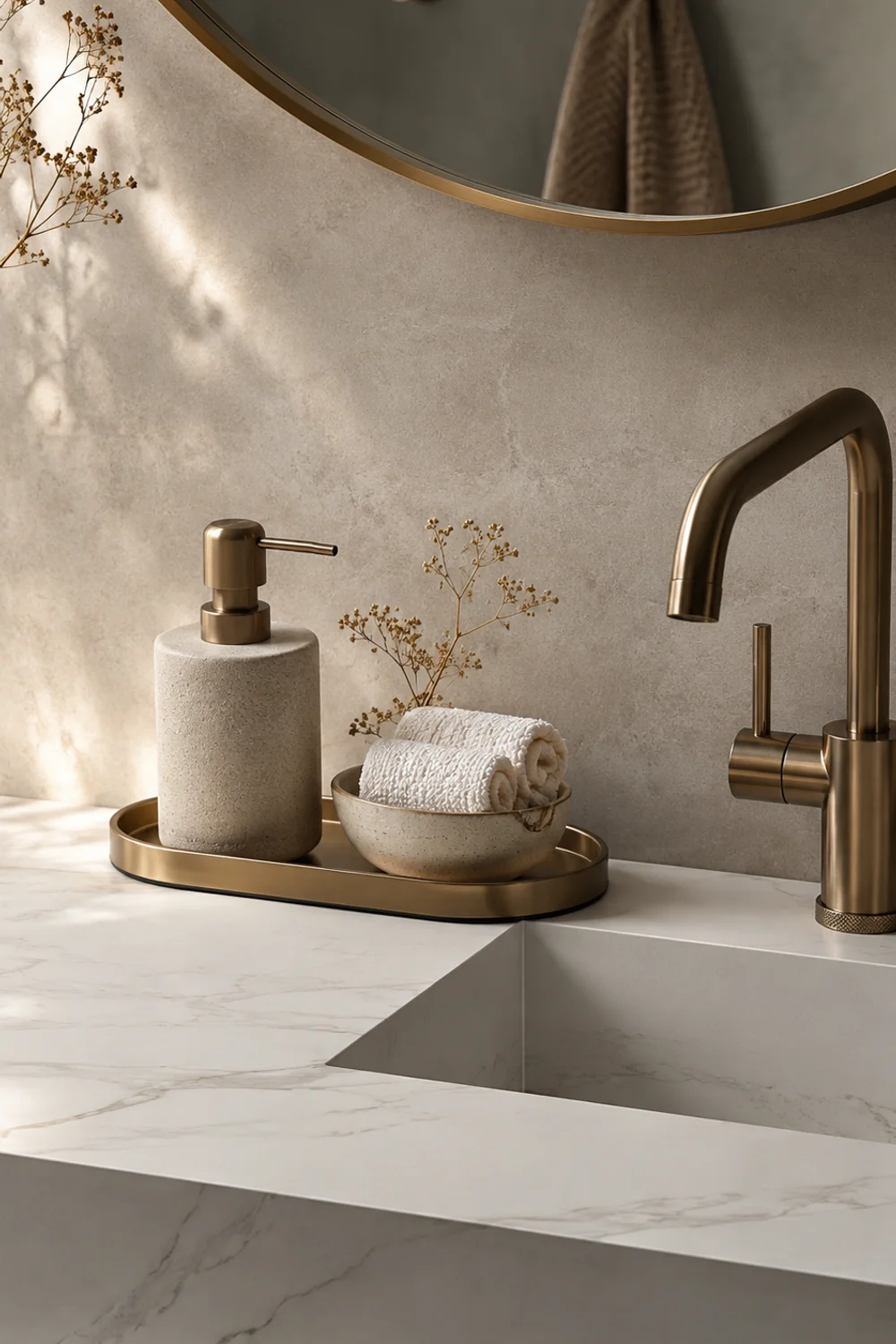
What belongs on the vanity is a short, carefully selected list. A quality soap — either a beautiful bar soap in a ceramic soap dish or a refillable pump dispenser with something genuinely nice inside.
A small tray or dish to contain the soap and perhaps a single candle or a folded hand towel. Optionally, a small plant or a bud vase with a single stem. That’s it. Less than you think. Edited to the point where every object is visible and intentional.
Soap is worth investing in for a guest bathroom specifically. A premium bar soap in a beautiful wrapper or a refillable glass pump dispenser with quality hand wash signals attention to detail before a word is spoken. It says: I thought about what you would need. I chose something good. This is for you. The cost difference between ordinary soap and something genuinely elevated is minimal, and the impact on how a guest perceives the room is disproportionate.
Trays do important organizational work on a vanity while simultaneously elevating the styling. A marble tray, a ceramic catchall dish, or even a simple lacquer tray groups objects visually and prevents the vanity from feeling chaotic even when multiple items are present.
If you’re refining how each object on the vanity relates to the others, exploring Beautiful Bathroom Shelf Styling Ideas with Modern Decor Touches will give you a more detailed framework for proportion, grouping, and visual balance across all the horizontal surfaces in the room.
7. Small Touches That Communicate Genuine Care
 Save it
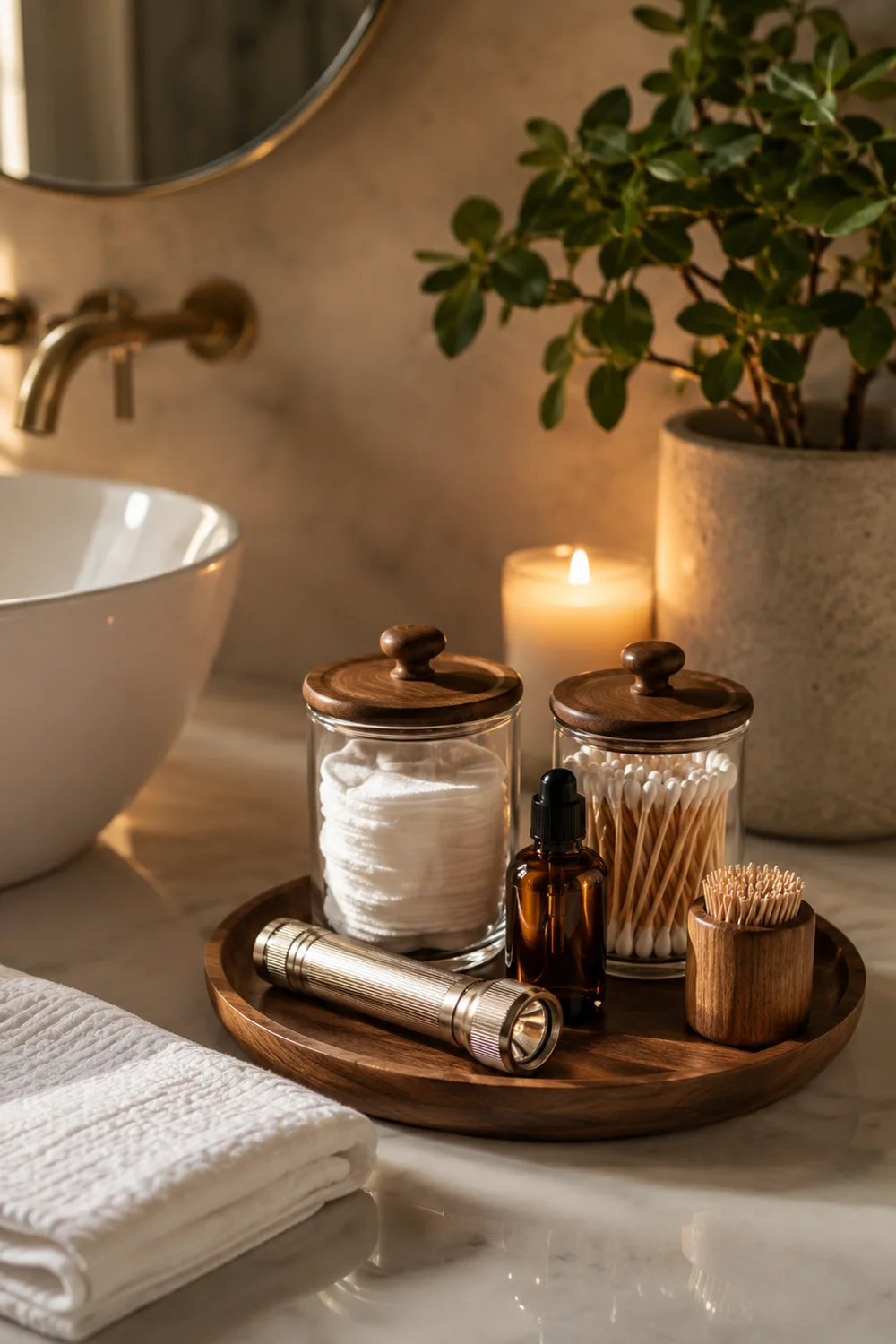
The guest bathroom moments that visitors actually remember are usually the smallest ones. Not the tile or the paint color, but the Q-tips in a small ceramic container they didn’t have to ask for. The little dish of mints on the vanity edge. The extra roll of toilet paper positioned openly rather than hidden in a cabinet. The folded face cloth they didn’t expect.
These details belong to the category of thoughtful hospitality — anticipating needs before they arise, so your guest never has to feel awkward asking for something basic.
A small toiletry tray or basket with guest essentials is one of the most effective moves you can make in any guest bathroom. Stock it with cotton rounds, Q-tips, a few hair ties, a small lint roller, a nail file, an extra toothbrush still in the packaging. Keep the packaging cohesive — transfer cotton rounds and Q-tips into small ceramic or glass containers rather than leaving them in their drugstore packaging.
A hand lotion beside the sink is genuinely appreciated in a way that surprises most hosts when they first add it. It’s a small luxury that communicates: I thought about how your hands would feel after washing them. That level of anticipation is what separates a guest bathroom that feels hospitable from one that merely functions.
The toilet paper situation deserves its own attention. An extra roll should be visible — not hoarded in a cabinet where a guest would have to dig around to find it. A small toilet paper holder with an extra roll stacked beside it, or a simple magazine-style holder that holds two rolls openly, is far more hospitable than hiding the backup supply.
For the black-and-white bathroom aesthetic where clean, graphic styling pairs particularly well with these editorial touches, 13 Modern Black and White Bathroom Decor Ideas Right Now offers a beautiful range of approaches that translate easily to a guest bathroom context.
8. Mirror and Lighting Pairing: The Most Impactful Duo
 Save it
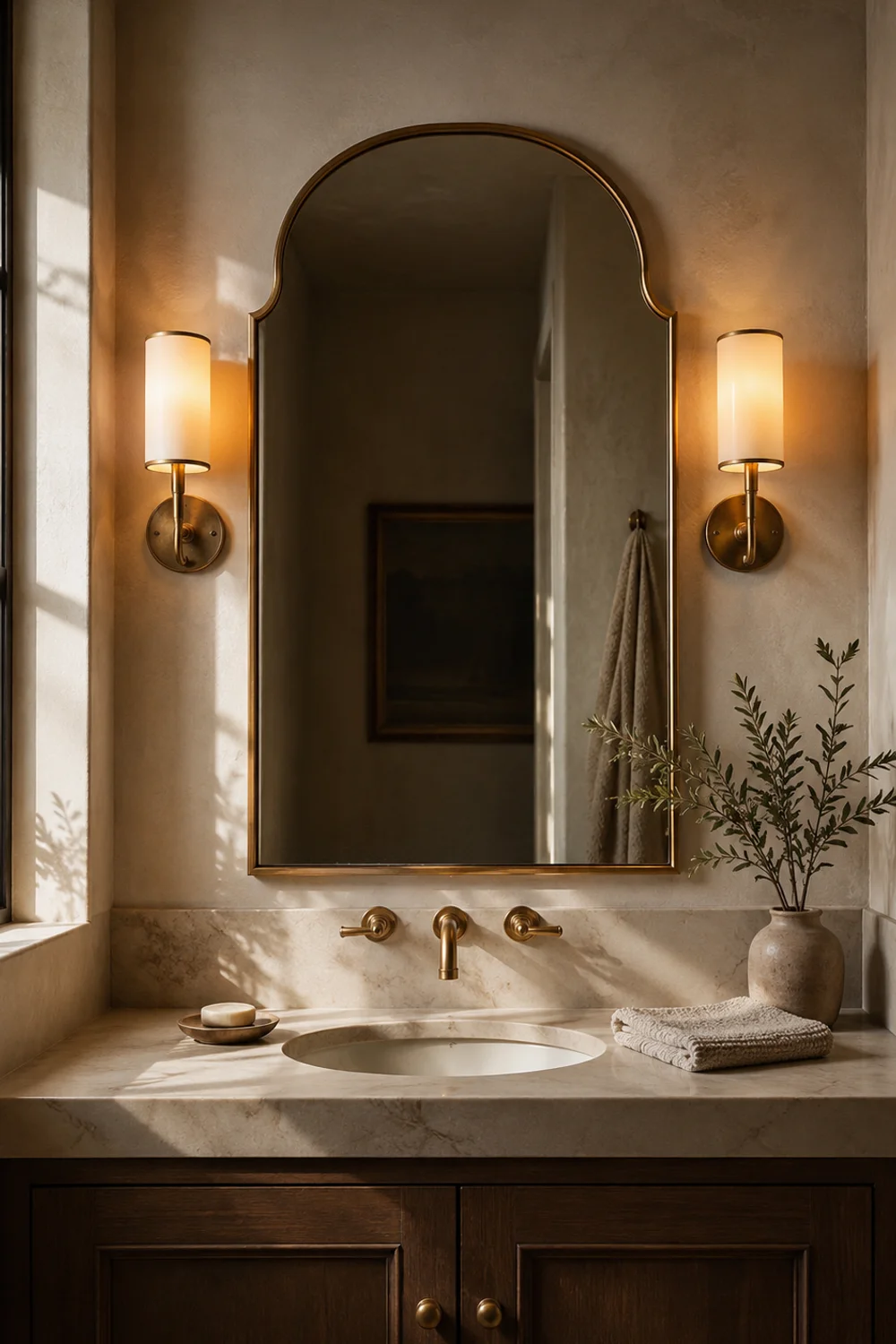
In a guest bathroom, the mirror and its lighting work as a pair — and the quality of that pairing determines more about how the room feels than almost any other single decision. A beautiful mirror in poor lighting loses half its impact. Excellent lighting in front of an awkward mirror creates its own frustrations. When the two are chosen and positioned together, they elevate the entire bathroom in a way that feels effortlessly sophisticated.
The mirror choice in a guest bathroom has enormous stylistic range. A simple arched frameless mirror communicates modern elegance. A thin brass or antique gold frame brings warmth and character. A backlit LED mirror with a floating effect suggests spa-level intention. Each works — the question is which works for this specific room and what the rest of the bathroom’s styling demands.
The rule about sizing applies in a guest bathroom as much as anywhere: the mirror should be at least as wide as the vanity, ideally wider by a few inches on each side. A mirror that feels undersized to the vanity creates immediate visual imbalance — the vanity becomes dominant, the mirror becomes an accessory rather than a focal point, and the room never quite settles into proportion.
Height matters too. The center of the mirror should sit at or just above average eye level — roughly 57 to 65 inches from the floor. This ensures the mirror is actually usable rather than merely decorative. A mirror hung too high is a frustrating daily reminder of an unconsidered installation.
If wall sconces flank the mirror rather than sitting above it, they should be mounted at approximately 60 to 65 inches from the floor — the approximate center of most people’s faces when standing. This positioning creates even, flattering light that eliminates the shadows overhead fixtures create. The sconces themselves become part of the decorative composition, framing the mirror on either side in a symmetry that reads as polished and intentional.
9. Texture Layering for Warmth and Depth
 Save it
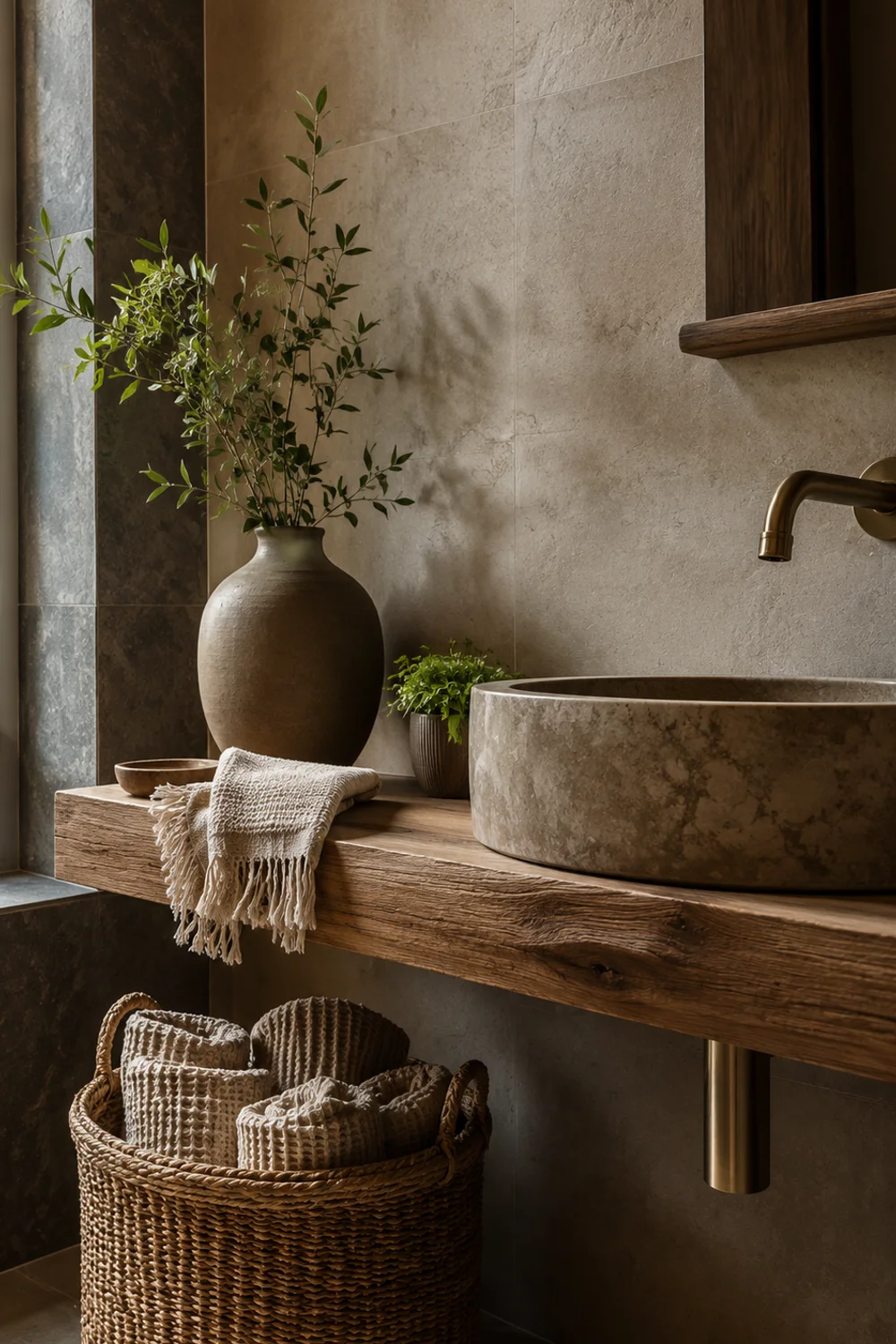
A guest bathroom that reads as genuinely luxurious is almost always one that has texture — multiple, layered materials that create visual depth and tactile interest throughout the space. Smooth tile, matte ceramic, woven cotton, rough linen, natural wood, polished glass. When these coexist in the right proportions, the room feels rich and considered in a way that purely uniform surfaces never achieve.
Texture in a bathroom comes from more sources than most people realize. The towels you choose carry enormous textural weight — a waffle-weave towel has completely different visual character than a plush terry cloth, and both differ from a flat-woven Turkish cotton. A ceramic soap dish with a hand-thrown quality and slight irregularity introduces texture on the vanity surface. A basket, even a small one, brings woven organic texture into what might otherwise be an entirely smooth room.
Wood is one of the most powerful texture-bringers in a bathroom. Even small amounts — a wooden soap dish, a simple bamboo tray, a wood-framed mirror — introduce warmth and organic richness that ceramic and stone alone rarely provide. Wood and tile in particular have a natural affinity that shows up in almost every high-end bathroom photograph for good reason.
Linen is the textile equivalent of what wood does structurally. A linen hand towel hanging over the vanity bar rather than a standard terry cloth changes the register of the entire room. A small linen pouch beside the soap, a linen-covered tissue box, even a linen window treatment if there’s a window — these touches accumulate into an atmosphere of considered luxury without ever feeling overdone.
If you’re drawn to this layered, organic approach to texture and material, the philosophy translates beautifully into the broader earthy design language explored in Beautiful Earthy Bathroom Decor Ideas with Warm Natural Tones.
10. Storage That Feels Intentional, Not Clinical
 Save it
Guest bathroom storage is a design challenge that most people either over-engineer or completely neglect. The over-engineered version is a cabinet stuffed with products and supplies that overflow onto the counter, creating a visual chaos that makes the bathroom feel like a storage room that also happens to have a sink. The neglected version has nowhere to put anything — no visible spare supplies, no place to set a bag or a phone, no sense that the space was designed with a real person’s needs in mind.
The ideal guest bathroom storage is edited, curated, and effortlessly accessible. It says: everything you might need is here, within reach, without you having to search.
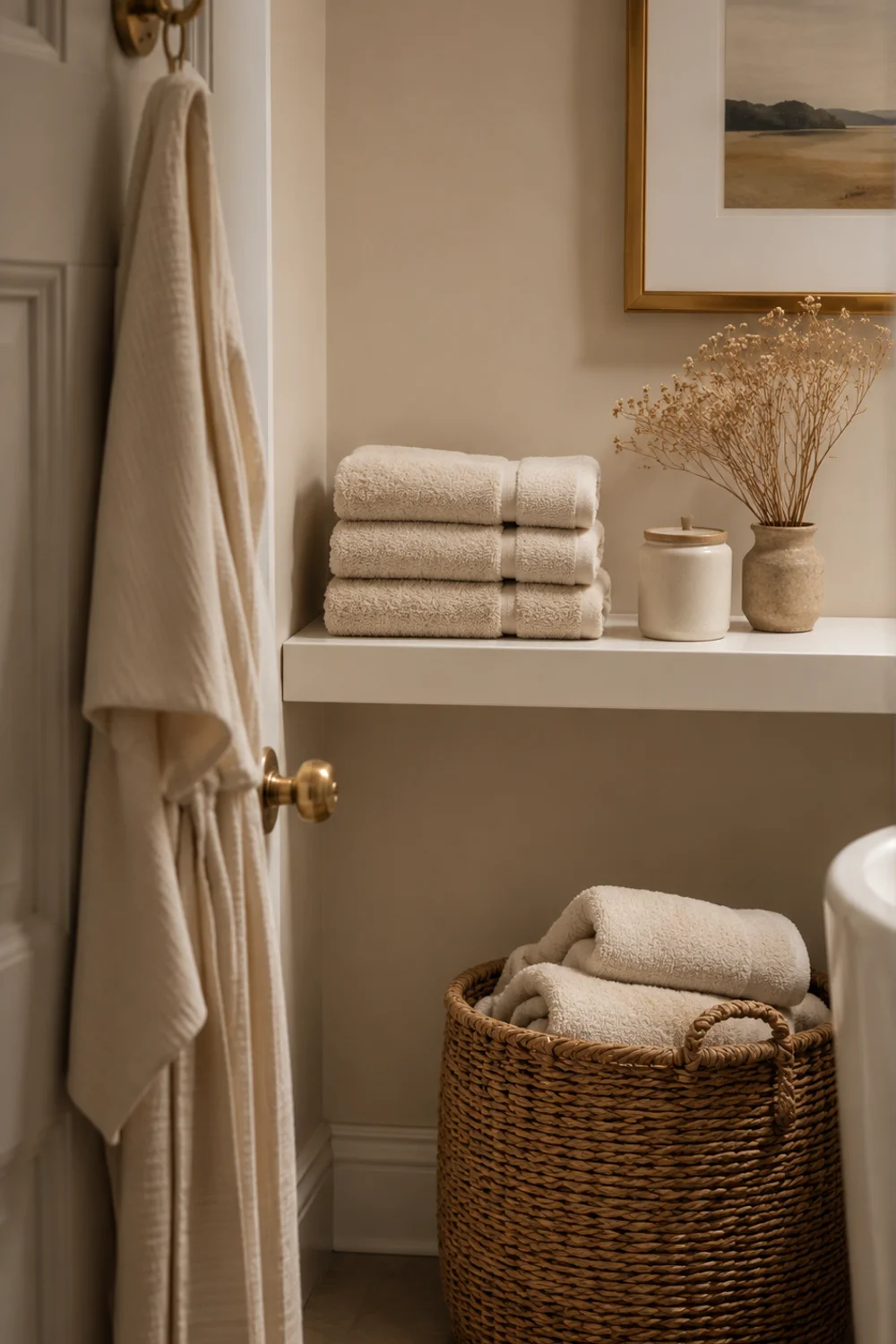
An open shelf, even just one, is one of the most useful storage additions in a guest bathroom. Styled with neatly folded towels, a small plant, a candle, and a decorative object or two, it provides both storage and visual warmth simultaneously. It gives the bathroom a vertical dimension and prevents the room from feeling flat.
A small tray or decorative basket on the vanity surface can hold guest essentials — soap, lotion, cotton supplies — without the randomness of loose objects. A lidded ceramic jar for cotton balls. A glass bottle for hand lotion. A small ceramic tray for the soap dish and a spare hand towel. When these objects share a cohesive material language — all ceramic, all natural, all matte — the collection reads as styled rather than assembled.
For guests staying longer, a small hook or robe hook mounted at the back of the door or on a wall near the shower is quietly transformative. It gives them somewhere to hang a towel without draping it over the sink or the toilet. The hook itself becomes a design element — choose one in brass or matte black with some sculptural quality rather than a generic utility hook, and it earns its place visually.
11. Color, Pattern, and the Art of One Statement Moment
 Save it
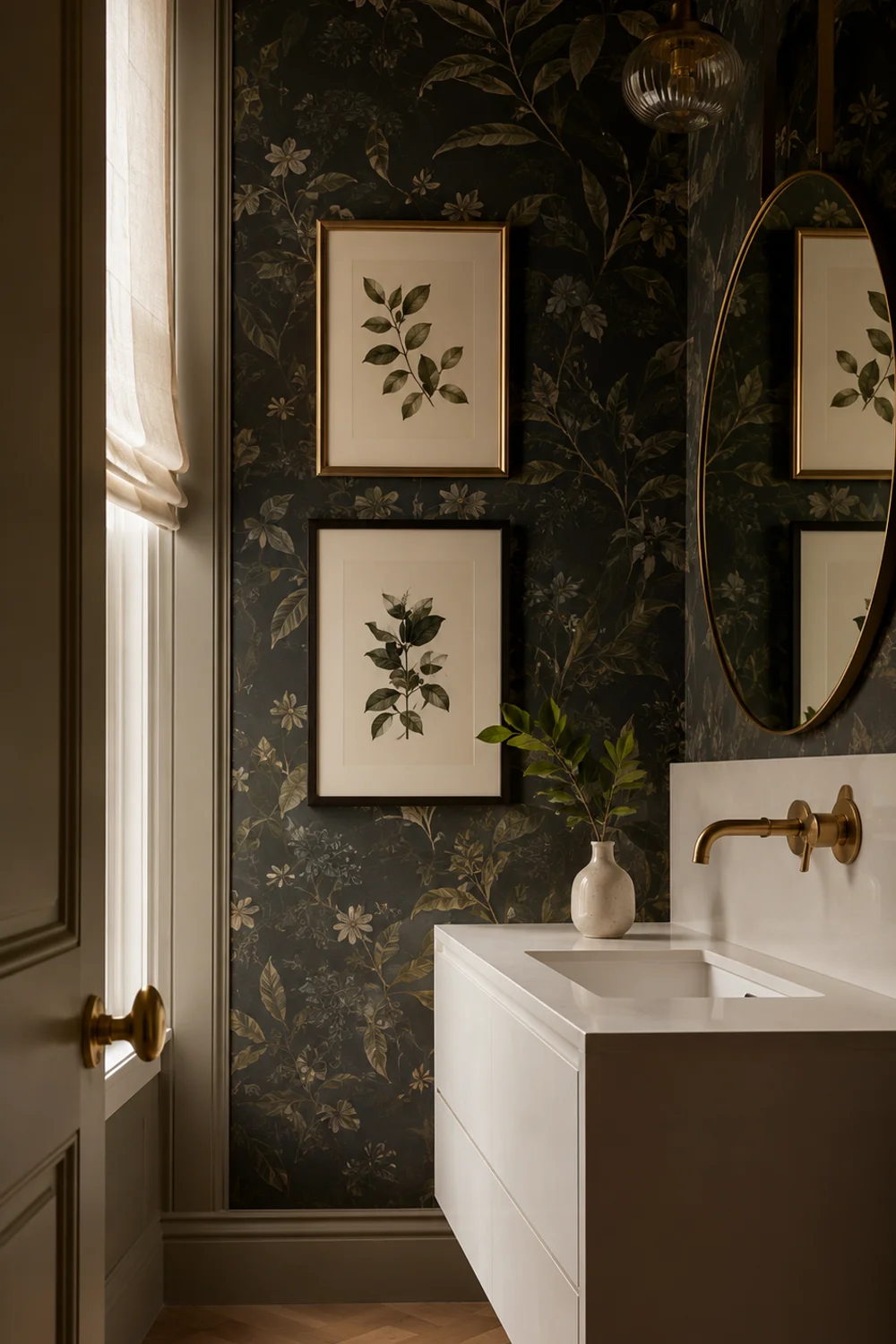
A guest bathroom doesn’t need to be a neutral box. In fact, some of the most memorable guest bathrooms are the ones with a single, confident statement — a color, a pattern, a material choice that communicates personality and intention. The key is singularity: one strong moment, executed well, rather than multiple competing elements fighting for dominance.
That statement moment can take many forms. A wallpaper feature wall — even in a powder room barely large enough to turn around in — can create extraordinary visual drama. A deeply colored vanity in forest green, navy, or terracotta against white tile establishes immediate sophistication. A single piece of art, well-chosen and well-framed, gives the room a cultural identity that no amount of product styling achieves.
Pattern plays by specific rules in a bathroom. In a small guest bathroom, a busy pattern on every surface creates chaos. But a patterned floor tile beneath simple white walls creates exactly the kind of visual drama that feels curated and considered. An encaustic cement tile, a classic black-and-white hex, or even a simple grid tile in an unexpected color on the floor makes the room instantly more interesting.
The Japandi bathroom aesthetic handles this singular-statement philosophy with particular elegance — using one material or texture as a defining feature against an otherwise restrained background. That approach, which works beautifully in a guest bathroom context, is explored in depth in Why Japandi Bathrooms Are the Biggest Interior Design Trend You Need to Try Right Now.
For smaller guest bathrooms where every visual decision carries more weight, the approach to creating space with strategic color and material choices detailed in How to Make a Small Apartment Bathroom Look Bigger with Minimalist Decor offers practical guidance on making bold decisions without sacrificing the sense of openness the room needs.
Art in a guest bathroom is one of the most underused styling opportunities available. A single framed print — a botanical illustration, an abstract, a vintage travel poster, a hand-drawn architectural sketch — gives the room cultural depth and personal character that product styling alone never quite achieves. Frame it well. Position it at eye level. Let it be the one moment in the room where your taste is clearly expressed.
Common Mistakes to Avoid
Leaving the room feeling unlived-in and impersonal. There’s a fine line between clean, edited simplicity and a bathroom that feels sterile and uncared for. A guest bathroom with bare walls, no scent, a single bar of drugstore soap, and one limp towel hanging on a bar isn’t minimal — it’s abandoned. The goal is curated warmth, not studied emptiness. Even three well-chosen objects — a quality candle, a beautiful soap dispenser, a folded towel stack — are enough to transform the atmosphere entirely.
Overcrowding the vanity with personal items. If you use this bathroom occasionally yourself, clear it completely before guests arrive. Everyday products — your moisturizer, your deodorant, your toothbrush — communicate that the space is yours, not theirs. Guests feel like intruders in a room full of someone else’s routine. Edit the surface to the essentials, styled for a visitor’s experience, not your own convenience.
Ignoring the lighting temperature. This is the most common technical mistake in guest bathrooms. Cool, blue-white LED bulbs above a mirror create a harshness that makes even beautiful styling feel cheap and clinical. The fix is straightforward and inexpensive: replace the bulbs with something in the 2700K to 3000K range. Warm white light transforms how the room feels in seconds. It makes the materials look better, the towels look softer, and the person using the mirror look more like themselves.
Choosing the wrong mirror scale. A mirror that’s too small for the vanity is a mistake visible from the moment you walk in. It creates an immediate visual imbalance that no amount of beautiful styling on the vanity surface will overcome. Always size the mirror to the vanity width as a minimum — and consider going wider by four to six inches on each side for a more confident, proportional result.
Neglecting the floor. In the quest to style the vanity and the walls, the floor often gets ignored. But the floor is what frames the entire room visually, especially in a small space. A quality bath mat in a warm, cohesive color brings softness, texture, and color to what might otherwise be a cold, hard surface. It also communicates, quietly but clearly, that the room was prepared for someone’s comfort.
Using fragrance products that smell synthetic. Plug-in air fresheners, cheap spray bottles, overly sweet room sprays — these undercut every effort you’ve made elsewhere in the room. Fragrance should feel like a final polish of luxury, not a last-ditch effort to mask something. One quality candle or reed diffuser in a clean, natural scent — eucalyptus, cedar, white tea, soft amber — does more for the room than any number of synthetic fragrance products.
Frequently Asked Questions
How do I make a small guest bathroom feel more luxurious without renovating?
The most impactful changes in a small guest bathroom require no renovation at all. Swap the mirror for something larger and more considered — even in a small space, a well-proportioned mirror feels more generous than an undersized one. Replace the lighting bulbs with warm white equivalents. Add a quality hand towel, a beautiful soap, a single plant, and a candle. These five moves alone are enough to transform the atmosphere completely. The goal isn’t to make the room feel bigger — it’s to make it feel more intentional. Small spaces with clear design decisions feel far more comfortable than larger spaces that lack them.
What’s the most important thing to add to a guest bathroom before visitors arrive?
If you could only do one thing, make it the scent and the towel. Light a quality candle and set out freshly laundered, beautifully folded towels. These two elements together communicate immediate care and preparation. They’re the things a guest notices first, unconsciously, before they’ve even registered the mirror or the tile. After that, a clear, edited vanity with a quality soap and an open hand lotion is the next most impactful addition.
Should a guest bathroom have a different style from the rest of the house?
Not necessarily different — but it can be more curated and confident. Because the guest bathroom is smaller and used less frequently, it’s often the safest place to experiment with a stronger color, a bolder wallpaper, or a more characterful mirror than you might commit to elsewhere. Some of the most memorable guest bathrooms in editorial interiors are the rooms that feel like a delightful surprise — stylistically cohesive with the rest of the house, but with a personality all their own. The constraint is keeping the room feeling pulled together rather than experimental for its own sake.
How do I keep a guest bathroom fresh between visits?
A few simple habits make an enormous difference. Remove towels after each guest’s visit and replace with clean ones. Wipe down the vanity surface. Replace or restock the soap if it’s running low. Trim or replace the plant if it’s looking tired. Check that the candle still looks presentable — replace it if the wax has burned unevenly or the vessel is marked. Open the window or door for a few hours if the room has been closed for a while. None of these take more than fifteen minutes, but they ensure the room always looks ready rather than recovered.
What plants work best in a guest bathroom with limited natural light?
Pothos, peace lily, ZZ plant, and cast iron plant are all genuinely low-maintenance options that thrive in the warmth and humidity of a bathroom environment without requiring direct sunlight. For a small guest bathroom, a single pothos in a simple ceramic pot on the vanity or a shelf is often the most elegant choice — it’s forgiving, fast-growing, and has a natural trailing quality that photographs beautifully. If the bathroom has no natural light at all, a preserved or dried botanical arrangement is a more reliable and equally attractive option.
Final Thoughts
A guest bathroom tells a particular kind of story about how you think about the people in your life. Not the big gestures — the renovation, the investment, the renovation — but the small, considered ones. The candle you lit before they arrived. The towels you folded instead of hanging. The hand lotion you placed beside the sink because you thought about how their hands would feel after washing them.
None of this requires a large budget or an architectural overhaul. It requires a point of view and the willingness to act on it. It requires deciding, in advance, how you want someone to feel when they walk through that door.
Start with one thing — the mirror, the lighting, the towels, the scent. Layer from there. Let the room evolve over time rather than demanding it be finished all at once. The most beautiful interiors are always the ones that feel accumulated thoughtfully, not staged overnight.
When a guest tells you your bathroom is beautiful, they usually can’t explain why. But you’ll know. It’s because you paid attention to the things that most people skip. And that attention — quiet, considered, and genuine — is what creates a room people remember.
This post contains affiliate links. I may earn a small commission at no extra cost to you.
Get cozy inspiration delivered to your inbox.
✓ 14-page beautifully designed ebook
✓ Cozy decorating ideas
✓ Practical room-by-room inspiration
You’re in! 🎉
Thanks for joining the NestFlowHome community!
Your free ebook is already on its way to your inbox. If you don’t see it within a few minutes, please check your Promotions or Spam folder.
Join the NestFlowHome community for weekly decorating inspiration.

Timeless home decor ideas and slow living inspiration for a calm, beautiful life.