
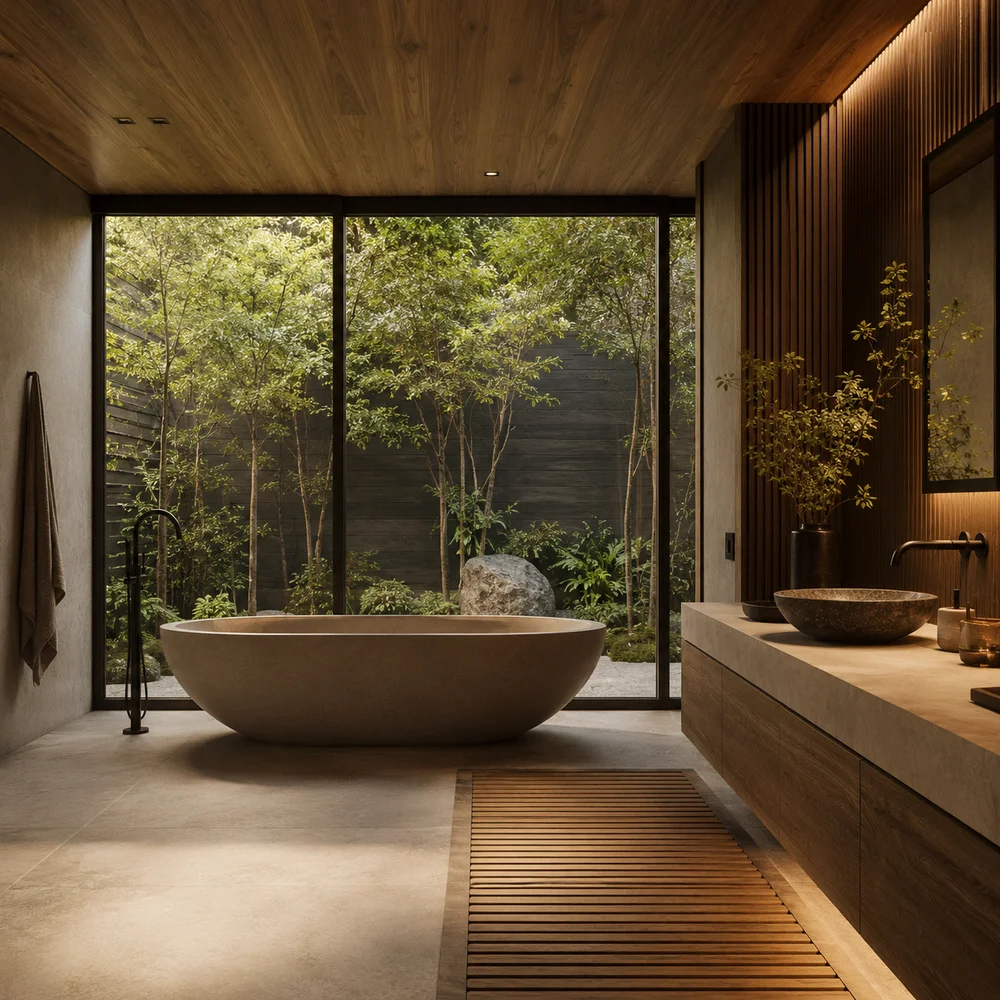
Why Japandi Bathrooms Are the Biggest Interior Design Trend You Need to Try Right Now
By Emily | May 29, 2026
There’s a certain kind of bathroom that stops you in your tracks. Not because it’s over-styled or trying too hard, but because it feels impossibly calm—like the room itself is exhaling. The light falls differently here. The materials feel deliberate. Nothing is fighting for attention, and somehow that restraint is the most beautiful thing of all. That’s Japandi.
Japandi is the design philosophy that emerged from the marriage of Japanese wabi-sabi and Scandinavian hygge—two cultures that, at first glance, seem worlds apart, but share an almost identical reverence for simplicity, craftsmanship, and the quiet beauty of natural materials. When those two sensibilities meet in a bathroom, the result is something that feels less like interior design and more like a considered way of living. It isn’t minimalism for minimalism’s sake. It’s intentional warmth. Edited warmth.
The reason this aesthetic is resonating so deeply right now is simple: we’re exhausted by visual noise. Social media has given us maximalism, bold pattern clashes, and rooms that perform rather than breathe. Japandi is the antidote. It asks you to choose fewer things, but choose them with real care. And nowhere does that philosophy land more powerfully than in the bathroom—the one room in your home that should feel like a true retreat. If you’ve been circling this aesthetic online and wondering how to actually live in it, this is where you start.
1. What Japandi Actually Means (and Why It Goes Beyond Minimalism)
 Save it
People often confuse Japandi with cold minimalism—all grey concrete and empty shelves that look beautiful in photographs but deeply uncomfortable to live in. That’s a misreading. Japandi isn’t about removing everything. It’s about keeping only what genuinely adds to the atmosphere of a space. There’s a crucial distinction there, and it changes how you approach every single design decision.
Japanese design brings the concept of ma—the deliberate use of negative space—and wabi-sabi, the appreciation of imperfection and natural aging. A slightly uneven handmade ceramic soap dish isn’t a flaw; it’s evidence of the human hand, and that’s what gives it soul. Scandinavian hygge brings warmth: soft textiles, candlelight, the understanding that a space should feel genuinely cozy rather than just visually composed. Together, these two philosophies create something neither culture could achieve alone.
In a bathroom context, this means materials that age gracefully—teak that deepens over time, stone that holds the warmth of sunlight, linen that softens with every wash. It means a palette that doesn’t demand attention. And it means resisting the urge to fill every surface, because in Japandi, the empty space is doing as much visual work as the objects within it. This approach overlaps beautifully with How to Achieve a Timeless Neutral Bathroom Decor Style, where restraint in color becomes its own form of luxury.
2. The Japandi Color Palette: How Muted Tones Create Maximum Atmosphere
 Save it
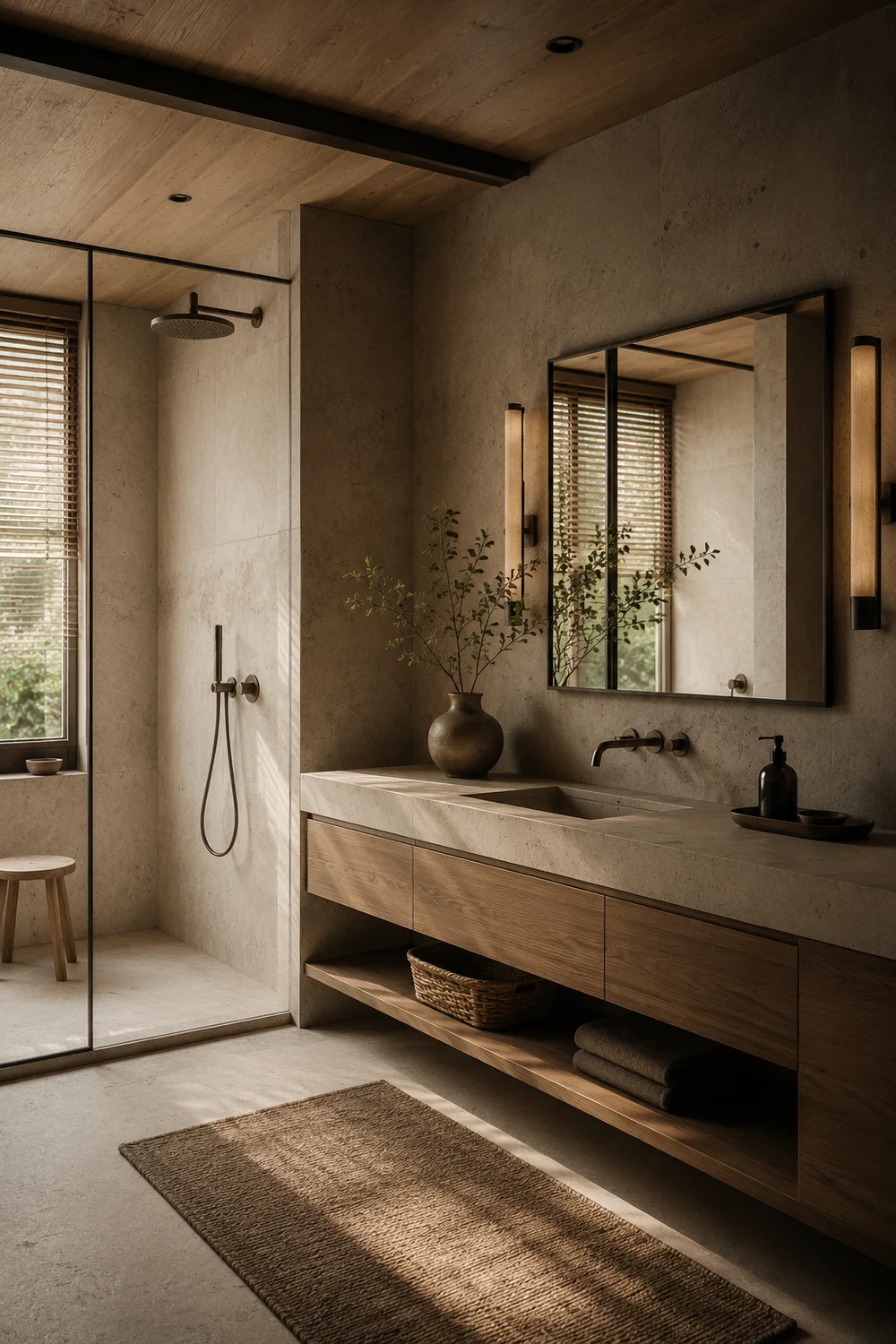
One of the most common mistakes people make when attempting Japandi is reaching straight for brilliant white. It’s a reflex—we associate minimalism with white, and white with clean. But pure white reads as clinical, and clinical is the opposite of what Japandi is chasing. The palette you want lives in a quieter register: warm greige, undyed linen, chalky sage, soft clay, mushroom brown. These are colors with depth rather than brightness, and that distinction is everything.
The key to Japandi color is that it should feel like it came from somewhere—from natural stone, from dried grasses, from earth. A wall painted in the right warm grey doesn’t read as a color choice so much as a material reference. It grounds the room without anchoring it to any particular season or trend. That’s what makes these tones so durable: they exist outside of style cycles because they belong to the natural world.
Contrast matters too, but subtly. Japandi bathrooms play with tonal contrast rather than chromatic contrast—darker flooring against lighter walls, a deep charcoal towel against a pale stone basin. Nothing shocks the eye. Instead the room builds depth gradually, the way a landscape does at dusk. If you’re drawn to richer earth tones and want to understand how they interact with natural materials, the ideas explored in Beautiful Earthy Bathroom Decor Ideas with Warm Natural Tones translate directly into Japandi territory.
3. Natural Materials: The Soul of Every Japandi Bathroom
 Save it
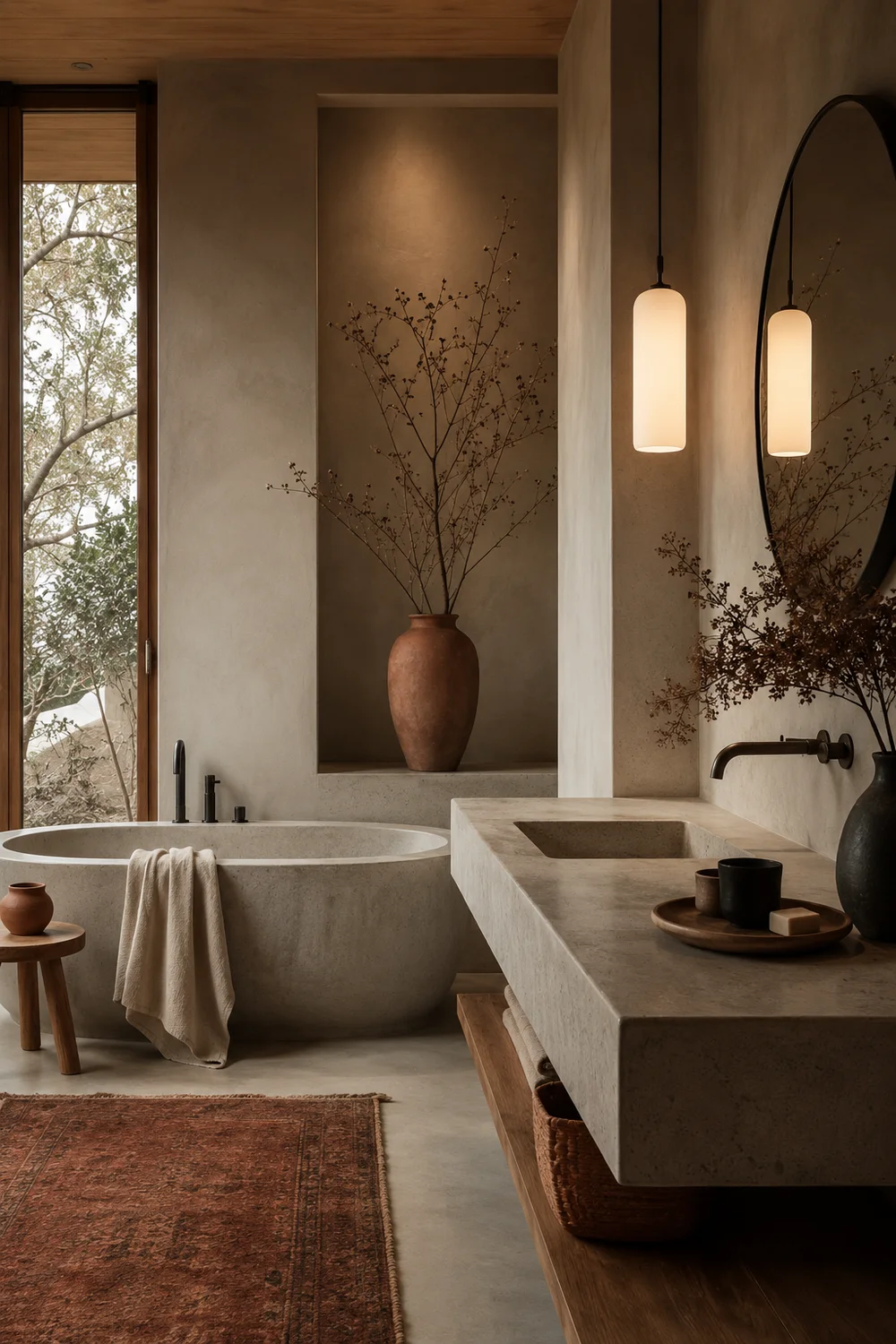
Strip away the color palette, the clean lines, even the negative space—and what you’re left with in a Japandi bathroom is texture. Material texture, specifically. The kind that makes you want to reach out and touch the wall, run your finger along the edge of a basin, bury your face in a towel. This tactile quality is non-negotiable. Synthetic materials—glossy plastic, faux chrome, laminate—feel wrong in a Japandi space not because they’re cheap but because they’re inert. They don’t respond to light, they don’t age, they have no story.
Teak and bamboo are the canonical Japandi woods because both handle moisture with grace and develop a beautiful patina over time. A teak bath shelf placed beside the tub isn’t just practical storage—it introduces warmth and organic grain into a space that can otherwise skew cold.
Stone is equally essential: honed travertine, raw limestone, matte black slate. These materials carry geological time in their surfaces, and that sense of age and permanence is deeply calming. You don’t need a stone feature wall to access this quality. A single stone soap dish or a concrete basin does the same work at a fraction of the cost.
Linen and cotton play the textile role—undyed where possible, or in the quietest possible shade. A warm linen waffle towel hanging beside the vanity introduces softness without decorative fuss.
The rule for materials in a Japandi bathroom is simple: if you can’t imagine finding it in nature, question whether it belongs here.
4. Lighting in a Japandi Bathroom: Warmth Over Brightness
 Save it
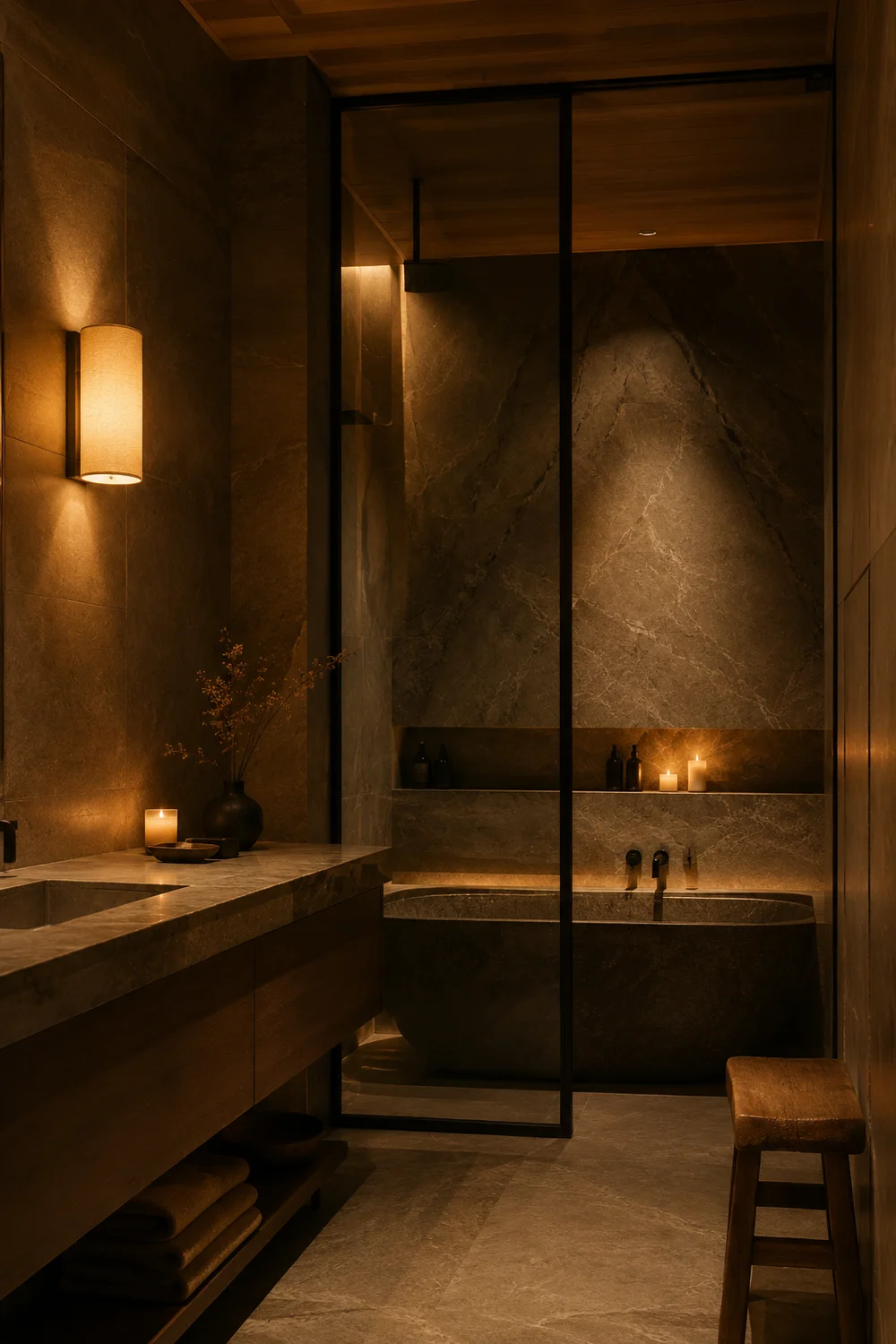
Overhead lighting is the enemy of atmosphere. It’s functional, yes—and sometimes genuinely necessary—but as a primary light source in a Japandi bathroom, it flattens everything. It removes shadow, and shadow is what gives natural materials their depth. Stone without shadow looks like painted plaster. Wood without shadow looks like laminate. Light in a Japandi bathroom should be warm, layered, and partially indirect.
The ideal approach is to treat lighting as you would in any high-quality hotel bathroom: a wall sconce or two flanking the mirror for grooming light, a warm pendant or recessed fixture for ambient fill, and candles or a small diffuser lamp for evening use. The color temperature matters enormously—stay below 3000K for bulbs, ideally around 2700K. That amber quality shifts the room from utilitarian to restorative, and once you’ve experienced a bath by that light, going back to cool white LEDs feels jarring.
Natural light should be maximized wherever possible. Japandi designers in both Japan and Scandinavia have long understood that the quality of daylight—the way it moves across a wall over the course of a morning, the way it catches the grain of a wood floor—is the most irreplaceable design element a bathroom can have. If you’re renovating, consider a frosted skylight or an obscured window positioned to cast diffuse morning light across the vanity wall. Even a modest change in how natural light enters a space can completely alter its mood.
5. Shelving and Storage: The Japandi Approach to Calm Surfaces
 Save it
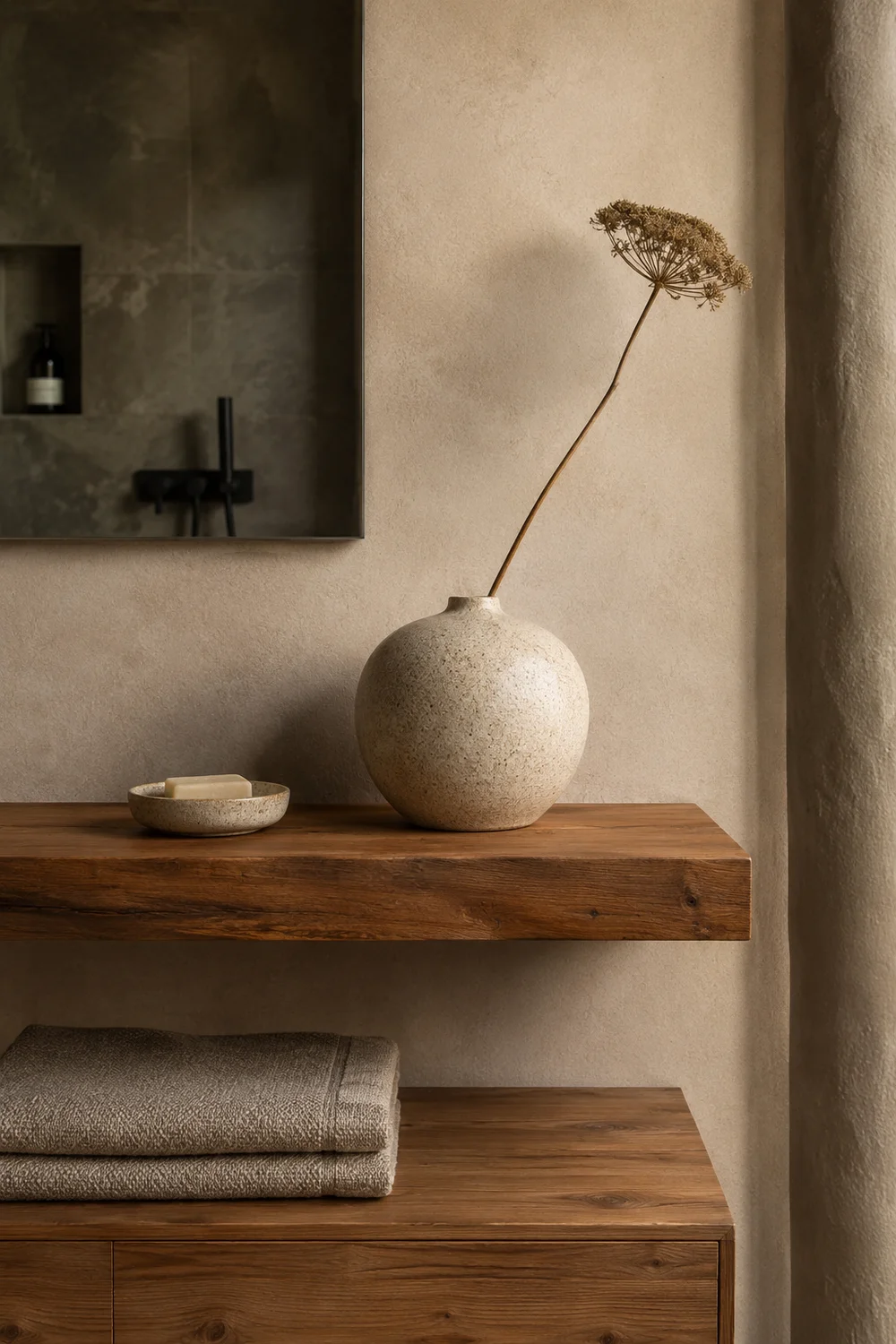
Clutter is the single fastest way to undo a Japandi bathroom. Not because clutter is aesthetically untidy—though it is—but because it creates visual anxiety, and visual anxiety is the antithesis of what this aesthetic is trying to achieve. The goal of Japandi storage is invisible functionality: everything is housed, nothing is hidden in a way that feels effortful or strained.
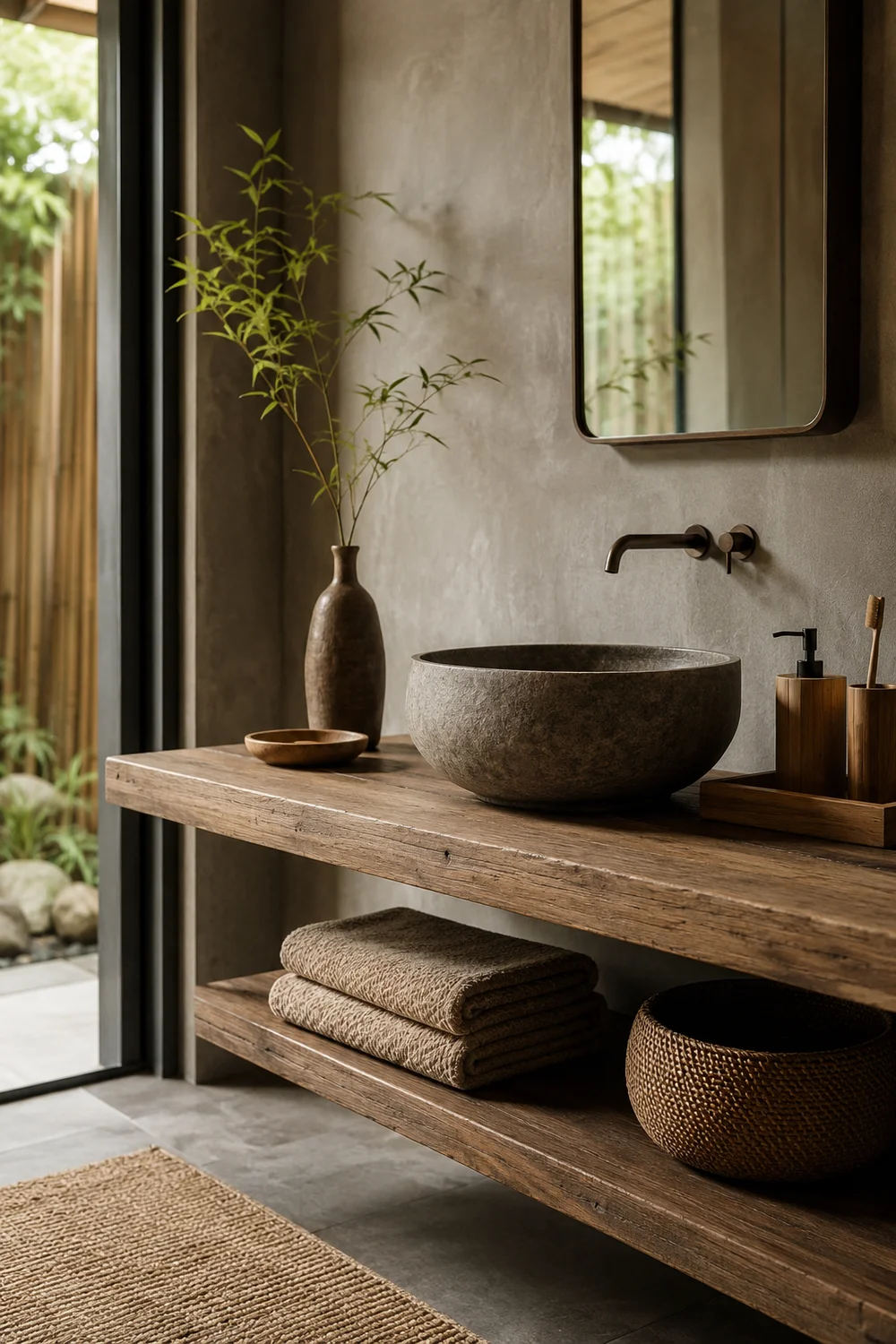
Floating shelves in oiled oak or matte black are the signature Japandi storage move—but only when what sits on them is deliberately edited. A single floating shelf with three things on it: a handmade ceramic vessel, a small plant in a simple pot, a folded linen cloth. That’s enough. The restraint feels generous rather than sparse because each object has room to breathe. The styling logic behind this is explored beautifully in Beautiful Bathroom Shelf Styling Ideas with Modern Decor Touches—the same principle of visual breathing room applies here completely.
For everything else—everyday products, cleaning supplies, extra towels—the solution is concealed storage. A wall-mounted cabinet with a flush, frameless door reads as a flat wall until you open it. A vanity with a deep drawer and internal organizers means the countertop can stay genuinely clear. The surface you see should feel like a choice, not a compromise. This isn’t about living without things; it’s about not letting the logistics of daily life become the visual narrative of your bathroom.
6. The Japandi Vanity: Choosing a Piece That Grounds the Whole Room
 Save it
The vanity is the architectural anchor of any bathroom, and in a Japandi space it carries particular weight. It’s not just furniture—it’s the primary material statement of the room. Choose wrong here, and every beautiful detail around it will feel incoherent. Choose well, and everything else becomes easier.
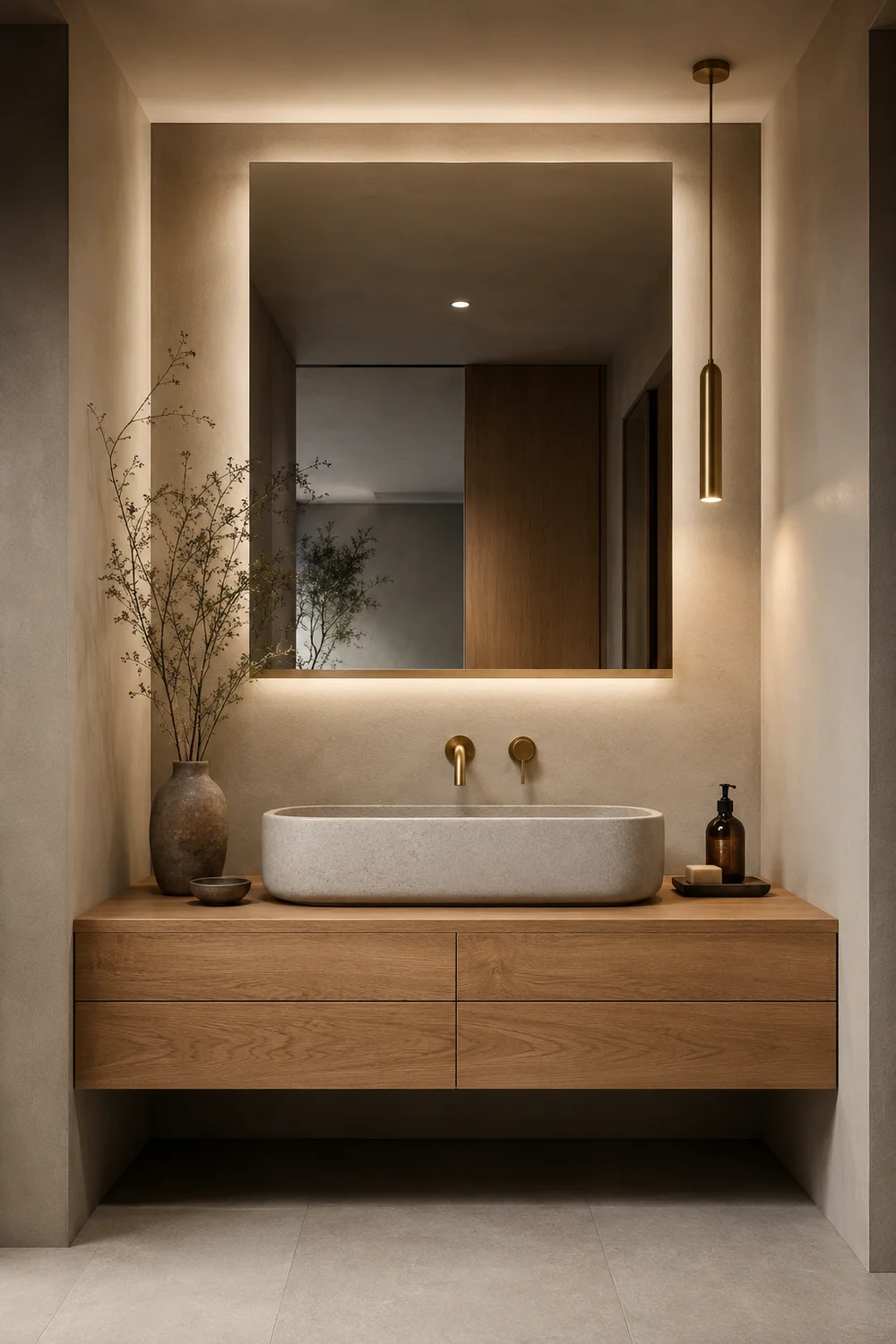
Floating vanities are the Japandi ideal because they preserve the visual continuity of the floor, making even small bathrooms feel open and deliberate. The material should be natural: white oak with a matte oil finish is perhaps the most versatile choice—warm without being orange, sophisticated without feeling cold. Darker walnut floating vanity works beautifully in larger bathrooms where the room can absorb its visual weight. What you want to avoid is anything with visible hardware that competes for attention: handleless drawers with push-to-open mechanism, or simple leather pull tabs, let the wood grain do the work.
The basin choice matters as much as the cabinet. A vessel sink in matte stone or handcast concrete sits above the vanity surface and becomes a quiet focal point in its own right—sculptural, tactile, and completely at home with the Japandi material language. Undermount sinks in the same stone as the countertop create a different effect: seamless, serene, and extremely easy to keep clean. Both approaches work. The deciding factor is how much visual punctuation you want the vanity to have. What sits on the vanity surface is covered beautifully in 20 Beautiful Bathroom Tray Styling Ideas to Elevate Your Vanity—a Japandi tray with three considered objects achieves the same curated effect in minutes.
7. Plants and Botanicals: Bringing Living Texture Into the Space
 Save it
There’s a specific kind of calm that a plant brings to a bathroom—not decoration, exactly, but presence. A living thing in a space shifts the atmosphere in a way that no object can replicate. Japandi design understands this intuitively; both Japanese and Scandinavian interiors have always incorporated nature not as ornamentation but as a grounding force.
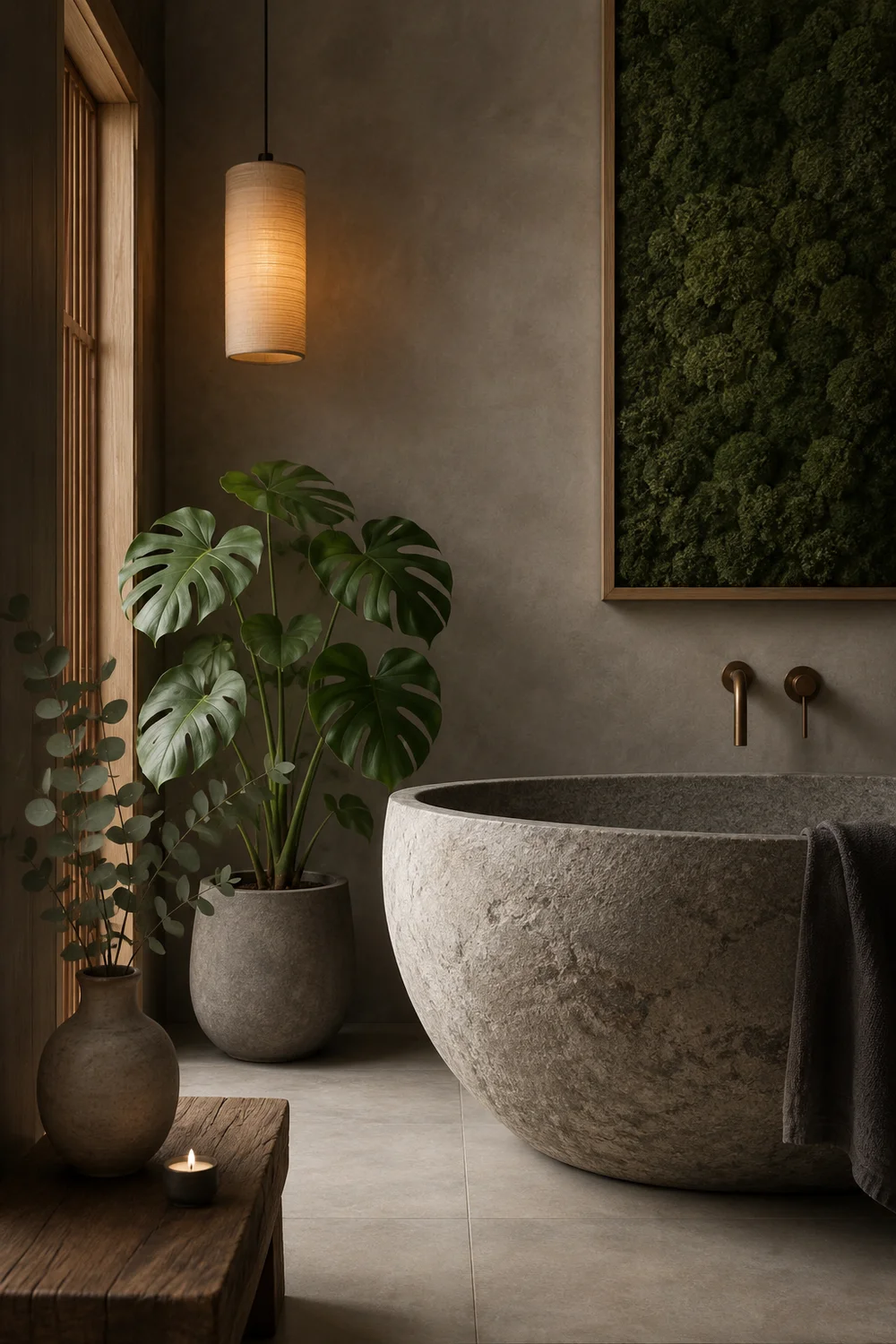
The plants that thrive most naturally in the Japandi bathroom aesthetic are those with simple, architectural forms: a single monstera leaf unfurling in a concrete planter, a stem of eucalyptus in a bud vase beside the sink, a trailing pothos on a high shelf where it can move freely downward. Restraint applies to botanicals just as it does to everything else. One well-placed plant does more than five competing ones. The goal is not a jungle bathroom but a single moment of organic life in an otherwise still space.
Dried botanicals deserve equal consideration—particularly in bathrooms with lower humidity where tropical plants struggle. A small bundle of dried pampas, a branch of bleached eucalyptus, or a single preserved palm frond in a matte ceramic vase introduces organic form without requiring care. These elements have a particular wabi-sabi quality: they exist mid-transition, between living and resting, and that in-between state has its own quiet beauty. A ceramic bud vase in an earthy, unglazed finish makes even a single stem feel considered.
8. Tiles and Flooring: Texture Underfoot and Overhead
 Save it
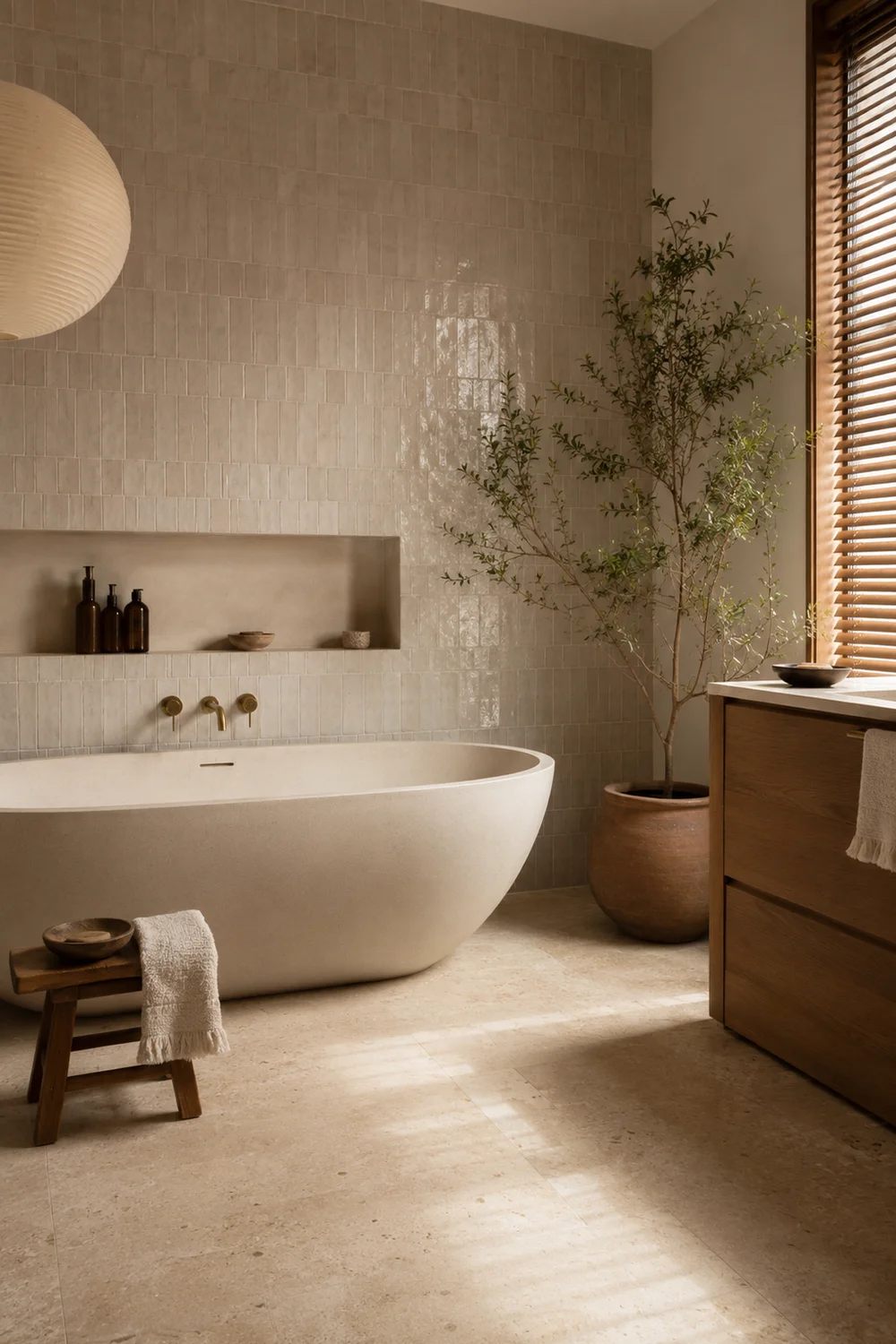
Tiles are the bones of a bathroom—the decision you live with longest and the one that most fundamentally shapes the room’s atmosphere. In a Japandi bathroom, the instinct should always be toward surfaces that catch light with irregularity rather than uniformity. Perfectly glossy, perfectly flat subway tiles belong in a different aesthetic. Here, you want materials that have slight variation in tone, texture, or surface—the kind that reward a second look.
Zellige tile—the handmade Moroccan ceramic with its characteristic undulating surface and subtle color variation—has become a Japandi favorite precisely because each tile is slightly different, and that collective imperfection is what gives a tiled wall its depth and soul. In soft whites, warm creams, or sage greens, zellige walls are stunning. Travertine is the natural stone equivalent: honed or tumbled travertine on floors and walls brings geological warmth and age in a way no manufactured tile can replicate. Both materials age beautifully, which aligns perfectly with wabi-sabi’s appreciation of the patina of time.
Grout color is an underrated decision. White grout makes tiles feel graphic; warm sand or grey grout lets the tile surface read as a material field rather than a pattern. In a Japandi bathroom, grout should disappear into the tile, not define it. The floor and wall tiles don’t need to match—but they should speak the same material language. A travertine floor with a complementary plaster-finish wall creates tonal dialogue without visual competition.
9. Hardware and Fixtures: When Small Details Make the Whole Room
 Save it
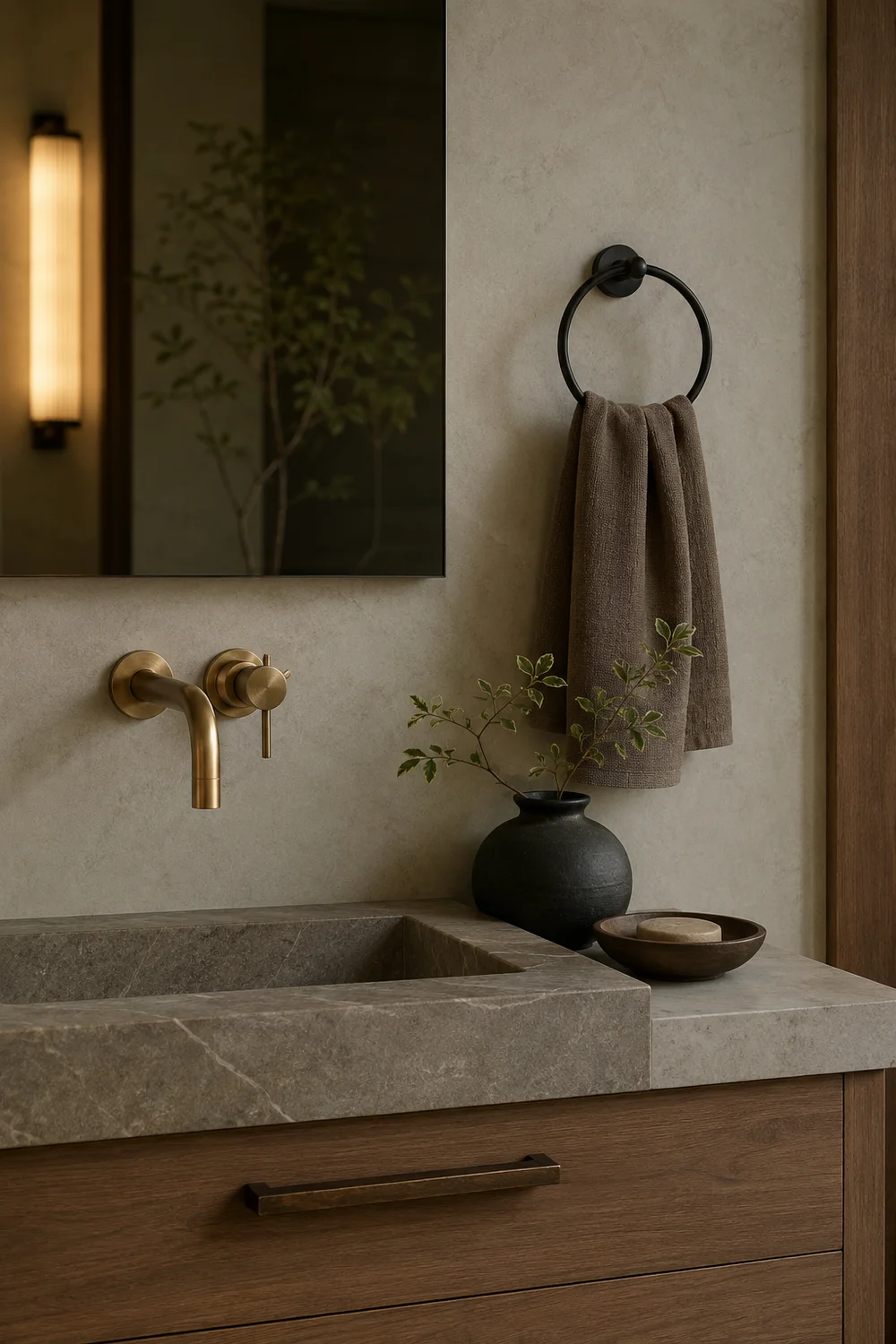
Hardware is where most bathroom renovations quietly fail. You can have beautiful tile, a handsome vanity, and considered lighting—and then install shiny chrome faucets and polished towel bars, and the room loses something indefinable. Finish matters. The wrong finish introduces a sharpness that cuts against the warmth Japandi is trying to create.
Brushed brass and aged bronze are the Japandi hardware signatures. Both finishes carry warmth without brightness—they catch light softly rather than reflectively, and they improve with time rather than showing every fingerprint. Matte black is the cooler alternative, and it works particularly well in bathrooms that lean more Scandinavian than Japanese in their material palette: white walls, pale wood, concrete basin. The cardinal rule: choose one finish and commit to it across every fixture. Faucet, towel bar, toilet paper holder, cabinet pulls, hooks—all in the same family. Consistency here reads as deliberateness, and deliberateness is the essence of Japandi.
Faucet form matters as much as finish. Wall-mounted faucets have a particular architectural elegance—they lift the plumbing off the basin surface, which keeps the vanity counter visually clean and also creates a more considered spatial relationship between the tap and the sink. A single lever in brushed brass with a simple curved spout is the Japandi ideal: nothing superfluous, every line purposeful. If you’re working with existing fixtures and can’t replace the faucet, even swapping to a matching brass soap pump and matching towel hooks can shift the hardware story meaningfully.
10. How to Achieve Japandi in a Small Bathroom Without Losing Warmth
 Save it
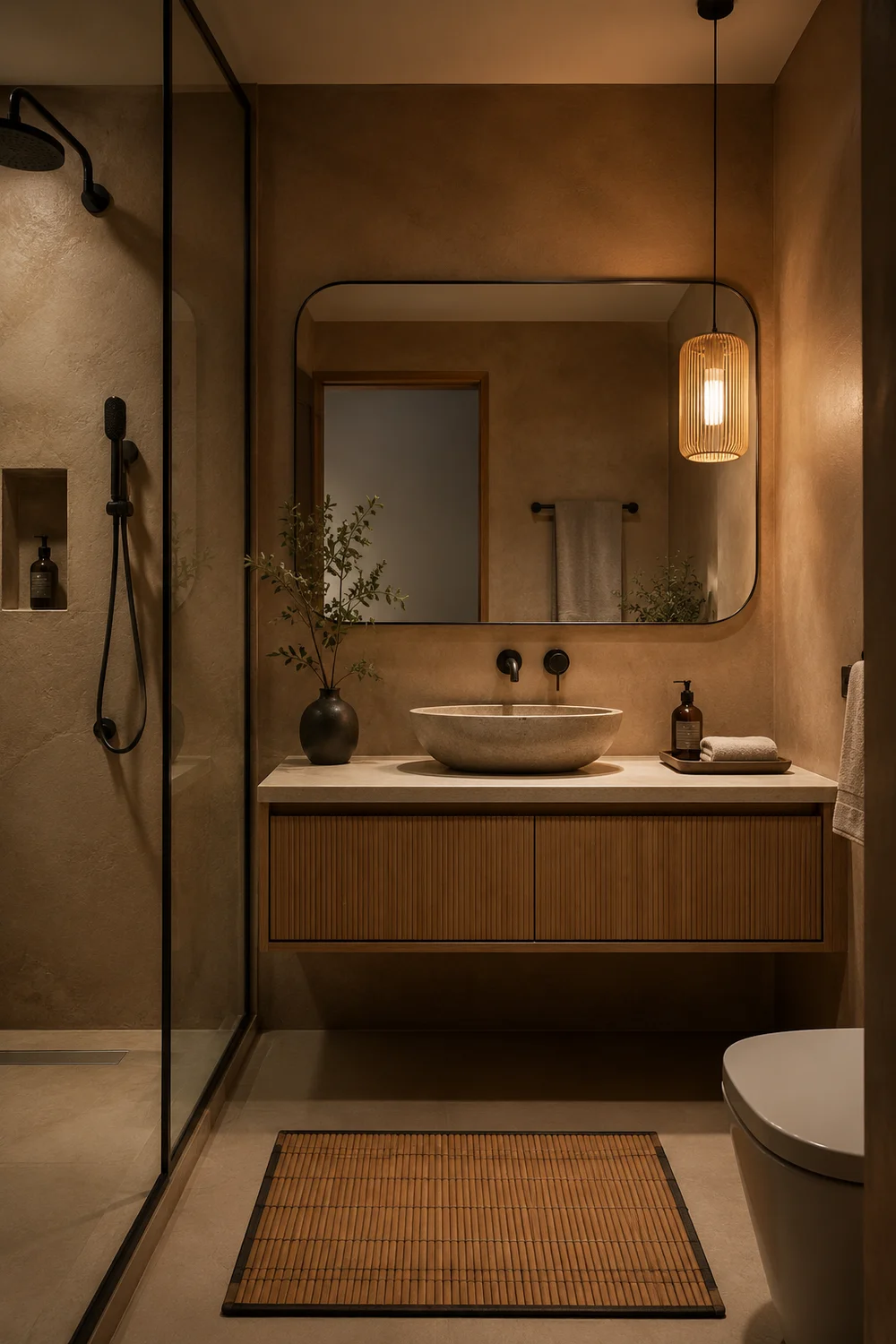
Here’s something important: Japandi is not a large-bathroom aesthetic. Some of the most compelling Japandi bathrooms are small—genuinely small—and they work precisely because the philosophy of editing and restraint is perfectly suited to compact spaces. When every element earns its place, a small room stops feeling cramped and starts feeling considered.
The floating vanity, as mentioned earlier, is one of the most powerful tools for small Japandi bathrooms—it lifts the visual weight of the largest piece of furniture off the floor, which instantly makes the room feel larger. Pair this with a large, simply-framed mirror that reflects natural light across the space, and the room opens up significantly. Don’t be tempted to use smaller-scale everything as a spatial compensating strategy—one bold, well-proportioned piece reads better than several correctly-sized but competing ones.
Color can expand a small bathroom too, but only when used strategically. Extending the wall color onto the ceiling creates a cocooning effect that’s warm rather than claustrophobic—the room feels enveloped rather than compressed. A tonal palette where walls, floor, and ceiling are in the same warm family but slightly different values achieves depth without visual noise. The ideas in Simple Small Bathroom Decor Ideas for a Clutter-Free Look share this same instinct—decluttering and tonal restraint are the twin foundations of making a compact bathroom feel spacious.
11. The Accessories That Complete a Japandi Bathroom
 Save it
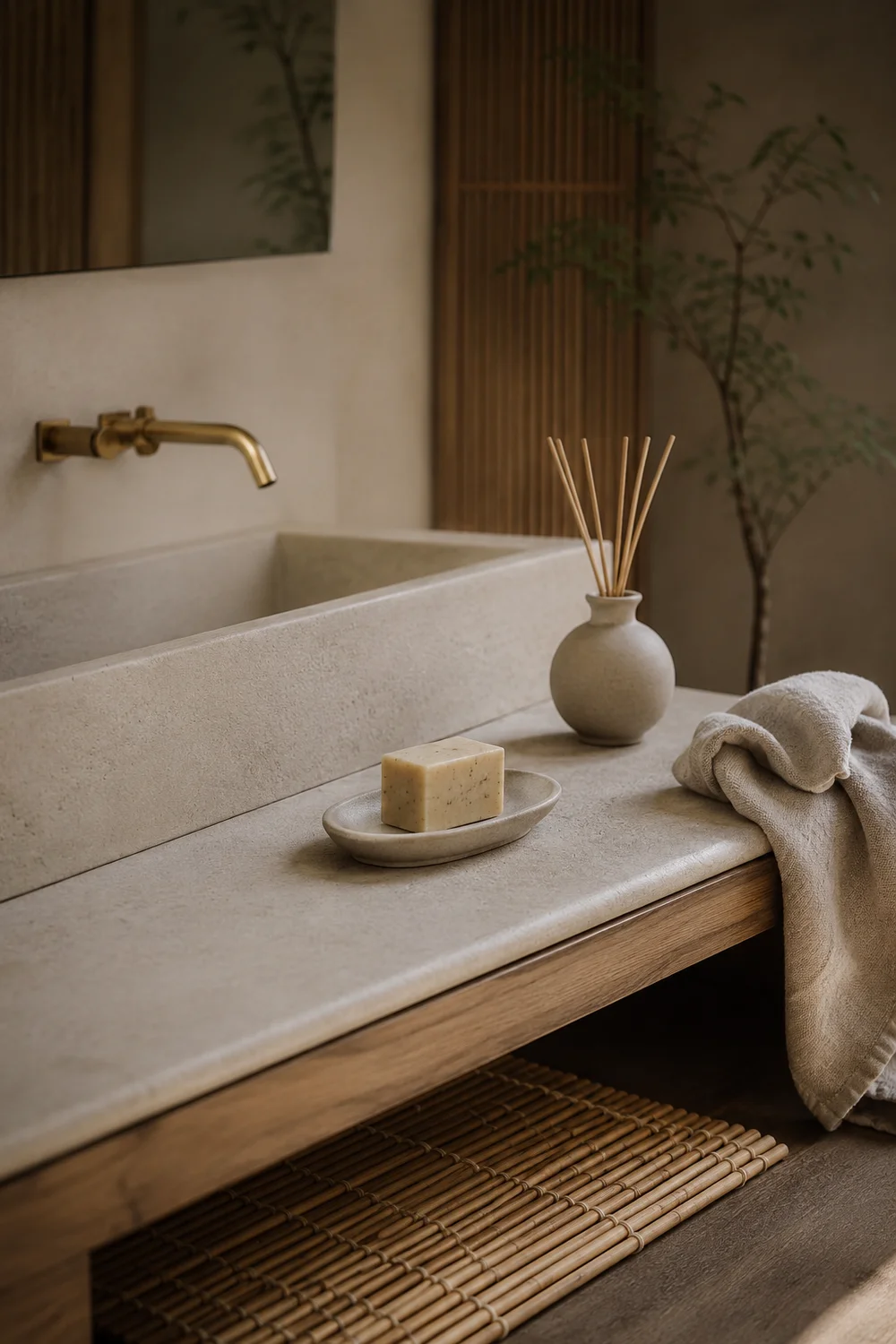
Accessories in a Japandi bathroom should feel earned. Each one should be there because it genuinely belongs—because it adds texture, warmth, or purpose that nothing else in the room provides. If you find yourself asking “does this need to be here,” the answer is probably no. That editing instinct is the core of the whole aesthetic.
The short list of accessories that consistently elevate a Japandi bathroom: a handmade ceramic soap dish or dispenser in an earthy, unglazed finish—the kind where you can see the thumbprint of the maker in the clay; a bamboo or teak bath mat that introduces organic grain at floor level; a reed diffuser or ceramic oil burner with a grounding scent like hinoki cypress, white cedar, or sandalwood; and a single hand towel in undyed organic cotton folded simply over a hook.
None of these objects shout. Together they whisper something coherent.
The counter, meanwhile, should stay almost entirely clear. The impulse to display every product—serums, candles, cotton pads, perfume bottles—is understandable, but it works against the Japandi premise entirely. A small decorative tray in raw wood or matte stone can contain the few items that live on the counter, creating a defined zone that reads as intentional rather than accumulated. This approach to counter styling—grouping rather than scattering—is examined closely in Affordable Bathroom Counter Decor Ideas That Look High-End, where the same principle of thoughtful containment transforms an ordinary surface into something that looks genuinely curated.
12. Above the Toilet: Vertical Space as a Styling Opportunity
 Save it
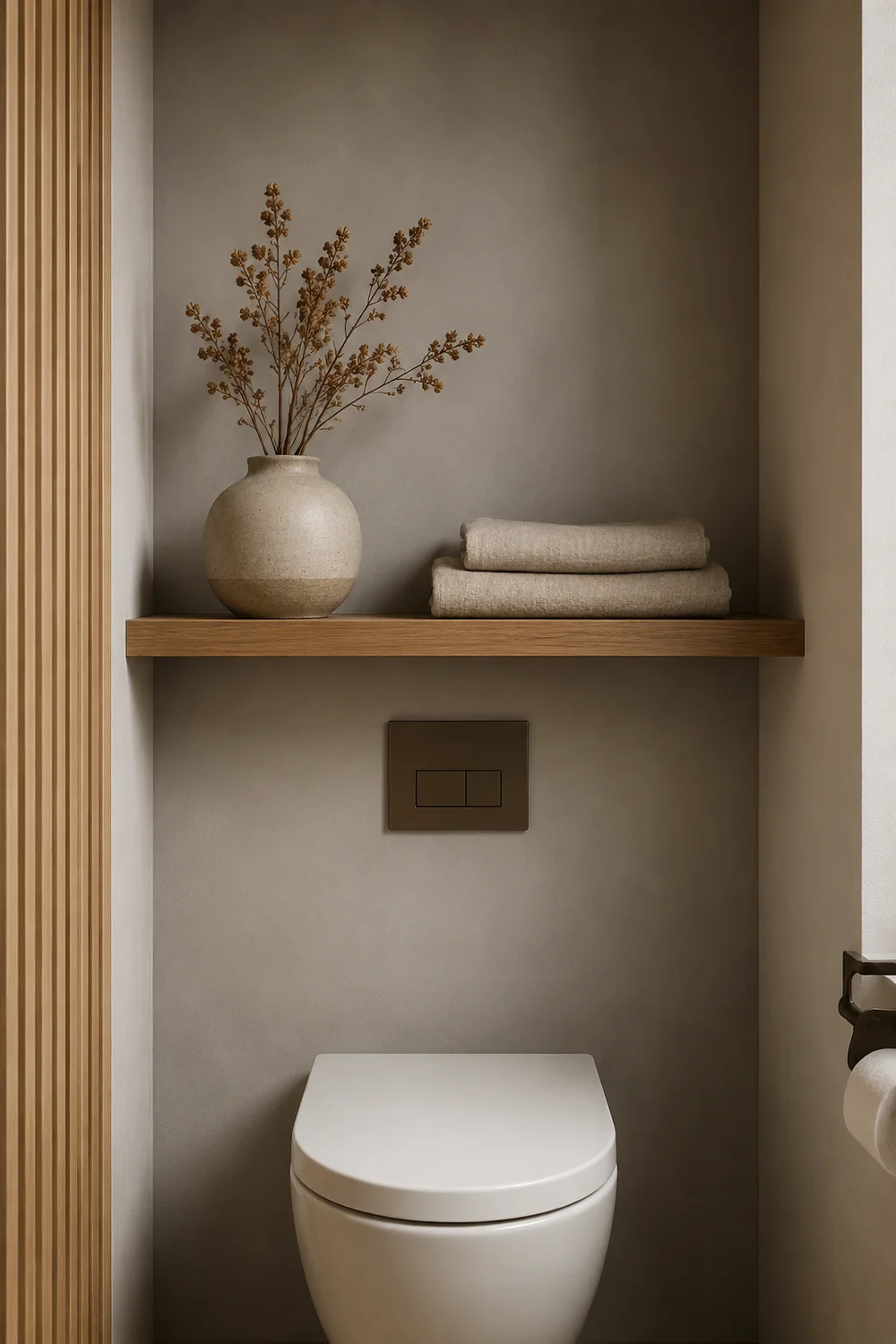
The wall above the toilet is consistently the most neglected vertical space in the bathroom—and in a Japandi context, neglect is as much a problem as over-decoration. Leaving this wall completely blank feels unfinished; filling it with conventional bathroom art feels generic. The Japandi solution is purposeful simplicity: one floating shelf, three carefully chosen objects.
A single slim shelf in oiled oak, mounted at roughly mid-wall height, transforms this space completely. On it: a small ceramic planter with a trailing plant, a spare rolled hand towel in natural linen, and perhaps a single stone or wooden object—a smooth river rock, a small carved sphere, a miniature candle in a ceramic vessel. Nothing more. The restraint is the point. Each object has breathing room, and that breathing room communicates care.
For those who want slightly more visual interest above the toilet, a small grouping of botanical prints in thin natural wood frames can work beautifully—particularly botanical line drawings in black ink on cream paper, which feel appropriately Japanese in their economy of line. A vertical ladder shelf in black matte iron or natural bamboo is the storage-oriented alternative, offering stacked space for towels and small plants without requiring any wall mounting beyond a simple lean. This zone is explored in detail in 18 Trending Above Toilet Decor Ideas for a Beautiful Bathroom—many of the ideas there translate directly into Japandi territory with minimal adjustment.
Practical Tips for Achieving Japandi on Any Budget
Start With What You Have
You don’t need a renovation budget to begin. The first and most powerful Japandi edit is subtraction: remove everything from your bathroom surfaces and shelves, then bring back only what genuinely belongs. This single act—done before spending a single dollar—often reveals that the bones of your bathroom are better than you thought. The Japandi quality was always there; it was just buried.
Swap Accessories First
If you’re working with a limited budget, accessories give you the highest aesthetic return for the smallest investment. A handmade ceramic soap dish, a bamboo bath mat, and a single quality linen hand towel in a warm neutral can transform a bathroom that’s otherwise unchanged. These are the objects you touch and use every day, and getting them right has an outsized effect on how the whole space feels.
Paint Before You Buy
A tin of warm greige or chalky sage paint is one of the most cost-effective design moves you can make. Repainting bathroom walls (and the ceiling, in the same tone) before investing in any new furniture or fixtures fundamentally changes the room’s atmosphere and makes every subsequent decision easier and more coherent. Get the color right first; everything else follows.
Hardware Swap: The Rental-Friendly Cheat
If you can’t replace the faucet, you can still shift the hardware story by replacing everything that is replaceable: towel bars, hooks, toilet paper holder, cabinet pulls. Swapping these to brushed brass or matte black—all in the same finish—costs relatively little but creates the material coherence that makes a bathroom feel designed rather than assembled. This is the rental-friendly cheat that professional stylists use constantly.
Common Japandi Mistakes to Avoid
1. Confusing Japandi with Cold Minimalism
The most common Japandi mistake is stripping warmth in the name of simplicity. Empty, cold, concrete-and-white bathrooms aren’t Japandi—they’re an incomplete interpretation of it. Warmth is structural to this aesthetic. If your bathroom feels stark rather than serene, add a wood element, introduce a warm textile, or reconsider the light temperature. Calm and cold are not the same thing.
2. Using Too Many Natural Materials at Once
Natural materials are essential, but more is not better. A bathroom with wood floors, stone walls, rattan accessories, bamboo towels, and a driftwood shelf starts to feel busy in a different way. Choose two or three primary materials and let them dominate. The negative space between them—the quiet plaster wall, the plain floor—is as important as the materials themselves.
3. Ignoring the Lighting Temperature
Cool white LEDs can undo an otherwise perfect Japandi bathroom in an instant. Lighting temperature is often overlooked because it’s an invisible design element—you don’t see it in the room, you see through it. But the quality of light it creates affects every surface, every material, every emotional register of the space. Stay at or below 3000K. Always.
4. Decorating Rather Than Editing
Japandi is not achieved by buying Japandi-adjacent things and adding them to a space. It’s achieved by relentlessly editing—by asking of every existing and proposed object: does this add something that nothing else in the room is providing? The instinct to add should always be balanced by the discipline to subtract. Buy less. Choose better. That’s the whole philosophy, distilled.
Frequently Asked Questions
Is Japandi just another interior trend that will fade?
Japandi draws from two of the oldest and most enduring design philosophies in the world—Japanese wabi-sabi and Scandinavian functionalism. Neither shows any sign of losing relevance, because both are rooted in how humans actually want to live: with beauty, calm, and intention. Japandi as a named aesthetic may evolve, but the values it represents are permanent.
Can I do Japandi in a rented bathroom I can’t renovate?
Absolutely. The most impactful Japandi changes don’t require drilling or renovation. Swap your accessories to handmade ceramics and natural textiles, replace visible hardware (towel bars, hooks) with brushed brass or matte black versions, bring in a plant and a diffuser, clear the surfaces ruthlessly. You can achieve a strong Japandi atmosphere through curation and subtraction alone—no permission from your landlord required.
What’s the difference between Japandi and Wabi-Sabi?
Wabi-sabi is a Japanese philosophy—an appreciation of imperfection, transience, and the beauty of natural aging. Japandi is a design aesthetic that incorporates wabi-sabi as one of its foundational principles, alongside the warmth and functionality of Scandinavian design. Wabi-sabi is the philosophy; Japandi is one contemporary application of it.
Do Japandi bathrooms work if the rest of my home is very different?
Yes, with some thoughtfulness. The bathroom is inherently the most private and self-contained room in a home—it doesn’t need to match the living room. What matters is internal consistency: the bathroom’s own palette, materials, and atmosphere should feel coherent within itself. Many people use the bathroom as a deliberately calming counterpoint to a more expressive home style elsewhere, and this contrast can feel entirely intentional.
Final Thoughts
The bathroom you return to at the end of a long day should feel like it’s on your side. Not performing, not demanding attention, not asking you to admire it—just holding space for you quietly, warmly, without fuss. That’s the promise of Japandi, and it’s why this aesthetic has resonated so deeply with people who are tired of interiors that prioritize image over experience.
You don’t need to rebuild your bathroom to begin. Choose one section from this article—the color palette, the accessories, the hardware finish—and make one considered change. Live with it for a few weeks. Notice how that single shift in quality or intention affects the way you feel when you walk in. That noticing is the beginning of designing a space you genuinely love rather than one you merely live with.
Japandi rewards patience. It’s built slowly, through deliberate choices made over time, each one aligned with the same underlying question: does this add genuine beauty, warmth, or calm to my daily life? When the answer is consistently yes, you’ll find yourself in a bathroom that feels—without being able to explain exactly why—like the best possible version of your home. Save this to Pinterest, return to it when you’re ready for the next step, and trust that small changes, made with real care, always add up to something extraordinary.
This post contains affiliate links. I may earn a small commission at no extra cost to you.
READ FOR THE NEXT STEP?
KEEP READING
Continue with another helpful idea.

Beautiful Bathroom Decor Ideas to Refresh Your Space
SHOP MY FINDS
Discover my favorite products for this place

My Favorite Bathroom Finds

Get cozy inspiration delivered to your inbox.
✓ 14-page beautifully designed ebook
✓ Cozy decorating ideas
✓ Practical room-by-room inspiration
You’re in! 🎉
Thanks for joining the NestFlowHome community!
Your free ebook is already on its way to your inbox. If you don’t see it within a few minutes, please check your Promotions or Spam folder.
Join the NestFlowHome community for weekly decorating inspiration.

Timeless home decor ideas and slow living inspiration for a calm, beautiful life.