
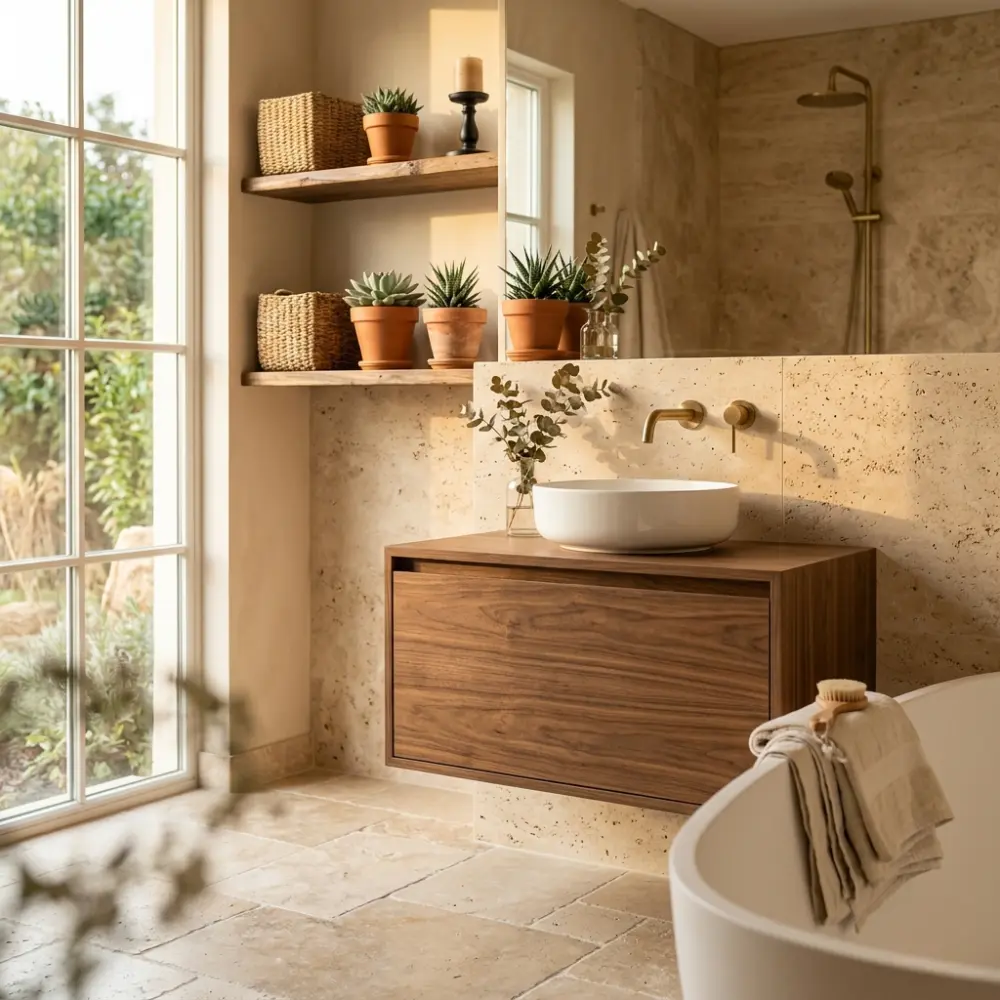
Beautiful Earthy Bathroom Decor Ideas with Warm Natural Tones
By Emily | May 26, 2026
There’s something deeply calming about stepping into a bathroom that feels less like a sterile box and more like a natural retreat. You know the feeling—when the space doesn’t just function, it exhales. The walls seem to wrap around you in soft warmth, the textures invite touch, and somehow, even on a rushed Tuesday morning, you feel a little more grounded. That’s what earthy bathroom decor does: it brings the outside in, creating a sanctuary that feels both timeless and alive.
But here’s the thing most people get wrong: “earthy” doesn’t mean rustic or farmhouse or cluttered with driftwood. It’s not about theming your bathroom like a cabin. It’s about material honesty, about choosing elements that have warmth, texture, and a connection to nature—without trying too hard. It’s the difference between a space that looks decorated and one that feels intentional, organic, effortless.
In this article, I’m going to walk you through how to build an earthy bathroom that feels sophisticated, not themed. You’ll learn why certain materials ground a space while others make it feel cold, how to layer warm tones without the room feeling muddy or dark, and how to balance natural elements with modern functionality. This isn’t about buying a specific product list—it’s about understanding the visual and emotional logic behind what makes a bathroom feel warm, welcoming, and beautifully connected to nature. By the end, you’ll see your bathroom differently: not as a challenge, but as a canvas for something genuinely restorative.
1. Natural Stone Creates Foundation and Permanence
 Save it
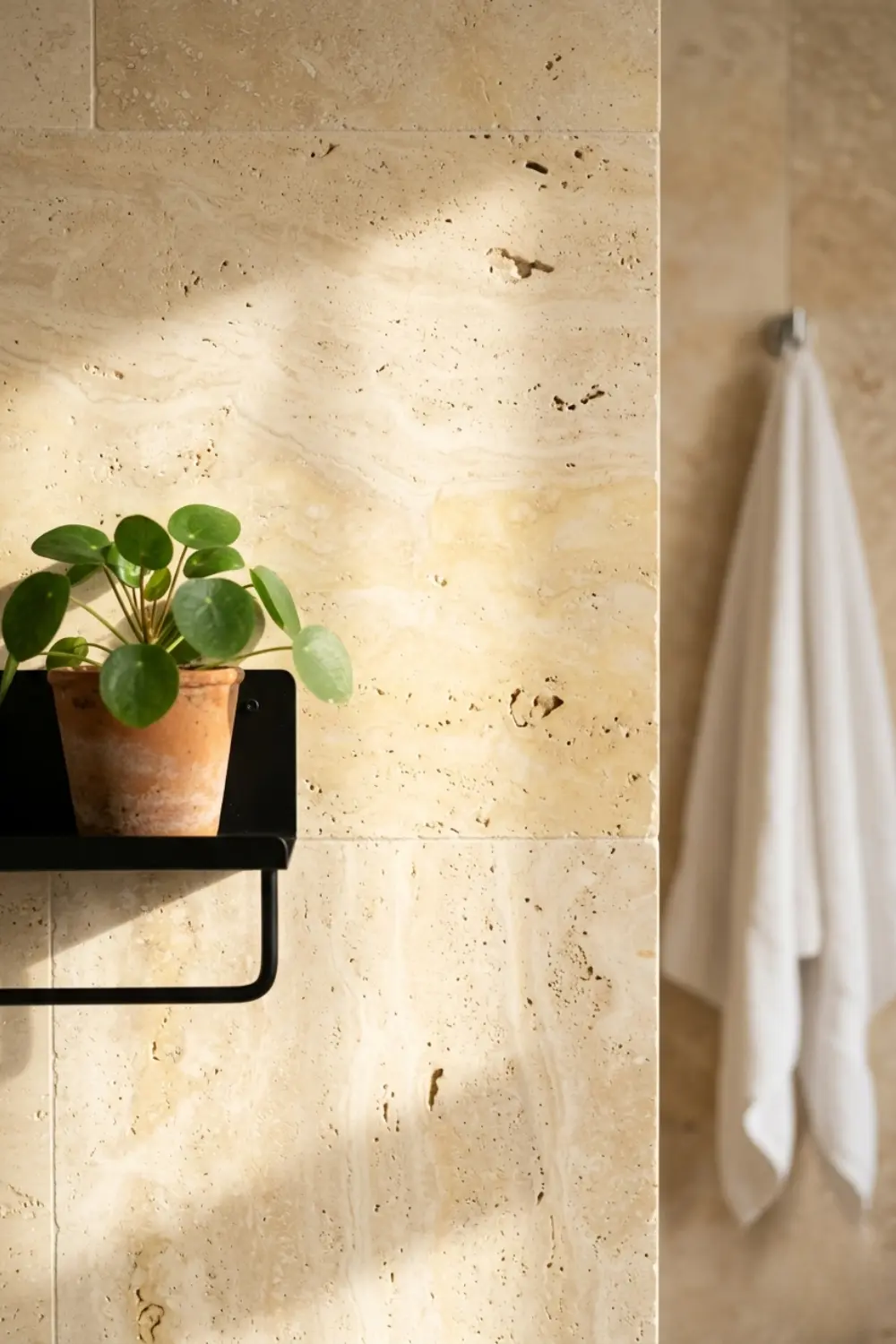
Stone is where earth begins in a bathroom. Not polished marble that screams luxury hotel—I’m talking about stone with texture, with variation, with a matte finish that catches light softly instead of bouncing it back at you. Travertine, limestone, natural slate—these materials have an ancient quality that immediately grounds a space because they feel like they’ve been there forever, like they grew from the floor.
The magic of natural stone is its imperfection. Every piece has slightly different veining, slightly different color variation, and that’s what makes it feel alive rather than manufactured. When you use stone on a bathroom floor or as an accent wall, you’re not just adding a surface—you’re adding weight, both literal and visual. The space feels anchored, solid, permanent. This is especially powerful in small bathrooms where everything else might feel temporary or builder-grade.
But stone needs balance. Too much, and the room can feel cold or cave-like. The trick is using it strategically: perhaps as flooring, or as a single accent wall behind the vanity, or even as a shower niche detail, like a shower shelf insert. Let the stone be the foundation, then layer warmth on top of it through wood, textiles, and softer tones.
Color matters here too. Warm-toned stones—beige travertine, honey-colored limestone, sandstone with golden undertones—bring warmth inherently. Cool gray stone can work in an earthy bathroom, but you’ll need to compensate heavily with warm wood and textile layers. In [How to Achieve a Timeless Neutral Bathroom Decor Style], I discussed how natural materials create longevity, and stone is the ultimate example: it never goes out of style because it was never “in” style—it just exists.
2. Warm Wood Tones Soften Every Edge
 Save it
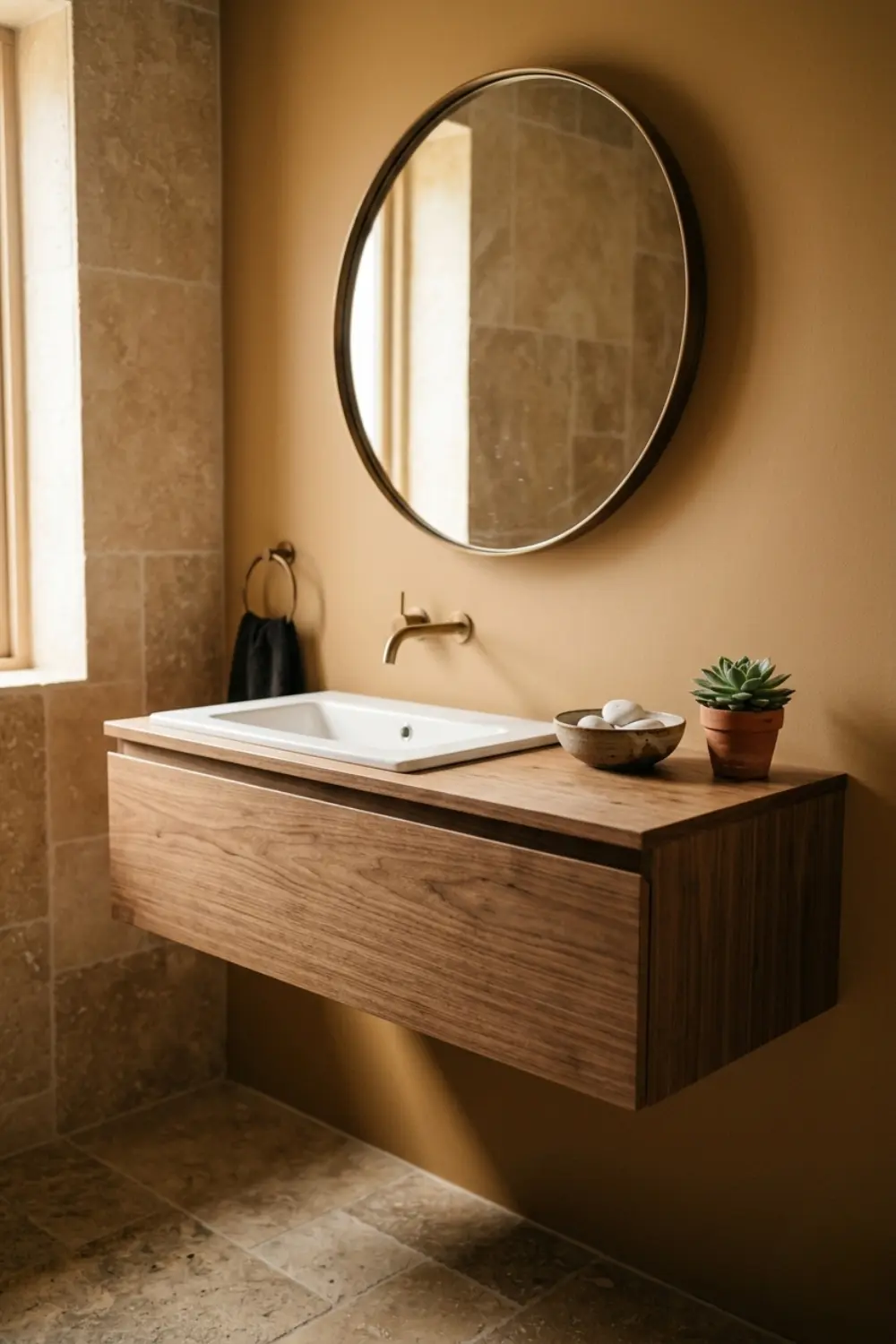
If stone is the bones, wood is the soul. It’s what takes an earthy bathroom from “nice materials” to “I never want to leave this space.” Wood brings warmth that’s impossible to replicate with any other material—not just visually, but emotionally. There’s something primal about wood in a wet space, something that says comfort and care, because historically we had to protect wood from water, which makes its presence feel considered, intentional.
The key is choosing the right wood tone. Cool, gray-washed wood won’t give you that earthy warmth—you need honey, amber, caramel, golden oak, warm walnut. These tones have yellow and red undertones that literally radiate warmth. When light hits them, they glow. A floating vanity in warm walnut instantly transforms a builder-grade bathroom into something that feels custom and thoughtful.
But wood doesn’t have to be big commitments. Even small touches make a massive difference: a wooden bath tray across the tub, a teak shower mat, wooden storage boxes on open shelving, a bamboo toilet paper holder. These elements create rhythm—your eye travels around the room and keeps finding these warm, organic moments that make the space feel cohesive.
Texture variation in wood is important too. Don’t make everything smooth and uniform. Mix a polished vanity with a rougher wood accent piece, or pair sleek wood shelving with a chunky wooden stool. The variation keeps it from feeling too designed, too matchy. In [Beautiful Bathroom Shelf Styling Ideas with Modern Decor Touches], I wrote about how material contrast creates visual interest, and wood is perfect for this because it comes in so many natural variations.
One practical note: in bathrooms, you want sealed or naturally water-resistant wood like teak, bamboo, or treated walnut. But even then, wood in a bathroom is a living thing—it will change over time, darken slightly, develop character. That’s not a flaw. That’s the point.
3. Terra Cotta and Clay Bring Handmade Warmth
 Save it
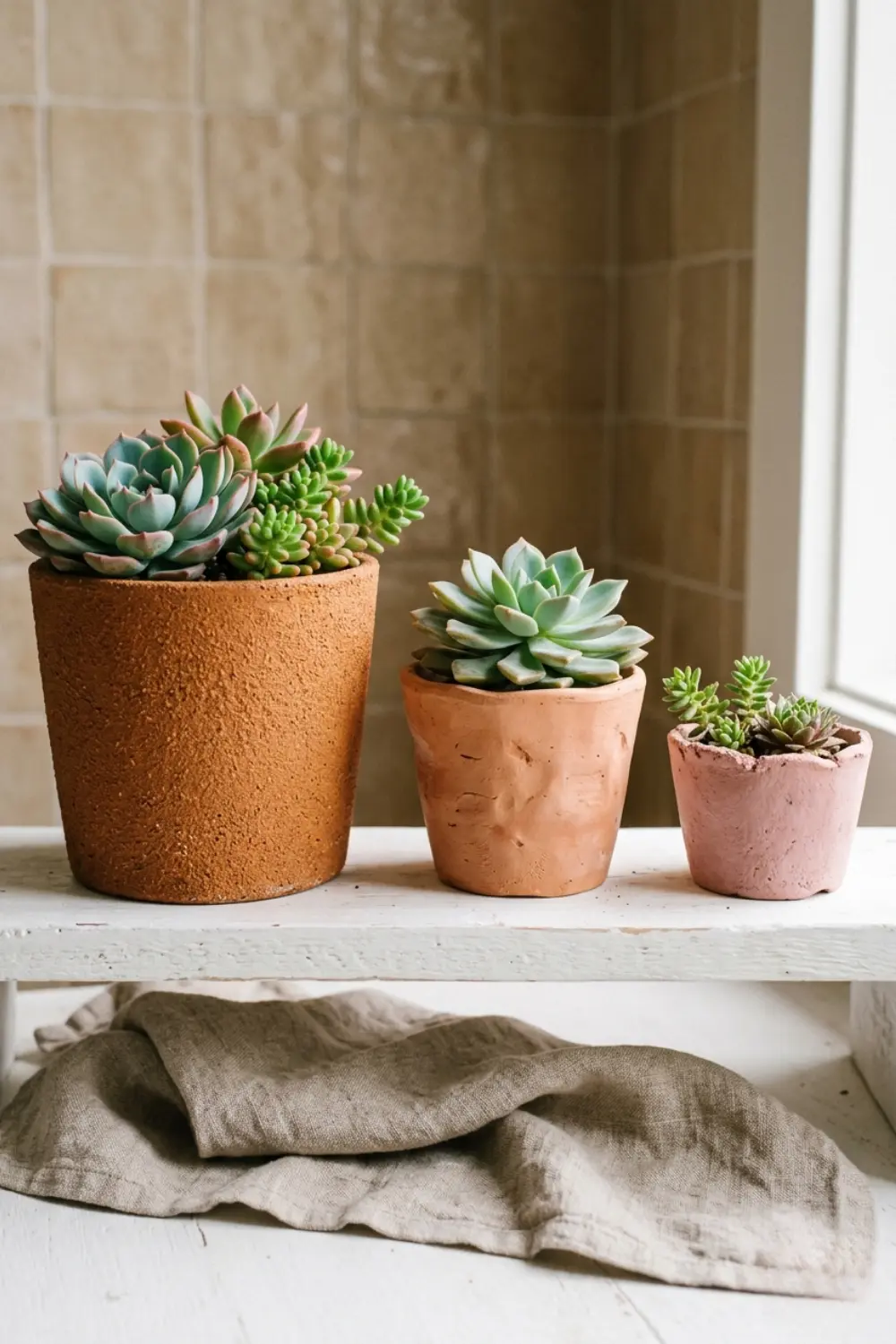
There’s a reason terra cotta has been used for thousands of years: it’s earth, literally. Fired clay in warm rust, burnt orange, dusty rose—these are colors that don’t exist in synthetic materials. They have depth, they have soul, and they bring an unmistakable warmth that feels both ancient and utterly contemporary.
In an earthy bathroom, terra cotta doesn’t need to dominate. In fact, it shouldn’t. This is an accent material, a supporting character that enriches the story. A few small terra cotta pots holding plants on a shelf, a handmade clay soap dish, a ceramic vase in that dusty terracotta tone—these small moments create warmth without overwhelming the space.
What makes terra cotta so effective is its matte, porous quality. It absorbs light instead of reflecting it, which creates this soft, grounded feeling. Compare that to shiny white ceramic or chrome, which bounce light around and create a harder, colder atmosphere. Terra cotta says: slow down, stay awhile, be present.
The handmade quality matters too. Mass-produced terra cotta is fine, but if you can find pieces with slight irregularities—uneven edges, subtle color variations, a slightly wobbly form—they add so much more character. These imperfections signal humanity, craftsmanship, care. In a world where everything is algorithmically perfect, these small imperfections are what make a space feel real.
You can also bring in other clay-based elements: stoneware soap dispensers, ceramic trays, earthenware cups for holding makeup brushes or cotton swabs. The key is keeping the finish matte or satin, never glossy. Shine reads as modern and cold; matte reads as earthy and warm. In [Affordable Bathroom Counter Decor Ideas That Look High-End], I talked about how matte finishes elevate even inexpensive items, and clay materials are the perfect example.
4. Organic Textiles Layer Softness Into Hard Spaces
 Save it
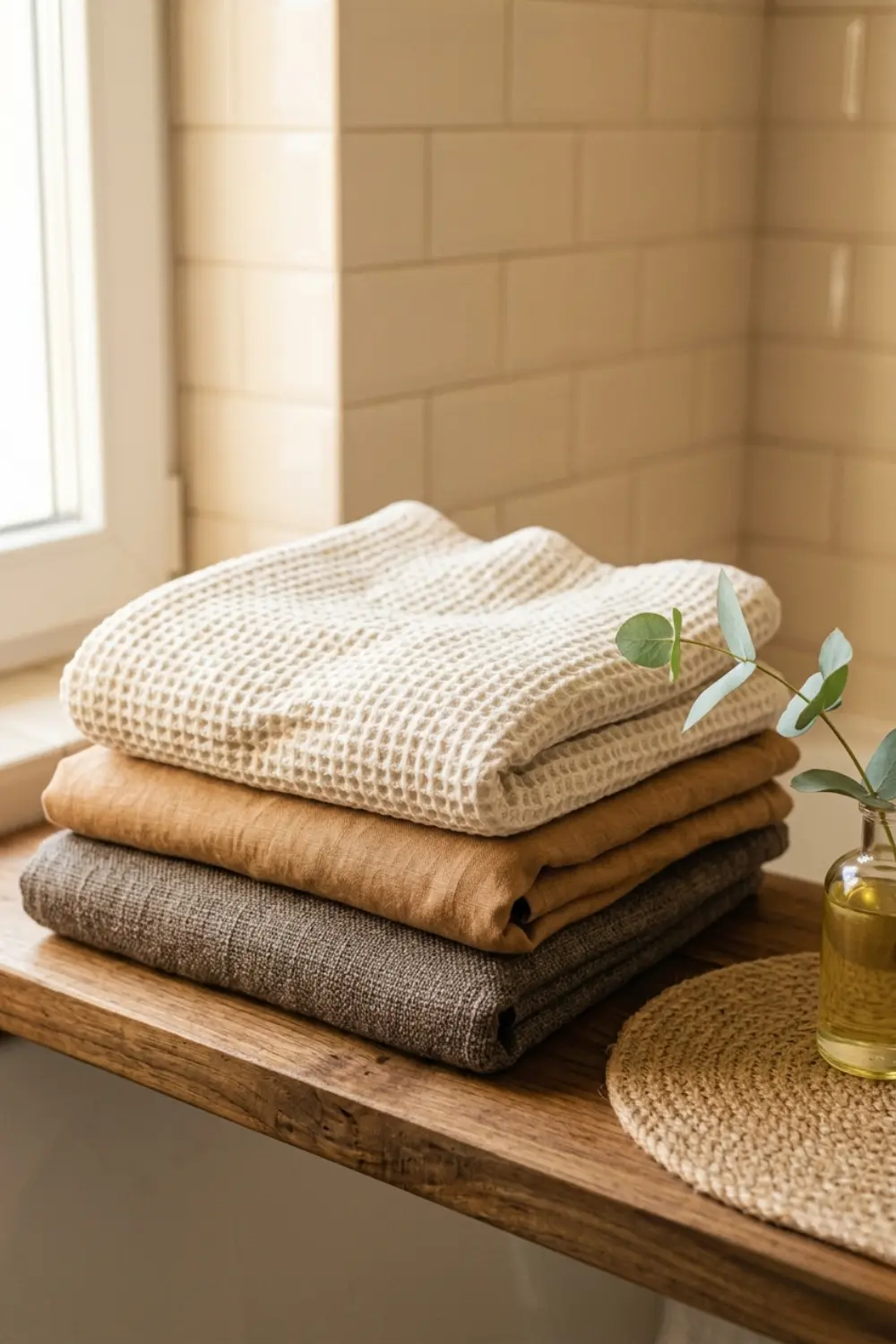
Bathrooms are inherently hard: tile, stone, porcelain, glass, metal. Without soft elements, they feel institutional, like a space you pass through quickly rather than linger in. This is where textiles become essential—not decorative, essential. They’re what transform a functional room into a sanctuary.
But not all textiles work in an earthy bathroom. You’re not looking for bright white fluffy towels or synthetic microfiber bathmats. You want natural fibers with texture and warmth: linen, cotton waffle weave, organic cotton in oatmeal or sand tones, jute, even wool if it’s a rug outside the wet zone.
Linen is particularly powerful because it has this beautiful, lived-in quality even when new. It wrinkles, it softens with use, it gets better over time rather than worse. A linen shower curtain in warm cream or soft gray-beige brings so much warmth to a bathroom without adding pattern or visual noise. It diffuses light beautifully and creates a softer boundary than a synthetic curtain ever could.
Texture is critical here. Smooth, flat towels look nice but don’t add dimension. Waffle weave, honeycomb texture, or even a subtle stripe adds visual interest and makes the textile feel more substantial, more present. These textures catch light and shadow, creating depth even in a monochromatic color scheme.
Layering textiles matters too. Don’t just hang one towel on a hook. Layer a hand towel over a bath towel, drape a small linen washcloth on the edge of the tub, place a woven basket with rolled towels on a shelf. These layers create visual rhythm and make the space feel abundant without cluttering it. In [Simple Small Bathroom Decor Ideas for a Clutter-Free Look], I emphasized that intentional layering is different from clutter—it’s about creating depth, not chaos.
5. Matte Black Fixtures Ground the Natural Palette
 Save it
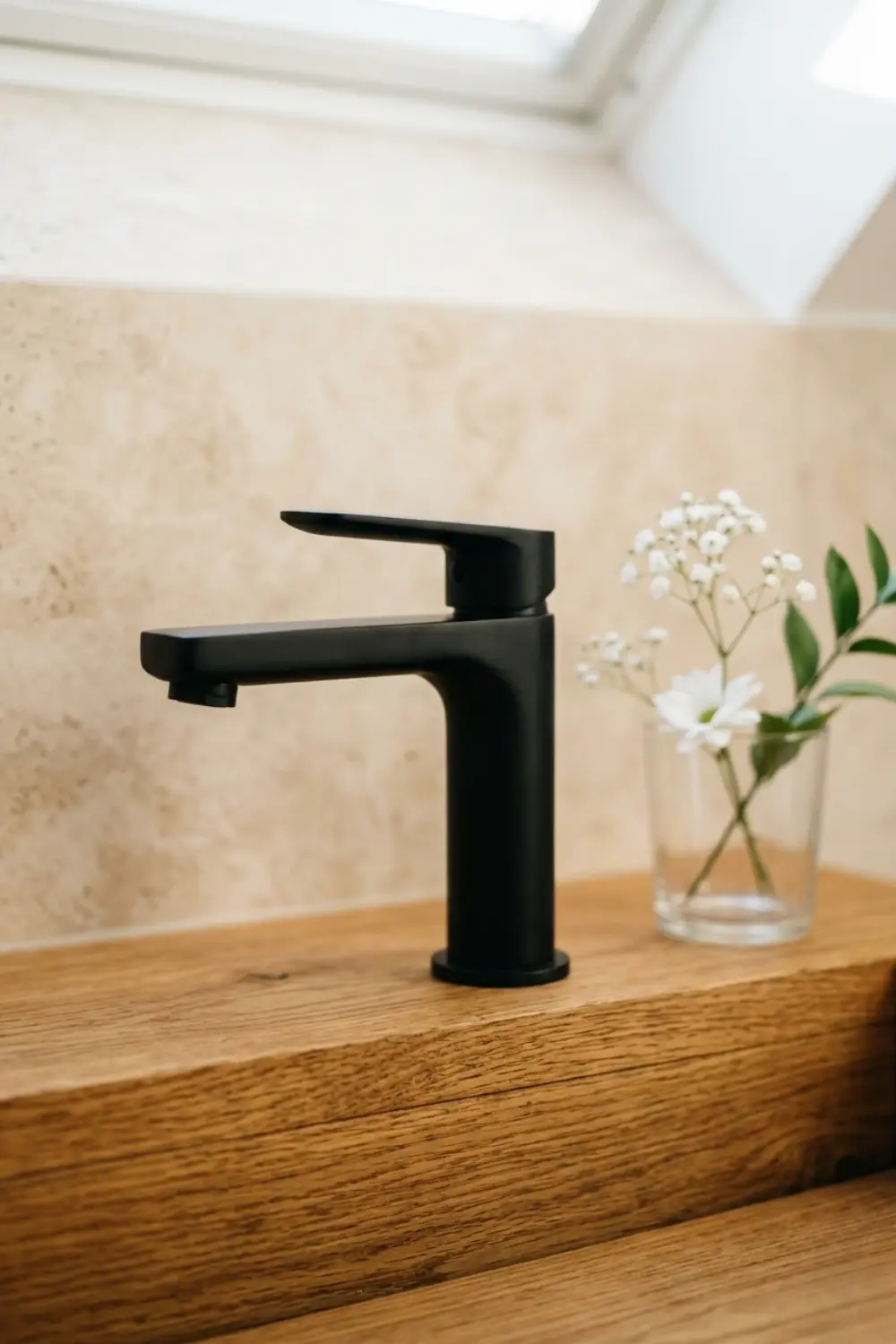
Here’s the surprise element that makes earthy bathrooms feel modern rather than dated: matte black fixtures. Black might seem counterintuitive when you’re working with warm natural tones, but it’s exactly what prevents the space from feeling too soft, too washed out, too “beige.” Black creates definition, structure, visual punctuation.
Think about nature: warm earth tones exist alongside deep shadows, dark tree trunks, black stones in a riverbed. Black isn’t unnatural—it’s grounding. When you add matte black faucets, cabinet hardware, towel bars, or light fixtures to a warm-toned bathroom, you’re creating contrast that makes every other element more visible, more intentional.
The key word is matte. Shiny chrome or polished brass would compete with the organic materials. Matte black recedes slightly while still providing structure—it’s present without being loud. A matte black faucet against a warm walnut vanity and cream stone countertop creates this beautiful, balanced triangle: warm wood, neutral stone, grounding black.
This works on every scale. Large: a matte black framed mirror or shower door. Medium: faucets, drawer pulls, towel rings. Small: a black ceramic soap dispenser, black picture frame, black plant pot or matte black metal toilet paper holder. These black elements create a visual thread that ties the space together and prevents it from feeling too soft or undefined.
One important note: use black intentionally, not everywhere. If everything is black hardware and fixtures, it becomes the dominant story. You want maybe 10-15% black in the overall composition—enough to ground it, not enough to overpower the warmth. In [18 Trending Above Toilet Decor Ideas for a Beautiful Bathroom], I mentioned how black frames create instant sophistication, and the same principle applies throughout the bathroom.
6. Live Plants Transform the Atmosphere Completely
 Save it
Nothing—and I mean nothing—makes a bathroom feel more alive and earthy than actual living plants. Not because they’re trendy or decorative, but because they’re literally alive. They change, they grow, they respond to the space. A bathroom with plants feels inhabited, cared for, breathing.
The psychology here is powerful. Most bathroom surfaces are static: tile that never changes, countertops that look the same every day. A plant introduces change, movement, life cycles. It connects the space to something larger than itself, something that existed before design trends and will exist after. That’s grounding in the deepest sense.
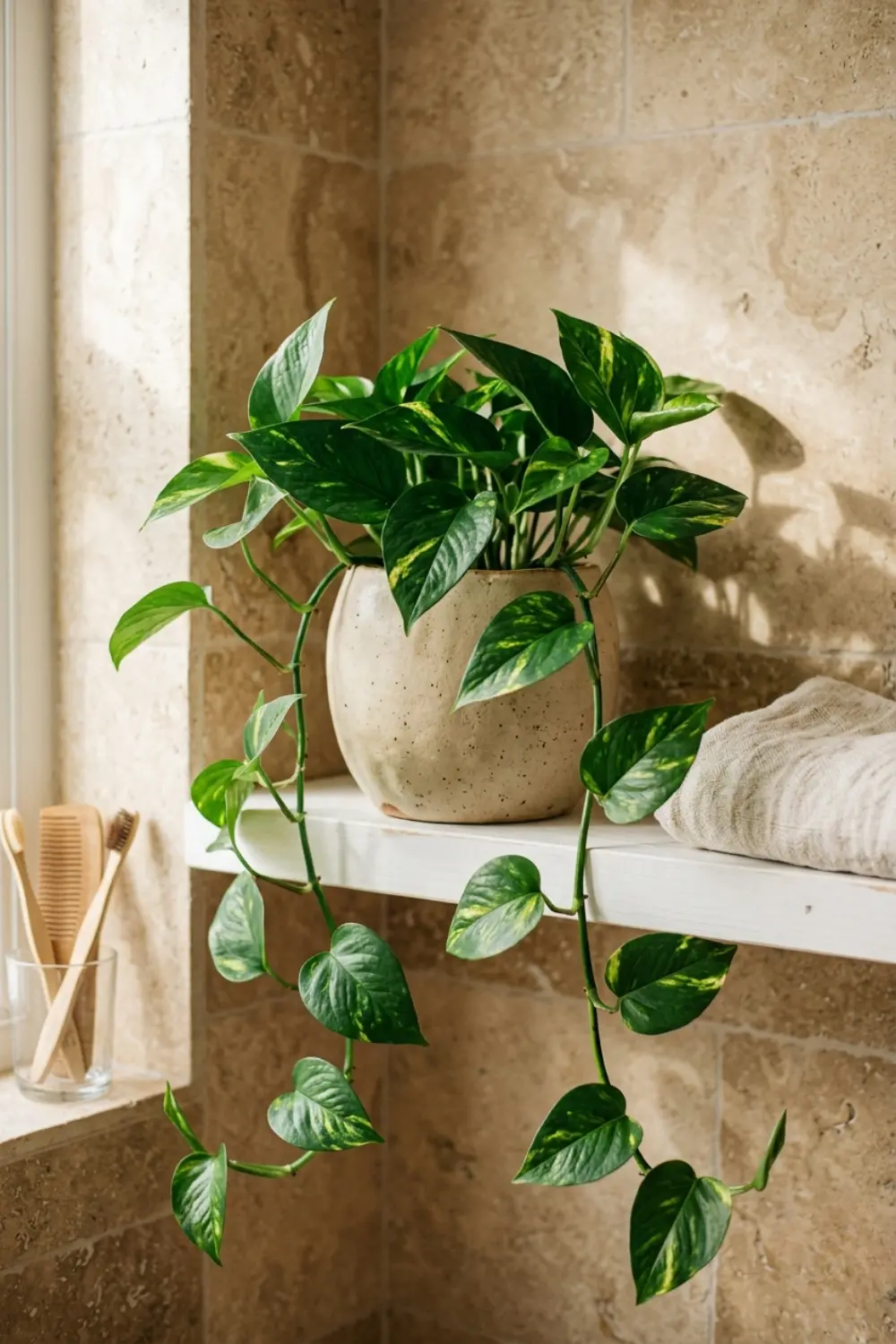
But you have to choose plants that will actually survive in your bathroom’s specific conditions. If you have a window with natural light, you have more options: pothos, snake plants, ferns, peace lilies in ceramic pots. If your bathroom has no windows or low light, stick with extremely hardy plants like ZZ plants or snake plants, or invest in a small grow light.
Placement matters enormously. Don’t just put a plant in a random corner and call it done. Think about where your eye naturally travels in the space. On a shelf above the toilet, creating a green focal point. On the counter next to the sink, where you’ll see it every morning. Hanging in a corner of the shower where steam will love it. Even a small plant on the back of the toilet tank makes a difference.
The vessels matter too. In an earthy bathroom, skip the bright colored plastic pots. Use natural materials: ceramic in cream or terra cotta, woven baskets that can hold a nursery pot, wooden planters, stone vessels. The pot becomes part of the styling, not just a holder. And remember scale: in a small bathroom, one medium plant is better than five tiny ones. In [Beautiful Bathroom Shelf Styling Ideas with Modern Decor Touches], I talked about how anchor pieces create hierarchy, and a healthy, substantial plant can absolutely be that anchor.
7. Warm Lighting Creates the Entire Mood
 Save it
You can have perfect materials, perfect colors, perfect styling—and if the lighting is wrong, the whole space will feel off. This is especially true in earthy bathrooms where warmth is the entire point. Cool-toned LED bulbs will kill that warmth instantly, making everything feel sterile and flat no matter how much wood and stone you have.
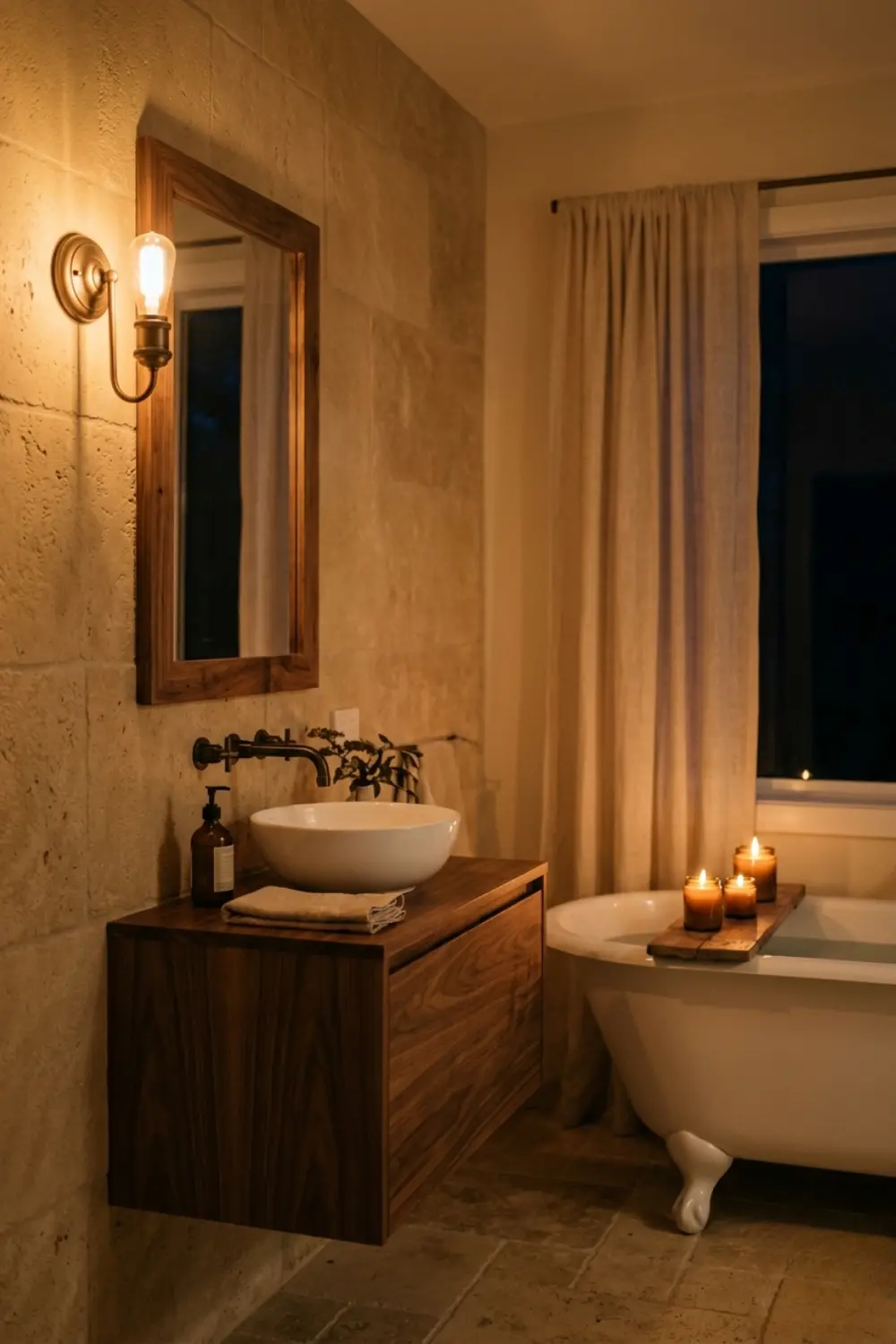
The color temperature of your bulbs matters more than almost anything else. You want 2700K-3000K—warm white, not daylight or cool white. This range mimics the warm glow of morning sun or candlelight, and it makes wood look richer, stone look warmer, and skin look healthier.
But lighting isn’t just about bulbs—it’s about layers. Overhead lighting alone creates harsh shadows and flat illumination. You need multiple light sources at different heights: overhead for general light, sconces flanking the mirror for task lighting, maybe a small lamp or LED strip under shelving for ambient glow. These layers create depth and allow you to adjust the mood.
Natural light, of course, is the ultimate earthy element. If you have a window, work with it rather than covering it completely. Sheer linen curtains filter light beautifully while maintaining privacy. If you don’t have a window, you can simulate natural light with full-spectrum bulbs and strategic placement that mimics window light coming from one direction.
Dimmers are game-changing. They let you adjust the intensity based on time of day or mood—bright for morning routines, soft for evening baths. A dimmer switch is a small investment that dramatically increases how you experience the space.
One often-overlooked element: candlelight. Real candles (or very good LED flameless ones) add warmth that electric light can’t quite replicate. A few candles on the tub edge, on a shelf, on the counter—their flickering, golden light creates instant coziness. In [16 Stylish Bathroom Mirror Ideas for a Luxurious Look], I discussed how lighting around mirrors changes everything, and in an earthy bathroom, that lighting should always lean warm.
8. Natural Fiber Storage Hides Clutter Beautifully
 Save it
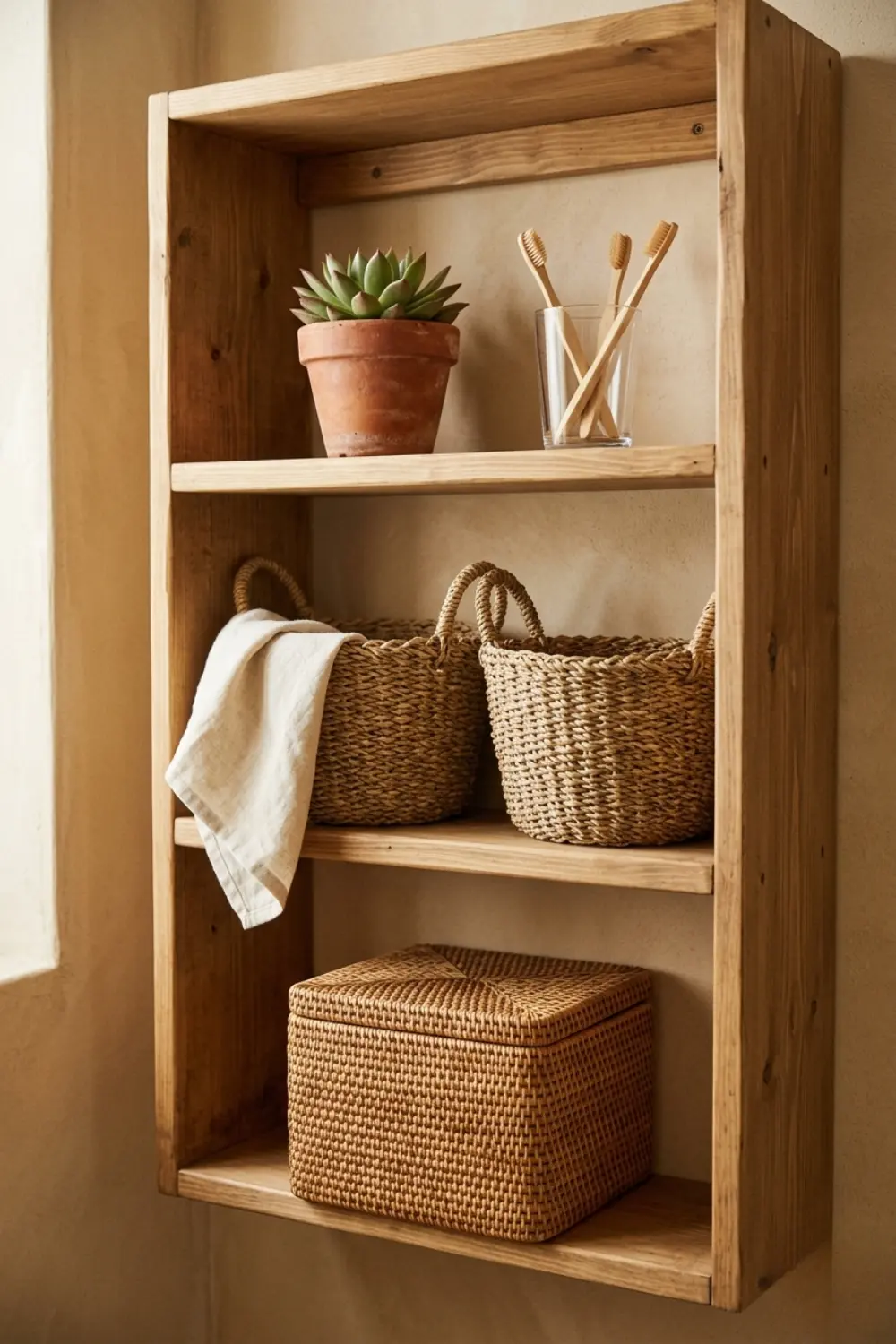
Storage is where most bathrooms fail the earthy aesthetic. Plastic bins, wire baskets, synthetic organizers—they all break the natural mood instantly. But you need storage; bathrooms accumulate stuff. The solution is natural fiber storage that’s both functional and beautiful: woven baskets, rattan boxes, wooden crates, linen bins.
These organic storage solutions do double duty. They hide the visual chaos of toiletries and towels, and they add texture and warmth to the space. A woven seagrass basket on a shelf doesn’t look like storage—it looks like intentional styling. But inside, it’s holding all the things you don’t want visible.
The key is choosing storage that matches your material palette. If you have warm wood tones, choose natural rattan or bamboo baskets. If you’re working with more neutral stone tones, linen or cotton rope baskets work beautifully. The storage should feel like an extension of the design, not a separate category of “organizing stuff.”
Open shelving works wonderfully in earthy bathrooms, but only if what’s on display is curated. Use baskets to corral smaller items, then display a few beautiful objects alongside them: a plant, a ceramic vase, folded linen towels. This creates the feeling of abundance and care without actual clutter. The basket says “I have my life together,” while the styled objects say “and I care about beauty.”
Under-sink storage is another opportunity. Instead of exposing pipes with no cabinet, or using a builder-grade particleboard vanity, consider a natural wood cabinet or even a woven basket system that sits beneath a wall-mounted sink. This adds warmth while solving the storage problem. If you’re renting and can’t change the vanity, at least use woven baskets inside the cabinet to organize—it makes opening the cabinet door a more pleasant experience.
In [20 Beautiful Bathroom Tray Styling Ideas to Elevate Your Vanity], I talked about how corralling items creates visual calm, and natural fiber storage is the larger-scale version of that principle. It’s about creating boundaries that feel organic, not plastic and temporary.
9. Neutral Color Palette with Warm Undertones
 Save it
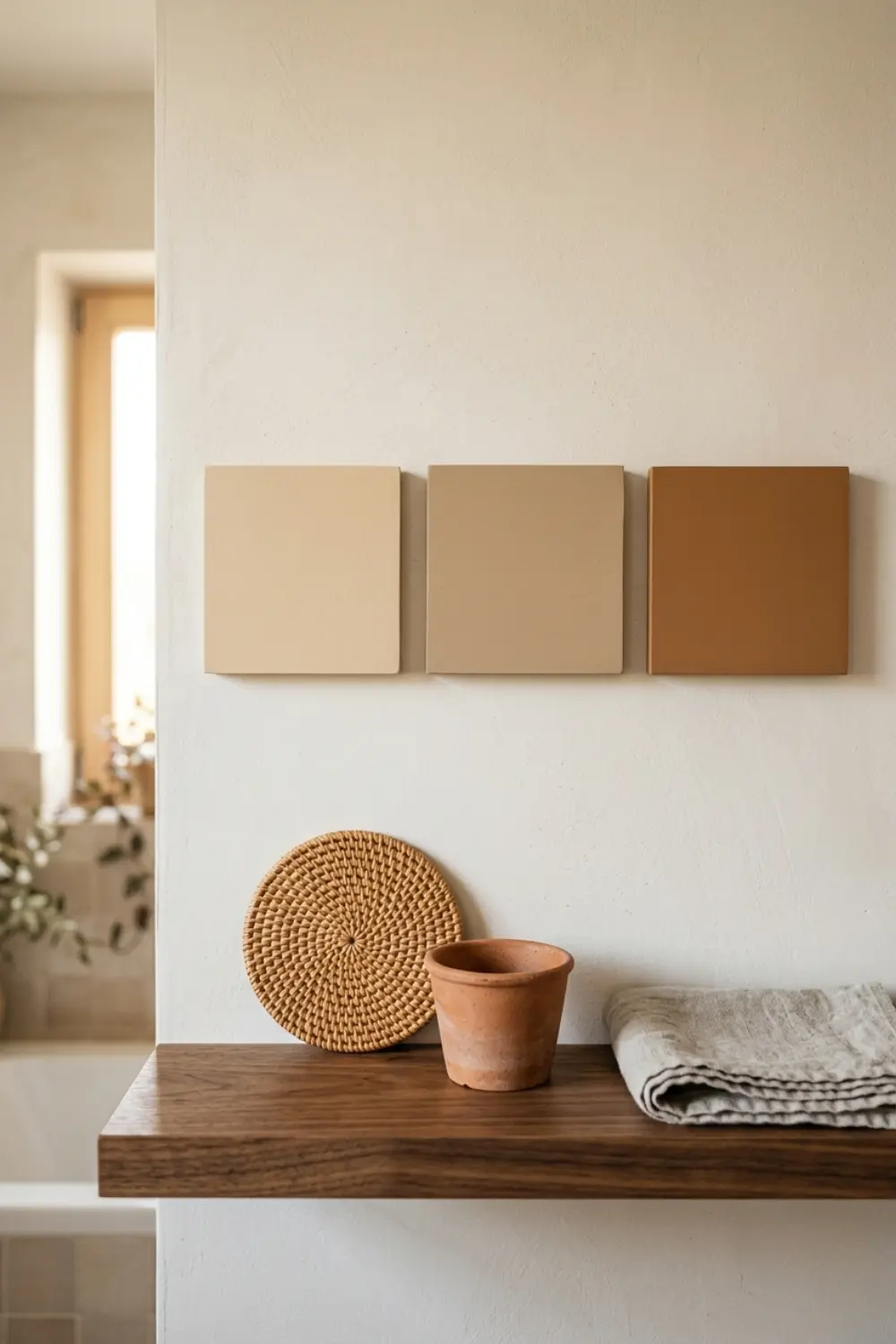
Color is where many earthy bathrooms go wrong. People think “neutral” and “earthy” mean beige everything, and the result feels muddy, flat, or dated. The secret is understanding undertones—not all neutrals are created equal, and warm undertones are what make a palette feel cohesive and inviting rather than dull.
Start with a base: warm white, cream, or soft greige (gray-beige). These are your large surfaces—walls, floors, potentially the vanity. The key is making sure these base tones have warm undertones: a cream with a hint of yellow or peach, a greige that leans taupe rather than gray, a white that’s not stark but slightly buttery. Hold paint samples next to each other and next to your lighting—cool undertones will look bluish or grayish, warm undertones will look golden or peachy.
Then layer in mid-tones: sand, caramel, honey, warm taupe, soft terracotta. These can be textiles, wood tones, ceramic accents. They create depth and variation without introducing actual “color” that might feel too bold or trendy. A caramel-toned wooden stool, sand-colored linen towels, honey-toned woven baskets—these mid-tones keep the palette interesting.
Finally, add depth with darker accents: chocolate brown, charcoal, matte black, deep terracotta. These ground the space and prevent it from feeling too light or washed out. This might be your fixtures, darker wood shelving, a black-framed mirror, dark grout lines in your tile or even matte black towel hooks.
The palette should flow, not jump. You’re creating a gradient from light to dark, all staying within the warm, natural family. Nothing should feel out of place or jarring. In [How to Achieve a Timeless Neutral Bathroom Decor Style], I explored how neutral doesn’t mean boring—it means intentional, and warm neutrals create a cocoon-like feeling that never goes out of style.
One practical test: take a photo of your bathroom in natural light. If the photo looks warm and golden, you nailed the undertones. If it looks gray or cold, something in your palette is fighting the warmth—likely a cool-toned element that needs swapping.
10. Handmade and Artisan Details Add Soul
 Save it
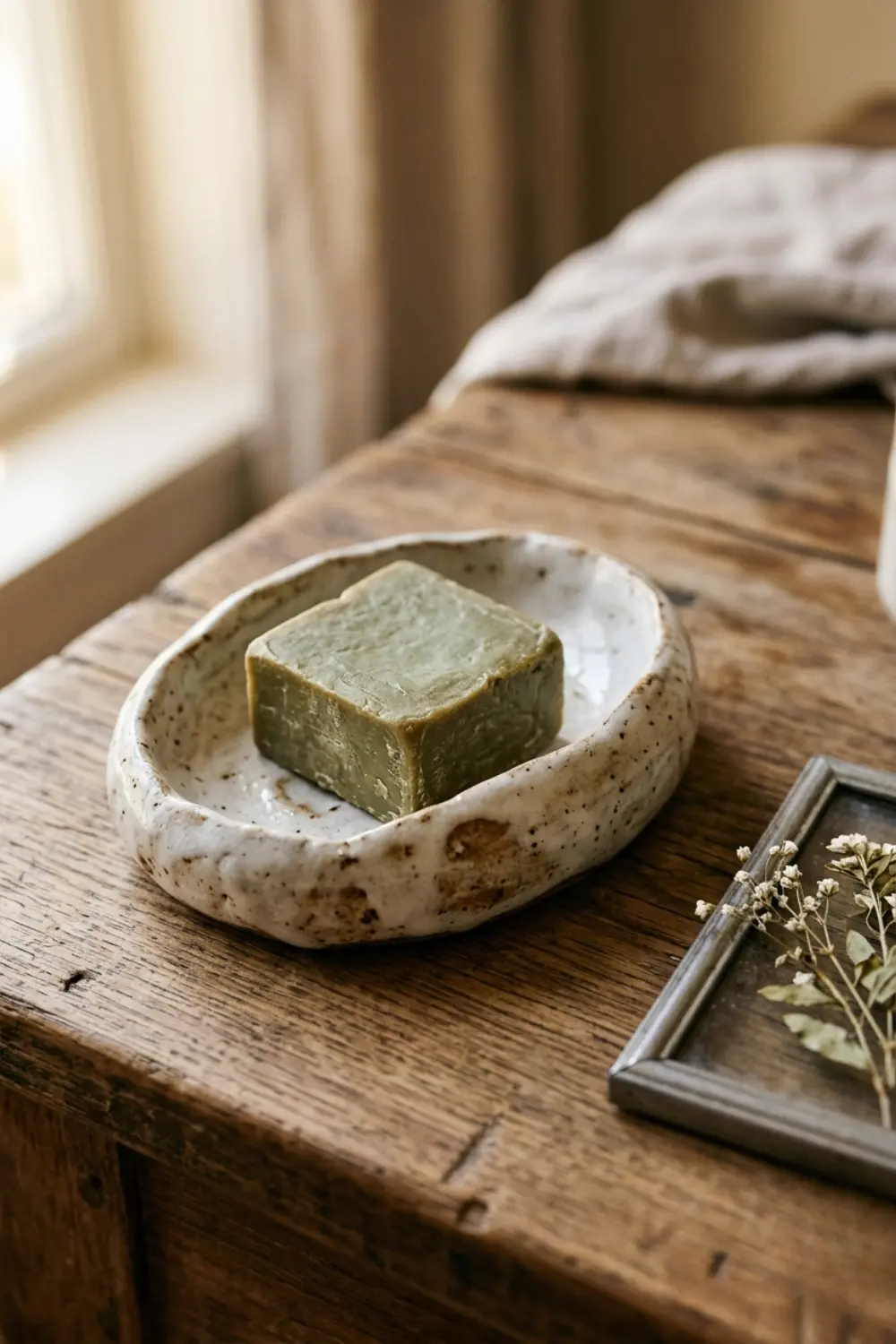
This is what separates an earthy bathroom that feels like a catalog from one that feels like home: imperfection, handmade quality, artisan details. A perfectly smooth, mass-produced ceramic soap dish is fine. A slightly wobbly, hand-thrown ceramic dish with visible fingerprints in the clay—that has soul.
We’re drawn to handmade objects because they carry evidence of human touch. They’re not algorithmically perfect; they’re individually unique. In a bathroom full of manufactured fixtures and builder-grade tile, these handmade moments become anchor points for emotional connection. They say: someone made this with their hands, and now it lives in your daily ritual.
This doesn’t mean everything needs to be expensive artisan craft. It means seeking out objects with character: a ceramic soap dish tray, a woven basket with irregular stitching, a wooden bath tray with visible grain and natural edge, a clay pot with a slightly asymmetrical rim.
Even commercially available items can have this quality if you choose wisely. Look for phrases like “hand-poured,” “artisan-made,” “small-batch,” or “natural variation.” Look at product photos closely—do you see slight differences between items, or are they identical? Handmade items will show variation, and that’s what you want.
Supporting small makers is a bonus here. Etsy, local craft markets, small ceramic studios—these sources often offer bathroom accessories that are truly one-of-a-kind. A hand-thrown soap dish from a local potter, even if it costs more than a Target version, becomes a piece you’ll keep for years because it feels special, irreplaceable.
Balance is important: you don’t need handmade everything. But having 2-3 obviously handcrafted pieces among your bathroom objects creates richness and depth. It signals that this space was curated thoughtfully, not just ordered from a single shopping cart.
Rental-Friendly Ideas and Small Bathroom Strategies
If you’re renting or working with a tiny bathroom, you might think an earthy aesthetic requires renovation. It doesn’t. In fact, small, non-permanent interventions are where earthy style really shines because it’s about objects and materials, not built-ins or major construction.
For renters: Focus on removable elements that pack maximum impact. Swap out the shower curtain for a warm linen or cotton one (instant transformation, zero commitment). Replace plastic soap dispensers with ceramic or wooden ones. Add a woven basket under the sink instead of leaving pipes exposed. Bring in a wooden bath mat to replace the generic polyester one. Install removable adhesive hooks for towels and robes in matte black or brass. Layer in plants on shelves or hanging from command hooks. None of this requires drilling, painting, or landlord approval, but it completely changes the feeling.
The beauty of earthy decor for rentals is that everything is portable. When you move, your baskets, plants, textiles, and accessories come with you. You’re not investing in permanent fixtures you’ll have to leave behind—you’re building a collection of beautiful, functional objects that work anywhere.
For small bathrooms: Don’t try to scale everything down. That’s the mistake most people make. Instead, choose fewer items but make them substantial. One large plant instead of five tiny ones. One beautiful wooden stool instead of multiple small storage pieces. One large woven basket instead of three little ones.
Vertical space is your friend. Use wall-mounted shelves to get storage off the limited floor space. A floating vanity instead of a floor-standing one makes the room feel larger because you can see the floor beneath. Hang plants from the ceiling or high on the wall rather than taking up counter space.
Keep the color palette very cohesive in a small bathroom—this creates the illusion of more space because your eye isn’t stopping at different color blocks. Stick to 2-3 tones maximum: maybe cream walls, warm wood accents, and one deeper tone like matte black or chocolate brown. In [How to Make a Small Apartment Bathroom Look Bigger with Minimalist Decor], I detailed how visual continuity expands perceived space, and earthy palettes naturally create this because they’re all from the same family.
Finally, use mirrors strategically. A large mirror bounces light and doubles the visual space. In a small earthy bathroom, choose a wood-framed or black-framed mirror rather than frameless—it adds warmth without taking up physical space.
Common Mistakes to Avoid
1. Choosing cold-toned “neutrals” that kill the warmth
The fastest way to ruin an earthy bathroom is using gray or cool beige thinking it’s “neutral.” Gray has blue undertones—it reads cold. Cool beige has green or gray undertones—also cold. You need warm undertones: cream, sand, honey, caramel. Check samples in your bathroom’s lighting before committing, because what looks warm in the store might look gray at home.
2. Over-relying on wood without balancing materials
Wood is essential, but too much wood becomes overwhelming or too rustic. You need contrast: stone, ceramic, metal, textile. The wood should be one voice in a conversation, not the only speaker. Balance a wooden vanity with stone countertops and metal fixtures, not more wood.
3. Using only smooth, polished surfaces
Bathrooms are already full of smooth tile and porcelain. If every surface is smooth, the space feels sterile. Bring in texture deliberately: rough stone, woven baskets, linen towels, matte ceramics. Texture creates depth and makes the space feel lived-in rather than staged.
4. Forgetting about scale in small spaces
In a tiny bathroom, people often choose tiny accessories thinking it’s proportional. But tiny things get lost and look cluttered. Choose fewer items at a more substantial scale—they’ll have more presence and the space will feel more intentional.
5. Mixing too many natural materials without a unifying element
Wood, stone, rattan, jute, bamboo, linen, terra cotta—you can’t use all of them at once. Pick 3-4 maximum and repeat them throughout the space. Otherwise, it feels chaotic despite all materials being “natural.” Unity comes from repetition, not variety.
Frequently Asked Questions
What’s the difference between earthy and rustic bathroom decor?
Earthy focuses on natural materials and warm tones in a way that can still feel modern and minimal. Rustic leans heavily into aged wood, farmhouse themes, and a more deliberately country aesthetic. Earthy bathrooms use stone, wood, and clay but keep lines clean and avoid heavy distressing or vintage props. It’s about material honesty, not nostalgia.
How do I keep an earthy bathroom from feeling dark or cave-like?
Use plenty of warm white as your base—cream walls, light stone, natural linen. Layer in the deeper tones (wood, terra cotta, black) as accents rather than dominant elements. Maximize natural light with sheer curtains, and use warm-toned LED bulbs. The goal is warmth, not darkness—you’re layering earth tones, not creating a brown cave.
Can I do earthy decor in a bathroom with existing cool-toned tile?
Yes, but you’ll need to balance it heavily. If you have gray or white tile with cool undertones, bring in as much warmth as possible through wood, terra cotta, warm textiles, and warm lighting. Use these elements to redirect the eye away from the tile. A warm wood vanity, rust-toned towels, and 2700K lighting can warm up even a cool space. You’re essentially compensating for what the tile lacks.
What’s the best way to incorporate plants if my bathroom has no windows?
Choose extremely low-light-tolerant plants like snake plants or ZZ plants, or use high-quality faux plants (they’ve gotten much more realistic). You can also install a small LED grow light bulb in an existing fixture to support real plants. Even one thriving plant with supplemental light makes more impact than five struggling ones.
How much should I spend to achieve an earthy bathroom look?
You don’t need to spend a lot. The earthy aesthetic is about materials and arrangement, not price tags. You can find affordable linen towels, basic ceramic pieces, simple wooden accessories, and woven baskets at accessible price points. Thrift stores and local craft markets often have unique handmade pieces for less than mass retailers. Focus on a few quality pieces (a good wood stool, a handmade ceramic soap dish) and fill in with affordable natural basics (plants, simple baskets, neutral towels).
Final Thoughts
If you’ve read this far, you now understand that earthy bathroom decor isn’t about filling a space with trendy products—it’s about building an intentional, sensory experience using materials that have warmth, texture, and connection to the natural world. It’s stone that grounds you, wood that welcomes you, clay that adds soul, textiles that soften every hard edge, and plants that remind you something’s alive in here besides you.
This isn’t a style that requires perfection or a big budget. Some of the most beautiful earthy bathrooms I’ve seen were small rental spaces where someone simply swapped in linen towels, added a few plants, chose warm lighting, and brought in one substantial wooden element. That’s it. The transformation came from understanding the logic: warm tones, natural materials, intentional empty space, handmade details.
Remember that your bathroom is a daily ritual space. You start and end every day here. It deserves to feel like a sanctuary, not a functional box you rush through. Earthy decor creates that sanctuary feeling because it connects you back to something primal and calming—the textures and tones of the natural world. You don’t need to live in a forest to bring that groundedness home. You just need to choose materials and colors that remember where they came from: the earth, warm and alive and endlessly renewing.
Now it’s your turn. Look at your bathroom with fresh eyes. What’s one warm element you could add today? What’s one cold element you could remove or soften? Start small, build gradually, and trust your instincts about what feels grounding versus what feels forced. This is your space. Make it breathe.
This post contains affiliate links. I may earn a small commission at no extra cost to you.
Get cozy inspiration delivered to your inbox.
✓ 14-page beautifully designed ebook
✓ Cozy decorating ideas
✓ Practical room-by-room inspiration
You’re in! 🎉
Thanks for joining the NestFlowHome community!
Your free ebook is already on its way to your inbox. If you don’t see it within a few minutes, please check your Promotions or Spam folder.
Join the NestFlowHome community for weekly decorating inspiration.

Timeless home decor ideas and slow living inspiration for a calm, beautiful life.