
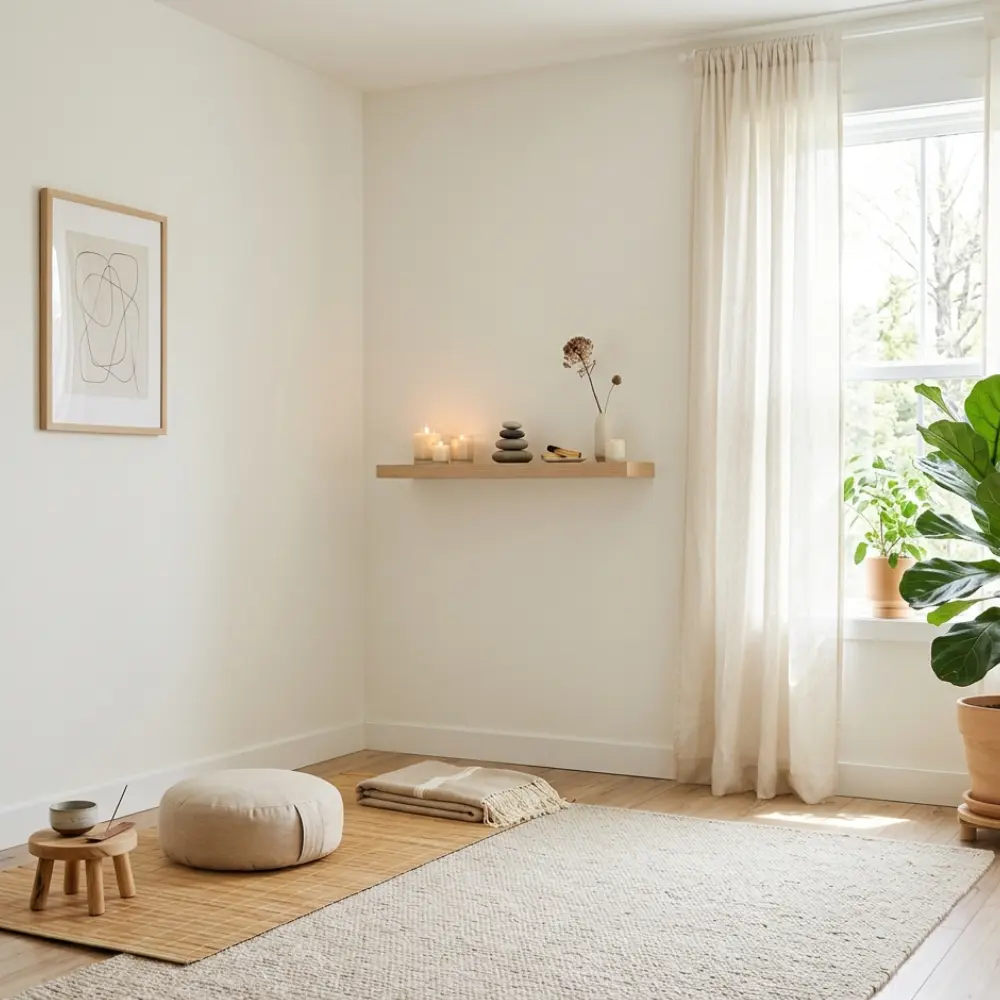
How to Create a Wellness Room for a Stress Free Lifestyle
By Emily | April 27, 2026
You come home in the evening, and instead of calming down, you’re faced with more stress: the kids are screaming, the dishes are piling up, your phone is ringing nonstop. There’s not a single corner in your house where you can let go of the day, where it’s just you and the silence. You think this is a luxury – a separate room that’s all about peace and quiet. But it’s not really a luxury. It’s a necessity. Because the constant stimulation of modern life is also physically damaging: higher cortisol levels, worse sleep, a nervous system that never rests. And if you don’t have a physical place where you consciously detach yourself from this, this pattern continues until you burn out.
A wellness room is not a bathroom, not a bedroom, not a living room. It’s a dedicated space that serves a single purpose: recovery. It doesn’t need a huge floor space or an architectural marvel – a corner, a small room, even a converted walk-in closet is enough. What matters is the intention. That you consciously create a place where the brain can learn: different rules apply here. There are no performance pressures, no to-do lists, no external expectations.
In this article, you will learn how to design a wellness room step by step – from choosing the space to the furniture to the lighting, from the scent to the sound. It will not be another Pinterest board that you admire and then never do. It will be a practical guide that you can start creating tonight that will change how you deal with stress. Because when you have a place to retreat to, your whole life looks different.
1. Choose a Dedicated Space Away From High-Traffic Areas
 Save it
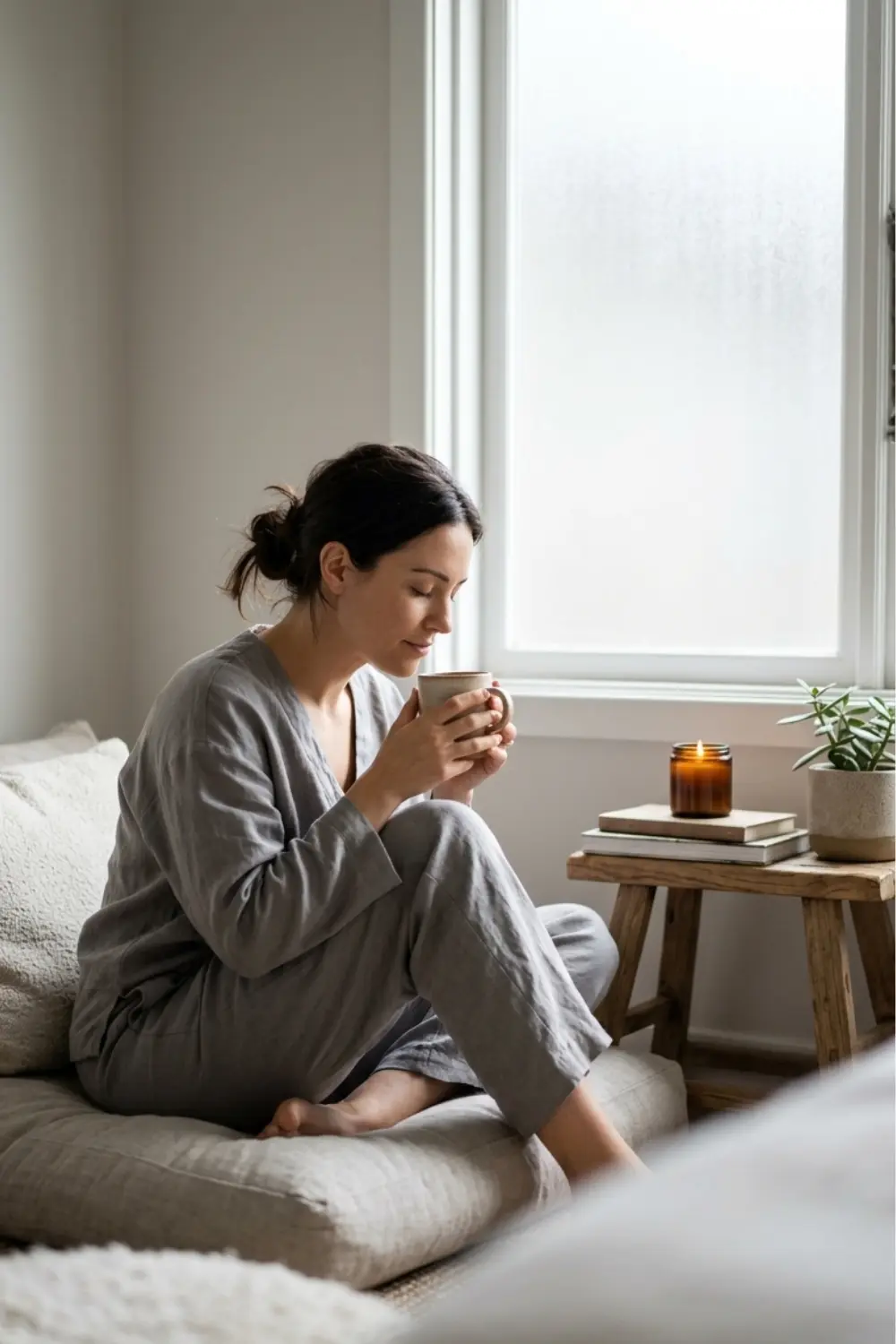
The first and perhaps most important decision is where your wellness room will be. It doesn’t matter, because the energy, sound, and accessibility of the space all affect how much you can use it. If you try to meditate in the middle of the living room while the family comes and goes, it won’t work. If it’s in your bedroom, where your bed brings up thoughts of “this needs to be done too,” it won’t work either.
The goal of a wellness room is detachment – both physically and mentally. Find an area that is away from the main lines of movement: not next to the entrance, not near the kitchen, not where everyone passes through. It can be a small room that has previously functioned as storage. It can be a corner of the basement, if it is tidy and bright. It can be the attic, if it is insulated. It could be a converted closet – smaller than you might think, but if it’s just you, it’s enough.
When I realized this, I struggled for years with “resting” in the living room, with the laptop on the table, the unwashed dishes in the kitchen. Then I converted a small guest room – barely 8 square meters – and the first day the door closed behind me, I felt the difference. Not the size, not the furniture. The fact that this space is for nothing but being in me.
If you don’t have a separate room, you can still create a dedicated corner. A screen can separate an area in your bedroom or living room. It’s a physical boundary that indicates: this area has different rules. When you’re there, you’re not working, you’re not cleaning, you’re not doing anything. You’re just being. When choosing a space, consider the noise level.
If you choose a room facing the street, there will be constant car noise. If next to the children’s room, there will be screaming. Find a quieter part – a courtyard-facing, interior room, where the outside world is less audible. And if it is still noisy, then soundproofing can help: thick curtains, carpet on the floor, or even foam panels on the walls.
2. Design for Calm With Neutral, Soft Color Palettes
 Save it
Color is one of the most powerful tools you can use to influence the mood of a space and the response of your nervous system. Vibrant, bright colors – red, orange, bright yellow – activate, make you alert, and trigger stress hormones. In a wellness room where the goal is to calm down, these work against you.
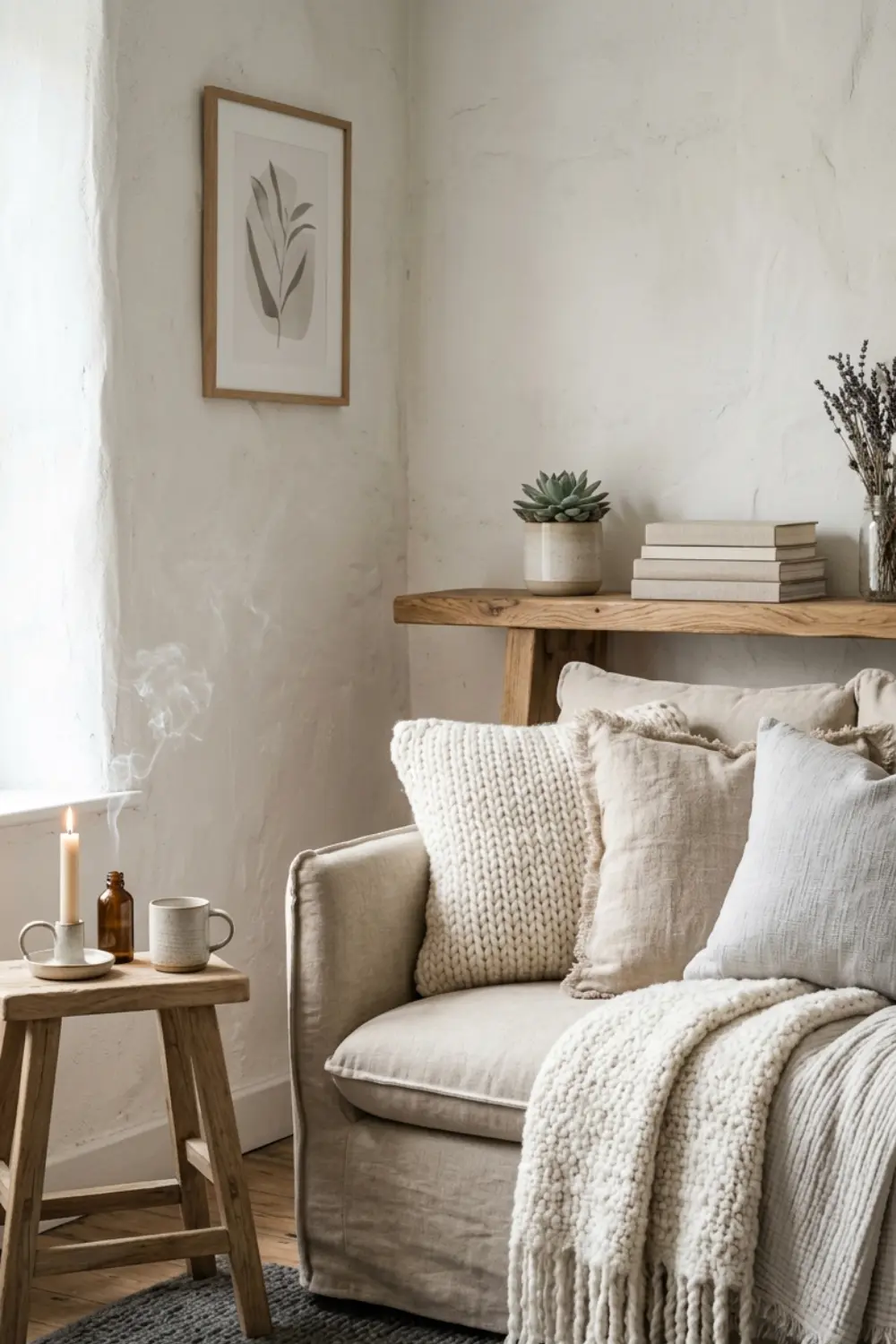
Stick to a neutral, soft palette, like off-white, beige, light gray, soft greens, pale blues, earthy colors. These tones do not overstimulate the brain, but rather exude calm. Beige, cream, sand – these are the colors of nature, and the human brain perceives them as evolutionarily safe.
My walls are light warm gray, almost white, but they have a hint of beige in them – so it is not sterile, but soft. The textiles are in shades of beige, white, and pale green. There is not a single sharp color in the space. And when you enter, you can almost feel your body releasing tension because nothing is shouting at you, nothing is demanding attention.
This doesn’t mean it’s boring. Textures add depth – linen, wool, wood, stone. The same beige looks completely different on a linen pillow versus a wool blanket versus a wooden shelf. The variety of materials creates a rich, layered space without causing visual overload.
If you do want color, bring it in as an accent: the green of a plant, the deep indigo of a pillow, the terracotta of a rug. But keep it minimal, controlled. Keep the base neutral so your eyes can rest, not jump.
The ceiling also matters – if you paint it white, it optically lifts the space, making it feel airier. If it’s the same color as the walls, it feels more intimate, more welcoming. Both can work, depending on what feeling you want: spaciousness or protection.
3. Layer Soft, Natural Lighting That You Can Control
 Save it
Light has perhaps the greatest influence on your nervous system and the effectiveness of your wellness room. Strong, cold light coming from above is activating – it evokes an office environment, a pressure to perform. Soft, warm, multi-level light, on the other hand, calms, gives security, and signals to your body: you can relax here.
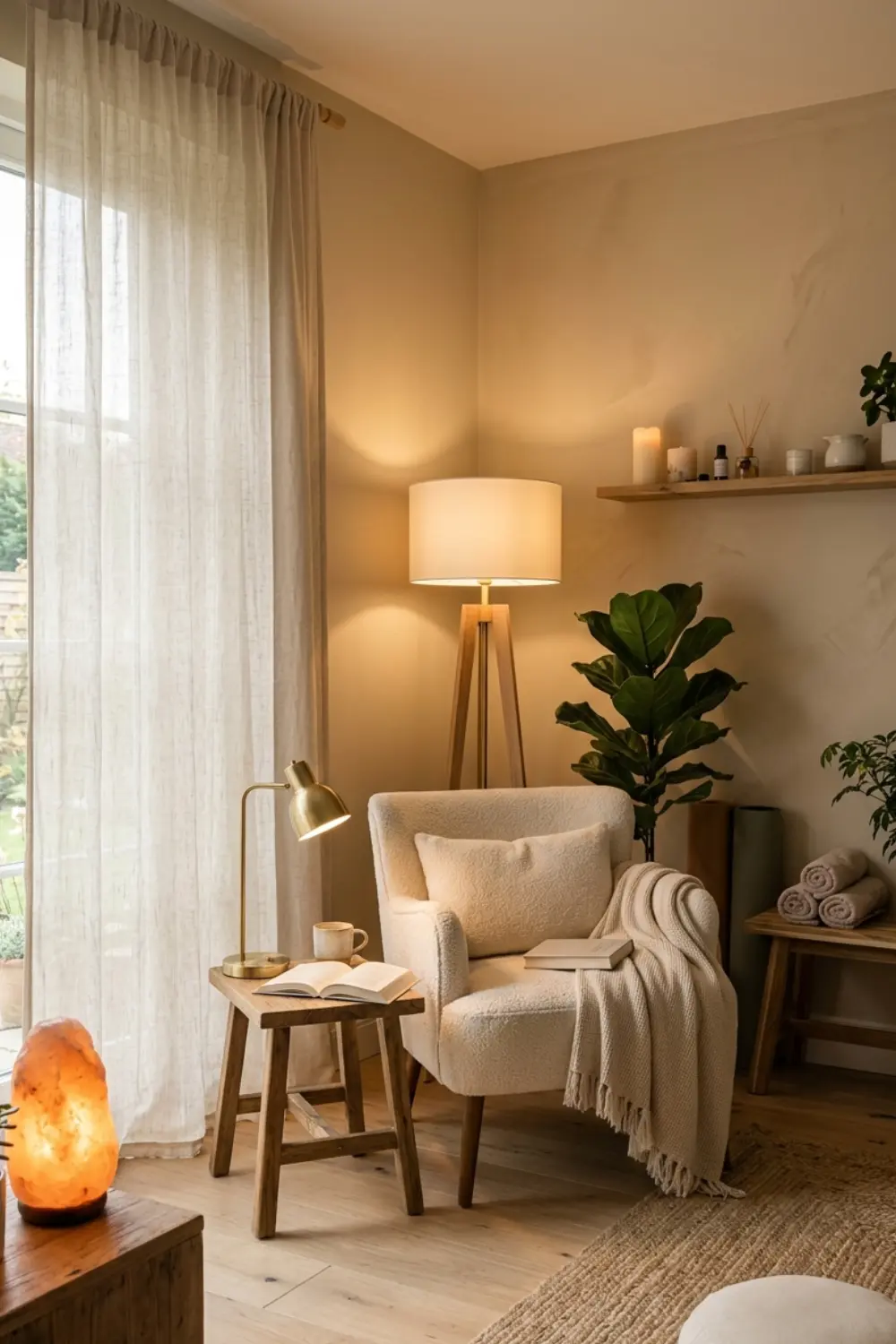
Natural light is the best starting point. If there is a window in the space, it is a huge advantage – but you need to be able to control it. You can let the light in during the day, but in the evening or when you want to relax, you need to be able to dim it. Use light, sheer curtains, which let light through but filter the direct sun. And a blackout curtain behind it, which you draw when you want complete silence and darkness.
But artificial lighting is just as important. Never have just one ceiling lamp – it gives a flat, shadowless, oppressive light. Instead, layer: a soft background light (maybe a floor lamp in the corner), a functional light (for reading, yoga), and a mood light (candle, salt lamp, LED strip).
I have three light sources: a floor lamp with a dimmable warm bulb, a small table lamp for reading, and a Himalayan Glow Natural Salt Lamp, which gives off an orange, flickering light. None are too harsh, none are cool white. And each one is individually switchable, so I can control how bright I want it—more light for morning yoga, just the salt lamp for evening meditation.
Dimmable lights are key. If you can’t dim them, they’re either too bright (activating) or too dark (sleepy, non-functional). The dimmable version allows you to fine-tune the light for your activity and the time of day.
Avoid cool white (5000K+) bulbs – they wake up your brain, not calm it down. Stick to the warm white (2700-3000K) range, which gives off a yellowish, sunset-like tone. This signals your body that it’s evening and ready to rest.
4. Incorporate Natural Materials to Ground the Space
 Save it
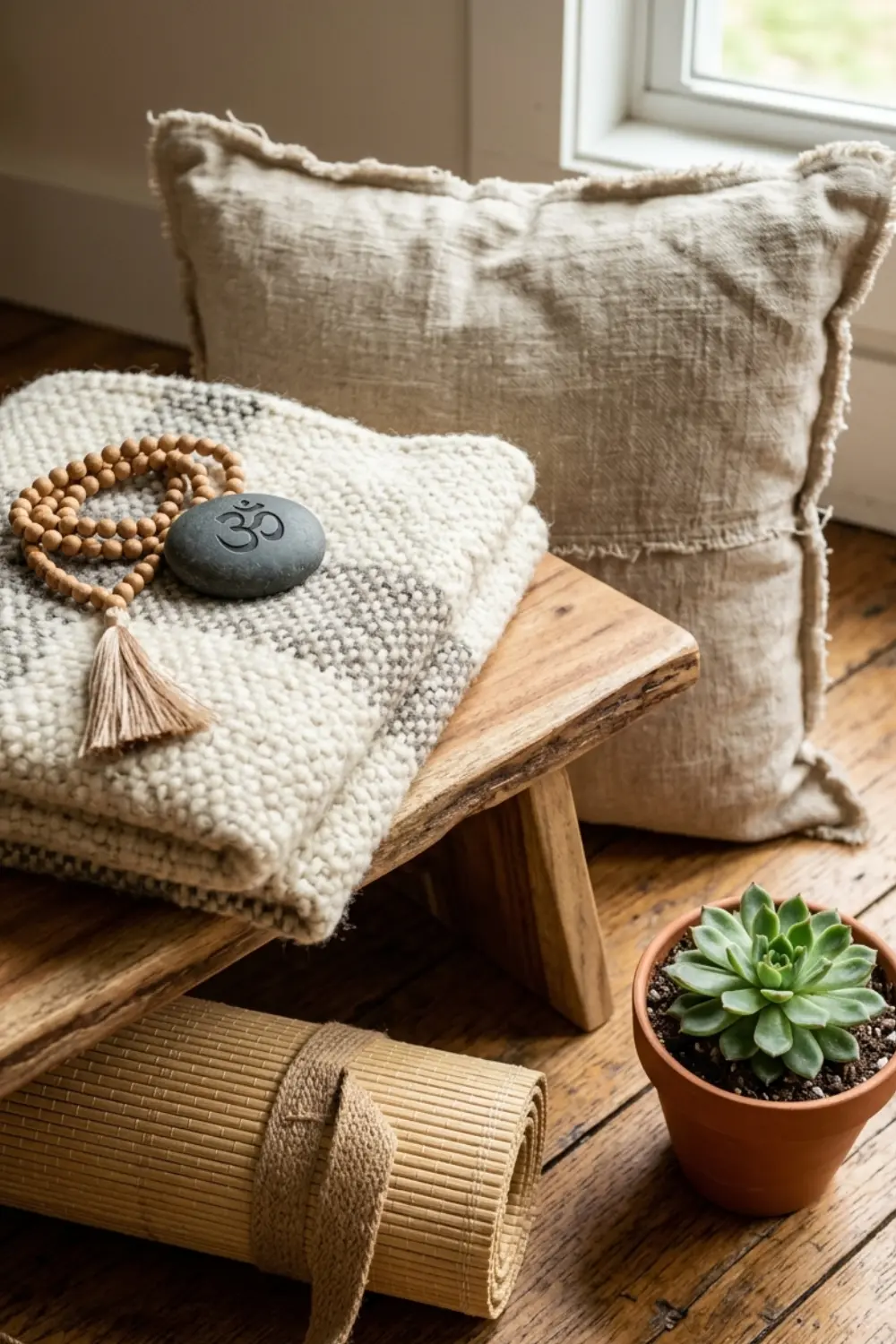
Natural materials – wood, stone, wool, cotton, linen – are not only beautiful, but also have a physiological effect on your nervous system. The human brain has been surrounded by these materials for millions of years and still perceives them as safe and familiar. Plastic, synthetic textiles, shiny surfaces are more modern inventions and are foreign to the brain, less soothing.
When you design a wellness room, build on natural materials. The floor should be wood or stone – if carpet, then wool or cotton, not synthetic. The furniture should be solid wood, rattan, bamboo – not plastic or metal. The textiles should be linen, cotton, wool – not polyester or synthetic fibers.
I have a bamboo yoga mat, a wooden meditation bench, linen pillows, a wool blanket. When I touch them, they have weight, texture, warmth. They are not cold, not smooth, not sterile. They are alive. And this small tactile experience is part of the ritual – when I sit down on the wooden bench, I feel the material, and my brain connects it: this is a place of relaxation.
Plants are also natural elements that give more than visual beauty. They produce oxygen, evaporate the air, give a living presence to the space. One or two large plants – for example, a potted ficus or a Snake Plant – are enough. Don’t overdo it: the wellness room is not a jungle, but a quiet, orderly space where a few selected elements find their place.
Another advantage of natural materials: they age beautifully. Wood patinas, linen softens, wool takes shape. Plastic tears, fades, breaks. But natural materials become richer with use, and this change is also part of the experience – you experience time together with the space.
If you imagine a wellness room as modern, then light wood, white linen, gray wool – clean lines, minimal shapes, but natural materials. If you want it to be rustic, then darker wood, coarsely woven textiles, stone elements. If you want it to be Japanese-inspired, then bamboo, rice paper, raw linen. Anything works as long as the materials are authentic.
5. Create Zones for Different Wellness Practices
 Save it
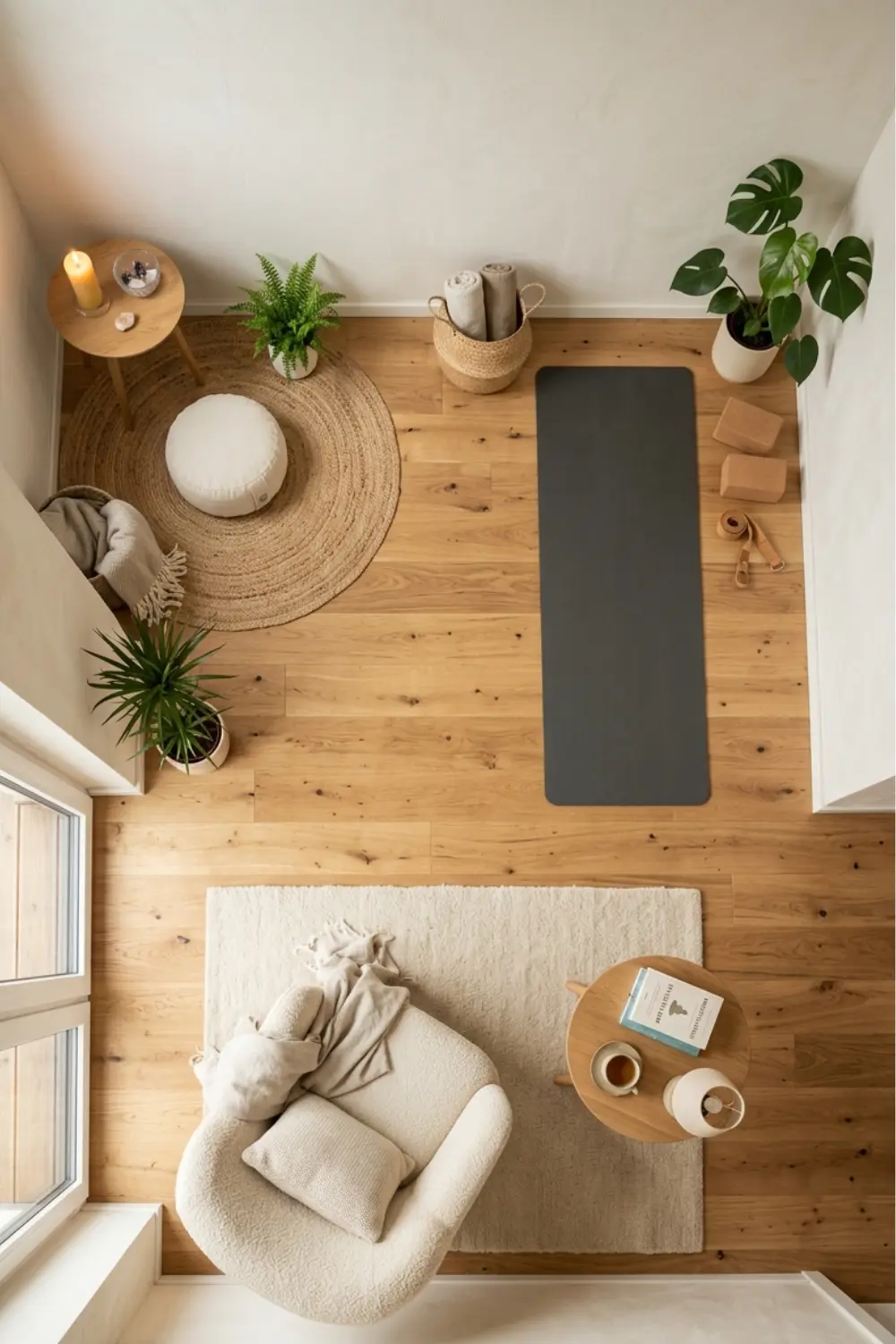
A wellness room works best when it is not a homogeneous space, but is divided into small zones – each dedicated to a specific activity. This helps the brain switch faster: if you sit on the meditation cushion, your body knows, now meditation is coming. If you are on the yoga mat, your body knows, now stretching is coming. This can be created even in a small space. In one corner, the meditation/breathing zone is placed: a cushion, a small blanket, maybe a candle. In another corner, the movement zone: a yoga mat, maybe a block, a strap. In a third place, the reading/journaling zone: a comfortable cushion, a small table or shelf for books, notebooks.
These zones do not require physical separation – only conscious placement. And when you enter and decide what you want to do, you go to that zone, and the space already supports you.
In the left corner, I have a meditation cushion next to a small wooden bench where I keep candles and incense. In the right corner, my yoga mat is rolled up, with blocks next to it. By the window, there is a soft armchair for reading. And when I come home in the evening and want to go in, I know right at the door: is it meditation or yoga today? And I go to that corner.
This zoning is especially important if the wellness room is multipurpose – for example, if you also work there during the day. Then there should be a clear boundary: this corner is work, this corner is wellness. And when your working hours are over, turn off the work light, cover your laptop, and physically move into the wellness zone. This movement is a ritual that signals your body: something different is coming.
The zones don’t change often. You set them up once, and they stay that way for months, years. This repetition strengthens the conditioning – the brain learns that you always meditate here, on this cushion. And over time, you just have to sit down and the mind automatically becomes quiet.
6. Introduce Calming Scents to Anchor Your Practice
 Save it
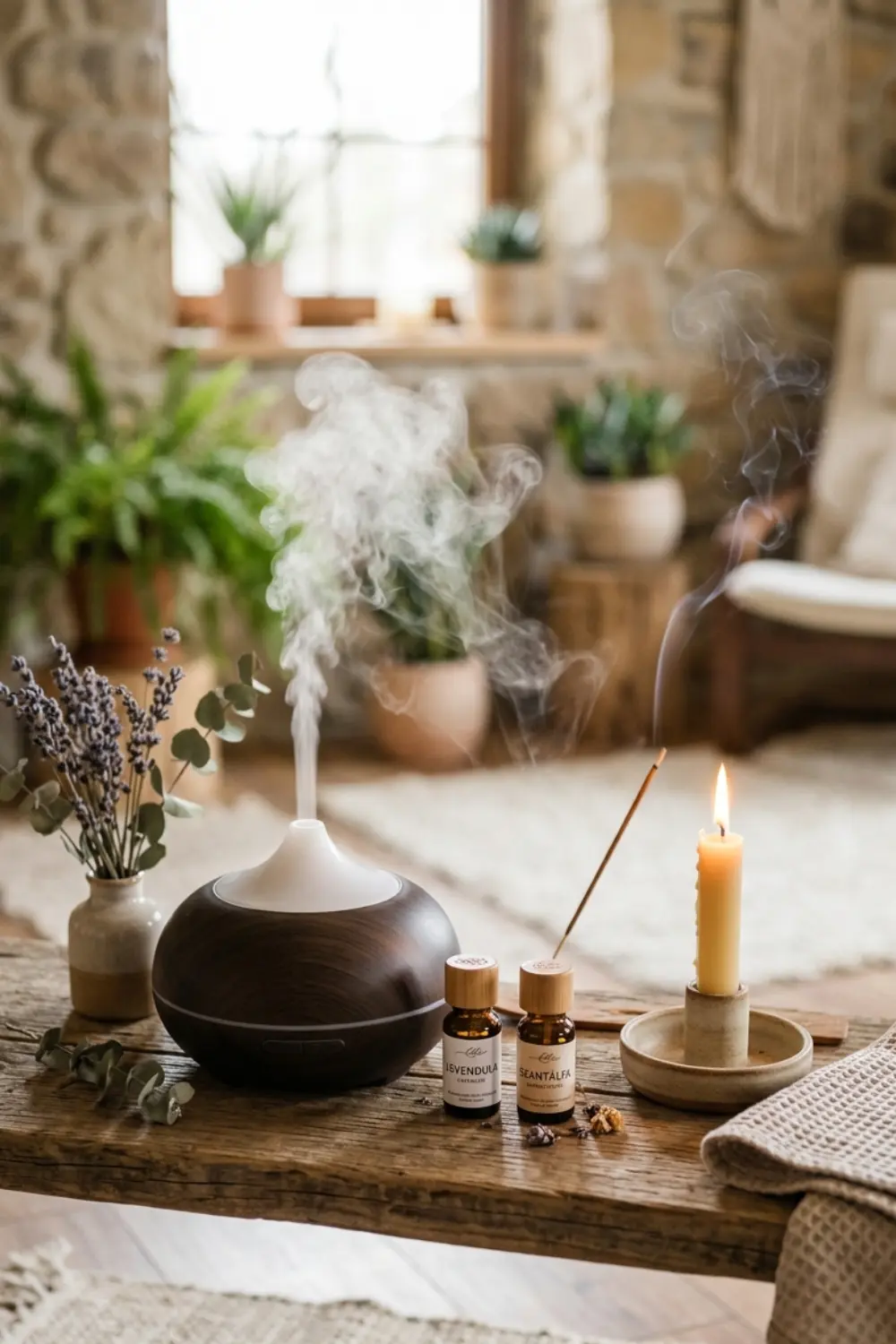
Scent is one of the most powerful sensory triggers, directly connected to your limbic system – the emotional center of your brain. That’s why a scent can instantly take you back to a memory or completely change your mood. And that’s why it’s worth using it consciously in your wellness room. But don’t just pack random scents and hope one of them helps. Scent works when it’s consistent and intentional. Choose one or two scents that you use exclusively in your wellness room – nowhere else. That way, your brain learns the association: when I smell them, relaxation comes.
For me, it’s lavender and sandalwood. Every night when I go in, I light a lavender candle or turn on my sandalwood diffuser. And for months, just the smell of the scent is enough to release the tension in my shoulders. It’s not magic – it’s conditioning. The brain has learned: lavender = wellness room = relaxation. Don’t use too many different scents at once – it’ll be confusing, not calming. Choose one or two and stick with them. If you want to change them later, that’s fine, but don’t change them every week, because then the association won’t form.
The intensity of the scent also matters. Don’t make it too strong – if you can specifically “feel” everything, it’s too much. The goal is a subtle background that’s barely noticeable, but still present. Like a whisper, not a shout.
Different scents have different effects: lavender is calming, chamomile is relaxing, sandalwood is grounding, eucalyptus is refreshing, ylang-ylang is relaxing. Choose the one that resonates with you – try a few and see which one makes you feel the calmest.
And important: the scent shouldn’t be synthetic air fresheners or cheap candles – they can irritate the respiratory tract and cause headaches. Use a quality, natural essential oil or a pure wax candle. The difference is not only in the scent, but also in how your body reacts to it.
7. Keep Technology Out to Protect the Sanctuary
 Save it
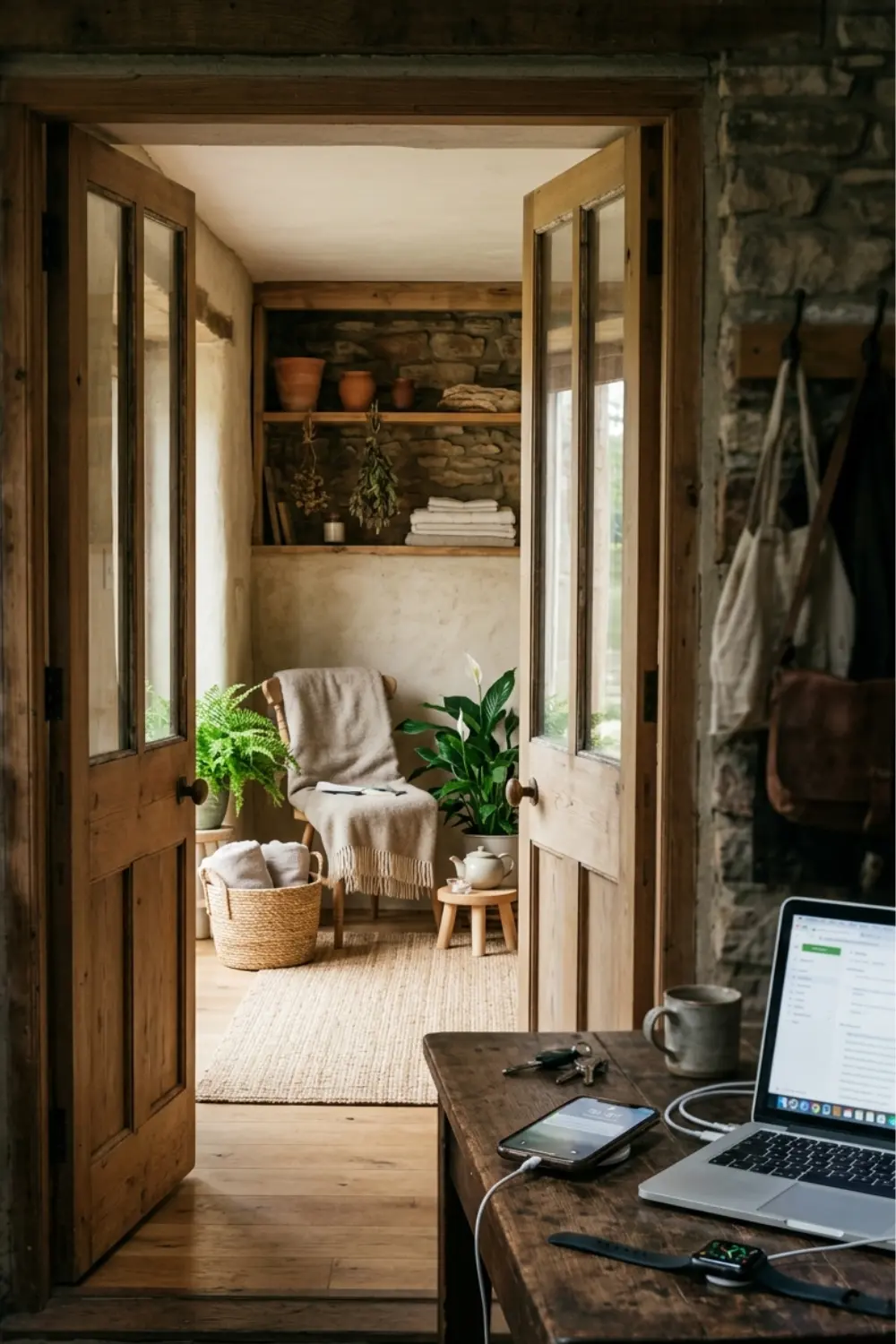
One of the most important rules of the wellness room: no technology. No phone, no laptop, no TV, no clock that flashes. This is the only space in your house where you completely disconnect from the digital world and are just inside you.
This may seem uncomfortable at first. “But what if I get an urgent call?” “But what if I want to time my meditation?” “But what if I want to listen to music?” There are solutions to all of these that don’t require a phone. You can use a timer for timing. For music, a small Bluetooth speaker that you set in advance and then don’t touch. But even better: no music, no timer. It’s just you and the silence.
The first time I tried to be without technology in the wellness room, I was nervous. My hand automatically reached for my pocket, where there was no phone. But then, after ten minutes, something loosened up. I realized: I’m constantly on standby. A notification, a call, a task could come at any time. And the nervous system knows this, which is why it never fully relaxes. But here, in this space where there is no technology, your body finally knows: I am safe now. I don’t have to react to anything now.
If you use music, use an offline player or a pre-loaded playlist that you start and then don’t touch. Don’t have your phone there, even if it’s in “airplane mode”. Because its mere presence signals to your brain: I can check it at any time.
The absence of technology is not a limitation – it’s a liberation. When there is no screen to distract you, you can finally be present. You can finally feel your body, hear your breathing, notice your thoughts without being immediately caught by some external stimulus. And that’s what makes a wellness room effective – not the furniture, not the smells, but the fact that you are actually present.
If it’s absolutely impossible without technology (for example, if you are home alone and looking after a child), then at least put your phone in a drawer on silent mode and only look at it in case of emergency. But basically: the wellness room is a technology-free zone.
8. Add Comfortable Floor Seating or a Meditation Cushion
 Save it
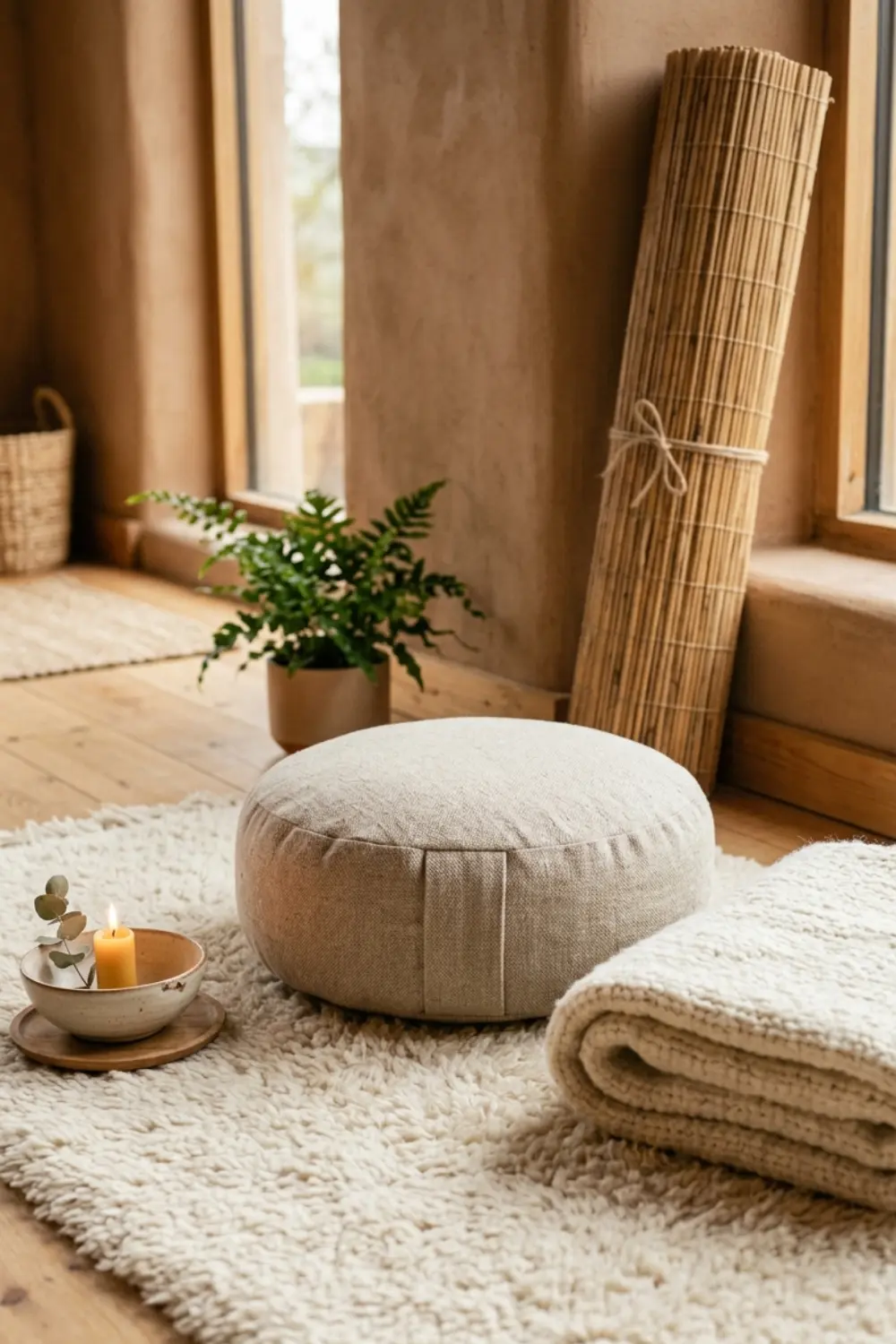
Sitting on the floor is an ancient practice – it’s natural in yoga, meditation, and many cultures. And it’s not just a cultural habit – it also has physiological benefits. Sitting on the floor stabilizes the body, grounds it, strengthens joints, and activates the core muscles. And there’s something humble about it – you’re not dominating the space, you’re part of it.
The option of sitting on the floor is essential in a wellness room. You don’t have to sit there every day, but it should be an option. You need something comfortable, supportive to sit on – not just a hard floor that hurts after a few minutes.
A meditation cushion elevates your hips, so you can sit cross-legged more comfortably without hurting your knees. The height allows you to keep your spine straight, which is essential for proper breathing and sitting for long periods of time.
Or a Japanese-style meditation bench – this is for kneeling if crossing is difficult. Or a thick, soft mat or wool blanket on the floor where you can practice lying down.
I have a round, gray meditation cushion and a wool blanket folded next to it. When I meditate, I sit on the cushion. When I do yoga, I lie on the mat. When I just want to relax, I lie on the blanket on the floor and watch the ceiling. All on the floor – grounded, stable.
If you are unable to sit on the floor at all (knee, hip problems), then have a low chair or bench, but try to be as close to the ground as possible. The point is not to be in a high, supported position like in an office chair – but lower, simpler, closer to the ground.
Sitting on the floor can be uncomfortable at first if you are not used to it. But with a few weeks of regular practice, your body will adapt, and then this will become a natural, comfortable position. And when you achieve this, you will realize: it is closer to your ancient, relaxed body state than the modern, hunched position in a chair.
If you want to delve deeper into developing good posture and the basics of yoga that support your wellness practice, check out my article [10 Best Yoga Poses for Better Posture at Home], where I go through exactly the most effective poses.
9. Use Sound Intentionally for Silence or Soothing Background
 Save it
Sound is one of the most underrated elements in a wellness space. Many people think silence is the only right answer – but in fact, conscious sound can be just as valuable, depending on what you’re trying to achieve. There are times when you want complete silence. In that case, no music, no background noise – just your own breathing, your own thoughts, the little creaks of the house. This kind of silence can be difficult at first because it’s unfamiliar – we live in some kind of background noise all the time. But once you get used to it, it’s incredibly powerful. Because silence gives space to inner voices and teaches the mind that it’s okay to do nothing.
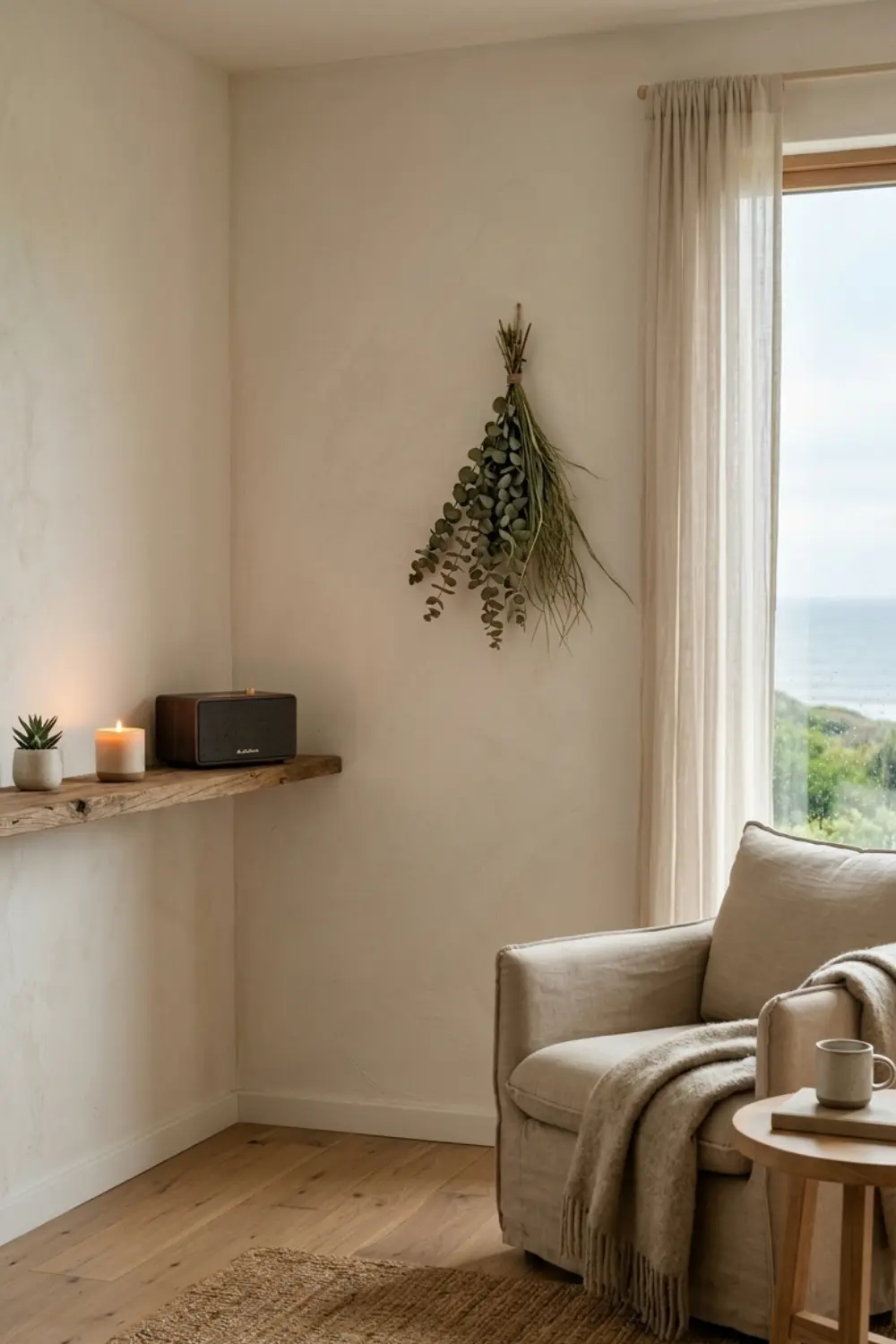
But there are times when you need some soft, unstructured background sound – especially when you’re meditating, stretching or relaxing. In these cases, don’t choose music that captivates you with melody, rhythm or lyrics. Instead, choose natural sounds – rain, ocean, forest, stream. These don’t demand attention, they don’t take your mind away – they just provide a subtle backdrop.
I have a small Bluetooth speaker that has pre-loaded nature sounds – usually ocean waves. But I don’t always use it. Sometimes I meditate in silence, sometimes with the waves. It depends on how much I can concentrate that day, how noisy it is in the house. The point is: I control the sound, it’s not random. Avoid lyrical music – even if it’s soothing. Lyrics activate the language part of the brain, and then you can’t completely let go. If you want music, go for instrumental ambient – something that has no structure, just flows.
If your house is very noisy – street traffic, neighbors, family members – then soundproofing or noise-canceling can help. But if possible, choose a quieter time or place, because artificial noise filtering is never as effective as real silence.
And one more important thing: the wellness room should not be echoey. If the sound bounces off the walls, it’s distracting. Carpet, curtains, textiles – they absorb sound and soften the space. A completely empty, hard-surfaced room is acoustically unpleasant, even if it looks visually minimalist.
10. Build in Storage to Keep the Space Clutter-Free
 Save it
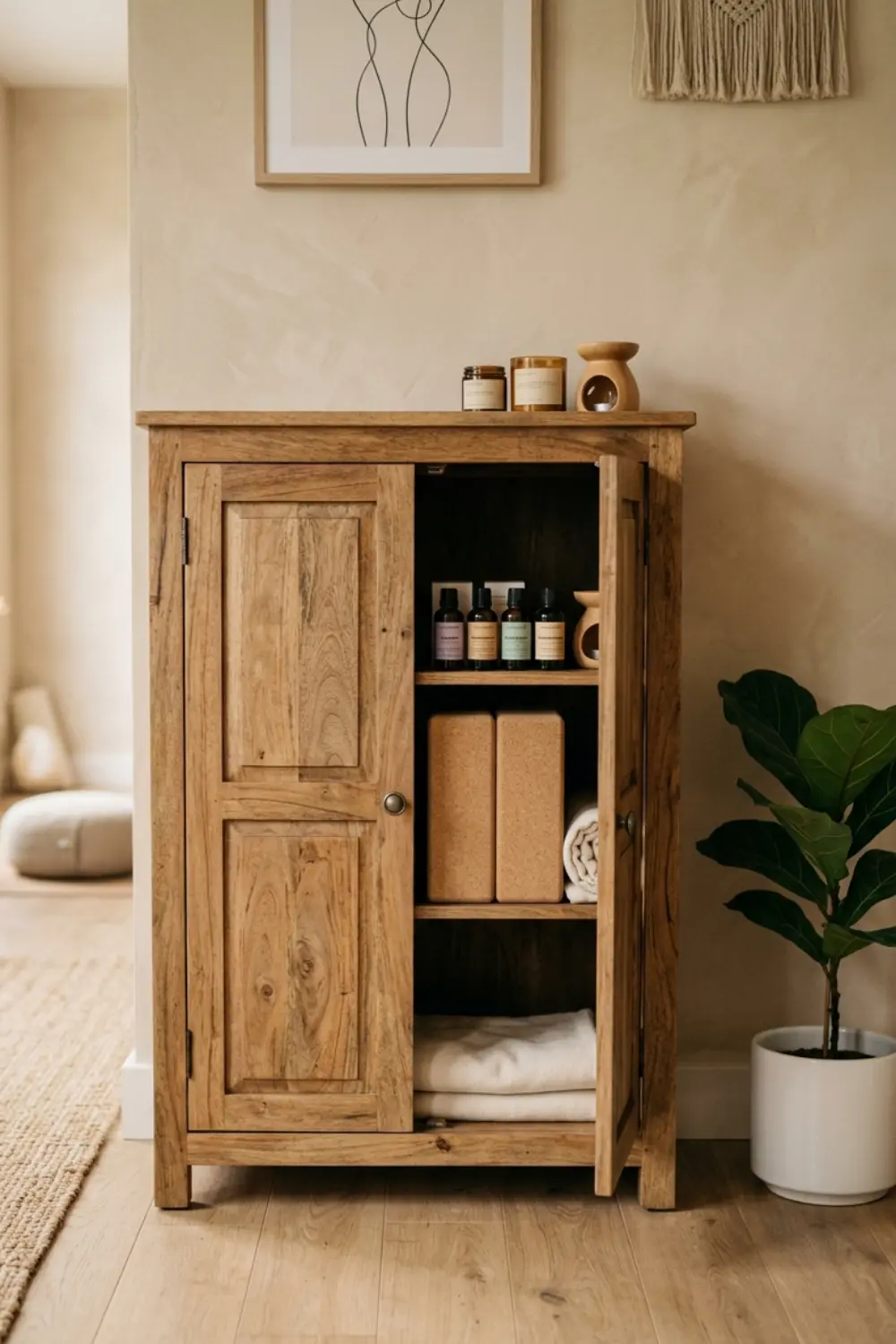
Visual clutter is stressful. When you have a lot of things visible in a space – books, pillows, candles, tools, clothes – your brain is constantly processing, categorizing, evaluating them. And that’s noise. Even if you don’t consciously know it, your mind is working in the background, and it’s preventing you from relaxing. That’s why your wellness room should be tidy and clean. But that doesn’t mean you have nothing – it means that what you’re not using right now is out of sight.
Build in storage: shelves with closed doors, drawers, baskets, boxes. This is where your unused yoga strap, extra blanket, various candles, notebook, pens go – everything that’s in the space but isn’t always needed. I have a small wooden cabinet, with shelves inside. I store my yoga blocks, extra pillows, candles, essential oils, notebook there. When I’m not using them, they’re out of sight. When I need something, I open it, take it out, use it, put it back. The space always stays clean.
If you don’t have room for a closet, use pretty baskets – they can be decorative, but they hide the contents. Or a small shelving system covered with a curtain. The point is: keep visual clutter to a minimum.
And what’s visible should be intentional. A candle on the table – that’s okay because it’s part of the ritual. A plant in the corner – that’s okay because it gives life to the space. But ten random objects scattered around – that’s noise. Maintaining order is also important. Go through it once a week, put away what’s hanging out, dust it off, tidy up the pillows. It’s not just cleanliness – it’s a ritual. You care about the space, and the space cares about you.
If you want to learn more about how to create a slow living approach throughout your home that supports the tranquility of your wellness space, read my article [10 Simple Ways to Create a Slow Living Home].
11. Personalize With Meaningful Objects, Not Decorative Clutter
 Save it
Personality is important – because a wellness room shouldn’t be a sterile, magazine-cover-like space that feels alien. But personality is not the same as decoration. It’s not about filling it with objects, it’s about putting in a few deeply meaningful things.
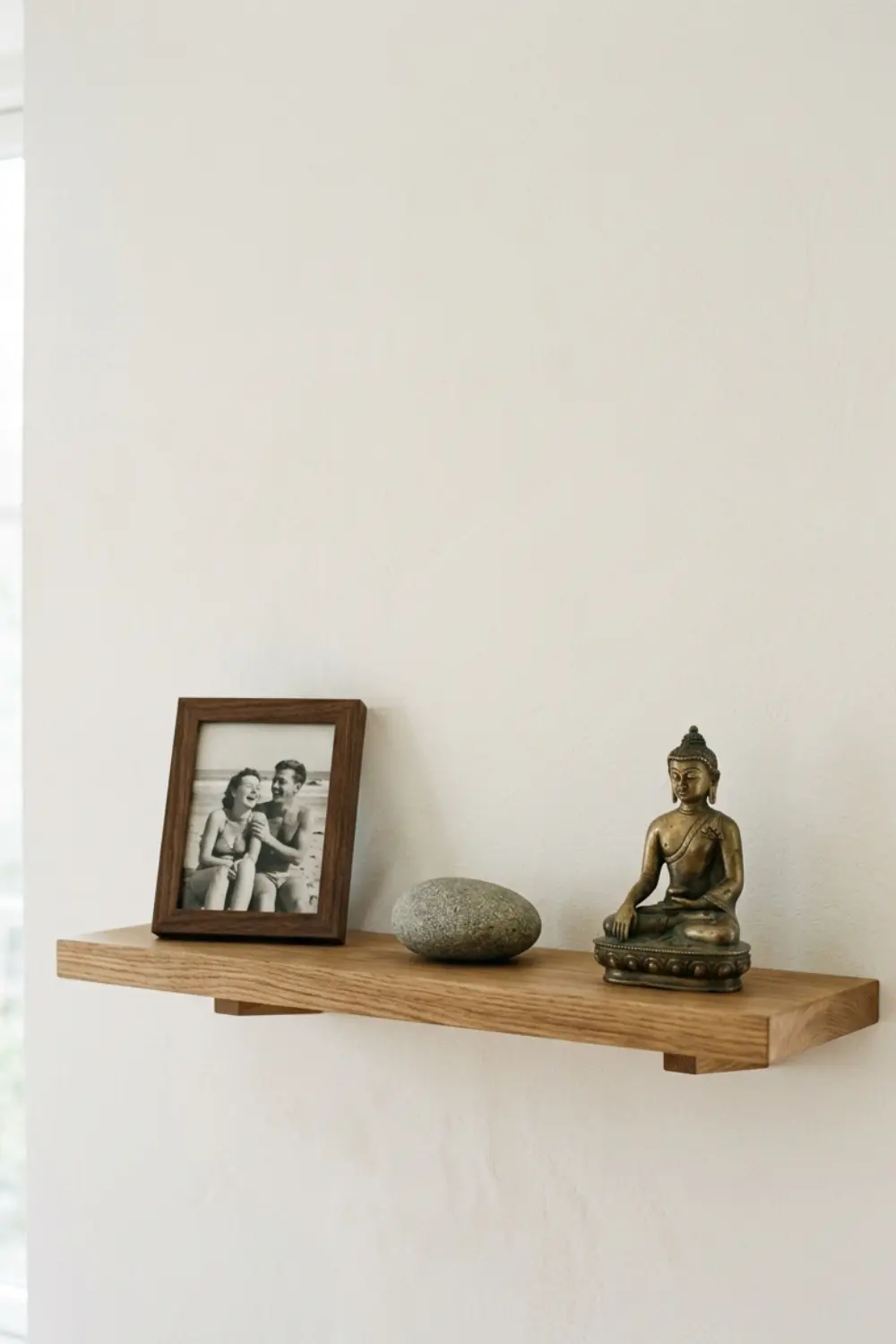
It could be a photo of someone important to you. It could be a rock you found in a special place. It could be a quote you wrote down and framed. It could be a small statue that symbolizes something valuable to you. It could be a book that changed your life. But don’t have too many. One or two of these items are enough. Because if there are too many, they lose their unique meaning – they become “just another thing on the shelf.”
I have a small Buddha statue that a friend brought me from Thailand. There’s a rock I found on a mountain where I first meditated in silence. And I have a notebook that I write in. That’s it. But each of these has a story, a weight, and when I look at them, they connect to something deeper.
Personal items should not be random. Something should not be there just because it “has to be put somewhere”. Everything that is visible in the wellness room is intentional – either functional (candle, pillow, blanket) or meaningful (photo, statue, stone).
And from time to time it is worth reviewing: is this still important to me? Or is it just there out of habit? If it has lost its significance, take it out. The space should be alive, changing, as you change.
Helpful Tips: Small Space vs. Dedicated Room Solutions
Not everyone has the opportunity to dedicate an entire room to wellness. But even in a small apartment or a crowded house, you can create a wellness zone – you just have to think about it differently.
If you don’t have a separate room, choose a corner in your bedroom or living room and decide: this corner is for wellness only. Use a screen, curtain or shelf as a physical separation – this will signal to your body that when you are in this area, there are different rules.
If even a corner is a luxury, then use a portable wellness kit: a roll-up yoga mat, a small bag with a meditation cushion, candles, essential oils. When you have wellness time, you unfold these in a quiet place – it could be a corner of the bedroom, it could be the living room, it could be the bathroom – and when you are done, you collect them. The objects themselves indicate the ritual.
If you are a renter and cannot change much in the space, use removable solutions: curtains, rugs, portable lamps, wall stickers, which are easy to remove. These also create atmosphere, but do not require drilling, painting, or construction.
The advantage of a small space: intimate, welcoming, easier to heat, easier to keep clean. The advantage of a large space: more room to move, more zones, more air. Both can work if you use them consciously.
One more tip that many people forget: if your wellness room or zone is in the bedroom, it is important that the bed and the wellness area are visually separated. Because the bed means rest, but also the associations of “I haven’t woken up yet” or “I’ve already gone to bed, but I’m not sleeping.” The wellness space, on the other hand, is active rest – conscious presence. If these two are mixed up, neither of them works clearly.
Now that you’ve built your wellness room, let’s move on to the common mistakes that most people make that undermine the effectiveness of the space.
Common Mistakes to Avoid
1. trying to cram too many functions into a space
You think: yoga, meditation, reading, journaling, art, work, relaxation – everything. But when a space tries to serve too many things, it doesn’t give any clear space for anything. The brain doesn’t know what the rule is here: am I working or resting? Am I active or passive?
2. Choose the 2-3 main activities that you intend the wellness room for
For example, meditation, yoga, reading – and support them. Move the rest somewhere else. If there is work, it shouldn’t be in the wellness room. If it’s watching TV, it shouldn’t be either. These bring a different energy and confuse the identity of the space.
3. Overdecorate
You think that the more candles, plants, pillows, rugs, pictures there are, the more “wellness” it will be. But in reality, excess creates visual noise and, instead of calming you, makes you stressed. Wellness is not about abundance, it’s about quality. A few, well-chosen elements that give you room to breathe.
4. Some people leave too much technology in their space
Phones, tablets, smartwatches, smart speakers. And they say, “But I use these to time my time, listen to music, measure my heart rate.” But each one is a small link to the digital world, and when they’re inside, the brain can never completely disconnect. Look for analog solutions and maintain a technology-free lifestyle.
5. Many people also make the mistake of not keeping their space clean
They let dust, candle wax, clothes, random objects accumulate. And when you walk in, you don’t feel calm, but a task: “I should clean this.” Maintaining your wellness room is part of the routine – a few minutes a week to make sure everything is in order.
Frequently Asked Questions
How much space do you need for a wellness room?
There is no minimum size. It can be a whole room, it can be a 2×2 meter corner. What matters is a dedicated, clean space where you can comfortably sit, stretch, and breathe. Even a small closet can work if it is organized and bright. The point is not the size, but the intention.
How much does it cost to create a wellness room?
It depends on how much you want to invest. You can create one for almost free – a mattress, a pillow, a candle, and it will work. Or you can spend more on quality furniture, lighting, a sound system. But basically: you can start minimally and gradually build up as you better understand what you need.
Do you need natural light in the wellness room?
Ideal, but not essential. Natural light helps during the day, but it should be controllable (curtains). You can also create a calming atmosphere with artificial lighting if you use layered, warm-toned lights. The main thing: the light should not be harsh, cold or too bright.
What is the difference between a wellness room and a regular room?
The intention. A regular room has multiple functions. A wellness room serves one purpose: restoration, tranquility, presence. Everything in it – the color, the light, the furniture, the scent – supports this. And when you enter, your body knows: here are different rules, I come here to relax.
Final Thoughts
A wellness room is not a luxury, it is not selfishness, it is not a “nice to have”. It is a basic need in a world where your nervous system is constantly bombarded with stimuli, demands, expectations. You need a place where you can switch it off. Where you don’t have to perform, you don’t have to comply, you don’t have to react. Where you can simply exist, breathe, recover.
It doesn’t have to be perfect from day one. Build something simple – a corner, a pillow, a candle. Use it. Notice what works, what doesn’t. Change it. A wellness room is a living space, just like you are alive, changing, learning. What you put together today may be different in six months, because you will be different too.
The most important thing: use it. Don’t just admire it, don’t just plan it, don’t just talk about it. Go in. Sit down. Breathe. Even if it’s just five minutes – those five minutes are worth it. Because when you regularly retreat to this space, something changes. Not dramatically, not immediately, but gradually. Stress becomes more manageable. Sleep becomes deeper. Your patience becomes longer. Your life becomes… more livable.
You deserve this space too. Not tomorrow, not when you “have time”, not when “everything will be fine”. Now. Because you live now, you need it now, and you can start now. Even tonight. A corner, a pillow, a deep breath. And it has begun.
This post contains affiliate links. I may earn a small commission at no extra cost to you.
Get cozy inspiration delivered to your inbox.
✓ 14-page beautifully designed ebook
✓ Cozy decorating ideas
✓ Practical room-by-room inspiration
You’re in! 🎉
Thanks for joining the NestFlowHome community!
Your free ebook is already on its way to your inbox. If you don’t see it within a few minutes, please check your Promotions or Spam folder.
Join the NestFlowHome community for weekly decorating inspiration.

Timeless home decor ideas and slow living inspiration for a calm, beautiful life.