
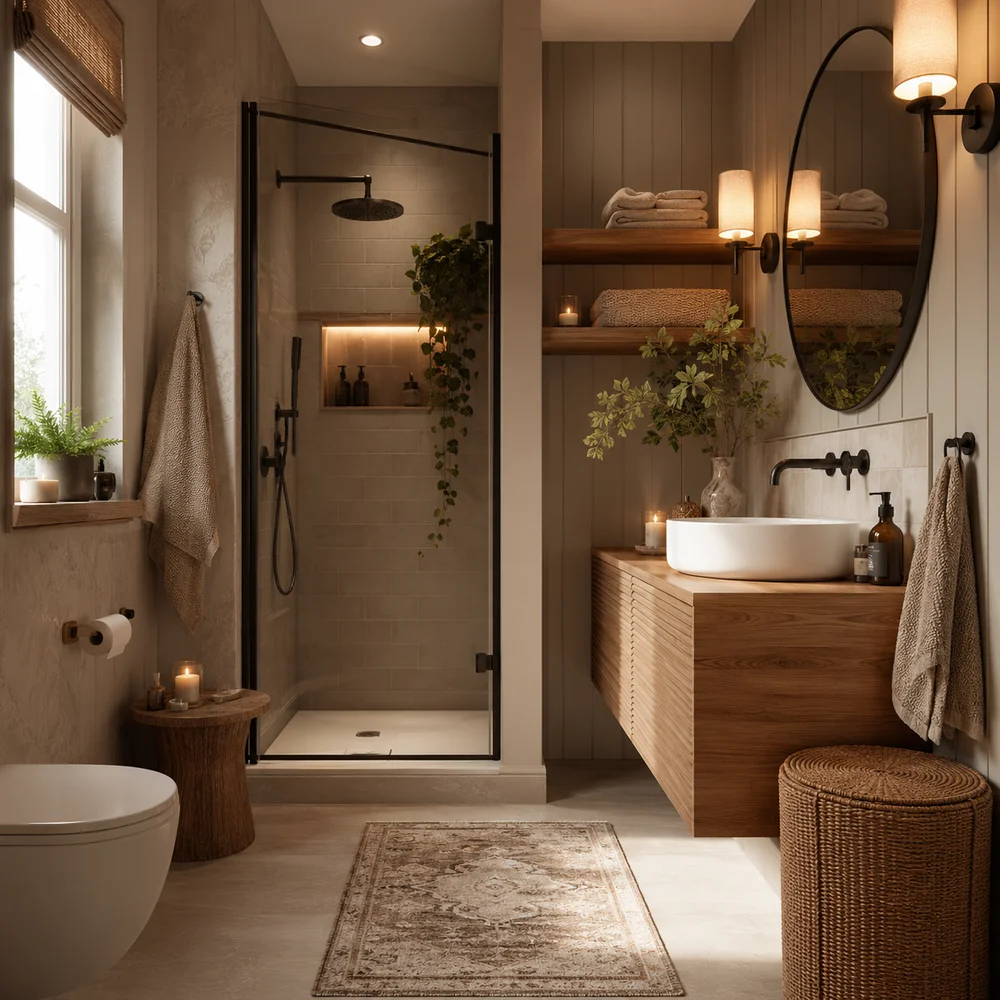
Everything You Need to Organize a Small Bathroom Without Renovating
By Emily | June 8, 2026
There’s a particular kind of frustration that comes from a small bathroom. Not the frustration of bad design—but the slow, daily accumulation of things that have nowhere to go. The products lined up along the edge of the sink. The towels folded too tightly because there isn’t enough bar space. The cabinet under the sink that’s technically storage, but opening it feels like a minor excavation project.
Here’s what most people get wrong: they think the problem is space. It isn’t. The problem is organization—and organization, done well, is a design discipline in itself.
A small bathroom doesn’t need new tiles or a gut renovation to feel calm, considered, and genuinely pleasant to use. It needs thoughtful decisions about where things live, how surfaces are treated, and which objects earn the right to be visible. The difference between a cramped bathroom and a serene one is rarely square footage. It’s intentionality.
This article is for anyone who has stood in their bathroom on a Sunday morning and thought: there has to be a better way. There is. And none of it requires a contractor, a permit, or even a weekend of serious labor. What it requires is a clear eye, a willingness to let go of what isn’t working, and the understanding that small spaces reward precision above everything else.
Every idea here works within the constraints of a rental, a modest footprint, and a real-world budget. The goal isn’t a magazine-perfect bathroom that no one actually uses—it’s a bathroom that works beautifully, feels calm every morning, and quietly reflects the life you want to live in it.
1. Start With a Full Declutter — Not an Organizer
 Save it
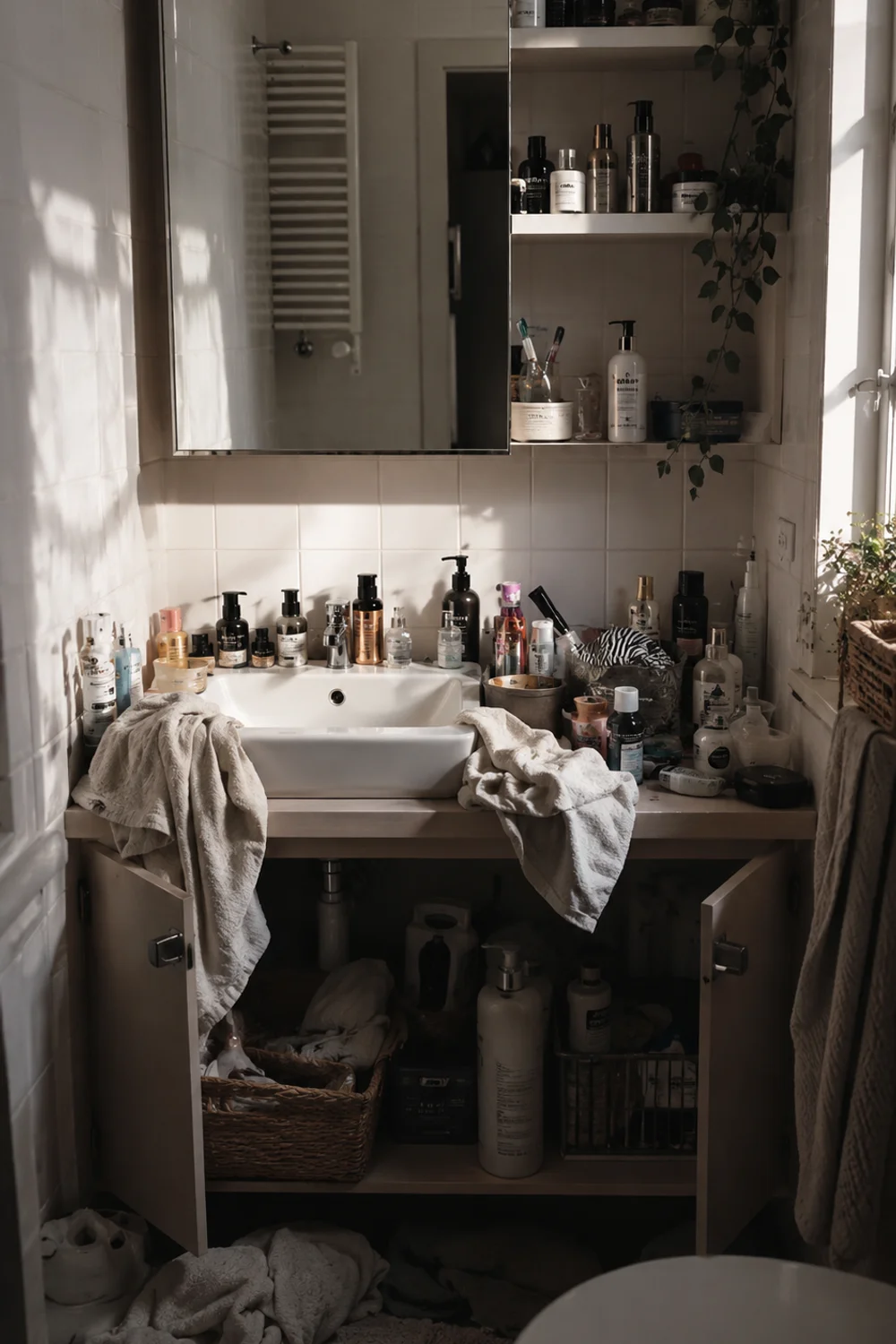
Before a single basket or shelf gets purchased, the bathroom needs an honest audit. This step gets skipped constantly, and it’s the reason most bathroom organization attempts fail within three weeks. People buy beautiful storage solutions, fill them with the same things they had before, and wonder why nothing feels different.
Pull everything out. Every product, every half-used bottle, every sample sachet from a hotel two years ago. Lay it all on the floor or the bed, and look at it clearly. What gets used every single day? What gets used occasionally, but genuinely? What is there purely out of habit, guilt, or inertia?
Most people are shocked by what they find. Duplicate products. Expired medications. Four different hand lotions, none of which are the right one. A hairdryer that works, but only just. Three types of face wash, with real loyalty going to exactly one of them.
The declutter isn’t just practical—it’s the foundation of the entire system. Every organization solution performs better with less inside it. A beautifully organized shelf with twelve products on it still reads as cluttered in a small bathroom. The same shelf with four considered objects reads as calm.
After decluttering, resist the immediate impulse to replace what was removed. Live with less for a week. Notice what you actually reach for. Notice what you walk past. That behavioral data—your own, real, daily habits—is far more valuable than any organizing framework you could follow online.
One useful principle for small bathrooms: every item on a visible surface should pass a simple test. Does it function daily, or does it add genuine visual calm? If it does neither, it lives inside a cabinet or leaves entirely. This single rule, applied consistently, transforms a bathroom faster than any product could.
2. Use Vertical Space Like a Designer Would
 Save it
The floor plan of a small bathroom is fixed. The vertical dimension, almost always, is not. Yet most people organize their bathrooms as though the walls end at shoulder height—leaving the space between eye level and ceiling entirely unused, and using precious floor space for things that could easily live higher up.
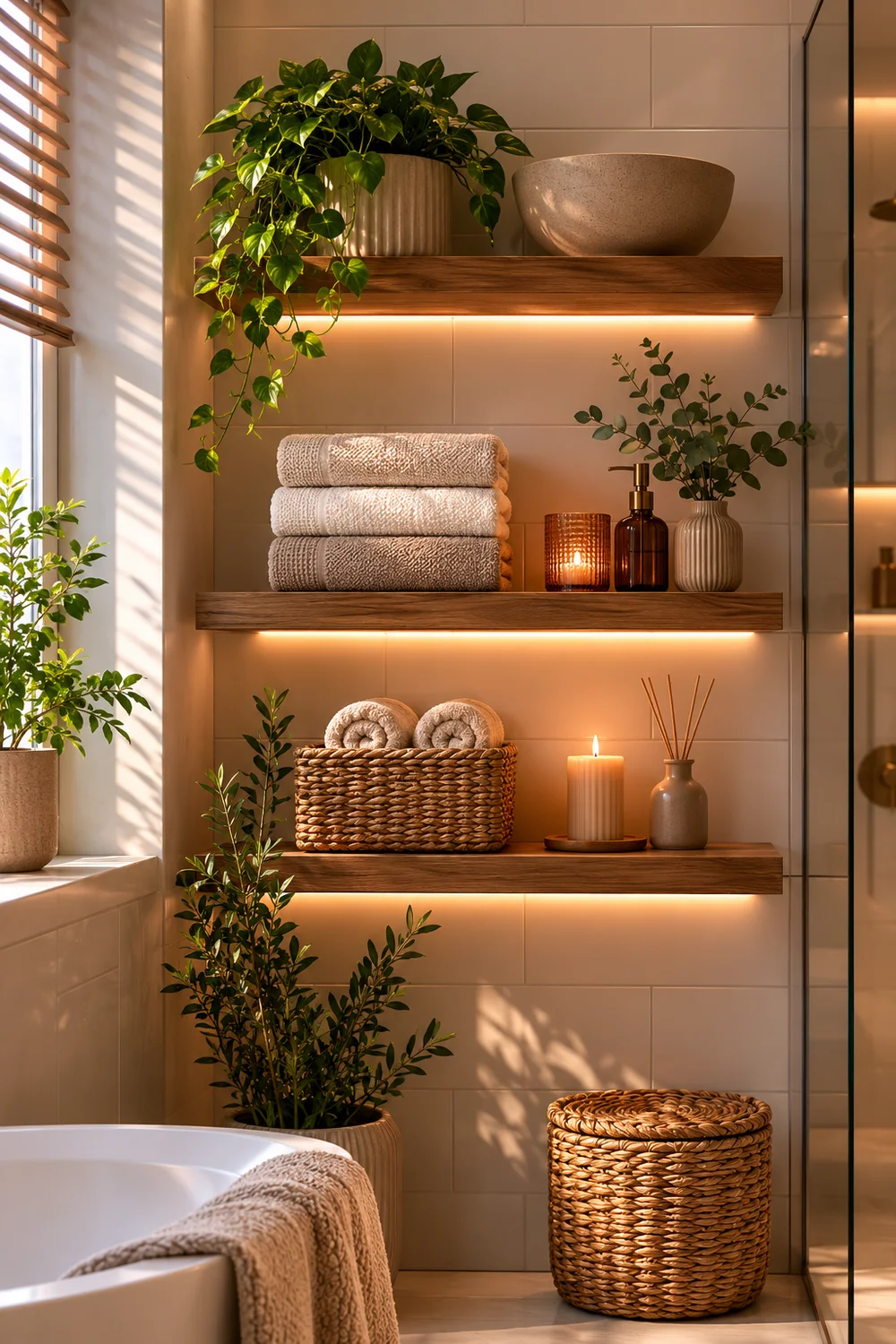
Floating shelves are the most immediate vertical solution, and the most rewarding. A single well-placed shelf at eye level—or slightly above the toilet, which is one of the most consistently wasted wall areas in any bathroom—can hold the objects that used to crowd the vanity. A small plant, a spare candle, a folded washcloth, a glass vessel with cotton rounds. Not storage in the utilitarian sense, but curated surface management with genuine visual payoff.
The key to floating shelves in a small bathroom is restraint. One shelf with four things on it reads as intentional and calm. Two shelves crowded with products reads as overflow. If shelves are going in, plan the exact items they’ll hold before drilling a single hole. The shelf is not a landing pad for whatever needs a home—it’s a designed surface with a predetermined inventory.
Above-door storage is another vertical zone that gets overlooked. A simple over-door caddy with a considered finish—matte black wire, brushed brass, or white powder coat—can hold the products that are used less frequently but still need to be accessible. Backup supplies, spare toiletries, the hair mask used twice a week rather than daily.
Tall, narrow ladder shelves are worth considering if there’s a spare corner. They occupy a very small floor footprint but deliver significant storage across multiple tiers. Styled well—alternating functional items with a small plant or a folded linen towel—they read more like furniture than storage.
The mental shift that makes vertical organization work is simple: stop thinking about bathroom storage as cabinet-and-counter management, and start thinking about the walls themselves as functional surfaces. In a small bathroom, the walls are the most underutilized asset in the room.
3. Make the Vanity Area Work Harder
 Save it
The vanity is the heart of the bathroom. It’s where the morning routine happens, where the day begins and ends, and where visual chaos accumulates faster than anywhere else. A vanity that works well doesn’t just have enough storage—it has the right storage, organized in a way that mirrors how the space is actually used.
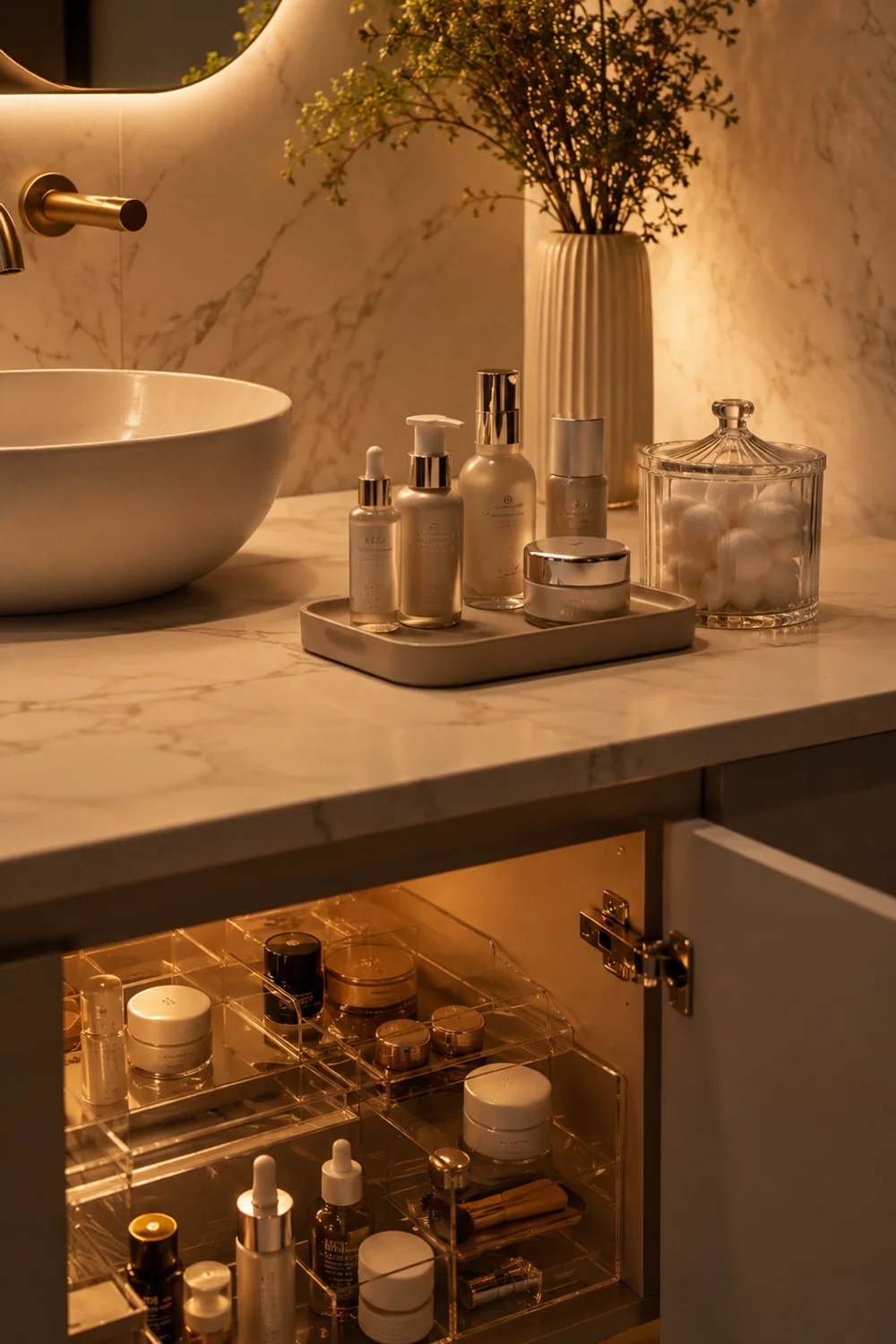
Start under the sink. This is almost universally chaotic in small bathrooms, not because there isn’t enough room, but because nothing inside it has a defined position. Products get pushed to the back, things get lost, and the entire space becomes a place to shove things rather than store them. A two-tier sliding organizer—or even a simple set of clear bins grouped by category—transforms the under-sink cabinet into genuinely usable space.
On the vanity surface itself, the goal is zero visual clutter with full functional access. The products used every single day can live in a small tray, grouped together so they read as intentional rather than scattered. A tray is a powerful organizational tool in this sense—it creates a visual boundary that contains the products within it and signals that the rest of the surface is clear.
The objects that don’t belong on the vanity surface are easy to identify: anything used less than daily should live inside a drawer or cabinet. The four products on the tray don’t compete with the rest of the room for visual attention. They simply exist, quietly, as part of a considered surface.
Drawer organizers are one of the most underrated bathroom investments. Even a basic set of adjustable drawer dividers—used thoughtfully—transforms a drawer from a jumble into a system. Each category of product has its own lane. Nothing migrates. The morning routine gets faster and calmer simultaneously.
If the vanity has no drawers—a common reality in older or rental bathrooms—a small rolling cart beside or below the vanity fills the gap without requiring any installation. Styled correctly, a slim rolling cart in white or matte black reads as furniture rather than improvised storage. If you’re thinking about how organization and decor can work together rather than against each other, [Simple Small Bathroom Decor Ideas for a Clutter-Free Look] is a useful companion for keeping surfaces both functional and visually coherent.
4. Rethink Towel Storage Beyond the Bar
 Save it
Towels take up more visual space in a bathroom than almost any other element—and in a small bathroom, how they’re stored dramatically affects whether the room reads as calm or chaotic. The standard single towel bar works, but it rarely works beautifully, and it almost never solves the full towel storage problem in a household of more than one person.
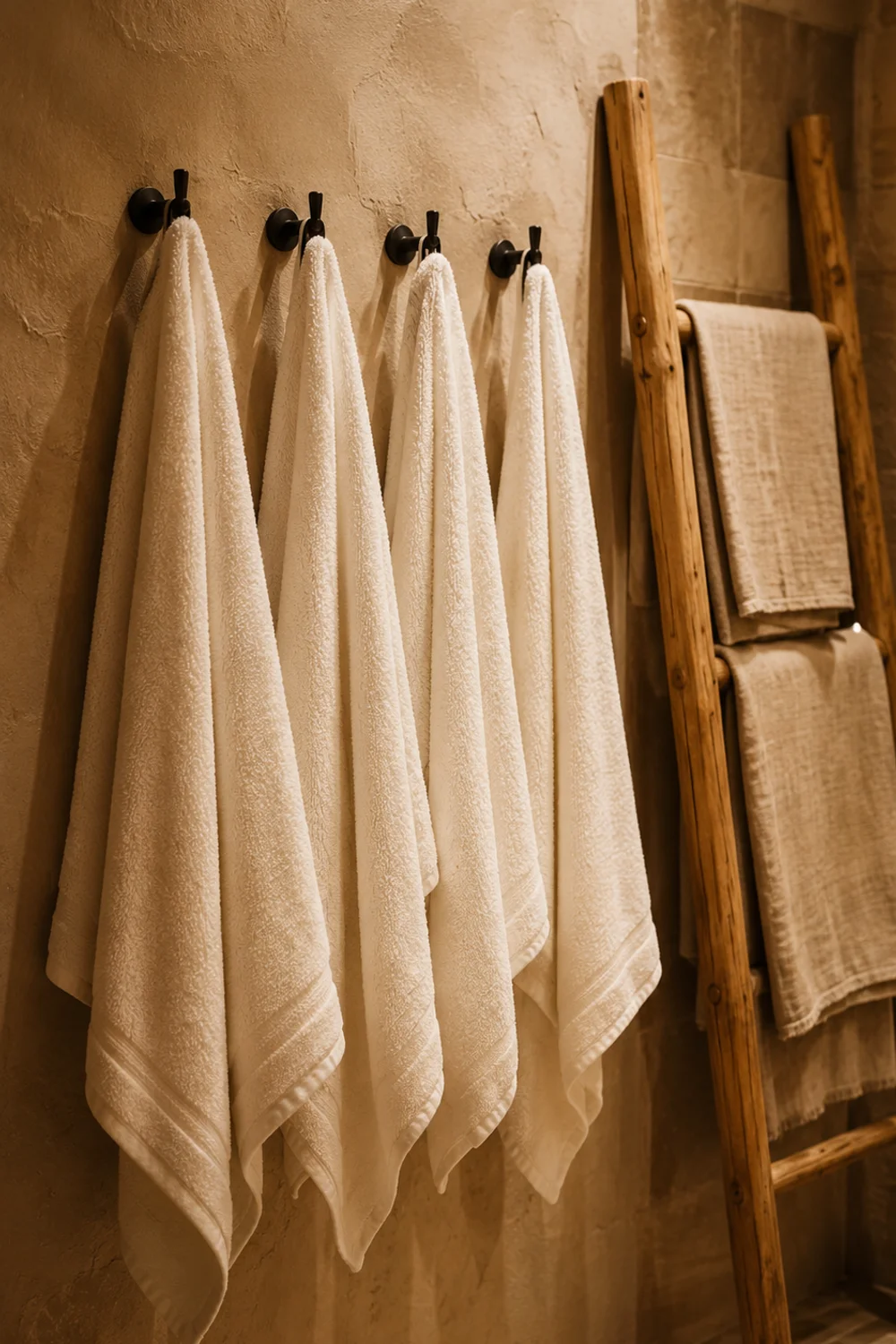
The first upgrade worth making is a set of oversized hooks rather than a bar. Hooks hold towels in a looser, more generous fold that actually dries them better than the tightly compressed arrangement a bar tends to create. A row of three or four matte black or brushed brass hooks along one wall—installed at staggered heights if space is tight—can hold bath towels, hand towels, and robes without any of them competing for the same narrow bar.
If wall space is limited, a freestanding towel ladder is one of the most quietly effective solutions in a small bathroom. It occupies a small footprint—typically no more than 12 to 14 inches deep—but delivers substantial storage across multiple rungs. Leaned against a wall beside the vanity or the shower, it functions as both storage and a styling moment. A wooden towel ladder with a warm natural finish softens a bathroom that’s otherwise hard and tile-heavy.
Rolled towels in a basket or a small wooden crate on the floor offer a different kind of storage logic—one that works especially well if the bathroom is bathroom-as-destination rather than purely functional. The rolled towel basket reads as spa-adjacent, and in a small bathroom where every surface choice carries visual weight, that small shift in presentation matters more than it might seem.
The material of the towels themselves is worth a thought. A set of waffle-weave linen towels—slightly thinner, faster drying, and more visually refined than standard terry cloth—take up less space on any hook or bar while still feeling genuinely luxurious in use.
The broader principle: towel storage should be designed as part of the room’s visual composition, not as an afterthought. In a small bathroom, every visible element contributes to the overall feel of the space. Towels, hung or rolled or folded, are always visible—which means they’re always decorating.
5. The Power of a Mirror With Storage Built In
 Save it
A bathroom mirror is one of the few elements that can carry both aesthetic weight and genuine organizational function simultaneously—without adding any visual bulk to the room. In a small bathroom, where every square inch matters, this combination is worth taking seriously.
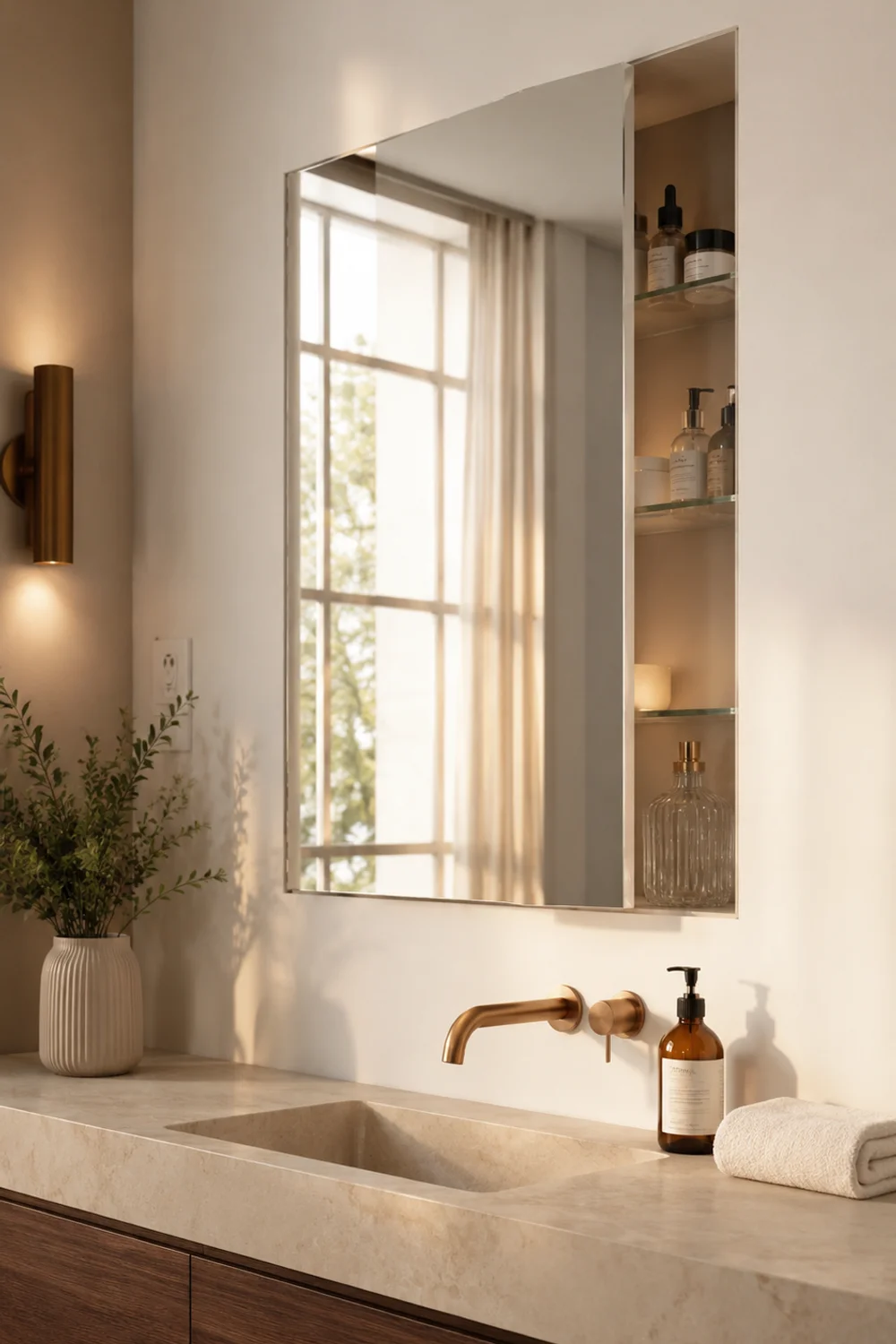
The medicine cabinet mirror is the most straightforward example. Modern versions have come a long way from the plastic-framed, fluorescent-lit cabinets of older apartments. A surface-mounted medicine cabinet with a frameless or thin matte-frame finish sits flush against the wall, opens quietly, and holds an entire category of products that would otherwise live on the vanity: medications, skincare treatments, spare contact lenses, the small products used occasionally rather than daily.
The genius of this solution is what it removes from sight. The products inside the cabinet are invisible when the door is closed. The mirror surface—clean, uninterrupted, properly sized for the vanity—does its reflective work without the visual interference of surrounding clutter. Two functions, one object, zero additional footprint.
If a medicine cabinet isn’t workable—either because of wall depth, rental restrictions, or personal preference—a mirror with built-in side shelving achieves a similar result. These mirrors extend slightly from the wall and offer small open shelves along the sides, contained within the mirror’s overall frame. They hold the products used daily in a considered, accessible way without the vanity surface absorbing them.
There’s a spatial psychology worth understanding here too. Mirrors expand the perceived volume of a small bathroom by reflecting light and doubling the apparent depth of the room. A larger mirror—one that extends slightly beyond the width of the vanity—amplifies this effect. Combining that expanded reflective surface with hidden storage is one of the most efficient upgrades available in a small bathroom, and it requires no renovation whatsoever. For more on the relationship between mirrors, light, and perceived space, [How to Make a Small Apartment Bathroom Look Bigger with Minimalist Decor] covers several approaches that pair naturally with a storage-forward mirror upgrade.
6. Lighting Changes Everything — Even in a Small Space
 Save it
Light is the element most consistently overlooked in small bathroom organization, and this is a mistake with real consequences. The way a bathroom is lit determines how organized, how calm, and how spacious it feels—arguably more than the actual arrangement of objects inside it.
Most small bathrooms rely on a single overhead fixture, often a builder-grade recessed light or a basic flush-mount ceiling light. This kind of lighting creates overhead shadows, flattens the room visually, and makes even a well-organized bathroom feel clinical. It’s functional, but barely.
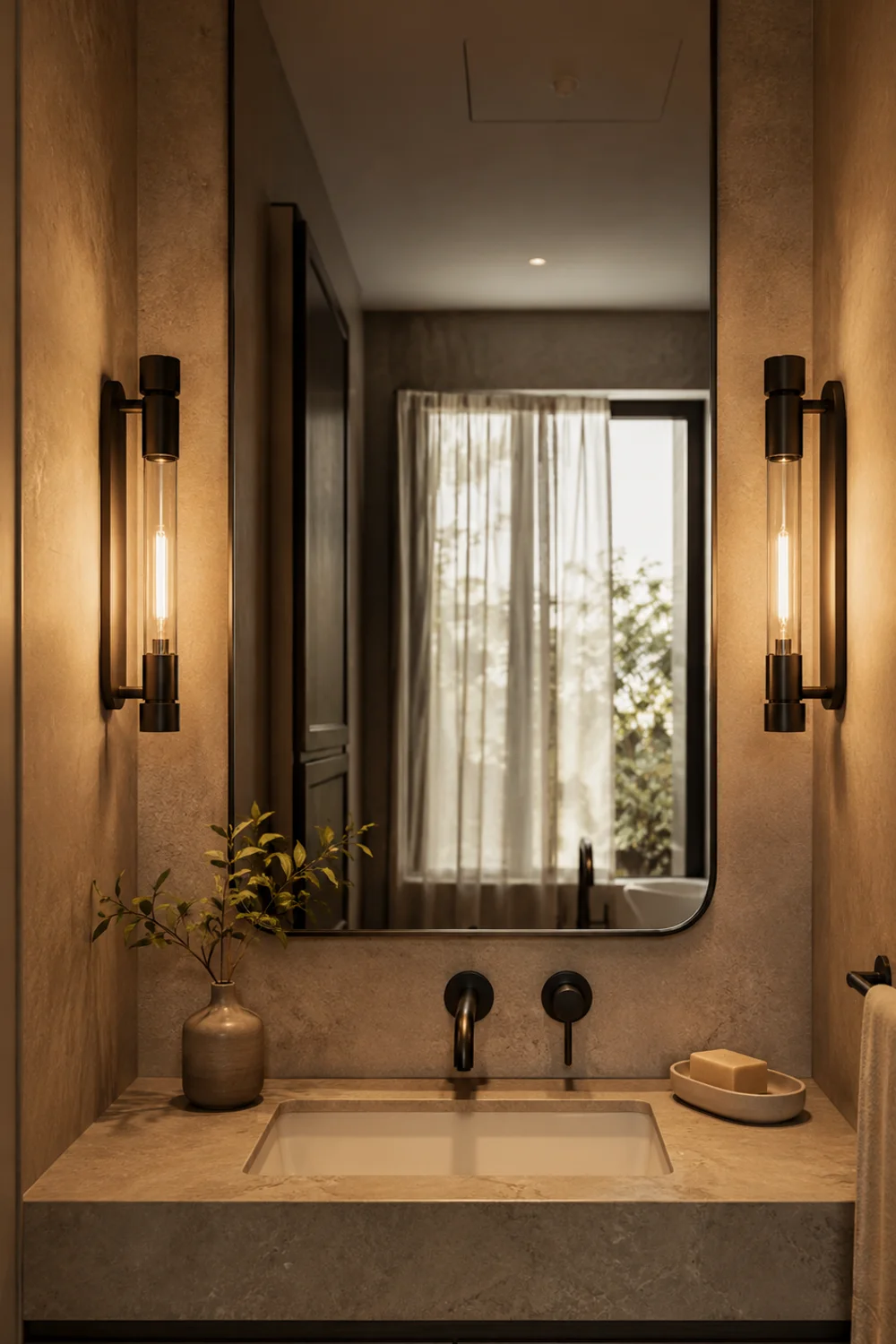
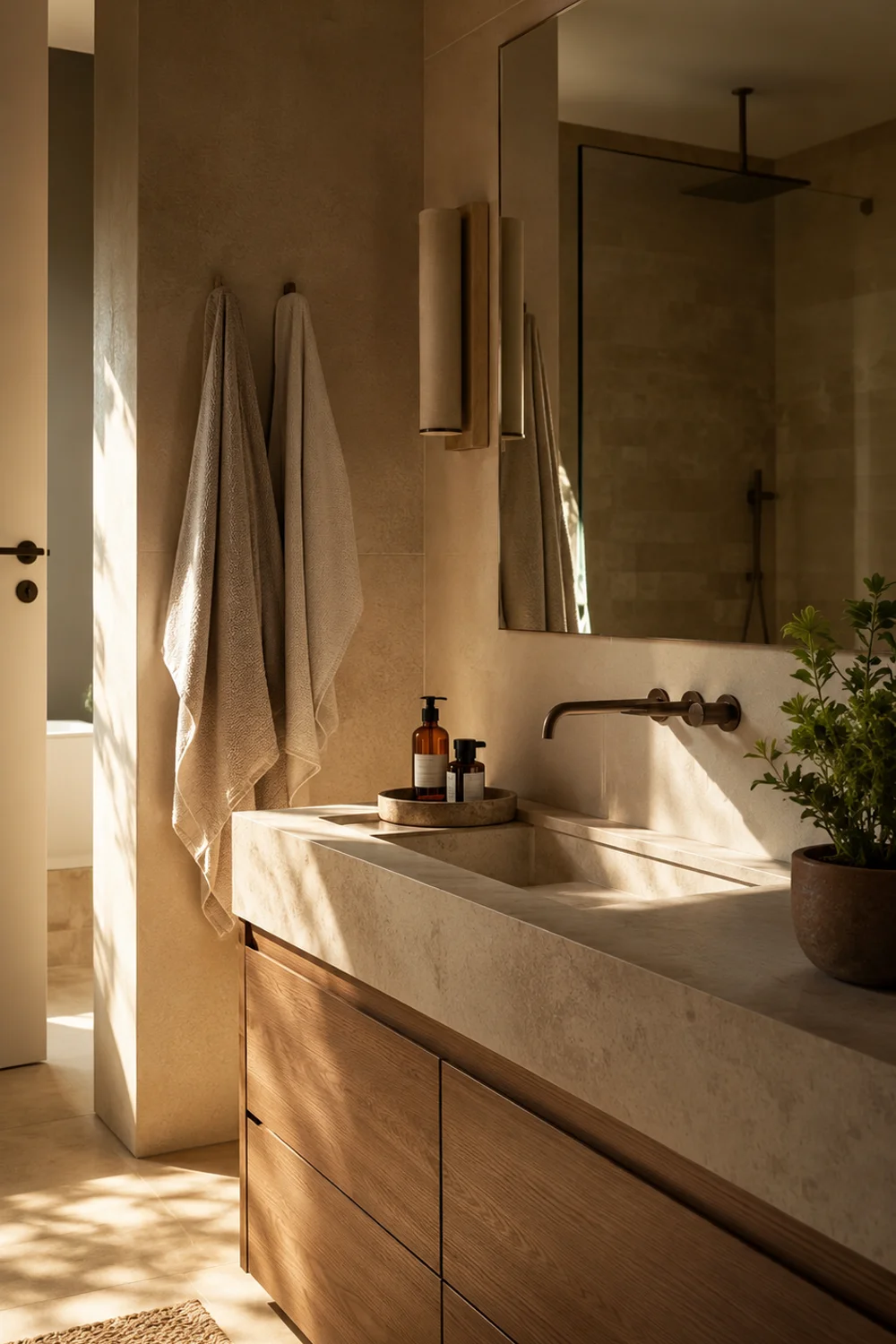
The most impactful lighting upgrade for a small bathroom without any renovation is a pair of wall sconces flanking the mirror. Side lighting—positioned at face height, one on each side of the vanity mirror—eliminates shadows entirely, creates an even, flattering quality of light across the face, and adds a layer of visual warmth to the space. This is how hotel bathrooms are lit, and the reason they always feel more elevated than what most people have at home.
The color temperature of bulbs matters enormously in a small bathroom. A warm white bulb—in the 2700 to 3000 Kelvin range—creates the kind of glow that feels natural, flattering, and calm. Cool white bulbs above 4000 Kelvin create a starkness that is genuinely difficult to counteract with any amount of styling or organization.
For bathrooms where sconce installation isn’t possible, a backlit mirror with a built-in dimmer is the closest available alternative. The diffused glow around the mirror’s edge functions similarly to flanking sconces—it creates indirect, even light without relying on overhead sources alone.
Beyond the functional, lighting affects how organized a room reads. A well-lit bathroom with a cluttered counter looks better than a dark bathroom with a tidy counter. Light does organizational work by making the room feel intentional and alive—which is exactly the quality that small bathrooms, organized or not, tend to lack when the lighting hasn’t been considered.
7. Create a System for the Shower and Tub Zone
 Save it
The shower is where bathroom organization most visibly breaks down. The average shower contains too many products, none of which have fixed positions, arranged in whatever corner of the ledge they landed last. This isn’t a storage problem in the traditional sense—it’s a system problem. There’s no defined home for anything, so everything migrates constantly.
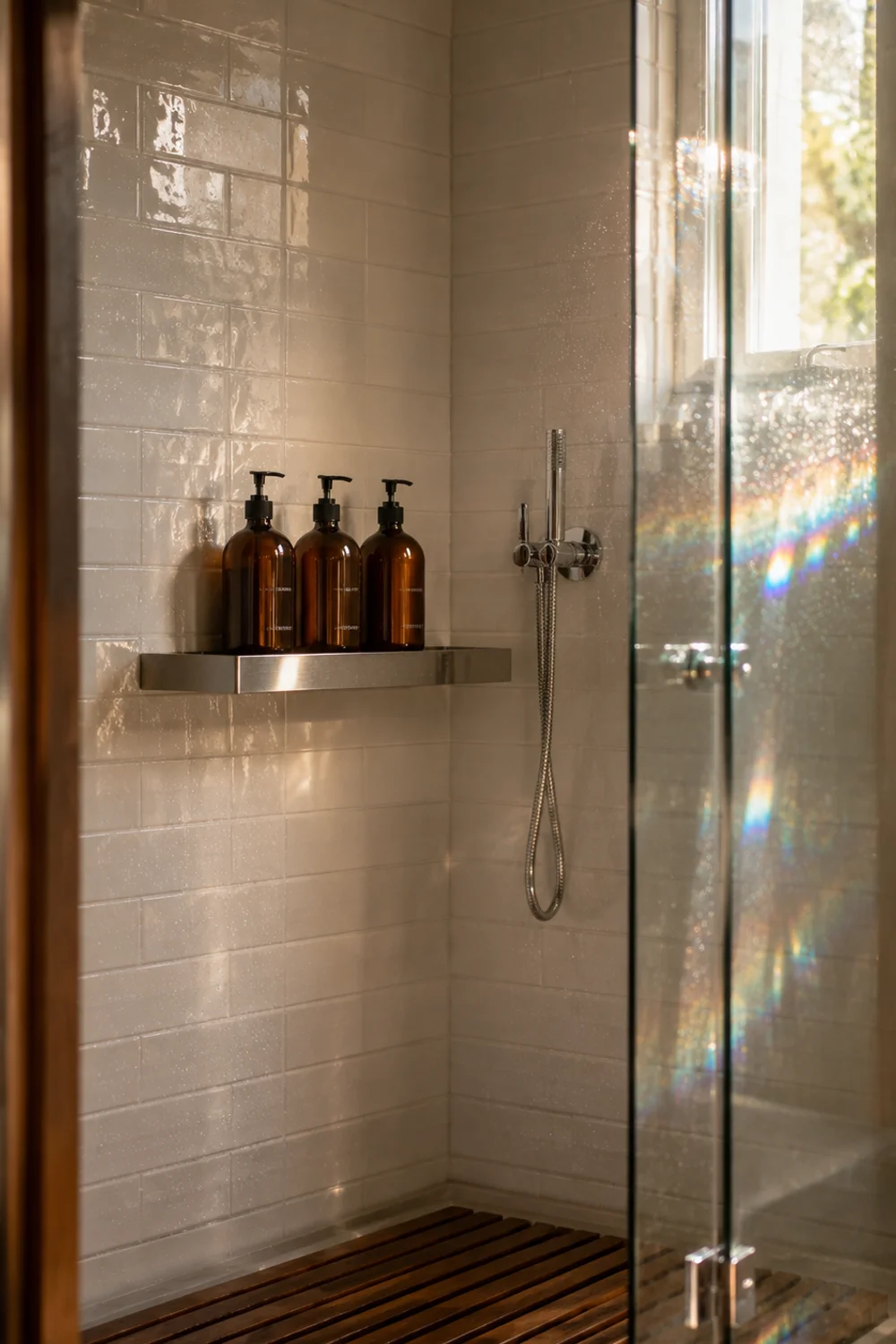
The most functional shower organization solution is a corner caddy with clear material assignments. Each tier holds one category: shampoo and conditioner on one level, body wash on another, razors and smaller accessories on a third. The assignment isn’t rigid, but it’s consistent—each product returns to the same spot after every use. This takes approximately two days to become habit, after which the shower essentially organizes itself.
Material matters here more than it might seem. Plastic caddies look cheap quickly, and they collect grime in corners that are difficult to clean. A stainless steel or brushed brass caddy—properly rust-treated—holds up in the humidity of a shower, ages well, and reads as considered rather than improvised.
The number of products in the shower is worth examining directly. Most people use fewer than half of what lives in there on any given morning. A once-monthly edit—removing anything that’s been sitting unused, consolidating duplicates, returning the occasional product to the medicine cabinet where it actually belongs—keeps the shower from accumulating the slow, organic clutter that tends to happen without any conscious decision.
If there’s a bathtub in the bathroom, the tub caddy is a similar opportunity. A good tub caddy—positioned across the width of the tub—holds a book, a candle, a single product, and a glass. It transforms the bath from a slightly awkward functional experience into a genuine moment of calm. For a sharper, more graphic approach to bathroom styling that complements a well-edited shower and tub zone, [13 Modern Black and White Bathroom Decor Ideas Right Now] offers a palette that keeps visual complexity deliberately low.
The shower zone also benefits from what isn’t there. A small squeegee hung on the shower wall keeps the glass clear and the tile dry, which means the shower reads as cleaner between actual cleaning sessions. In a small bathroom, that visual clarity—a gleaming shower rather than a water-spotted one—contributes more to the overall sense of organization than many purely functional solutions do.
8. Small Details That Read as Luxury
 Save it
There’s a category of bathroom organization that doesn’t quite fit the conventional storage conversation—because it’s less about where things go and more about how things feel when they’re where they belong. These are the small, considered details that transform a bathroom from organized to genuinely refined.
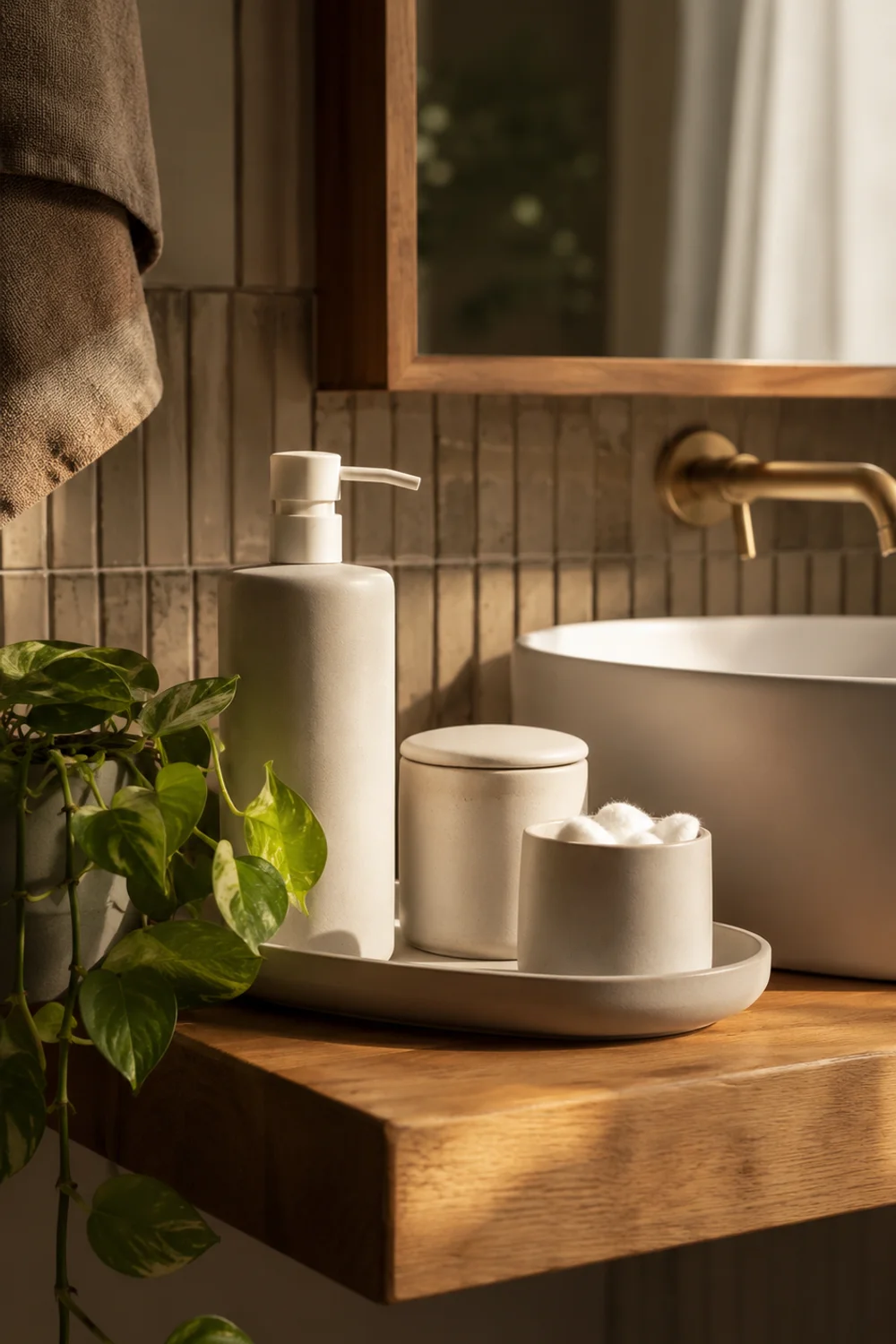
A matching set of dispensers on the vanity does something that individual product bottles cannot. When the hand soap, lotion, and cotton round container share the same material and finish—matte white ceramic, brushed brass, warm wood—the vanity reads as designed rather than assembled. The products inside can be whatever you actually use. The presentation is what changes.
A wooden or stone bath mat beside the shower introduces texture and warmth in a way that a standard fabric bath mat simply doesn’t. Beyond aesthetics, a wooden slat mat or a diatomite stone mat dries almost instantly—which means it never holds the slightly damp quality that fabric mats develop between uses. In a small bathroom where surfaces are always visible, this distinction matters.
A single plant—small enough to sit on a shelf or the edge of the vanity—adds the kind of life and color that no amount of organization alone provides. Pothos and ferns are ideal for bathrooms with limited natural light and high humidity. The plant doesn’t need to be large or particularly styled. It needs only to be alive, and in reasonable health, to shift the entire atmosphere of the room.
Scent belongs in this conversation too. A bathroom that smells considered—a single small reed diffuser, a candle with a clean botanical note, or nothing more than genuinely clean surfaces—creates an impression of quality that extends beyond what the eye registers. In a small bathroom, sensory completeness is the difference between a room that’s been organized and a room that’s been truly designed. If you find that this kind of layered thinking about small spaces appeals to you, [15 Small Bedroom Ideas for Better Storage and Smart Layouts] applies the same logic to a room where restraint and intentionality matter just as much.
9. Build a Maintenance Habit, Not Just a System
 Save it
The most beautifully organized bathroom in the world returns to chaos within three weeks if there’s no system for maintenance. This is the part of bathroom organization that almost no one talks about, because it’s less photogenic than floating shelves and less satisfying than a declutter—but it’s the piece that makes everything else last.
The principle is simple: the maintenance habit needs to be easier than the disorder. If putting something away requires opening a cabinet, navigating a system, finding the right container, and closing everything back up—it won’t happen consistently. The friction is too high. Instead, the right storage position for any object should be the path of least resistance. The place where things go should also be the easiest place to put them.
This is why the surface tray works so well for daily products. The tray has an open top, a defined boundary, and a fixed position on the vanity. Putting a product back onto the tray takes less effort than setting it down randomly on the counter. The system sustains itself because it’s easier to follow than to ignore.
A weekly five-minute reset—not a full clean, just a return of every object to its assigned position—maintains the system without requiring significant time or effort. Products that migrated get returned. Things that ran out get noted for replacement. The shower gets a quick edit. This kind of light-touch maintenance keeps the bathroom feeling organized without the cumulative effort of a full reorganization every month. The same habit translates naturally to other small spaces in the home — [12 Small Living Room Ideas for a Cozy Apartment] shows how the same discipline of regular, light upkeep creates lasting calm in a room that gets considerably more daily traffic.
The seasonal edit is equally important. Once every few months, revisit the original declutter with fresh eyes. Products accumulate. Gifts arrive. Samples find their way into the bathroom and stay there indefinitely. A periodic full clear-out ensures the system doesn’t quietly absorb more than it should, and it’s the best time to ask honestly: is what’s here still what I actually use?
The bathroom that stays organized isn’t the one with the best storage products. It’s the one whose system is simple enough to follow without thinking about it—and whose owner has built the small daily habits that keep it from drifting. Organization, at this level, becomes less about storage and more about intention. That shift, once made, is permanent.
Common Mistakes
1. Buying storage before decluttering
This is the most common and most costly mistake in bathroom organization. The impulse to purchase baskets, organizers, and shelving before removing what doesn’t belong creates a very specific kind of failure: beautifully organized clutter. The containers fill with products that shouldn’t be there, the system looks cohesive for a week, and then slowly collapses as the underlying excess reasserts itself. Always declutter first—completely and honestly—before a single organizational product is purchased.
2. Choosing aesthetics over function
Open shelves look beautiful in photographs and can look beautiful in real life—but only if the discipline required to maintain them is genuinely sustainable. In a bathroom used daily by two or more people, open shelving frequently becomes the place where things land rather than the place where things are displayed. If open storage is appealing, be honest about whether the maintenance reality matches the aesthetic aspiration. Closed storage, less visually dramatic, is often the more reliable solution.
3. Underestimating the visual weight of products
Every product bottle on a visible surface adds visual weight to the room. In a small bathroom, this compounds quickly. A surface that holds eight products—even eight products you actually use—reads as cluttered. The goal isn’t to hide everything, but to be genuinely selective about what earns visible surface space. The three products used most frequently can sit on a tray. Everything else belongs inside a cabinet or drawer.
4. Mismatched finishes across the bathroom
Organization is partly a matter of visual coherence, and mismatched metal finishes—chrome hooks beside brass towel bars, black dispensers beside silver cabinet hardware—create a low-level visual noise that makes a room feel disorganized even when it technically isn’t. Choosing one metal finish and applying it consistently across hooks, hardware, and accessories is one of the simplest ways to make a bathroom feel deliberately designed.
5. Ignoring the floor
The floor of a small bathroom is often treated as dead space, or worse, a place where things accumulate: the laundry that didn’t make it to the hamper, the cleaning products that have no cabinet home, the bathroom scale that gets used occasionally but lives permanently in the way of everything. Keeping the bathroom floor as clear as possible—with only the bath mat and any intentional freestanding piece—contributes enormously to the sense of space and calm. Everything that can be raised off the floor should be.
Frequently Asked Questions
How do I organize a bathroom with no storage at all?
The most effective approach for a bathroom with genuinely limited built-in storage is to work in layers. Start with vertical wall space—floating shelves above the toilet and beside the mirror provide immediate surface area without touching the floor plan. Then add a slim over-door caddy for infrequently used supplies. A small rolling cart beside the vanity fills the cabinet gap without requiring installation. Finally, a medicine cabinet mirror replaces an existing mirror while adding hidden storage for the products used daily. Together, these four moves can create substantial storage in a bathroom that started with almost none.
What’s the best way to keep a small bathroom organized long term?
Consistency matters more than the specific system. Any system maintained with a simple daily habit—returning products to their assigned positions before leaving the bathroom—will outlast a complex system that requires effort. The two most important habits are: putting things away immediately after use, and doing a monthly edit to remove products that have accumulated without being genuinely needed. The goal is a bathroom that resets automatically rather than one that requires constant management.
Can I organize a bathroom I’m renting without making permanent changes?
Completely. Almost every organizational solution in this article is either fully removable or requires no installation at all. Floating shelves can be installed with damage-free adhesive strips rated for the appropriate weight. Over-door caddies require no hardware. Rolling carts, leaning towel ladders, tray systems, and basket storage leave no trace. The medicine cabinet is the one installation that requires more consideration in a rental, but surface-mounted versions can be installed with minimal wall impact and removed cleanly. The organizational quality available without permanent modification is genuinely high—the limitation is mostly one of perception rather than reality.
How many products should actually be visible in a small bathroom?
As a general principle: the fewer, the calmer. The products on visible surfaces should be limited to what’s used daily and what contributes to the overall visual composition of the room. A curated tray of three to five daily-use products, a single plant, and one or two intentional decorative objects—a candle, a ceramic dish, a clean glass vessel—is roughly the right scale for most small bathroom vanities. The shower and tub zone should hold only active-use products. Everything else belongs behind closed doors.
Is it worth investing in quality organization products or will budget options work?
Quality matters selectively. The items worth investing in are the ones that are highly visible—dispensers, trays, hooks, and the medicine cabinet mirror—because these form the visual baseline of the room and are handled daily. For the organizational infrastructure that lives inside cabinets and drawers—bins, dividers, shelf organizers—budget options perform as well as premium ones, because they’re never seen. The visible surfaces deserve quality. The hidden systems can be economical.
Final Thoughts
A small bathroom organized with intention doesn’t feel like a small bathroom anymore. It feels considered, calm, and genuinely pleasurable to spend time in—even for the two minutes of a morning routine. The square footage hasn’t changed. The renovation hasn’t happened. But the quality of the experience has shifted in a way that’s immediately and persistently felt.
The ideas here are designed to work incrementally. There’s no single intervention that transforms everything at once—but there’s also no step that requires significant time, money, or expertise. Each decision builds on the one before it, and the cumulative effect is a bathroom that quietly reflects a careful way of living.
Start wherever feels most urgent. The overcrowded counter. The chaotic under-sink cabinet. The towels that never quite have the right place. One resolved problem creates momentum for the next, and the next. The whole bathroom comes into focus gradually, section by section, until the room you use every single day finally feels like it belongs to the life you’re actually living.
If this process inspires you to look at other small spaces with similar clarity, the same principles apply—proportion, restraint, thoughtful vertical thinking—in every room of a home.
This post contains affiliate links. I may earn a small commission at no extra cost to you.
Get cozy inspiration delivered to your inbox.
✓ 14-page beautifully designed ebook
✓ Cozy decorating ideas
✓ Practical room-by-room inspiration
You’re in! 🎉
Thanks for joining the NestFlowHome community!
Your free ebook is already on its way to your inbox. If you don’t see it within a few minutes, please check your Promotions or Spam folder.
Join the NestFlowHome community for weekly decorating inspiration.

Timeless home decor ideas and slow living inspiration for a calm, beautiful life.