
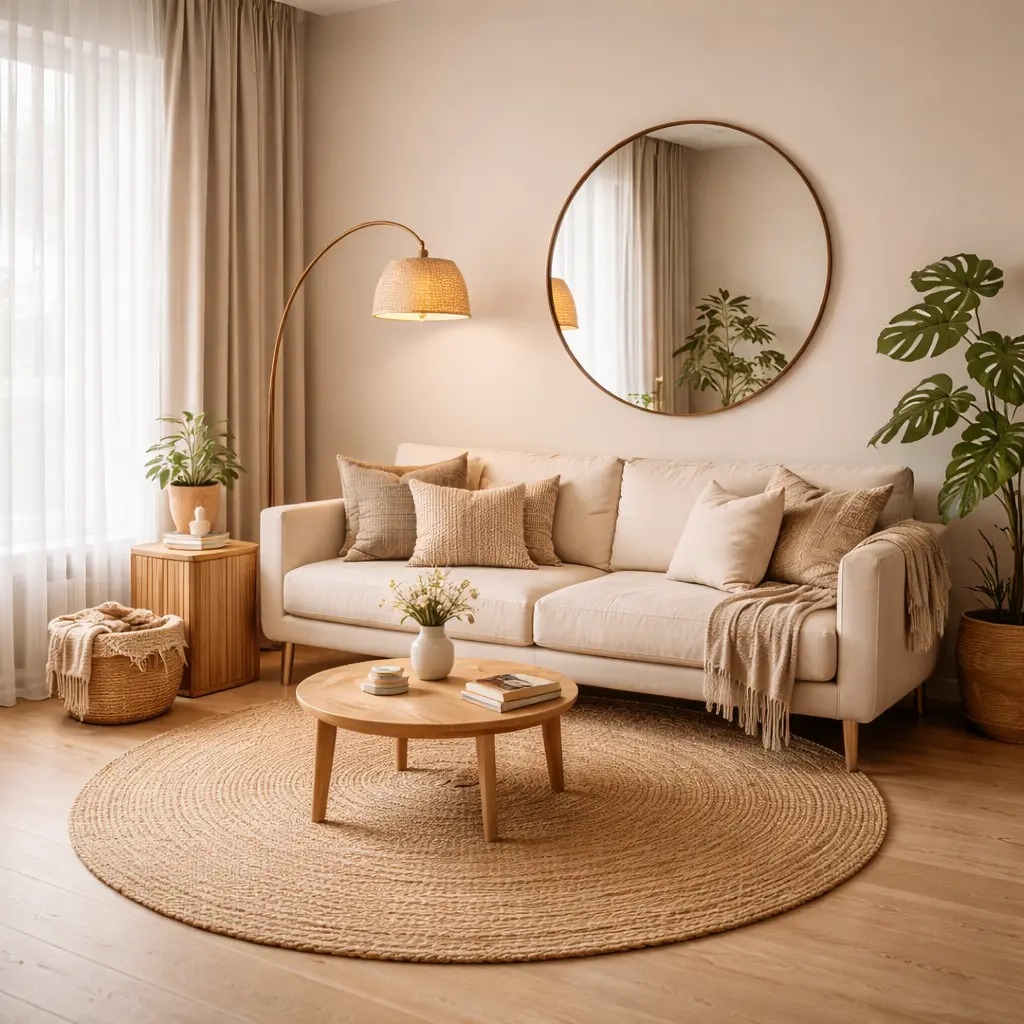
12 Small Living Room Ideas for a Cozy Apartment
By Emily | April 09, 2026
Designing a small living room is like writing a sentence where every word has to count — there’s no room for filler, no escaping bad decisions, and when something doesn’t work, it shows immediately. And yet, the small living room is one of the most exciting design challenges there is, because constraint breeds creativity. The apartments that make you feel, the moment you walk in, that something is deeply right — they’re rarely large. They’re just thoughtfully designed.
This article is for anyone living in a rented or owned small apartment who feels like the living room never quite becomes what they imagined. For anyone who has tried furniture arrangements, rugs, shelving — and something always feels slightly off. For anyone who has bookmarked beautiful small living rooms online and can’t figure out why the same approach won’t work in their own space.
The answer is almost always the same: the size isn’t the problem. It’s the order of decisions. Most people start with furniture when they should start with light. Or they start with décor when they should start with layout. Or they buy something because it’s beautiful, without asking whether it makes the space feel larger or smaller.
What follows are twelve specific, proven approaches — with style guidance, product recommendations, and the kind of detail that rarely gets shared elsewhere. Not generalities, but genuinely applicable thinking. Because a small living room doesn’t have to feel small — only when you don’t know how to work with it.
1. Choose a Sofa That Does More Than One Job
 Save it
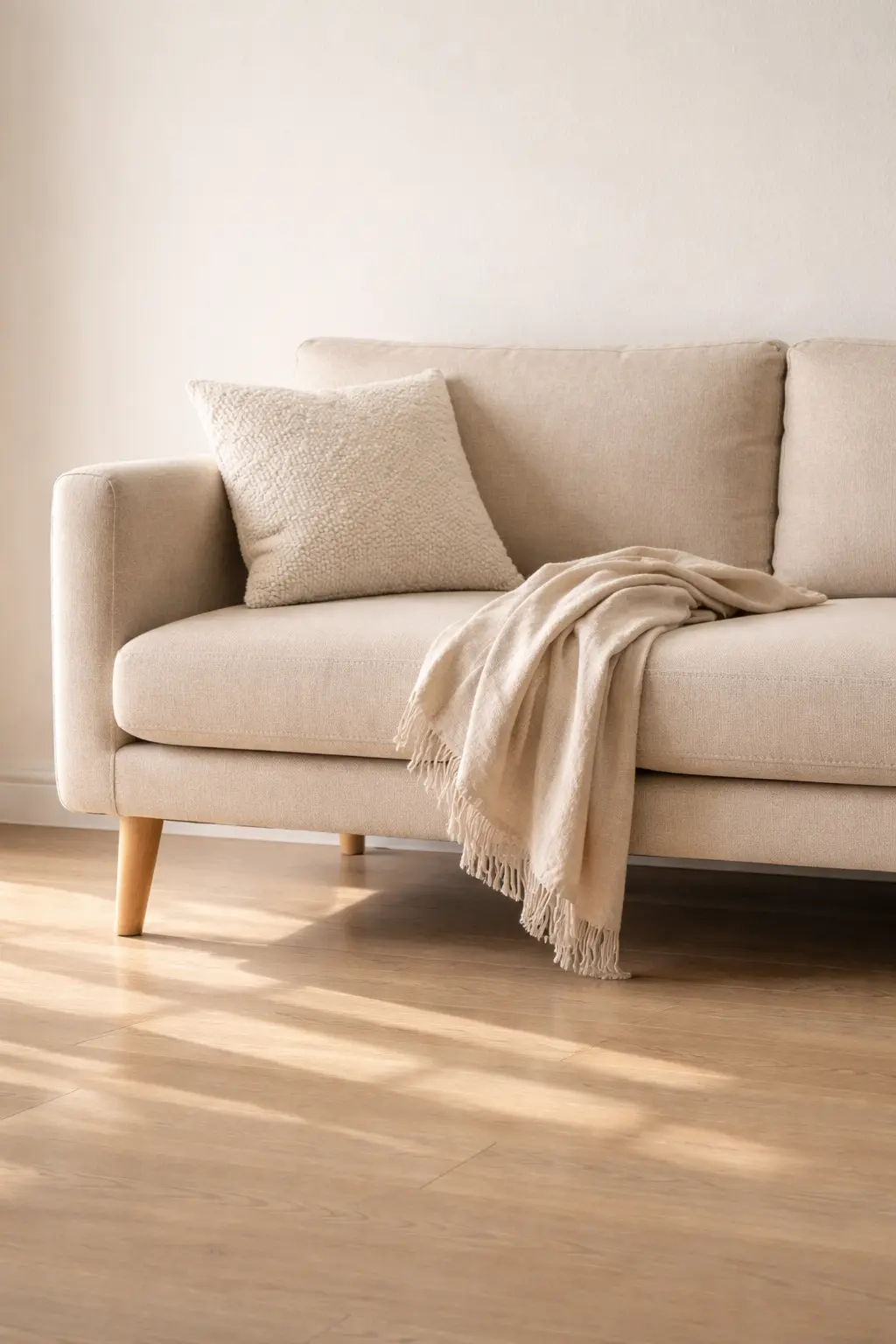
The sofa is the biggest decision in a small living room — and the biggest source of mistakes. Most people buy the sofa they like rather than the one that suits their space. The result: a beautiful piece that dominates the room entirely, making the space feel smaller than it actually is.
In a small living room, the sofa needs to do at least two jobs. The first and obvious one: seating. The second: visual lightness. This means the sofa should ideally have raised legs — because visible floor space creates the impression of more room than the measurements suggest. Low, heavy sofas that sit flush to the floor visually anchor and weigh down the space. Slim, elevated-leg versions feel airier — even when their footprint is identical.
Color matters just as much. Dark, saturated sofas become a dominant visual statement, and in a small space that’s rarely an advantage. Neutral sofas — sand, light grey, warm white — don’t disappear; they integrate into the room’s visual rhythm and allow the space to feel like it surrounds the sofa, rather than the sofa ruling the room. In a small living room, a two-seat or compact three-seat sofa is almost always the better decision over a large L-shape. The L-shaped sectional is appealing because it promises plenty of seating — but in a small space, it almost always closes off the room and eliminates every flexible arrangement option.
A modular, raised-leg sofa in a neutral tone is one of the best investments you can make for a small living room — adaptable, visually light, and a piece that works regardless of where you move next.
2. Use Mirrors to Double the Visual Space of Any Room
 Save it
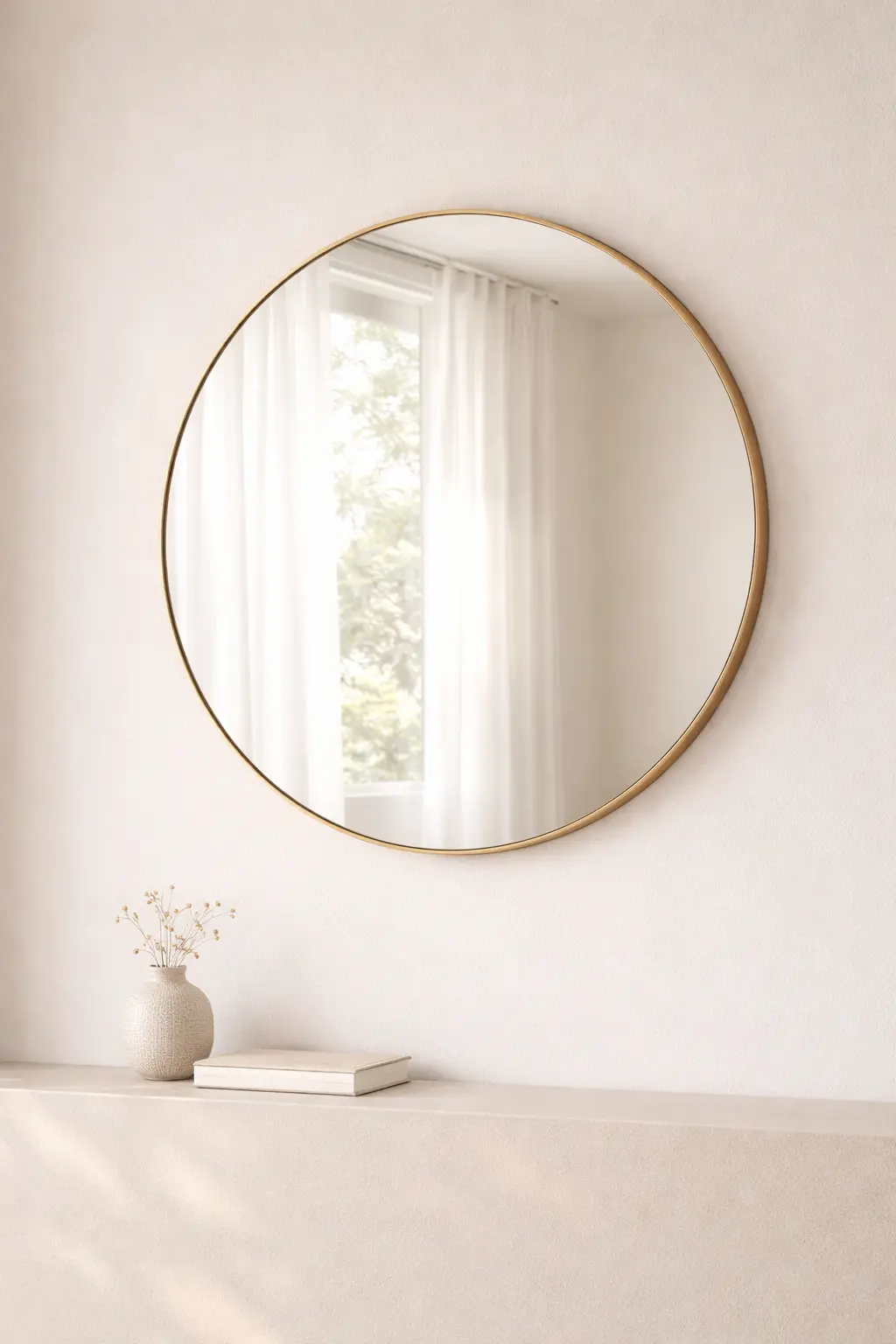
A mirror is the only decorative tool that genuinely changes the perceived size of a space — not through illusion, but through physics. It reflects light and doubles visual depth, making the room feel larger than it is. This isn’t a trick. It’s optics. The question isn’t whether a small living room needs a mirror. The question is where it goes and how large it should be. The most common mistake: a small mirror in the wrong position. A small decorative mirror on the wall is pretty enough, but it doesn’t change the room’s felt dimensions. For a mirror to actually work, it needs to be substantial — at least 80-90 cm in diameter, or large enough to cover a meaningful portion of wall.
The best placement: opposite a window, where it can catch and scatter natural light across the room. During the day, this dramatically increases brightness — and at night, it does the same with artificial light. The other strong position: a wall visible from the entry point, where it shapes the first impression of the space.
From a style perspective, the mirror’s frame does a great deal of work. In a minimalist room, a frameless or thin steel-framed mirror is perfect. In Scandinavian or japandi spaces, a wood frame brings warmth. In rustic farmhouse settings, cast iron or antique gold works well. In a modern, contemporary living room, the arched organic-form mirror is one of the most current and versatile choices available right now. A large round or arched mirror is one of the highest-return purchases you can make in a small living room — a single piece that simultaneously adds light, depth, and a visual focal point.
3. Define Zones with an Area Rug Instead of Furniture Arrangement
 Save it
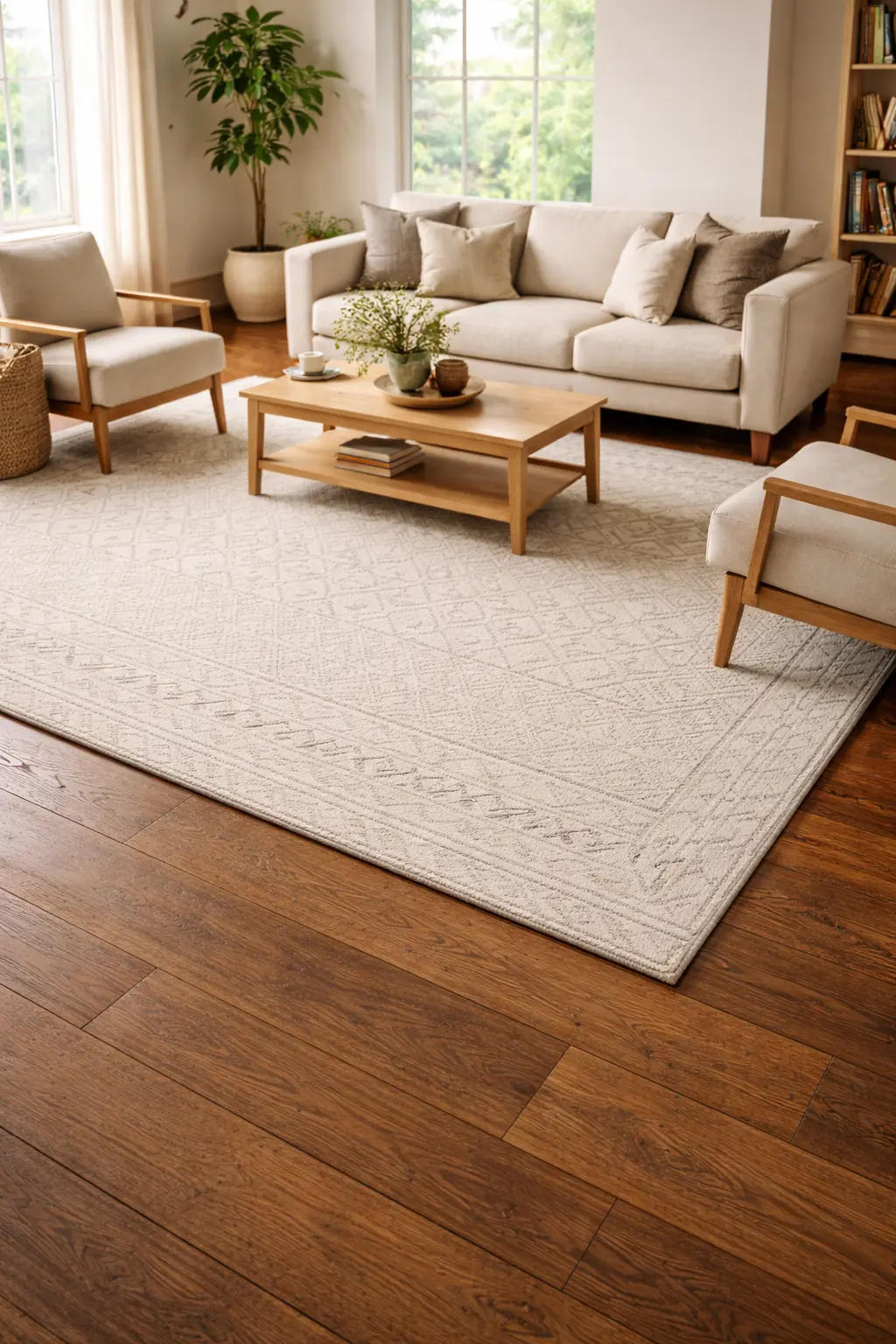
One of the biggest design challenges in a small living room is zoning — how to visually separate the “living” area from a dining corner, a workspace, or a hallway when there simply isn’t enough room to do it physically. Dividing space with furniture in a small apartment almost always creates clutter. A rug, by contrast, draws invisible boundaries: it defines a zone without physically occupying it. Rug sizing is a critical decision — and one of the most consistently mishandled. A small rug in a small living room isn’t a “budget-friendly” approach. It creates a floating, isolated effect that makes everything feel disconnected. The ideal rug is one that at minimum catches the front legs of every seating piece — but the real solution is a rug large enough for all the main furniture to sit on or partially overlap.
Pattern and texture also shape the room’s felt dimensions. A striped rug — particularly when the stripes run parallel to the room’s length — elongates the space. A geometric pattern creates a strong visual anchor. A solid, textured rug quietly enriches the space without generating visual noise.
If you want to go deeper on rug selection — what material, what size, what pattern works best in a small living room — my article Best Area Rugs for Small Living Rooms in Apartments covers this topic in full detail, with specific recommendations for every apartment style and budget.
A neutral, low-pile woven rug suits most small living room styles and is one of the highest-impact, most accessible changes you can introduce to a space.
4. Go Vertical: Make Your Walls Work as Hard as Your Floor
 Save it
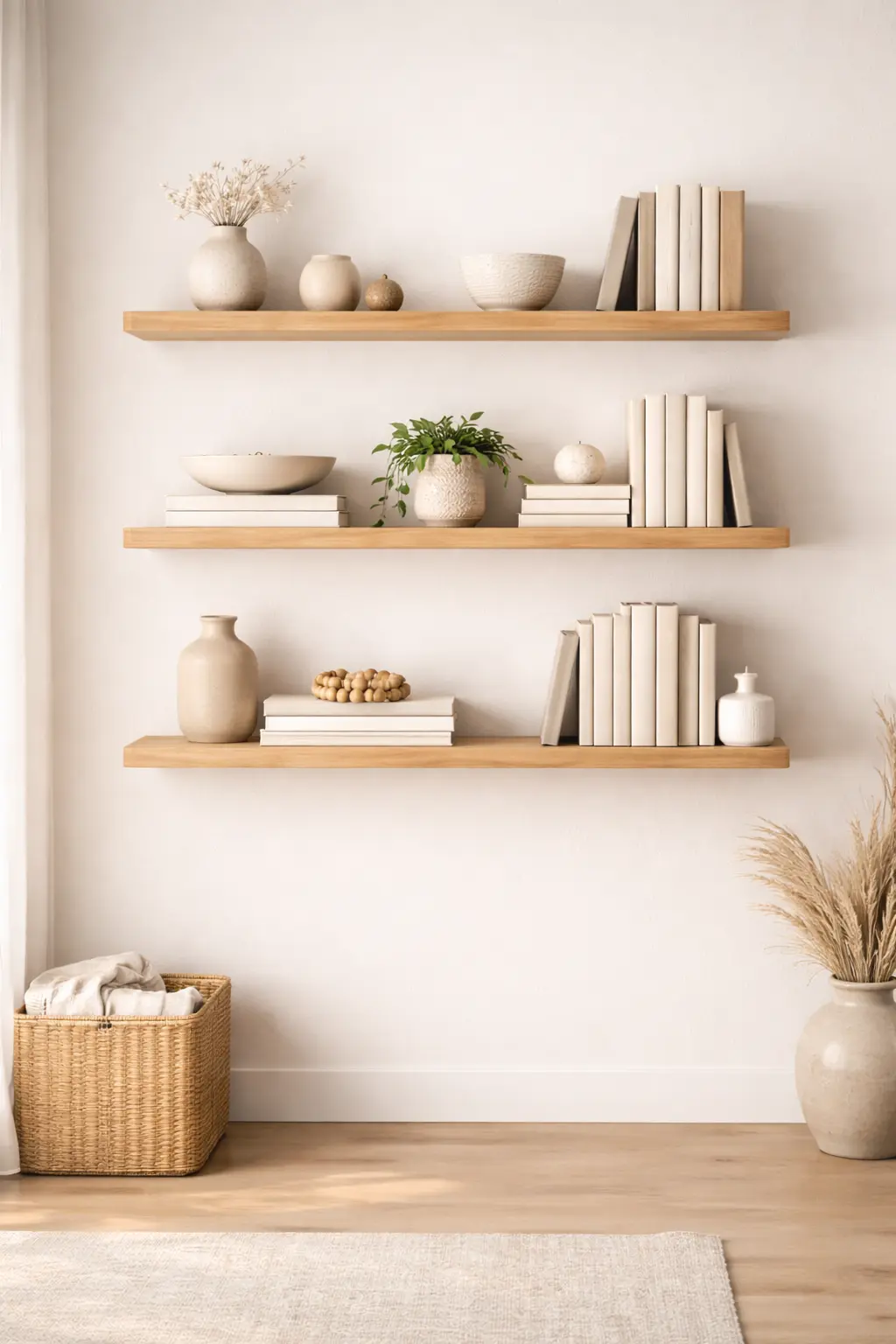
In a small apartment, most people think horizontally — concentrating on floor-level furniture while leaving vast stretches of wall completely unused. Thinking vertically is one of the most effective ways to make a small living room feel larger: it adds storage and, just as importantly, draws the eye upward, which makes ceilings feel higher than they are.
A floor-to-ceiling shelving system is the strongest example of this principle. It doesn’t need to be densely packed — the point is the height. A shelving unit that reaches the ceiling immediately raises the visual scale of the room, even if only the lower shelves hold objects. The upper sections can hold beautiful neutral baskets, books spine-out, or simple plants — the visual effect works regardless. A tall, slim floor lamp achieves the same vertical lift while simultaneously solving a lighting problem. Wall-mounted lamps, floating shelves, ceiling-height curtains — all apply the same visual logic: they direct the eye upward, and the room feels taller and more spacious as a result.
Floor-to-ceiling curtains deserve particular mention. Hanging the curtain rod not above the window frame but close to the ceiling causes the curtain to fall its full height, making the window appear significantly taller. This is one of the cheapest and most effective space-expanding moves available — and surprisingly few people apply it. A modular wall-mounted floating shelf system solves both storage and visual challenges simultaneously in most small living rooms — and integrates into every style from minimalist to bohemian-eclectic.
5. Embrace Multifunctional Furniture as a Design Philosophy
 Save it
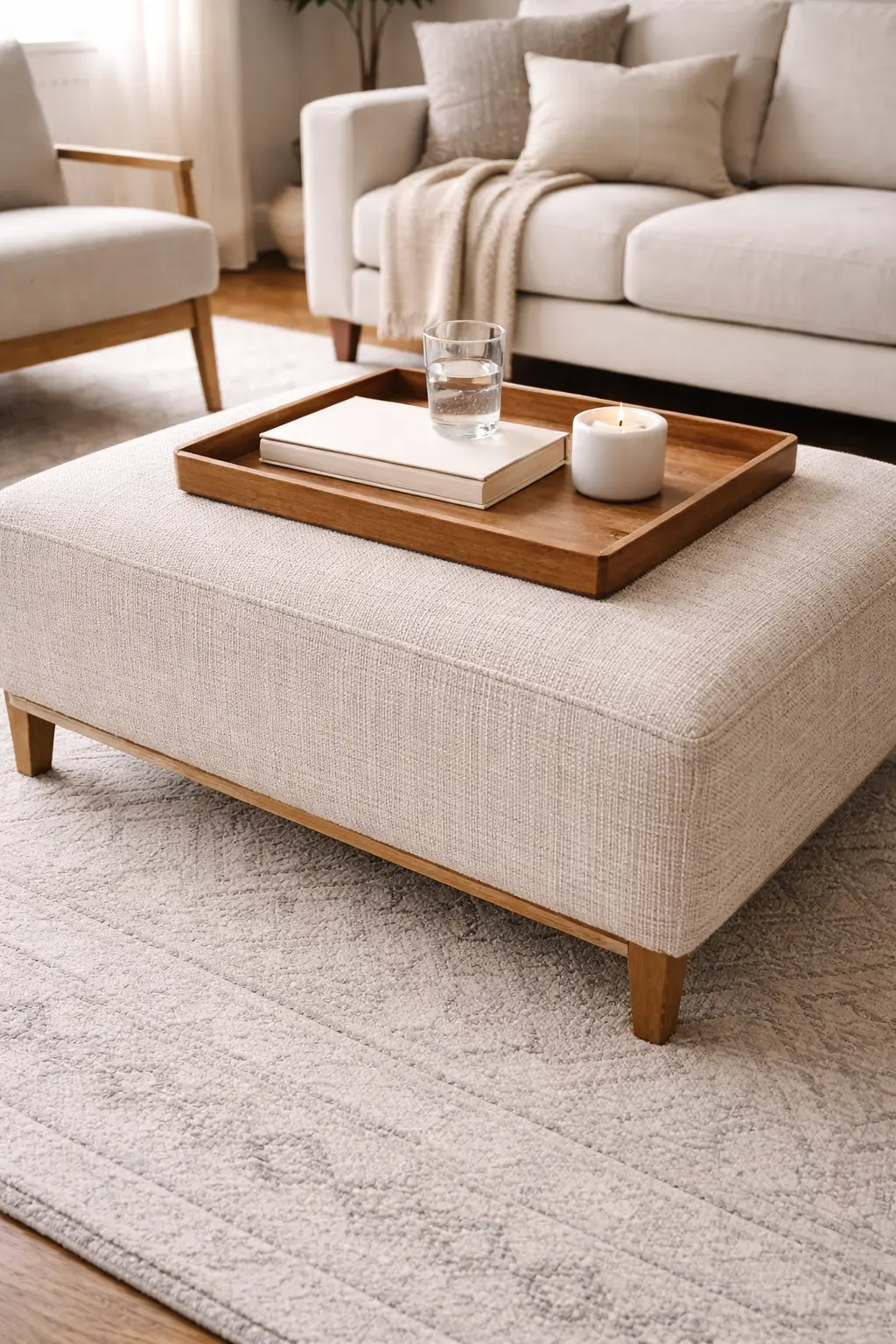
One of the foundational principles of small living room design — one that cannot be overstated — is that every piece of furniture should do at least two jobs. This isn’t compromise. It’s design. The best small apartments feel larger and more organized because the double-function principle is embedded in every object in the room.
The ottoman is one of the hardest-working pieces of furniture in a small living room: seating, footrest, coffee table (with a tray on top), and — if it has internal storage — a place to hide visual clutter. One quality storage ottoman replaces four separate pieces and reads as visually lighter than a traditional coffee table because it has no rigid frame or legs. Instead of a coffee table, consider a slim side table that sits beside the sofa and supports a drink, a book, a lamp. It takes up less room than a traditional table and doesn’t interrupt movement through the space in the same way.
A bench in the transition zone between entry and living room serves as seating and shoe storage. A floating TV console preserves floor space. A fold-out dining table stays living room-sized on weekdays and accommodates six people on the weekend.
Multifunctional furniture doesn’t mean cheap or compromised pieces. The best versions are objects that are beautiful in their design, with the functionality only revealing itself on closer acquaintance. An upholstered storage ottoman is one of the best first investments in a small living room — it immediately addresses clutter and is naturally usable from every point in the space.
6. Control Natural Light to Make Small Rooms Feel Twice as Big
 Save it
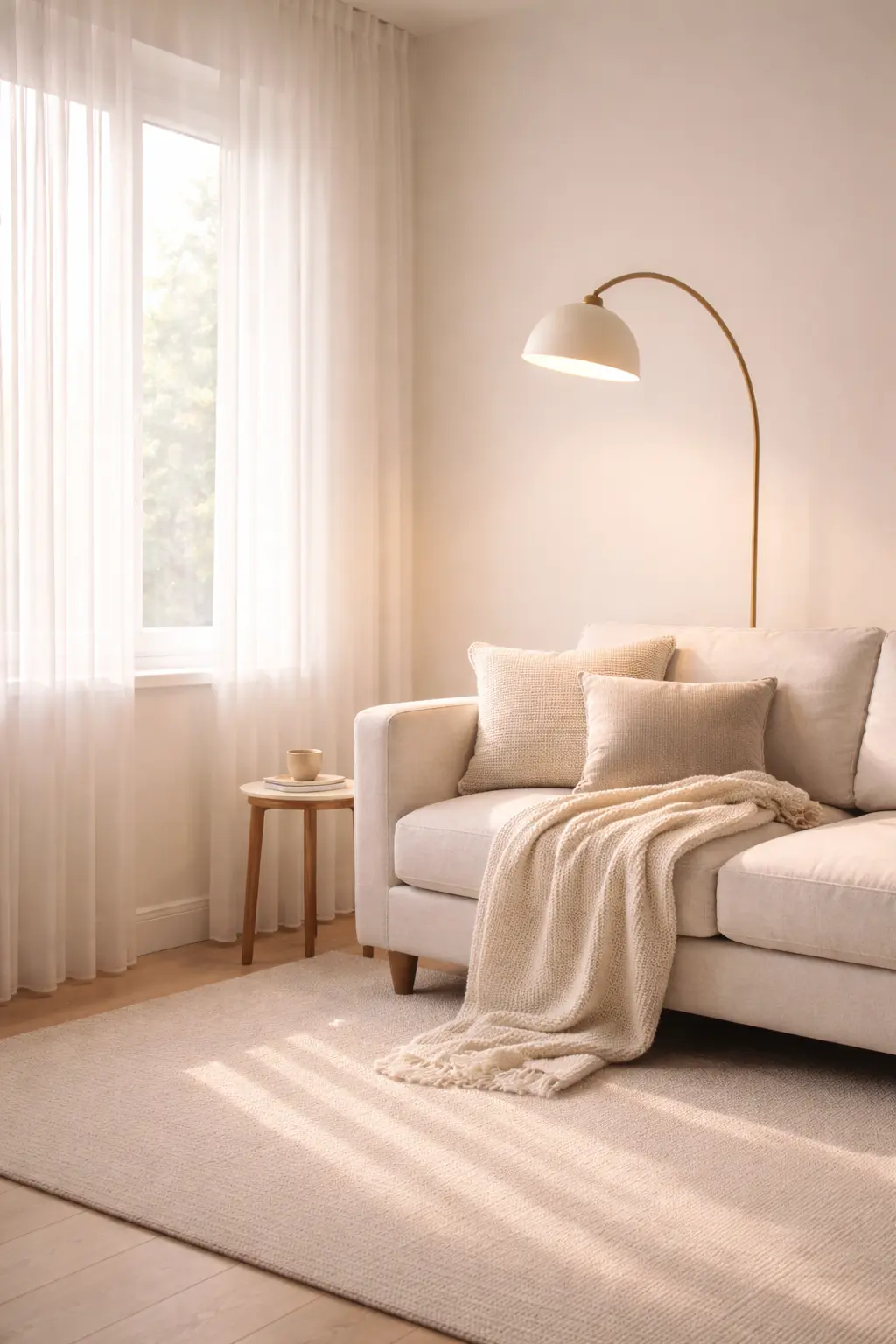
Natural light is a small living room’s greatest asset — and most people block it, cover it, or simply ignore it. Managing light is not an optional extra in small space design. It’s one of the most important decisions you can make.
First rule: never cover a window with a heavy, dark curtain unless you absolutely have to. Blackout curtains are essential in a bedroom — in a living room, they rob the space of the natural light that makes it feel alive. If some form of shading is necessary (strong southern exposure, a busy street outside), choose a sheer, lightweight fabric that filters rather than eliminates the light.
Second rule: maximize light reflection. Light walls, reflective surfaces, mirrors opposite windows — these amplify and scatter natural light throughout the room. This doesn’t mean everything needs to be white, but dark, saturated wall colors in small living rooms almost always weigh the space down.
Third — and less obvious — rule: layer your light sources and their directions. A ceiling light provides a functional base, but used alone it creates a flat, clinical effect. Alongside it: a floor lamp, a table lamp on a shelf or side table, perhaps a wall-mounted reading light beside the sofa. Layered light produces warmer, more atmospheric, more visually rich spaces.
A slim, arched floor lamp simultaneously addresses light layering and vertical visual interest — and integrates into any small living room style without making the space feel more crowded.
7. Pick a Neutral Base and Let One Color Do All the Work
 Save it
Color strategy in a small living room is an area where most people either play it too safe or too bold. One extreme: an entirely neutral white-grey-beige room with no character. The other: too many colors competing for attention and visually compressing the space. The right approach sits between them — and is exactly as simple as it is effective.
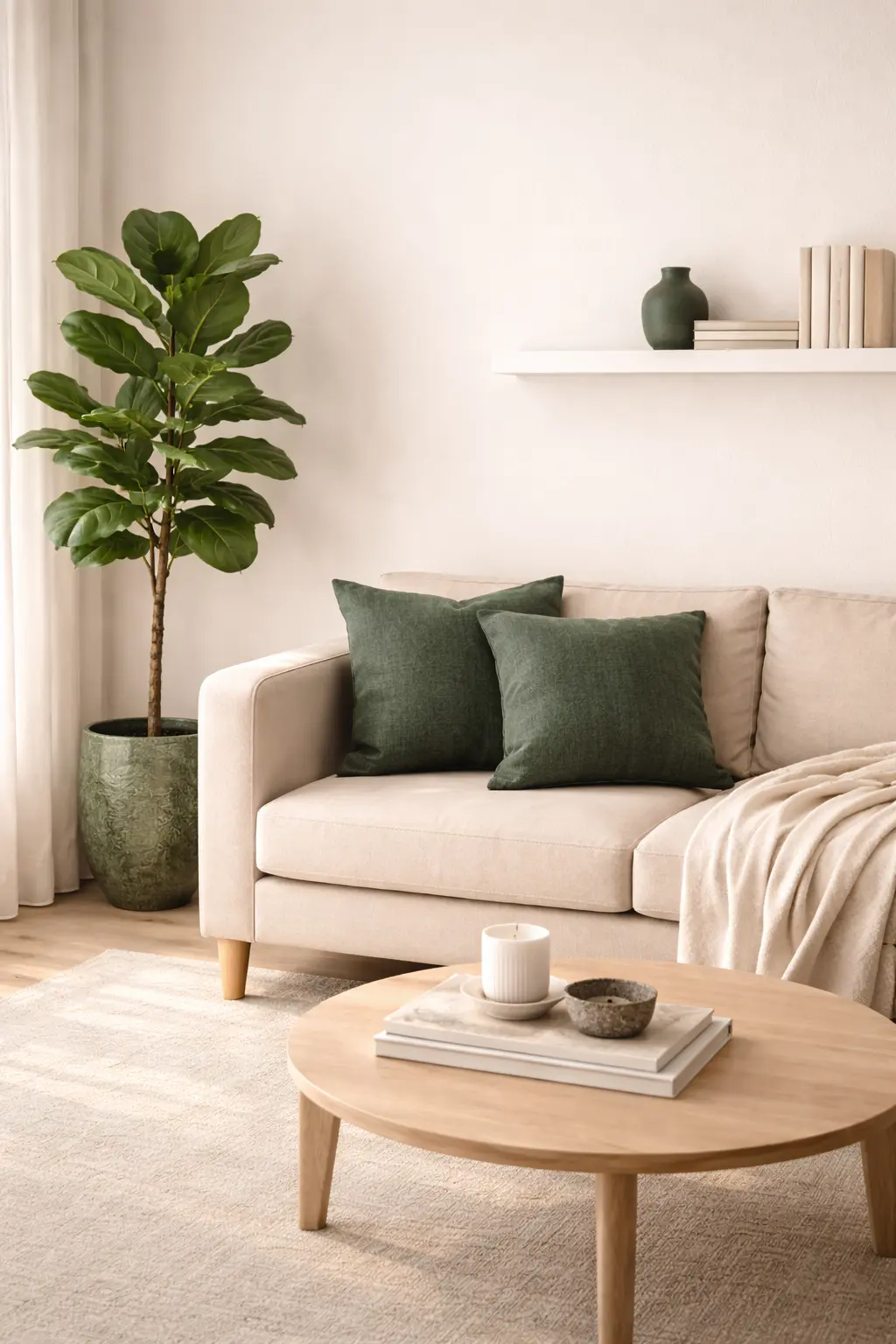
The rule: one neutral base, one dominant color, one or two accents. The neutral base covers the walls, large furniture pieces, and the rug’s ground tone — these should be restrained and harmonious. The dominant color appears in a stronger, more characterful shade: in cushion covers, in the rug’s pattern, or in one more prominent furniture piece. The accent is one or two smaller elements that either contrast or harmonize with the dominant color.
Why does this work in a small space? Because visual unity creates a sense of openness. When the eye enters a room and quickly identifies the visual logic — these go together, and these, and these — the space reads as organized and spacious. When the eye pulls in multiple directions simultaneously, the room feels smaller than it is.
Currently one of the most effective palettes for small living rooms: warm white or linen-toned walls, a deep green accent (cushions, a plant, ceramic objects), natural wood and organic materials as neutrals. This combination reads as simultaneously nature-forward, modern, and highly photogenic — and it works in any apartment size. A deep green or terracotta velvet cushion cover set is one of the cheapest and most effective ways to introduce character into a neutral living room — and you can rotate the palette seasonally without touching a single piece of furniture.
8. Use Coffee Tables Strategically — or Replace Them Entirely
 Save it
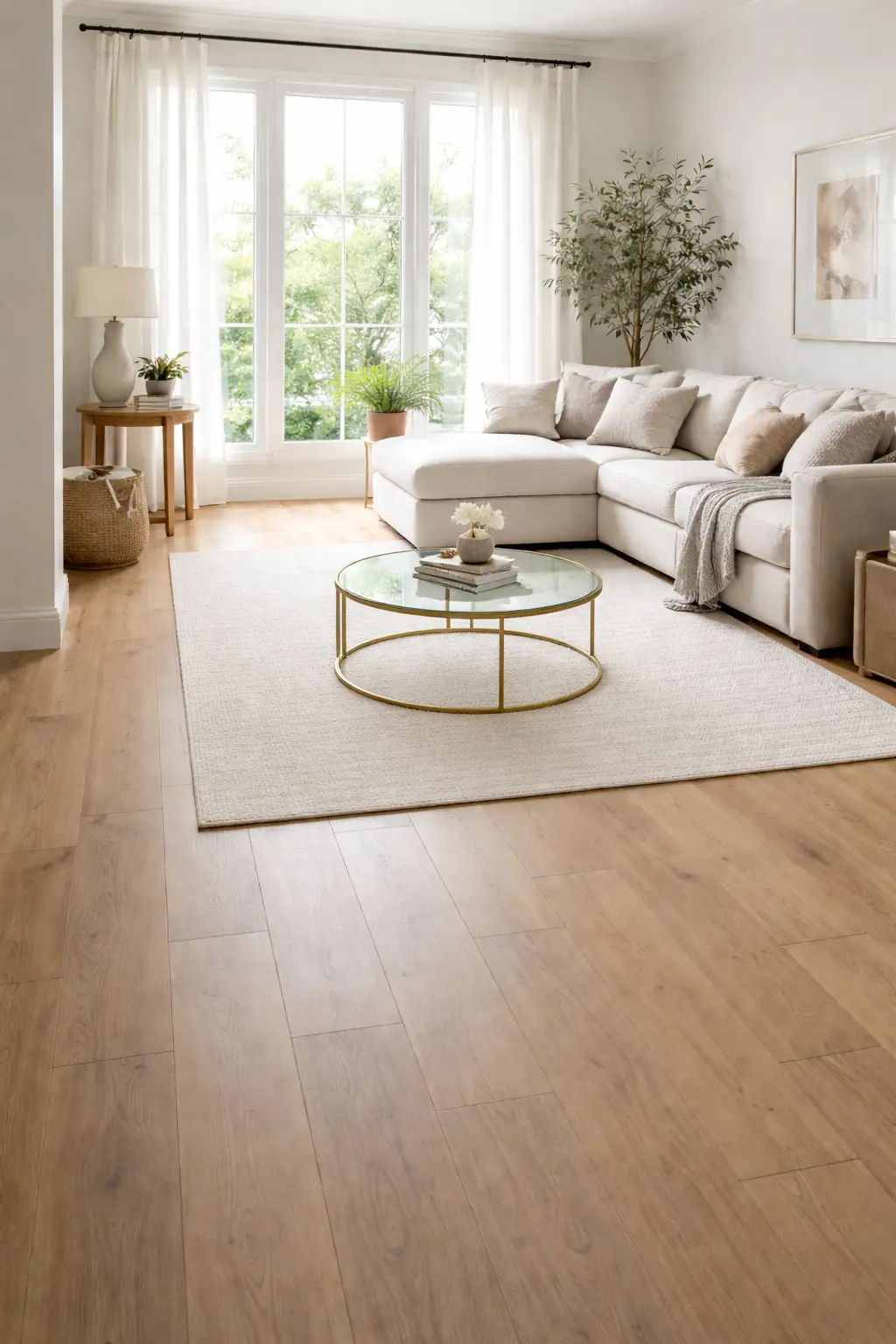
The coffee table is one of the most debated pieces of furniture in a small living room. Conventionally, everyone places one in front of the sofa — because that’s where it goes. But in a small living room, the traditional coffee table is one of the biggest space-wasting decisions you can make. A solid, rectangular coffee table occupies the center of the room, blocks free movement, and visually “seals” the space. In a small living room, it almost always takes more than it gives. The alternatives are smarter.
First alternative: two smaller, round side tables flanking the sofa, easily moved and repositioned. This allows a more flexible arrangement, doesn’t interrupt movement, and reads as visually lighter than a single large piece.
Second: an ottoman used as a coffee table, with a firm tray on top providing a stable surface for drinks and books — covered in the previous section.
Third, and increasingly popular: no coffee table at all. A slim side table, a low shelf beside the sofa, and the floor stays free. This works particularly well in minimalist and japandi-style living rooms, where open floor space is itself a design element.
If you do want a coffee table, a glass-topped version is the best choice for a small space — glass doesn’t interrupt the visual flow, and the room remains more visually open as a result. A round, glass-topped coffee table with a slim frame is one of the best compromises for a small living room — it provides the surface when you need it without dominating the space or disrupting movement.
9. Layer Your Lighting for a Space That Feels Warm and Lived-In
 Save it
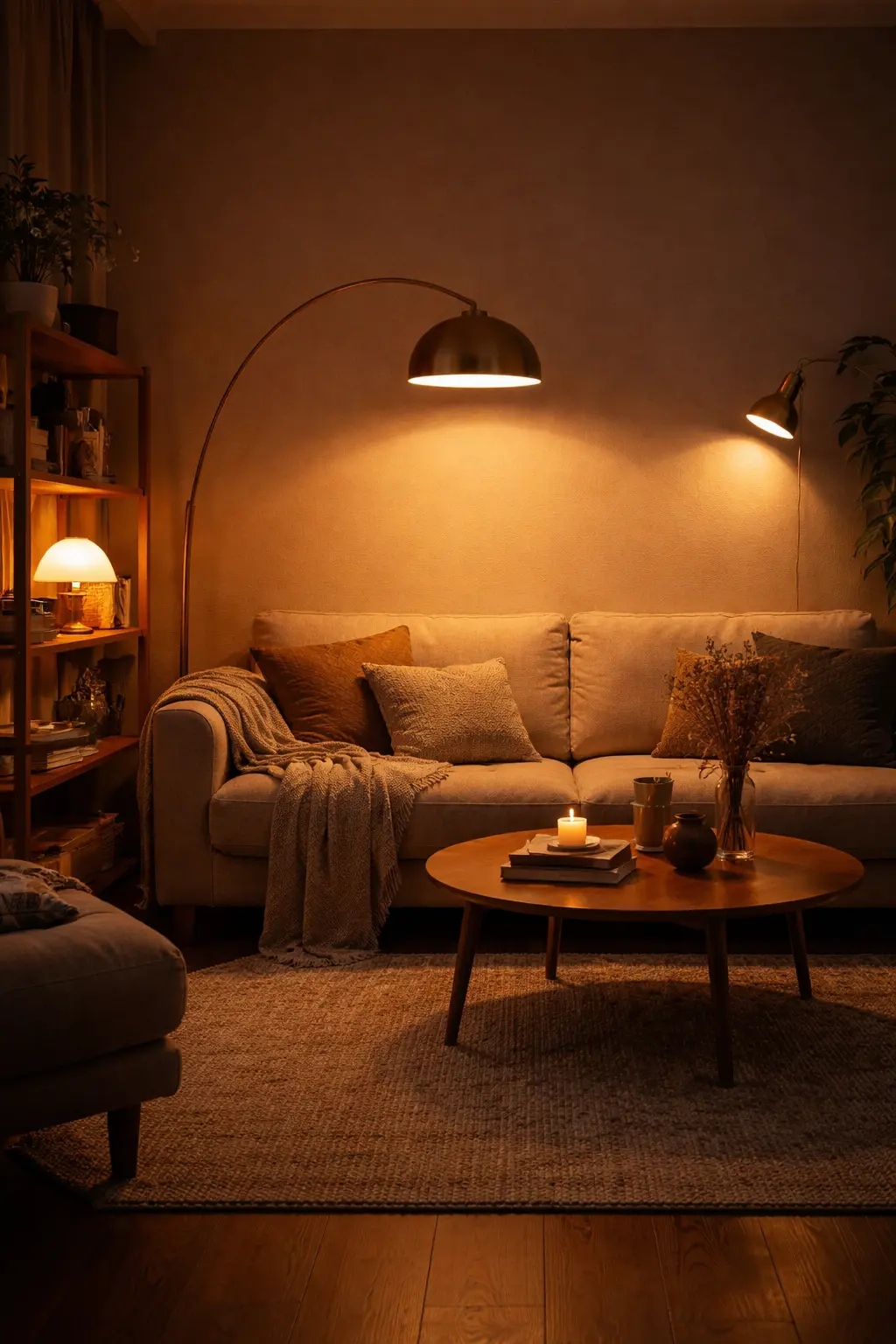
Lighting is one of the most neglected and highest-impact factors in a small living room’s atmosphere. Most apartments have a single ceiling fixture — and that’s what everyone uses, in every situation, all day long. The result: an evenly lit, slightly sterile space with no depth, no warmth, no character. Layered lighting changes exactly this. No electrician required, no renovation — just multiple types of light source at different heights and from different directions.
The base: the ceiling light provides general illumination. Above that: a floor lamp in a corner, a table lamp on a shelf or side table, a wall-mounted reading light beside the sofa. These supplementary sources can be on when the ceiling light is off — and when that happens, the room takes on an entirely different quality.
Light temperature matters. Cool, blue-white light promotes alertness and creates a clinical feel. Warm, amber-white light (2700-3000K) is more intimate, more domestic, better suited to evenings. In a small living room, warm color temperature is almost always the right choice.
Smart bulbs and dimmable switches are one of the best small investments available — they allow the same lamps to be used at different intensities depending on the time of day and the mood of the room. A dimmable arc floor lamp with a warm-toned bulb is one of the hardest-working accessories in a small living room — it simultaneously illuminates, creates atmosphere, and adds vertical visual interest to the space.
10. Decorate with Plants to Add Life Without Adding Visual Weight
 Save it
A plant is the only decorative element that brings genuine life into a space — and does so without “occupying” it in the way a piece of furniture or a shelf full of objects does. Plants breathe, change, respond to light, and bring an organic presence to a room that no manufactured product can replicate.
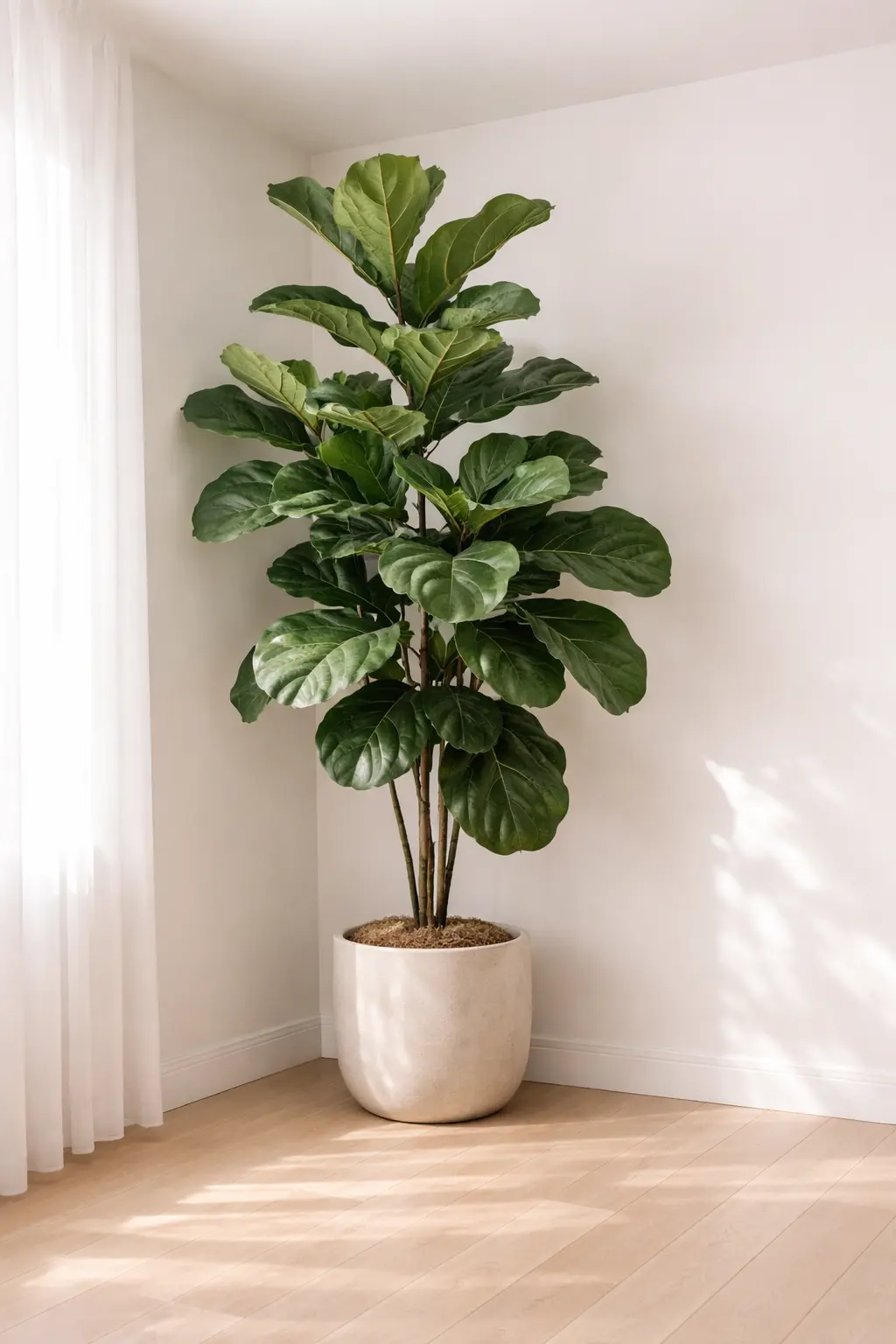
In a small living room, decorating with plants requires strategy. A few principles worth keeping: Think vertically. A large, tall plant — a monstera, a fiddle-leaf fig, a yucca — placed in a corner provides vertical interest and fills that “dead zone” that couldn’t be purposefully occupied by any other piece of furniture. One large plant creates a stronger visual impact than ten small ones scattered around the room.
Small plants on shelves — succulents, propagated cuttings in glass vessels, compact pothos — bring texture and life to a shelf arrangement without making the room feel more cluttered.
A trailing plant — hung from the ceiling or draped from a high shelf — is one of the most effective vertical elements available, and completely “free” in terms of floor space, since it occupies none of it.
On style: in a minimalist living room, one large, architecturally interesting plant in concrete or a neutral ceramic is ideal. In a bohemian or eclectic space, many small plants in macramé hangers and terracotta pots work beautifully together. In a Scandinavian room, a collection of plants in matching white pots arranged on wooden shelves reads as quietly composed and carefully considered.
A self-watering indoor planter in a modern design is one of the best solutions for anyone who wants plants but doesn’t always remember to water them — practical and genuinely attractive at the same time.
11. Create a Focal Point So the Eye Knows Where to Rest
 Save it
In a well-designed room, there’s always one point where the eye lands first — and where it’s happy to stay. This is the focal point, and the absence of one is one of the most common and least-named design mistakes in a small living room. When the eye enters the space and finds nowhere to “arrive,” the room feels unresolved — even when every piece of furniture is in exactly the right place.
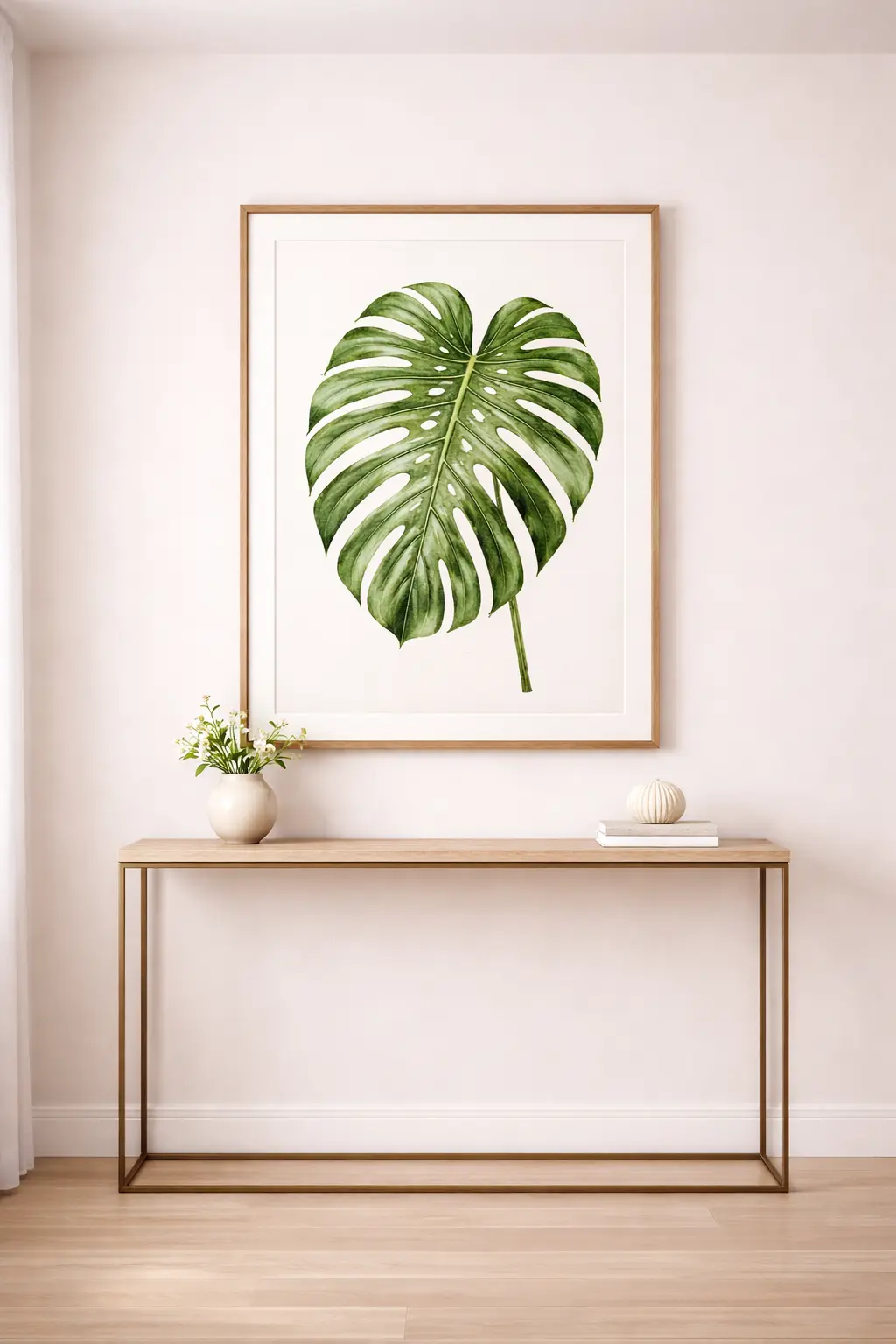
A focal point can be structural: a fireplace, a large window, an architectural wall. But it can equally be designed: a gallery wall, an oversized artwork, a statement mirror, a bold-patterned rug, or a richly arranged shelving system.
A gallery wall is one of the most accessible focal-point solutions. It doesn’t require expensive prints — the key is coherence: a consistent frame color or style, a considered arrangement, and one dominant “anchor” piece around which the composition is built. In a minimalist living room, one large, simple artwork or print is the most powerful focal point available — nothing else needs to surround it; it fills the wall and defines the room’s mood entirely on its own.
In a modern industrial space, a raw-textured decorative wall element — a concrete-effect panel, a single piece of reclaimed wood hung horizontally — creates a strong, characterful focal point without requiring any elaborate arrangement. A large framed botanical or abstract print is one of the simplest ways to create a focal point in a small living room — no renovation, no lasting commitment, and an immediate transformation of the room’s character.
12. Edit Ruthlessly — Small Spaces Demand Intentional Curation
 Save it
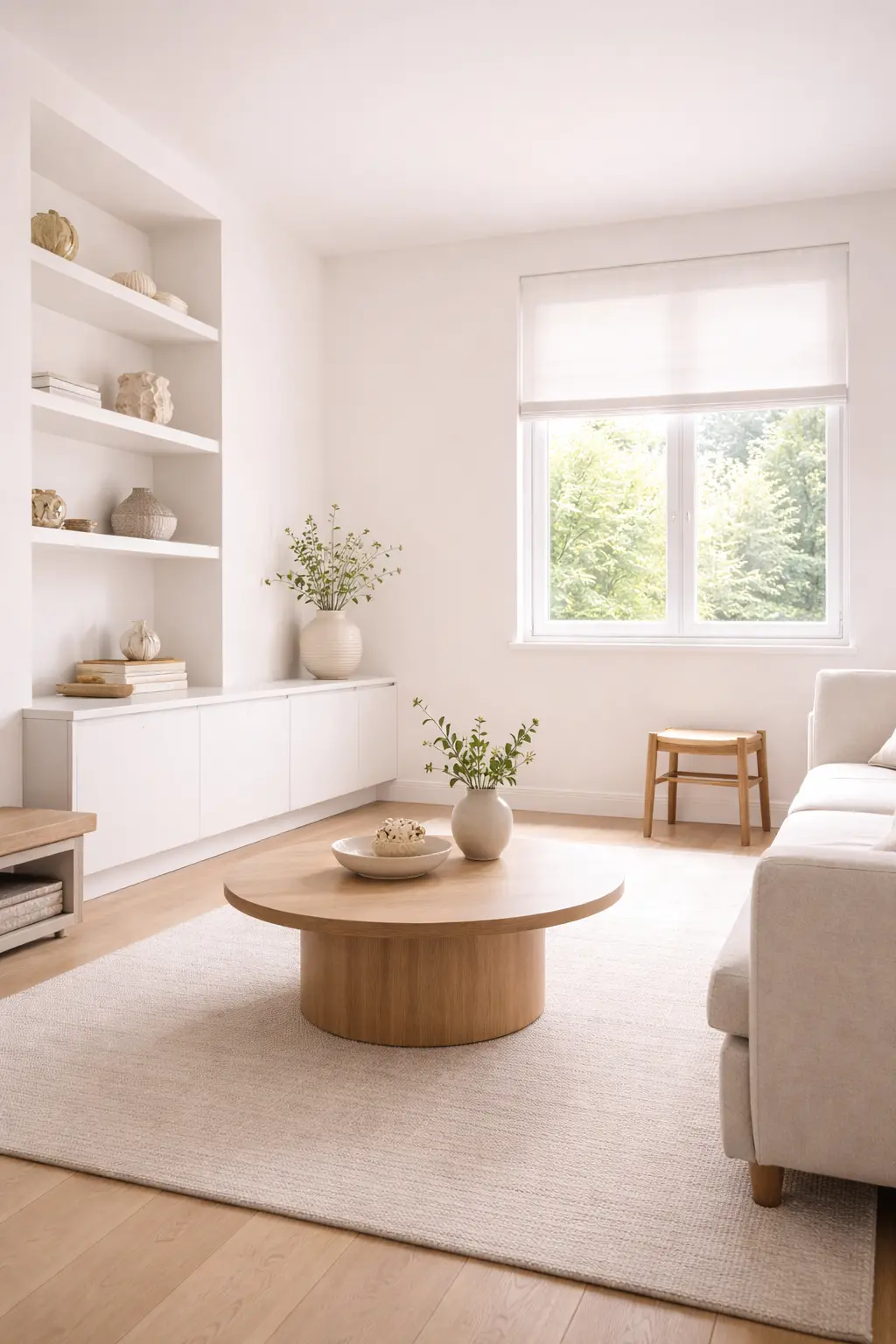
The twelfth idea isn’t a specific piece of furniture or a decorative element. It’s a mindset — and perhaps the most important one on this list. In a small living room, the best decision is very often what you choose not to include. Restraint isn’t poverty. Editing isn’t boring. Less is not a compromise — it’s the most powerful tool a small space has. The “edit ruthlessly” principle means asking of every object you put in the room: does this genuinely need to be here? Does it perform a function, visually enrich the space, or is it there simply because there was an empty corner? If the answer is the last one, that object almost certainly belongs somewhere else.
In a small living room, most clutter doesn’t come from buying too much — it comes from the accumulation of too many small things over time. The little decorative objects that colonize shelves, the “just one more” candle, the third cushion on the sofa — each one is harmless in isolation, but together they generate visual noise that makes the room feel smaller and more burdensome than it is.
An annual “living room audit” — walking through the space and asking every object whether it truly belongs — is one of the simplest and most effective maintenance practices for a small space.
If you want to understand this approach more deeply — how to create warmth and coziness without creating clutter — my article How to Create a Cozy Living Room with Simple Design Tricks explores exactly this: how to make a space feel genuinely warm, livable, and personal without it becoming overstuffed.
The single best editing tool available: photograph the room and study the image. The camera sees what familiarity conceals. If something bothers you in the photo, it bothers you in the room — and in most cases, the solution is not more furniture, but less.
Helpful Tips That Actually Work
Designing a small living room is not a one-time project — it’s a continuously refined process. A few pieces of advice that have proven themselves over time:
The first piece of furniture you buy determines all the others. If you start with the sofa, it sets the scale, color, and style framework for every subsequent decision. If you start with a shelving system, that establishes the room’s spatial logic. Decide which element is the “anchor” — and start there.
Floor space is the most valuable square footage in the room. Everything that stands on the floor occupies it. Wall-mounted elements, floating shelves, raised-leg furniture — all of these give back that valuable floor area. Think of the floor as something to preserve, not something to fill.
Size always trumps style. The most beautiful piece of furniture is the wrong decision if it doesn’t fit the space proportionally. Always measure before buying — and measure in your own room with tape on the floor, not in a showroom.
Textiles are the cheapest renovation available. Cushion covers, a new rug, curtains, a throw — changing these gives the room an entirely new face without requiring a single new piece of furniture. When something isn’t working, change the textiles first.
Order makes a small room feel larger. A cluttered small room always feels smaller than it is. A tidy small room always feels larger. This isn’t a design trick — it’s psychology. Which is why storage solutions matter just as much as decoration.
Before the most common mistakes — one final thought: the best small living room isn’t the one that looks like it’s large. It’s the one that feels like home.
Common Mistakes to Avoid
1. Furniture that’s too large for the space.
This single mistake can undermine an entire room. The L-shaped sectional that fills the floor plan, the oversized coffee table that makes movement impossible, the large armoire that covers the window — all stem from the same instinct: “we need more seating, more storage, more of everything.” The reality is the opposite: smaller, smarter furniture almost always gives back more space.
2. A single overhead light source.
One ceiling fixture illuminates everything evenly — and that uniformity is exactly what strips the space of depth, warmth, and character. Layered lighting, as detailed in section nine, is not a luxury. It’s one of the cheapest and highest-impact improvements available to a rented apartment.
3. Dark walls without compensation.
A dark wall color in a small living room isn’t automatically a bad decision — but without compensation it makes the space feel heavier and more compressed. If you want a dark wall, bring in significantly more light (layered sources, mirrors), and choose lighter, less visually heavy furniture as counterbalance.
4. Too many small decorative objects scattered around.
Ten small objects on a shelf generate more visual noise than three larger, unified pieces. Small decorative items don’t “fill” a space — they fragment it. Group them, edit them, remove what’s unnecessary.
5. The wrong rug size.
As covered in section three, a small rug in a small living room creates an isolated, disconnected effect. If the rug doesn’t anchor the furniture arrangement, it does more visual harm than good.
Frequently Asked Questions
How do I furnish a small living room without it feeling cluttered?
The key is editing and proportion. Fewer but larger and smarter pieces of furniture; raised-leg elements that allow the floor to be seen; neutral base tones with one dominant accent color; and layered, warm lighting. Clutter in a small living room almost always comes from too many small objects and poor proportional choices, not from the size of the space itself.
What color makes a small living room feel bigger?
Light, warm neutrals — white, cream, sand, soft grey — visually expand a space. But color alone doesn’t make a room feel larger: light management and furniture proportions matter at least as much. A single strong color, applied consistently across the room, can also work well if the light and the furniture support it.
Is it worth investing in expensive furniture for a small living room?
Yes — but strategically. Invest in quality for the anchor pieces (sofa, rug, primary shelving), because these determine the perceived value of the entire room. Budget pieces work in accessories; they rarely work in the large structural elements.
How do I create storage in a small living room without it looking cluttered?
Vertical storage (wall shelves, floor-to-ceiling units), hidden storage (storage ottomans, baskets under tables), and consistent editing — reassessing what’s on shelves and in cabinets every three to six months. Open storage only works well when its contents are curated and visually unified.
Final Thoughts
A small living room will never be large — and it doesn’t need to be. The goal isn’t to imitate scale. The goal is to create a space that feels the way it should: livable, personal, warm, and ordered. A place you genuinely want to come home to, where you feel comfortable, and where guests immediately feel at ease — without ever being able to say exactly why.
The twelve approaches in this article aren’t complicated principles. A sofa at the right scale. A mirror opposite the window. A rug that anchors the furniture. Layered light. Multifunctional pieces. Consistent editing. Individually, these are small decisions — together, they produce a completely different room.
Start with one. Don’t try to solve everything at once — that’s the fastest route to abandoning the project halfway through. Choose the single element that would make the most difference, and build from there. The best small living rooms aren’t born all at once. They’re assembled decision by decision, patiently and intentionally — and the result, when it comes together, feels less like a compromise and more like exactly where you’re meant to be.
This post contains affiliate links. I may earn a small commission at no extra cost to you.
Get cozy inspiration delivered to your inbox.
✓ 14-page beautifully designed ebook
✓ Cozy decorating ideas
✓ Practical room-by-room inspiration
You’re in! 🎉
Thanks for joining the NestFlowHome community!
Your free ebook is already on its way to your inbox. If you don’t see it within a few minutes, please check your Promotions or Spam folder.
Join the NestFlowHome community for weekly decorating inspiration.

Timeless home decor ideas and slow living inspiration for a calm, beautiful life.