
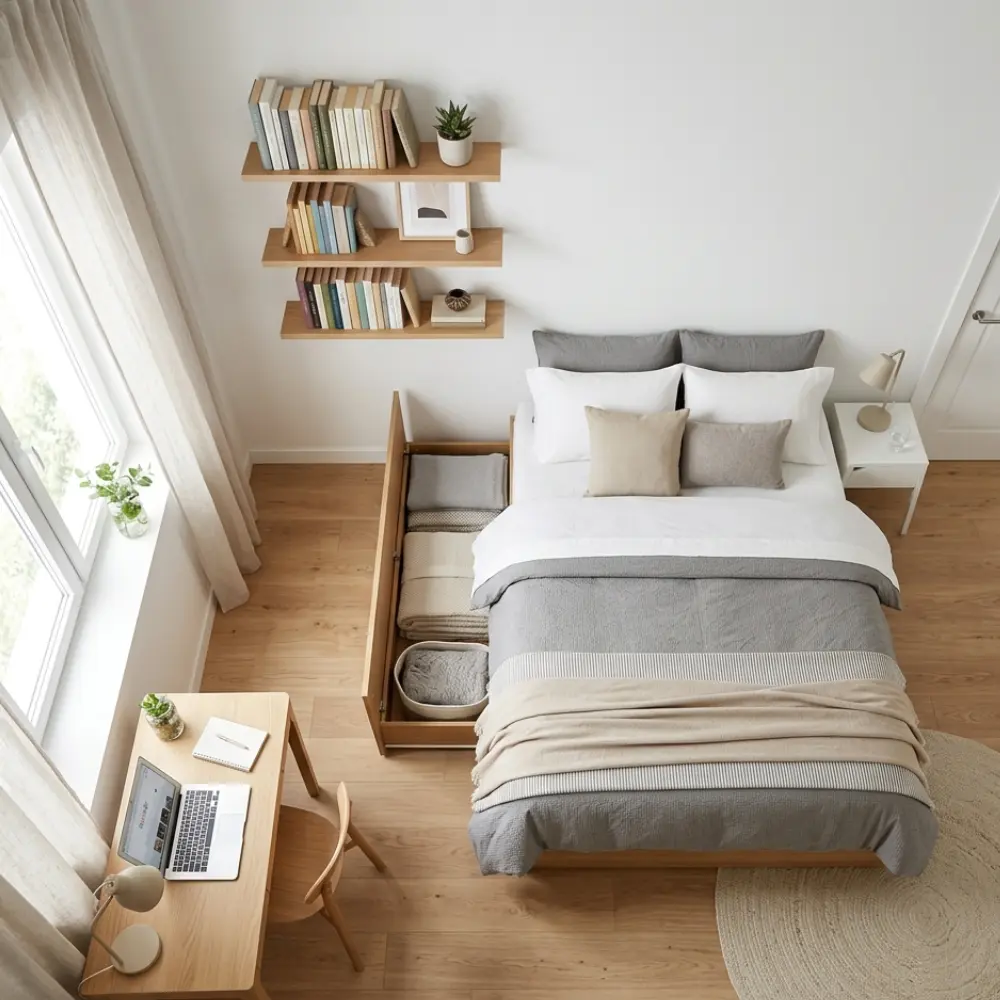
15 Small Bedroom Ideas for Better Storage and Smart Layouts
By Emily | April 24, 2026
You wake up at 2am to find something falling off a shelf because you tried to cram too much stuff into a small space. The closet door won’t close properly because the clothes are sticking out. The box you put there weeks ago slides out from under the bed. And in the morning, when you get ready, you can’t find your shoes because they’ve disappeared somewhere in the chaos. It’s not because you’re messy. It’s because your small bedroom isn’t your fault it’s small – but it might be your fault for designing it.
A small bedroom is one of the most difficult spaces you’ll ever try to furnish. Not only do you have to relax in it – you also have to store everything that doesn’t fit anywhere else. Clothes, shoes, bedding, books, electronics. And all without making the room look cluttered, chaotic or overwhelming. But here’s the thing: a small bedroom is not an obstacle. It’s an opportunity. If you understand how to think about space – vertically, in layers, multifunctionally – you can make the most of even a 10 square meter room.
In this article, you will find fifteen concrete, proven solutions that are not just decorative ideas, but structural considerations. You will learn how to take advantage of the height of the walls, how to choose furniture that performs a double function, how to create visual spaciousness without adding a single square inch. We are not talking about trends, but about what works – regardless of whether you are a renter, moving, or have been living in the same small room for years.
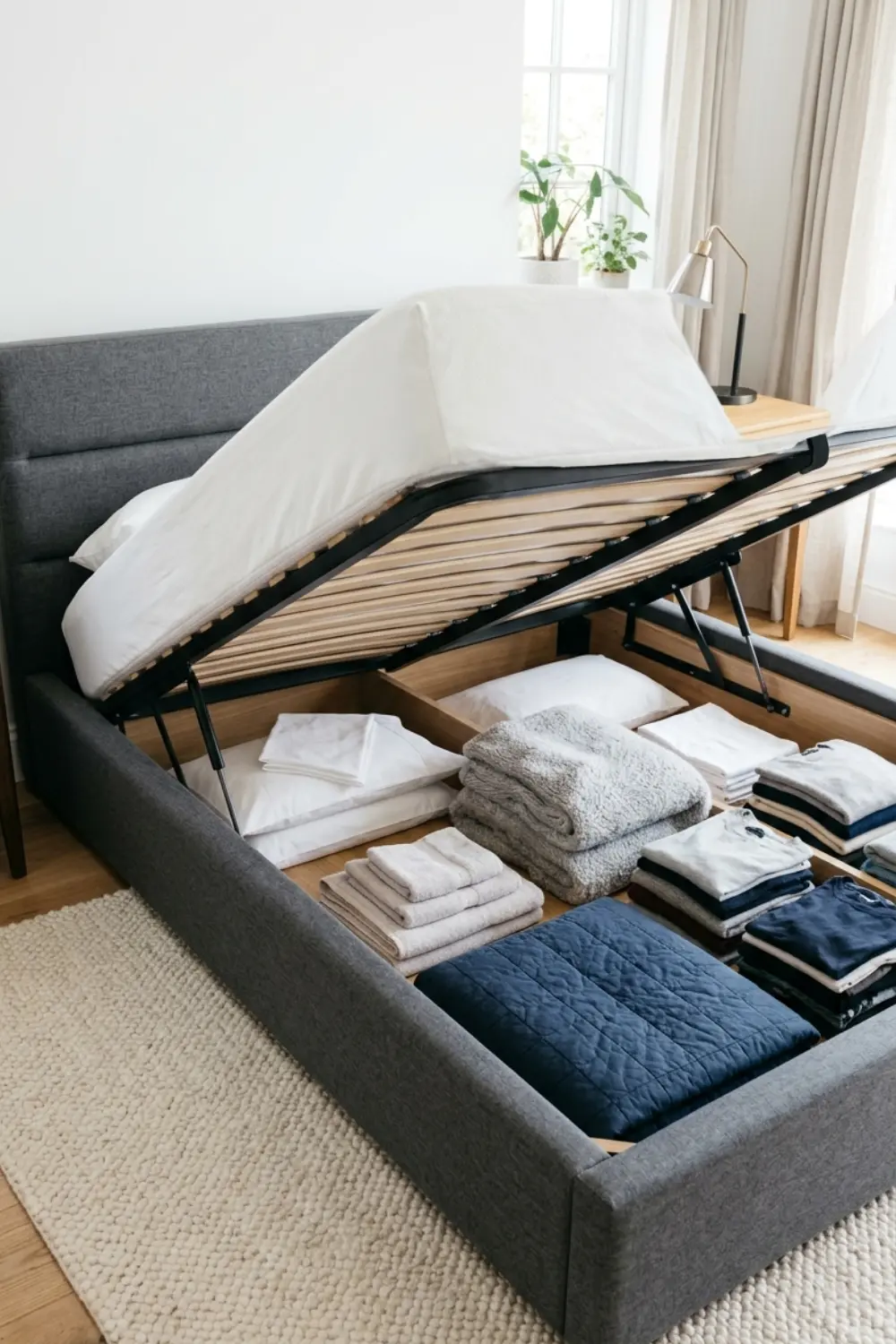
1. Choose a Bed Frame With Built-In Storage Underneath
 Save it
Most people think of a bed as a piece of furniture that serves only one purpose: to sleep on. But in a small bedroom, that’s a luxury you can’t afford. The bed is one of the largest pieces of furniture you have in the room, and there’s a lot of unused space underneath it—unless you choose a frame that also utilizes that space.
I’m thinking of a platform bed, where the mattress lifts up and there’s a huge compartment underneath. This isn’t the little drawer you see on the side of some beds. This is a full-size storage unit that can hold bedding, winter coats, rarely used shoes—anything you don’t need on a daily basis but can’t throw away. This solution is brilliant because it doesn’t take up any extra space—your bed is already there, you’re just using the space underneath.
When choosing a bed frame, look at how easy it is to lift your mattress. There are versions that work with a hydraulic mechanism – you simply lift it up and it stays open by itself while you pack. There are also those that are manual, but they are light. And there are those that have a drawer system on the side or end of the bed – this is more practical if you don’t want to lift everything all the time, but you just want to quickly take something out.
They also vary in style: a modern upholstered version with clean lines, a wooden frame with a mid-century modern feel, or even a minimalist metal construction. The point is: choose it not only because you like it, but because it also solves your storage problem functionally. If you have the opportunity, choose one that is in a neutral color – gray, beige, white – because it is timeless and can be combined with any textiles and pillows.
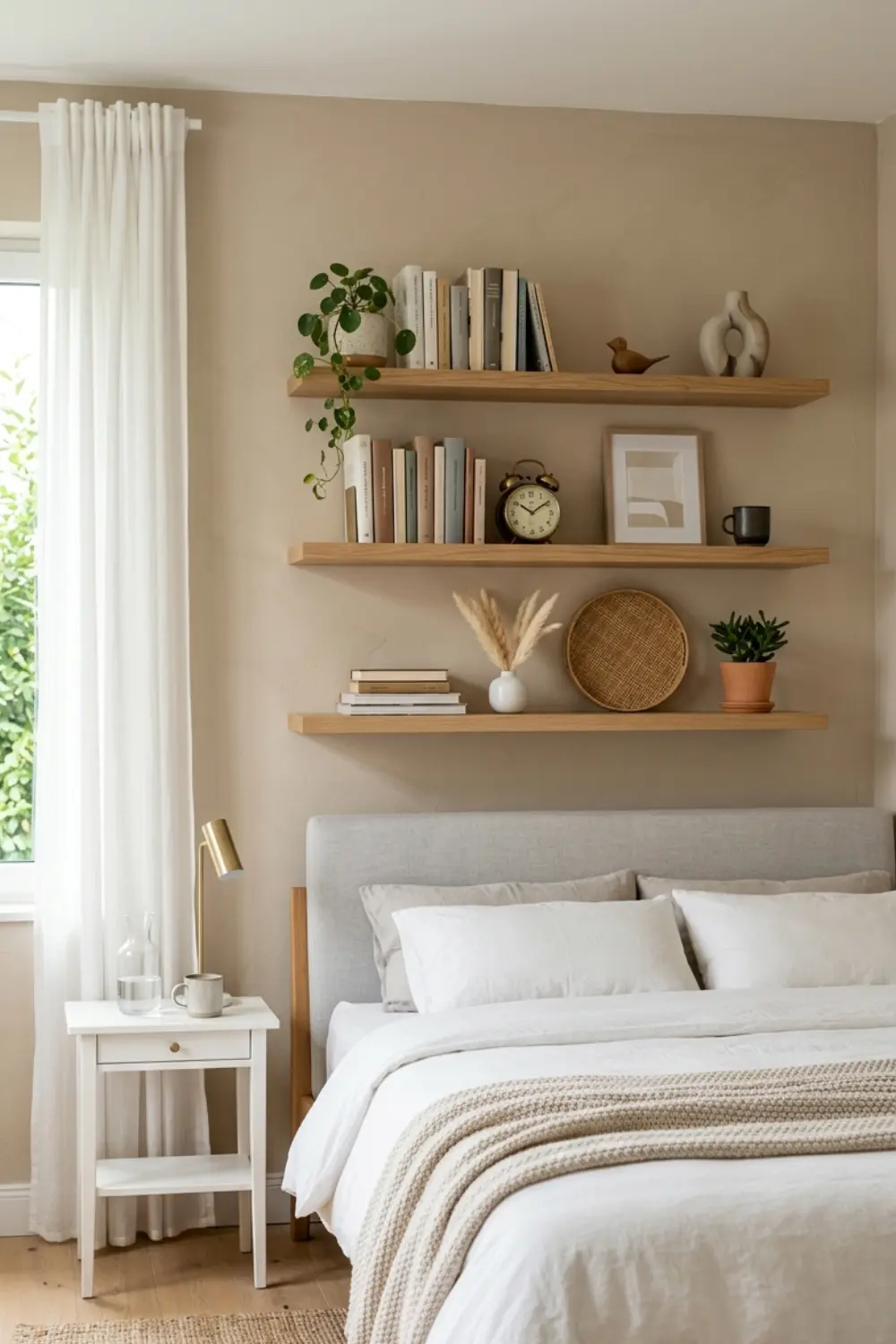
2. Install Floating Shelves to Free Up Floor Space
 Save it
The floor space is what really makes a small room feel cramped. The more furniture you have on the floor – nightstands, shelves, dressers – the more cluttered the space becomes. But when you start building upwards, the room suddenly opens up. The wall is not just a place for decoration, but a functional surface that you can use for storage. Floating shelves are simple, cost-effective, and dramatically increase storage capacity without taking up floor space. You can put them above the bed – this is where you can store your books, alarm clock, phone charger, or a little decoration. Or next to the closet, where you can store perfumes, cosmetics, and jewelry. Or even above the door, where you can store rarely used items.
The depth of the shelves matters. A shelf that is too deep will stick out from the wall and make the space look ugly. A shelf that is too shallow will not fit anything on it. Usually, a shelf with a depth of 5.91 x 7.87 inches is best – enough to fit a book, phone, or small bowl, but not so thick that it “sticks out”. The length depends on where there is space: it can be narrow 15 inches above a corner, or long 47 inches above the entire bed.
Floating shelves give visual lightness. Because the supports are not visible, it is as if the shelf is floating in the air. This makes the room optically more spacious, because there is no massive furniture that weighs down the space. And another advantage: if you are a renter, putting up a few shelves is much less of an intervention than bringing in a huge wardrobe. A few screws, dowels, and you are done.
You can vary the style: wooden shelves add warmth, white shelves blend into the wall, metal shelves create an industrial feel. But stay consistent – if you put up three shelves, all three should be the same material and color, otherwise it will look chaotic.
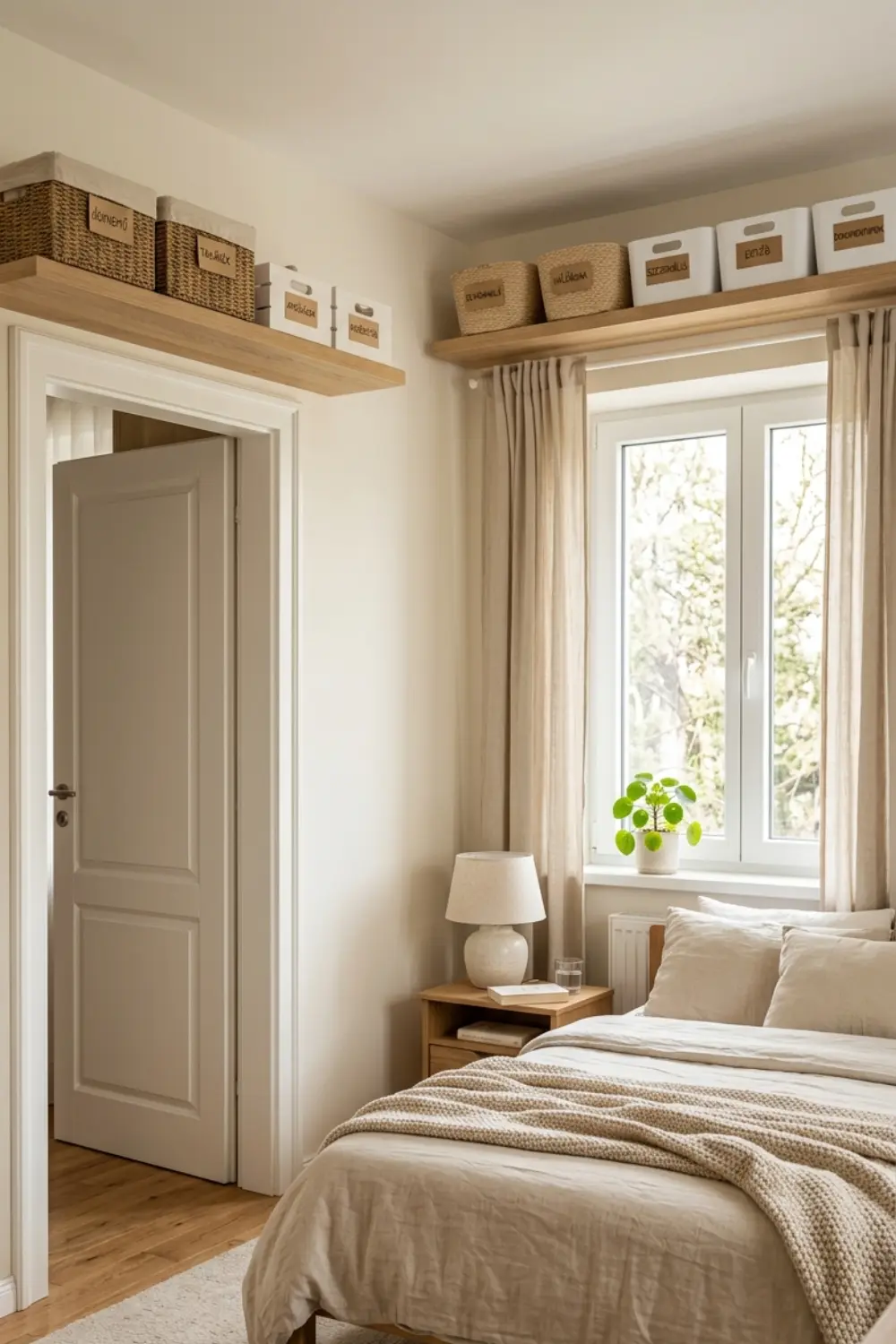
3. Use the Vertical Space Above the Door and Windows
 Save it
Everyone thinks of the walls when it comes to storage, but almost no one thinks of the area above the door or the strip above the window. However, these places are dead spaces – they do nothing, they are just there. But if you use them wisely, you will suddenly gain dozens of centimeters of storage space.
A narrow shelf or a shelving system can be pulled towards the door, where boxes and baskets can be placed. You can store out-of-season things here – winter scarves, hats in the summer, beach items in the winter. It does not have to be beautiful, because it is high up, it does not catch the eye. But it is a huge help in terms of storage function.
You can also put a narrow shelf above the window – here you can put more decorative elements, books, plants, because this area is more visible. But this way the window sill itself remains free, you do not have to cram everything there. This gives visual order.
Another option: a wall-rail system, which covers the entire wall, from floor to ceiling. You can hang shelves, hangers, baskets on this – and you can also put elements above the door or window. It’s a modular solution that can be expanded and changed later. If you use more of the space vertically, you have to take up less horizontally.
The trick, if you store things high up, use labels or transparent boxes so you know what’s inside without having to take them down. This way you save time, energy, and you don’t have to unpack everything when you’re looking for something.
4. Swap Bulky Nightstands for Wall-Mounted or Slim Alternatives
 Save it
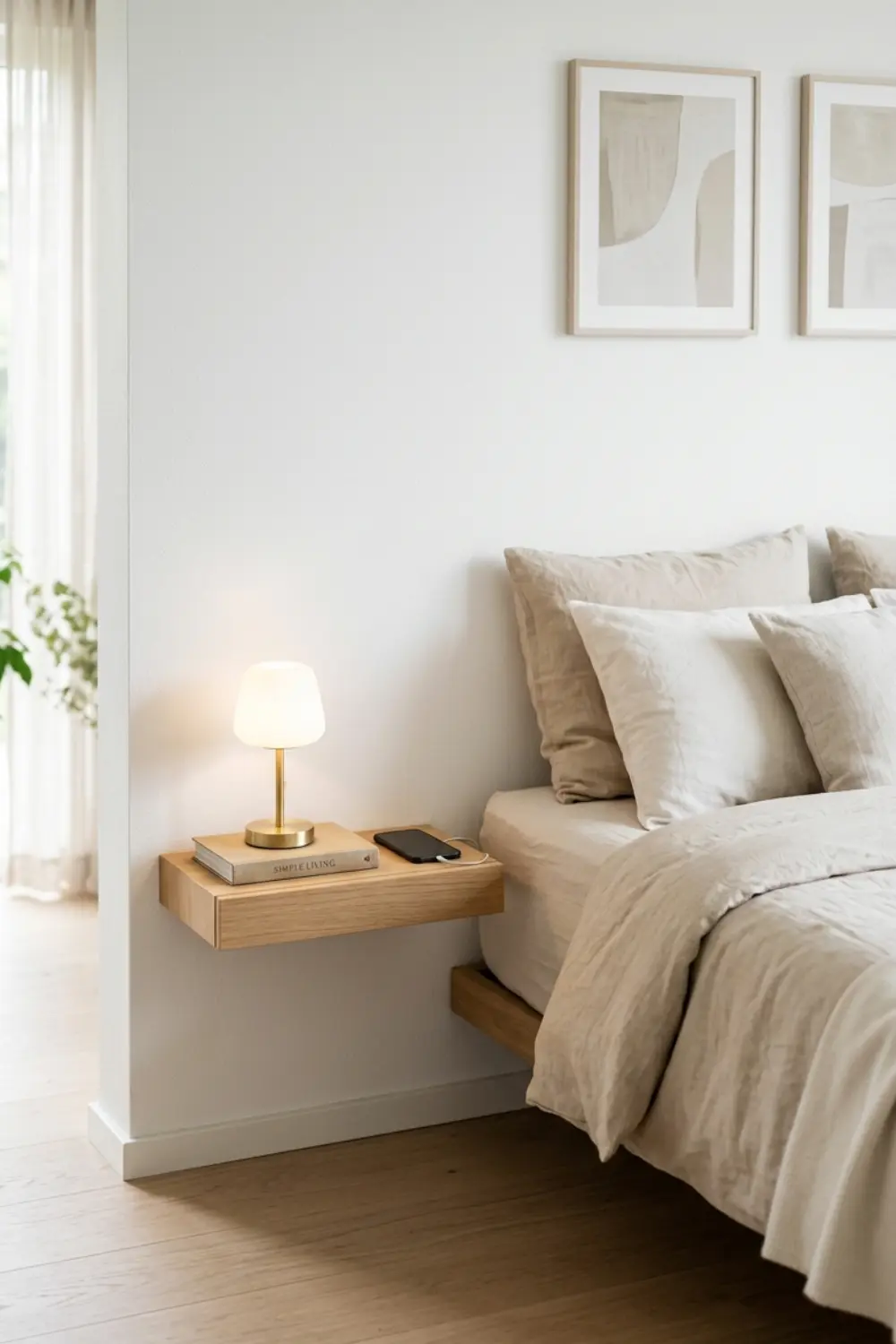
The nightstand is one of the biggest floor-savers in a small bedroom. Many models are wide, deep, and have multiple drawers – and in a small room, this is simply too much. But you can’t completely avoid it either, because you need a place to put your phone, book, or glass of water. The solution is a slim, wall-mounted nightstand or a floating shelf. It attaches to the wood, doesn’t take up any floor space, and is visually much lighter. A narrow shelf is enough – it holds everything you need, but doesn’t weigh down the space. If you want a drawer, there is a version that is combined with a mini drawer, but it is still much more compact than a classic nightstand.
As another option use a narrow small table or seat that performs several functions. You can sit on it during the day and function as a nightstand at night. Or a small ladder-shelf system, the lower level of which is a nightstand, and the upper level is storage. This works especially well if you have space on two sides of the bed – a ladder shelf on one side and a floating shelf on the other. This gives you an asymmetrical but functional layout.
Style matters here too. In a modern minimalist bedroom, a white floating shelf blends perfectly into the wall. In a rustic space, a wooden console adds warmth. In a mid-century modern space, a small table with slender legs fits in. But regardless of the style: think thin, tall, and preferably wall-mounted.
5. Opt for a Wardrobe With Mirrored Doors to Expand Visual Space
 Save it
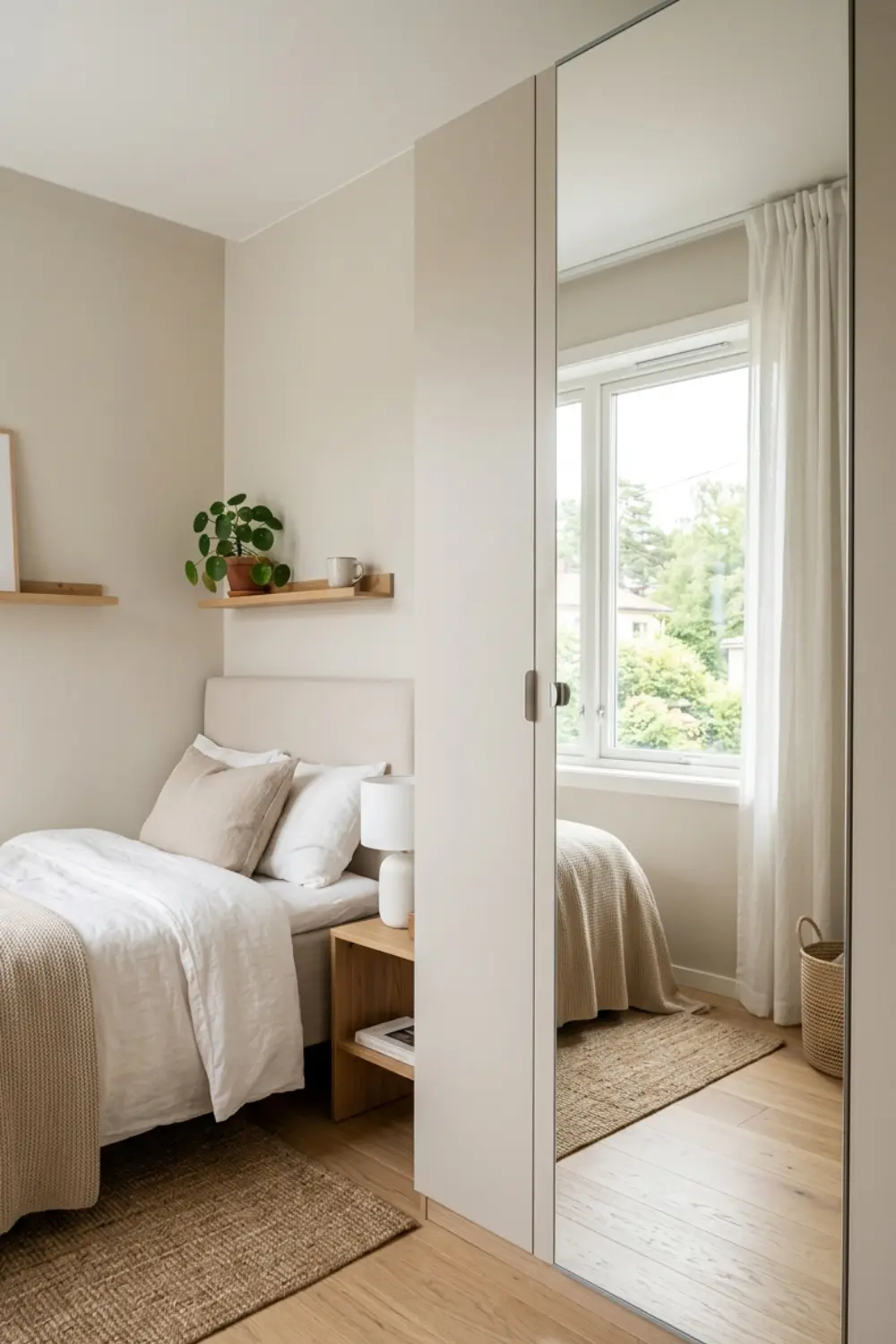
A mirror is one of the most effective ways to visually enlarge a space without adding a single square centimeter. A mirror doubles the visible area, reflects light, and adds depth to the room. And when you combine it with a functional piece of furniture, such as a wardrobe, you get a double benefit. A mirrored cabinet not only provides storage, but also visually expands the room. If the cabinet is opposite the window, it reflects natural light, making the room brighter. If it is opposite the door, when you enter, you will not see a solid piece of furniture, but an extension of the space.
This is especially effective in narrow, long rooms, where the cabinet stands along one wall. The mirror optically expands the space, because the opposite wall appears in it. And the best thing: you do not need to hang a separate wall mirror – the cabinet does this itself.
What to watch out for: a mirrored door only works well if the space in front of the wardrobe is tidy. If there is chaos, the mirror will reflect it and make the room even more chaotic. So this is a solution that also requires discipline – keep the area in front of the wardrobe tidy, and the mirror will only help.
If you buy a new wardrobe, choose a full-height mirrored door – not just a small mirror on the door, but the entire door should be a mirror. This will maximize the optical effect. And if possible, the mirror should be of high quality, clean, not wavy or distorted, because cheap mirrors spoil the effect.
If you have an existing wardrobe that does not have a mirror, but you do not want to buy a new one, then try to place a wall mirror strategically – on the wall opposite the bed to visually increase the space. But mirrored cabinet doors are better because they combine function and optical illusion.
6. Invest in Under-Bed Storage Boxes or Bins
 Save it
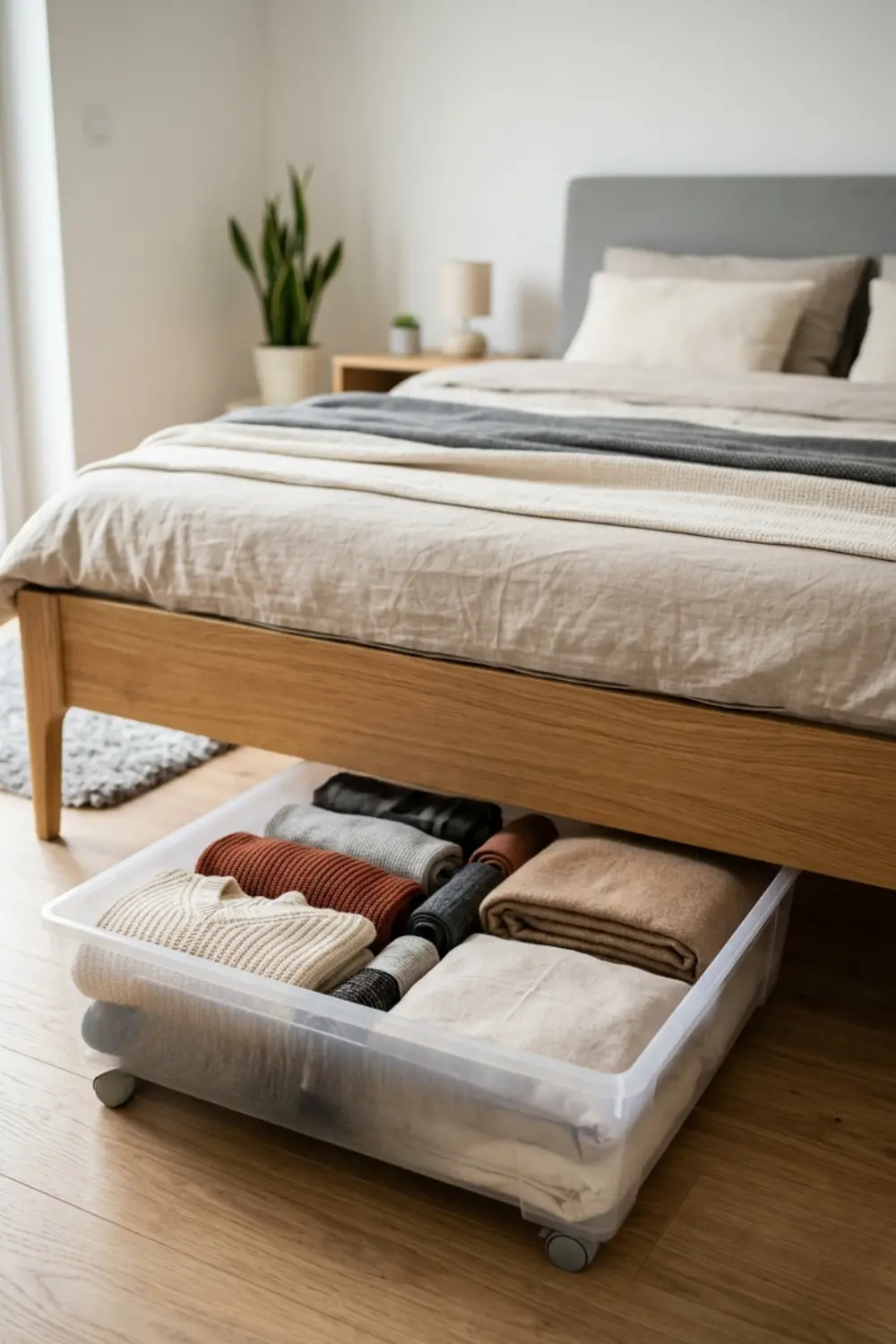
The space under the bed is one of the biggest underused areas in a bedroom. If you have a regular bed—not a storage frame—there’s a huge void there that collects dust. But with a few well-chosen storage containers, this space can be used to store a ton of stuff. The key is to choose flat, rolling storage containers that are easy to pull out but still fit under the bed. Everything that’s seasonal or rarely used can go here: winter blankets, summer clothes, extra pillows, shoes, sports equipment.
The material of the boxes matters. A plastic box is durable, easy to clean, and you can see what’s inside if it’s transparent. A canvas box is softer, looks better when it slides out from under the bed, but is harder to clean. A wooden box is the most stable, but also the heaviest.
It’s important that the bed is high enough to accommodate the boxes. If your bed is too low, you can use bed risers – this will raise the bed by 1.18 to 2.36 inches and suddenly there will be more space under it. It’s a small intervention, but it makes a huge difference.
Don’t fill your storage boxes completely – leave a little space so that it can be pulled out easily, don’t suffer with it. And label them: “winter clothes”, “extra bedding”, “sports equipment” – so you don’t have to pull everything out when you’re looking for something.
If you really want to be organized, use identical boxes – all the same size, color, shape. This gives a uniform look, and if someone sees the bottom of the bed, it doesn’t look chaotic. But if the boxes are completely covered, you can even use different ones – the only thing that matters is function.
7. Choose Multi-Functional Furniture Wherever Possible
 Save it
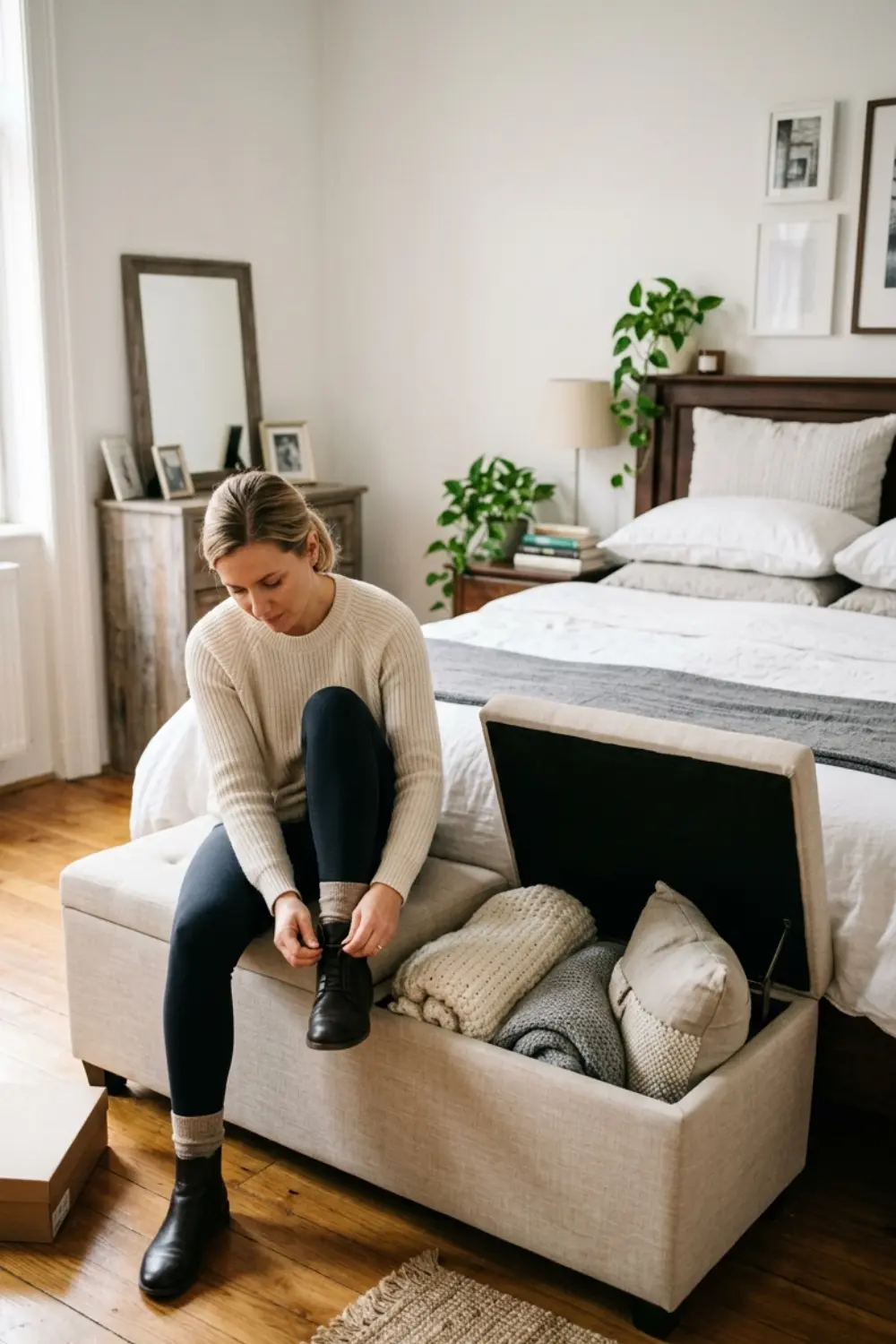
In a small bedroom, every square inch counts, and if a piece of furniture only serves one function, it’s a waste. Multi-functional furniture is brilliant because it can do two or three things at once, so you get the same functionality with less furniture. For example, a bench at the end of the bed, which is also a storage box. You can sit on it when you put on shoes, but there’s also storage space inside – bedding, extra pillows, clothes. This replaces a chair and a storage cabinet. Or a small table that is both a bedside table and a desk. This is where you work with your laptop during the day, and where your book and phone are at night. If you choose the size wisely, a compact table can do everything without having to keep two separate pieces of furniture.
Another example: a headboard with shelves, which provides storage and decoration at the same time. You don’t need a separate shelf on the wall, because it’s already built into the headboard. This is where you can put your book, alarm clock, lamp, and small plant. And since it’s behind the bed, it doesn’t take up any floor space.
When choosing multi-functional furniture, the question is: what do I need every day? And is there a piece of furniture that can fulfill more than one of these needs? If the answer is yes, then this is the one you should buy. Don’t buy a separate chair for reading, a separate bench for putting on shoes, or a separate storage unit for pillows – buy one piece that does all three.
Minimalist style works especially well with multi-functional furniture, because clean lines, neutral colors, and simple shapes can be easily combined. But it also works in a rustic or boho bedroom if you choose pieces made of wood or natural materials.
8. Create Zones to Mentally Organize the Space
 Save it
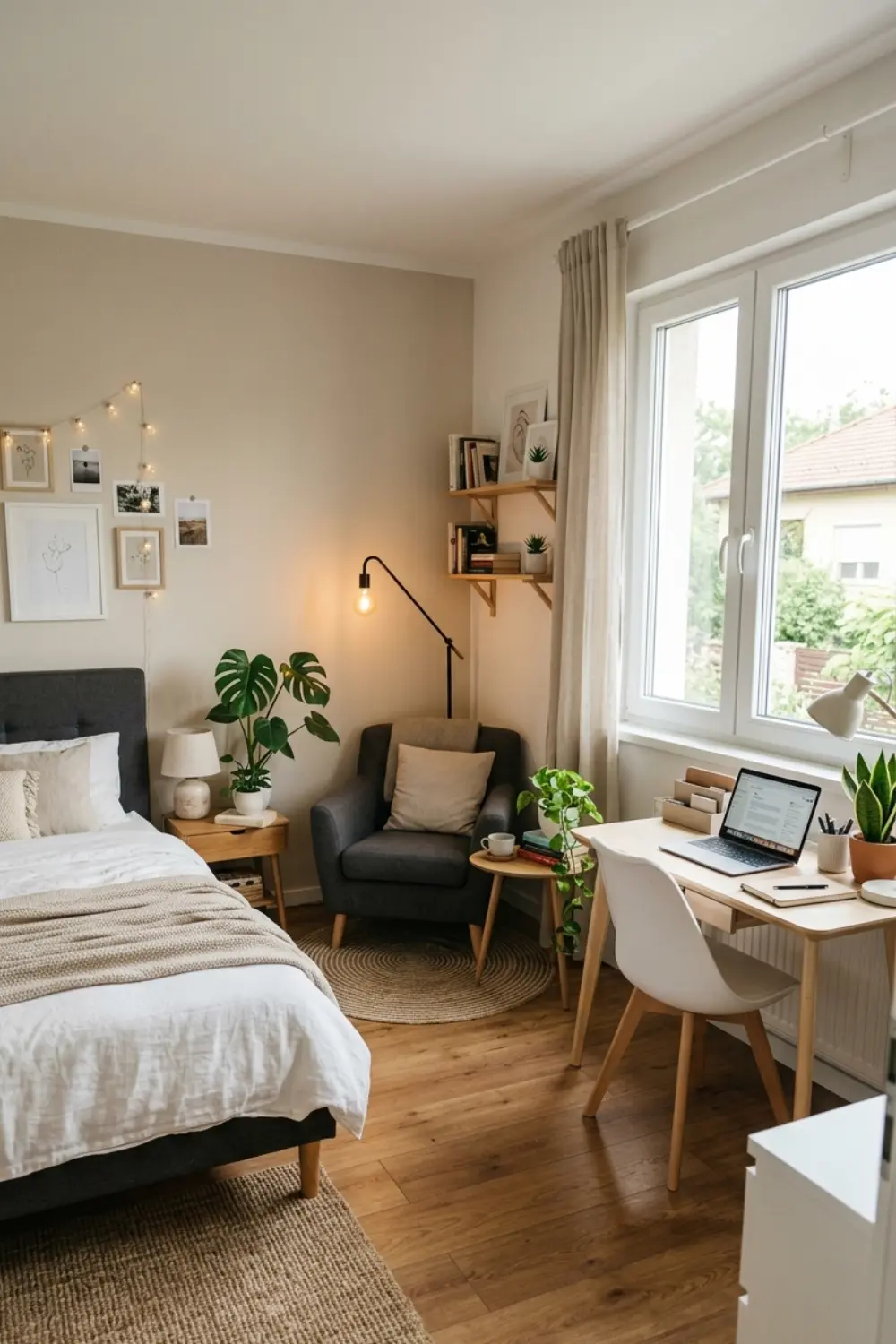
In a small bedroom, it’s easy to feel like everything is a big pile, there’s no structure. But if you create small zones – sleep, dress, work, rest – then the space will be more mentally organized and easier to navigate. This doesn’t mean you have to put up physical partitions. It’s enough to mark the zones with rugs, furniture, and lighting. For example, a small rug around the bed – this is the sleep zone. A narrow runner in front of the wardrobe – this is the dressing zone. An armchair with a small lamp in a corner – this is the reading zone.
Zones are important because they help you not feel like you’re doing “everything at once”. When you’re working, sleeping, eating, relaxing in bed – then your brain can’t differentiate and you’re always in a semi-active state. But if you have a dedicated work area (even if it’s just a small desk), when you’re there, you’re working, when you’re in bed, you’re resting. It gives you mental boundaries.
Lighting also helps you create zones. Soft, warm light by the bed – that’s getting ready for sleep. Stronger, whiter light by the desk – that’s concentration. In the reading area, it’s in between – bright enough to see, but not too harsh. If you use multiple lights, you can consciously control which zone you’re activating at the moment.
If you’re interested in more in-depth information on how to design your bedroom lighting by zone and mood, read my article [Brighten Your Bedroom the Modern Minimalist Way: Expert Lighting Ideas], where I go into detail about the logic of layered lighting. Don’t be too rigid when creating zones – in a small room, not every zone needs to be huge. Just have a corner, a small area that represents that function. The point is mental distinction, not physical separation.
9. Hang Hooks and Pegboards for Flexible Storage
 Save it
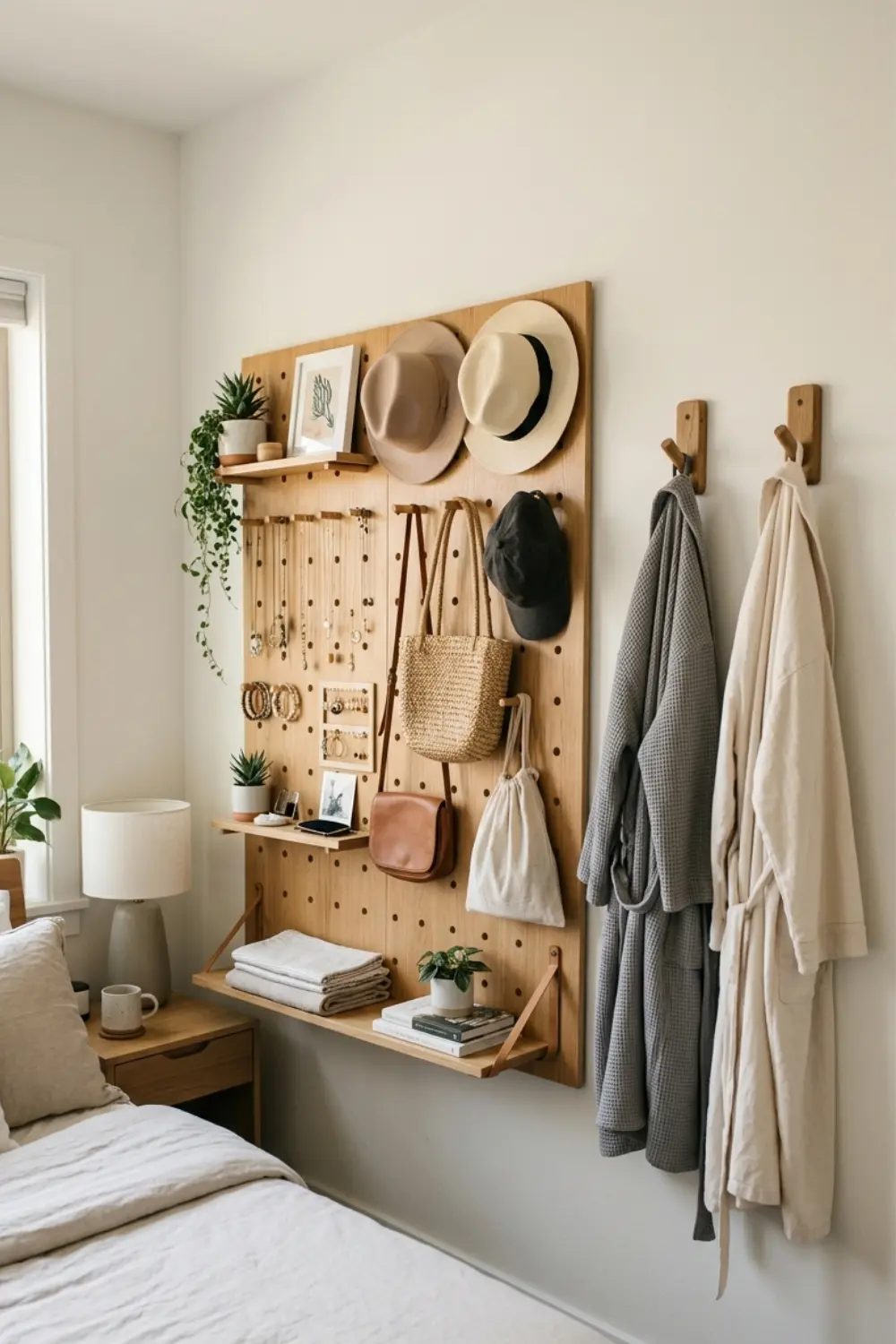
Wall-mounted storage systems – hooks, pegboards, rail systems – are flexible, easy to install and do not take up floor space. This is especially useful if you want to store things that you use often and want to reach quickly. A pegboard on the wall next to the bed can be perfect for storing jewelry, watches, bags. Everything is visible, everything is accessible, and it can also be visually decorative if you organize it well. The advantage of a pegboard is that you can rearrange the hooks at any time – today the watch is here, tomorrow the bag is there. It is completely customizable.
Hooks behind the door, on the side of the closet, on any part of the wall – these are small interventions, but they help a lot. You can hang your robe, pajamas, bag on a hook – things that you don’t want to put in the closet every day, but you don’t want to leave on the chair either.
The style of the hooks matters – metal hooks in a modern room, wooden or antique-effect hooks in a rustic room, white or transparent hooks in a minimalist room. But regardless of the style: don’t put too many – too many hooks will make the wall look cluttered, and then it’s no longer storage, but visual noise.
Another option: a clothes rack with an open system if you don’t have enough space in the closet. This isn’t ideal in the long run, because everything is visually visible, but if you organize it minimalistically – only the most frequently used items – it can work. And if it has nice, uniform-colored clothes on it, it can even act as decoration.
The important thing is not to overuse wall storage systems – don’t fill every inch of wall space. Leave some empty space, because that gives the room air. The goal is balance: enough storage so that everything isn’t on the floor, but not so much that the walls are overcrowded.
10. Use Light Colors and Minimal Patterns to Open Up the Room
 Save it
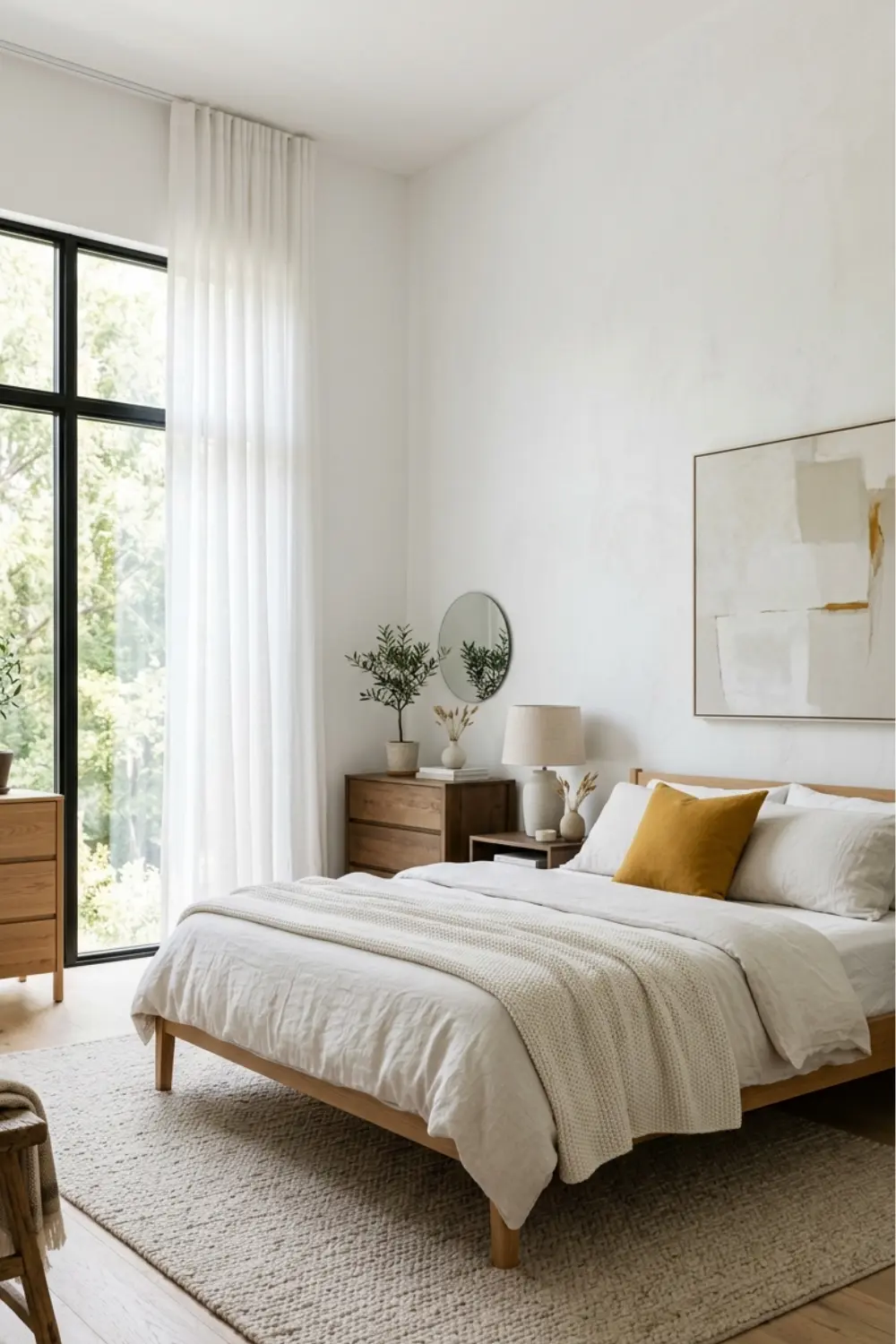
Color plays a huge role in how spacious or cramped a room feels. Dark colors absorb light and visually narrow the space. Light colors, on the other hand, reflect light and make it feel larger. In a small bedroom, stick to a light, neutral palette – white, off-white, light gray, beige, soft pastel tones. This doesn’t mean it has to be boring – a variety of textures and materials adds depth. A white wall with white bedding can also be rich with white curtains if you have linen, cotton, velvet – different textures that look different in the light.
Patterns also matter. Big, bold patterns visually narrow the space – a floral wallpaper, a large geometric pattern on the curtains. These can be beautiful on their own, but in a small room they provide too much visual information and the eye can’t rest. Instead, opt for subtle, small patterns or solid colors. If you want to add color, do it in accents – pillows, a blanket, a rug, an art print. These are interchangeable, can be changed seasonally, and don’t tie up as much as a painted wall or a large piece of furniture. Keep the walls, ceiling, and large pieces of furniture neutral – these are the foundation you can build on.
Another advantage of light colors is that natural light spreads better throughout the space, and the room is brighter all day long. If you have dark walls, the space can seem dark even with lots of windows. But if the walls are light, the light will reflect and every corner will be illuminated. The ceiling also matters – if you paint the ceiling a light color (white or very light gray), the room will appear higher. This is especially important if the ceiling is low – the light color “lifts” it.
11. Declutter Regularly and Keep Only What You Actually Use
 Save it
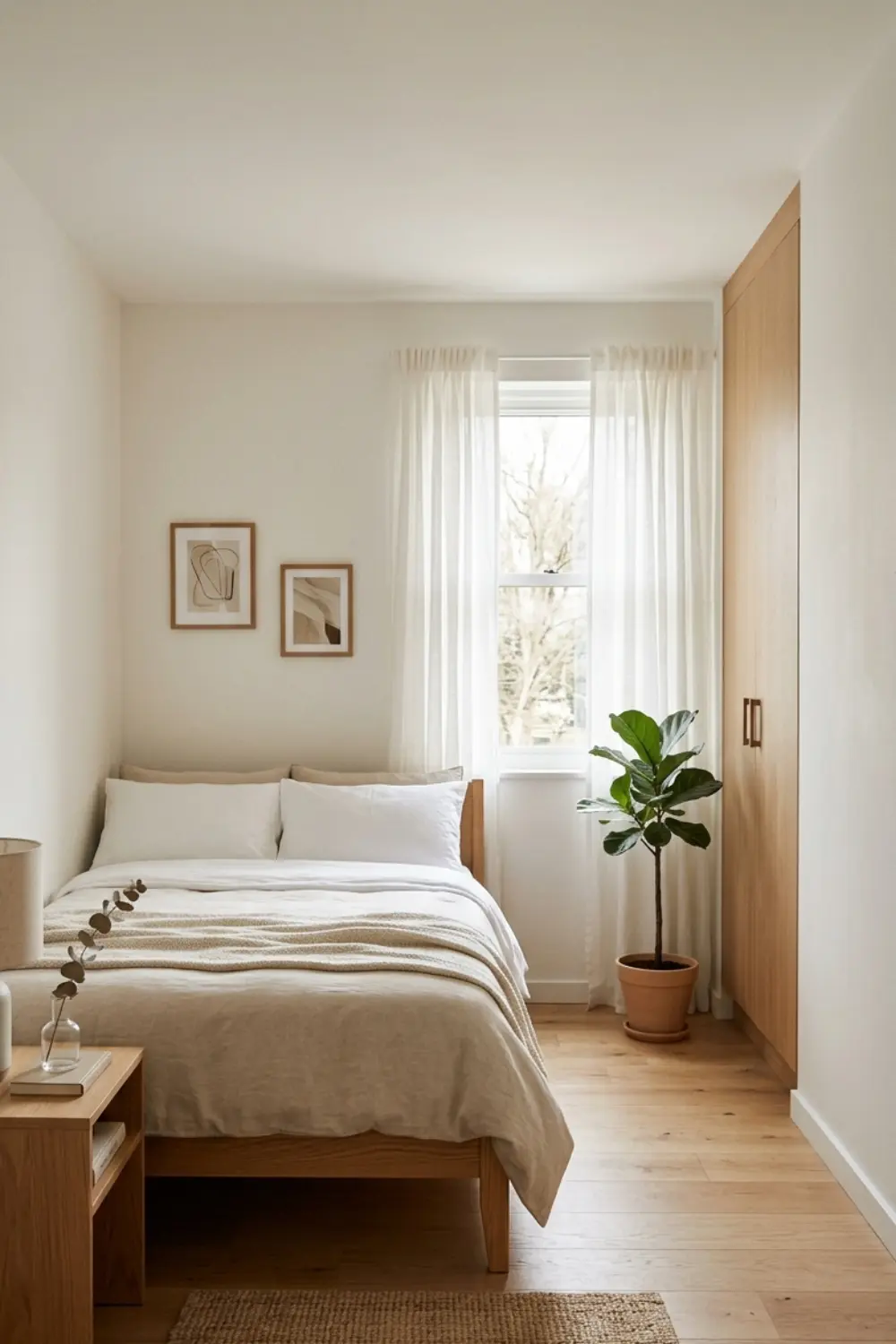
There are not many storage tricks that will solve the problem of having too much stuff. The best storage solution is to store less stuff. This is not minimalist propaganda – it’s simple logic. The less stuff you have, the easier it is to keep organized, the more spacious the space, the less oppressive the room feels.
Start with a simple rule: if you haven’t used an item for six months and don’t plan to use it in the next six months, then it has no place in your bedroom. It may have sentimental value – then put it somewhere else, in the basement, attic, storage. But in the bedroom, only the things you really need on a daily, weekly basis should be there. This is not a one-time process, but regular maintenance. It’s worth looking at it every month or quarter: what am I no longer using? What is just taking up space? And throw it away, sell it, donate it. Because your bedroom is not a warehouse – it’s a place to rest.
The mental effect of decluttering is also huge. When there is less visual noise, the brain is more rested. When you know where everything is, you don’t spend five minutes in the morning looking for something. When you don’t pile up with stuff, you don’t feel “choked” by the space. It gives you a sense of freedom.
If sorting is difficult, use the “one in, one out” rule: when you buy a new item of clothing, sell/throw away an old one. That way, it doesn’t pile up, and you always have only what you have. This keeps you disciplined and helps you consciously decide what you want to keep.
If you want to dive deeper into how to reorganize your closet so that everything is easily accessible, visible, and organized, check out my article [Closet Organization Ideas You’ll Fall in Love With], where I walk you through the logic of categorization, storage boxes, and a visual system.
12. Layer Lighting for Functionality and Ambiance
 Save it
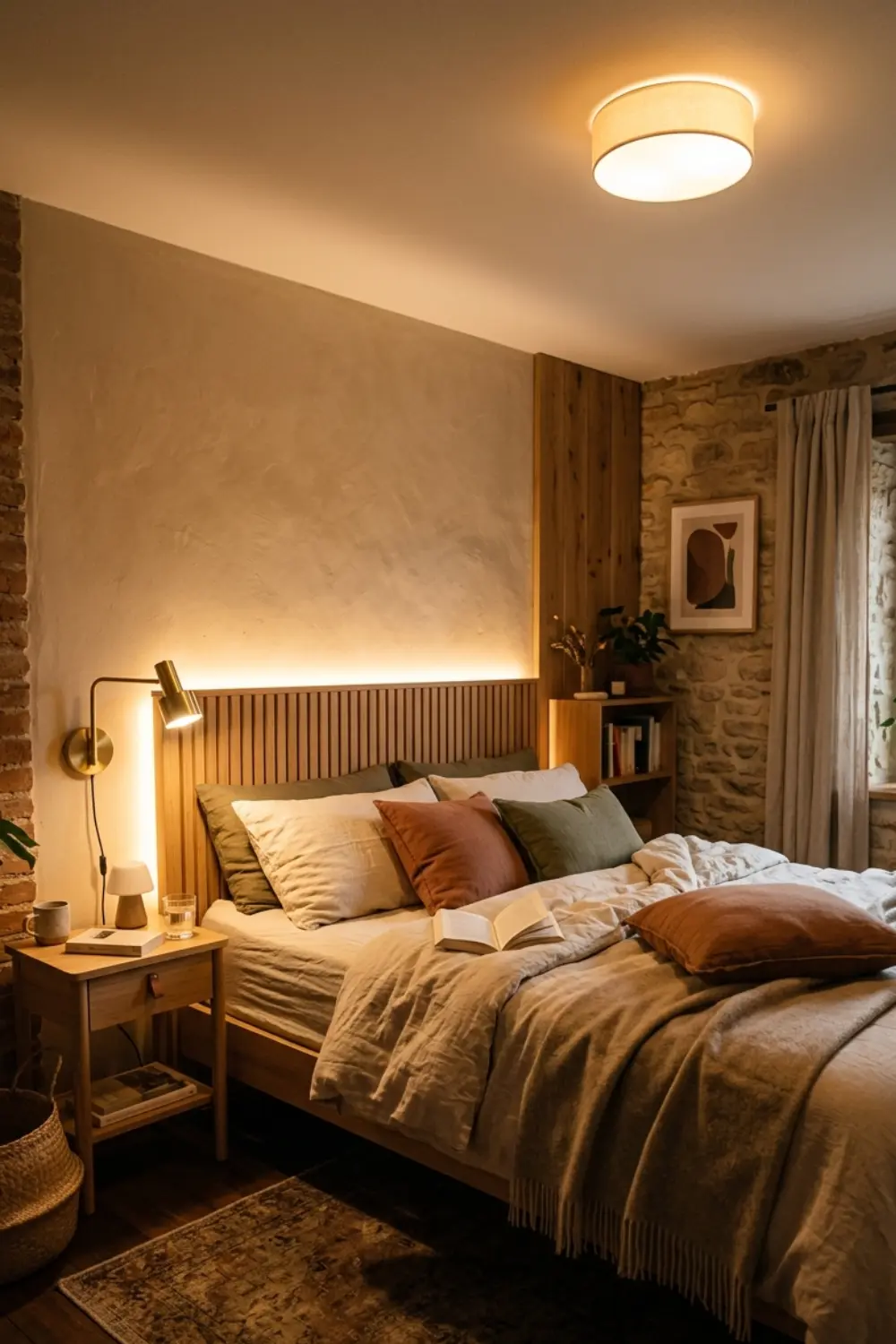
Lighting is not just about seeing. Lighting determines the mood, functionality, and how spacious a room feels. In a small bedroom, it’s especially important to have layered lighting – multiple sources with different functions.
First layer: general lighting – this is the ceiling light or central light source that illuminates the entire room. Don’t let it be too harsh, don’t let it be cold white – choose a warm-toned LED bulb, which is more pleasant. This lighting is for seeing while cleaning, tidying up, getting dressed.
Second layer: task lighting – this is the reading light, the desk light, the dressing corner light. These are stronger, directed, and focused on a specific activity. If you read in bed, you need an adjustable reading light that doesn’t illuminate the entire room, just the book.
Third layer: mood lighting – this is the background light that creates atmosphere. It can be an LED strip behind the bed, a salt lamp, or a candle. This light is soft, dim, not for lighting, but so that the room is not completely dark and has a subtle, soothing glow.
The advantage of layered lighting is that you can control the mood. In the morning, you turn on the general lighting so that you can see. In the evening, you turn it off and leave only the mood light on to be relaxing. When working, you turn on the task lighting, and when you rest, you turn it off. In a small room, avoid large, hanging chandeliers – they visually depress the ceiling and make the space seem narrower. Instead, use a flat ceiling lamp or built-in spotlights. And the more indirect light (reflected from the wall, LED strip), the softer and more spacious the space will be.
13. Avoid Overcrowding With Too Many Decorative Items
 Save it
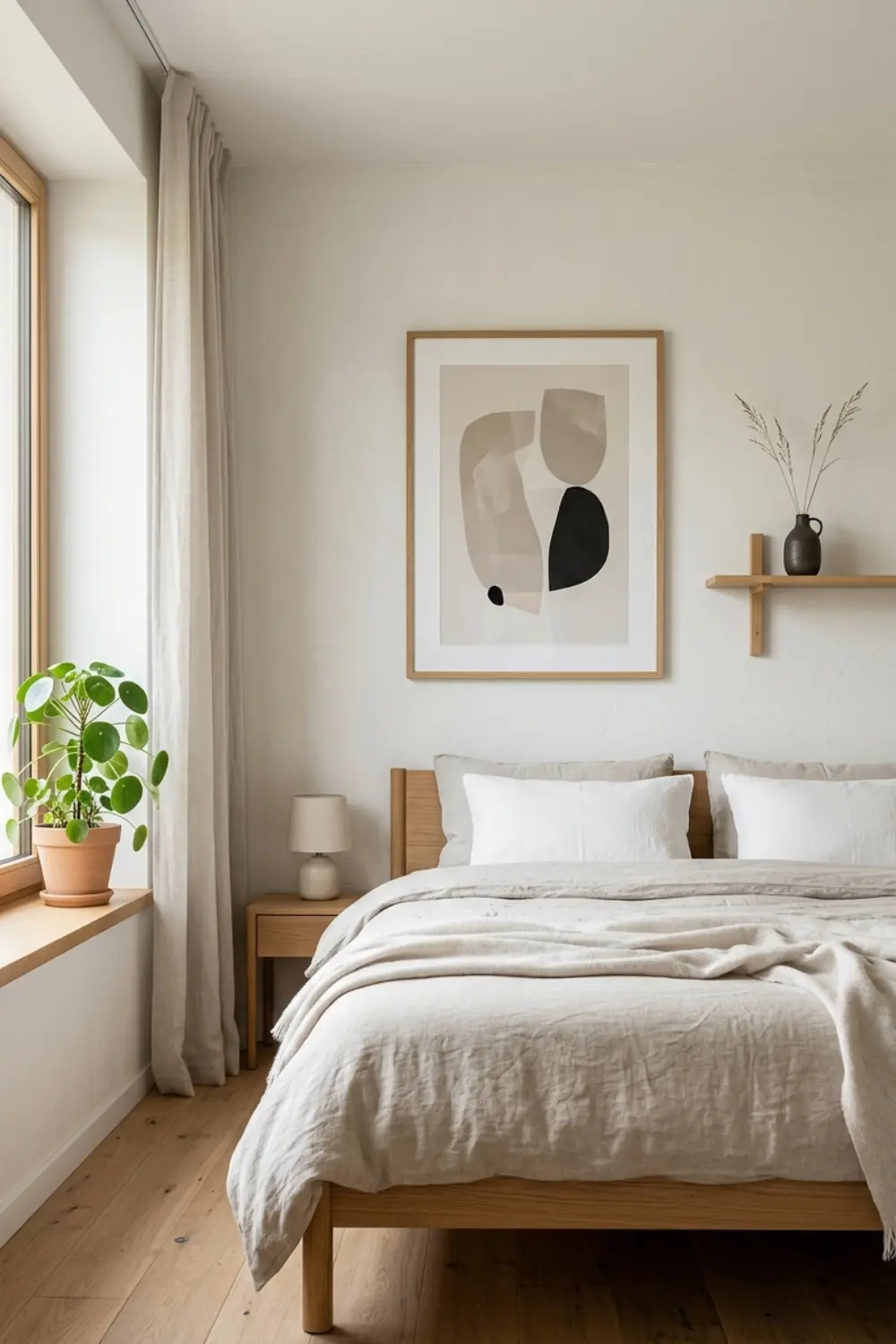
Decor is important – it personalizes the space, it shows who you are. But in a small bedroom, too much decor visually overwhelms the space, and instead of being beautiful, it becomes cluttered.
The golden rule: choose a few favorite pieces and highlight them. It can be a large art prints on the wall, a beautiful vase on the shelf, a plant in the window. But don’t have everything everywhere – don’t have shelves full of small sculptures, photos, candles, books at once. Because then you don’t see the individual pieces anymore – you just see a lot of visual noise.
The principle of “less is more” is especially true here. A well-chosen print says more than ten random pictures. A large plant gives more life than five small ones. A beautiful candle is more elegant than ten random candles.
When placing decorations, think about grouping – don’t scatter things randomly. Instead, group them: three books on a shelf, a vase next to it, and that’s it. This creates visual unity and makes it look organized, even if it’s simple.
Colors also matter. If your decor follows the room’s palette – for example, all neutral tones, or everything in the same color family – then it will be unified. If it’s completely random colors – red, blue, green, yellow all at once – then it’s chaotic.
And finally: don’t force your decor. Just because you have a shelf doesn’t mean it has to be full. It can be just two things on it, and that’s it. Empty space is also part of the design – it gives air, clarity, and visual rest.
14. Invest in Quality Over Quantity for Key Pieces
 Save it
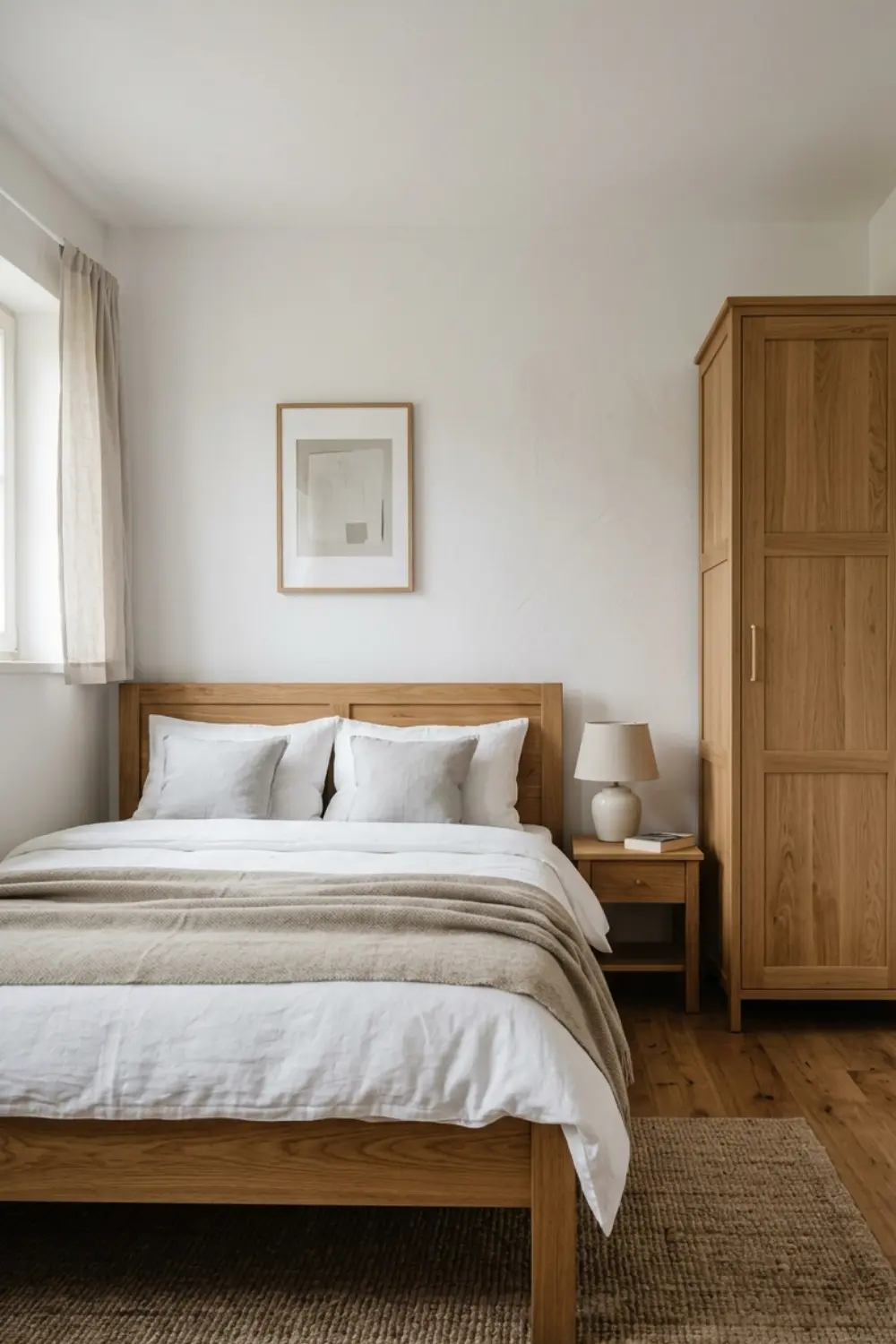
In a small bedroom, you don’t have room for a lot of furniture, so what you keep should be good. It’s not worth buying ten cheap, flimsy pieces of furniture that will break, look ugly, and look bad. It’s better to buy fewer pieces, but they should be quality, durable, and timeless. For example, the bed – this is the largest and most important piece of furniture. Don’t buy a random, cheap bed just because it’s available. Buy one that’s stable, comfortable, and comes with built-in storage or a quality frame. It’s a long-term investment. If you’re thinking about a good bed, read my article [Transform Your Space: The Best Bedroom Essentials You’ll Love], where I’ve compiled in detail the essential elements you need for a well-functioning bedroom.
The same goes for the wardrobe – if you can buy a cheap, flimsy wardrobe that will fall apart in five years, or a more expensive, but durable, high-quality piece that will last for decades, then the latter is the better choice. Because you don’t have to replace it, it’s less frustrating, and it looks better. Quality doesn’t always mean the most expensive brand. But it does mean good materials (solid wood vs. chipboard), solid construction (screws, frame), clean design (that doesn’t go out of style). And it also means that you’ll enjoy it for a long time, not replace it every year.
When you’re working with a small room with few pieces of furniture, every piece counts. So make sure each piece is something you love, something that works well, and something that will last. This may seem more expensive in the short term, but it’s cheaper in the long term because you don’t have to replace it all the time.
15. Use Slim, Tall Storage Units Instead of Wide Ones
 Save it
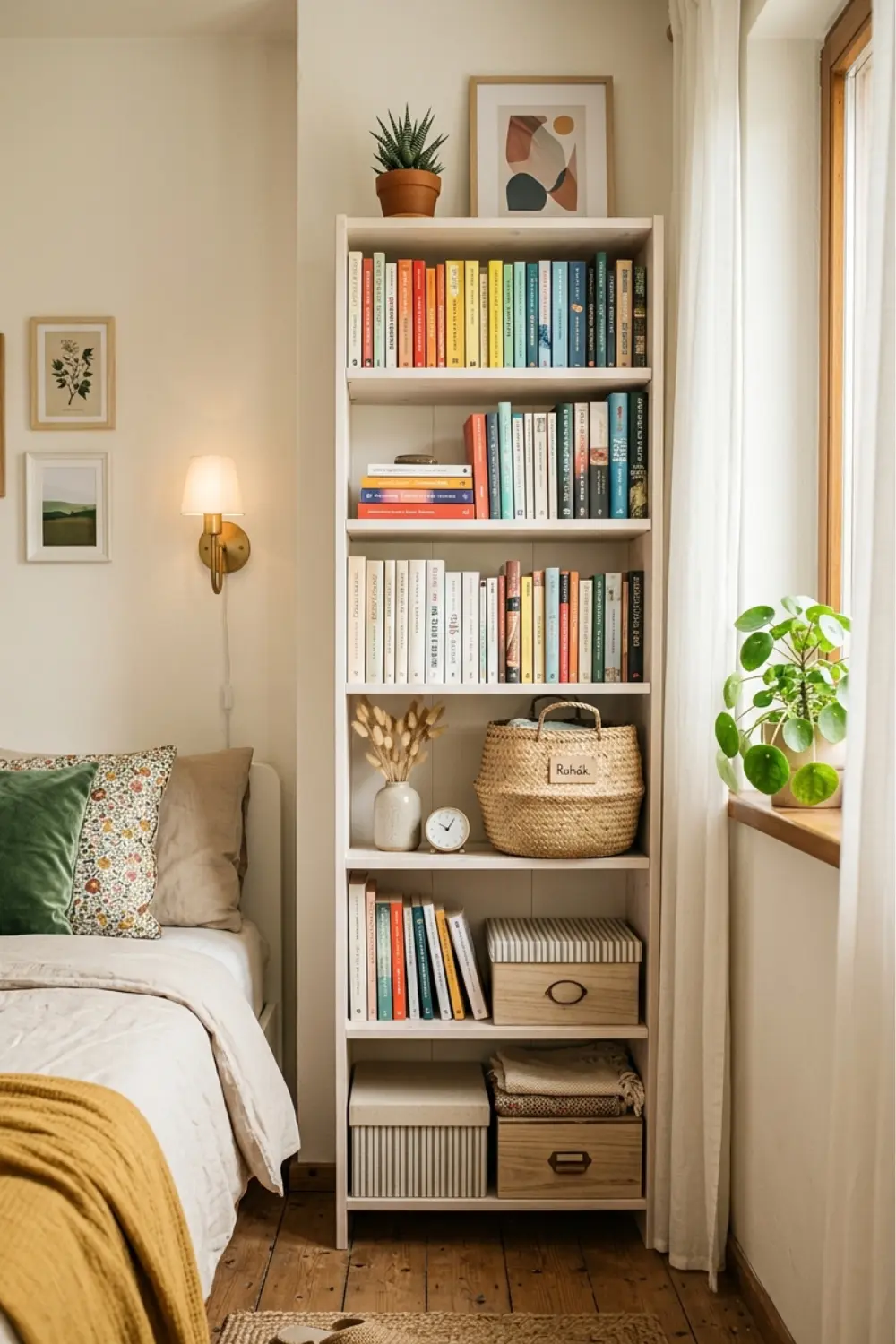
When choosing storage furniture, think vertically, not horizontally. A wide, low dresser takes up a lot of floor space and is visually “heavy.” A narrow, tall shelving unit or cabinet, on the other hand, provides the same amount of storage, but takes up less space and is visually slimmer. Tall furniture works in a small room because it takes up space on the wall instead of the floor. And because it’s narrower, it’s easier to fit in corners, next to doors, next to windows – places where a wide piece of furniture wouldn’t fit.
A narrow, tall bookcase is perfect for a corner – it doesn’t take up much space, but it can hold a lot of books, decorations, storage boxes. Or a narrow, tall dresser – five or six drawers on top of each other, instead of three drawers across.
Another advantage of slim furniture: it’s visually lighter. It doesn’t weigh down the space, it doesn’t dominate the room. Especially if they are light in color – white, light wood, gray – they almost blend into the wall.
When choosing furniture, always look at the dimensions: width, depth, height. And ask yourself: is there a version that is narrower but taller? Because usually there is, and that is the better choice for a small room.
Rental-Friendly Solutions and Removable Options
If you’re a renter, most structural changes – drilling, painting, built-in furniture – aren’t an option. But you can still create smart, functional spaces, just with different tools.
Use Command Picture Hanging Strips for pictures, shelves, hooks: they don’t leave a mark on the wall, but they hold a surprisingly high weight. This way you can create wall storage, decor, and systems without drilling holes.
Freestanding furniture: shelving units, cabinets, racks – that lean against the wall but don’t drill into it. They give you mobility – if you move, you can take them with you. And because you’re not fixing them, they don’t cause any damage.
Flexible textiles: curtains, rugs, throws – that define the space, set the mood, but aren’t permanent. A large rug creates a zone under the bed, a curtain separates a small work area, a blanket brings color to the space. And when you move, you can take all of these with you.
Furniture on wheels: which is easy to move, so it’s flexible. A small table on wheels can be a nightstand, a desk, a tray – depending on where you move it. A clothes rack on wheels can be temporary storage when the closet is full.
The advantage of tenant solutions is not only that they don’t destroy the apartment, but that they are flexible. If you try a layout and it doesn’t work, you can simply rearrange it. No need to tear it down, repaint it, or re-drill.
Now that we’ve gone through the fifteen specific ideas, let’s move on to the mistakes that most people make when trying to furnish a small bedroom.
Common Mistakes to Avoid
1. Choosing furniture that is too big
A king-size bed in a 10 square meter room will take up almost the entire space, leaving no room for anything else. Even if it technically fits, it will be visually overwhelming. Choose a smaller bed – a double or queen – and leave some air around it.
2. There is no vertical thinking
All the furniture is low, wide, and on the floor – and the wall is empty. And the wall is a huge unused surface. If you don’t use the height, you won’t get the most out of the room. Think upwards, not outwards.
3. Overdecorate the space
They think that if they put a lot of things on it – pictures, candles, plants, pillows, blankets, rugs, sculptures – it will make it personal. But in reality it will just be cluttered. In a small room, less is more – choose a few favorite pieces and highlight them.
4. Some people neglect lighting
There’s only one ceiling light, and it makes everything either too bright or too dark. There’s no layering, no control. And it’s not just a functional problem, it’s also a mood problem – bad lighting can turn even the most beautiful room into a flat, unfriendly space.
5. Don’t declutter your space regularly
You pile things up because “I might need them,” “it reminds me of something,” “I’ll use them someday.” And in the meantime, you have less and less space for the things you actually use. Decluttering isn’t a one-time event, it’s an ongoing maintenance.
Frequently Asked Questions
How to make a small bedroom look bigger?
Use light colors on the walls and large furniture, maximize natural light, use mirrors to visually double the space, and keep the floor free. Vertical storage, floating furniture, and minimal decor can also help make a room feel more spacious.
What size bed is best for a small bedroom?
Usually, a queen size is the best compromise – it’s big enough to sleep comfortably on, but not as huge as a king size, so there’s room for other furniture. If space is really tight, a double/full size will also work.
How do I store clothes if I don’t have enough closet space?
Use the space under the bed with storage boxes, install floating shelves or pegboard on the wall, or buy a narrow, tall wardrobe. An open clothes rack can also work if you keep it minimalist. And always be selective about what you keep – the fewer clothes you have, the easier it is to fit.
Final Thoughts
A small bedroom is not a disadvantage – it’s a challenge that makes you better at designing. Because when space is limited, you can’t be lazy. You can’t just buy random furniture, you can’t just pile it on top. You have to think, prioritize, and be creative. And when you do it right, the result is a space that not only works, but also looks better than most large bedrooms that lack structure.
Start small. Pick one or two things – say, add floating shelves or replace your nightstand with a slim, wall-mounted version. Try it, see how you feel. Then move on. Because transforming a small bedroom isn’t a one-time project – it’s a process where you gradually build a space that supports, soothes, and works.
And remember: the goal isn’t to make it perfect. The goal is to make it work. So that you can easily find what you need every morning. So that when you walk in at night, you don’t feel stressed, but relaxed. So that the room isn’t a warehouse, but a place where you can relax. Once you have that, everything else – the design, the style, the decor – is just icing on the cake.
This post contains affiliate links. I may earn a small commission at no extra cost to you.
READ FOR THE NEXT STEP?
KEEP READING
Continue with another helpful idea.
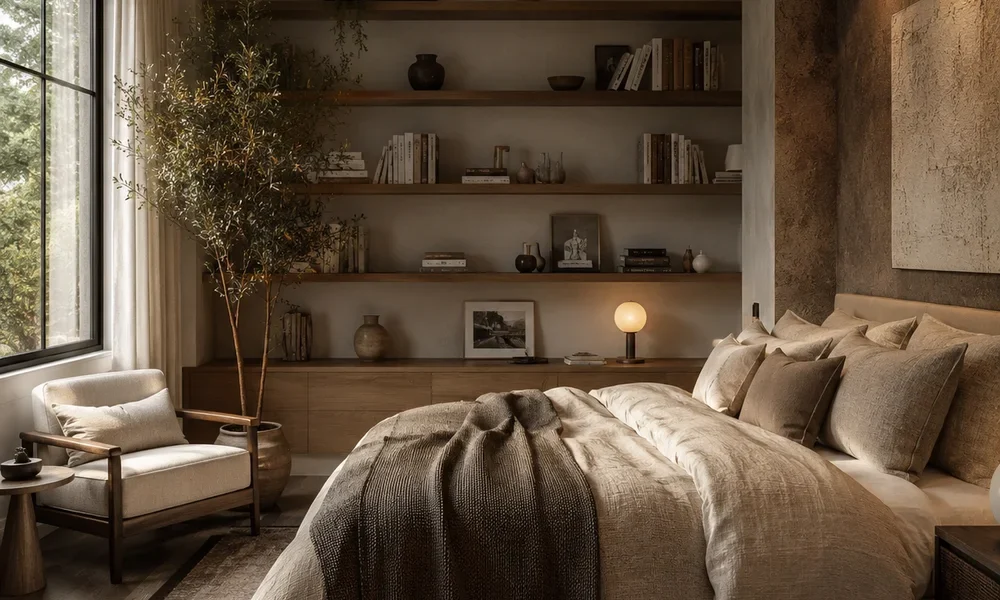
Bedroom Shelf Styling Ideas Designers Love Worth Copying Right Now
SHOP MY FINDS
Discover my favorite products for this place
My Favorite Bedroom Finds
GET THE PLANNER
Get the planner guide and make it easier.
The Ultimate Bedroom Planner
Get cozy inspiration delivered to your inbox.
✓ 14-page beautifully designed ebook
✓ Cozy decorating ideas
✓ Practical room-by-room inspiration
You’re in! 🎉
Thanks for joining the NestFlowHome community!
Your free ebook is already on its way to your inbox. If you don’t see it within a few minutes, please check your Promotions or Spam folder.
Join the NestFlowHome community for weekly decorating inspiration.

Timeless home decor ideas and slow living inspiration for a calm, beautiful life.