
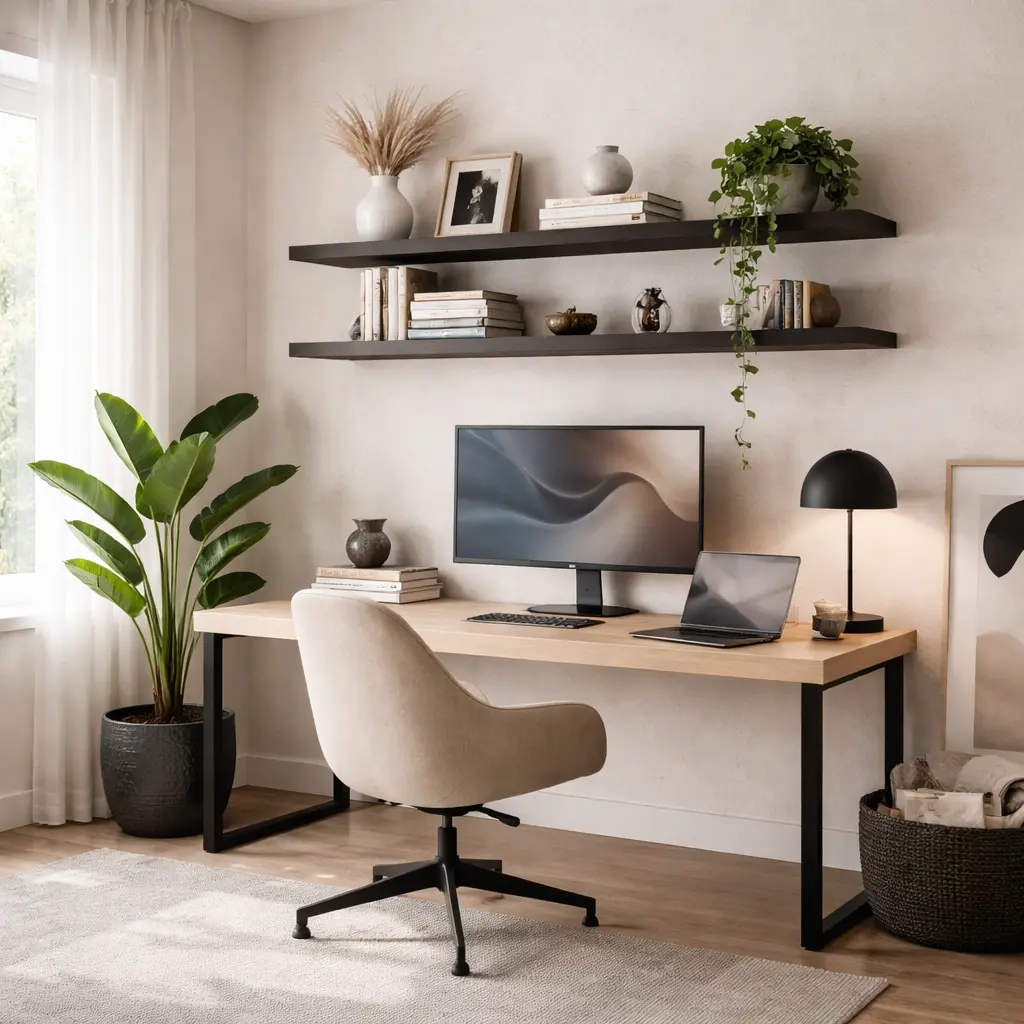
How to Design a Workspace You’ll Actually Love Working In?
By Emily | March 18, 2026
There’s something particularly disheartening about sitting down to work in the morning and having your first thought be that you’d rather be anywhere but here. It’s not always the work itself that’s the problem — it’s the place where you do it. The corner of the couch where the laptop always slides. The desk with not a single square inch of free space. The light that’s simultaneously too harsh and never enough. Designing your home office isn’t an aesthetic luxury — it fundamentally affects how much energy, focus, and — let’s say it — joy you bring to your work.
This article isn’t about spending a fortune on a designer office. It’s about understanding what actually works — and what just looks good on Pinterest. Over the years, I’ve come to realize that a thoughtfully designed work environment doesn’t just boost productivity; it sets the tone for your entire day. It shapes how you approach tasks. It determines when you give up and when you push through.
Whether you’re furnishing an entire room as an office or trying to conjure a functional workspace out of a single corner, this guide is for you. We’ll walk through lighting, ergonomics, and style — always keeping the real point in focus: how to feel good in the place where you work.
1. Define How You Work Before You Design Anything

 Save it
Most people do it backwards. They look at what’s trending, buy furniture they like the look of, then try to mold their working style around it. This almost always leads to a string of bad decisions.
Before you start buying, painting, or rearranging furniture, ask yourself a few questions. How many hours a day do you spend at a desk? Do you have video calls where your background matters? Do you need physical storage or do you work entirely digitally? Is there another person in your household you share the space with?
If, for example, you spend eight to ten hours a day sitting, ergonomics aren’t optional. If you video call with clients, your background and lighting immediately become professional concerns. If you do creative work you likely need different stimuli and different lighting conditions than an accountant does.
Workspace design only really starts to work when you accept that your working style is unique. Not every office needs to look the same. The minimalist Scandinavian aesthetic is beautiful, but if you work better with a little chaos, if you need your physical tools within reach, if white walls genuinely irritate you — then don’t copy that. Design for yourself.
It’s worth spending a week actively observing yourself: when are you most productive? What’s the light like? What’s the temperature? How much noise can you handle? That data is far more valuable than any Instagram feed.
Only once you have that self-knowledge does it make sense to move on to designing the physical space. Otherwise, you’ll end up with a beautiful but utterly unusable office — which is exactly as frustrating as the messy corner was.
2. Layer Your Lighting Thoughtfully
 Save it
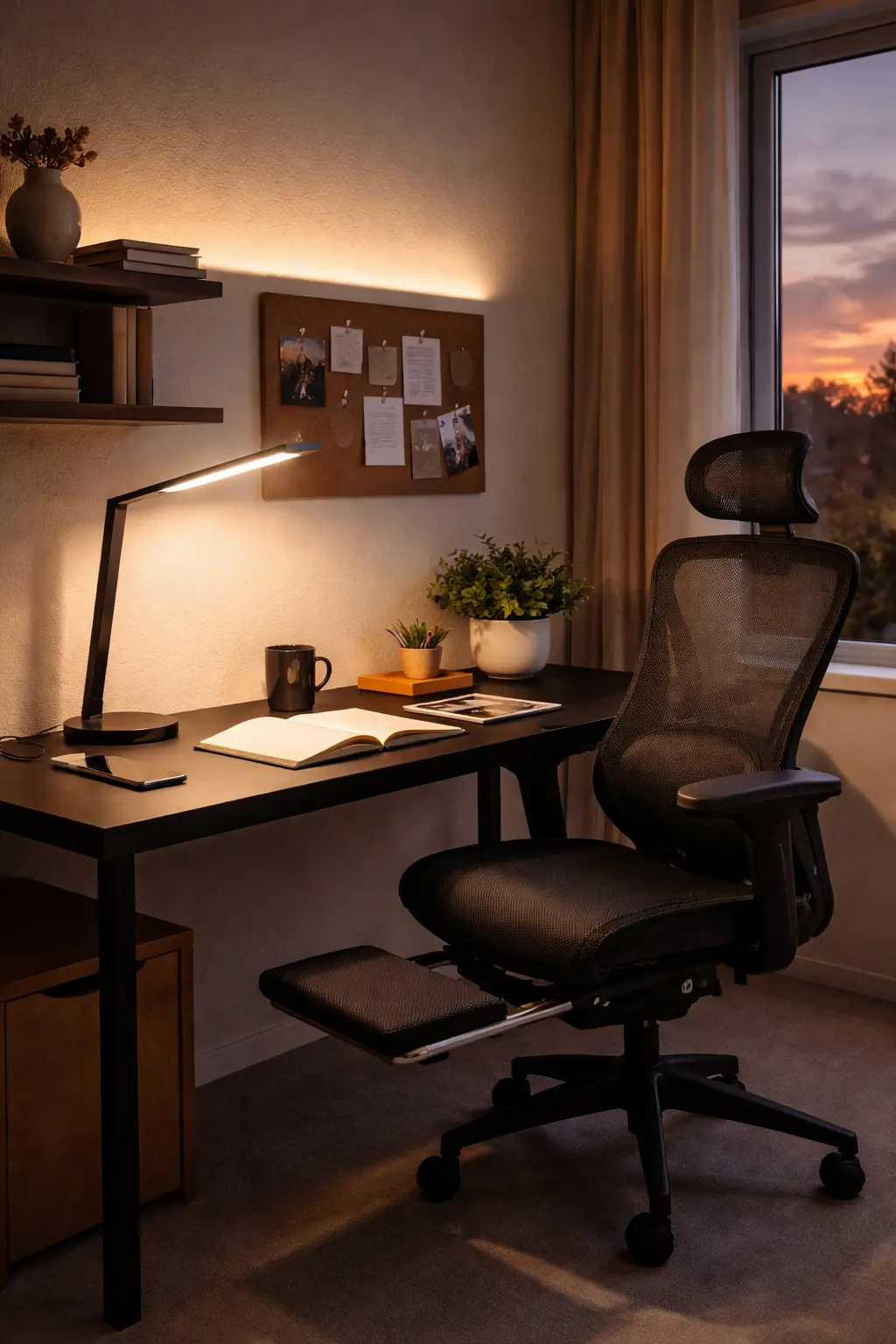
Bad light slowly kills concentration. Not immediately, not dramatically — but if you work from ten in the morning until four in the afternoon in a windowless room under cold white LEDs, the evening is guaranteed to end with a headache and exhaustion. Lighting is perhaps the least glamorous, yet the highest-return investment you can make when redesigning your workspace.
Ideal office lighting is built in layers. The first is natural light — ideally from the side, not from the front or behind. If the window is behind your monitor, the contrast constantly strains your eyes. If light pours in from the front, you’ll see it reflected in the screen. Side natural light is what actually works. If you can, position your desk so the window is to your left — for most people, this also reduces wrist shadows when writing by hand.
You can’t always control natural light. What you can control is the artificial layer. A good desk lamp isn’t a luxury — it’s a tool. Look for one with adjustable brightness and color temperature. During the day, a cooler white light around 4000–5000 Kelvin supports alertness; in the evening, warm light at 2700–3000 Kelvin won’t disrupt your circadian rhythm. A quality dimmable LED desk lamp with color temperature control is a perfect solution for this — widely available for a reasonable price with plenty of strong reviews.
Background lighting is also worth considering. If your monitor is backed against a dark wall, the contrast will wear you out. A simple LED strip placed behind your monitor — also known as bias lighting — dramatically reduces eye fatigue and, as a bonus, visually transforms the mood of the space. This is one of the cheapest interventions with the most noticeable impact.
3. Choose a Desk That Supports the Way You Actually Work
 Save it
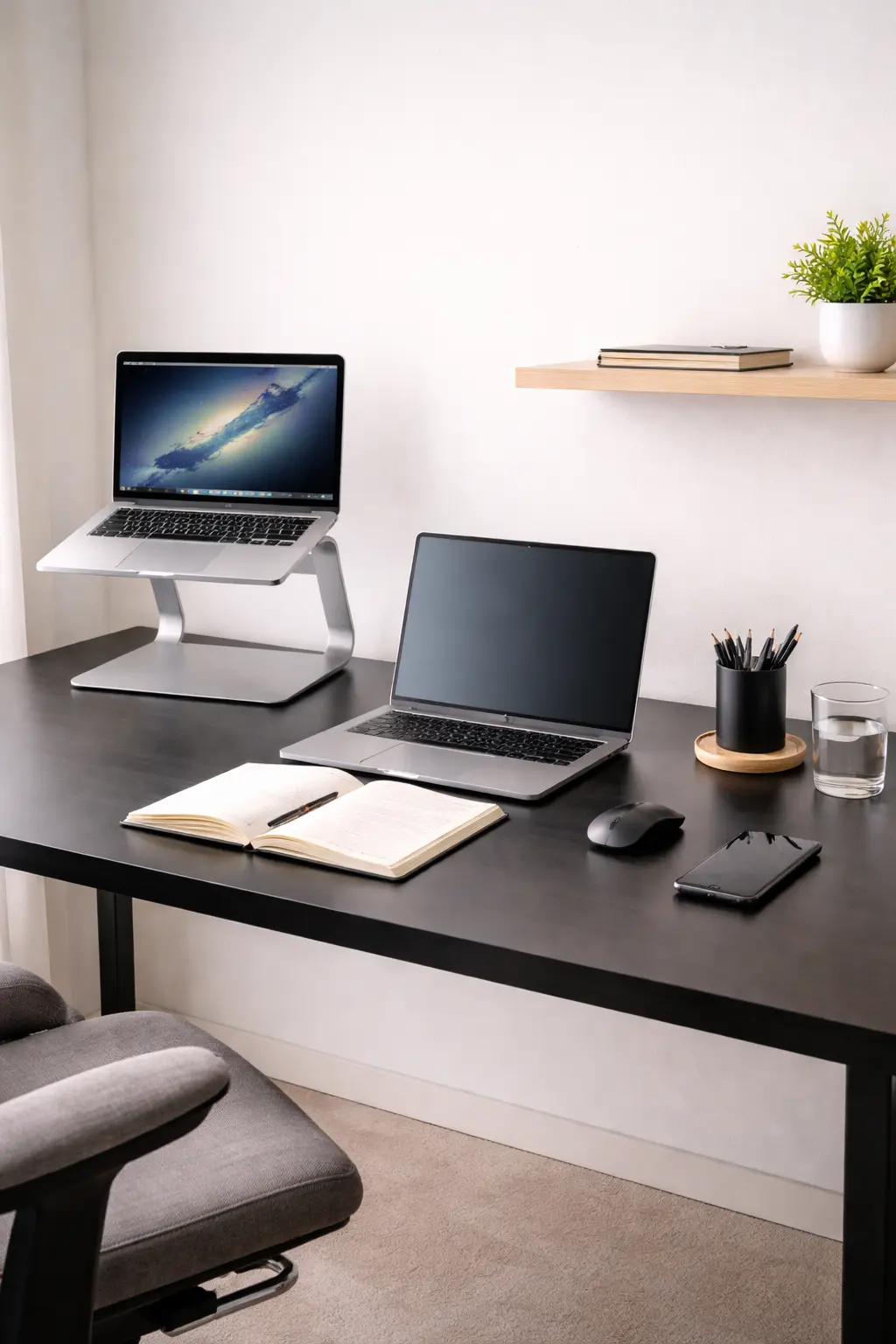
The size, height, and layout of your desk directly affects how you work. This might sound obvious, yet the vast majority of people work at a desk that’s either too low, too shallow, or covered in things that should be stored somewhere else.
Desk height is critical. Standard furniture-store desks are around 29–30 inches, which suits a person of average build — but for a shorter woman or a tall person, it can cause serious shoulder problems over the years. The ideal height is one where your elbows rest at a 90-degree angle on the edge of the desk surface and your shoulders don’t rise. If that’s not right, a desk riser set or a height-adjustable standing desk is the long-term solution.
Sit-stand desks have evolved in the past five years from a serious trend into a genuine workplace standard. If you spend six to eight hours a day at a desk, the physiological case is compelling: alternating between sitting and standing reduces back pain, improves circulation, and many people find they complete certain tasks — emails, short to-dos — faster while standing. A motorized electric standing desk is a reliable entry-level choice, and based on reviews, most users can’t imagine their day without it after the first three months.
On surface area: don’t be stingy with space. If you have the option, a 63×31 inches surface allows far freer work than a cramped 47 inches one. Your monitor, laptop, notebook, and a cup of coffee should all fit side by side without stacking on top of each other.
4. Invest in Ergonomics Your Future Self Will Thank You For
 Save it
Nobody thinks about their back at twenty-five. Everyone thinks about it at forty-five — and that’s precisely where ergonomics comes in, something you shouldn’t wait to address.
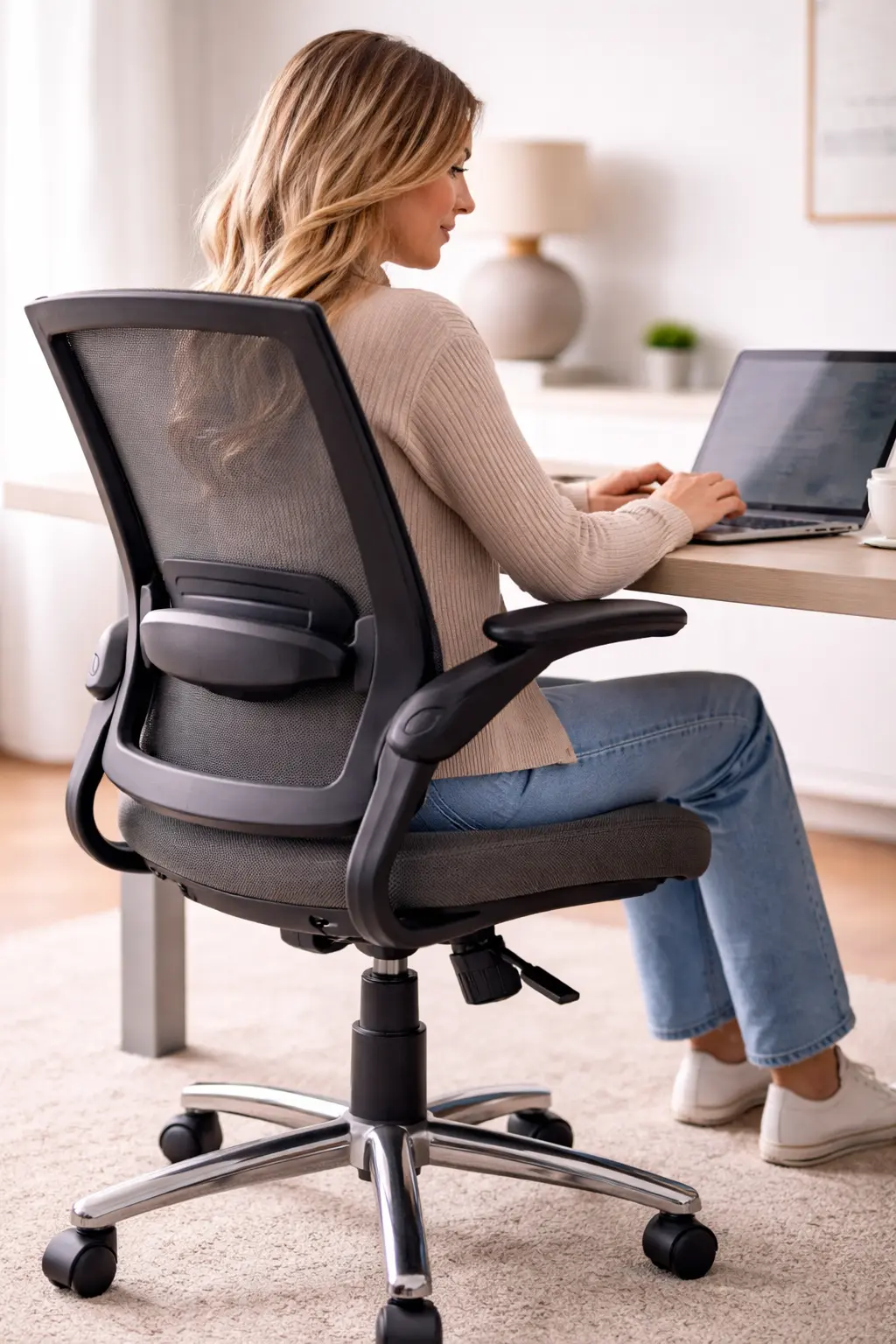
Your chair is the most important piece of furniture in your office. Not the desk, not the monitor, not the decor. If you sit for eight hours, the chair is what defines your whole day. A poorly adjusted or low-quality chair leads to back pain, neck tension, and over time, more serious musculoskeletal problems.
What you need to know in a good office chair like this: adjustable height so your feet sit flat on the floor; lumbar support that fills the curve of your lower back; adjustable armrests that don’t force your shoulders up; and ideally a reclining backrest so you can lean back slightly now and then.
Monitor placement matters just as much. The top of your screen should be at or just below eye level, and the distance should be roughly one arm’s length. If you work on a laptop, the screen is almost certainly too low in which case a laptop stand is what will save you. If you use a computer, a good quality monitor riser can help you. This is one of the most consistently repeated pieces of advice from ergonomics specialists who focus on home offices, and I can confirm it from personal experience: the neck pain I suffered for years disappeared the moment I raised my laptop to eye level.
5. Build a Storage System That Actually Functions
 Save it
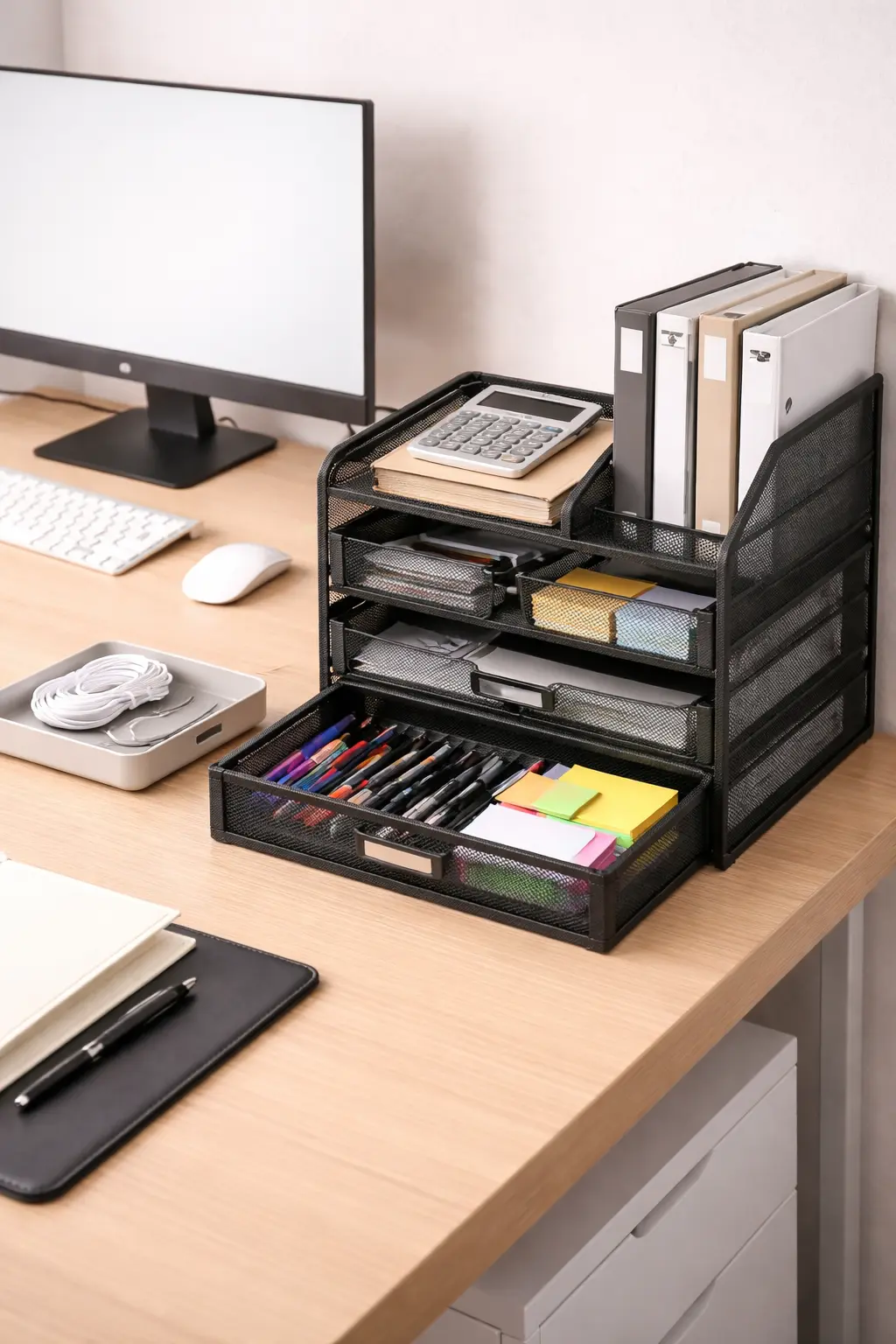
One of the biggest myths in home office design is that a tidy workspace equals an empty workspace. It doesn’t. A tidy workspace means everything has a place — and returns to it.
When planning storage, start from what you use daily, what you use weekly, and what rarely comes out. Daily tools — pens, chargers, sticky notes, headphones — should be within one reach. Weekly supplies — folders, forms, equipment — in a drawer or on a shelf, but close at hand. Rarely used items belong in a cabinet or another room entirely.
Desk organizers have gotten smarter over the years. A quality metal desk organizer doesn’t just create order, it gives the workspace a visual coherence. Staring at visual chaos all day is the same kind of drain as working in a physically noisy environment.
Cable management is also worth addressing, because the jungle of cables is the most common aesthetic and practical problem in the home office. Cable ties, cable boxes under the desk, or a Smart Plug Strip — these solutions save you from countless moments of frustration. Be ruthless: if you don’t use something daily, its charger has no business being on your desk.
6. Reduce Noise and Protect Your Concentration

 Save it
People tend to focus on visible elements when designing an office, but the acoustic environment is at least as influential on productivity. Working in an open-plan apartment allows for an entirely different level of performance than a sonically ordered space.
If you can’t physically separate your workspace, acoustic interventions can help. Rugs and curtains absorb sound — this can be a side effect of simpler interior design decisions. A solid bookshelf on the wall is acoustically useful as well as decorative. If those measures aren’t enough, a quality pair of active noise-cancelling headphones is one of the fastest solutions to concentration problems — which is precisely why it’s one of the most reviewed categories of office equipment.
The question of background music is personal and task-dependent. Instrumental music and ambient noise (rain, café sounds, white noise) improve concentration for many people — especially during monotonous tasks. For text-based work, however lyrics interfere with verbal thinking. Learn to know yourself here, too.
7. Bring in Plants and Natural Elements to Breathe Life Into the Space
 Save it
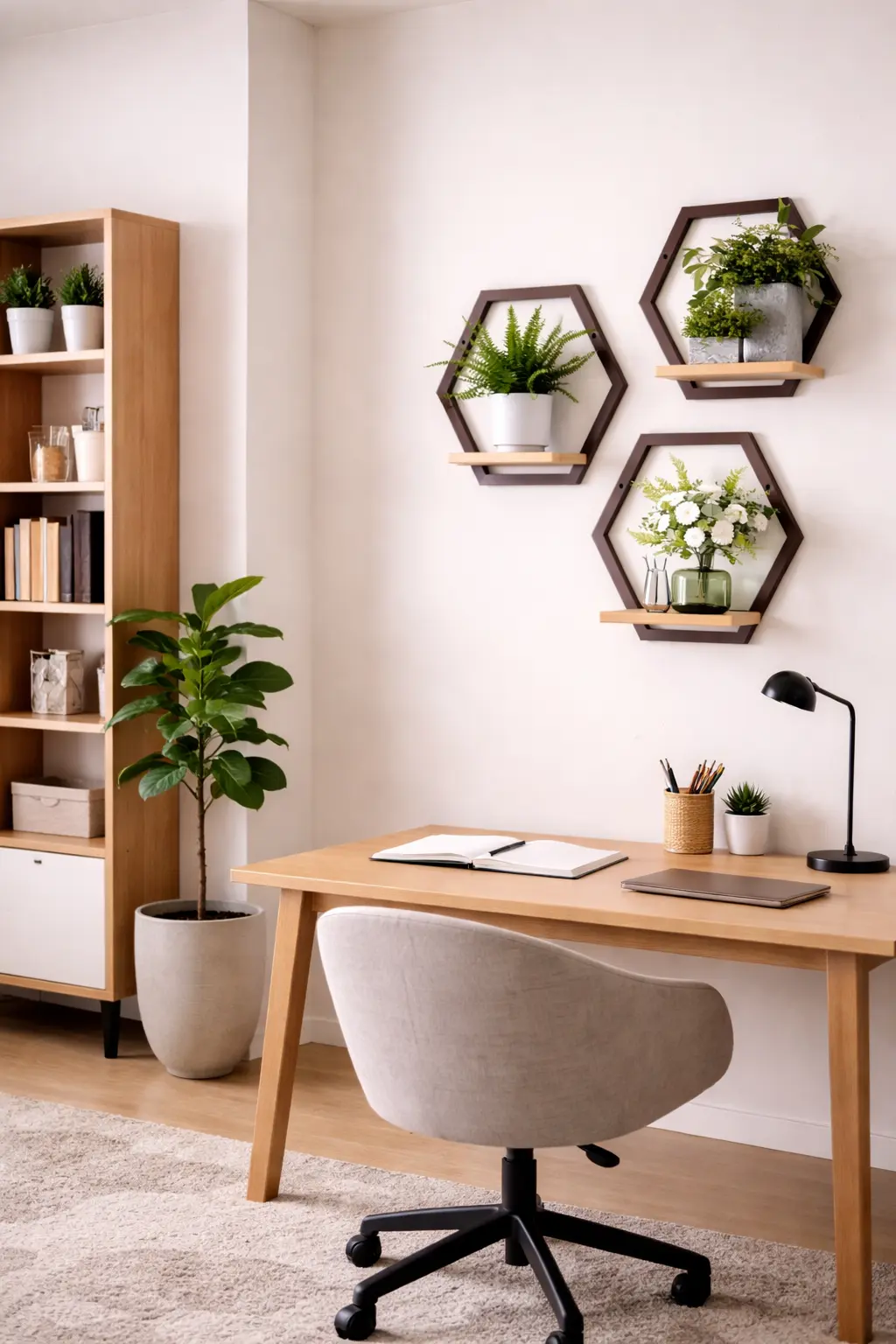
A work desk with nothing living on it always feels sterile — even when it’s otherwise attractive and tidy. Plants aren’t merely decorative: research on office plants consistently shows that their presence reduces stress, improves concentration, and positively affects air quality in enclosed spaces.
The question, of course, is which plant to choose if you’re not particularly green-fingered. Office environments typically mean lower light intensity and drier air — the most resilient plants for these conditions are the snake plant (sansevieria), pothos, and the ZZ plant. All three are nearly indestructible, manage on low light, and need watering just once a week. If you have a reasonably bright spot, a small ficus or aglaonema also works well and creates a visually richer effect.
Placement matters too. A larger plant in the corner of the room adds depth and elegance to the space — especially in a Scandinavian or natural-style office. Smaller potted plants on a corner of the desk or on a shelf serve as energizing accents without taking up much room. If shelf space has run out, a wall-mounted plant holder solves the greenery problem vertically — and is one of the most Pinterest-worthy solutions you can bring home.
If you’re more interested in plants and indoor greenery and want to understand how to choose the right varieties and where to place them, my article How to Make Any Room Feel Alive with Plants can help you.
8. Add Personal Touches That Make the Space Truly Yours
 Save it
The final layer is what turns a functional office into genuinely your office. This is the point where people most often stop — because they feel that personal objects, decoration, and “inefficient” elements are unnecessary. They’re not.
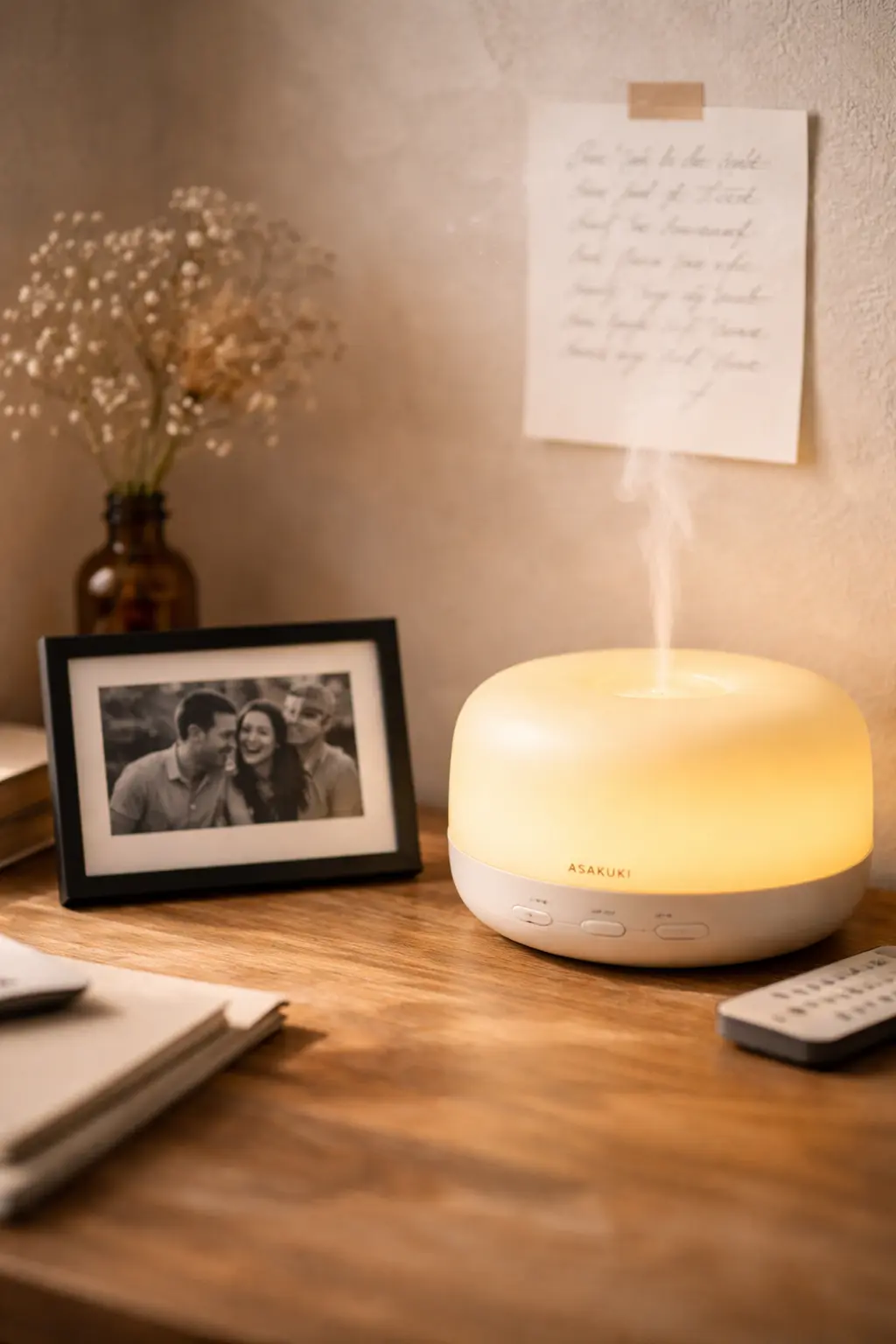
The atmosphere of your workspace is influenced by what you smell there, what objects are in your field of vision, what the surface of your desk feels like. These aren’t mere whims — they’re the sensory cues that signal to your brain that this is your place, where it’s permitted and worthwhile to concentrate.
A diffuser with a few drops of rosemary or lemon essential oil has a surprisingly effective alertness-boosting effect — backed by serious research, not just wellness mythology. A favorite photo, an inspiring quote on the wall, pens kept in a beautiful but practical mug — these details communicate to your brain that you feel good here. And where you feel good, you stay longer and do better work.
If stress and exhaustion are a part of your life, it’s worth making a conscious effort to not only transform your workspace, but your entire home. For example, the bathroom, where you start and end your day, has a huge impact on your overall well-being — and here’s a full guide: Feeling Stressed? Here’s How to Build a Relaxing Bathroom Retreat
Before You Begin: A Few Thoughts on Making Changes Last
Redesigning a workspace isn’t a one-time project. Life changes, working styles change, needs change. What seems perfect now may need adjusting in six months — because you’ve taken on a new project, your partner is also working from home, or a child enters the equation. The best offices are flexible: easy to rearrange, easy to plug devices in and out of, with storage systems that can grow.
Before we turn to the typical mistakes, it’s worth taking a moment to understand: designing your workspace requires not perfectionism, but awareness. The perfect office isn’t the one that contains everything — it’s the one that contains nothing unnecessary.
Mistakes Everyone Makes — and How to Avoid Them
1. Underestimating your storage needs.
Everyone thinks they’ll need less space than they actually do. Papers multiply, equipment accumulates, clutter spreads. Build in 20–30% more storage capacity than you currently think necessary — you’ll be grateful for it in six months.
2. Forgetting about cables.
One of the most commonly after-thought problems in office design is cable chaos. Beautiful monitor, beautiful desk, gorgeous lamp — and underneath it all, six cables hanging in a tangle. Cable management isn’t an afterthought; it has to be part of the foundation. Plan where your sockets will be, where cables will run, how you’ll secure them.
3. Copying a style that doesn’t fit your lifestyle.
Instagram and Pinterest are full of stunning offices — many of which are never actually used for work. The white-rug, honey-wood, fresh-flower home office is beautiful to look at, but if you’re on conference calls all day and spill coffee on your keyboard once a week, that style isn’t for you. Always start from function; style comes second.
4. Ignoring natural light — or its absence.
Many people set up an office in a north-facing room because it’s the quietest or has the most space — then wonder why they work under artificial light from eight in the morning until late evening. If this is unavoidable, invest more seriously in artificial lighting: layered light, biodynamic lighting, or a daylight lamp for the darker months.
5. Undervaluing the chair and overvaluing the desk.
The desk makes a more impressive statement — but the chair is what you sit in for eight hours a day. Many people think backwards: invest in an expensive, imposing desk, then buy “something” for a chair. The correct order of priorities is exactly the reverse.
Frequently Asked Questions
1.How do I create an office in a small apartment with no spare room?
The most important thing is visual and mental separation. A bookshelf, a room divider, a rug that defines the work area — all of these help establish boundaries. If possible, don’t work in the bedroom: the brain learns the function of spaces, and if you work at a desk beside your bed, sleep quality can suffer because the brain doesn’t switch off easily in the same environment. If there’s no alternative, a foldable, put-away-after-work office setup (a fold-out desk, a wall-mounted pull-down surface) can help you mentally “close” the day.
2. When is it worth buying a standing desk?
If you spend more than six hours a day at a desk and have back or neck problems, there’s no question: it’s worth it. If you sit less and move regularly — walking, sport — a traditional desk is fine, provided the height is properly set. A standing desk isn’t a magic cure, but the long-term physiological benefits of alternating between sitting and standing are well documented.
3. What colors support concentration at work
Research suggests blue tones help focus during intellectual work, green has a balancing and stress-reducing effect, and yellow stimulates creativity. Red is energizing but tends to become distracting with prolonged exposure. White and gray are neutral, but in large quantities can feel cold and demotivating. The best approach: neutral bases (walls, furniture) and one or two deliberately chosen accent colors — through plants, cushions, or a piece of art.
4. How do I keep my workspace tidy long-term?
Systems beat willpower. If every tool has a designated place, and that place makes logical sense — meaning it’s where you use it — the system nearly runs itself. The single best organizing habit: five minutes of tidying at the end of every working day. Not a deep clean — just putting everything back in its place, wiping the desk, and visually closing the day. This habit does a surprising amount for sustaining both the office and your work morale over the long term.
Final Thoughts
A well-designed work environment won’t make hard tasks disappear, and it won’t substitute for motivation — but it provides the foundation on which everything becomes easier. In a place where the light is right, where your chair doesn’t drain you, where everything is within reach and nothing distracts — you become a different person during working hours.
You don’t have to change everything at once. If you do just one thing today — think through how light falls on your desk, untangle the cable chaos, or swap a cheap seat for a real office chair — that’s already progress. The best offices aren’t born overnight: they take shape over time, through a series of small decisions.
What really matters is this: don’t design your workspace for someone else — design it for yourself. With the self-knowledge, the working style, and the needs that are genuinely yours. Because the most inspiring office isn’t the one that looks best on Pinterest — it’s the one where you do your best work.
Start. Even today. With one small change.
This post contains affiliate links. I may earn a small commission at no extra cost to you.
Get cozy inspiration delivered to your inbox.
✓ 14-page beautifully designed ebook
✓ Cozy decorating ideas
✓ Practical room-by-room inspiration
You’re in! 🎉
Thanks for joining the NestFlowHome community!
Your free ebook is already on its way to your inbox. If you don’t see it within a few minutes, please check your Promotions or Spam folder.
Join the NestFlowHome community for weekly decorating inspiration.

Timeless home decor ideas and slow living inspiration for a calm, beautiful life.