

Feeling Stressed? Here’s How to Build a Relaxing Bathroom Retreat
By Emily | November 15, 2025
There comes a point at the end of every day when you simply can’t take in any more information. You don’t want to talk, make decisions, stare at screens, or be productive. You don’t want stimulation – you want peace. You just want to genuinely “switch off.” Yet most people handle this need poorly. When exhaustion hits, they collapse onto the couch and start scrolling, looking for relief through more screens, more information, more stimulus. The body is tired, but the nervous system is still running at full speed, flooded with stimulation. This isn’t truly resting – it’s numbing yourself passively with yet another form of sensory input.
I did this for years. I understood intellectually that I needed to relax, but I didn’t understand that relaxation doesn’t happen simply because you’re physically inactive. True relaxation requires an intentional environment and ritual that tells your body: you are safe, you can slow down, the day is genuinely over. Surprisingly, the most suitable space for creating this state wasn’t my beautifully designed living room, despite all the investment there. It was my bathroom – a space that naturally separates from the rest of the home, a place traditionally associated with self-care and transition.
The key insight I discovered was this: true “switching off” doesn’t happen where you work, eat, or scroll. It happens in a dedicated space where your body can gradually shift out of alert mode. Where the lighting, temperature, scents, and movements all communicate the same message: the day is over, your body can rest now. In this article, I’ll show you how to transform your bathroom from a purely functional space into a nervous-system “cool-down zone” where you can genuinely regenerate – even on ordinary weekday evenings when life feels overwhelming.
This isn’t about expensive renovations or complicated systems. It’s about understanding the biological and psychological needs of your nervous system, then creating simple, strategic interventions that help your body actually shift from stress to restoration.
Understand Your Nervous System's Decompression Window
 Save it
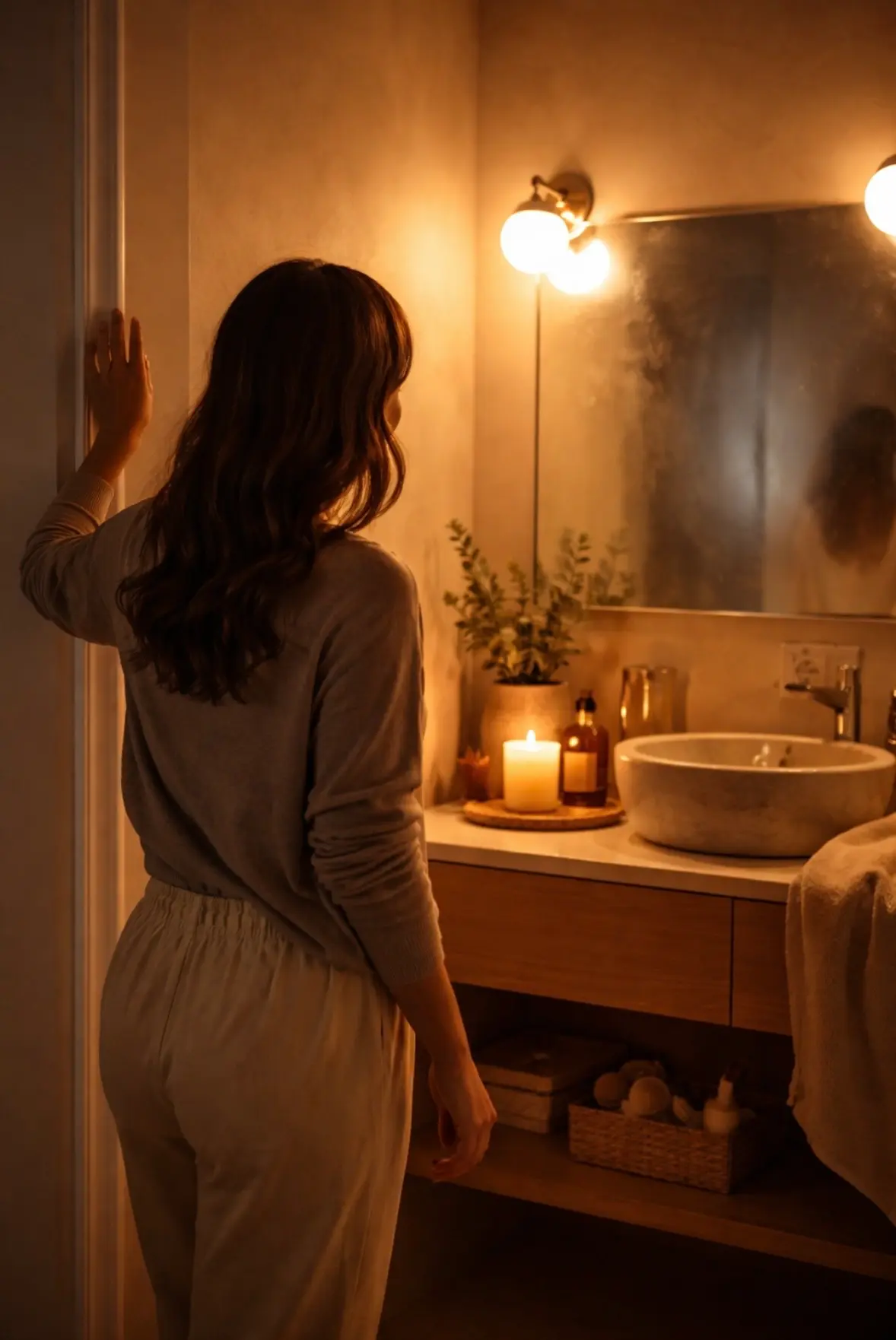
One of the biggest shocks to your nervous system isn’t the stress itself – it’s trying to suddenly exit from that stressed state. Jumping directly from an active, decision-making, problem-solving day straight into bed and expecting immediate relaxation is biologically impossible. It’s like trying to stop a car traveling at 60 mph in just one meter – the physics don’t work. Your nervous system needs transition time.
This transition window – lasting roughly 20 to 40 minutes – is the space between finishing work and entering sleep. During this window, your body gradually shifts from sympathetic mode (alert, activated, ready to respond to threats) to parasympathetic mode (relaxed, restorative, capable of genuine rest). This shift isn’t automatic; it requires intentional physical and environmental cues that communicate safety to your nervous system.
These cues are specific: a warmer environment signals that there are no threats (cold is associated with danger). Lower light intensity signals the arrival of evening. Slower movements communicate calm rather than urgency. Fewer visual stimuli reduce the amount of information your brain must process. When you cluster all these cues in a dedicated space you create a powerful psychological and biological threshold. The bathroom becomes a clear demarcation point where the active day genuinely ends before the restorative night begins.
By placing this transition ritual in your bathroom, you leverage the space’s natural separation from the rest of your home. You step into a different zone. Neurologically, this spatial separation supports psychological separation. Your brain receives multiple cues that normal daytime rules no longer apply – this is a different mode, a different state. This simple act of creating a dedicated transition space transforms your entire evening experience and your ability to actually rest.
Master Mood Lighting
 Save it
If there is one element that can most quickly and dramatically change your nervous system’s state, it is light. Not decorative choices, not scents, not even water temperature – but the quality and color of your lighting. This is biologically wired into your nervous system. Cold, bluish light is designed by nature for alertness. It signals daylight, prompts action, demands focus and activity. Your eyes perceive it, and your brain says: stay alert, something requires your attention.
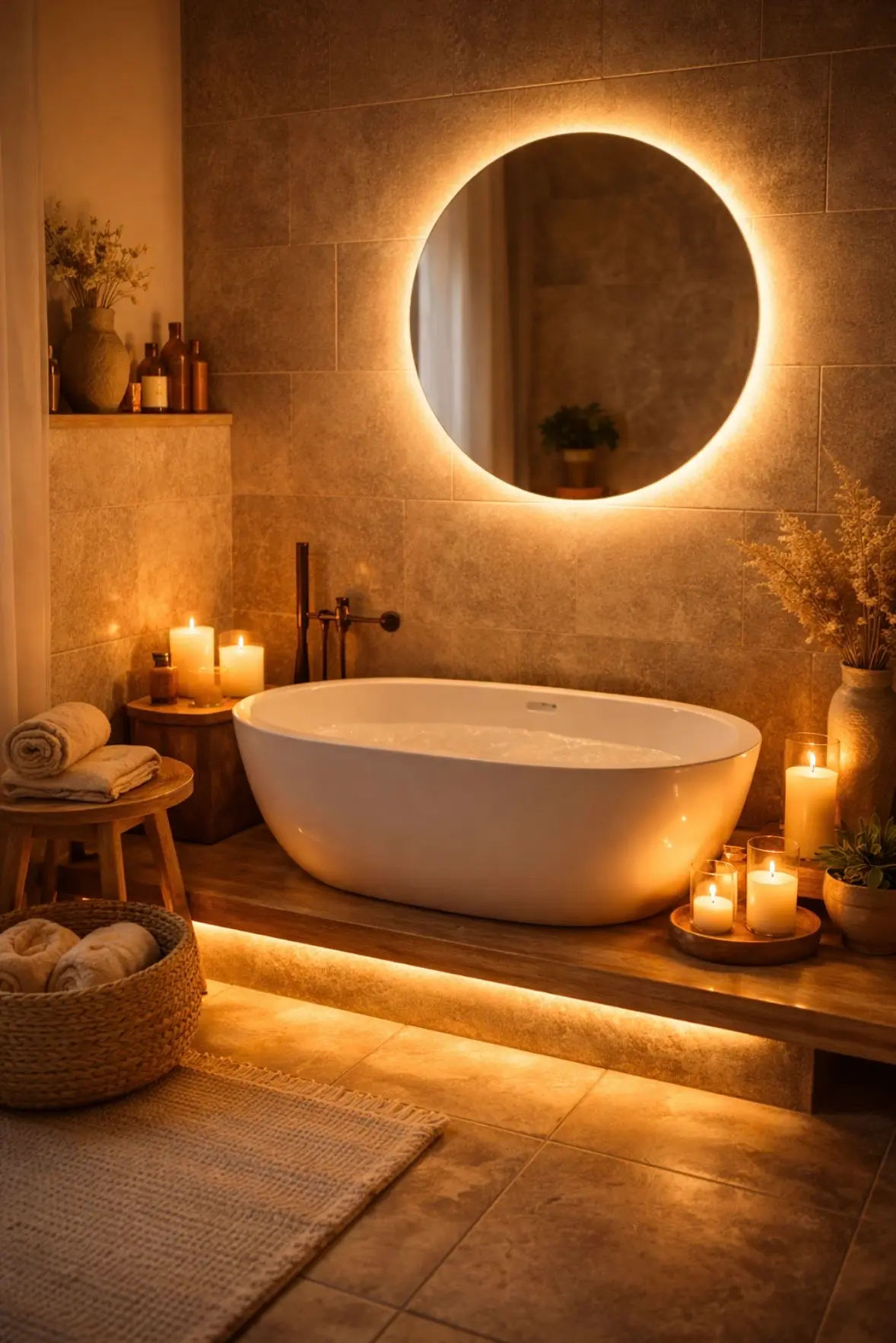
If you’re bathing or doing your skincare routine in this cold, energizing light at the end of your day, your brain never receives the crucial message: you can slow down now. You’re fighting your own biology. I consciously replaced my main bathroom light with a warm-toned option – around 2700K color temperature – and use exclusively dimmable lights in the evening hours. Dimmability is absolutely key because both color temperature and intensity matter equally. Gradually reducing brightness throughout your evening routine literally helps transition your body from daytime activity mode to evening regeneration mode.
I don’t use candles as romantic gestures – they’re nervous-system tools. The subtle movement of a flame has a micro-hypnotic effect on your visual system. Your eyes naturally slow down when tracking the gentle flicker. Your breathing adjusts to match the pace. This physiological response is real and measurable. I’ve also added LED strips under the bathtub and behind the mirror – indirect, warm light that doesn’t blind or startle, but rather gently embraces. The light shouldn’t be noticeable as a source; it should simply create an environment that feels safe and restorative.
The psychological impact is profound. When you’re lit by warm, gradually dimmed lighting, your body believes evening has truly arrived. Melatonin production begins. Your pulse slows. Muscles relax. You’re not fighting your biology; you’re supporting it. This single change – upgrading your bathroom lighting from harsh overhead to warm, layered, dimmable options – often provides more relaxation benefit than any other single intervention.
Use Scent as a Nervous-System Anchor
 Save it
Scents directly affect the limbic system – the ancient part of your brain that governs emotions and memory. This is why aromatherapy works on a deeper level than most people realize. It’s not about smelling pleasant for social reasons. It’s about creating reliable nervous-system anchors – scent profiles that your brain learns to associate with specific states. Over time, these scents trigger the corresponding state automatically.
Lavender is synonymous with evening wind-down in my routine. Clinically, lavender reduces anxiety and supports sleep quality – these aren’t just pleasant associations but documented physiological effects. Eucalyptus comes out on days when my mind is racing and I need mental clarity after intense, demanding hours. Chamomile, with its softer, more earthy scent profile, emerges on emotionally challenging days when I need gentleness and comfort. The key principle is consistency paired with strategic variety.
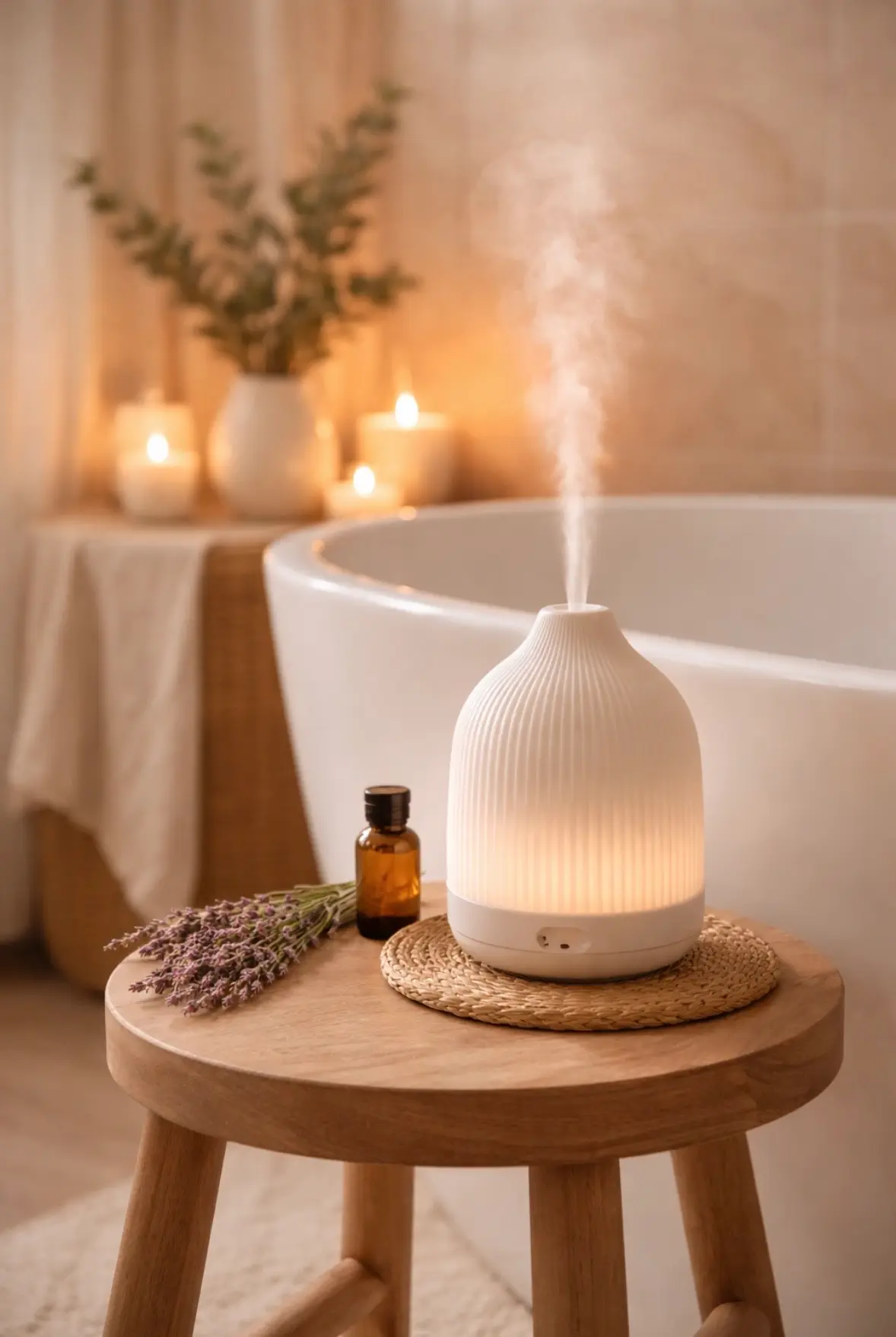
Placement of scent sources matters tremendously. I don’t position the diffuser right by the sink where you’re preparing – that creates a sharp, alert interaction with the scent. Instead, I place it near the bathtub at a safe distance from water. Scented bath salts create a layered aromatic effect: warm water gradually releases the aroma over time, so your senses aren’t suddenly overwhelmed. This gradual, sustained release is far more relaxing than sudden strong scent.
The biggest mistake with bathroom aromatherapy is mixing too many scents simultaneously. This creates olfactory chaos rather than calm. I choose a single main scent for my evening routine, coordinating candles or bath oils with it for consistency. Over time – usually within two to three weeks – my brain automatically associates this specific scent profile with relaxation and wind-down. The scent becomes a reliable trigger. You can explore how these small sensory cues compound into major state shifts in my article on Small Daily Habits That Lead to Big Life Changes, which discusses how repeated, tiny rituals shape our internal state and quality of life.
Craft Structured Relaxing Rituals

 Save it
For me, bathing isn’t a hygiene task – it’s a structured ritual with clear beginning, middle, and end points. This structure is crucial. When I decide to begin my evening ritual, I mentally transition: the main light turns off, and everything needed is already prepared. Towel positioned, robe waiting, herbal tea prepared, a book or journal on the bath tray. Nothing is left to chance or requiring decision.
I prefer magnesium-rich bath salts for their documented muscle-relaxing effects and ability to support relaxation. I use bubble bath less frequently, instead favoring high-quality bath oils that provide both scent and beneficial skin effects. The ritual feels more intentional and luxurious this way. Digital detox isn’t optional during this time – my phone stays outside the bathroom entirely. The first few times this felt strange, like something crucial was missing. Then I realized that’s exactly the point: breaking the constant, addictive flow of digital stimuli is the entire purpose. That discomfort passes quickly.
The duration matters: 15 to 20 minutes is optimal. This timeframe is sufficient for your pulse to significantly drop, muscles to genuinely relax, and your thought patterns to noticeably slow. With regular practice, your body learns: immersing in warm water equals letting go, equals safety, equals permission to rest. This conditioning is powerful. Over time, simply beginning the bath ritual triggers your parasympathetic nervous system, even before temperature and scent fully register. Your body recognizes the familiar pattern and begins shifting into restoration mode automatically.
Create an Acoustic Environment That Supports Calm
 Save it
Sound is one of the subtlest – and most frequently overlooked – tools for creating genuine relaxation. You can’t see it or touch it, yet sound directly affects your nervous system. Sudden, unpredictable noises – dripping faucets, street sounds, echoing footsteps – keep your body in a state of micro-alert, constantly monitoring for potential threats. I’ve deliberately created what I call an “acoustic backdrop” for my evening routine – intentional sound that filters out chaotic environmental noise.
Water sounds are particularly powerful. Evolutionarily, water signaled resources and survival – no wonder a flowing stream or gentle rainfall instantly soothes modern humans. Playing quiet, looped water or rain sounds during bathing helps filter out daytime noise and gently structures your attention. The brain focuses on the calm sound rather than the random bathroom noises that would otherwise interrupt relaxation.
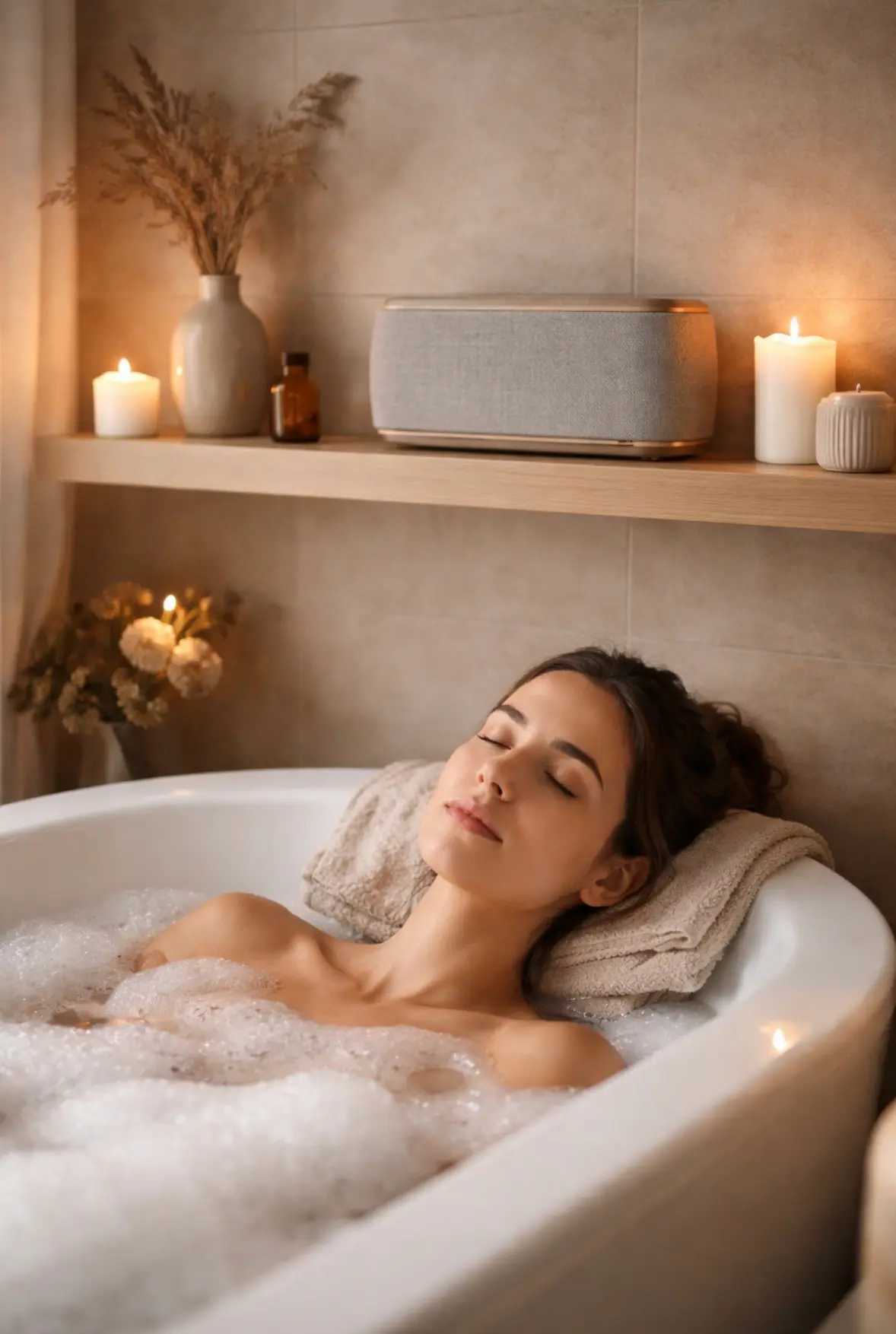
I choose meditation playlists with meticulous care. No sudden shifts in tempo, no singing, no strong rhythmic patterns that demand active listening. Instead, I select long, stretched sound textures that require no active attention – just a gentle presence in your auditory environment. The Bluetooth speaker sits on a higher shelf so sound travels downward naturally, not bouncing off bathroom tiles in ways that create acoustic distortion. Volume stays deliberately low; if you notice the sound consciously and think “I’m listening to something,” the volume is too high.
The goal isn’t to “listen to something” – it’s to let your acoustic environment support your wind-down process. Sound should be a transparent support system, not an object of attention. When sound is right, you don’t think about it; you simply feel its calming effect.
Organize a Personal "Spa Corner"
 Save it
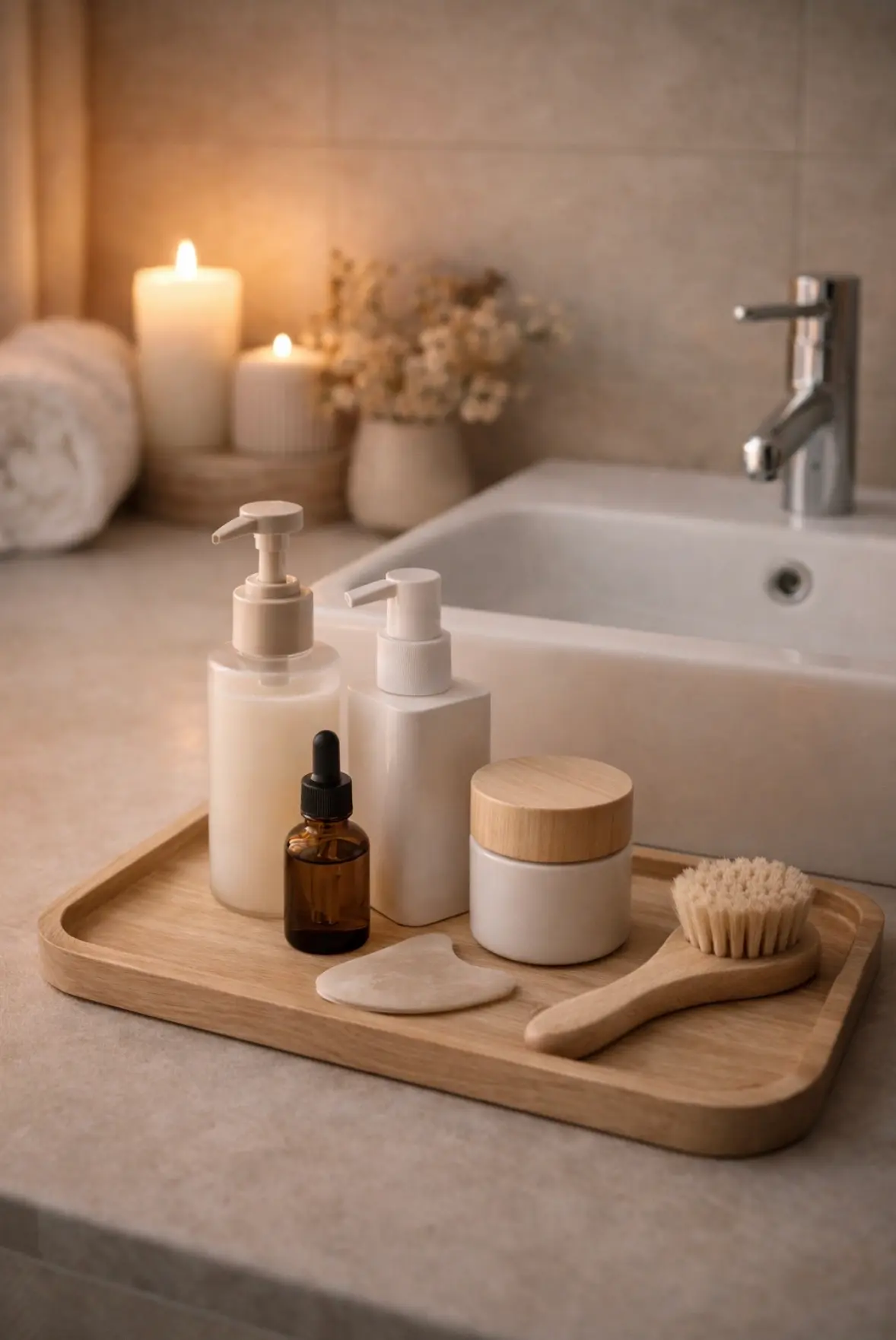
A critical element of relaxation is reducing decision fatigue. If you have to hunt for your products, open multiple drawers, remember where things are stored, or improvise because items are scattered, that creates mini stress. Your brain is still working, still problem-solving, still making choices – and that’s incompatible with genuine relaxation. I created a dedicated “spa corner” – a single surface holding only my essential evening routine products.
A simple tray holds my favorite skincare products, a face massage roller, and a soft cloth. Everything has a permanent, fixed place. When I turn off the main light and step into my evening ritual, I don’t think about what comes next or where items are – the motions flow automatically. This automation is the goal. Your brain can focus on relaxation rather than logistics. Visual order matters equally. If your spa corner is cluttered or visually chaotic, even subconsciously your nervous system registers disorder and remains partially activated.
For creating an aesthetically harmonious bathroom that supports this spa corner concept, explore Beautiful Bathroom Decor Ideas to Refresh Your Space, which details how to create surfaces that are both clean and warm, organized and inviting. The visual environment directly affects your ability to relax. A beautiful, organized spa corner becomes something you genuinely anticipate and enjoy stepping into each evening.
Use Bathroom Massage Tools
 Save it
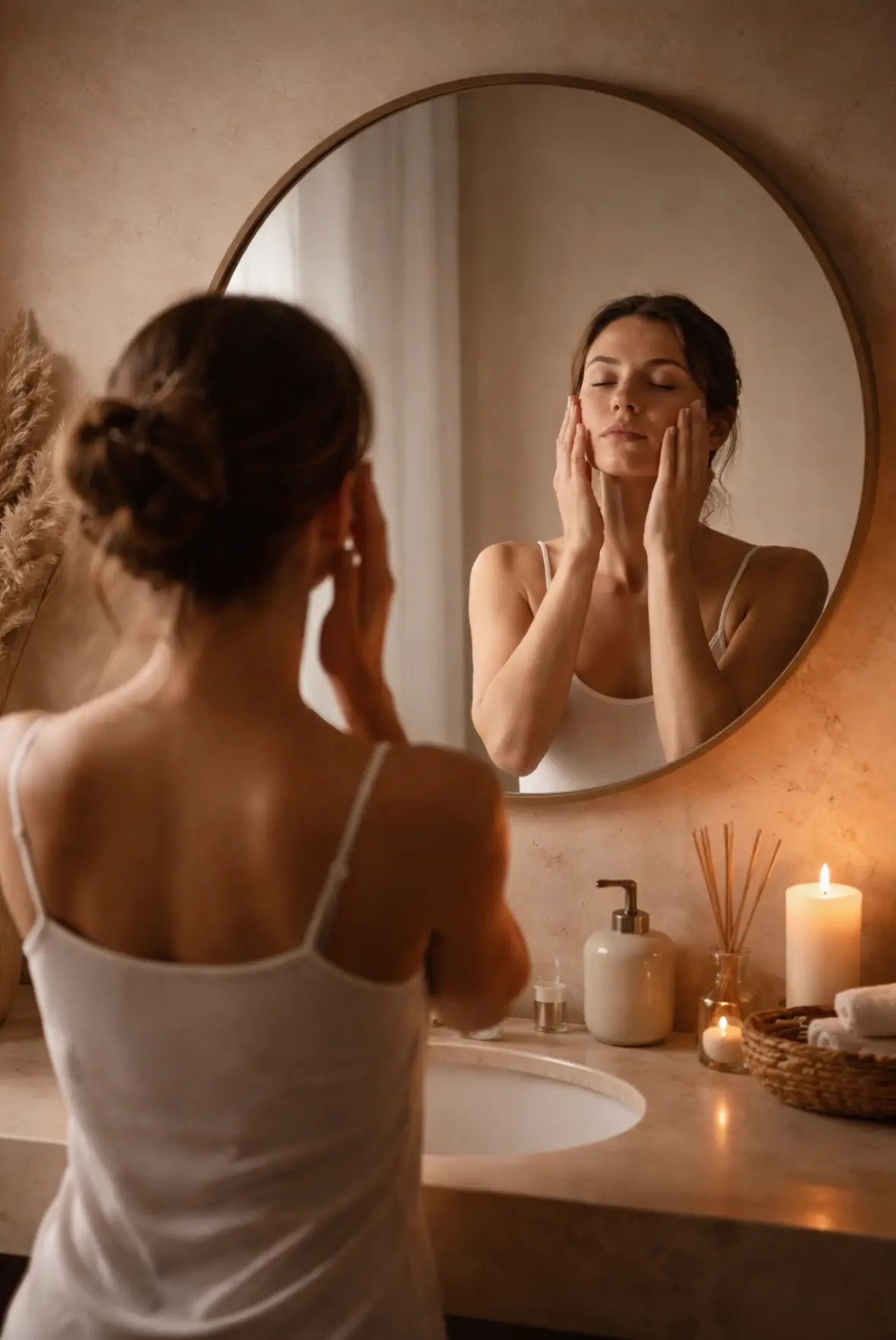
Massage isn’t purely physical – it’s a direct nervous-system intervention. Slow, repeated pressure on skin or muscles provides proprioceptive feedback (information about where your body is in space). This feedback tells your nervous system that tension is decreasing and safety is increasing. The repetition and predictability of massage movements are equally important to the physical pressure.
I use a gua sha tool not for the “lifting” effects marketed in skincare – I use it to release jaw and forehead tension, two areas where stress hides unnoticed even to you. Combined with warm facial oil, the movements become smooth and almost meditative. The repetition and gentleness signal relaxation to your nervous system. Foot massagers are another evening favorite, particularly after a long day. The feet contain over 7,000 nerve endings; stimulating them affects your entire body’s relaxation state. I spend 3 to 5 minutes with a foot massager after showering but before putting on my robe. This timing is strategic – your body is warm from the shower, muscles are already somewhat relaxed, and the massage deepens that state.
Dry brushing is performed before the shower – upward strokes that literally “close the day,” transitioning your nervous system from daytime activation to evening restoration. It boosts circulation and provides gentle proprioceptive input that mentally marks the transition from day to evening. The ritualistic nature of dry brushing – the repetitive upward strokes, the time required, the specific timing in your routine – makes it psychologically powerful beyond just the physical effects.
Choose Water Temperature Strategically
 Save it
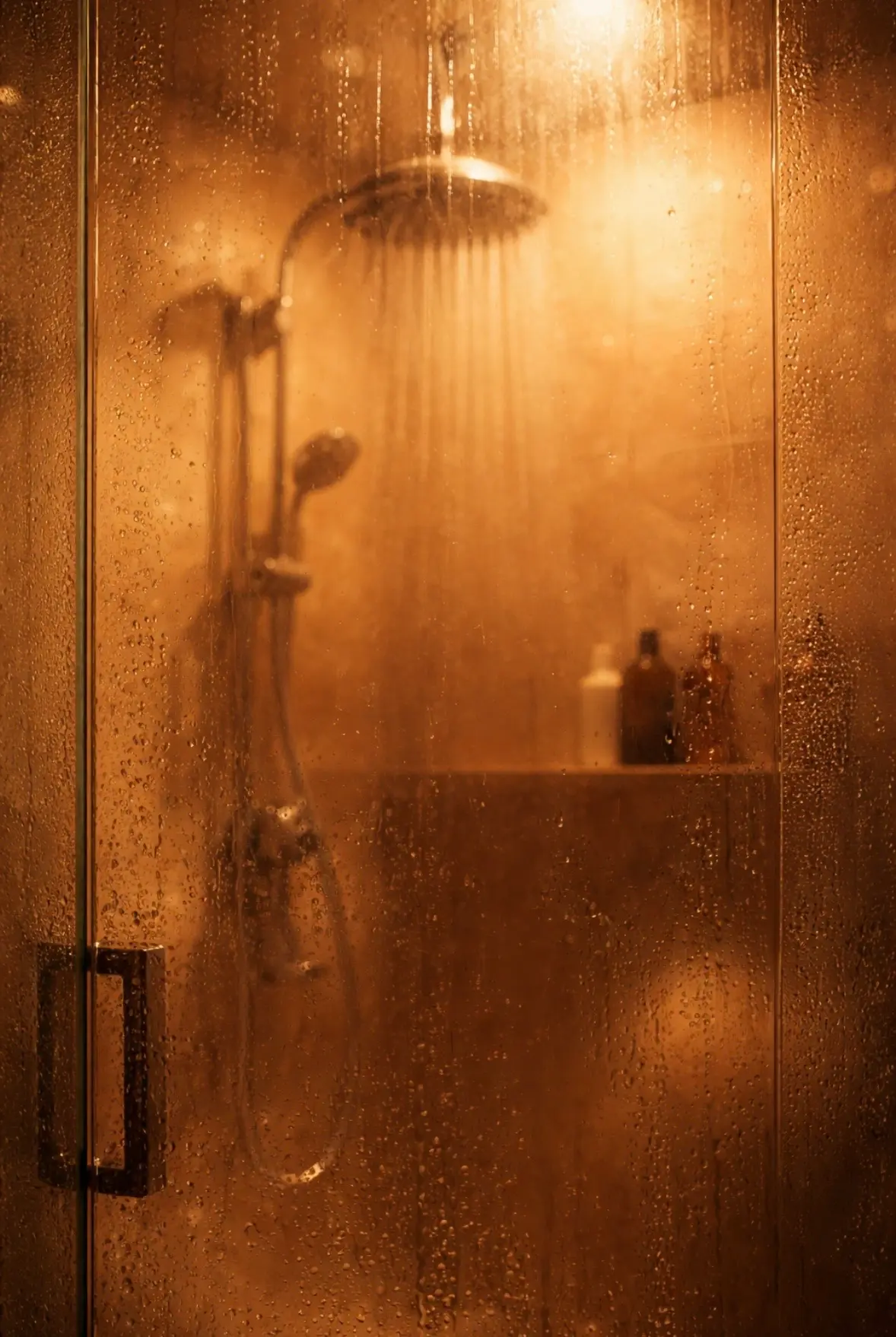
Evening showers are profoundly underrated as relaxation tools. Water temperature directly affects hormonal responses and nervous-system state. Warm water – around 37 to 39 degrees Celsius – dilates blood vessels, genuinely relaxes muscles, and lowers cortisol. A brief rise in body temperature triggers a natural cooling process that’s part of your circadian rhythm, signaling to your body that sleep is approaching.
Contrast showers are traditionally known for morning energizing. However, mild contrast works in the evening too. I typically end with 20 to 30 seconds of slightly cooler water. This boosts circulation, reduces inflammation, and triggers a gentle parasympathetic response without overstimulating your nervous system. The key word is “slightly” – too cold activates your system and hinders sleep. Ideal evening shower temperature is warm and enveloping rather than hot and energizing.
Here’s the crucial insight: water isn’t just a cleaning tool. It’s a nervous-system switch that signals: the day is over, your body can prepare to regenerate. When water temperature, duration, and ritual are combined intentionally, they become powerful tools for state management. You’re not just getting clean – you’re actively shifting your nervous system from alert daytime mode to restorative evening mode. This understanding transforms how you approach your evening shower, making it far more than hygiene and genuinely therapeutic.
Practical Tips and Useful Advice
Start by upgrading your bathroom lighting this week – this is the single highest-impact change. Replace harsh overhead lights with warm, dimmable options. Next, establish water temperature consistency. Fill your tub or adjust your shower to the optimal 37-39°C range. Set a timer so you don’t inadvertently rush.
Choose one essential oil or scent and commit to using it consistently for at least two weeks. This allows your brain to build the relaxation association. Add one massage tool – a gua sha, foot massager, or dry brush – and incorporate it into your ritual. These tools make the experience feel luxurious while providing genuine nervous-system benefits.
Create your spa corner this week: gather your evening routine essentials and place them on a dedicated tray or surface. Everything should be within arm’s reach when you’re in the bath or at the sink. This eliminates decision-making and creates the sense of a curated, intentional space.
Finally, establish non-negotiable “no phone” time during your evening ritual. Start with just your bathroom time if doing your entire evening without your phone feels impossible. The relief you experience – the absence of the constant anticipation of notifications – is often the most transformative change. Practice this consistently for one week and notice the difference in your sleep quality and overall nervous-system state.
Common Mistakes to Avoid
1. Using Cold or Blue-Toned Lighting in the Evening
This is the most common and most damaging mistake. Cold light keeps your nervous system activated. It signals alertness rather than rest. If you keep overhead lights bright and blue-toned in the evening, you’re fighting your own biology. Invest in warm, dimmable lighting immediately.
2. Mixing Too Many Scents at Once
Multiple strong scents create olfactory chaos rather than calm. Stick to one scent per evening routine. Consistency allows your brain to build associations. Mixed scents prevent this conditioning and feel overwhelming.
3. Keeping Your Phone in the Bathroom
Digital stimulation completely undermines your nervous system’s ability to decompress. The phone’s presence alone creates anticipation of notification. Leave it outside entirely. The first few times feel uncomfortable; after that, the relief is profound.
4. Rushing Through Rituals
If you’re treating your evening routine as another task to complete quickly, you won’t benefit from the relaxation. Intentionality and time are essential. Give yourself 30-40 minutes minimum. Rushing defeats the entire purpose.
5. Neglecting the Space’s Aesthetics
A beautiful, intentionally designed bathroom supports relaxation physiologically and psychologically. If your bathroom is cluttered, visually chaotic, or uninviting, your nervous system won’t fully relax despite perfect lighting and scent. Visual order matters.
Frequently Asked Questions
How long does it take before bath rituals actually relax me?
Most people notice subtle effects within 3-5 sessions. More substantial nervous-system conditioning takes 2-3 weeks of consistent practice. Your body learns patterns through repetition. Consistency matters more than any single session’s perfection.
What if I don’t have time for a 30-minute ritual on weeknights?
Even 15 minutes of intentional ritual provides genuine nervous-system benefits. The key is consistency and removing distractions. A 15-minute bath without your phone is far more restorative than 30 minutes with constant digital interruption.
Can these techniques work if I shower instead of bathe?
Absolutely. Warm showers with intentional lighting, scent, and no digital devices provide similar benefits. The water immersion is the key element. You can add the same ritual structure – precise temperature, specific duration, acoustic backdrop, massage tools – to showers.
What’s the best temperature for an evening bath?
Around 37-39 degrees Celsius (99-102 degrees Fahrenheit) is ideal. Warm enough to relax muscles and trigger the natural cooling that supports sleep, but not so hot that it overstimulates or causes dehydration.
Final Thoughts
Your bathroom has the potential to be far more than a functional space. It can be your nervous-system reset zone – a reliable refuge where you actively shift from the demands of your day to genuine rest. This isn’t about luxury or expensive renovations. It’s about understanding how your nervous system works and creating simple, strategic conditions that support its natural shift into restoration mode.
This daily retreat supports everything else in your life. When you genuinely rest in the evening, you recover from stress. You sleep better. You wake more resilient. You have more capacity for challenges. You feel more grounded and present. A bathroom retreat isn’t selfish or indulgent – it’s essential maintenance for your nervous system and your quality of life.
Start today. Upgrade one element. Tomorrow, add another. Within a month, your evening ritual will have transformed from something you “should” do into something you genuinely look forward to – a reliable moment of genuine peace in your busy life. Your bathroom is waiting to become your sanctuary.
This post contains affiliate links. I may earn a small commission at no extra cost to you.
Get cozy inspiration delivered to your inbox.
✓ 14-page beautifully designed ebook
✓ Cozy decorating ideas
✓ Practical room-by-room inspiration
You’re in! 🎉
Thanks for joining the NestFlowHome community!
Your free ebook is already on its way to your inbox. If you don’t see it within a few minutes, please check your Promotions or Spam folder.
Join the NestFlowHome community for weekly decorating inspiration.

Timeless home decor ideas and slow living inspiration for a calm, beautiful life.