

Small Daily Habits That Lead to Big Life Changes
By Emily | December 22, 2025
If waking up at 5AM actually worked the way productivity gurus promise, you wouldn’t still be searching for a better morning routine. The truth is, most 5AM morning routine plans fail — not because you lack discipline, but because they’re built around motivation instead of structure. They look inspiring on Pinterest, sound powerful in theory, and collapse the moment real life, real fatigue, and real responsibilities kick in.
A sustainable 5AM morning routine isn’t about forcing yourself into someone else’s schedule. It’s about designing a system that supports your energy, your workload, and your natural rhythm — so waking up early feels intentional instead of exhausting.
This article will guide you through practical, realistic daily habits that lead to meaningful growth. We’ll explore how to select habits aligned with your goals, how to track progress without stress, and how to prevent burnout while building momentum.
Whether you want uninterrupted quiet time, clearer thinking before work, or calmer mornings that don’t start in chaos, this article will show you how to build a 5AM morning routine that actually fits your life.
Morning Mental Reset – Rewrite your day in 5 minutes

 Save it
The quality of your morning sets the tone for your entire day — and most people waste it before they even get out of bed. The phone is the first thing they reach for, and within sixty seconds they’re already reacting: to notifications, to news, to someone else’s agenda. The day hasn’t started yet and the mind is already in a defensive crouch, responding instead of choosing. That reactive pattern doesn’t disappear when you close the app. It carries through your focus, your mood, your decision-making — all the way to the evening.
The good news is that it takes only five minutes to interrupt this cycle. Not a complete lifestyle overhaul, not a 4:30am alarm, not an hour of journaling. Five minutes of deliberate mental orientation before the noise begins — and those five minutes rewire the entire emotional architecture of the day. Instead of reaching for your phone as your first move, try a structured mental reset. It starts with three questions: What am I genuinely grateful for right now? What is the single thing that would make this day feel successful? What kind of energy do I want to carry into the hours ahead? These aren’t motivational poster phrases. They’re genuine cognitive redirects — pulling your brain away from scarcity and reaction, toward intention and agency.
One of the simplest tools for this practice is the Five Minute Journal, which structures these exact prompts in a format that’s honest, easy to use, and surprisingly powerful over time. The journal itself isn’t the point. What matters is the act: choosing, before the day chooses for you. Over weeks and months, this small ritual does something significant. Your default mental setting shifts from “what’s wrong” to “what’s possible.” Complaints gradually give way to action. Awareness grows — of what you’re thinking, feeling, and choosing. And that awareness, compounded daily, is the foundation every other good habit is built on.
If you want to develop a sustainable morning routine, take a look at my article on How to Build a 5AM Morning Routine That Actually Works.
Start Your Morning with Intentional Hydration

 Save it
Most people are chronically mildly dehydrated. It’s not dramatic – it just dulls your focus, affects your mood, and lowers your performance in ways so subtle you stop noticing them. You don’t realize how much sharper you could think, how much steadier your emotions could be, until you actually commit to consistent hydration. One simple daily habit can reverse this: consistently drinking 2–3 liters of water throughout the day, not all at once, but spread across your waking hours.
The trick? Make the goal visible. A water bottle with motivational time markers isn’t just practical – it’s a visual reminder that works on two levels. First, it literally tells you how much you should drink by what time. Second, and more importantly, it creates accountability. You see the bottle, you’re reminded of your commitment, and your brain registers progress as you watch the level drop. This is behavioral design working for you, not against you.
Hydration isn’t a “wellness trend” that will fade like intermittent fasting or cold plunging. It’s foundational biochemistry. Your joints need water to move smoothly. If your body doesn’t function optimally, your mind won’t either. This is where every other wellness habit begins – with a simple glass of water.
Build Your Morning Around 20 Minutes of Movement

 Save it
You don’t have to run a marathon. You don’t need to go to the gym every day or maintain an Instagram-worthy fitness routine. But 20 minutes of movement? That’s no longer about excuses. That’s a non-negotiable investment in your physical and mental health, and the barrier to entry has never been lower.
A simple yoga flow or stretching session on a quality yoga mat – for example, a stable, non-slip yoga mat designed for comfort and durability – is enough to reduce stress, improve posture, and signal to yourself something crucial: you matter. Movement isn’t about achieving a body type or hitting a number on a scale. It’s about telling your nervous system that you’re worth caring for. It’s about consistency, not intensity.
If you’d like data-driven feedback, a modern Health & Fitness Tracker can help you monitor activity, sleep, and heart rate in real time, giving you concrete data about your patterns. These devices can be motivating because they transform abstract concepts like “I moved today” into measurable numbers. But here’s the reality: the numbers aren’t the point. You could achieve the same results without a tracker. Consistency is what matters. The tracker just makes consistency visible, which makes it easier to maintain.
Design an Intentional Evening Routine

 Save it
Attention is the currency of the 21st century. If you start every morning with a newsfeed and end every night with endless scrolling, your brain never truly rests. You’re essentially working for social media algorithms 24 hours a day, letting them decide what captures your attention, what makes you anxious, what triggers comparison. This isn’t a minor lifestyle choice – it’s a fundamental decision about who controls your mental space.
Try a 30-minute offline evening routine. Read. Reflect. Slow down. Sit with your thoughts without the constant input of other people’s curated lives. An e-reader can help you rebuild a consistent reading habit without being tempted by notifications, since it’s designed for one purpose: reading. There’s a reason some of the most successful people in the world – from Elon Musk to Oprah – prioritize reading. Reading doesn’t just provide knowledge – it creates mental space. It teaches your brain to focus. It quiets the noise.
A silk sleep mask can help block out light while being gentle on your skin and hair, making it a practical tool for light sleepers or those sharing a bed with someone on a different schedule. Sleep isn’t a luxury for people with free time. It’s a strategic advantage for anyone who wants to think clearly, make better decisions, and feel emotionally stable. It’s where all your other habits compound their benefits.
If you want to go deeper on exactly how to structure an evening routine — what to do, in what order, and why it works — my article The Ultimate Healthy Night Routine for Better Sleep and Productivity walks through the full framework in detail.
Understand How Habits Build on Each Other
 Save it
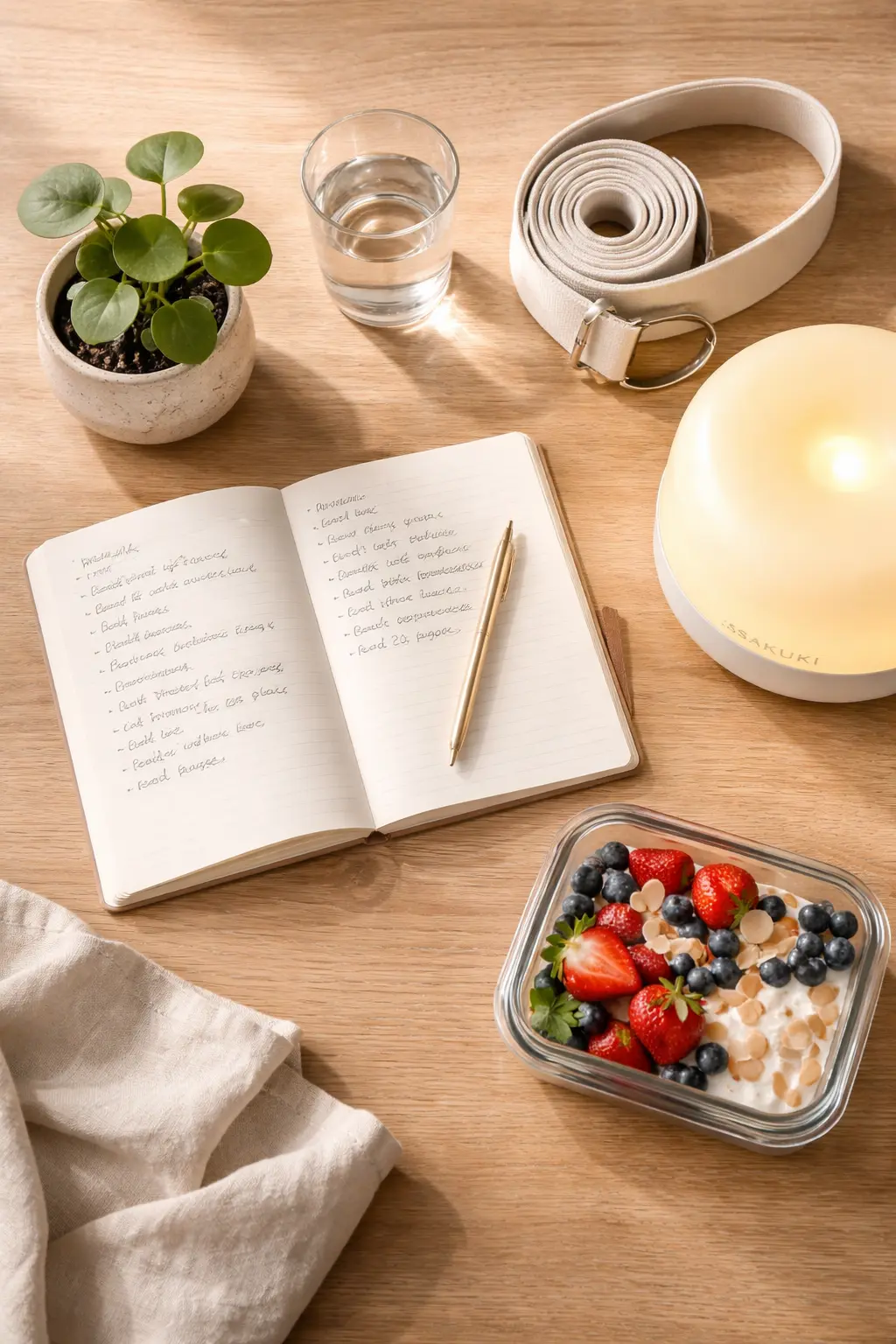
Habits aren’t isolated elements that exist independently from each other. They form a system, a ecosystem where each habit strengthens the others. Morning journaling improves emotional stability by helping you process feelings before they build up into stress. Hydration increases focus, which makes your work more efficient. Movement reduces stress, which makes your sleep better. An evening routine improves sleep, and better sleep creates stronger, more resilient mornings.
If you want to support this entire system, small practical tools can help in ways that go beyond their obvious function. For example, preparing healthy meals in advance and storing them in quality food storage containers makes intentional eating easier. When you open your fridge and see prepared meals ready to go, you don’t make impulsive decisions during the day. You don’t reach for convenience food because convenience is already working for you.
An essential oil diffuser isn’t just about atmosphere or pleasant smell – it symbolizes consistency. When you turn it on, your brain knows: it’s time to slow down. This is ritualistic design. Change isn’t about motivation, which is unreliable and temporary. It’s about environment design – creating a physical space that makes the right choice the easy choice. Your surroundings should support your habits, not fight against them.
Common Mistakes When Changing Your Lifestyle
1. All-or-Nothing Thinking
The biggest mistake people make is trying to implement all these habits simultaneously. You don’t need to overhaul your entire life overnight. Start with one – hydration is usually the easiest – and add others gradually. This prevents burnout and makes lasting change possible.
2. Focusing on Motivation Instead of Systems
Motivation is a terrible strategy. It’s inconsistent and unreliable. Instead, focus on environment design. Remove friction from good choices and add friction to bad ones. Make hydration visible. Put your yoga mat out before bed so you see it in the morning. Delete apps if you need to.
3. Neglecting Recovery
People often sacrifice sleep and rest in pursuit of productivity. This is backwards. Sleep, proper hydration, and adequate movement aren’t obstacles to productivity – they’re prerequisites. Without them, everything else falls apart.
4. Skipping the Tracking Step
You don’t need a fitness tracker, but you do need some way to notice your progress. This could be a simple habit tracker, journaling, or just checking in with yourself weekly. Visibility creates accountability and motivation.
5. Ignoring Individual Differences
Not everyone needs exactly 3 liters of water or 8 hours of sleep. These are starting points. Pay attention to how you feel and adjust. Wellness is personal, not prescriptive.
Frequently Asked Questions
How long does it take for these habits to really make a difference?
Within 3-5 days of regular hydration and exercise, you’ll notice subtle changes in your focus and mood. Improvements in sleep usually occur within a week. More significant changes in energy levels, mood stability, and concentration usually take 3-4 weeks.
Do I really need special equipment, like yoga mats and fitness trackers?
A: No. These devices are helpful because they remove friction and create visual reminders, but they’re not essential. You can stretch out on your living room floor and track your habits on paper. Equipment is a support system, not a requirement.
What if I mess up one day? Should I start over?
Absolutely not. One day won’t erase your progress. The 80/20 rule applies here: if you’re consistent 80% of the time, the 20% of days you miss won’t derail your results. Skipping an evening routine doesn’t mean you failed—it just means you had a day. Continue the next morning without guilt.
Can I do these habits if I have a very busy schedule?
These habits are actually designed for busy people because they’re efficient. 20 minutes of movement beats 0 minutes. Drinking water while you work beats not drinking water. The question isn’t whether you have time; it’s whether you prioritize yourself.
Conclusion
The habits discussed here aren’t optional add-ons to a busy life. They’re the foundation that makes everything else possible. They’re the difference between functioning and thriving, between managing your day and owning it.
The beautiful part is that these habits aren’t complicated. They don’t require expensive supplements, exclusive gym memberships, or hours of research. They require consistency and a willingness to design your environment to support you. When you drink water throughout the day, your focus sharpens. When you move for 20 minutes, your stress dissolves. When you protect your sleep and your attention, your entire life shifts. These aren’t isolated improvements – they compound.
Start small. Pick one habit. Make it visible. Build in one success, and that success makes the next habit easier. Your future self – the one who sleeps better, thinks clearer, and feels more stable – is already grateful for the decision you’re making today. The system works, but only if you work the system. The good news? You don’t need perfection. You just need to start.
This post contains affiliate links. I may earn a small commission at no extra cost to you.

Get cozy inspiration delivered to your inbox.
✓ 14-page beautifully designed ebook
✓ Cozy decorating ideas
✓ Practical room-by-room inspiration
You’re in! 🎉
Thanks for joining the NestFlowHome community!
Your free ebook is already on its way to your inbox. If you don’t see it within a few minutes, please check your Promotions or Spam folder.
Join the NestFlowHome community for weekly decorating inspiration.

Timeless home decor ideas and slow living inspiration for a calm, beautiful life.