
How to Decorate a Small Living Room for Christmas
By Emily | September 25, 2026
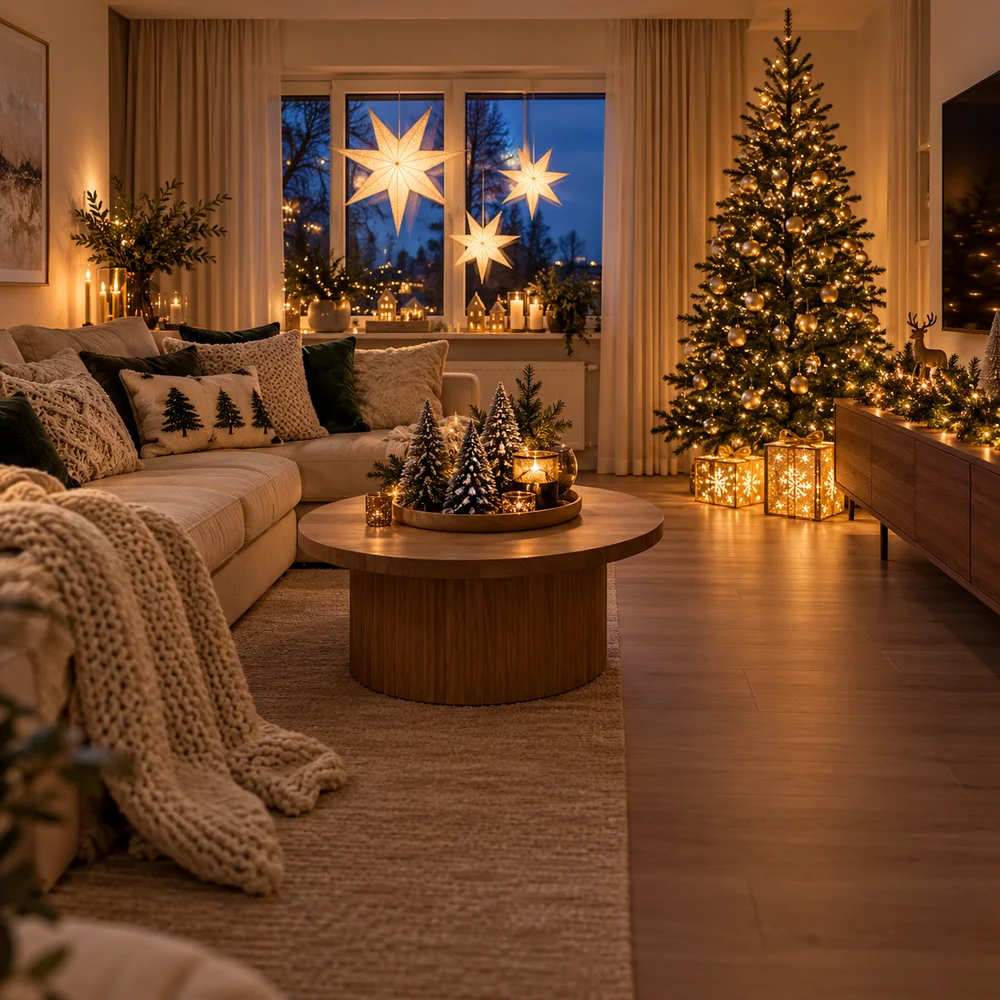
There is a particular moment on a December evening when a small living room gets it exactly right. The overhead light is off, the tree is glowing in the corner, there is still a clear path from the door to the sofa, and nothing is balanced on the arm of a chair because there was nowhere else to put it. The room feels full of Christmas without feeling full.
Most small living rooms never reach that moment, and it isn’t for lack of effort. Holiday decorating advice is quietly written for rooms with a fireplace, a bay window, and a spare corner the size of a parking space. Follow it in four hundred square feet and you end up with a seven-foot tree swallowing the reading chair, a skirt spreading across the rug, and a coffee table so crowded that the mugs go on the floor. The room becomes something you navigate around rather than something you sink into.
The better approach treats floor space as the one thing you are not allowed to spend. Every decoration has to earn its place in one of three ways: it goes up onto a wall, a window, or a ceiling line; it goes onto a surface that already exists — a console, a shelf, a side table — without crowding it; or it replaces something you already own instead of adding to it. Decorate by those rules and you can have a tree, stockings, greenery, and light in a room that still seats everyone who needs to sit.
What follows are fourteen ideas built on that principle, moving from the tree outward to the walls, windows, surfaces, and textiles. Each one is paired with one specific piece that makes it easy to recreate. The palette running through them is deliberately narrow — evergreen, warm gold, and cream, with a few vintage red accents — because in a small room, a tight palette is what keeps a lot of Christmas from reading as a lot of clutter.
1. Choose a Slim Pencil Tree Scaled to Your Ceiling, Not Your Wish List
 Save it
The tree is the single largest decision you will make, and in a small living room it is almost always made wrong in the same direction: too wide. A standard full-profile tree at seven feet can easily measure fifty inches or more across the bottom branches, which in a compact room means losing a chair, blocking a window, or forcing everyone to turn sideways to reach the sofa. Height is rarely the problem. Width is.
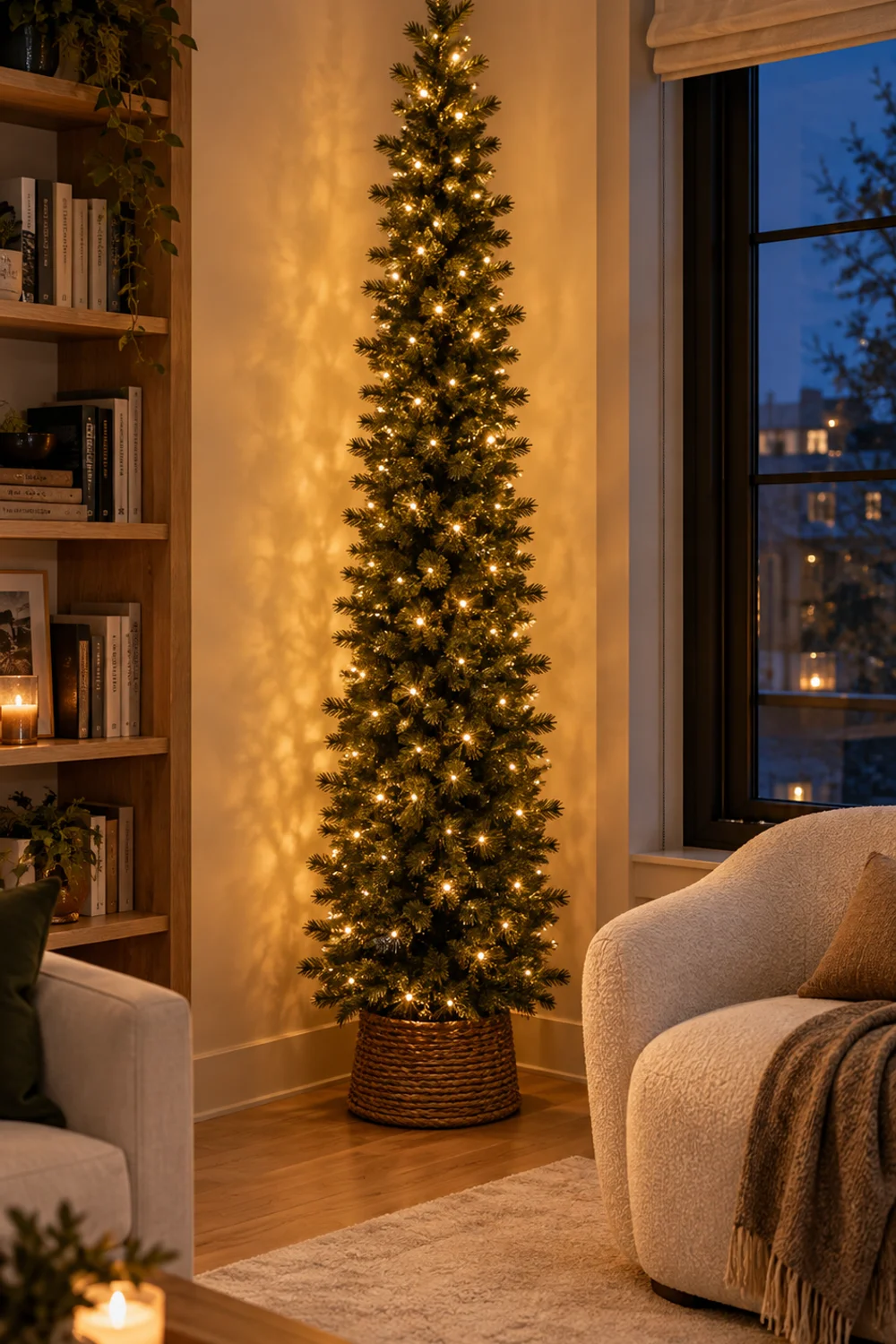
That is why the pencil silhouette is the most useful shape for a small space. It keeps the height that makes a tree feel celebratory while cutting the footprint to a fraction. The Puleo International pencil tree stands six and a half feet tall but only thirty inches wide, so it can slide into a corner beside a window or between the sofa and a bookcase without claiming the walkway.
Measure before you buy. Take your ceiling height, subtract about a foot for the topper and breathing room, and that is your ideal maximum. In a room with standard eight-foot ceilings, six and a half feet is almost exactly right — tall enough to draw the eye upward, which makes the whole room feel taller, and short enough that the top never looks jammed against the ceiling.
Placement matters as much as size. The best spot is usually the corner farthest from the main entry, where the tree becomes the room’s destination rather than an obstacle you pass on the way in. A corner also gives you two walls to reflect the light, which doubles the glow for free. Avoid placing it directly in front of a radiator or in a spot where the door swings.
Because this tree comes pre-lit with 250 clear lights, you skip the most frustrating hour of the season, and the evenly spaced clear bulbs give a calm, warm glow rather than the busy effect of mixed colors. Fluff the hinged branches outward and slightly upward, working from the bottom tier to the top, and pay extra attention to the side facing the room. In a small space, the tree is seen up close, so fullness at eye level matters more than perfection at the back.
2. Run a Battery-Lit Cedar Garland Along the Media Console
 Save it
Most small living rooms don’t have a mantel, and holiday decorating tends to treat that as a problem. It is really an opportunity to decide where the room’s festive horizontal line should go. In most compact living rooms, the natural answer is the media console — the one long, low surface every eye already travels to, and one that usually has little on it besides a television.
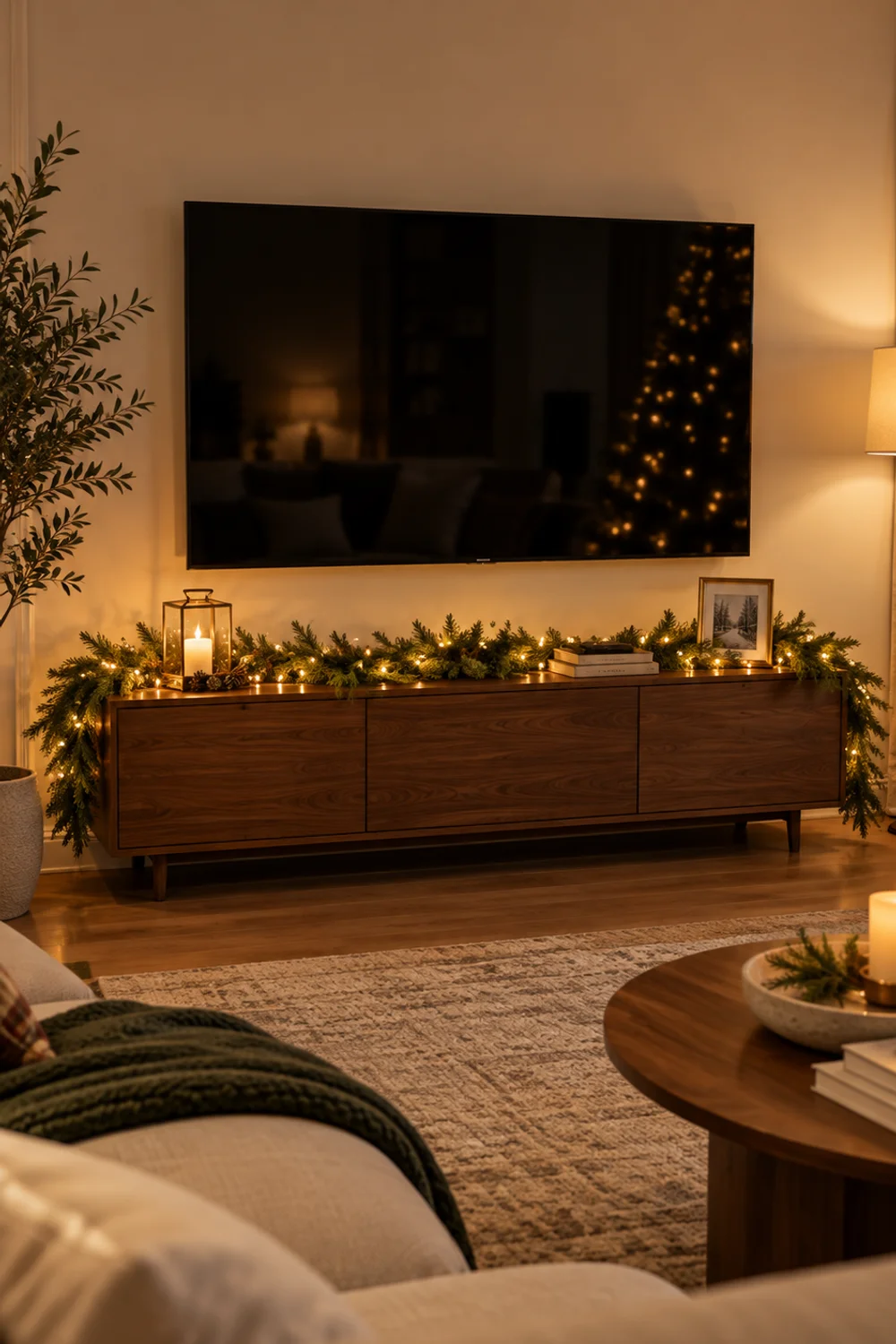
A garland laid along the front edge of the console gives the room the same horizontal sweep of greenery a mantel would, at a height you actually see from the sofa. A cedar garland is nine feet long, which covers a typical six-foot console with enough extra length to let each end drop gracefully over the sides instead of stopping abruptly at the corners.
The practical advantage here is power. This garland is battery operated with a six-hour timer, so there is no cord running across the floor to the nearest outlet — a real consideration when the console sits in the middle of a wall and the outlets are hidden behind the TV. Set it once in the late afternoon, and it glows every evening without anyone reaching behind the furniture.
To make it look lush rather than laid down, start by bending each branch section up and outward so the garland has depth, not just length. Let it undulate slightly along the surface instead of pulling it straight; a gentle wave reads as natural greenery, while a rigid line looks like a cable. The cedar has brown twigs mixed through the green, which gives it a woodland quality that pairs well with a walnut or oak console.
Keep what sits on top minimal. Two or three objects nestled into the garland — a small lantern, a stack of books, one framed photo — are enough. Anything more, and the console tips from festive to crowded, which in a small room is felt immediately. If you want to take greenery further through the house, the ideas in Simple but Stunning Christmas Decorations You’ll Fall in Love With show how garlands can move beyond the living room to stair rails and doorways.
A final tip: keep the garland a few inches back from the screen’s lower edge so the lights never reflect in the television when you’re watching a holiday film.
3. Dress the Slim Tree in One Metallic Family of Gold Ornaments

 Save it
A slim tree changes how ornaments behave. On a wide tree, a mix of colors, themes, and heirloom pieces spreads out enough to look collected. On a thirty-inch pencil tree, the same mix compresses into a narrow column, and the result often reads as busy rather than charming. The fix is to edit the ornaments down to one metallic family and let variety come from finish and size rather than color.
Gold is the most forgiving choice for a small living room because it reflects warm light rather than cold. A 87-piece gold ornament set is built around exactly this idea: every piece is gold, but the finishes range from glitter to mirrored to matte, and the sizes and styles vary. That mix is what keeps a single-color tree from looking flat.
Hang ornaments in three layers rather than all on the branch tips. Tuck the larger matte pieces deep inside the tree, close to the trunk, where they catch the glow of the inner lights and create depth. Place mid-sized mirrored pieces in the middle layer, and save the smallest glitter ornaments for the tips, where they sparkle against the room. This inside-out approach is the difference between a tree that looks decorated and one that looks lit from within.
Scale matters on a narrow tree. Keep the largest ornaments in the lower half and gradually shift to smaller ones toward the top, following the tree’s natural taper. On a pencil shape, oversized ornaments at the top make the whole silhouette look top-heavy.
Because the set is shatterproof, it’s also a sensible choice for a small room where the tree sits close to foot traffic, pets, or a child’s reach. A knocked branch in a tight space is inevitable; a broken glass ornament on the rug doesn’t have to be.
If you have a few sentimental pieces you can’t leave out, give them a place of honor at eye level on the side facing the sofa. Surrounded by gold, a handful of personal ornaments reads as intentional. Scattered throughout a mixed tree, they would disappear. Resist adding ribbon or picks as well; on a slim tree, the gold alone is enough.
4. Stack Lighted Gift Boxes Beneath the Tree Instead of Spreading a Skirt
 Save it
A traditional tree skirt is one of the quietest space-thieves in a small living room. A standard skirt spreads forty-eight inches or more across the floor, turning the base of a slim tree into a wide circle that blocks the corner and catches every passing foot. The pencil tree you chose to save floor space ends up occupying just as much as a full one.
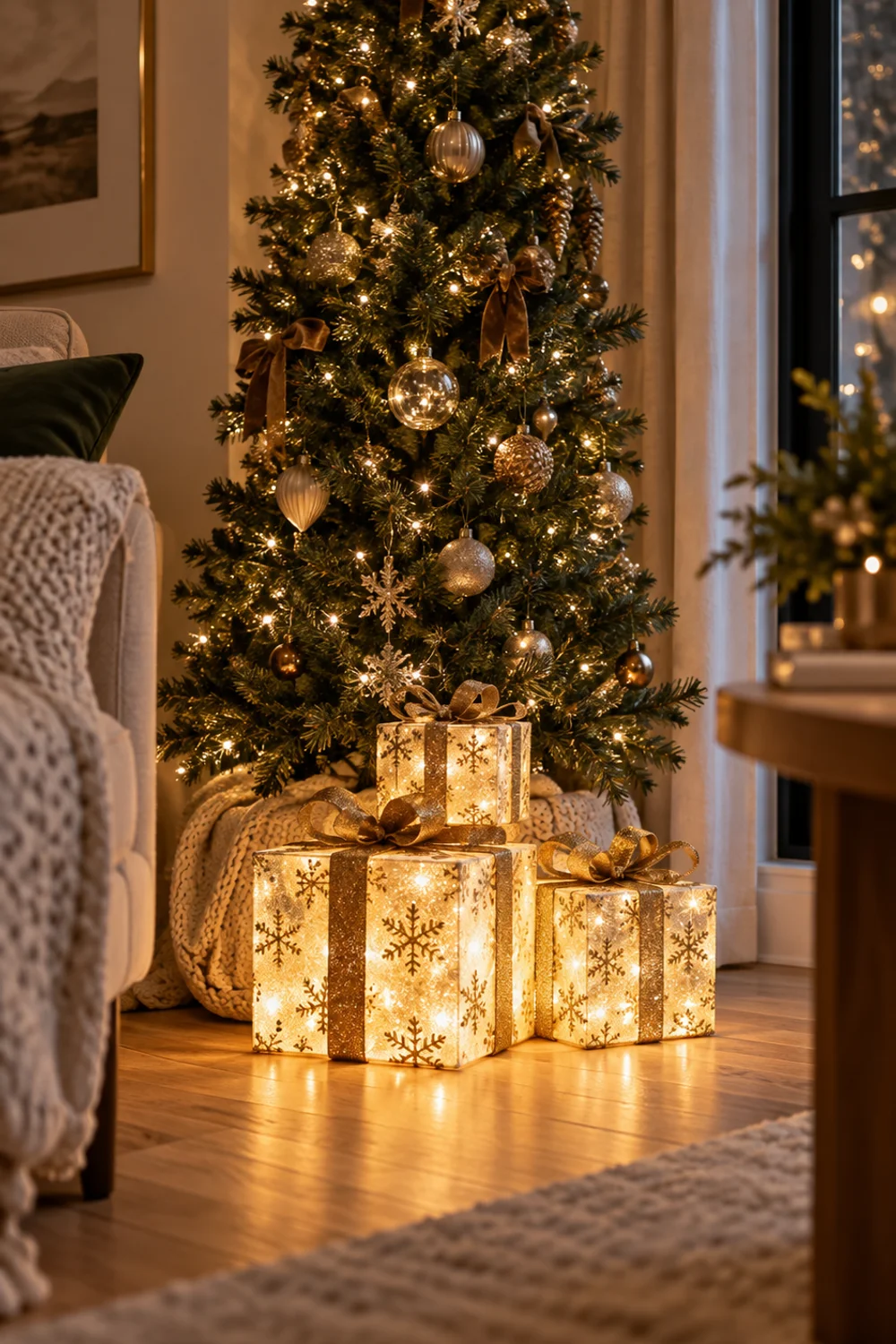
A better answer is to finish the base vertically instead of horizontally. A small stack of lighted gift boxes covers the tree stand, fills the visual gap at floor level, and adds glow in the lowest, darkest part of the room — all within the tree’s own footprint. The set includes three nesting sizes, from about seven and a half inches down to five, with a gold snowflake design and warm white LEDs inside.
Arrange the boxes in an offset stack rather than a neat pyramid. Place the largest box slightly in front of the stand, the medium one beside it at an angle, and the smallest either on top or tucked a few inches to the side. The slight irregularity makes them look like presents set down rather than a display, and it lets light spill from different heights.
The glow matters more than it might seem. Most tree lighting stops about a foot above the floor, which leaves a dark patch at the base that makes the tree look like it’s floating. Lighted boxes fill that gap and ground the tree visually. Because they’re battery operated with a six-hour timer, there is no extra cord competing with the tree’s own plug in the corner.
Choose the boxes to echo the tree. With gold ornaments above, the gold snowflake pattern ties the base to the branches so the whole corner reads as one composition. If the tree stand is still visible, wrap it loosely in a soft throw in cream or oatmeal, tucked under the boxes; it hides the metal without spreading across the floor the way a skirt would.
When real presents start arriving, rotate them in and let one or two lighted boxes stay in front. You get the generous look of gifts under the tree without the pile creeping toward the sofa.
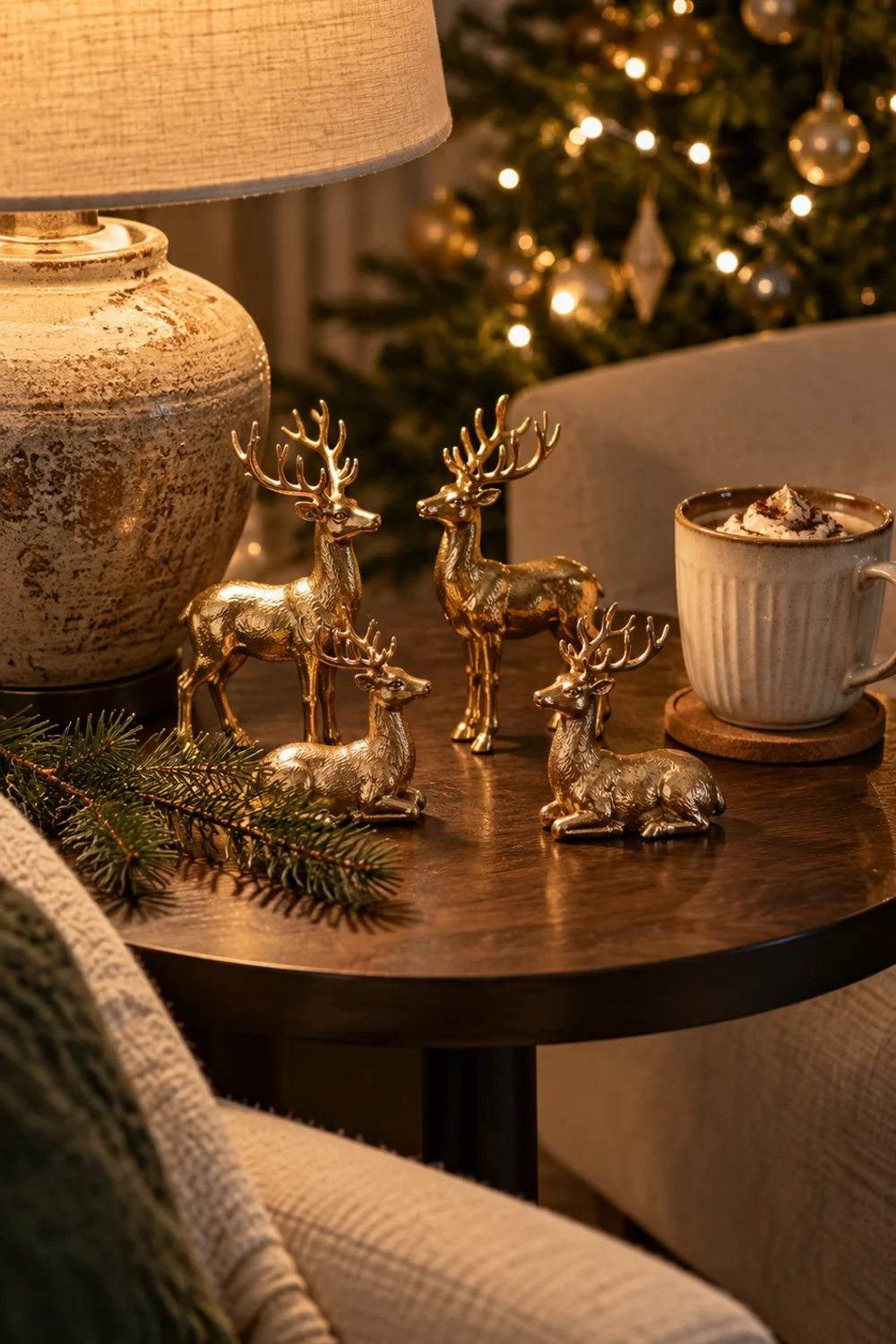
5. Gather Small Gold Reindeer on the Side Table
 Save it
In a small living room, the side table is prime real estate. It holds the lamp, the remote, a coaster, maybe a book — and it sits right at your elbow, which means anything placed there is seen more closely and more often than almost any other decoration in the room. That makes it the perfect place for something small, detailed, and quietly festive rather than something large and loud.
A little group of gold reindeer figurines does exactly that. The Thyle set includes four small resin deer — two standing, at about six inches, and two sitting, at a little over four — finished in gold. They are small enough to share a side table with a lamp and a mug without crowding either, and their metallic finish picks up the lamplight the way the tree’s ornaments do.
Arrange them as a small scene rather than a lineup. Place one standing deer toward the back of the table, near the lamp base, so it gains height and catches the light. Set the second standing deer slightly forward and angled toward it, then let the two sitting deer rest low in front, as though the group has paused. Staggering the heights and angles makes four small pieces look like a moment rather than a row of objects.
Keep the rest of the tabletop edited. Clear away anything that doesn’t earn its place for the season, leaving the lamp, one practical item such as a coaster, and the reindeer. A single sprig of greenery or a small stack of two books under one standing deer can add height, but stop there. The deer’s small scale is what makes them feel refined; surrounding them with clutter erases that.
Because the deer have weighted bottoms, they stay put when someone reaches past them for the lamp switch, which matters on a surface used every day. If you have two side tables, resist splitting the set evenly between them. Keeping all four together makes a stronger statement, and a second table can carry something different — a small bowl of greenery or a candle — so the room doesn’t feel repetitive.
When the season ends, the deer are neutral enough to stay into January, bridging the gap between Christmas and winter.
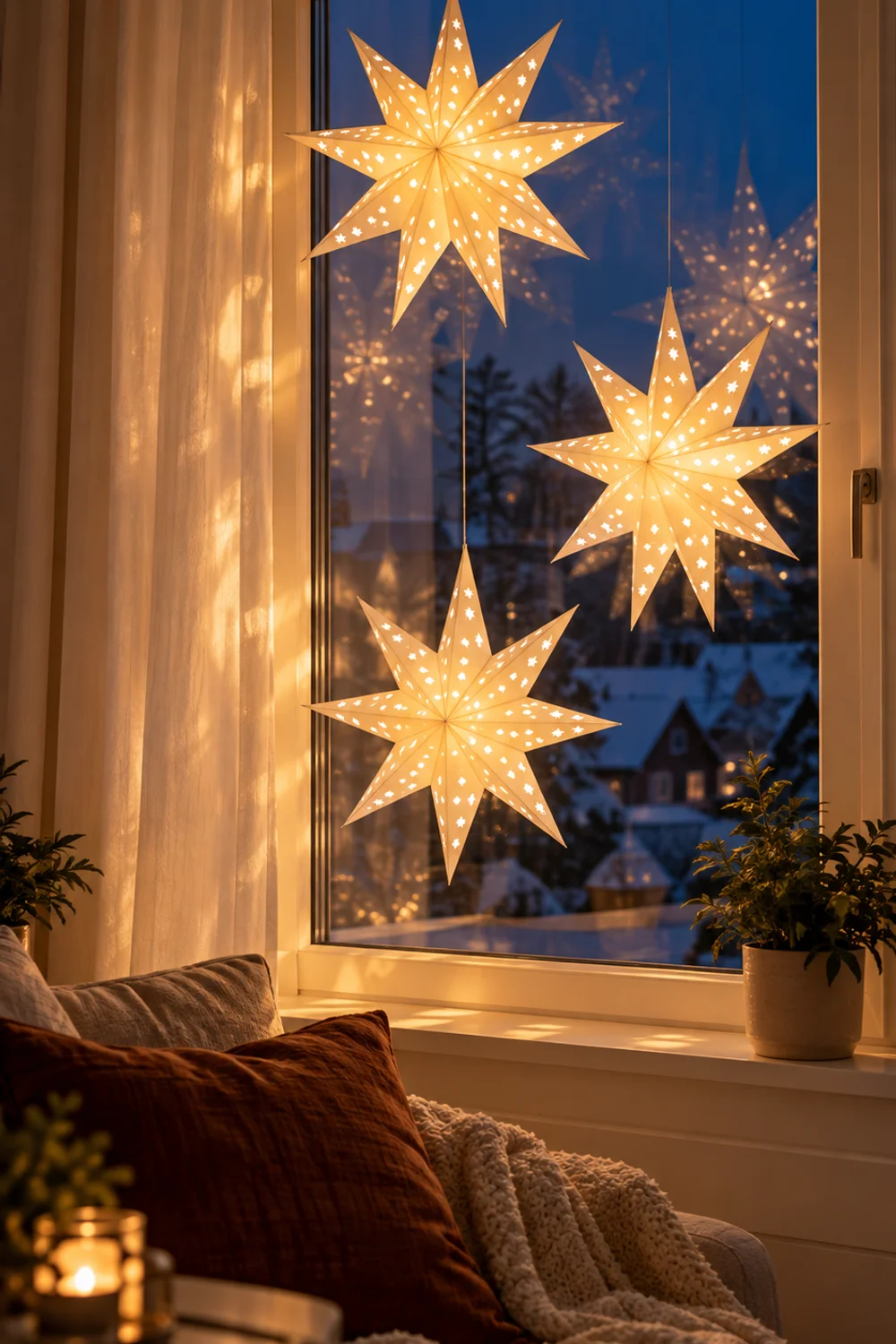
6. Let Paper Star Lanterns Turn the Window into Decor
 Save it
Windows are the most underused decorating surface in a small living room. They take up no floor space and are seen from inside and out. At night they turn into dark mirrors that reflect whatever glows in front of them. Hang something luminous in a window, and you effectively double it.
Paper star lanterns are the classic Scandinavian way to use that space, and they suit small rooms especially well because they are light, airy, and visually soft. The HOUISM set includes three white, seven-pointed paper stars, each about eighteen inches, with star and circle cutouts that scatter patterns of light when the included warm white fairy lights glow inside. They are battery powered, so there’s no cord dangling down the window frame.
Hang them at staggered heights rather than in a straight row. In a standard window, hang one star near the top of the frame, a second a little lower and off to the side, and the third lower still. The uneven rhythm looks natural and lets each star catch a different part of the glass reflection. Clear fishing line or a thin ribbon from a small hook in the frame keeps the stars floating without visible hardware.
If you have only one window, you can hang all three there. If you have two, consider two stars in the main window and one alone in the second, which spreads the glow around the room without scattering it too thinly. Avoid the temptation to add more stars elsewhere in the room; their impact comes from being concentrated.
Keep the window treatment simple around them. Open curtains or blinds fully in the evening so the stars read clearly from outside, and so the dark glass behind them becomes a backdrop. If you use sheer curtains, draw them just behind the stars; the fabric diffuses their light beautifully and hides the street view without losing the glow.
White paper keeps the look calm and modern, which is especially useful next to a gold tree and green garland. The stars add pattern and light without adding color, so the room keeps its narrow palette.
The flat-folding design matters after the holidays, too: the stars fold down for storage, so they won’t take up a closet shelf you don’t have.
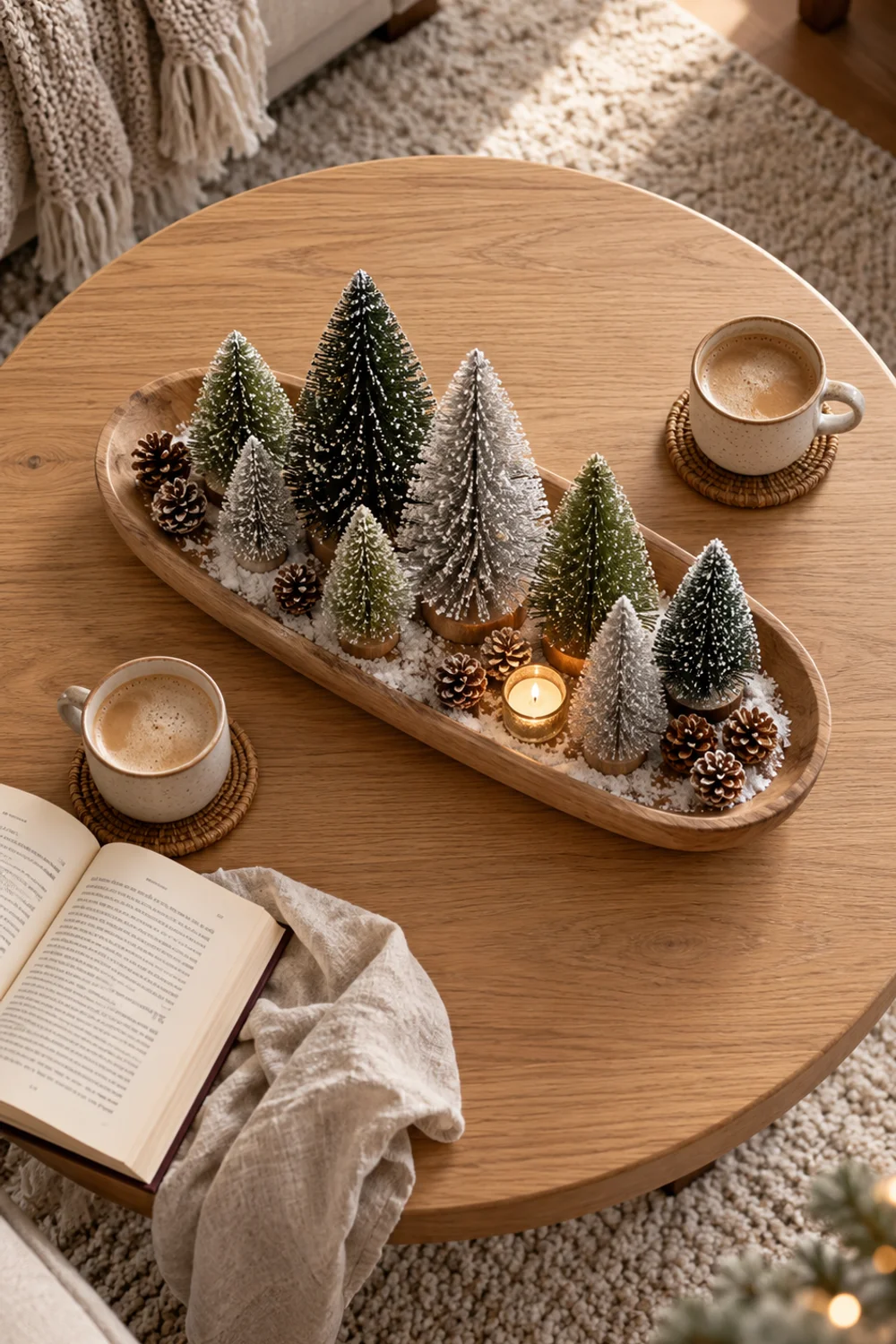
7. Build a Miniature Snowy Forest on the Coffee Table
 Save it
The coffee table is where small living rooms most often go wrong at Christmas. It’s the center of the room, so it feels like it should hold something important, and the usual answer is a tall centerpiece — a big arrangement, a lantern, a candle cluster — that blocks the view across the room and leaves no space to set down a cup. In a compact space, the coffee table needs decor that stays low and leaves room to live.
A cluster of miniature bottle brush trees is the ideal answer. The Hommtina set includes nine small trees in four sizes, from about four to ten inches, in dark green, light green, and silver, each dusted with faux snow and set on a round wooden base. Grouped together, they read as a tiny winter forest — festive and full of detail, but low enough that you still see the person on the other side of the table.
Contain the forest on a tray or a long wooden board so it reads as one composition and can be lifted off in a single move when you need the table. Arrange the tallest trees toward the back or center, let the smaller ones drift forward and outward, and leave uneven gaps between them the way trees grow in a real landscape. Mixing the three colors throughout, rather than grouping them by color, keeps the scene natural.
Add texture on the tray’s surface to finish the look: a thin layer of faux snow, a small pile of pinecones, or a folded piece of cream linen. Keep the arrangement to one end of the table or the middle third; the rest should stay clear for drinks, books, and board games. If you want more on keeping a coffee table beautiful without crowding it, How to Decorate a Coffee Table for a Modern Living Room covers the proportions and layering that make a tabletop feel intentional.
The small scale of these trees is exactly what makes them work in a compact room. A single large centerpiece becomes a wall between people; a scattering of small trees becomes a landscape you look across. At night, set one small battery candle among them, and the snow-dusted tips catch the light.
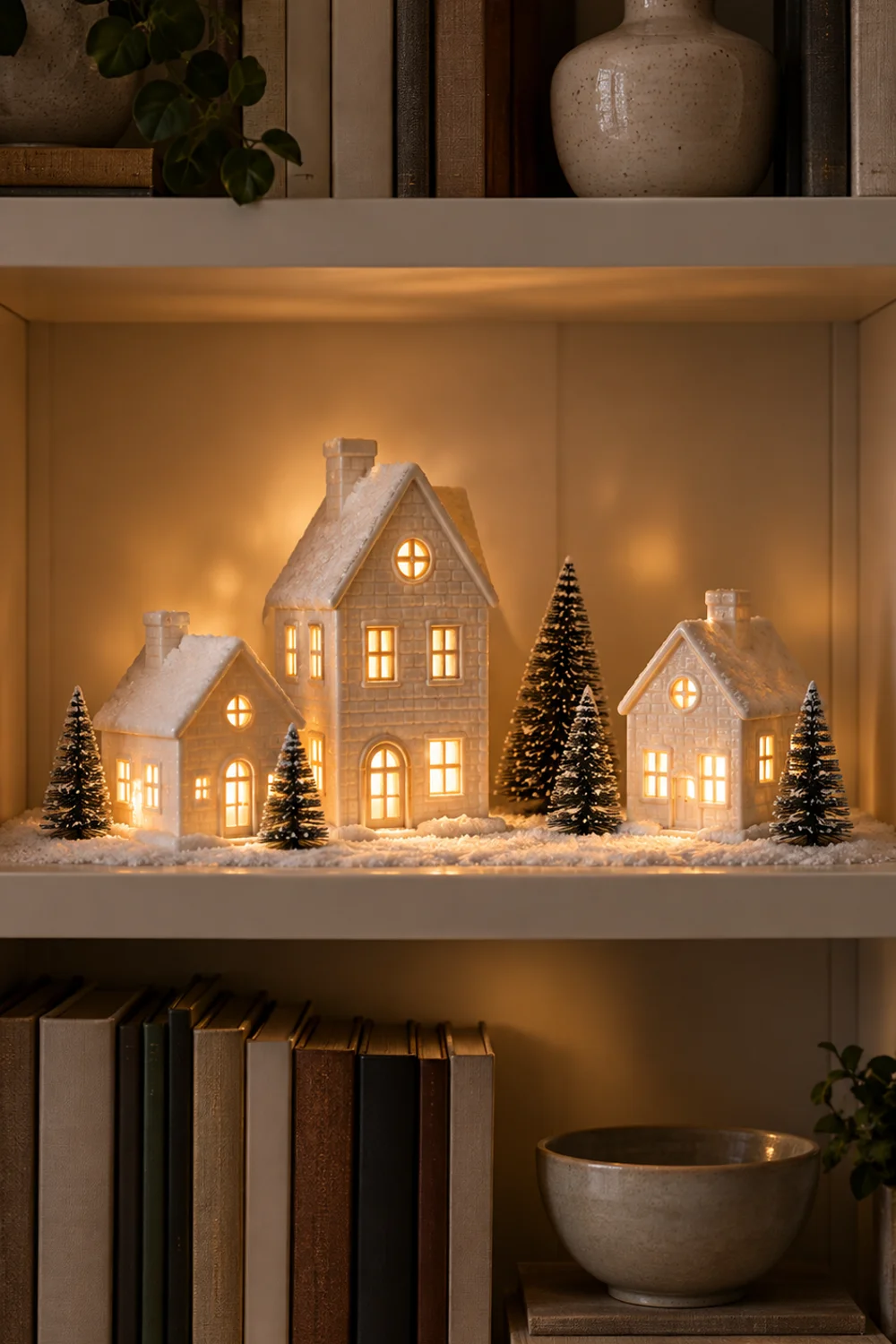
8. Give One Bookshelf Ledge a Glowing Porcelain Village
 Save it
Bookshelves are one of the richest decorating spaces in a small living room, and one of the easiest to overload. The instinct at Christmas is to add a little something to every shelf, and the result is a unit that looks cluttered from across the room. A better approach is to dedicate one shelf — ideally at or just below eye level — to one strong seasonal moment and leave the others as they are.
A small lighted village is perfect for that single shelf. This set includes three white glazed-porcelain houses, the tallest just over six inches, each with a subtle brick outline and a frosted tree beside it. They glow from inside with LED lights, and the all-white palette keeps them modern rather than nostalgic. They sit comfortably on a standard shelf without needing the depth of a mantel.
Clear the chosen shelf completely before you start, then build the scene with intention. Place the tallest house slightly off-center rather than in the middle, and arrange the other two at different depths — one toward the front, one a little farther back — so the village has perspective rather than looking like a row of ornaments. Leave a few inches of empty shelf on either side; negative space frames the village and keeps it from blending into the books around it.
Ground the houses with a thin strip of faux snow or white felt along the shelf, or a few small pinecones tucked between them. That is enough. Resist adding figurines, cars, or signs; the simplicity of the white porcelain is what makes it look refined in a contemporary room.
Lighting is where this idea shines. On a dark December evening, three softly glowing houses at eye level create a pocket of warmth that draws the eye across the room, balancing the tree in the opposite corner. That balance matters in a small space, because it spreads the room’s glow around rather than concentrating it all in one place.
If the shelf is near the sofa, you’ll see the village every time you sit down, which is exactly the kind of close, detailed moment that makes a small living room feel special.
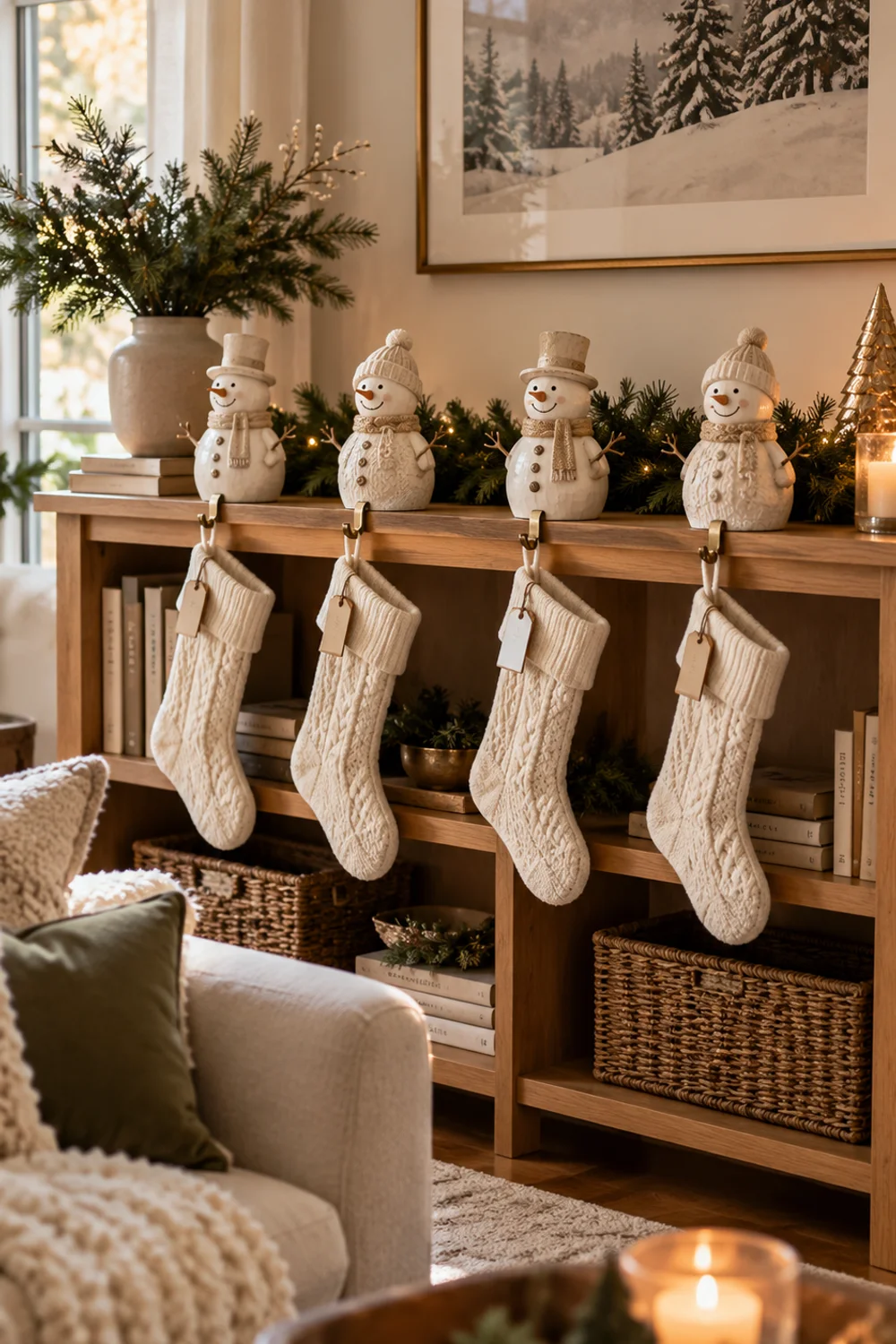
9. Let Clay Snowman Holders Hang Stockings Without a Mantel
 Save it
Stockings are the decoration most tied to a fireplace, and without one, many small-space dwellers simply skip them. That’s a loss, because stockings are among the most personal elements of Christmas, each one a small promise of the morning to come. You don’t need a mantel to hang them. You need a sturdy horizontal edge and holders heavy enough to do the job.
Freestanding stocking holders solve this neatly, and figurative ones do double duty as decoration. The Newtay set includes four white clay snowmen in two styles, each weighing about two pounds, with a hook built in to hold a stocking. The handmade, terracotta-inspired look gives them warmth and a slightly rustic character, which softens a room full of gold and glass.
The best places to use them in a small living room are the top of a waist-high bookcase, a console table against a wall, or a deep windowsill. Any surface where the stockings can hang freely without brushing the floor or blocking a drawer will work. The front edge should be clear so the stockings fall straight down.
Space the snowmen evenly, leaving roughly the width of a stocking between each one, so the stockings hang side by side without overlapping. Four holders on a three- or four-foot surface is usually the right density; more starts to feel crowded. If your household has fewer than four stockings, use the extra snowmen as bookends or place one on the side table as a small accent.
Choose stockings that suit the palette of the room. Cream knit, soft oatmeal, or a simple evergreen velvet will look calm against white snowmen, while busy prints tend to fight with them. Keep them all the same style for a cohesive look, and personalize them with a simple name tag rather than a mix of patterns.
Because the holders are heavy, they stay put even when a stocking is filled with gifts on Christmas morning. That is the whole point: a decorative, stable, fireplace-free way to keep a tradition alive in a room that was never designed for it.
10. Trade Everyday Pillow Covers for Plush Christmas Tree Covers

 Save it
Textiles are one of the fastest ways to bring Christmas into a living room, but in a small space, the common instinct — piling on extra festive pillows — works against you. Every added cushion takes up seating, and a sofa buried in pillows is one nobody can actually sit on. The smarter move is to replace, not add: keep the pillow inserts you already own and change only their covers.
Covers are inexpensive, easy to store, and change the entire feel of a sofa in minutes. Christmas pillow covers are made from soft, plush faux fur in beige, with an embroidered Christmas tree on the front and an invisible zipper. They fit standard eighteen-inch inserts, which means they slip onto the pillows most sofas already have.
The beige works well in a small room because it’s quiet and tonal — it signals Christmas through the embroidered motif and the plush texture rather than through bright red and green, which would compete with the tree and garland. The faux fur also adds a tactile, wintery warmth that invites people to sit.
Place the two covers in the sofa’s corners, where they act as bookends for the seat, and leave your other pillows in their everyday covers or swap them for solid cream or soft green. Two festive pillows among two or three quieter ones look curated; four identical holiday pillows look themed. If your sofa is a loveseat, two pillows total is plenty.
Layering a throw over one arm finishes the look. Choose something in a complementary texture — chunky knit or boucle in cream or oatmeal — and let it drape casually rather than folding it perfectly. It’s one more cozy layer that doesn’t take any extra floor space. For more on making a compact living room feel warm without overcrowding it, 12 Small Living Room Ideas for a Cozy Apartment explores the layout, lighting, and editing choices that make small spaces feel generous year-round.
When the holidays end, the covers come off, fold flat, and store in a drawer. Your everyday pillows are ready in two minutes, and the sofa is back to normal without a closet full of seasonal cushions.
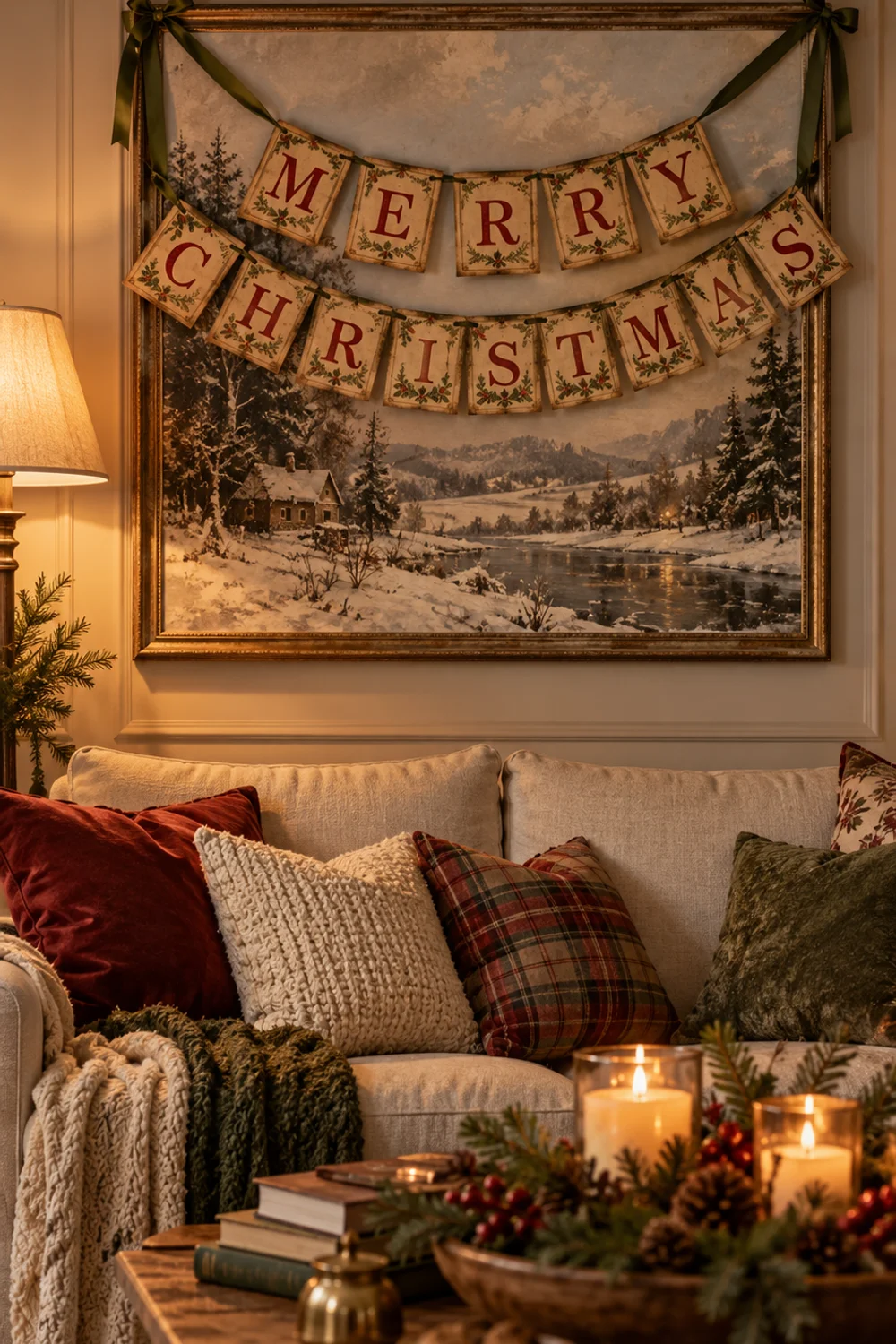
11. String a Vintage Merry Christmas Banner Across Wall Space You Already Use
 Save it
In a small living room, wall space is almost always spoken for. There’s the art above the sofa, the mirror by the door, the shelves and screen, and very little blank wall left for anything seasonal. Instead of hunting for a free wall, layer the festive element over what’s already there. A banner strung across an existing piece — the art above the sofa, a mirror, or the face of a bookcase — adds Christmas without adding a single new nail.
A vintage-style letter banner is ideal for this because it’s light, flexible, and reads as graphic decoration rather than clutter. The Merry Christmas banner has square cards of about six inches, distressed in brown for a vintage look, with red letters backed by an olive green flourish, all strung on green satin ribbon. The palette of faded red and green gives the room a nostalgic accent without the brightness of new holiday colors.
The banner can hang in two rows of about fifty-four inches, with “Merry” above “Christmas,” or in a single line of about eighty-four inches. For a small living room, two rows are usually better: the shorter width fits above a standard sofa or across a mirror without running wall to wall, and the stacked words read more like a composition than a long string.
Hang it in a gentle, shallow curve rather than pulling it tight. Attach the ribbon ends to the frame’s hanging wire, to removable adhesive hooks at each side, or to the top corners of a bookcase, and let the middle dip a few inches. A slight swag feels festive and relaxed; a rigid line looks like a sign.
Keep the art or mirror beneath it visible. The banner should frame and layer over the existing piece, not hide it. If you’re hanging it above the sofa, position it high enough that heads don’t brush the cards when someone leans back.
The banner’s olive and red also tie together other parts of the room — the green of the garland and the red berries you might add elsewhere — so it becomes a small thread connecting the scheme. It’s one of the few decorations that adds words to the room, so let it be the only one.
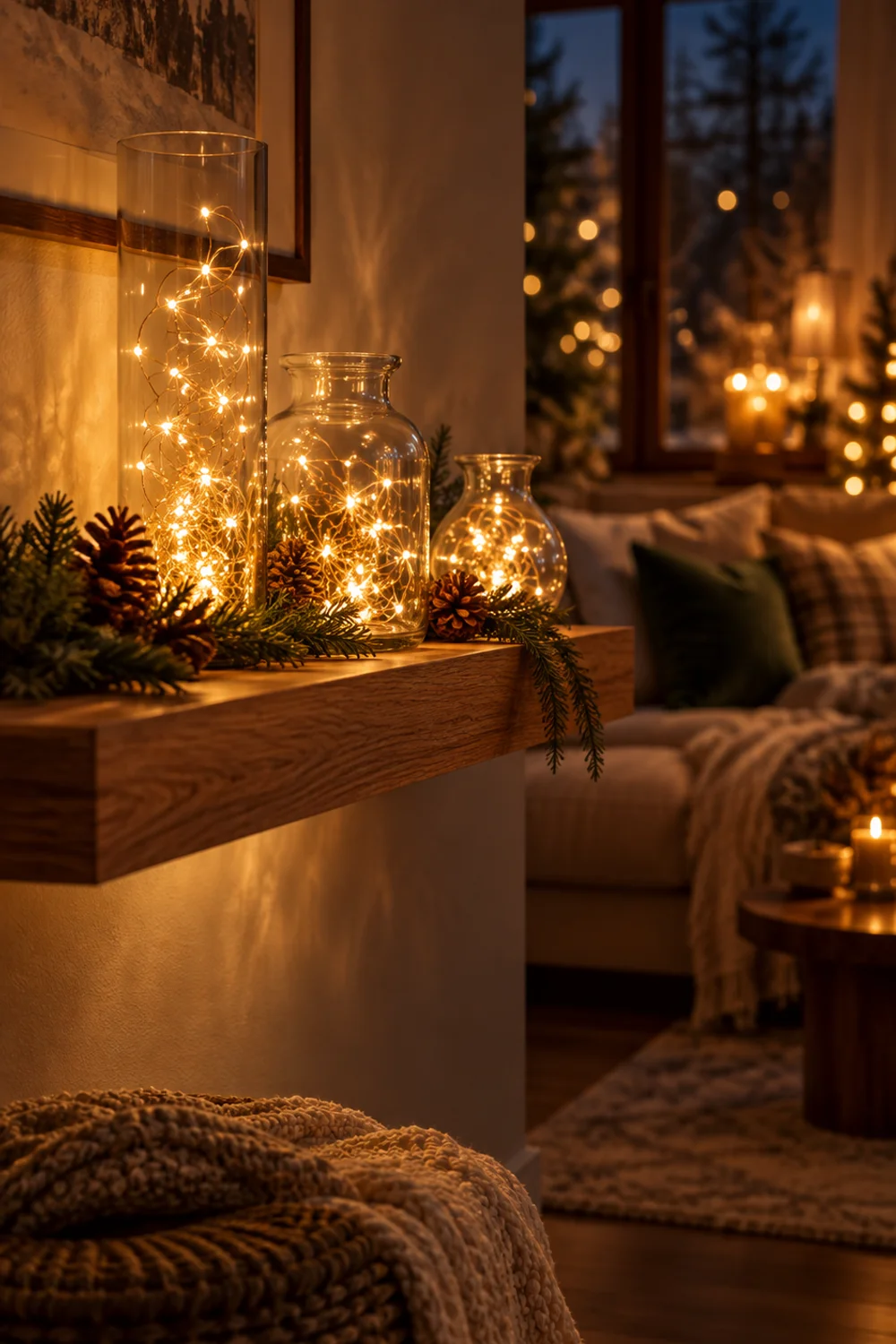
12. Trade Extension Cords for Cordless Fairy Lights in Glass
 Save it
Nothing breaks the spell of a small, softly lit living room faster than a tangle of extension cords snaking across the floor. In a larger space, cords can hide behind furniture. In a compact one, they run across walkways, catch feet, and fight for limited outlets. The more you rely on plugged-in lighting, the more the room starts to look like a power strip.
Battery fairy lights solve this elegantly, and placed inside glass, they become a glowing decoration in their own right. A set includes six strands of warm white fairy lights on thin copper wire, each ten feet long, with a battery box and a six-hour timer. Six strands give you enough to create several small moments of light around the room without a single cord.
The most beautiful way to use them is inside clear glass vessels. Loosely coil a strand into a tall glass cylinder, a large apothecary jar, or a clear vase, and hide the battery box underneath a sprig of greenery or a few pinecones inside. The copper wire nearly disappears, leaving a cloud of tiny points of light that looks almost like captured stars. Group two or three vessels of different heights on a shelf, a windowsill, or the far end of the console.
You can also weave a strand through places a plugged-in string could never reach: along the top of a mirror frame, around a stack of books, or through a small bowl of greenery on the side table. Each strand becomes a small, independent source of glow, placed exactly where the room needs it.
The timer is what makes this practical rather than a chore. Switch each strand to timer mode once, and it will light for six hours every evening and turn itself off. You get layered, flexible light all season without anyone crawling behind furniture or remembering to unplug anything.
In a small room, many small points of light are more flattering than one bright source. They add depth, draw the eye to different corners, and make the space feel larger at night.
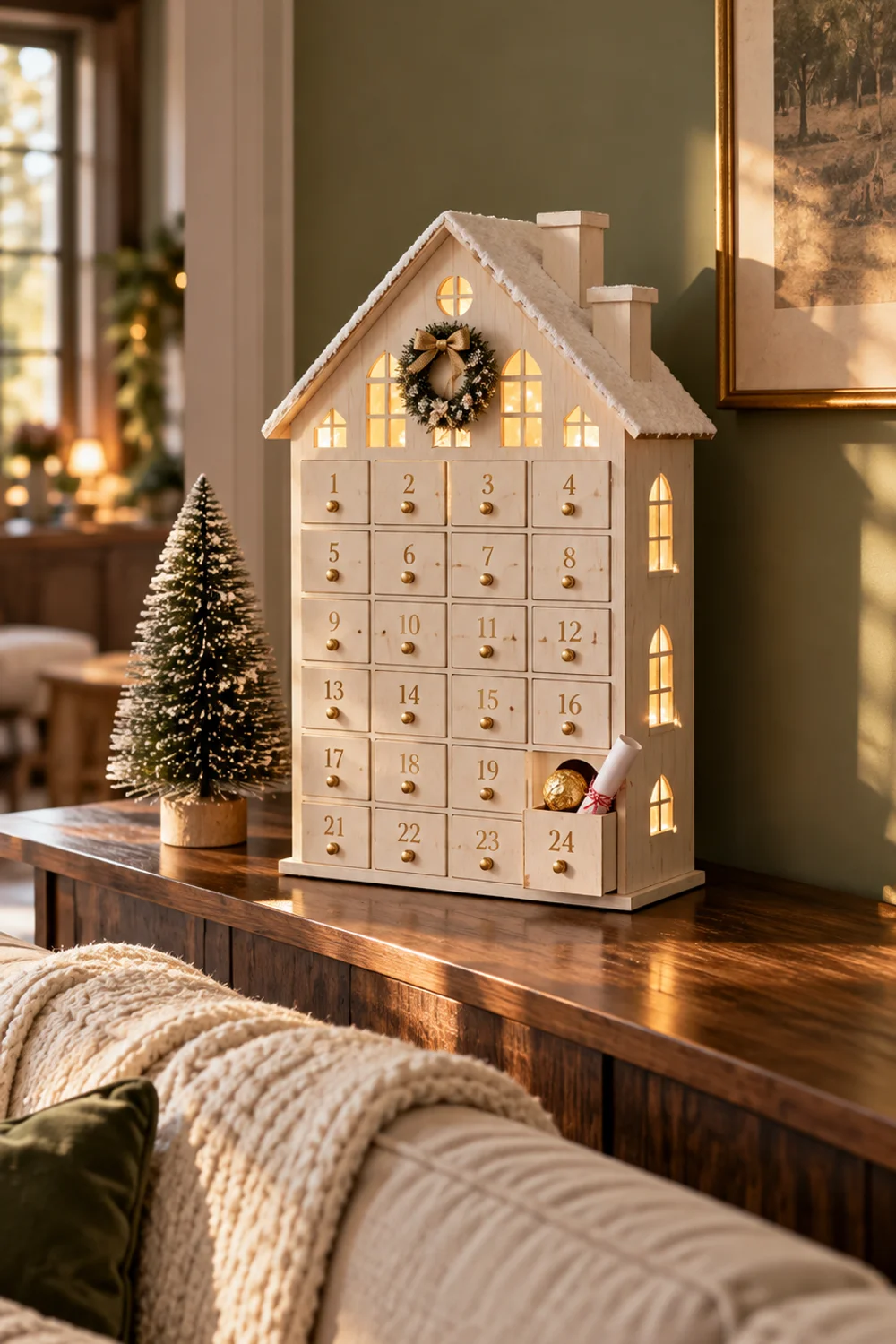
13. Make the Advent Calendar Earn Its Surface
 Save it
Advent calendars are wonderful traditions, but many of them are designed as temporary novelties — cardboard boxes that sit awkwardly for twenty-four days and then go in the recycling bin. In a small living room, where every surface matters, an advent calendar needs to be genuinely decorative as well as functional. It should look like it belongs.
A wooden calendar shaped like a house does exactly that. A calendar is white wood with twenty-four small drawers, battery-operated LED lights, and a footprint about sixteen inches wide but under three inches deep. That shallow depth is what makes it suitable for small rooms: it fits on a narrow shelf, a sofa table, or the edge of a console without crowding everything around it.
The best spot is somewhere you pass every morning — the top of a low bookcase near the door, a narrow console behind the sofa, or a wall shelf at eye level. Making the calendar part of the daily route turns opening a drawer into a small ritual rather than something you remember at bedtime. It also keeps it within reach of children without being in the middle of the floor.
Style around it lightly. Because it’s white, it pairs naturally with the porcelain village and the paper stars, and it looks especially good against a warm wood or painted wall. Place one small green element beside it — a potted mini tree or a single bottle brush tree — and stop there. The calendar is already a detailed object; surrounding it with more would muddy its outline.
Fill the drawers with things that make sense for your household: small treats, a note with a holiday activity for that day, a tiny ornament to add to the tree, or a line from a favorite Christmas story. The drawers are small, so think in terms of single chocolates, rolled-up notes, or miniature trinkets.
The LED glow adds another soft light source in the evening, one that feels festive but quiet. And unlike cardboard calendars, this one gets packed away and reused, becoming a family tradition that returns year after year.
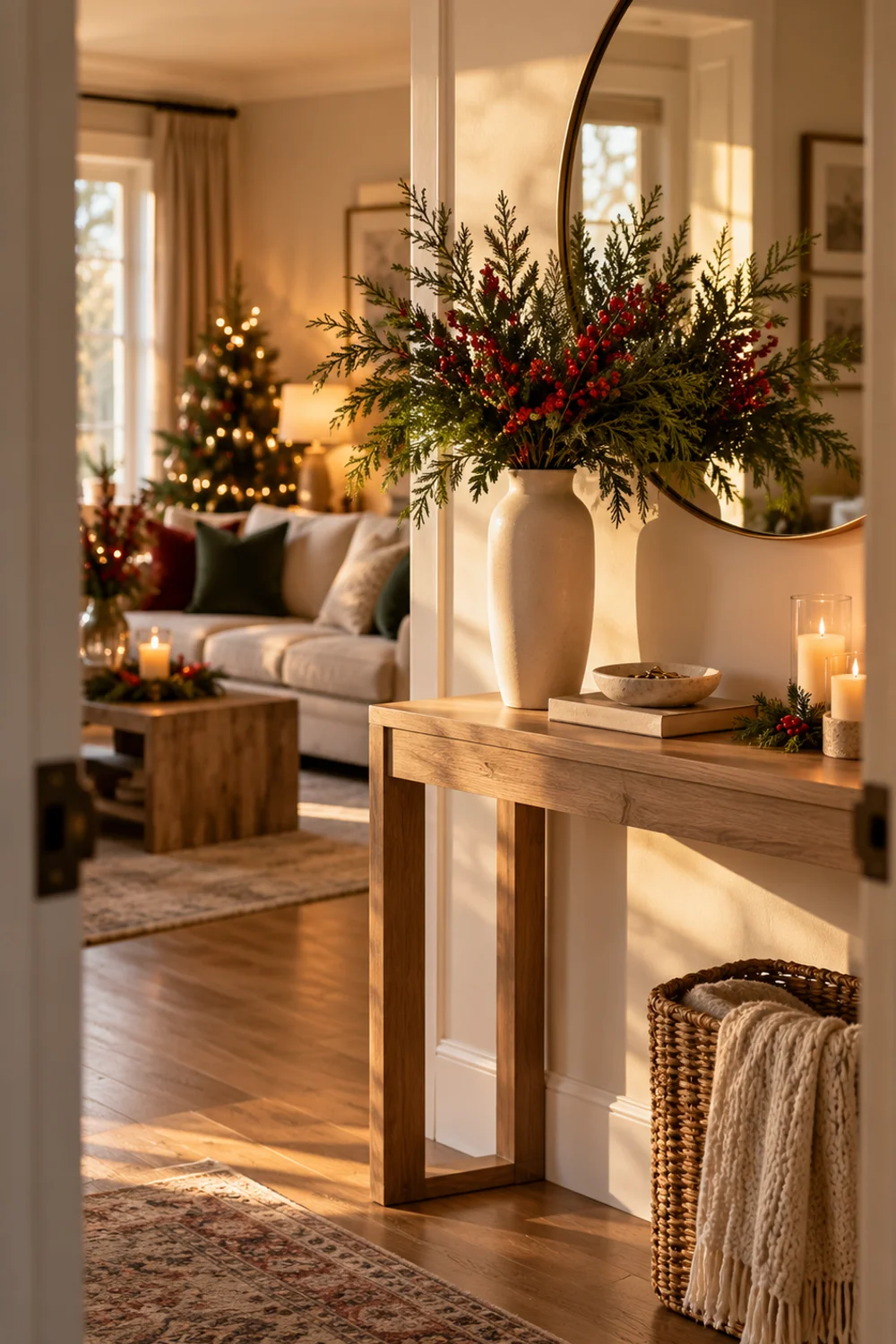
14. Fill One Slim Vase With Faux Pine and Red Berry Stems
 Save it
Every room has a spot where your eye lands first when you walk in. In a small living room it’s often the console or table facing the door, or the corner just inside the entrance. That spot sets the tone before you’ve even taken off your coat, and it is the right place for one generous, living-looking arrangement of greenery.
A single vase of evergreen and berries does more for a small room than several scattered arrangements, because it concentrates the natural element into one confident gesture. This set includes thirty-five faux pine branches of about ten and a half inches and ten red berry stems of about seven inches, loose, so you can arrange them in a vase you already own.
Choose a slim, tall vessel — a narrow ceramic vase, a clear glass cylinder, or an earthenware jug. A slim neck holds stems upright and keeps the arrangement’s footprint small, which matters on a narrow console. Start with the pine: insert the longest branches first, letting some lean outward, then fill in with shorter ones to build a loose, natural shape. Add the berry stems last, placing them unevenly so the red appears in small flashes rather than a band.
Use more stems than you think you need. A thin arrangement looks sparse and artificial; a full one reads as abundant and lush. With forty-five pieces, you can make one substantial arrangement or a large one plus a small bud vase for the side table.
The red berries are the only real red in this scheme, so let them be the room’s accent. Their color connects to the red lettering on the vintage banner and gives the eye a warm point to rest on among the greens, golds, and creams. That restraint is what keeps the room feeling sophisticated rather than themed.
Because these stems are faux, they don’t drop needles or dry out in a warm, heated room, and they can be packed away and rearranged year after year. Swap the berries for dried citrus or white stems after Christmas, and the same pine carries you gracefully into January.
Common Mistakes
1. Buying a tree that is too wide instead of too tall
Most people measure a tree’s height and forget its width. In a small living room, a full-profile tree swallows a chair or blocks a walkway even when it clears the ceiling. Measure the floor space you can realistically give up, then choose a slim or pencil tree that fits that footprint, not the tree you remember from childhood.
2. Adding decorations instead of replacing things
Every holiday piece added to an already furnished small room competes for space with what’s there. Before bringing something in, decide what it replaces or where it goes that isn’t floor. Swapping pillow covers, layering a banner over existing art, or clearing one shelf for a village keeps the room feeling spacious even when it’s full of Christmas.
3. Spreading decor evenly across every surface
Putting a little something on every shelf, table, and ledge makes a small room look cluttered, even if each piece is lovely. Concentrate decorations in a few strong moments — the tree corner, one shelf, the coffee table, the window — and leave other surfaces calm. Concentration reads as design; distribution reads as clutter.
4. Relying on plugged-in lighting
Every plugged-in decoration adds a cord, and in a small room, cords end up crossing walkways and fighting for outlets. Battery-operated lights with timers — in garlands, lanterns, boxes, and glass vessels — give you layered light without the clutter and without a daily routine of switching things on and off.
5. Using too many colors
Red, green, gold, silver, blue, and white all together make even a beautifully decorated small room feel chaotic. Choose a narrow palette — evergreen, gold, and cream with a touch of vintage red, for instance — and repeat it throughout the room. A consistent palette lets many decorations read as one calm, coordinated scheme.
Frequently Asked Questions
What size Christmas tree is best for a small living room?
Width is more important than height. For a room with standard eight-foot ceilings, a slim or pencil tree about six to six and a half feet tall and roughly thirty inches wide gives you real height while leaving the floor clear. Place it in a corner away from the main entry so it becomes a destination instead of an obstacle.
How can I decorate for Christmas without a fireplace?
Choose a long, low surface to act as your mantel — a media console, bookcase top, or console table. Run a garland along it, use weighted stocking holders on its edge, and add a few small objects. You get the same horizontal focal point a mantel would give, at a height you actually see from the sofa.
How do I keep a small living room from looking cluttered at Christmas?
Concentrate your decorations into a few strong moments rather than spreading them everywhere, keep the palette narrow, and use walls, windows, and existing surfaces instead of the floor. Replacing items — like pillow covers — rather than adding new ones also helps the room stay open.
Are battery-operated lights bright enough for decorating?
Yes, especially in a small room, where several soft sources of light are more flattering than one bright one. Battery fairy lights, pre-lit garlands, lanterns, and lighted boxes create a warm, layered glow, and their timers mean they switch on every evening without cords or extra effort.
What colors work best for small-space Christmas decor?
A narrow palette works best. Evergreen, warm gold, and cream are calm and cohesive, with a small amount of red for warmth. Repeating the same few colors throughout the room ties everything together and keeps the space from looking busy.
Final Thoughts
Decorating a small living room for Christmas isn’t about doing less. It’s about being deliberate with the one resource a small room can’t spare. When the tree is slim, the stockings hang from a shelf, the greenery runs along the console, and the light comes from windows, glass, and tabletops rather than cords across the floor, you can bring in a remarkable amount of Christmas and still have a room that welcomes people in and lets them settle.
Start with the tree and the palette, then add the moments that matter most to your household — the stockings, the calendar, the vase by the door. Leave room for the evening itself: for the sofa to hold everyone, for the coffee table to hold the mugs, and for the lights to do their quiet work as the sky darkens. That’s when a small living room stops feeling small and starts feeling exactly the right size for Christmas.
This post contains affiliate links. I may earn a small commission at no extra cost to you.
Get cozy inspiration delivered to your inbox.
✓ 14-page beautifully designed ebook
✓ Cozy decorating ideas
✓ Practical room-by-room inspiration
You’re in! 🎉
Thanks for joining the NestFlowHome community!
Your free ebook is already on its way to your inbox. If you don’t see it within a few minutes, please check your Promotions or Spam folder.
Join the NestFlowHome community for weekly decorating inspiration.

Timeless home decor ideas and slow living inspiration for a calm, beautiful life.