
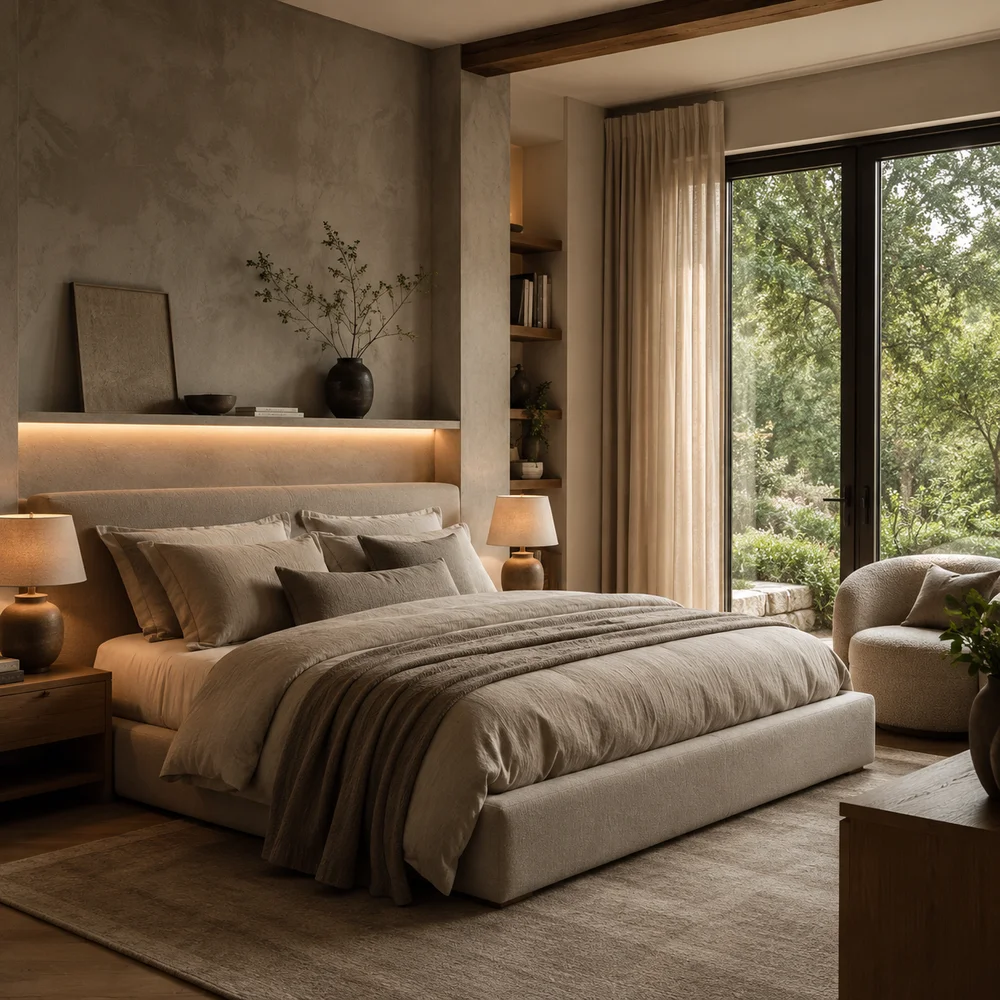
Calming Bedroom Ideas That Define the Best Wellness Design Inspiration
By Emily | July 15, 2026
Most people assume a calming bedroom is about color palette. Soft grays, muted sage, a few candles, maybe a weighted blanket folded at the foot of the bed. But if you have ever spent money on a “relaxing” bedroom refresh and still lain awake at 1 a.m. scrolling your phone, you already know that mood boards do not fix physiology. The room can look serene and still be quietly working against your nervous system every single night.
The real issue is that wellness design is not decoration — it is regulation. Your body reads light, temperature, sound, and air quality as instructions long before your conscious mind registers comfort or discomfort. A bedroom can be beautifully styled and still send confusing signals: a screen glowing at 11 p.m., a mattress too warm to release heat, a streetlight seeping through a curtain gap. None of that shows up in a photograph, which is exactly why it gets ignored.
This guide reframes the calming bedroom around the systems that actually shape sleep and daily recovery: light exposure timing, thermal regulation, acoustic control, air quality, ergonomic support, and the small behavioral rituals that tell your body when to switch modes. Each section explains not just what to change, but why your body responds to that specific change the way it does.
Treat this less like a shopping list and more like a room audit. Some sections will point to something you can fix this weekend — sealing a light leak, moving a charging cable. Others describe a slower shift, like retraining your evening lighting sequence. Work through them in whatever order matches your current bedroom’s biggest gap, and let the smaller wins build momentum toward the bigger ones.
1. Circadian Lighting: Staging Your Room's Light From Waking Bright to Wind-Down Amber
 Save it
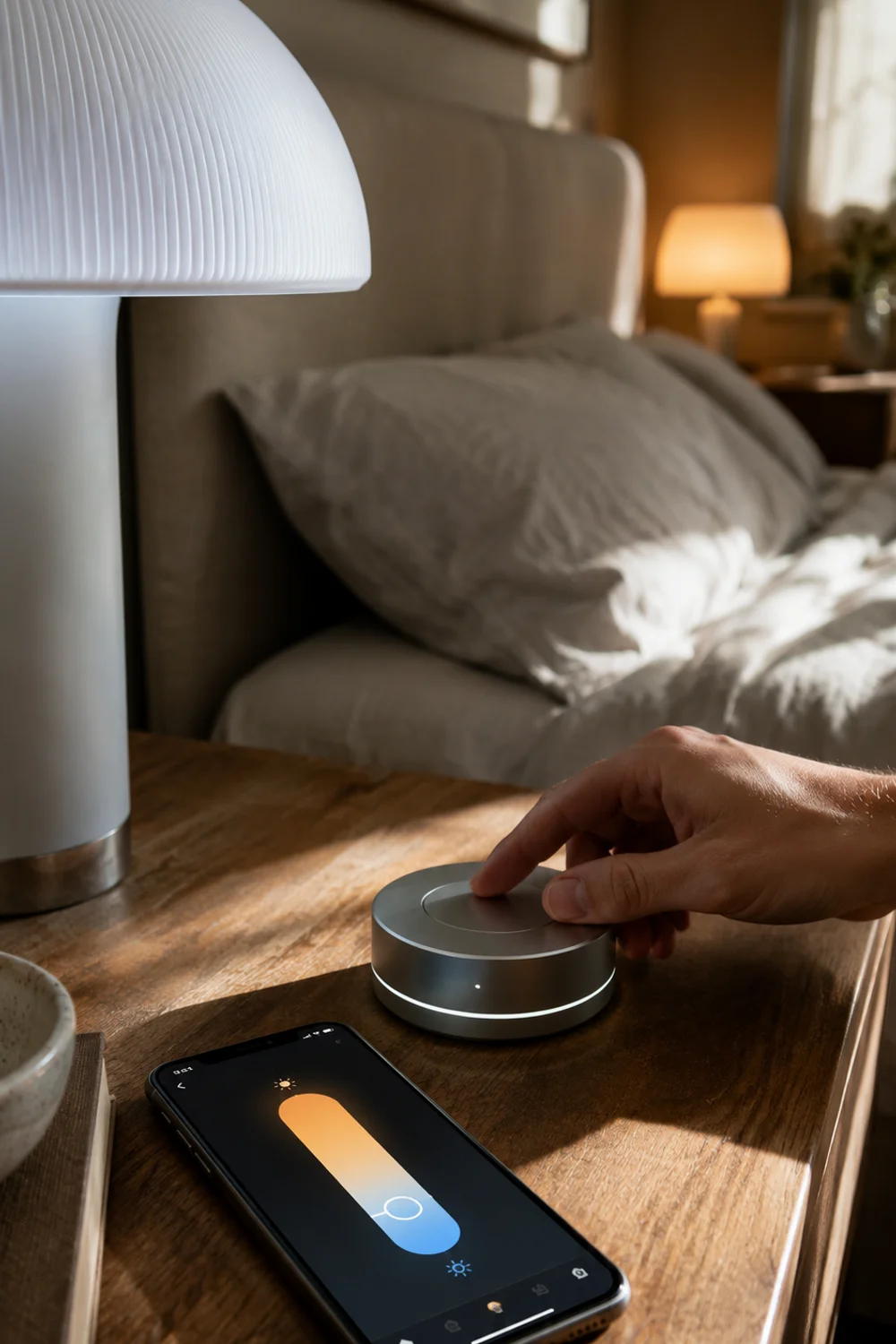
Most bedrooms run on a single lighting mode: one overhead fixture, one brightness, one color temperature, used identically at 7 a.m. and 10 p.m. This flattens one of the most powerful biological cues in your home. Your circadian rhythm does not just respond to whether a light is on — it responds to its color temperature and intensity, reading cool, bright light as daytime and warm, dim light as the signal to begin winding down. A bedroom that never shifts is a bedroom that never clearly tells your body which phase of the day it is in.
The fix is staged lighting rather than a single fixture. Morning light should be bright and cool-toned, ideally above 4000K, to suppress melatonin and support alertness. As evening approaches, that same space should shift toward warm amber tones under 2700K, dimmed low enough that you are relying on peripheral vision rather than a fully lit room. This is most easily achieved with a tunable smart bulb that can be scheduled to change automatically rather than relying on you remembering to swap settings by hand.
Variations matter here. If you share a bedroom, a single overhead bulb rarely satisfies two different sleep schedules, so a secondary low-glow accent lamp on a separate switch gives one partner reading light without flooding the whole room in cool white at 9 p.m. Smart plugs paired with ordinary lamps work nearly as well as a full smart-bulb system if you are not ready to rewire fixtures, and they are considerably cheaper to test before committing to a whole-room overhaul.
Picture a couple who both work from home and whose bedroom doubles as an early-morning dressing space. For years they used one 3000K ceiling light for everything, which meant getting dressed at 6:30 a.m. felt identical to reading in bed at 9:45 p.m. — no wonder neither of them felt sleepy on schedule. Once they split the room into a bright cool-white morning setting and a scheduled amber wind-down setting starting at 8:30 p.m., both reported falling asleep faster within the first week, without changing anything else in the room.
This is really a lesson in signal clarity. Your brain is constantly interpreting environmental cues, and a room that gives contradictory signals — bright white light at bedtime, dim light in the morning — makes it harder for your internal clock to lock onto a consistent rhythm. Staged lighting is not an aesthetic upgrade so much as a piece of information your body has been missing.
2. Thermoregulating Textiles: Why a Slightly Cooler Bed Sleeps Better Than a Warmer One

 Save it
Core body temperature has to drop by roughly one to two degrees to initiate and sustain deep sleep, and most bedding actively works against that process. Thick duvets, synthetic fill, and non-breathable sheets trap heat against the body precisely when it needs to be releasing it. People chase “cozy” bedding without realizing that trapped heat is one of the most common reasons for restless, fragmented sleep in the second half of the night, long after the room itself has cooled down.
The mechanism is straightforward: fabrics with high breathability and moisture-wicking properties allow heat and perspiration to escape rather than accumulate, keeping skin temperature lower even under a full duvet. Natural fibers like linen and certain cotton weaves perform this function well because their fiber structure allows airflow between threads. Synthetic microfiber blends, by contrast, tend to trap both heat and moisture, which is why a bed can feel “hot” even in a cool room.
Layering strategy matters as much as fabric choice. Rather than one heavy duvet, a lightweight breathable duvet insert paired with a top sheet gives you the option to shed a layer mid-sleep without waking up shivering, which mimics how your body naturally wants to regulate through the night. This overlaps beautifully with the layering philosophy in How to Recreate the Cozy Bedroom Trends Everyone Is Saving in 2026, though here the goal is thermal function first and visual softness second.
Consider a bedroom in a converted attic space that runs noticeably warmer than the rest of the house in summer. The homeowner had assumed the discomfort was purely about room temperature and invested in a stronger air conditioner, which helped but did not fully solve restless nights. Swapping a synthetic-fill comforter for breathable cotton percale and a bamboo sheet set made a measurable difference within days, because the previous bedding had been retaining body heat regardless of how cool the air around it was.
The broader principle is that comfort and temperature are not the same sensation, even though we use the word “cozy” to describe both. A room can feel visually warm and inviting while the bedding underneath is quietly overheating you every night. Thermoregulating textiles let you keep the aesthetic warmth of a well-styled bed without paying for it in sleep quality.
3. The Total-Darkness Audit: Sealing Every Light Leak Your Body Still Notices

 Save it
Even a small amount of ambient light can suppress melatonin production, and most people underestimate how much light actually enters a supposedly dark bedroom. A streetlamp through a curtain gap, a hallway light under the door, a router’s blinking LED across the room — none of these feel bright enough to notice consciously, but your retina’s light-sensitive cells register them anyway, particularly the blue-wavelength light emitted by most electronics and LED indicators.
A proper darkness audit means physically lying in bed with the lights off and letting your eyes adjust for several minutes, then scanning the room for every visible light source. Curtains that look opaque during the day often reveal thin light lines along the edges and top once your eyes adapt. Electronics with standby lights are frequently the biggest overlooked offenders, since they sit at eye level within a few feet of the sleeper.
The fix layers several small interventions rather than one dramatic one. A properly fitted blackout shade mounted close to the window frame closes the side gaps that ordinary curtains leave open, while a strip of electrical tape or a small opaque sticker handles a stray charger or smoke-detector LED. For rented spaces where mounting anything is restricted, a tension-rod blackout curtain layer hung just inside the window frame achieves a similar seal without any drilling.
Picture a shift worker who sleeps during daylight hours and had always assumed her thick curtains were doing their job, since the room “looked” dark. After a proper audit she found nearly an inch of gap on both sides where daylight streamed in along the wall, plus a router blinking green from across the room. Closing both light leaks — the side gaps and the router light — cut her reported wake-ups nearly in half within two weeks, without any change to her actual sleep schedule.
Total darkness is one of the few wellness interventions with a clear, almost mechanical cause and effect: less light in, more melatonin retained, deeper sleep sustained. It rarely requires a full renovation, just the discipline of actually testing your room in the dark instead of assuming it is dark enough because it looks that way with the lights on.
4. Sound Engineering: Turning a Bedroom Into Its Own Quiet Zone
 Save it
Sound is processed by the brain even during sleep, which is why a sudden noise can trigger a partial awakening you never consciously remember the next morning. Bedrooms are rarely designed with acoustics in mind, which means hard flooring, bare walls, and thin doors let outside noise travel freely and let internal sounds — a partner’s movement, a creaking floorboard — bounce rather than absorb. The result is a room that technically feels quiet during the day but performs poorly at actually protecting sleep at night.
Soft, irregular surfaces absorb sound; hard, flat surfaces reflect it. A room with a rug, upholstered textiles, and layered soft furnishings will have noticeably shorter reverberation than one with bare floors and a single flat headboard, because sound waves lose energy each time they strike an absorptive material instead of bouncing cleanly off a hard one. This is less about eliminating noise entirely and more about softening the acoustic bounce that amplifies small sounds into sleep-disrupting ones.
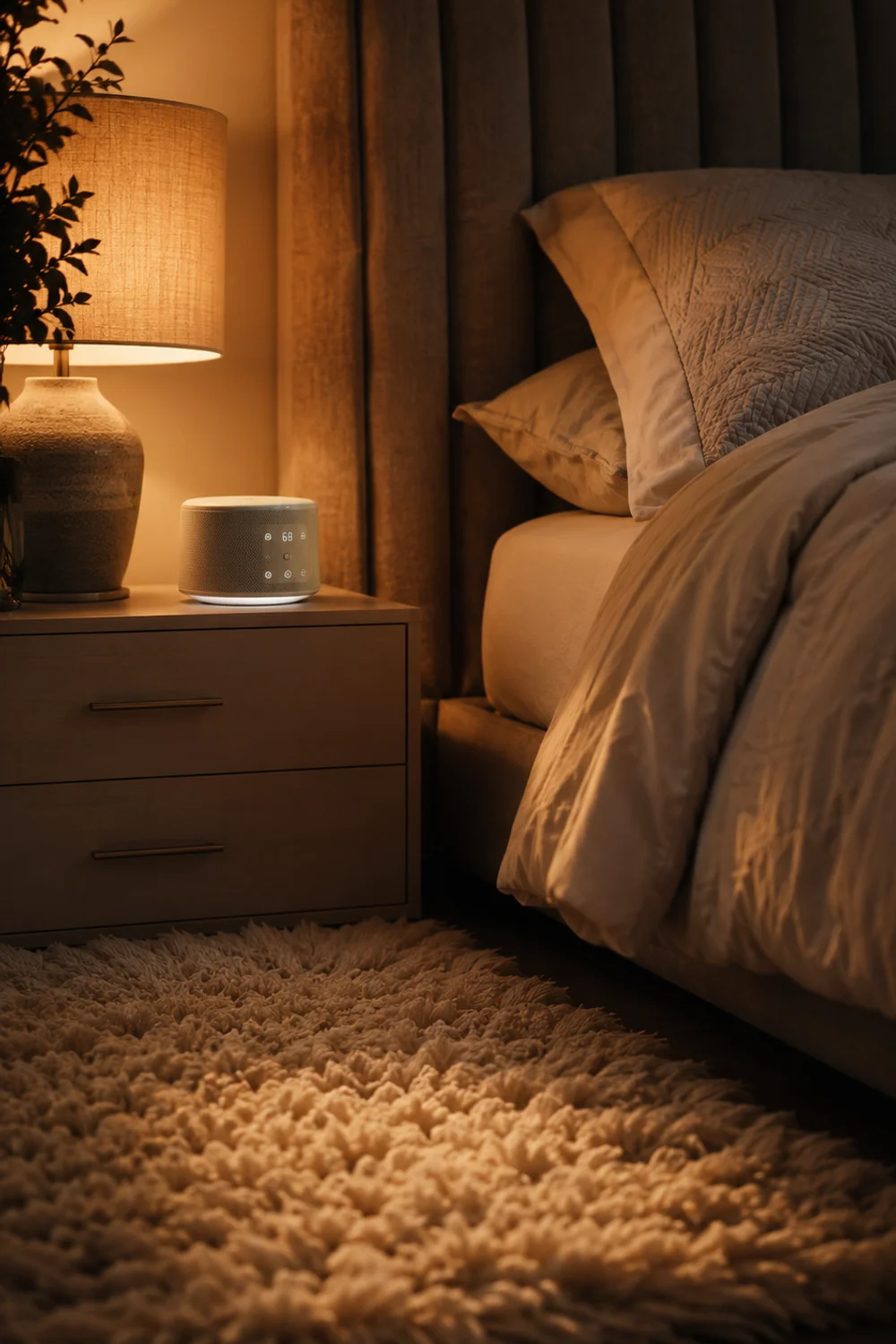
For noise coming from outside the room rather than generated within it, masking is often more practical than blocking. A white noise or brown noise machine set at a steady, low volume creates a consistent sound floor that makes sudden noises — a car door, a neighbor’s footsteps — far less noticeable by comparison, since the ear reacts more to sudden changes in sound than to steady background levels. A door draft stopper along the bottom edge of the bedroom door also meaningfully reduces hallway noise bleed for very little cost.
Consider an apartment bedroom sharing a wall with a stairwell, where footsteps and door slams had been waking the occupant several times a week. Adding a low rug, a fabric headboard, and a white noise machine set to a soft, steady tone did not eliminate the building’s noise, but it changed how disruptive each sound felt, because the steady background tone reduced the contrast between silence and sudden noise that had been triggering the awakenings.
Acoustic comfort is easy to overlook because silence itself has no visual signature — you cannot see a quiet room the way you can see a well-lit one. But for anyone in a shared building, a busy street, or a household with different sleep schedules, sound engineering is often the single highest-leverage wellness change available, precisely because it is so rarely addressed on purpose.
5. Air as a Wellness Layer: Purifier Placement and the Humidity Range That Helps You Breathe Easier
 Save it
Air quality inside a bedroom is frequently worse than outside air, since dust, pet dander, and off-gassing from furniture and textiles accumulate in an enclosed space with limited airflow overnight. Breathing this air for seven or eight straight hours means even mild irritants can compound into morning congestion, dry throat, or a general grogginess that gets blamed on poor sleep quality rather than the air itself. Most people never test their bedroom air because there is no obvious visual cue that anything is wrong.
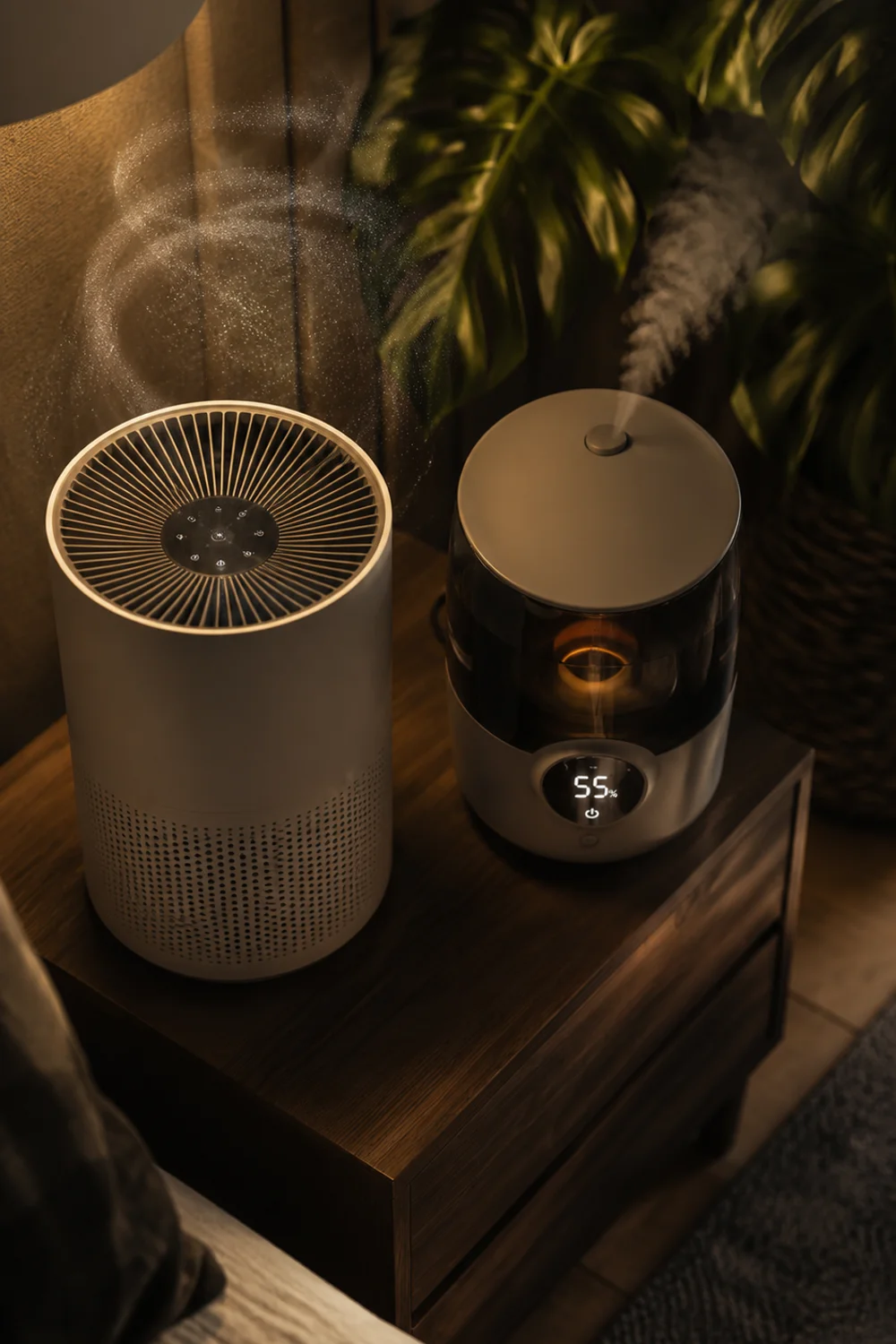
Humidity plays an equally overlooked role. Air that is too dry, often below 30 percent relative humidity, dries out nasal passages and throat tissue overnight, while air above roughly 50 percent supports dust mite and mold growth. The ideal sleeping range sits closer to 40 to 50 percent, which is dry enough to discourage mold but humid enough to keep airways comfortable — a narrow band that most bedrooms drift outside of seasonally without anyone noticing.
Purifier placement matters as much as owning one. A unit tucked in a corner behind furniture loses significant efficiency compared with one placed a few feet from the bed with clear airflow on at least two sides, since blocked intake vents simply recirculate the same stale pocket of air. Pairing the purifier with a compact humidifier with a built-in hygrometer lets you actually monitor and correct the humidity range rather than guessing, which is the detail most air-quality efforts skip entirely.
A useful comparison point for material choices here is the approach taken in How to Create Warm Neutral Bedroom Ideas That Will Never Go Out of Style, where warmth is built through fiber and tone rather than heavy upholstered pieces that trap dust. A bedroom with fewer thick, dust-collecting textiles combined with a properly placed purifier and monitored humidity level gives measurably cleaner air than either intervention alone, since the two address different sources of the same problem.
Air is invisible, which is exactly why it gets left out of most wellness bedroom conversations focused on what can be seen and styled. But breathing quality air for a third of every day is one of the more direct physiological levers available, and unlike lighting or sound, it requires almost no behavioral change once the equipment is placed correctly — just occasional filter maintenance and humidity checks.
6. The Ergonomic Sleep Surface: Mattress Support and Pillow Loft as the Room's Real Centerpiece

 Save it
Every wellness bedroom conversation eventually circles back to aesthetics, yet the single object that determines sleep quality most directly is the mattress and pillow combination, and it is usually the last thing anyone budgets properly for. A mattress that has lost its support over years of use, or a pillow with the wrong loft for your sleep position, forces subtle muscular compensation all night long, which shows up the next day as neck stiffness or lower back tension that gets attributed to stress rather than the surface you slept on.
Support needs differ by sleep position in ways that are easy to get wrong. Side sleepers need a pillow loft tall enough to keep the neck aligned with the spine, since a flat pillow leaves the head tilted downward for hours. Back sleepers generally need less loft, while stomach sleepers — the position least supportive of spinal alignment regardless of pillow choice — benefit most from an especially thin, soft pillow or none at all under the head.
An adjustable pillow solves a problem most fixed-loft pillows cannot: sleep position often changes through the night even when someone identifies primarily as a side or back sleeper. A shredded memory foam pillow with a removable-fill design lets you add or remove material to dial in the exact loft your neck needs, rather than replacing an entire pillow through trial and error every time your preferences shift with age, injury, or a new mattress.
Picture someone who replaced an aging mattress and immediately noticed morning shoulder pain that had not existed before. The mattress itself was appropriately supportive, but the pillow, sized correctly for the old, softer mattress, was now sitting the head at a subtly wrong angle relative to the firmer surface. Adjusting the pillow loft to match the new mattress height resolved the shoulder pain within about a week, illustrating how support decisions are relational rather than isolated — a change to one element can quietly undo the fit of another.
The sleep surface rarely gets treated as a design element because it is hidden under bedding, but it is arguably the room’s actual centerpiece in physiological terms. Everything else in a calming bedroom — light, sound, air, temperature — supports the hours spent on this one surface, which makes it worth more scrutiny than most people give it.
7. Visual Load Reduction: Matte, Low-Glare Surfaces That Calm the Eye Before the Lights Go Off
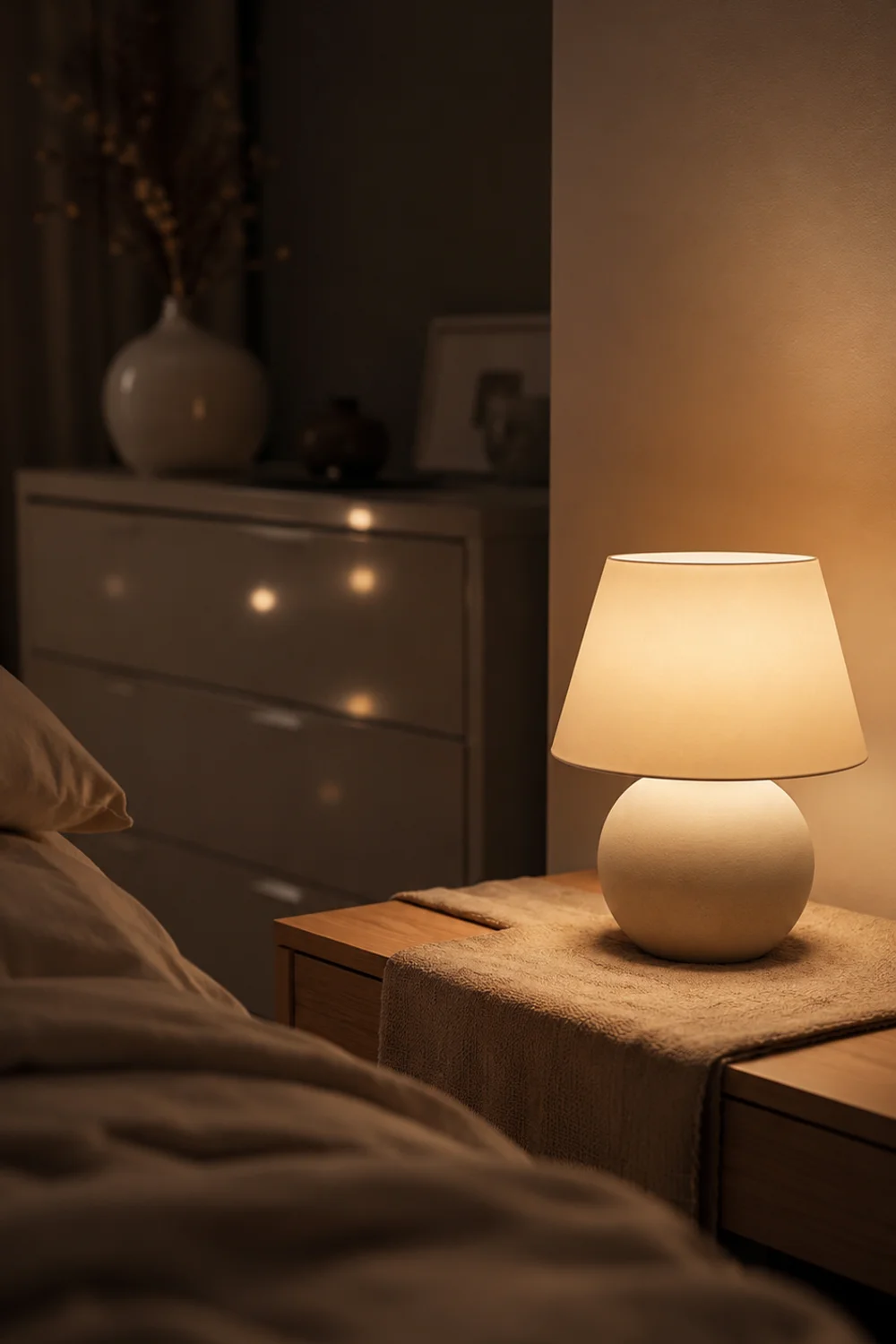
 Save it
Glossy, reflective surfaces bounce ambient light unpredictably around a room, and in a space meant for winding down, that unpredictability keeps the visual system subtly more alert than it needs to be. A high-gloss dresser, a mirrored nightstand, or a lacquered headboard can look polished in daylight photography, but at night, with a single lamp on, those same surfaces create small hot spots and reflections that pull the eye around the room instead of letting it settle.
Matte finishes behave differently: they scatter light evenly rather than reflecting it in a concentrated point, which reduces the visual “noise” a room produces under low, warm lighting. This is a genuinely different mechanism from color choice or clutter — two rooms with identical color palettes and identical tidiness levels can feel very different at night purely based on whether their surfaces are glossy or matte, because glare interacts with the eye regardless of what color is underneath it.
Swapping a few specific high-glare items tends to matter more than repainting an entire room. A matte-finish lamp base placed directly at eye level on a nightstand has an outsized effect compared with, say, a glossy dresser across the room, simply because of its proximity and its role as the room’s primary evening light source. Glass or acrylic decorative objects near a lamp are common overlooked glare sources worth auditing the same way you might audit for stray light leaks.
Consider a bedroom styled with a beautiful glossy black lacquered dresser as its focal point, chosen entirely for its visual impact in daylight. At night, with a single bedside lamp lit, the dresser’s surface threw a distracting reflected glow across the ceiling that the homeowner had never consciously registered until a friend pointed it out. Replacing just the lamp with a matte-finish version and adding a small textile runner across the dresser top eliminated most of the glare without touching the furniture’s core design.
Visual calm at night is less about softness in the daytime sense and more about how a surface behaves under low, angled light. A room can be visually striking during the day and still be quietly overstimulating after dark if its dominant surfaces are glossy, which makes glare one of the more counterintuitive things to check in a genuinely calming bedroom.
8. The Decompression Threshold: A Doorway Ritual That Signals Day Mode Into Night Mode

 Save it
Most people carry the mental residue of their day directly into bed, checking one more email or replaying a stressful conversation while already lying down, which primes the nervous system for alertness at exactly the moment it should be downshifting. Without some kind of clear transition point, the bedroom doorway is functionally invisible — you cross it, but nothing about the environment tells your body that a different mode of being is now expected.
A decompression threshold works by attaching a small, repeatable physical or sensory cue to the act of entering the bedroom for the night, distinct from simply walking in to grab something during the day. This might be as simple as switching on a specific low lamp only used at bedtime, removing shoes at a consistent spot, or hanging a robe on a dedicated hook — the specific ritual matters less than its consistency, since repetition is what eventually turns the action into an automatic signal.
A dedicated hook placed just inside the bedroom door gives the ritual a fixed physical anchor rather than leaving it to memory, which matters because rituals that depend purely on willpower tend to fade within a few weeks. Placing a small tray nearby for a phone and watch extends the same threshold logic, turning “entering the bedroom” into a brief, repeatable sequence of small physical acts rather than an unmarked transition.
Someone who worked from a home office down the hall from their bedroom found that simply walking through the doorway did nothing to shift their mental state, since the two rooms looked and felt nearly identical. Establishing a small routine — removing a watch and setting it on a dedicated tray, hanging a robe on a hook installed specifically for that purpose — created a repeatable physical cue that, after a few weeks, reliably signaled the shift out of work mode even before getting into bed.
This is really about outsourcing a mental transition to a physical habit, since willpower alone is an unreliable way to change state on command every night. A consistent, small doorway ritual does quietly, over time, what no amount of styling can do on its own: it teaches your nervous system when the day is actually over.
9. Distance-Based Digital Habits: Placing the Charging Dock Outside Arm's Reach of the Bed
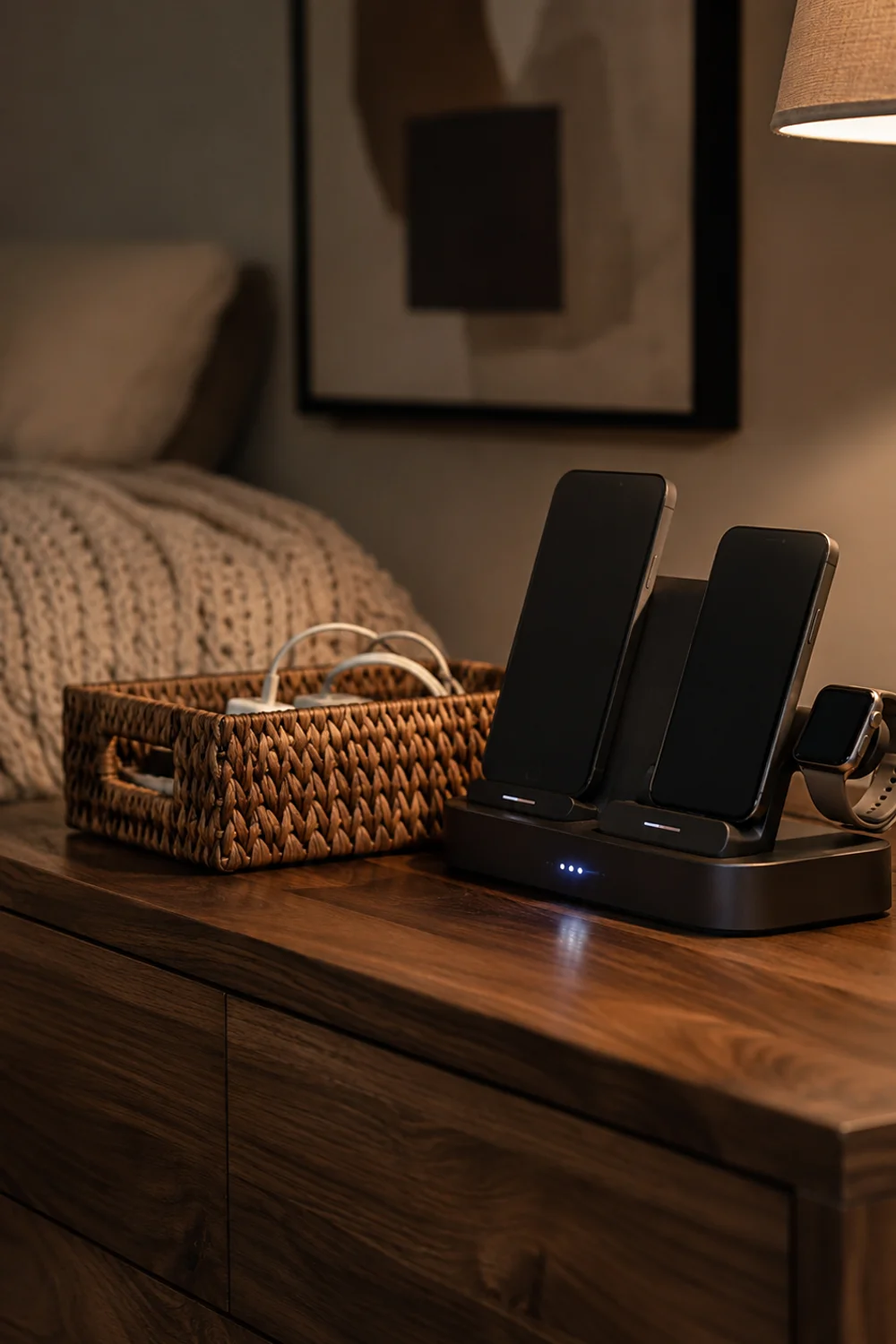
 Save it
A phone charging within arm’s reach of the bed is one of the most common and most underestimated disruptors of a calming bedroom, not primarily because of blue light exposure but because of proximity-driven behavior. A device that is reachable without getting up gets checked — reflexively, at 2 a.m., during a moment of restlessness — in a way that a device requiring you to physically stand and walk across the room simply does not.
The mechanism here is friction, not willpower. Removing a behavior’s ease of access reduces its frequency far more reliably than trying to resist the behavior itself while the option remains fully available. This is why placing a charging dock on a dresser across the room, rather than on the nightstand, meaningfully reduces nighttime phone checking for most people, even those who fully intend to leave their phone alone once they are in bed.
A dedicated charging station positioned deliberately away from the bed solves the practical objection people raise — needing the phone as an alarm — without requiring the phone to remain within reach all night. Pairing this with a basic analog alarm clock on the nightstand removes the last practical reason to keep a phone bedside, closing the loop entirely rather than leaving a convenient exception that gradually erodes the habit.
Consider someone who had genuinely tried to stop checking their phone before sleep but kept failing despite real intention, simply because the device sat charging six inches from their pillow every night. Moving the charging station to a dresser on the opposite wall, paired with a fifteen-dollar analog alarm clock, eliminated the habit almost immediately — not because willpower improved, but because the phone was no longer the easiest object to reach in a moment of restlessness or boredom.
This overlaps with the same design logic explored in 14 Earthy Bedroom Decor Inspiration Ideas Every Cozy Home Actually Needs Right Now, where physical distance and deliberate placement do quiet behavioral work that no amount of intention alone can achieve. A calming bedroom often has less to do with adding a soothing object and more to do with removing an easily reachable one.
10. Scent-Free, Low-VOC Materials: Why Wellness Bedrooms Remove Fragrance Instead of Adding It

 Save it
Fragrance has become the default answer to making a bedroom feel calming, but scented candles, heavily perfumed fabric sprays, and synthetic air fresheners introduce volatile organic compounds into precisely the enclosed space where you spend the most consecutive hours of your day. A room can smell wonderful and still be quietly working against respiratory comfort overnight, particularly for anyone with mild sensitivities that never get formally diagnosed but show up as morning congestion or a scratchy throat.
The wellness-forward approach flips the usual instinct: instead of adding scent to create atmosphere, remove unnecessary fragrance sources and choose genuinely low-VOC materials for anything applied directly to walls, floors, or large textile surfaces. Paint, in particular, continues off-gassing for weeks or months after application, and a standard low-cost paint can measurably affect indoor air quality in a small, enclosed bedroom long after the smell itself has faded and become undetectable to the nose.
Choosing a certified low-VOC wall paint for a bedroom repaint is one of the highest-impact, lowest-visibility changes available, since it addresses a source most people never think to question. The same logic applies to mattress protectors, curtain fabric, and furniture finishes — natural, untreated materials generally off-gas less than synthetic equivalents treated with flame retardants or stain-resistant coatings, though this is a spectrum rather than a strict binary.
A household with a family member who experienced unexplained morning headaches eventually traced the pattern to a recently repainted bedroom using a standard low-cost paint, despite the room appearing and smelling completely normal within a week of the work finishing. Repainting with a certified low-VOC formula and removing a plug-in fragrance diffuser that had also been added around the same time resolved the headaches within roughly ten days, illustrating how air quality issues can hide behind a room that otherwise looks and smells entirely unremarkable.
The instinct to make a bedroom smell like calm is understandable, but true wellness design treats scent as something to audit for hidden sources rather than something to add on top. A room that smells like nothing in particular, built from genuinely low-VOC materials, is very often doing more for your actual respiratory comfort than one carrying the most beautifully marketed candle available.
11. Morning-Light Architecture: Windows and Curtains Engineered for a Real Waking Light Dose

 Save it
Total darkness at night only solves half of the circadian equation; the other half is a genuine dose of bright light shortly after waking, which anchors your internal clock and makes the following night’s melatonin release happen on schedule. Many bedrooms optimized purely for nighttime darkness end up over-correcting into rooms that stay dim well into the morning, since the same heavy blackout curtain that blocks evening light exposure also blocks the morning light dose the body needs.
The solution is architectural rather than purely product-based: layering a blackout layer that can be fully opened each morning with a sheer or light-filtering layer that allows some daylight through even before you get up. A motorized curtain track removes the friction of manually opening heavy blackout drapes at a groggy 6:30 a.m., automating a light dose that would otherwise depend on remembering to physically get up and pull a cord.
For those unwilling to invest in motorized hardware, a simpler but less automatic fix is positioning the bed and curtain gap so that a thin strip of morning light naturally lands somewhere in the room upon waking, even with curtains only partially opened. This overlaps with the restraint-based window philosophy found in Scandinavian Cozy Bedroom Inspiration Ideas Worth Copying Right Now, though here the emphasis is specifically on timed light dosage rather than daylight volume throughout the day.
Someone working an early office job had installed heavy blackout curtains to fix a persistent light-leak problem at night, which worked well, but left their bedroom completely dark until they physically got up and opened the curtains around 7:15 a.m. — often thirty to forty minutes after their alarm. Installing a motorized track set to open automatically at 6:45 a.m. gave them a genuine morning light dose before they were even fully out of bed, and they reported feeling noticeably more alert within the first two weeks without changing their wake time at all.
Darkness and daylight are two ends of the same circadian lever, and treating only the nighttime half leaves real benefit on the table. A truly calming bedroom is dark exactly when it needs to be and bright exactly when it needs to be, on a schedule that matches your actual wake time rather than an arbitrary blanket rule.
12. The Automated Wind-Down-to-Wake Handoff: Letting Smart-Home Cues Run the System for You
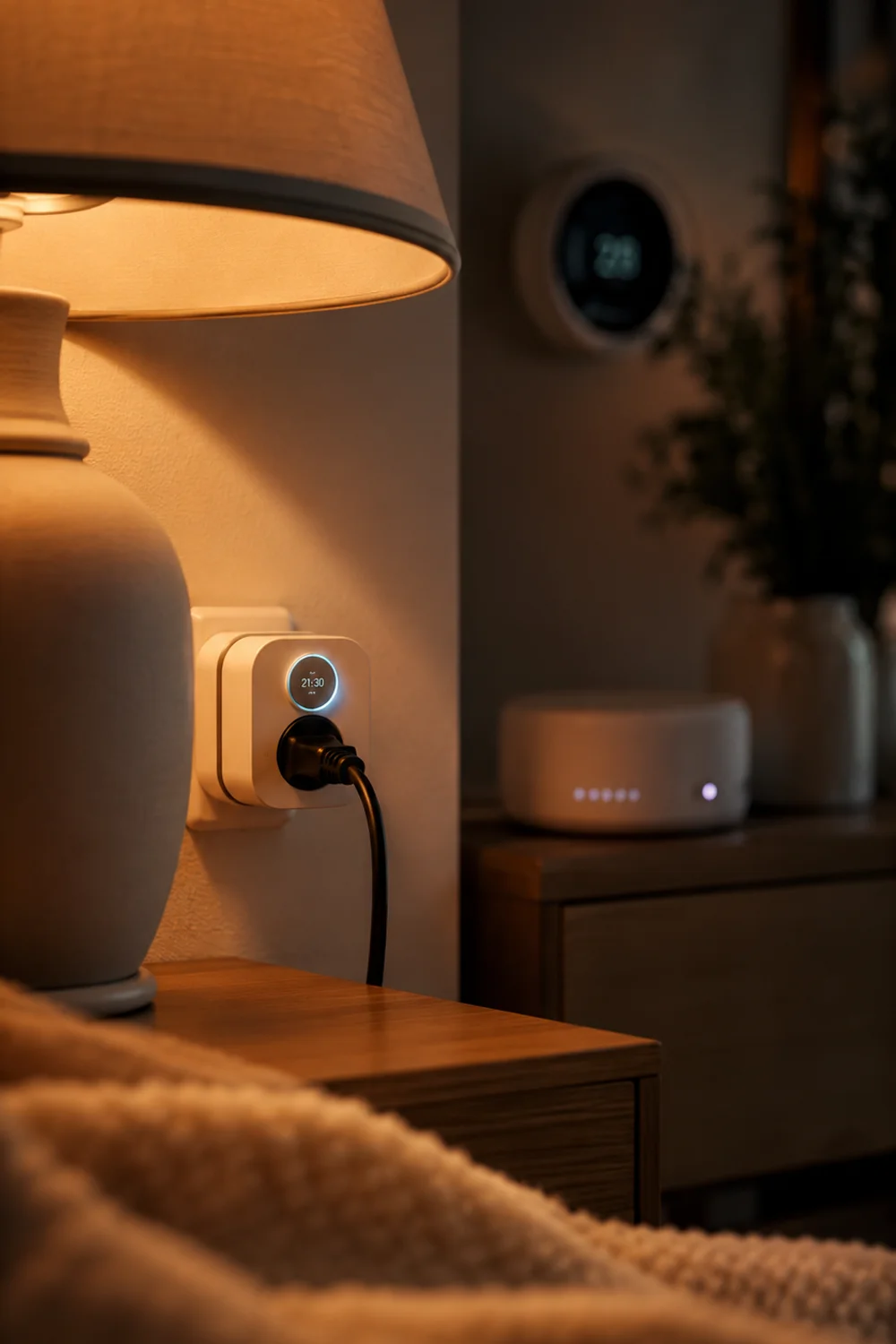
 Save it
Every system described so far — lighting, temperature, air, sound — works best when it changes automatically on a schedule, because relying on memory to manually adjust five different things every evening is exactly the kind of friction that causes wellness habits to quietly lapse after the first enthusiastic week. The final layer of a genuinely calming bedroom is handing the coordination of these systems to simple automation rather than continuing to manage each one by hand.
A basic smart plug or hub-based schedule can link several of the previous sections together without requiring a full smart-home overhaul: lights dimming and warming at a set hour, a white noise machine switching on, a thermostat nudging down a degree or two, all triggered from one scheduled sequence rather than five separate actions each night. The value is not the sophistication of the technology but the removal of the decision fatigue involved in remembering to do it all consistently.
A single scheduled smart plug controlling a bedside lamp is often the easiest entry point, since it requires no rewiring and immediately demonstrates the effect of consistent, automatic wind-down lighting without asking you to manage anything nightly. From there, additional devices — a purifier, a white noise machine, a curtain motor — can be added to the same schedule incrementally, each one removing one more manual step from the evening routine.
Consider a household that had successfully implemented staged lighting, blackout curtains, and a white noise machine individually, but found that on tired or busy nights, half of these systems simply did not get turned on because doing so required five separate manual actions. Linking the lamp, the white noise machine, and the thermostat to a single scheduled smart-home routine meant the full wind-down sequence happened automatically every night regardless of how tired or distracted anyone was, which finally made the earlier changes stick.
Automation is not a replacement for good design decisions — it is what makes those decisions durable over months rather than the first motivated week. A calming bedroom stops being a project you maintain and becomes an environment that maintains itself, which is ultimately the difference between a room that looks wellness-oriented and one that actually functions that way every single night.
This same instinct toward removing friction rather than adding effort shows up in The Ultimate Guide to Scandinavian Bathroom Design Everyone Is Obsessed With, where restraint does more work than any single statement piece.
Common Mistakes to Avoid
1. Treating darkness and morning light as the same problem
Many people install heavy blackout curtains to solve nighttime light leaks and unintentionally block the morning light dose their circadian rhythm needs to reset. Darkness at night and brightness in the morning are two separate requirements that need two separate solutions, often within the same window treatment layered rather than combined into one heavy fabric.
2. Adding scent instead of auditing for hidden air quality issues
Scented candles and fragrance diffusers mask discomfort rather than resolving it, and can introduce additional volatile compounds into an already enclosed space. A bedroom that smells calming is not necessarily a bedroom with genuinely clean air, and chasing fragrance often delays the real fix of checking paint, textiles, and ventilation.
3. Keeping the phone charger within arm’s reach “just for the alarm”
This single habit undoes lighting, sound, and darkness improvements simultaneously, since a reachable phone gets checked regardless of how well the rest of the room is optimized. A cheap analog alarm clock removes the last practical justification for keeping a device bedside overnight.
4. Assuming one lighting setting works for the entire day
A single bulb, brightness, and color temperature used from morning until night removes one of the clearest signals your body relies on to distinguish daytime alertness from evening wind-down. Staged, scheduled lighting costs very little to implement but gets skipped because it requires slightly more setup than screwing in one bulb.
5. Prioritizing visual softness over material function
Heavy, plush textiles and glossy statement furniture often photograph beautifully but work against thermal regulation, glare reduction, and air quality. A genuinely calming bedroom sometimes looks slightly less dramatic in photographs than a purely styled one, because function-first material choices are not always the most visually striking option available.
Frequently Asked Questions
What is the single highest-impact change for a calming bedroom on a limited budget?
A total-darkness audit combined with moving your phone charger away from the bed costs almost nothing and addresses two of the most disruptive habits at once: light leaks suppressing melatonin and reachable devices triggering reflexive nighttime checking. Both changes require no new furniture or major purchases, just a redistribution of what you already own, and most people notice a difference within the first few nights of consistent practice.
How long does it typically take to notice results from these changes?
Lighting and darkness changes tend to show effects within days, since they directly influence melatonin timing each night. Behavioral shifts like the decompression threshold or reduced phone checking generally take two to three weeks of consistent repetition before they feel automatic rather than deliberate. Air quality and material changes, such as low-VOC paint, often show more gradual improvement over several weeks as off-gassing from previous materials fully clears the space.
Do I need smart-home technology to build a genuinely calming bedroom?
No — every system described can be implemented manually with consistent habits, though automation reduces the chance of habits lapsing on busy or tired nights. A basic smart plug is a reasonable low-cost entry point if you want to test automation before investing further, but blackout curtains, a white noise machine, and a decluttered charging routine work just as well without any connected technology at all.
Is it possible to over-optimize a bedroom and make it feel clinical rather than calming?
Yes, particularly if every surface becomes purely functional with no personal or visual warmth. The goal is layering wellness-oriented choices, like matte finishes and breathable textiles, within a room that still reflects your taste through color, art, and a few meaningful objects. Function and atmosphere are not competing goals; a well-executed wellness bedroom should feel inviting first and only reveal its underlying logic on closer inspection.
Final Thoughts
A calming bedroom is less about a single transformative purchase and more about a series of small, physiologically grounded adjustments working together consistently every night. Light, temperature, sound, air, and habit each play a distinct role, and none of them substitutes for the others — a beautifully dark room still fails if the mattress is unsupportive, and a perfectly supportive mattress still underperforms in a room full of light leaks.
Start wherever your current room has its most obvious gap, rather than attempting every section at once. A darkness audit this weekend, a lighting schedule next month, an air purifier repositioned once you notice the difference — this gradual approach tends to produce lasting change more reliably than an ambitious overhaul completed in a single exhausting weekend, then abandoned once the novelty fades.
Save the ideas that matched your own bedroom’s gaps, and return to this guide as your space evolves. Wellness design is never really finished; it shifts as your sleep needs, schedule, and household change over time, and the most calming bedrooms are the ones that keep quietly adjusting alongside the people sleeping in them.
This post contains affiliate links. I may earn a small commission at no extra cost to you.
READ FOR THE NEXT STEP?
KEEP READING
Continue with another helpful idea.

How to Use the Biggest Bedroom Color Trends for 2026 in Your Home Right Now
SHOP MY FINDS
Discover my favorite products for this place

My Favorite Bedroom Finds
GET THE PLANNER
Get the planner guide and make it easier.

The Ultimate Bedroom Planner

Get cozy inspiration delivered to your inbox.
✓ 14-page beautifully designed ebook
✓ Cozy decorating ideas
✓ Practical room-by-room inspiration
You’re in! 🎉
Thanks for joining the NestFlowHome community!
Your free ebook is already on its way to your inbox. If you don’t see it within a few minutes, please check your Promotions or Spam folder.
Join the NestFlowHome community for weekly decorating inspiration.

Timeless home decor ideas and slow living inspiration for a calm, beautiful life.