
14 Earthy Bedroom Decor Inspiration Ideas Every Cozy Home Actually Needs Right Now
By Emily | July 10, 2026
Most people assume an earthy bedroom is simply a matter of paint chips — swap the cool grey for something the color of wet clay, add a few rattan baskets, and call it done. But if you’ve ever done exactly that and still walked into your room feeling like it hadn’t actually softened, you already know the color theory alone isn’t holding up its end of the bargain. Something else is missing, and it isn’t aesthetic.
That missing piece is sensory, not decorative. Your body reads a room the way it reads terrain — through weight, temperature, and texture underfoot and underhand — long before your eye registers a color palette. A bedroom that feels grounding isn’t necessarily the one with the most tasteful ochre wall; it’s the one where your nervous system recognizes mass, roughness, and material honesty the same way bare feet recognize grass instead of tile.
This guide walks through fourteen ways to build that recognition into your bedroom, deliberately, room by room. You’ll find ideas about furniture proportion, aged materials, raw fiber, unglazed surfaces, and the kind of intentional imperfection that a nervous system reads as safe rather than staged. None of this depends on a specific color story — the color, if it shows up at all, is a byproduct.
Read it the way you’d approach any physical space you’re trying to recalibrate: pick two or three ideas that solve a real friction point in your current room, not all fourteen at once. Grounding isn’t achieved through density of objects — it’s achieved through the right weight, in the right place, doing the right sensory job.
1. Why Furniture Height Is a Grounding Signal, Not Just a Style Choice
 Save it
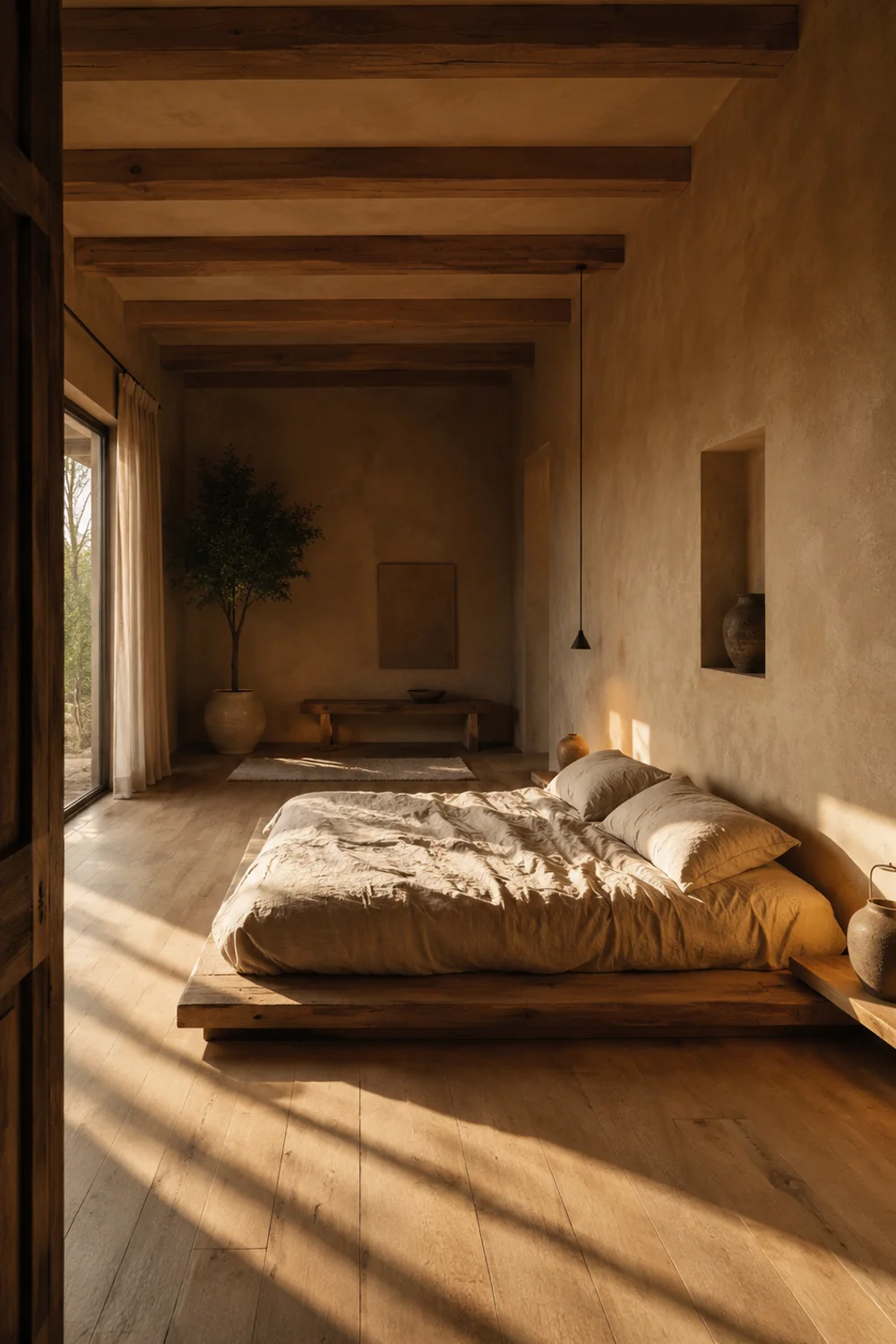
Most bedroom furniture guides talk about scale in terms of proportion to the room, but almost none of them talk about height in relation to the human body at rest. A platform bed sitting low to the ground does something a tall, skirted bed frame simply can’t: it shortens the distance between your body and the floor plane, and that distance is exactly what your nervous system uses to judge whether a space is stable or precarious. This isn’t a stylistic preference — it’s closer to how your inner ear reads elevation.
The mechanism is straightforward once you notice it. Furniture with a low center of gravity mimics the horizon line you’d find outdoors — logs, stones, low garden walls — surfaces the body has evolved to trust. A low-profile platform bed puts your sleeping height closer to that horizon than a traditional box-spring setup does, and the visual effect is a room that reads as anchored rather than perched. It’s the same reason floor cushions feel more relaxing than bar stools.
There’s variation depending on ceiling height and room proportion. In a room with low ceilings, going lower still with the bed height exaggerates the sense of openness above you, while in a taller room a slightly higher platform can keep the bed from feeling swallowed. Either way, avoid frames with tall skirting or elevated box springs — they reintroduce the visual gap between body and floor that undoes the grounding effect entirely, no matter how earthy the surrounding palette is.
Picture a rented apartment bedroom with nine-foot ceilings and a factory-standard bed frame sitting a full two feet off the ground. The moment that frame is swapped for a Low-Profile Solid Oak Platform Bed Frame, the entire room reads differently — not because anything else changed, but because the eye and body both register a shorter distance to solid ground. It’s a strange kind of relief that has nothing to do with color.
Height, in other words, is a sensory cue disguised as a design decision. We tend to file “low furniture” under minimalism or Japandi aesthetics, but the actual mechanism is closer to physiology — your body wants proof that it’s close to solid ground before it can fully release tension. Once you start noticing furniture height this way, it becomes hard to unsee in every room you walk into, earthy or not.
2. Unglazed Stoneware as the Room's Quiet Material Anchor

 Save it
Every bedroom accumulates small objects — the tray for rings, the dish for loose change, the bowl by the bed for a phone at night — and almost all of them default to glass, polished ceramic, or lacquered wood. The problem with glossy surfaces in a bedroom isn’t aesthetic, it’s tactile: reflective, sealed materials give your hand nothing to read. Your fingers register temperature and smoothness instantly and then move on, because there’s no texture left to process.
Unglazed stoneware works differently. The surface retains the faint grain and porosity of the raw clay it came from, so touching it produces a tiny amount of friction and thermal variation your hand actually has to interpret. That micro-second of tactile processing is part of what makes a room feel slower and more grounded — it’s a small, repeated sensory event every time you set something down or pick it up, rather than a frictionless non-event.
Not every unglazed piece needs to be handmade or expensive to do this job. A simple Unglazed Stoneware Catchall Bowl Set, Raw Clay Finish placed on a nightstand or dresser does the same sensory work as a one-of-a-kind studio piece, because the effect comes from the material property, not the price point or provenance.
Consider a nightstand that currently holds a smooth lacquered tray for jewelry and keys — swap only that tray for an unglazed stoneware bowl, and the nightly gesture of dropping in a watch or a ring changes texture entirely. It’s a small, almost invisible upgrade, but it’s repeated daily, which means its grounding effect compounds far more than a decorative object you only look at occasionally.
This is the broader principle worth carrying into every room: objects you touch daily do more sensory work than objects you merely display. A beautiful vase on a high shelf contributes almost nothing to how your body experiences the room, while a rough-surfaced bowl within arm’s reach of the bed does real, repeated, physiological work every single night.
3. Leather and Hide as the One Aged Texture the Room Needs

 Save it
Bedrooms tend to be soft by default — linen sheets, wool throws, cotton upholstery — and while softness is comforting, an entire room built from pliant textiles can start to feel formless, almost like there’s nothing solid to push against. The body needs at least one surface with structure and resistance, and full-grain leather with visible aging is one of the few materials that delivers texture, temperature, and firmness all at once.
The mechanism here is about contrast rather than addition. A single leather surface — a chair seat, a headboard panel, a bench cushion — gives the hand and body something firmer to register against all the surrounding softness, the same way a stone in a riverbed gives your foot something to locate itself against. Aged, full-grain leather in particular carries visible creasing and patina, which reads as lived-in rather than showroom-new, reinforcing the sense that the room has settled into itself over time.
Not every bedroom has room for a full leather chair, and that’s fine — a leather-wrapped bench at the foot of the bed, or leather drawer pulls on a low dresser, can deliver a smaller dose of the same tactile contrast. The goal is one aged leather surface somewhere in the sightline of the bed, not leather layered throughout the room, which would flatten the very contrast that makes it work.
Picture a reading nook beside a window where a Full-Grain Leather Accent Chair with Aged Patina sits opposite a linen-covered bed — the leather’s slight give and cool-to-warm temperature shift as you sit down creates a genuinely different physical experience than sinking into upholstered fabric, and that difference is exactly the point.
Aged leather also ages further with use, which means the sensory payoff actually improves over years rather than degrading — a rare quality in bedroom materials, most of which are chosen to look their best on day one and slowly decline from there.
4. A Cane-Front Wardrobe as Sculptural Storage
 Save it
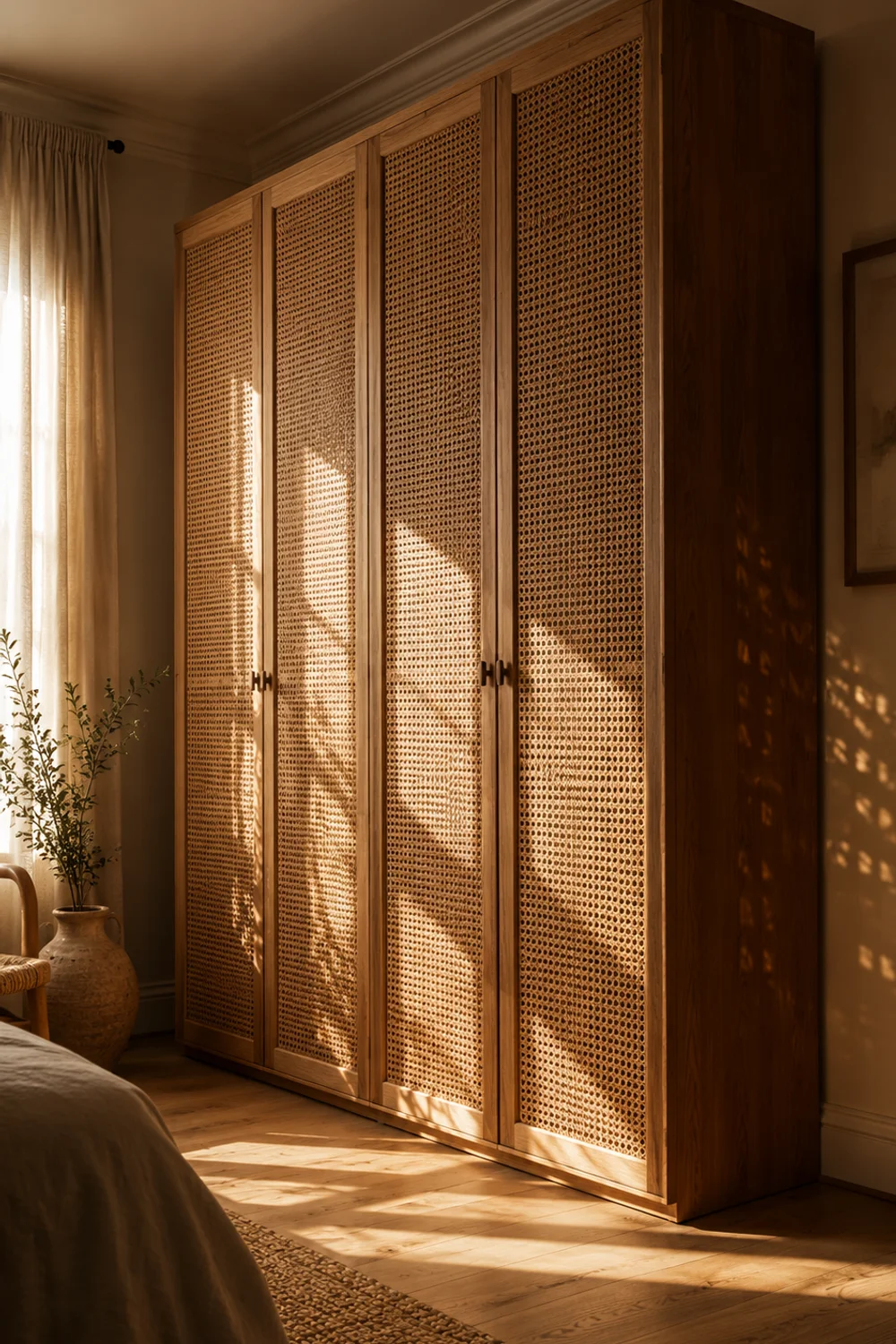
Storage furniture is usually treated as a necessary evil in bedroom design — something to be minimized, hidden, or visually neutralized so it doesn’t compete with the rest of the room. Woven cane fronts reject that premise entirely. Because cane is semi-transparent and dimensional, a cane-front wardrobe reads less like a storage box and more like a piece of sculpture that happens to hold clothing, which changes its entire relationship to the room.
The visual mechanism is light interaction. Solid wardrobe doors absorb light flatly across their surface, while woven cane fractures it into hundreds of small shadows that shift throughout the day as the sun moves. That shifting shadow pattern gives the wardrobe a kind of quiet movement that a flat door never has, and movement — even this subtle — is part of what keeps a room from feeling static or overly staged.
Cane also solves a practical problem that closed wardrobes create: airflow. Fabric stored behind solid doors traps humidity and odor, while a cane front allows just enough air circulation to keep garments from developing that closed-in smell, which matters enormously in bedrooms without dedicated closets. If you’re weighing wardrobe options against a full walk-in setup, Luxury Walk-In Closet Inspiration Ideas You Will Absolutely Love covers how open-weave materials perform in larger storage systems too.
Picture a small city bedroom with no closet at all, relying entirely on a freestanding Woven Cane and Oak Wardrobe Armoire against the far wall — instead of reading as a compromise, the cane front becomes the room’s most photographed feature, doing double duty as both function and focal point in a space that has no room to spare for purely decorative pieces.
The larger lesson is that storage doesn’t have to disappear to feel calm — it just has to be made from a material that participates in the room’s sensory logic rather than opting out of it entirely.
5. The Case for Undyed, Unbleached Textiles

 Save it
Most bedding decisions start and end at color — soft grey, warm white, blush — without ever questioning what happens to a natural fiber during the dyeing and bleaching process that produces those colors. Undyed, unbleached cotton and linen skip that processing almost entirely, and the result is a fabric that retains more of its original fiber structure, which changes how it actually feels against skin, not just how it looks.
Bleaching in particular strips and smooths fiber in ways that make fabric feel uniformly soft but also slightly flatter and less textured. Undyed fiber, left closer to its raw state, tends to have subtle irregularities — small slubs, faint color variation from fiber to fiber — that create a more complex tactile surface. Your skin registers that complexity as texture rather than as flat softness, and texture is part of what reads as grounding rather than sterile.
There’s a practical edge case worth knowing: undyed doesn’t mean unwashed-feeling. A well-made Unbleached Organic Cotton Bed Blanket, Undyed Natural Fiber goes through gentle finishing that keeps it soft, it simply skips the dyeing and optical brightening most white bedding relies on, so the fabric ages by softening further rather than yellowing or greying the way bleached-white textiles eventually do.
Picture a bed currently dressed in crisp white bleached sheets and a matching duvet — swapping just the top blanket for an undyed, unbleached weight introduces a visible and touchable irregularity into an otherwise uniform bed, immediately breaking the slightly clinical feeling that all-white, all-bleached bedding can create.
This is a useful principle to extend elsewhere in the room: processing removes character in the name of consistency, and consistency, while easy to sell, is rarely what a nervous system reads as calming. Fiber that still shows its own variation is doing more grounding work than fiber that’s been engineered into perfect sameness.
6. Sisal Underfoot: Texture as a Sensory Cue, Not a Layering Trick
 Save it
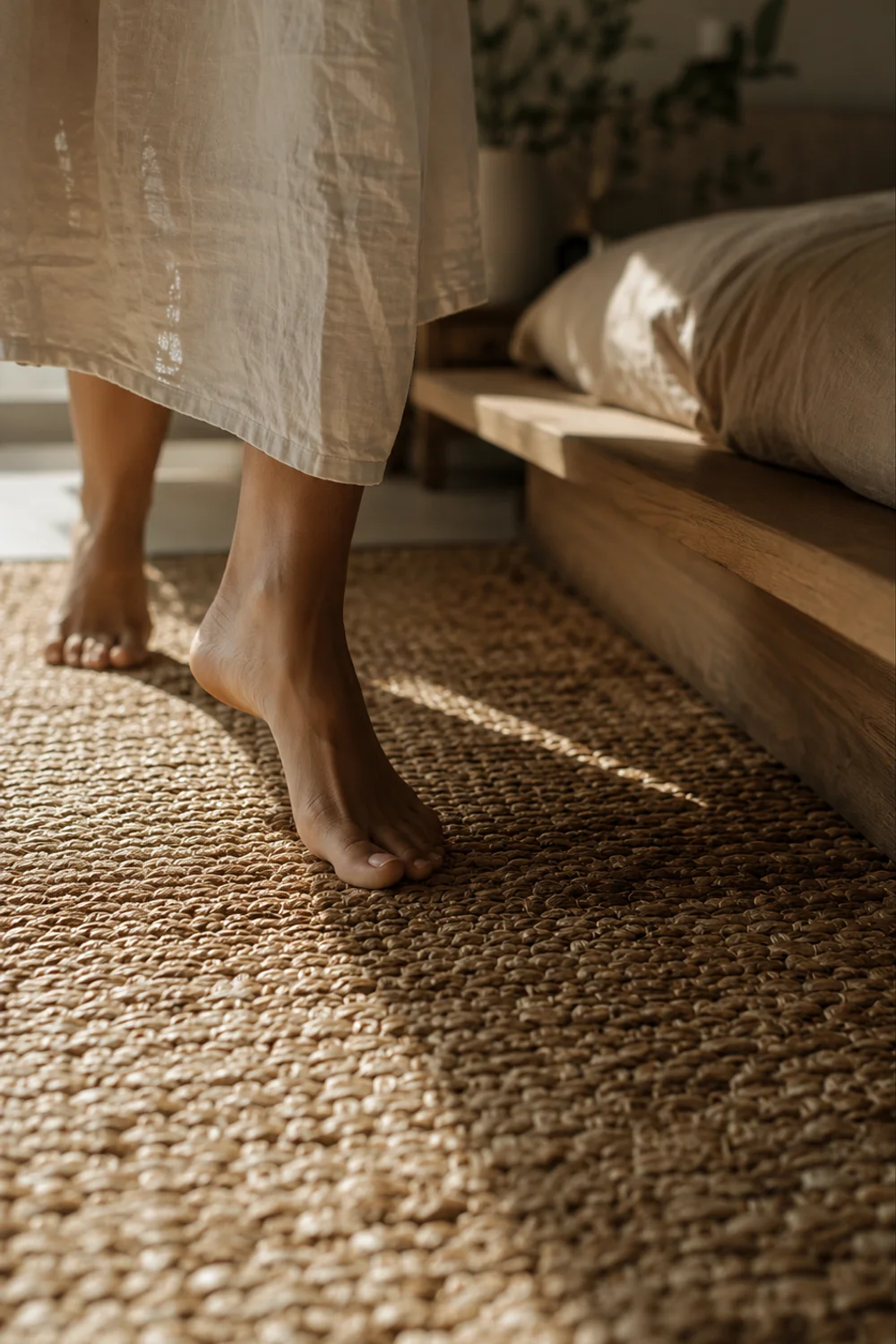
Rug shopping for bedrooms tends to prioritize plushness above almost everything else — the deeper the pile, the more luxurious it’s assumed to feel. But an entire room of soft, sinking textures underfoot, alongside soft bedding and soft upholstery, removes one of the few remaining tactile cues your feet could be using to locate yourself in space. Sisal interrupts that softness with genuine, fibrous resistance.
The sensation of sisal underfoot is closer to walking on dry grass or packed earth than to walking on carpet — there’s a slight roughness, a firmness that pushes back against the sole of the foot rather than yielding completely. That resistance is a meaningful sensory signal precisely because it’s rare indoors; almost everything in a modern bedroom is designed to be soft, so a rug that isn’t becomes a genuine textural landmark in the room rather than another layer of sameness.
A wool blend softens sisal’s rougher edge without erasing the resistance entirely, which matters if bare feet are a daily reality in the bedroom rather than an occasional one. A Sisal and Wool Blend Area Rug keeps enough of sisal’s fibrous structure to register as grounding while remaining comfortable enough for actual daily use, which is the balance most fully natural sisal rugs fail to strike on their own.
Picture stepping out of bed onto a plush wall-to-wall carpet every single morning for years — the transition is so seamless it barely registers as a sensory event at all. Replace even just the area beneath the bed with sisal blend, and that first step each morning becomes a small, deliberate wake-up cue for the body, similar to the way Why Japandi Bathrooms Are the Biggest Interior Design Trend You Need to Try Right Now discusses natural stone flooring doing the same job in wet spaces.
The broader idea is that texture underfoot shouldn’t just vary in softness — it should occasionally push back. A room entirely made of yielding surfaces gives the body nothing to orient against, while one deliberately firm, fibrous surface restores a sense of physical location that plush carpet alone can’t provide.
7. Fiber Wall Art in Place of Framed Prints

 Save it
Framed prints are the default answer to empty bedroom walls, but glass-fronted frames introduce a flat, reflective barrier between the art and the room — light bounces off the glass rather than interacting with the piece itself, and from across the room a framed print often reads as a flat rectangle rather than a textured object. Fiber wall art removes that barrier entirely and replaces flatness with dimension.
Handwoven fiber pieces cast their own shadows because the material itself has depth — knots, fringe, and varying cord thickness create a three-dimensional surface that shifts subtly depending on the light source and time of day, much like the cane wardrobe discussed earlier but at wall height instead of storage height. That shadow play does more to soften a wall visually than a flat print ever could, regardless of what the print depicts.
Natural, undyed cotton cord keeps the piece from competing with the room’s other textures, letting it read as texture-forward rather than color-forward. A Handwoven Macrame Wall Hanging, Natural Cotton Cord works especially well above a low headboard, where its irregular bottom edge softens the hard horizontal line the bed frame creates against the wall.
Picture the wall above a platform bed that’s currently holding a single black-framed print — swapping it for a fiber hanging of a similar footprint changes the wall from a flat, static focal point into something that visibly moves with the room’s changing light throughout the day, without adding a single additional color to the space.
The underlying principle applies well beyond wall art: dimension reads as alive, flatness reads as static. Anywhere a flat, glossy surface currently occupies prime visual real estate in the bedroom is a candidate for a dimensional, fiber-based alternative that does more sensory work for the same amount of wall space.
8. A Single Floor Vessel as the Room's Sculptural Anchor
 Save it
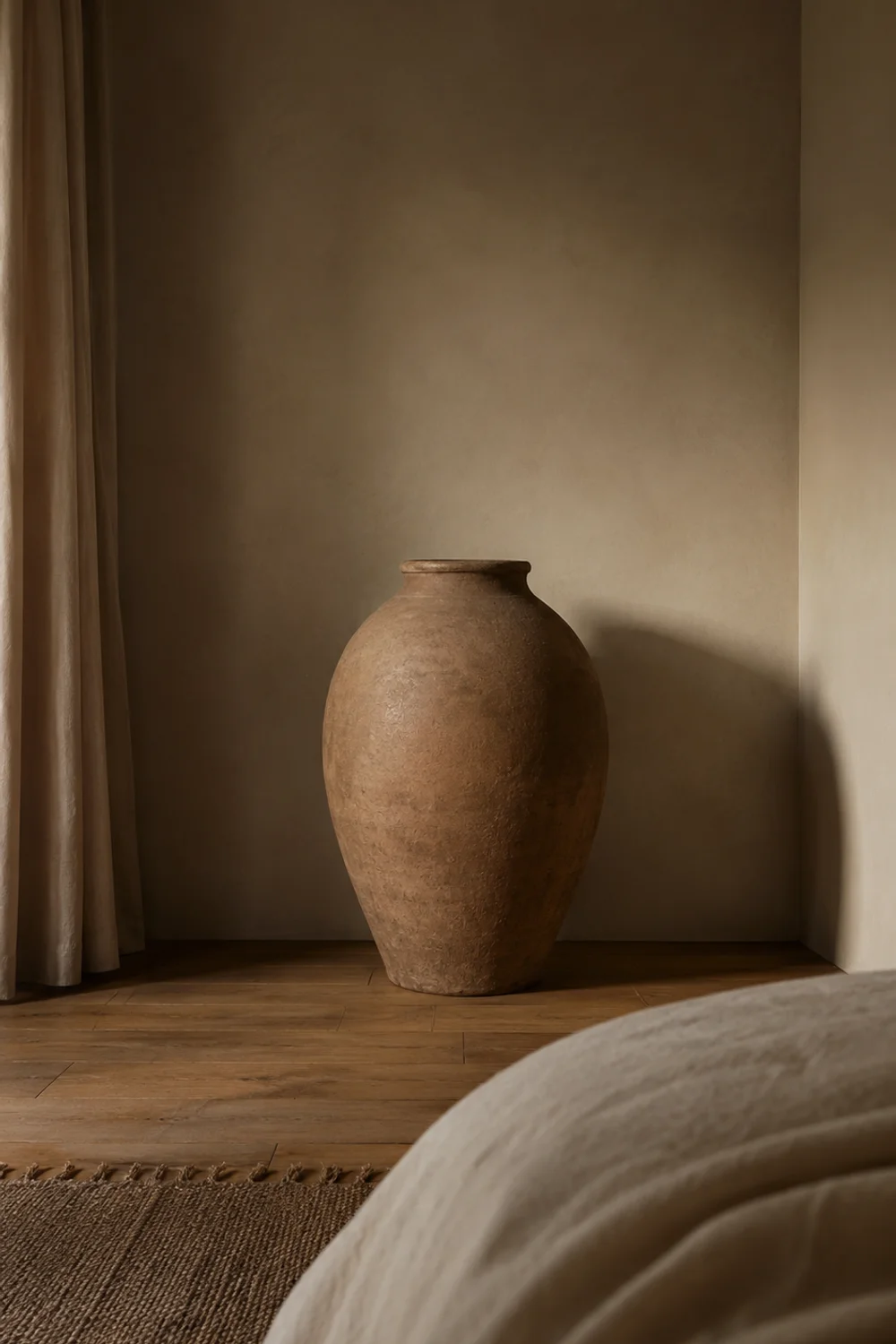
Bedrooms often accumulate small decorative objects across every surface — nightstands, dressers, windowsills — until the room feels visually busy without ever having one clear point of stillness. A single, oversized floor vessel does the opposite of accumulation: it claims one deliberate spot on the floor and asks the rest of the room to organize itself around that mass, rather than scattering visual weight evenly across every surface.
The mechanism is about scale and placement rather than decoration. Because the vessel sits on the floor rather than a shelf, it reads as architectural rather than ornamental — closer to a column or a piece of furniture than a knickknack. Its raw clay surface, left unglazed, keeps the piece from reading as precious or fragile, which allows it to anchor a corner without demanding careful styling around it.
Placement matters more than the vessel’s specific shape. An empty corner, the foot of the bed, or the dead space beside a wardrobe are all candidates, but the vessel needs breathing room on at least two sides to read as sculptural rather than crowded. A Sculptural Raw Clay Floor Urn, Oversized Silhouette works best alone, without a cluster of smaller objects competing for attention nearby.
Picture a bedroom corner that’s currently home to a pile of shoes or an overflow laundry basket — clearing that corner and placing a single large clay vessel there instead turns a neglected, cluttered patch of floor into the room’s quietest, most deliberate visual moment, with zero additional square footage required. In a slope-ceilinged attic bedroom, the same idea does even more work: tucking the vessel into the lowest, most awkward part of the eave — a spot too cramped for a chair or a nightstand — gives that dead zone a reason to exist instead of leaving it looking like an afterthought.
The lesson scales to any room: one large, confident object does more grounding work than a dozen small decorative ones, because scattered objects ask the eye to keep moving while a single mass gives it somewhere to rest. Resist the urge to soften the corner with a plant or a framed print alongside it — the vessel’s power comes precisely from being the only thing there.
9. One Wall, One Earth Tone: Color as Restraint
 Save it
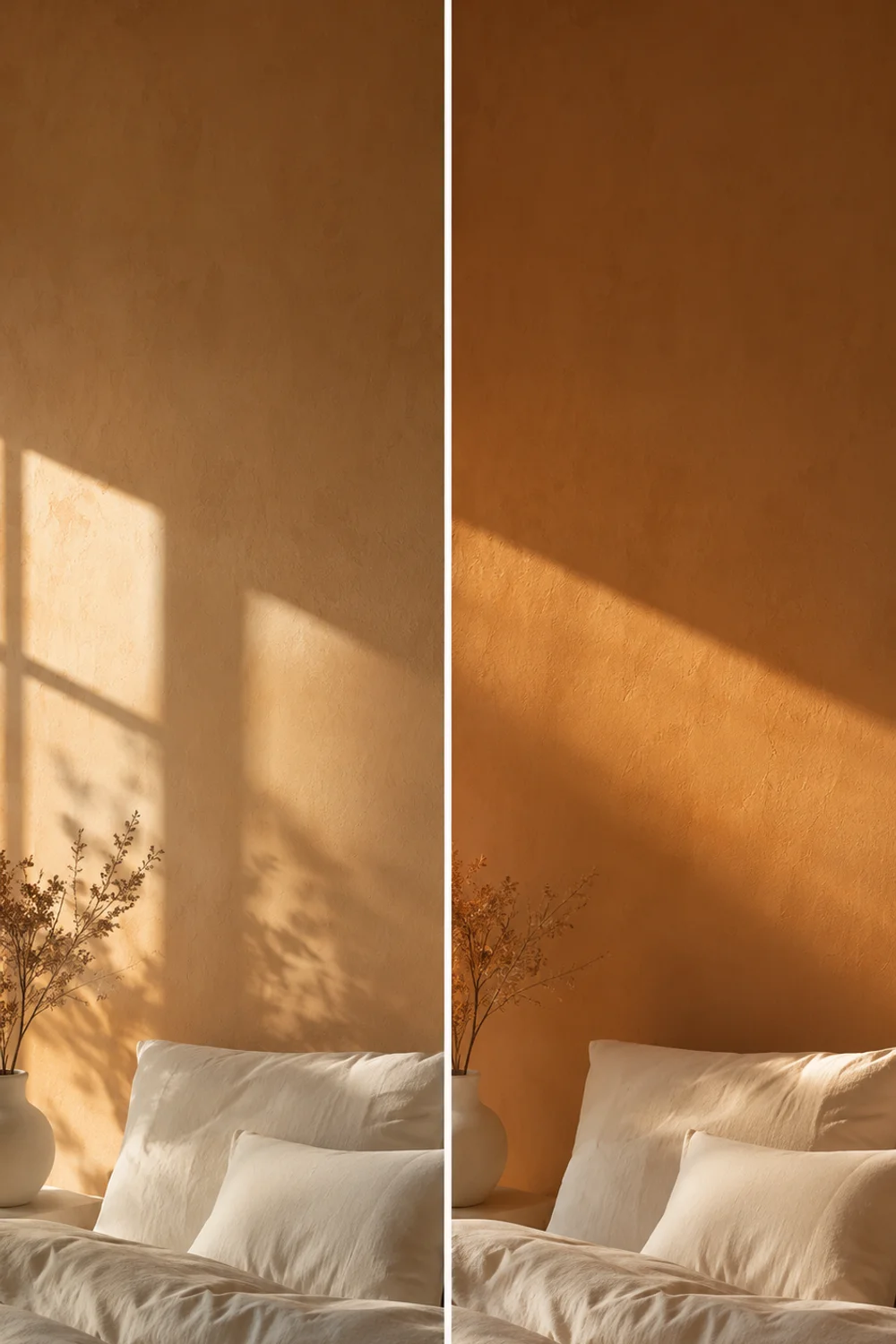
Color is usually the first decision made in bedroom design and the last one that should be, because color applied without restraint tends to spread across every surface until the room feels like a themed palette rather than a lived-in space. Treating color as a single, contained gesture — one wall, one earth tone, nothing matched elsewhere — keeps pigment from overwhelming the sensory work the materials in the room are already doing.
The mechanism is that a single colored wall functions as a backdrop rather than a statement competing with everything else. An ochre or clay-toned wall behind a low bed gives the eye a warm field to rest against without requiring every textile, frame, and accessory in the room to match it — the color does its job quietly, in one place, rather than repeating itself into visual noise. This kind of restraint is what separates an earthy room from a themed one, a distinction How to Create Warm Neutral Bedroom Ideas That Will Never Go Out of Style explores in more depth from the neutral end of the spectrum.
Testing before committing matters enormously here, since earth pigments shift dramatically under different light sources throughout the day. An Earth-Pigment Wall Paint Sample Set, Ochre and Clay Tones lets you see how a tone behaves at 7am versus 7pm on the actual wall in question, rather than guessing from a small chip under showroom lighting.
Picture a bedroom currently painted entirely in the same warm white on all four walls — repainting only the wall behind the headboard in a muted clay tone gives the room a single, deliberate focal point without requiring a single other change, and the surrounding white walls suddenly read as more intentional by contrast rather than simply unfinished.
Color, used this sparingly, becomes a design decision rather than a default. The goal isn’t an earth-toned room in the sense of matching everything to a mood board — it’s a room where one wall carries the color conversation so the materials elsewhere can carry the texture conversation instead.
10. Raw-Weave Linen Drapery Without a Blackout Layer

 Save it
Bedroom curtains are almost always chosen for their blackout properties first and their material feel second, which makes sense functionally but quietly removes one of the room’s largest textile surfaces from doing any sensory work at all. Blackout lining is typically smooth, synthetic, and light-blocking by design — none of which reads as tactile or grounding, no matter what fabric sits on the visible face of the curtain.
Raw-weave linen, left unlined, does the opposite. Its visible slub texture — the small, irregular thickenings in the yarn that come from minimal processing — catches light unevenly across the fabric’s surface, creating soft shadow variation rather than a flat, uniform panel. Because there’s no blackout backing, the linen also moves more freely in air currents, which adds a subtle kinetic quality that lined curtains simply can’t replicate.
This isn’t the right choice for every sleeper — anyone who needs a fully dark room for sleep will want blackout somewhere in the window treatment, even if it’s a secondary layer behind the linen rather than built into it. Unlined Raw-Weave Linen Curtain Panels, Visible Slub Texture work best as the visible, textural layer of a window, with darkness handled separately if darkness is a hard requirement.
Picture a west-facing bedroom window currently dressed in smooth, synthetic blackout curtains that block afternoon glare completely but also flatten the light into a dim, uniform grey whenever they’re drawn — swapping to unlined raw linen instead lets the afternoon sun filter through as warm, textured, dappled light, changing the entire mood of the room at exactly the time of day it’s most often occupied.
The underlying idea is that window treatments are one of the largest fabric surfaces in any bedroom, and defaulting to smooth, synthetic blackout fabric across that much square footage sacrifices a significant amount of potential texture for a functional benefit that could often be achieved another way.
11. Cork or Clay Tile as a Grounding Accent Surface
 Save it
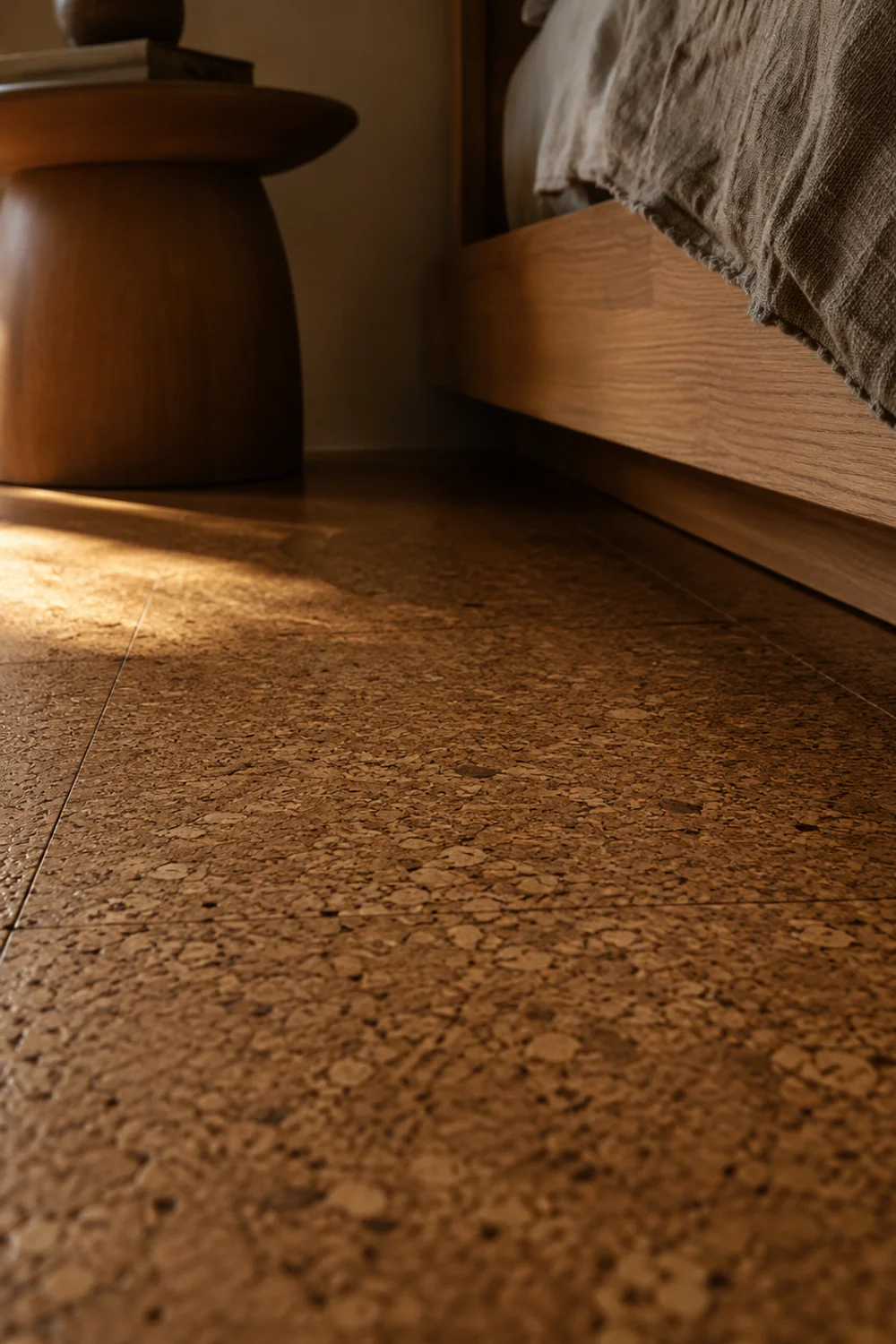
Full-room flooring changes are rarely realistic for most bedrooms, whether due to rental restrictions or simple cost, but that doesn’t mean flooring has to stay entirely off the table as a grounding tool. A contained accent area — beneath a chair, in front of a wardrobe, or as a small transitional zone near the bed — can introduce a genuinely different underfoot material without requiring a full renovation.
Cork in particular offers a sensory profile unlike almost anything else typically found in a bedroom: it’s warm rather than cold underfoot, slightly springy rather than hard, and faintly textured in a way that reads as organic rather than manufactured. Clay tile, by contrast, stays cool and firm, closer to stone, and works well in warmer climates or south-facing rooms where a cooling surface is welcome rather than uncomfortable, a contrast worth considering alongside The Ultimate Guide to Scandinavian Bathroom Design Everyone Is Obsessed With, which covers similar material trade-offs in wet-room contexts.
Self-adhesive options make this approach realistic even in rentals, since they typically install without permanent modification and can be removed later without damaging the subfloor beneath. A Natural Cork Flooring Tile Set, Self-Adhesive covers a defined accent zone — a three-foot square beside the bed, for instance — without committing the entire room to a new floor material.
Picture the small patch of floor directly beside a low platform bed, currently the same carpet or laminate as the rest of the room — installing a self-adhesive cork tile section there creates a distinct “first step” texture each morning, similar in spirit to the sisal rug idea but warmer and springier underfoot, ideal for anyone who finds sisal’s firmness a bit too rough for direct daily contact.
The broader principle is that grounding doesn’t require an all-or-nothing renovation. A contained, well-placed accent surface can deliver a meaningfully different sensory experience in exactly the spot where it matters most — the first few steps out of bed — without touching the rest of the room’s flooring at all.
12. The Barefoot Threshold Between Hard and Soft Flooring
 Save it
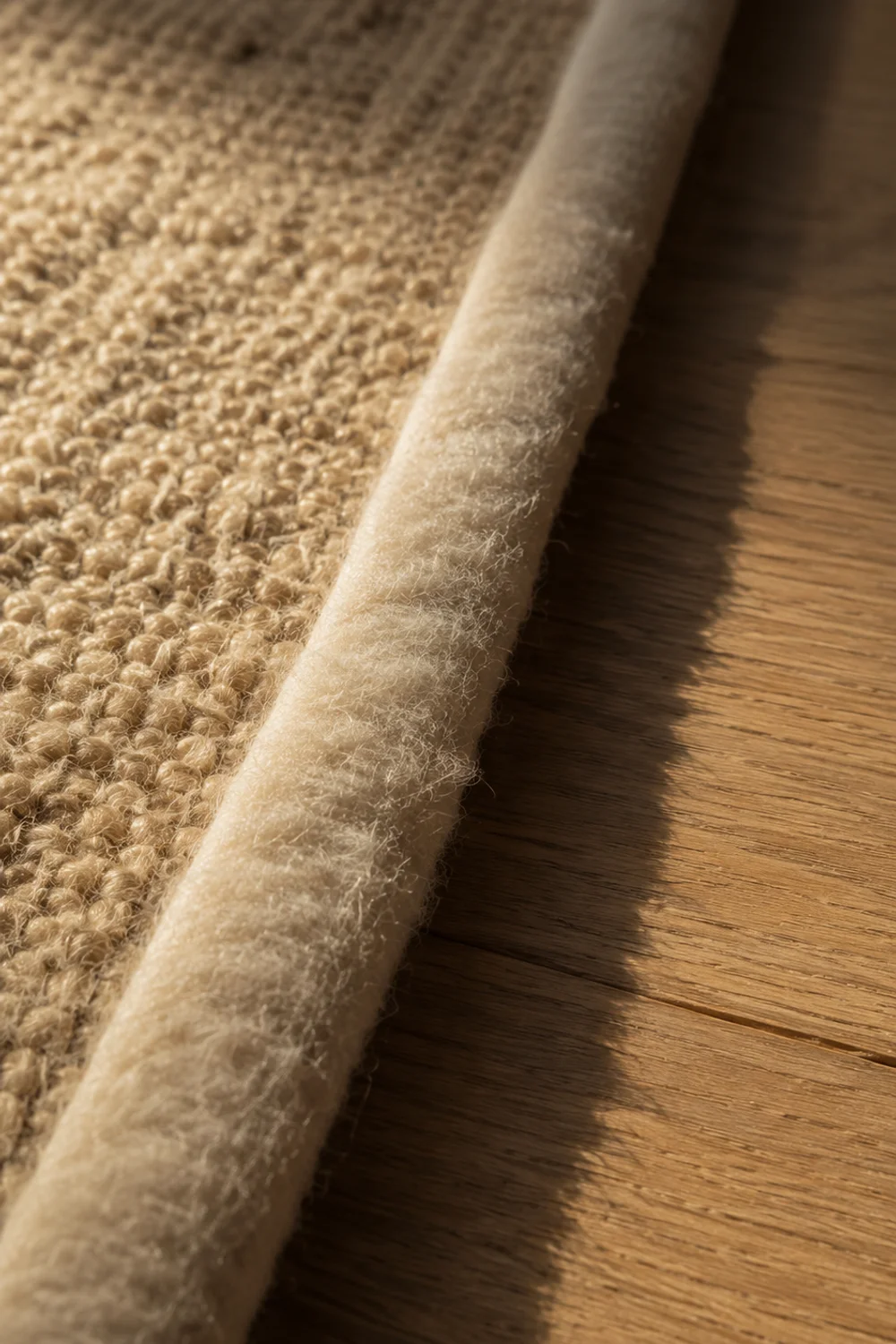
Most bedrooms handle the transition between a rug and bare floor with a plain metal or plastic transition strip, chosen purely for function and never considered as a design or sensory element. That’s a missed opportunity, because the threshold between two flooring textures is exactly the kind of spot where the foot registers a change — and a felt transition strip can turn that functional necessity into a deliberate, soft-edged sensory cue instead of an abrupt, hard line.
The mechanism is about softening a transition that would otherwise be jarring. A hard metal strip creates a sharp, cold ridge underfoot exactly where the body is moving from one texture to another, while a felted wool strip tapers the change gradually, letting the foot register softness fading into firmness rather than an abrupt edge. This detail is small, but thresholds are crossed dozens of times a day, which gives this tiny material choice an outsized cumulative effect.
Undyed felt keeps the transition visually quiet, avoiding the temptation to turn a functional strip into a decorative statement that competes with the flooring on either side of it. A Wool Felt Floor Transition Strip, Natural Undyed works well between a sisal rug and a bare wood or cork floor, extending the grounding logic of the flooring itself into the seam between materials.
Picture the edge of a bedroom rug that currently ends abruptly against bare floorboards, with nothing but a slight height difference marking the change — adding a felt transition there means every barefoot crossing from rug to floor becomes a soft, gradual textural handoff rather than a small, repeated jolt, a detail so minor most guests would never consciously notice it, yet the body registers it every time.
This is a useful reminder that grounding design lives in transitions as much as in surfaces themselves. The seams between materials — where a rug meets a floor, where a wall meets a ceiling — are frequently the most overlooked spots in a room, and they’re often exactly where a small, deliberate choice does the most repeated sensory work.
13. Weight and Density as a Design Cue
 Save it
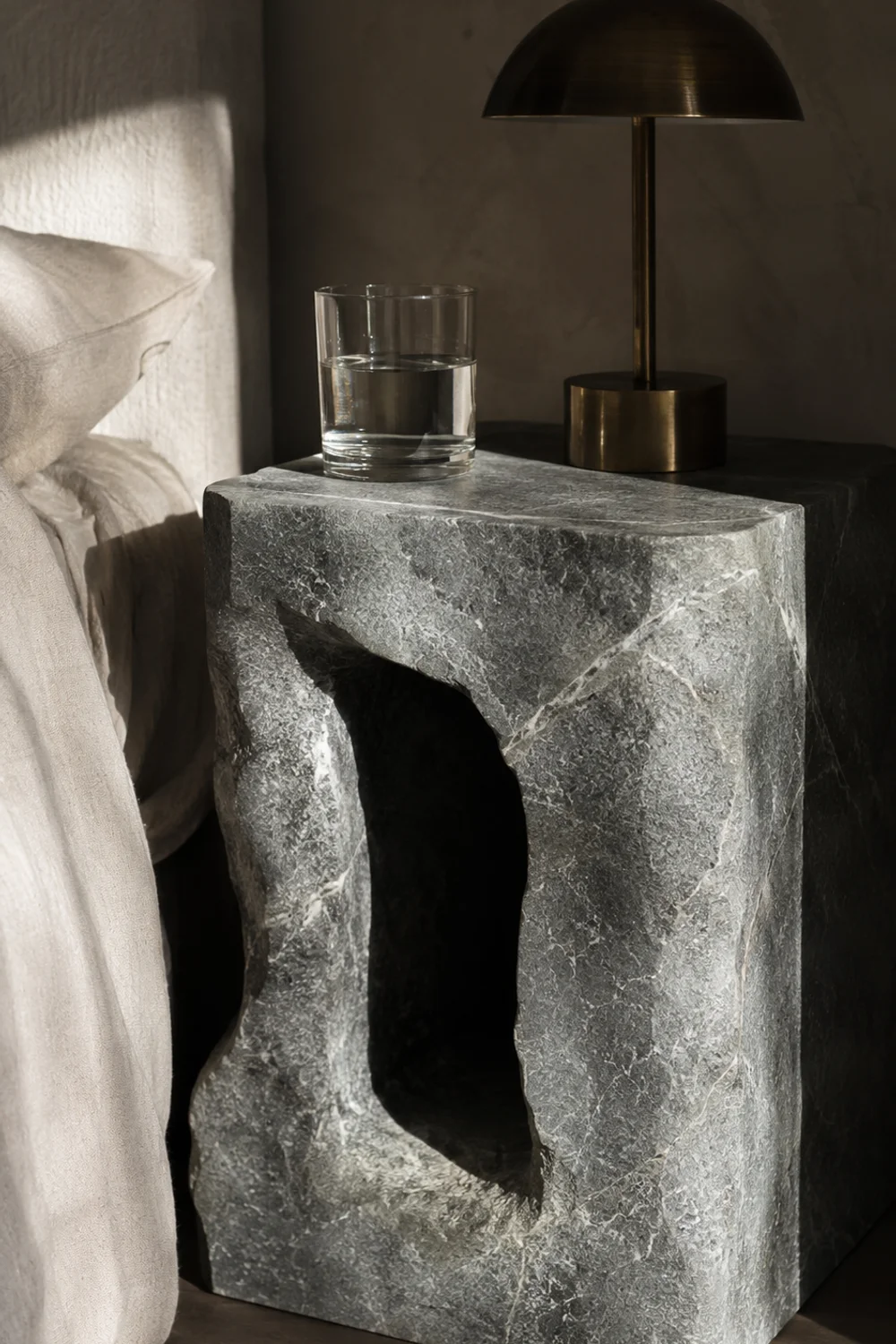
Furniture shopping tends to prioritize visual proportion — does this table look the right size for this spot — without ever considering the object’s actual mass. But weight is a sensory cue your body registers the moment it touches or moves an object, and dense, solid materials communicate permanence and stability in a way that lightweight, hollow furniture simply cannot, regardless of how similar they look from across the room.
Soapstone is a useful material here because its density is immediately obvious the moment you touch it — it’s cool, heavy, and clearly solid all the way through, unlike many modern furniture pieces that look substantial but are actually hollow or veneered over particleboard. That immediate tactile confirmation of solidity is part of what makes dense materials feel grounding: there’s no gap between how an object looks and how it actually behaves in the hand.
This doesn’t mean every piece of furniture in the room needs to be stone-heavy — one dense object does enough work to shift the room’s overall sensory register, the same way one leather chair or one clay vessel does. A Solid Soapstone Side Table, Hand-Carved placed beside a low bed introduces genuine mass into arm’s reach, without requiring the rest of the room’s furniture to match its weight.
Picture a nightstand currently made of lightweight engineered wood that shifts slightly whenever you set a glass of water down too firmly — replacing it with a solid soapstone table removes that instability entirely, and the simple, repeated act of setting something down at night becomes a small daily confirmation that at least one object in the room is exactly as solid as it appears.
The principle extends well beyond bedside tables: in a room built mostly from lightweight materials, a single dense object does more to signal permanence than an entire room of merely well-proportioned furniture, because density is a claim the body verifies immediately, without needing to think about it at all.
14. A Caned Bench as the Room's Single Seating Moment
 Save it
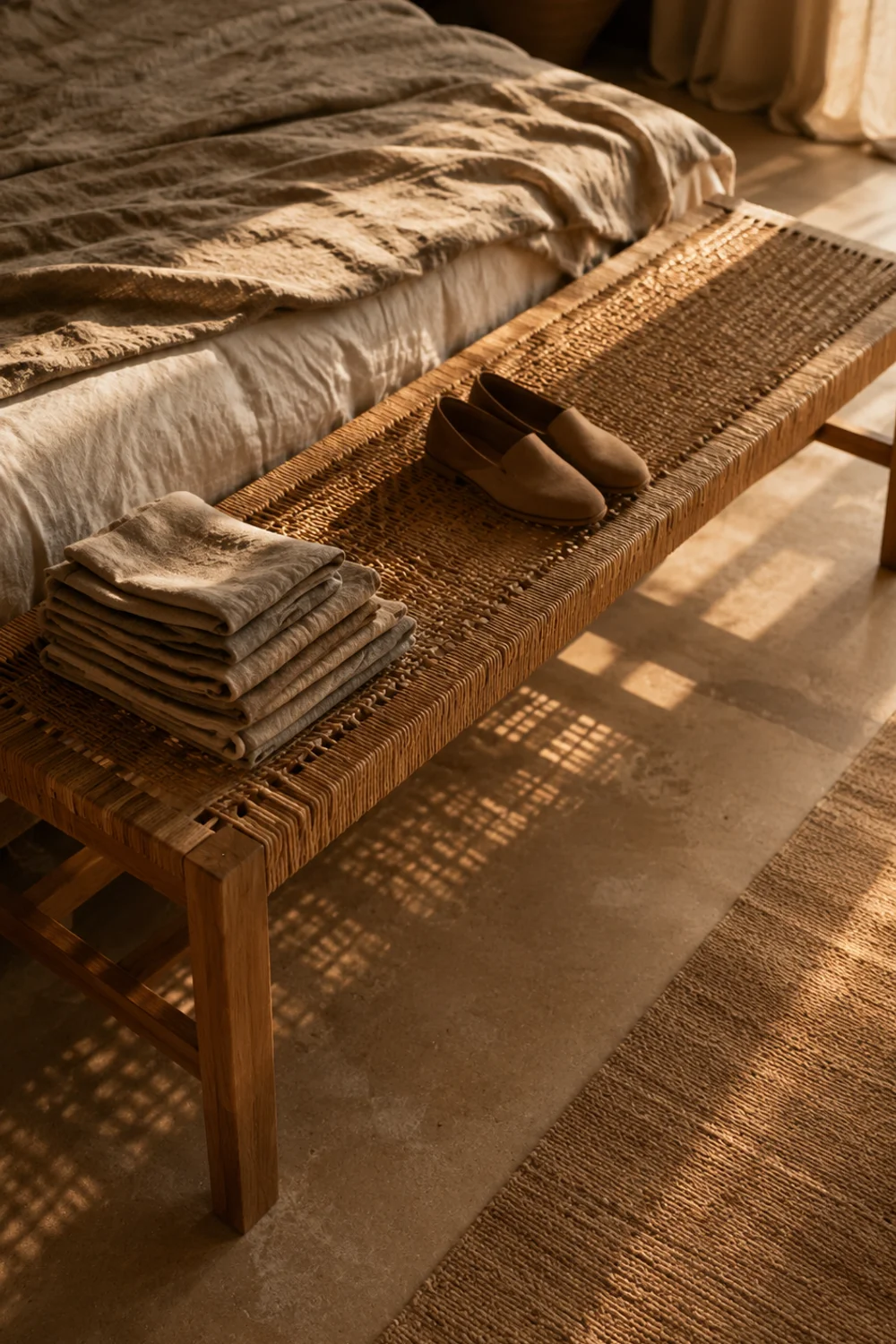
Every bedroom eventually needs one spot to sit that isn’t the bed itself — for tying shoes, for folding laundry, for a moment of pause before or after sleep — and that seating moment is often filled by whatever spare chair happens to be available, chosen with far less intention than the bed or wardrobe nearby. A caned bench brings the same woven, light-filtering quality discussed earlier in the wardrobe section down to a smaller, more functional scale.
The material logic mirrors the wardrobe: woven cane seating interacts with light and air in a way that solid upholstered benches don’t, staying cooler to sit on and visually lighter in a room that may already contain a fair amount of dense, solid furniture elsewhere. Positioned at the foot of a low platform bed, a caned bench also echoes the wardrobe’s material story, tying two separate pieces of furniture together through texture rather than matching finish.
Solid oak framing keeps the bench sturdy enough for genuine daily use — sitting to put on shoes, setting down a stack of folded linens — without sacrificing the airy, woven quality that makes cane feel lighter than solid wood alone. A Woven Rush Seat Bench with Solid Oak Frame offers the same textural benefit as caning while standing up to more direct daily weight-bearing use.
Picture the foot of a bed that currently has no seating at all, just an empty stretch of floor where shoes and bags tend to accumulate — adding a rush-seat bench there gives that space a defined purpose, turning a cluttered dead zone into a genuine daily-use spot that also happens to reinforce the room’s woven, natural material story, an approach that pairs naturally with How to Recreate the Cozy Bedroom Trends Everyone Is Saving in 2026 and its broader take on functional coziness.
The larger takeaway is that even a single seating moment in a bedroom is an opportunity to extend the room’s sensory logic rather than default to whatever spare chair is on hand. One well-chosen, well-placed bench does more grounding work than an entire room of otherwise carefully chosen furniture undermined by one mismatched, purely functional afterthought.
Common Mistakes to Avoid
1. Treating “earthy” as a color story instead of a sensory one
This is the single most common mistake, and it’s the one this entire guide has tried to argue against. People choose an ochre paint and a few terracotta accents and expect the room to feel grounded, but color alone does very little of the actual sensory work — weight, texture, and material honesty do far more, and a room can be color-accurate and still feel flat if none of the materials underneath the paint are doing anything tactile.
2. Layering too many raw textures at once
Sisal, cane, leather, and unglazed clay are each powerful in isolation, but stacking all of them into one small room creates visual and tactile noise rather than calm. The goal is one or two dominant raw textures per room, used deliberately, not an inventory of every natural material available.
3. Choosing lightweight furniture for the sake of easy rearranging
Furniture that’s easy to move is often furniture with very little mass, and mass is one of the primary cues the body uses to judge stability. A room built entirely from lightweight, easily shifted pieces will struggle to feel grounded no matter how earthy its color palette is, because permanence is part of what the nervous system is actually reading.
4. Skipping the accent surface because a full renovation feels unrealistic
Many people assume grounding flooring changes require replacing an entire floor, and when that feels financially unrealistic, they skip the idea entirely. Small, contained accent areas — a self-adhesive cork square, a felt transition strip — deliver much of the same sensory benefit at a fraction of the cost and effort.
5. Forgetting that daily-touch objects matter more than display objects
A beautiful raw-clay vase on a high shelf does far less grounding work than a rough stoneware bowl on the nightstand you touch every night. Prioritize the objects your hands and feet actually interact with daily over the ones you simply look at from across the room.
Frequently Asked Questions
Do I need to replace all my bedroom furniture to achieve this grounded, earthy feeling?
No — the goal is targeted, not total. A single low platform bed, one dense side table, and one raw-textured rug can shift a room’s entire sensory register without touching anything else. Start with whichever object you physically interact with most often, since daily-touch pieces deliver more grounding effect per change than furniture you only look at. Full-room overhauls are rarely necessary and often dilute the effect through overcrowding.
How is this different from a typical “earthy” or “boho” bedroom trend?
Typical earthy or boho styling treats color, pattern, and accessory density as the main levers, often layering many textures and objects at once for visual richness. This approach treats sensory input — weight, temperature, texture, material honesty — as the primary lever, and color as a secondary, restrained detail. The result usually looks calmer and more restrained than a typical boho room, with fewer objects doing more physiological work.
Will raw, unprocessed materials like unglazed stoneware or raw-weave linen be harder to maintain?
Slightly, but manageably. Unglazed stoneware can absorb oils or moisture over time and benefits from occasional gentle sealing if used for anything beyond decorative catchall purposes. Unlined linen wrinkles more visibly than synthetic blackout fabric and shows dust differently than tightly woven cotton. None of this requires special expertise, just an acceptance that these materials show wear and use more visibly than heavily processed alternatives — which is largely the point.
Can this approach work in a small bedroom, or does it need more square footage?
It works especially well in small bedrooms, because the strategy relies on one or two deliberate, well-chosen elements rather than volume of objects. A single low bed, one dense side table, and a contained rug or accent floor patch can transform a small room without requiring the kind of extra floor space that a full furniture collection would need. If anything, restraint is easier to achieve when space is already limited.
Final Thoughts
An earthy bedroom, done well, isn’t really about following a color trend at all — it’s about giving your body evidence that the room is stable, textured, and honest about what it’s made of. Weight, roughness, temperature, and material honesty do more grounding work than any paint chip, and once you start noticing that difference, it’s difficult to walk into a purely decorative room without noticing what’s missing.
Start small. Pick the one idea from this list that solves a real friction point in your current bedroom — a bed that feels too high off the ground, a nightstand with nothing textural on it, a window treatment that’s flattening your afternoon light — and change only that. Grounding compounds through repetition, not density of objects.
Save this guide for later, and come back to it room by room rather than trying to apply all fourteen ideas in a single weekend. A bedroom built this way rewards patience, since each material choice earns its place through daily use rather than a single dramatic reveal — which is, in its own way, exactly the point.
This post contains affiliate links. I may earn a small commission at no extra cost to you.
READ FOR THE NEXT STEP?
KEEP READING
Continue with another helpful idea.

How to Use the Biggest Bedroom Color Trends for 2026 in Your Home Right Now
SHOP MY FINDS
Discover my favorite products for this place
My Favorite Bedroom Finds
GET THE PLANNER
Get the planner guide and make it easier.

The Ultimate Bedroom Planner
Get cozy inspiration delivered to your inbox.
✓ 14-page beautifully designed ebook
✓ Cozy decorating ideas
✓ Practical room-by-room inspiration
You’re in! 🎉
Thanks for joining the NestFlowHome community!
Your free ebook is already on its way to your inbox. If you don’t see it within a few minutes, please check your Promotions or Spam folder.
Join the NestFlowHome community for weekly decorating inspiration.

Timeless home decor ideas and slow living inspiration for a calm, beautiful life.