
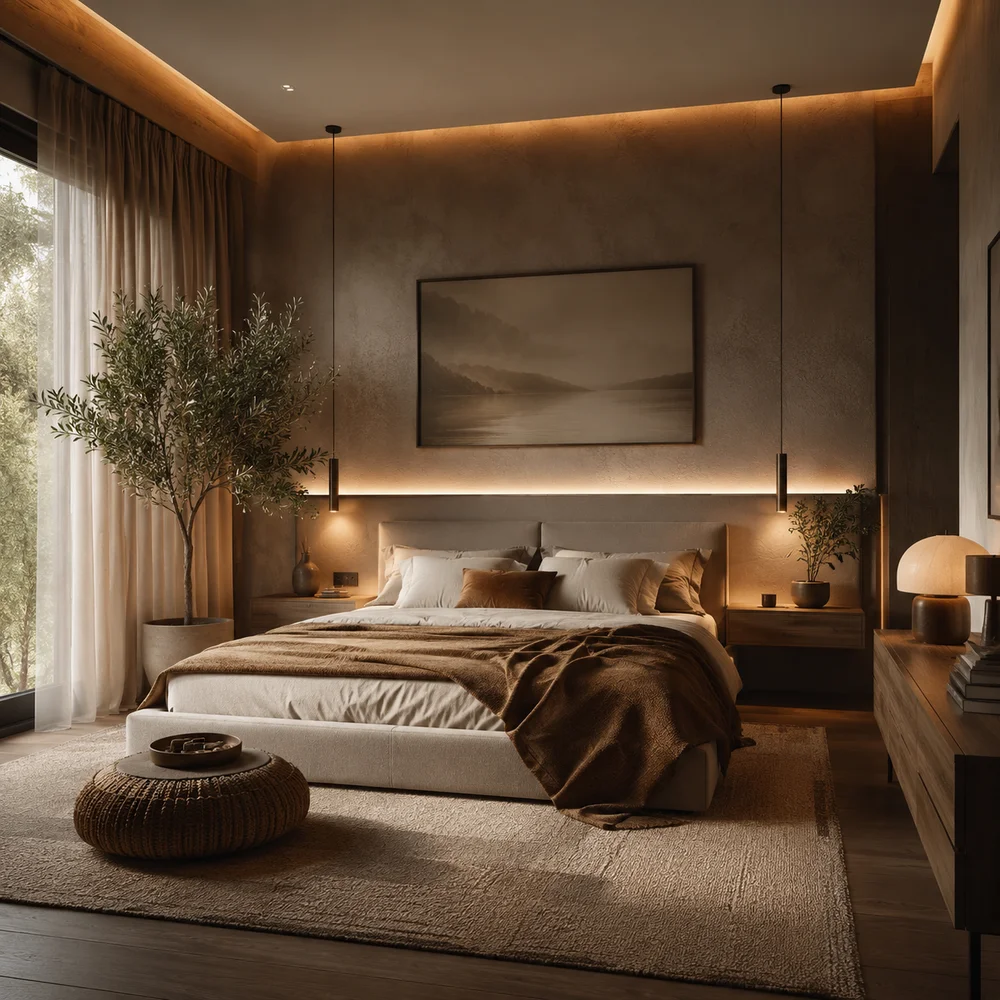
Bedroom Lighting Ideas That Define the Best Environment for Better Sleep
By Emily | July 22, 2026
Most people upgrade their bedroom lighting one bulb at a time, swapping a lamp here or adding a dimmer there, and then wonder why the room still doesn’t feel restful. The problem is rarely the fixture itself. It’s the assumption that lighting is decoration rather than a system your body reads every single evening, deciding whether it’s time to relax or stay alert.
The uncomfortable truth is that a beautifully styled bedroom can still sabotage your sleep if the light inside it behaves the wrong way. A single overhead fixture blasting the same brightness at 7pm as it does at noon sends your nervous system a confusing signal, no matter how soft the bedding looks around it.
This guide walks through eleven specific, often-overlooked lighting decisions that shape how a bedroom actually functions after dark — from where a reading lamp should sit to why some “warm” bulbs still look strangely lifeless. These aren’t abstract design tips; they’re mechanical adjustments with a real, felt effect on the room.
Read this less like a mood board and more like a checklist. Some sections apply to a full renovation, others to a fifteen-minute fix with a new bulb or bracket. Pick the ones that match your current setup, and treat the rest as ideas worth returning to the next time you’re ready to change something.
1. Why Bedroom Lighting Works as a Layered System, Not One Fixture
 Save it
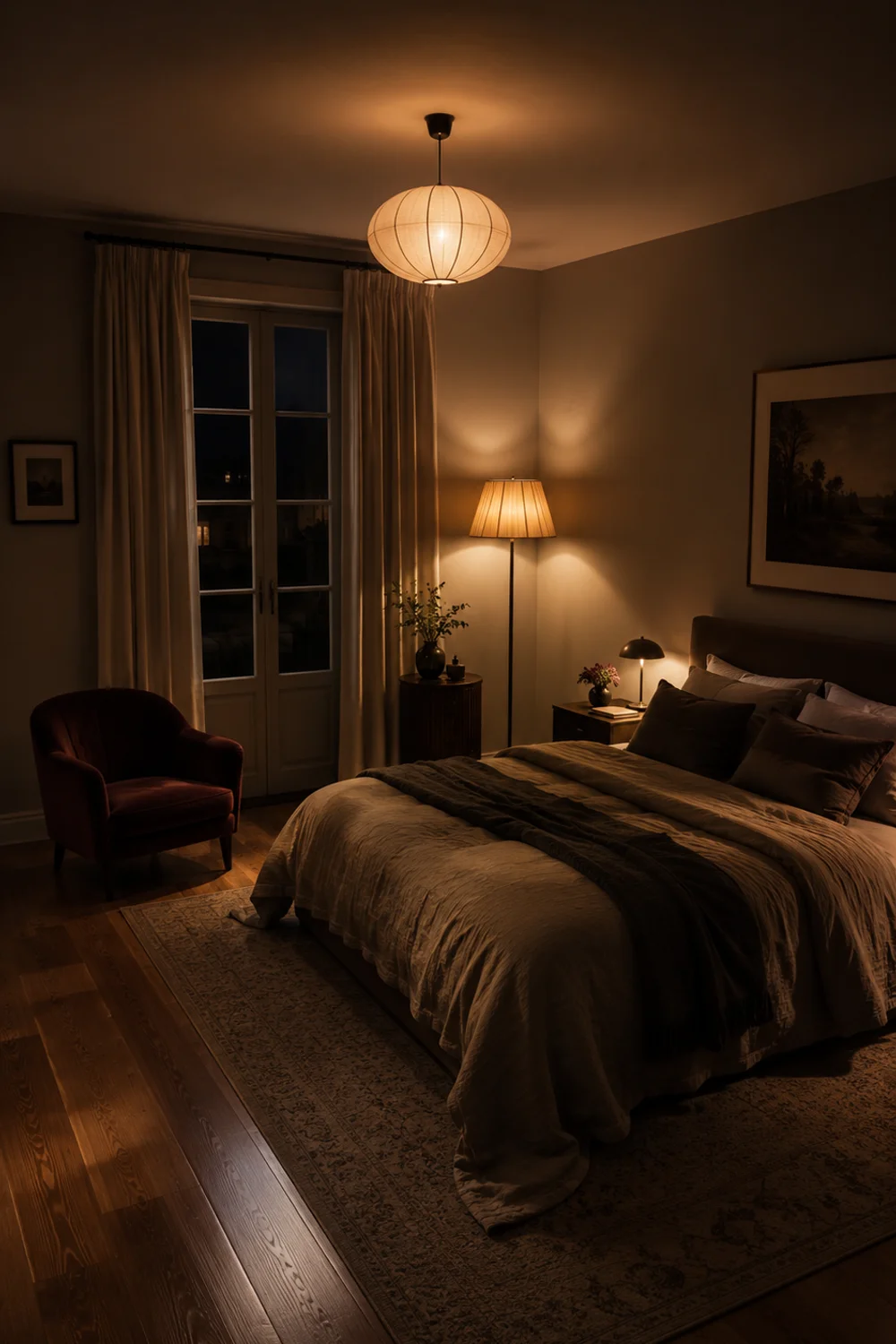
A bedroom lit by a single ceiling fixture is a room with exactly one lighting option: on or off, bright or dark. That binary choice is the root of most nighttime lighting complaints, because your evening routine actually needs several different light levels depending on the moment — reading, undressing, walking to the bathroom, or lying awake scrolling. One fixture cannot serve all of those moments without compromising at least one of them.
A layered system separates light into distinct jobs: ambient light for general visibility, task light for reading or dressing, and accent light for mood and depth. Each layer has its own switch or dimmer, so you’re never forced to choose between “too bright to relax” and “too dark to function.” The layers overlap just enough that turning one off doesn’t leave the room feeling incomplete.
The most common variation is a room with good task lighting but zero ambient layer, or the reverse — a soft floor lamp with no reading light nearby, forcing someone to squint at a book by lamp glow that was never designed for close-up focus. Either gap creates friction that shows up nightly, even if no one identifies lighting as the cause.
Picture a guest bedroom with a single flush-mount ceiling light and two identical bedside lamps. Every task defaults to the same lamp glow: makeup, reading, phone-charging, folding laundry from the chair. Adding one dimmer to the ceiling fixture and a focused reading light beside just one nightstand instantly gives the room three usable states instead of one, without adding a single new piece of furniture.
Layering is the same logic behind a well-composed room described in Calming Bedroom Ideas That Define the Best Wellness Design Inspiration, where visual calm comes from intentional separation rather than more objects. Lighting works the same way — the goal isn’t more fixtures, it’s fixtures that don’t compete for the same job.
This same layered approach to light also shapes mood in surprising ways, and the softer, more intentional glow explored in How to Create Romantic Bedroom Decor Without Looking Overdone shows just how far a few well-placed light sources can go toward making a bedroom feel considered rather than merely lit.
2. Eye-Level Glare: Why an Overhead-Only Room Fights the Body's Wind-Down Signal
 Save it
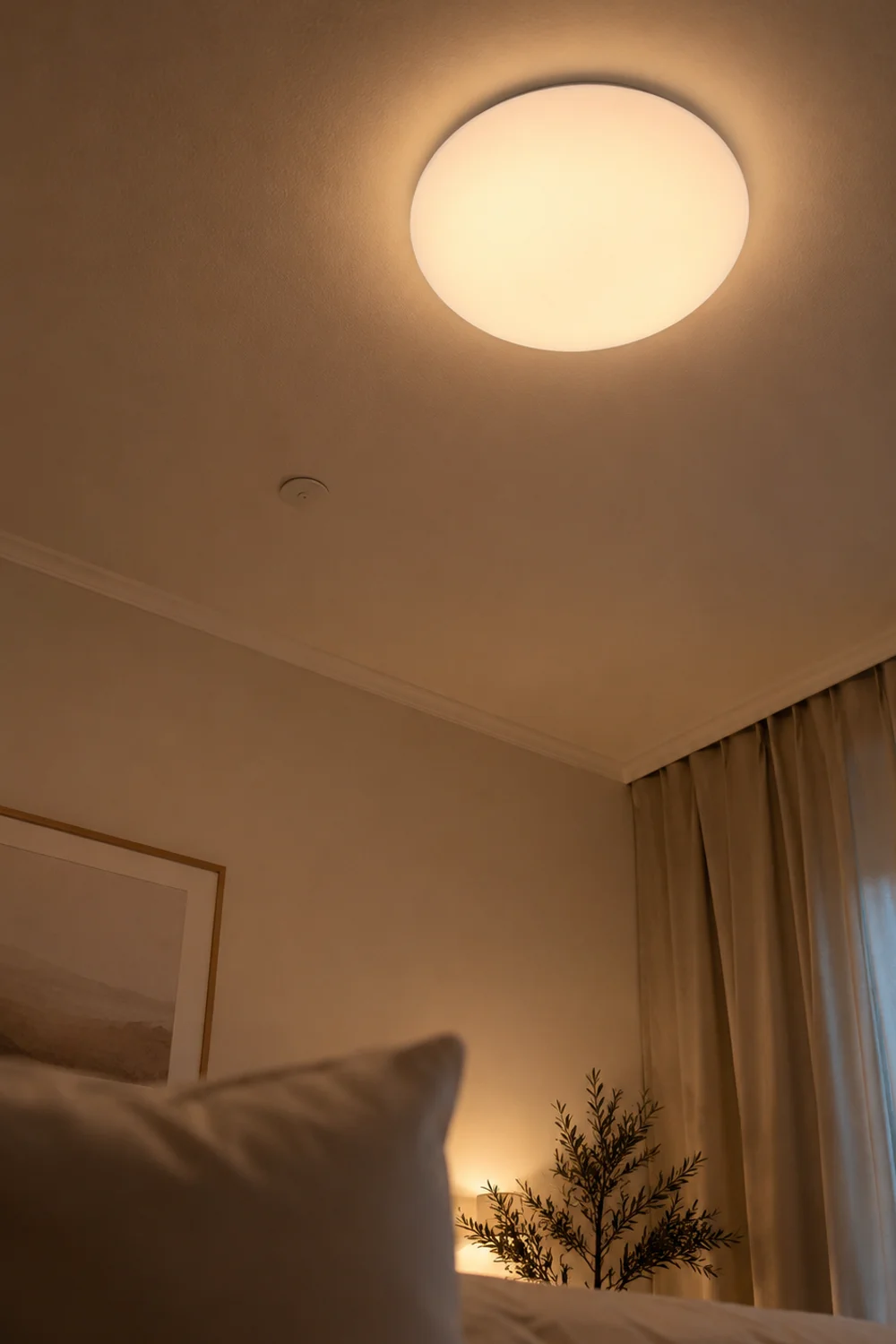
Overhead lighting sits directly in your field of view more often than people realize, especially in a room where you spend most of your time lying down. A ceiling fixture that looks perfectly normal when you’re standing becomes a glaring point source the moment you’re horizontal on the bed, looking up at a bright bulb instead of a softly lit room. This is a geometry problem, not a brightness problem, and it explains why some rooms feel harsh even at a moderate wattage.
The mechanism is simple: bare or lightly diffused bulbs mounted flush to the ceiling emit light directly into the eye at a low, reclined angle. Even a warm-toned bulb reads as harsh under these conditions, because the issue isn’t color temperature — it’s the unobstructed line of sight between your eye and the light source. Fully frosted diffusers, recessed cans with deep baffles, or fixtures angled toward the wall all interrupt that direct path.
A common workaround is switching the ceiling fixture off entirely after a certain hour and relying only on lower, indirect sources — floor lamps, sconces, or lit shelving. This doesn’t require removing the ceiling fixture, just accepting that it becomes a daytime-only tool once evening arrives, while a secondary layer takes over lower in the room.
Consider a bedroom where the bed faces directly under a center light with a bare glass globe. Anyone lying back to read before sleep is staring straight into it. Repositioning just one lamp onto a dresser opposite the headboard, angled away from the pillow, removes that direct sightline completely without touching the ceiling fixture at all.
Reducing eye-level glare matters more in a room designed around visual softness, an idea that pairs naturally with the tonal approach in How to Create Warm Neutral Bedroom Ideas That Will Never Go Out of Style, where softened surfaces only read as calm if the light hitting them isn’t harsh to begin with.
3. The Reading Light That Doesn't Wake the Other Side of the Bed
 Save it
Shared beds create a lighting conflict that single-occupant guides rarely address: one person wants to read at 11pm while the other is already trying to sleep. A shared overhead lamp or a single bright bedside light solves this for exactly one person and actively disrupts the other, which is why so many couples default to reading on a phone instead — not because they prefer it, but because it’s the only genuinely private light source in the room.
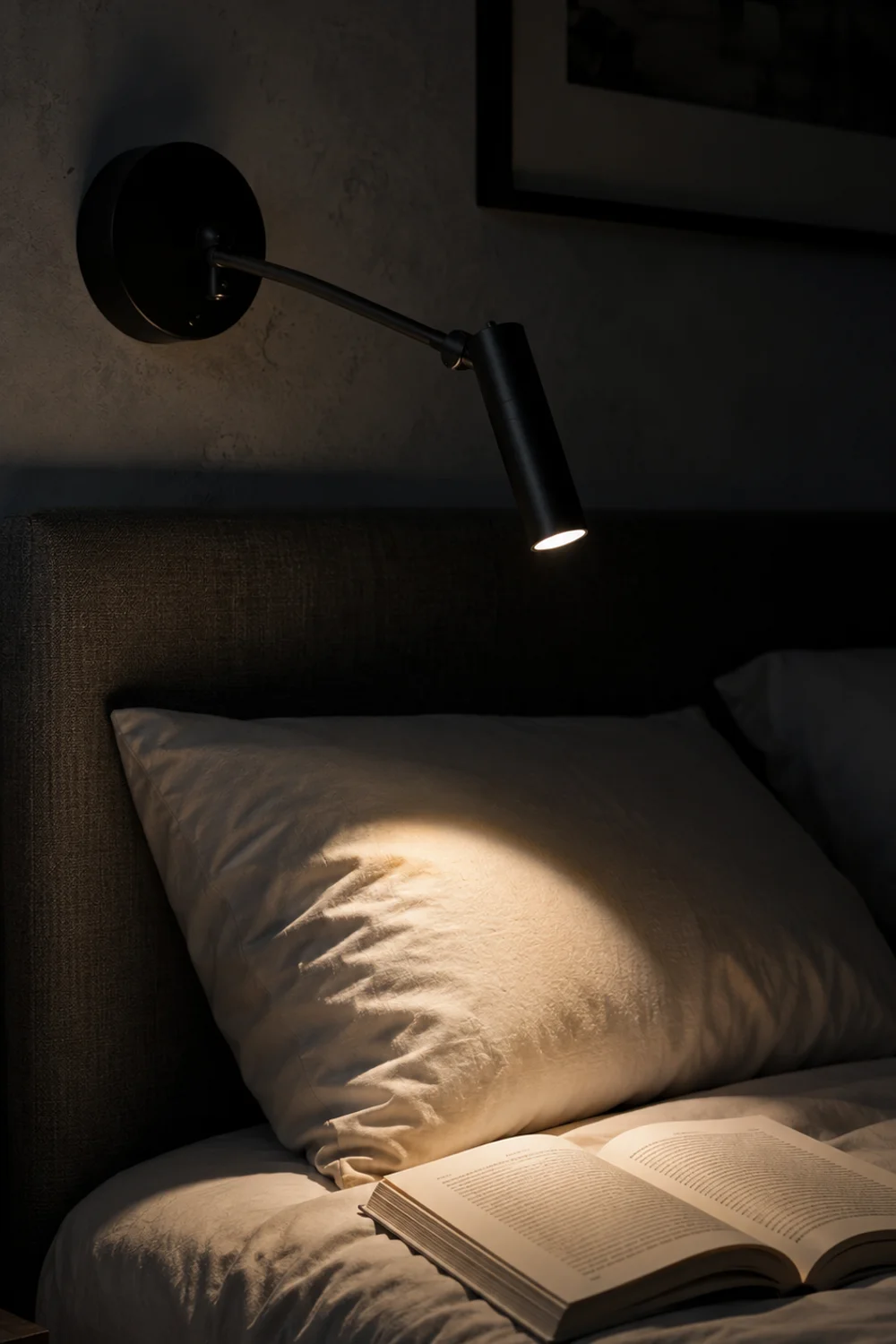
A directional, narrow-beam reading light solves this mechanically rather than through compromise. Unlike an ambient lamp that fills the whole side of the room with glow, a focused beam — whether from a swing-arm fixture, a clip-on light, or a shielded pendant — illuminates only the page or book in front of the reader, leaving the rest of the room, and the sleeping partner’s eyelids, largely undisturbed. The beam angle matters more than most people expect: a fixture with a spread wider than roughly 30 degrees starts to wash light across the pillow next to it, while anything tighter stays contained to the page itself.
Wall-mounted swing-arm fixtures are the most adjustable version of this idea, since the arm can be pulled close to the book and pointed downward, containing the light within a tight radius. Clip-on book lights work for renters who can’t mount hardware, though they sit closer to the face and can still catch a partner’s peripheral vision if positioned carelessly. Warm-toned bulbs, in the 2700K range rather than a cooler daylight tone, help too, since they read as dimmer to a peripheral, half-closed eye even at the same brightness.
Picture a couple with mismatched schedules, one going to bed early and one reading until midnight. Swapping their identical pair of bedside lamps for one ambient lamp and one swing-arm reading light — installed only on the later reader’s side — solves months of quiet tension without a single conversation about it. Even small placement choices matter here: mounting the fixture slightly behind the reader’s shoulder, rather than directly beside the pillow, keeps the light source itself out of the sleeping partner’s line of sight, not just the light it casts.
This is a small, mechanical fix, but it reflects a bigger principle that shows up again in 15 Layered Bedding Ideas That Look Like a Luxury Hotel You Will Absolutely Love: comfort in a shared bed usually comes from solving for two different people, not designing around an average of their preferences.
4. Freeing the Nightstand: Pendant and Wall-Mounted Light Instead of a Floor-Standing Lamp
 Save it
A traditional bedside lamp claims a disproportionate amount of nightstand real estate, competing for space with a glass of water, a phone charger, glasses, and whatever book is currently in rotation. On a narrow nightstand, this often means the lamp base sits crowded against the edge, more accident-prone than it should be and visually heavier than the small surface can comfortably hold.
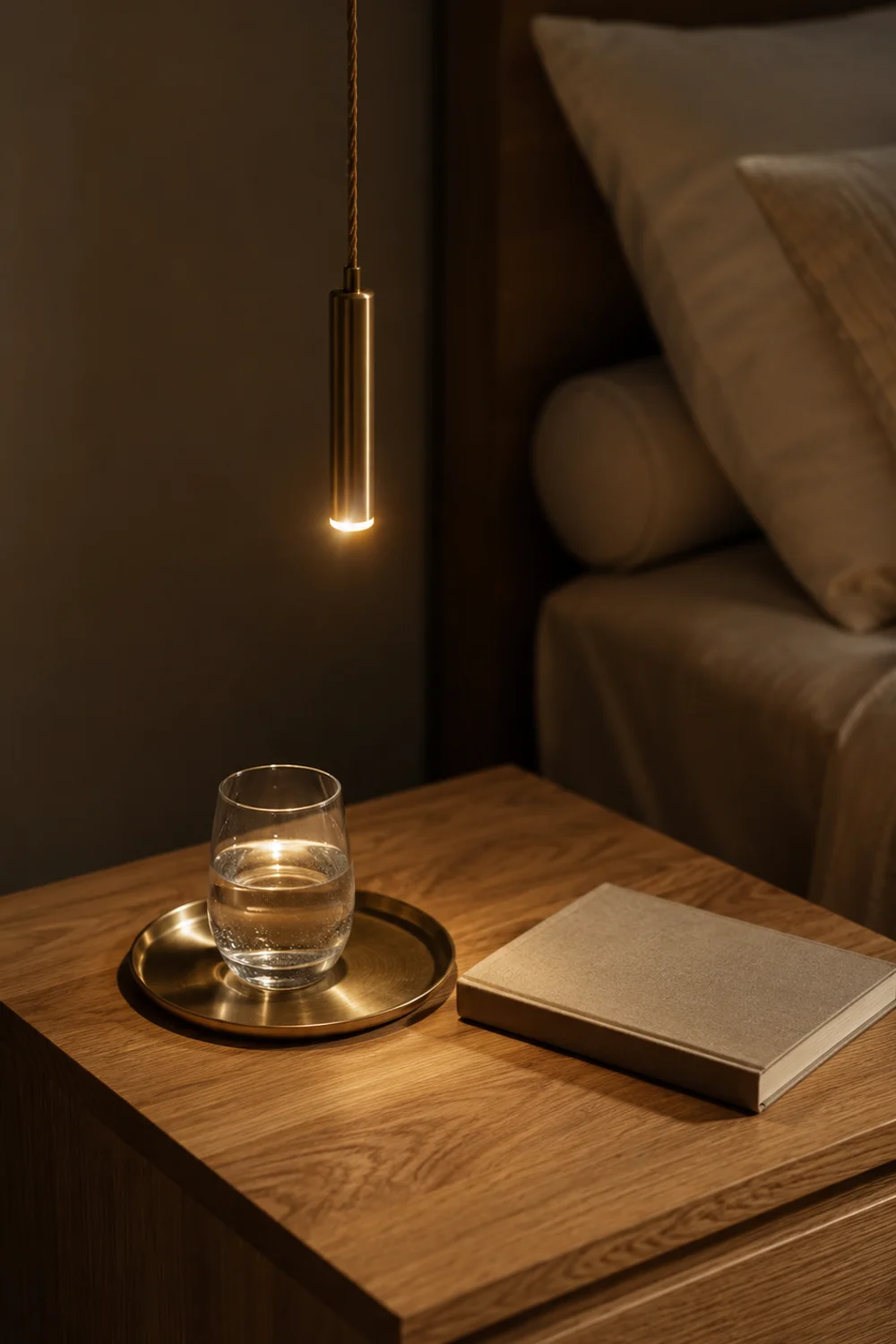
Moving the light source off the surface entirely — onto the wall or ceiling above — resolves this without sacrificing brightness. A wall-mounted sconce or a small pendant hung just above and to the side of where a lamp would normally sit performs the identical lighting job while returning the entire nightstand surface to actual use. The visual effect is also lighter, since nothing is anchoring the eye downward at furniture height.
Pendants require a ceiling junction box or a plug-in cord version that hangs down the wall, which is the more renter-friendly route since it needs no electrical work, just a cup hook and a visible cord treated as an intentional design detail rather than something to hide. Wall sconces are typically hardwired or plug-in as well, and both options free up roughly a third of the nightstand’s usable surface immediately. In rooms with lower ceilings, where a hanging pendant would sit too close to head height for comfort, a swing-arm sconce solves the same problem from the wall instead, letting you pull the light closer for reading and push it flush again afterward without ever touching the nightstand.
A narrow nightstand in a small guest room, previously overwhelmed by a wide-based ceramic lamp, becomes usable again with a slim brass pendant mounted eighteen inches above the surface instead. Suddenly there’s room for a small tray, a glass, and a book stack that isn’t in danger of being knocked over by a reaching hand in the dark.
This shift toward vertical rather than horizontal light sources echoes a broader lesson from Scandinavian Cozy Bedroom Inspiration Ideas Worth Copying Right Now, where restraint on the nightstand surface itself reads as intentional rather than sparse.
5. Cove Lighting Behind the Headboard: Indirect Glow That Never Faces the Eyes
 Save it
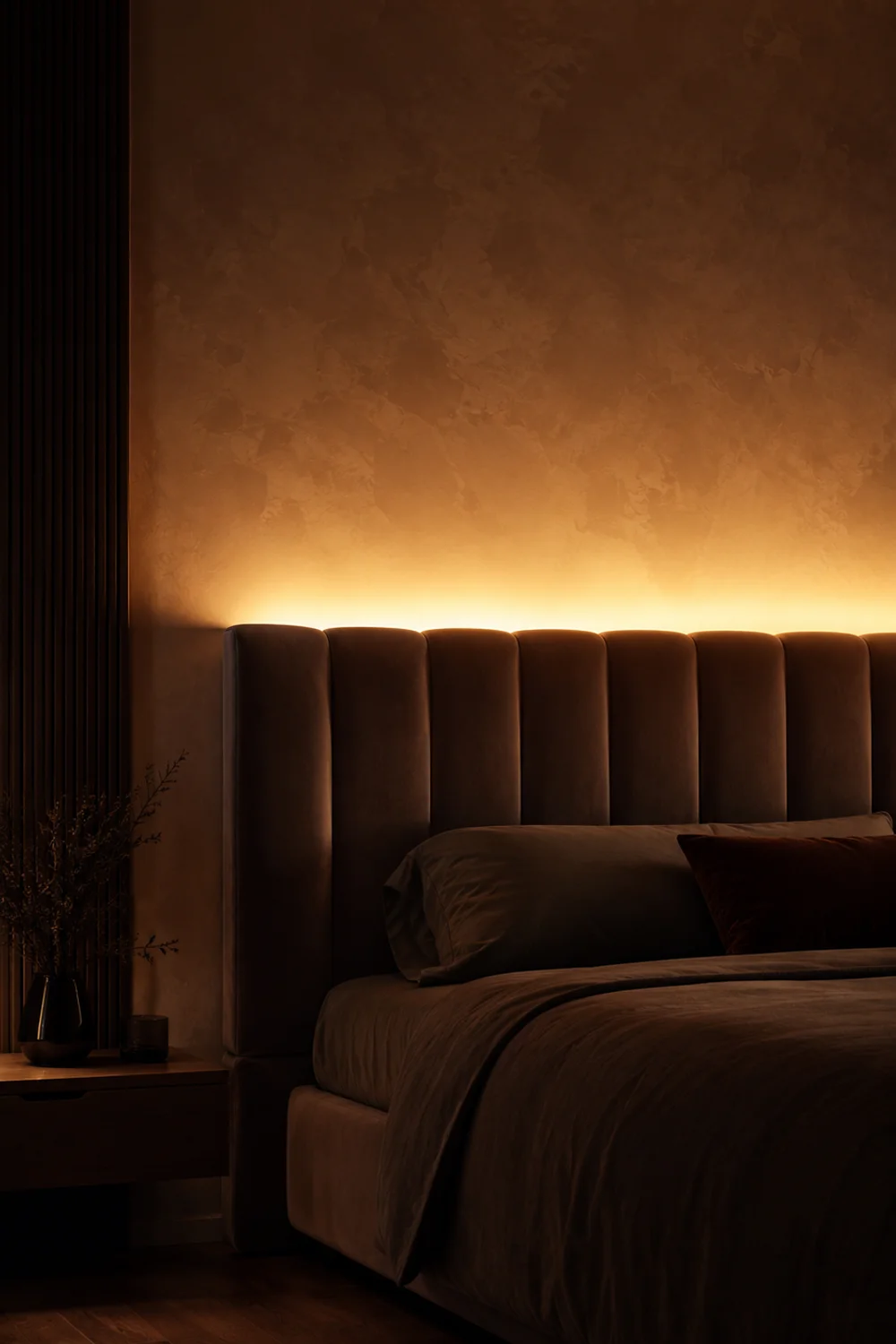
Cove lighting refers to a concealed light source, typically an LED strip, tucked into a recess so the bulb itself is hidden and only the reflected glow is visible. Behind a headboard, this creates a soft halo of light that never points toward the bed’s occupant, which solves the same glare problem from a completely different angle than adjusting the ceiling fixture. The light source disappears; only its effect remains.
The mechanism relies on bouncing light off a nearby surface — the wall behind the headboard, or the underside of a floating shelf — rather than emitting it directly outward. Because the eye never meets the bulb, cove lighting can run at a surprisingly generous brightness without ever feeling harsh, since diffusion happens naturally against the wall surface before the light reaches you. A diffuser channel over the strip matters more than people expect here — without one, the individual LED points can still read as small hot dots once your eyes adjust to the dark, undermining the whole point of hiding the source in the first place.
This works particularly well behind an upholstered or paneled headboard with even a shallow gap for the strip to sit in, though a floating shelf mounted above the bed achieves a nearly identical effect without requiring any headboard modification at all. Battery-powered LED strips with remote dimmers make this achievable in a rental without any wiring. For a low platform bed with no headboard at all, the same trick works mounted along a slim ledge just above the mattress line, so the glow still originates below eye level rather than washing down from the ceiling.
In a bedroom with a tall, flat headboard against a plain wall, running a warm LED strip along the top edge transforms a static backdrop into a softly glowing frame around the bed each evening. The wall behind takes on gentle depth instead of flat shadow, and the light source itself stays completely out of view from either side of the mattress, even when you’re propped up against pillows reading rather than lying flat.
6. Wall-Washed Art and Architectural Accents as a Secondary Ambient Layer

 Save it
Most bedrooms rely on point sources — lamps, pendants, overheads — and rarely consider light that’s designed to graze a vertical surface rather than illuminate a task. Wall-washing, where a fixture directs light upward or downward along a flat surface, creates a soft gradient of brightness that reads as atmosphere rather than function, filling in the visual gaps that point sources leave behind.
A picture light mounted above a framed print, or a small adjustable spotlight aimed at a textured accent wall, achieves this by grazing the surface at an angle rather than flooding it head-on. The angled light catches texture — brushstrokes, plaster ridges, wood grain — that flat, front-facing light flattens out completely. This is what separates a gallery-lit room from one that merely has a light switched on nearby.
The most common variation is battery-powered picture lights, which avoid the need for a nearby outlet or wiring and can be repositioned freely if art gets rearranged. Plug-in wall-wash fixtures with a swiveling head offer more adjustability for accent walls or architectural details like a header beam or a textured plaster section.
A gallery wall of several smaller prints changes the math slightly. Instead of one picture light centered above a single large piece, the cleaner solution is often a single low-profile wash fixture set back and angled across the whole grouping, rather than lighting each frame individually, which tends to look cluttered and competes with the art itself. Whichever fixture you choose, warm color temperature matters as much as placement — anything above 3000K starts to read clinical against plaster or linen, undercutting the effect you’re trying to create.
In a bedroom with one large framed print above the dresser, a small battery-operated picture light transforms it from a flat rectangle into the visual anchor of the wall each evening, without adding an outlet or running a single wire. The rest of the room stays dim, but that single wash of warm light gives the space a sense of depth it didn’t have under flat ambient lighting alone.
7. Why a Cheap Dimmer Ruins a Good Bulb: The Dimming Curve and Flicker Problem
 Save it
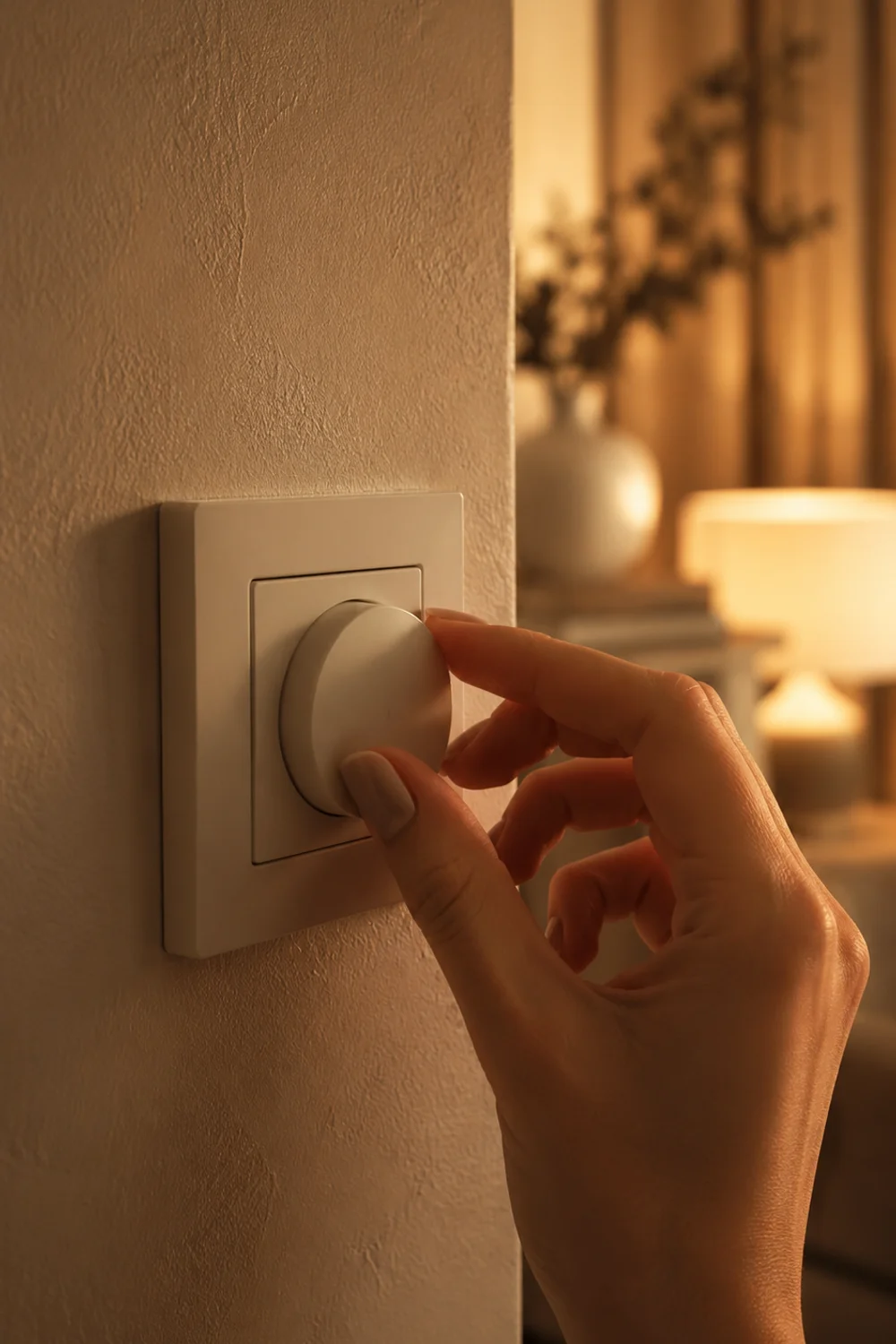
Not all dimmers are compatible with all bulbs, and mismatching the two produces a specific, recognizable failure: flickering at low brightness, an audible buzz, or a dimming range that jumps abruptly from bright to nearly off with no smooth gradient in between. This is a wiring compatibility issue, not a bulb quality issue, and it’s the reason so many people give up on dimmers entirely after one bad experience.
LED bulbs require dimmers rated specifically for LED loads, typically labeled trailing-edge or ELV-compatible, because older incandescent-style dimmers control electrical current in a way that modern LED drivers can’t interpret smoothly. The mismatch shows up as flicker precisely because the dimmer is sending signals the bulb’s internal circuitry wasn’t built to read. Older leading-edge dimmers were engineered for the simple resistive load of an incandescent filament, chopping the electrical wave at the front of each cycle. LED drivers, by contrast, expect that chop at the back end of the cycle, which is exactly what a trailing-edge dimmer provides — without it, the driver receives an incomplete or oddly-shaped signal it has no reliable way to translate into a steady light level.
A common workaround, when replacing an old dimmer isn’t feasible, is choosing bulbs explicitly labeled as dimmable and testing a single bulb before replacing an entire fixture’s worth. Some manufacturers also sell dimmer-and-bulb bundles pre-matched for compatibility, removing the guesswork for anyone unwilling to research wiring specifications themselves. Minimum load requirements complicate things further: many dimmers designed for incandescent bulbs need a certain wattage to function correctly, and a handful of low-wattage LED bulbs on a single dimmer sometimes falls short of that threshold, producing the same flickering symptoms even with an otherwise dimmable bulb.
Picture someone installing a beautiful new dimmer switch only to find their bedside lamps flicker distractingly whenever dimmed below fifty percent. The dimmer itself wasn’t broken — it was a standard incandescent dimmer paired with LED bulbs, an extremely common and easily corrected mismatch once identified, solved by swapping in a trailing-edge model rated for LED loads.
8. Color Rendering Index: Why a "Warm" Bulb Can Still Look Flat

 Save it
Color temperature, measured in Kelvin, describes whether a bulb looks warm-yellow or cool-blue, but it says nothing about how accurately that light renders actual colors in the room. Two bulbs can share the identical warm 2700K rating and still look completely different once switched on, because the missing variable is Color Rendering Index, or CRI — a separate measurement of how faithfully a light source reveals true color and texture.
A low-CRI warm bulb can still make skin tones look sallow, wood grain look muddy, and textiles look washed out, even though the overall tint reads as cozy. This happens because low-CRI bulbs emit an incomplete spectrum, missing wavelengths needed to render certain colors accurately, especially reds and warm mid-tones common in bedroom textiles and skin.
High-CRI bulbs, generally rated 90 or above, fill in that missing spectrum and reveal color the way daylight does, which is why a room lit with high-CRI bulbs often feels richer and more expensive without any change to the actual decor. The Kelvin number tells you the mood; the CRI number tells you whether that mood renders honestly. It’s worth noting that CRI rarely appears on the front of the packaging the way wattage and Kelvin do, so it usually has to be hunted down in the fine print or the product’s lighting facts label — which is exactly why so many bedrooms end up with mismatched fixtures without anyone noticing the cause.
A bedroom with warm 2700K bulbs still looked strangely dull despite a rich color palette of clay walls and layered textiles, until the bulbs were swapped for high-CRI equivalents at the identical Kelvin rating. The walls suddenly looked like the intended warm terracotta instead of a flattened brownish tone, and the same bedding read as noticeably richer under the exact same wattage.
The mismatch problem compounds when a room mixes sources — a low-CRI overhead fixture paired with a high-CRI bedside lamp will make the two pools of light feel like they belong in different rooms entirely, since one renders the clay walls honestly while the other dulls them just a few feet away. Matching CRI across every fixture in the space, not just picking one flattering lamp, is what keeps the whole room reading as a single coherent atmosphere rather than a patchwork of competing light quality.
9. The Wake-Up Light: Replacing a Jarring Alarm With a Simulated Dawn
 Save it
A traditional alarm creates an abrupt transition from deep sleep to full alertness in a matter of seconds, triggering a stress response that many people carry with them for the first hour of the day. This isn’t a psychological quirk — waking abruptly in darkness or near-darkness genuinely interrupts the body’s natural cortisol rhythm, which is designed to rise gradually rather than spike suddenly.
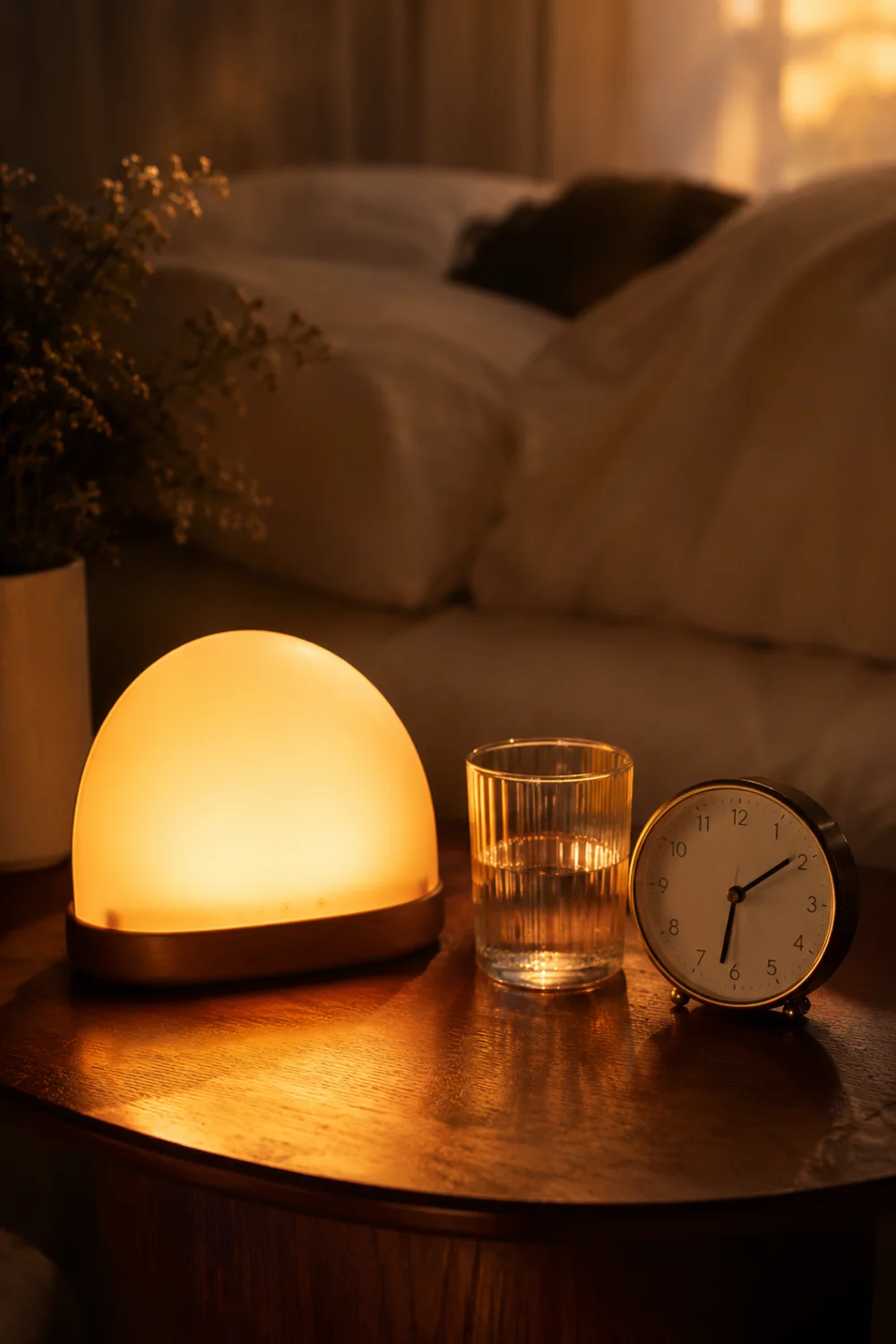
A wake-up light simulates a slow sunrise in the twenty to thirty minutes before your alarm time, gradually brightening from a dim amber glow to a fuller daylight-toned light. By the time the audible alarm sounds, if it sounds at all, the room has already shifted toward daytime brightness, and the body has had a gradual runway rather than an abrupt jolt from total darkness.
Most wake-up lights double as bedside lamps or clocks, and many pair the gradual brightening with a soft ambient sound rather than a jarring beep, though the light itself does most of the work regardless of whether sound is used. Placement matters here too — the unit needs a clear line toward the sleeper’s face, not tucked behind a lamp or obstructed by a headboard wing. This becomes especially relevant for couples on staggered schedules, where one person rises well before the other; a wake-up light angled correctly can brighten gradually for the early riser without flooding the whole room in a way that disturbs the partner still asleep beside them.
In a bedroom where the only prior alarm was a phone left charging across the room, adding a bedside wake-up light changed the entire tone of the mornings within about a week. Waking to gradually increasing light rather than a sudden phone alarm made the transition out of bed noticeably less jarring, even on days requiring an earlier-than-usual start. Even on overcast winter mornings, when no actual daylight was reaching the window until well after the alarm time, the simulated sunrise still carried the same effect, easing the body into wakefulness on a schedule the sky itself couldn’t yet provide.
10. Hallway Spill and Screen Glow: The Light Leaks Nobody Accounts For
 Save it
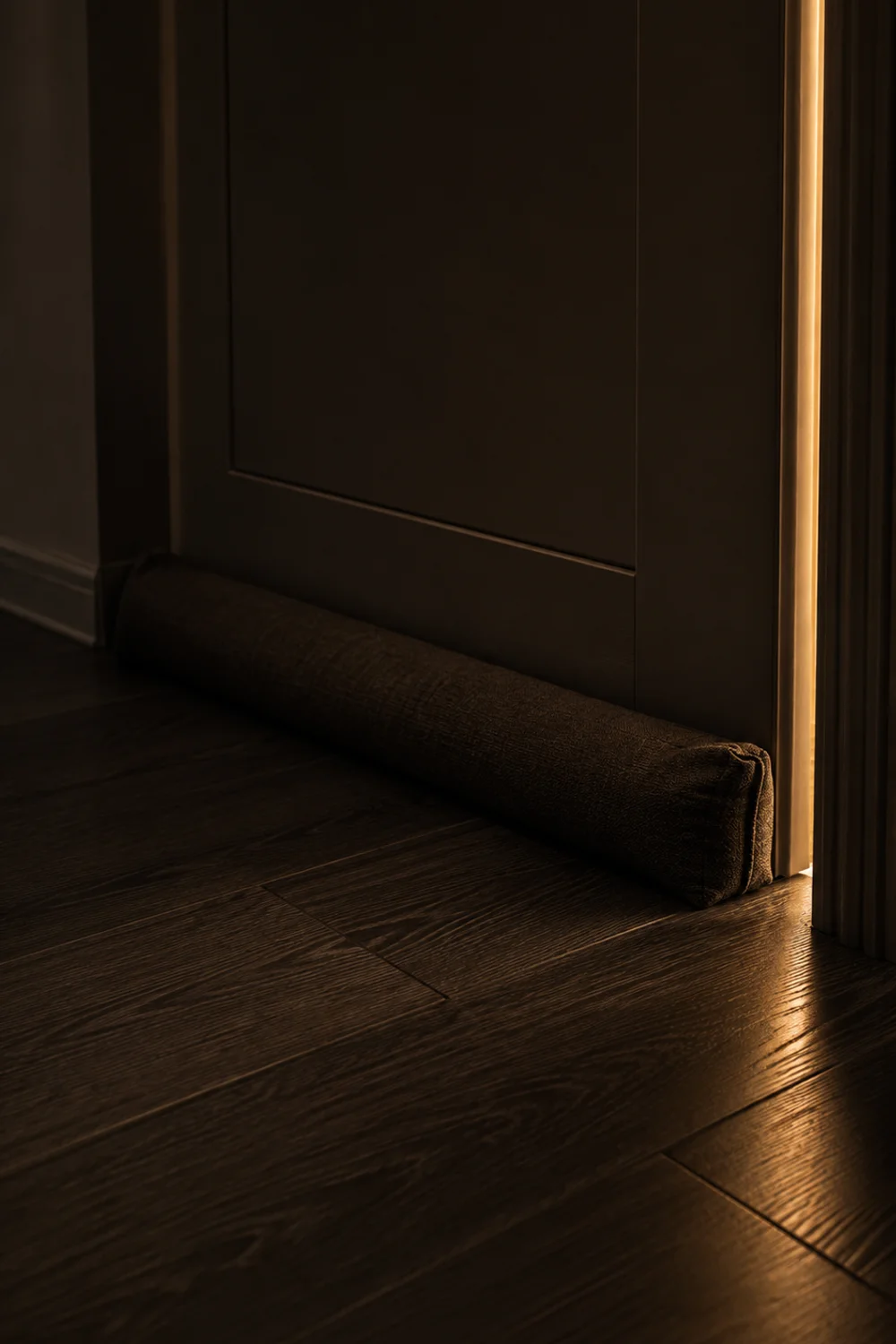
Most conversations about bedroom darkness focus on windows, assuming curtains solve the entire problem, while ignoring a second, often larger source of unwanted light: the gap beneath the bedroom door, through which hallway light, a nightlight from another room, or motion-sensor fixtures spill in as a thin but persistent strip across the floor. This low, horizontal light leak is easy to miss because it doesn’t hit the eyes directly, yet it still measurably brightens the room.
The mechanism is straightforward: standard interior doors are cut with a half-inch to inch gap at the bottom for ventilation and clearance, and that gap acts as a slot for any corridor light to enter. A door sweep or a fabric draft stopper placed along the bottom seals this gap, blocking both light and, as a secondary benefit, sound bleeding through from the hallway.
Pocket doors and sliding closet-style bedroom doors complicate this fix, since they run in a track rather than closing against a jamb, which means light also seeps in along both vertical edges and not just underneath. In these cases, a bottom draft stopper alone won’t fully solve the problem — adhesive foam seal strips along the side tracks are needed as well, since the door never forms a true seal the way a hinged door does when latched shut.
The second overlooked source is electronic glow — router lights, phone chargers, smoke detector indicators, or a television left in standby — all of which emit a small but persistent point of light that the eye adjusts to and notices increasingly as the room otherwise darkens. Covering these with a small piece of electrical tape or repositioning devices out of the sleeper’s direct sightline solves most of this instantly and at no cost.
In a bedroom with blackout curtains that still never felt fully dark, the culprit turned out to be a router blinking blue from a hallway shelf, visible through the door gap every single night. A simple door draft stopper combined with turning the router’s indicator light off in its settings resolved a years-long, previously unexplained sense that the room was never quite dark enough.
11. Fixture Placement Geometry: The Height, Distance, and Beam Angle That Change a Room

 Save it
Two identical fixtures, installed at different heights or distances from the bed, can produce completely different results, which is why copying a lighting idea exactly from a photograph sometimes fails in a real room. Placement geometry — how high a fixture sits, how far it is from the surface it’s lighting, and the angle of its beam — determines the actual felt effect far more than the fixture’s style or price point.
A wall sconce mounted too high above a headboard casts light downward at a steep angle, creating a small circle of brightness on the pillow rather than a broad, even wash across the wall. Dropping the same sconce closer to nightstand height, roughly at eye level when seated up in bed, spreads its beam more horizontally and avoids that harsh spotlight effect entirely. The same logic applies to distance from the wall itself: a sconce with a rigid arm that holds the bulb four or five inches out reads completely differently than one mounted flush, since even a small amount of extra throw changes how much wall surface the light actually grazes.
Beam angle matters just as much for pendant or recessed fixtures: a narrow-beam bulb concentrates light into a tight cone, useful for a reading nook but glaring anywhere it’s aimed near the face, while a wide-beam bulb spreads the identical wattage over a broader area at lower intensity per square inch. Choosing the wrong beam angle for the fixture’s job is one of the most common, least-diagnosed lighting complaints. Recessed ceiling lights suffer from a related but distinct version of this problem — positioned even a foot too close to the headboard wall, they wash the surface in flat, shadowless light that erases the texture of linen or plaster instead of revealing it, while pulling them slightly further out lets the beam graze the wall at an angle that brings the material’s grain forward.
A bedroom with two identical brass sconces, mounted at differing heights due to an asymmetric headboard, produced two noticeably different lighting experiences on each side of the bed, one glaring and one comfortably soft, despite using the exact same fixture and bulb. Adjusting both to a matching height, roughly twenty inches above the mattress surface, resolved the imbalance completely.
This same attention to precise placement, rather than general style choices, is echoed in How to Recreate the Cozy Bedroom Trends Everyone Is Saving in 2026, where small positional adjustments consistently outperform larger, more expensive changes.
Common Mistakes to Avoid
1. Relying on a single overhead fixture for every task
This is the most foundational lighting mistake and the root cause of most other complaints in this guide. A single ceiling light forces the entire room into one brightness level regardless of whether you’re reading, dressing, or trying to wind down, and no amount of styling elsewhere compensates for that missing flexibility.
2. Mismatching dimmers and LED bulbs
Installing a standard dimmer with modern LED bulbs produces flicker, buzzing, or an unusable dimming range, and many people blame the bulb or the fixture when the actual issue is a wiring compatibility mismatch that a correctly rated trailing-edge dimmer solves immediately.
3. Choosing color temperature and ignoring CRI entirely
A warm-rated bulb can still render color poorly if its CRI is low, leaving skin tones and textiles looking flat despite a cozy-sounding Kelvin number. Checking for a CRI rating of 90 or above matters just as much as checking the color temperature itself.
4. Positioning a reading light where it disturbs a sleeping partner
A bright, wide-beam lamp used for reading in a shared bed often spills enough light to disturb the other side of the mattress, quietly pushing people toward reading on phone screens instead, which brings its own sleep disruption through blue light exposure at close range.
5. Ignoring light leaks below doors and from electronics
Blackout curtains solve window light but leave the door gap and glowing electronics untouched, both of which contribute more ambient brightness than most people realize until they’re specifically identified and addressed with a draft stopper or simple tape.
Frequently Asked Questions
What’s the single most impactful lighting change for better sleep?
Separating your bedroom into distinct light layers — ambient, task, and accent — with independent dimmers or switches for each typically produces the most noticeable improvement. This lets the room shift genuinely between daytime brightness and a low, wind-down glow in the evening, rather than forcing an all-or-nothing choice between one overhead fixture being fully on or fully off.
Do I need smart bulbs to get a proper lighting layer system?
No. Layering is about fixture placement and independent control, not automation. A wall sconce on its own switch, a reading lamp on a pull-chain, and a dimmed overhead fixture accomplish the same layered effect as an app-controlled system, just with manual switches instead of scheduled automation.
Is warm white always better than cool white for bedrooms?
Generally yes for evening use, since warm tones around 2700K to 3000K support winding down more comfortably than cooler, blue-heavy light. But the color temperature alone isn’t the full story — checking for a high CRI rating ensures that warm light also renders skin tones, wood, and textiles accurately rather than looking flat.
How do I fix a bedroom that still feels too bright even with curtains closed?
Check for secondary light leaks beyond the window: the gap under the door, a blinking router or charger, or a phone screen left face-up. These smaller, easy-to-miss sources often account for more perceived brightness than people expect, and sealing or covering them makes a bigger difference than upgrading curtains further.
Final Thoughts
Bedroom lighting rarely gets the same attention as bedding or paint color, yet it quietly shapes how the room actually functions every single evening. A layered, thoughtfully placed lighting plan does more for how restful a bedroom feels than most decorative changes, because it works with the body’s natural rhythms rather than against them.
None of these adjustments require a full renovation. A trailing-edge dimmer, a repositioned lamp, a door draft stopper, or a higher-CRI bulb can each be addressed in an afternoon, and the cumulative effect of several small corrections is often more noticeable than one large, expensive overhaul.
Save the ideas that fit your current setup, and treat lighting as an ongoing project rather than a one-time fix. As your routine or room layout changes, revisit which fixtures are doing which job, and adjust accordingly — the goal is a bedroom that adapts to how you actually use it, evening after evening.
This post contains affiliate links. I may earn a small commission at no extra cost to you.
READ FOR THE NEXT STEP?
KEEP READING
Continue with another helpful idea.

Japandi Bedroom Ideas You Will Absolutely Love and Need to Try in 2026
SHOP MY FINDS
Discover my favorite products for this place

My Favorite Bedroom Finds
GET THE PLANNER
Get the planner guide and make it easier.

The Ultimate Bedroom Planner

Get cozy inspiration delivered to your inbox.
✓ 14-page beautifully designed ebook
✓ Cozy decorating ideas
✓ Practical room-by-room inspiration
You’re in! 🎉
Thanks for joining the NestFlowHome community!
Your free ebook is already on its way to your inbox. If you don’t see it within a few minutes, please check your Promotions or Spam folder.
Join the NestFlowHome community for weekly decorating inspiration.

Timeless home decor ideas and slow living inspiration for a calm, beautiful life.