
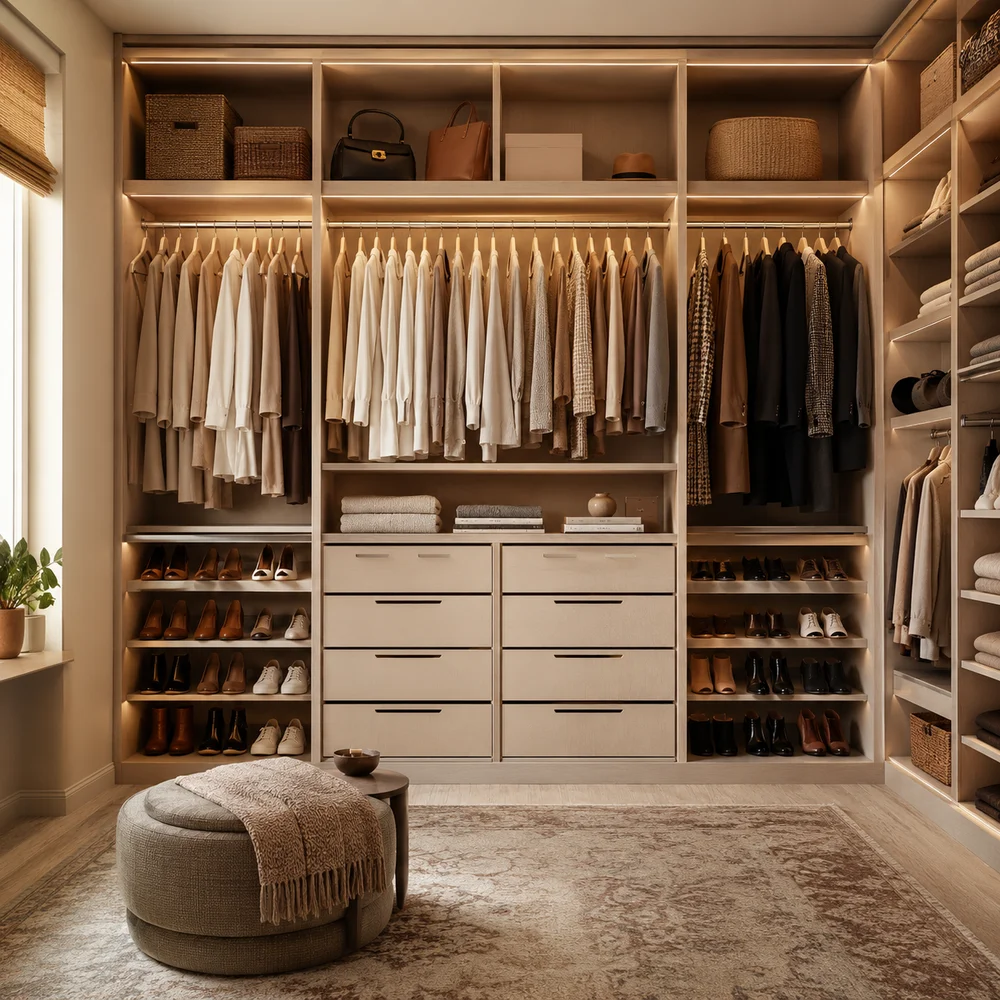
The Most Searched Neutral Closet Aesthetic Ideas Homeowners Are Obsessing Over Right Now
By Emily | June 26, 2026
There’s a moment that happens in almost every home renovation story — not the dramatic before-and-after, but the quieter realization that the space making you feel most at peace isn’t the one with the most color or the most personality. It’s the one with the least noise. The neutral closet aesthetic has become one of the most searched interior ideas of the past two years, and it isn’t hard to understand why. In a world that moves fast and demands attention at every turn, the idea of opening a closet door and seeing something calm, cohesive, and carefully considered feels almost radical.
What’s happening isn’t minimalism in the austere sense. This isn’t about owning less or stripping everything back to bare walls. It’s about a deliberate visual language — one built from soft tones, honest materials, and a kind of restrained beauty that makes getting dressed feel like a ritual rather than a task. The neutral closet doesn’t shout. It doesn’t perform. It simply holds everything in a way that feels considered and quietly elevated.
What makes this aesthetic so enduring is that it works across virtually every home style. Whether you’re working with a walk-in wardrobe, a reach-in closet with sliding doors, or a small bedroom with an open hanging rail, the neutral closet logic applies. It’s about atmosphere more than architecture. And the reason homeowners keep returning to it — keep searching for it, saving it, building toward it — is because it genuinely changes how they feel every morning. This article breaks down exactly how that feeling is built, from the foundational decisions to the smallest finishing details that most people overlook.
1. Why the Neutral Closet Became the Most Searched Aesthetic of the Moment
 Save it
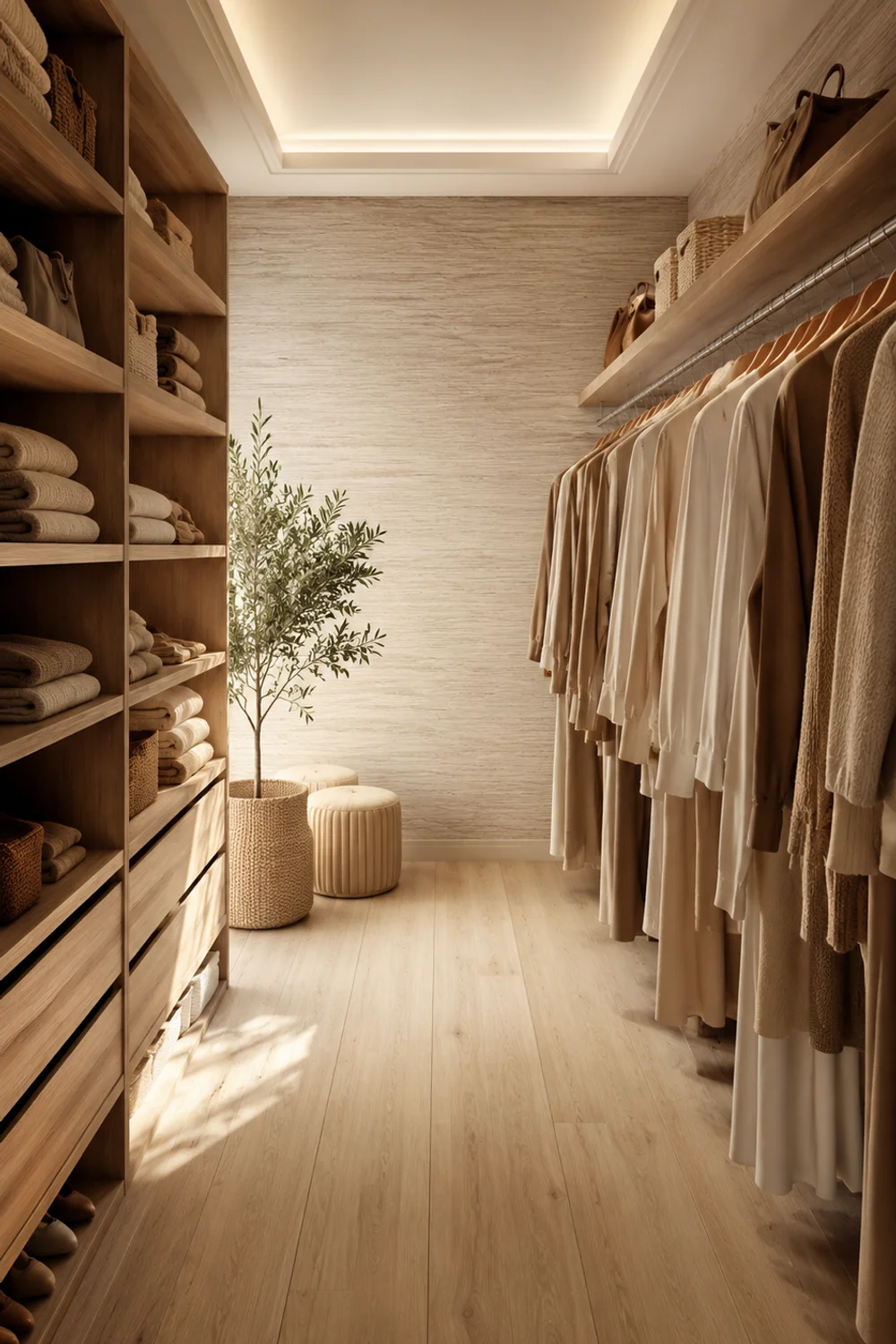
There is something worth examining in the fact that the neutral closet didn’t rise to prominence during a period of calm. It arrived during one of the most visually overwhelming cultural moments in recent memory — a time when screens, feeds, and curated spaces competed relentlessly for attention. The closet became a refuge by contrast. Not a showroom. Not a backdrop. A place designed specifically to reduce decision fatigue before the day has even properly started. That psychological value is exactly why the search volume kept climbing.
What happened aesthetically was a slow but deliberate rejection of the maximalist wardrobe — the rainbow-organized clothing arrangement, the brightly lit display of color-saturated pieces. Those images still circulate, but they stopped feeling aspirational to a significant portion of the audience. What replaced them was something harder to describe but immediately recognizable: a softly lit space where every element existed in the same tonal family. Warm whites, undyed linens, pale woods, brushed metals. A closet that looked less like a storage solution and more like a considered interior space in its own right.
The cultural shift also reflects something broader happening in how people think about their wardrobes. The move toward a neutral closet aesthetic often runs parallel to a move toward a more edited, capsule-style approach to clothing — a shift that, for storage design purposes, connects beautifully to The Best Aesthetic Closet Storage Ideas for Small Bedrooms and the logic of building around fewer, better pieces. When your clothing palette is quieter, the space holding it naturally becomes quieter too. The two ideas reinforce each other without requiring a dramatic overhaul.
What ultimately makes the neutral closet so searchable — so persistently popular — is that it photographs beautifully, translates across room sizes and budgets, and holds its appeal long after trends cycle through. It doesn’t age the way accent walls or statement hardware do. The soft, layered warmth of a neutral space has a kind of permanence that more trend-driven aesthetics rarely achieve. Homeowners aren’t just searching for an idea — they’re searching for something they won’t want to change in three years.
2. The Three-Tone Rule: Building Depth Without a Single Drop of Color

 Save it
The most common mistake people make when attempting a neutral closet is treating it as a monochromatic exercise. They paint everything the same shade of white, buy matching storage baskets, hang similar-toned clothing, and then wonder why the result feels flat rather than elevated. The neutral closet doesn’t work because everything is the same — it works because everything exists within a carefully controlled tonal range, and within that range, there is deliberate variation. That variation is what creates depth, and depth is what separates a beautiful neutral space from a dull one.
The three-tone rule is a practical framework for building that depth without introducing color. The approach works like this: choose one dominant tone that covers the majority of the space — typically the lightest and most airy version of your neutral, used on walls, primary shelving, or hanging rods. Then introduce a mid-tone, slightly warmer or darker, through textiles, drawer fronts, or woven baskets. Finally, bring in a deep anchor tone — something that grounds the composition visually, whether through a darker wood element, a black hanging rail, or a deep linen storage bin.
What makes this system so effective is that it mimics the tonal logic of a well-composed photograph. The eye needs a light point, a middle ground, and a shadow to read a space as three-dimensional. Without the anchor tone, a neutral closet can look washed out — pretty in concept but slightly formless in execution. Without the mid-tone bridge, the jump between light and dark feels abrupt rather than considered. All three tones working together create something that reads as layered and intentional rather than simply beige.
The practical application of this rule is more forgiving than it sounds. The three tones don’t have to be dramatically different from one another — in fact, the subtler the difference, the more sophisticated the result tends to look. Think of the lightest ivory shelf against a warm greige wall, anchored by a walnut wood clothing rail. None of those elements are colorful. But together they create a space with genuine visual texture and depth that feels designed rather than default.
3. Warm Ivory or Cool Greige: Choosing the Right Neutral Temperature
 Save it
The first question most people skip — and the one that causes the most visible problems later — is whether their neutral closet should read warm or cool. It seems like a subtle distinction, but it shapes every subsequent decision, from the paint or wallpaper on the closet walls to the undertone of the storage containers to the metal finish on the hardware. Getting the temperature wrong is exactly why some neutral closets feel slightly off even when every individual element seems correct. The components aren’t the problem. The tonal direction is.
Warm neutrals — the ivory, cream, warm white, and biscuit family — work best in spaces with limited natural light or in rooms with warmer existing tones, such as hardwood floors or timber ceiling beams. They read as inviting and softly luminous, and they pair naturally with organic materials like undyed linen, rattan, and natural oak. Warm ivory in particular has a quality of borrowed light — it seems to glow faintly even in low-light conditions, which makes it especially flattering in a walk-in closet where overhead lighting does the heavy lifting. The effect is cocooning and restful in a way that cooler tones rarely achieve.
Cool neutrals — greige, soft gray, stone, and pale putty — read more architectural and contemporary. They suit spaces with stronger natural light or rooms with existing cool undertones, such as white-painted floors, steel-framed windows, or concrete surfaces. A well-chosen greige has enough warmth to avoid feeling clinical, while retaining the visual crispness that makes it photograph beautifully and feel ordered. If your clothing palette leans toward black, navy, and gray, a cool neutral closet tends to feel more coherent — the space and the wardrobe exist in the same tonal family.
The simplest way to decide is to look at the floor. The floor tone in the room that contains your closet is a fixed variable — you probably aren’t changing it — and it will pull any neutral closet in one direction or the other regardless of your intentions. A warm timber floor will fight against a cool gray closet interior. A concrete-effect tile will make a warm ivory closet look slightly yellow by comparison. Choose your closet’s neutral temperature to complement what’s already there, not to work against it, and the entire space will feel more resolved from the first moment you open the door.
4. The Linen and Natural Wood Material Story
 Save it
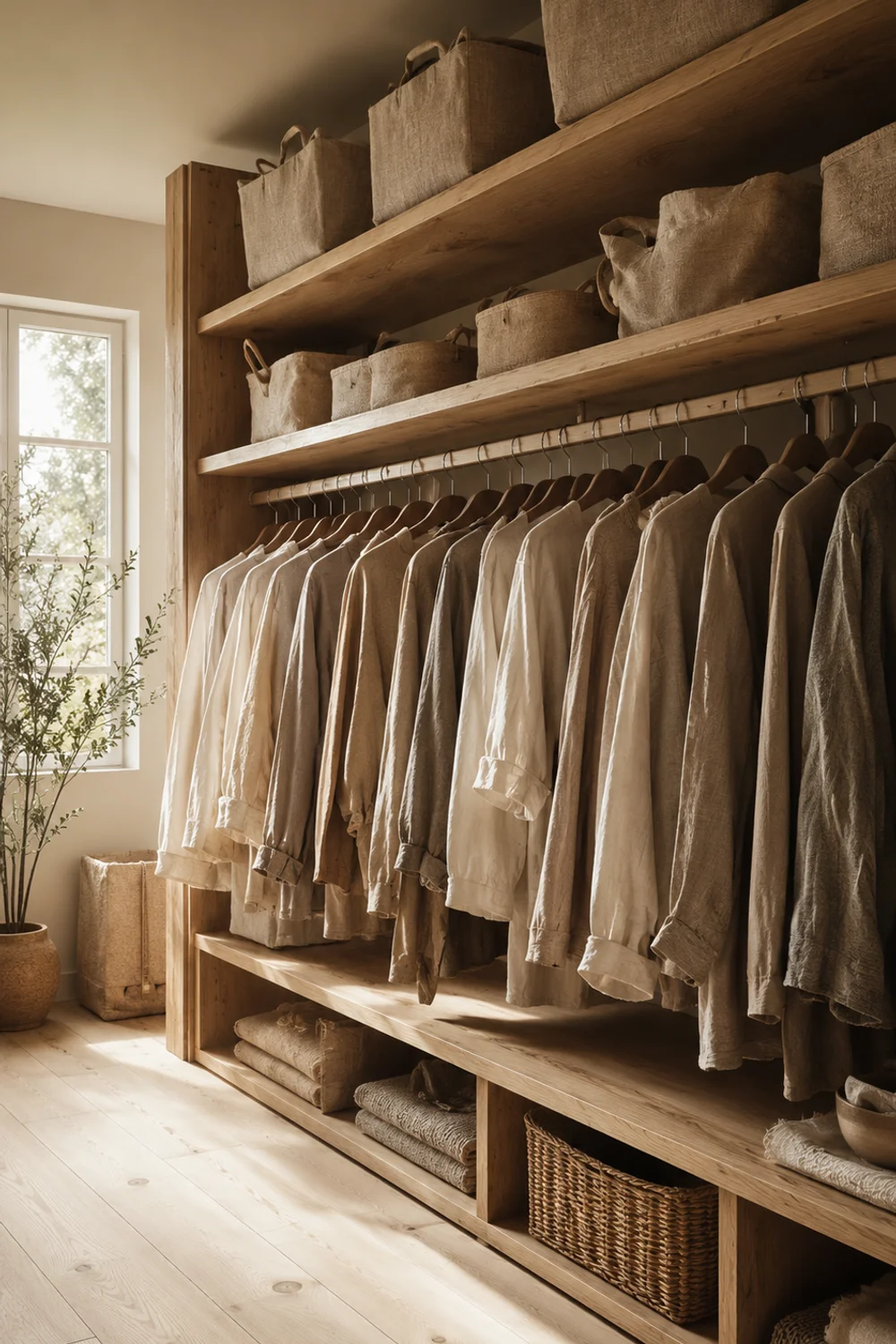
If there is a single material combination that defines the neutral closet aesthetic most completely, it is the pairing of undyed linen with natural wood. Not the pale, treated version — the honest, grain-visible, slightly imperfect real thing. These two materials have been used together in interior design for decades precisely because they solve a problem that most aesthetics struggle with: how to make a functional storage space feel genuinely warm without adding visual clutter. Linen absorbs light rather than reflecting it. Wood diffuses it. Together they create an atmosphere that feels tactile and grounded rather than slick and synthetic.
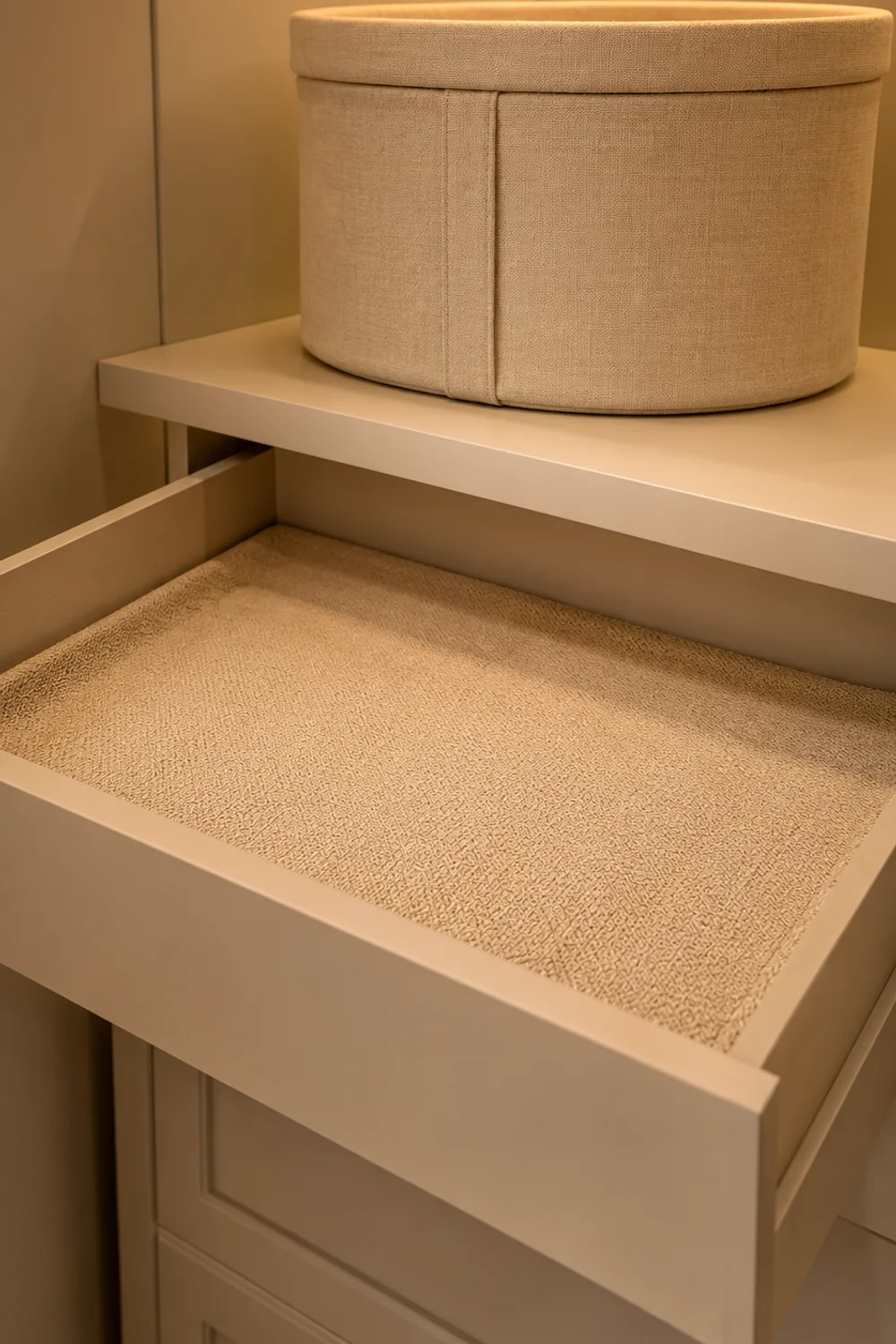
The linen element typically enters the closet through soft storage — drawer liners, open-shelf fabric bins, hanging garment bags, or the clothing itself. Undyed linen storage baskets in particular have become a staple of the neutral closet because they occupy the mid-tone slot in the three-tone composition while also providing functional concealment for items that would otherwise disrupt the visual calm of an open shelf. They don’t need to match perfectly. A slight variation in the natural dye of different linen pieces adds texture rather than inconsistency, provided everything stays within the warm, undyed family.
Wood works best in the neutral closet when it appears in its most natural form — not stained dramatically darker or painted over, but simply sealed or lightly oiled. The grain becomes part of the composition. A hanging rail in pale oak or ash reads as an architectural element rather than a piece of furniture, and that distinction matters enormously in a closet where the goal is integration rather than assembly. For those working with rented spaces or built-in systems that don’t allow structural changes, Everything You Need to Know About Organizing a Small Apartment Closet offers practical adaptations for layering natural materials within systems you can’t permanently modify.
What the linen-and-wood pairing achieves, beyond the aesthetic, is a quiet sensory richness. Reaching for a garment in a space lined with these materials feels different from doing the same in a melamine-shelved, wire-hung closet. The tactile dimension of a well-designed space isn’t frivolous — it’s part of the reason certain rooms feel restorative while others feel merely functional. A closet that engages the senses gently, through soft textures and natural warmth, contributes to the beginning and end of every day in a way that’s easy to underestimate until you’ve experienced it.
5. The Color-Gradient Hang: Organizing by Tone, Not by Category
 Save it
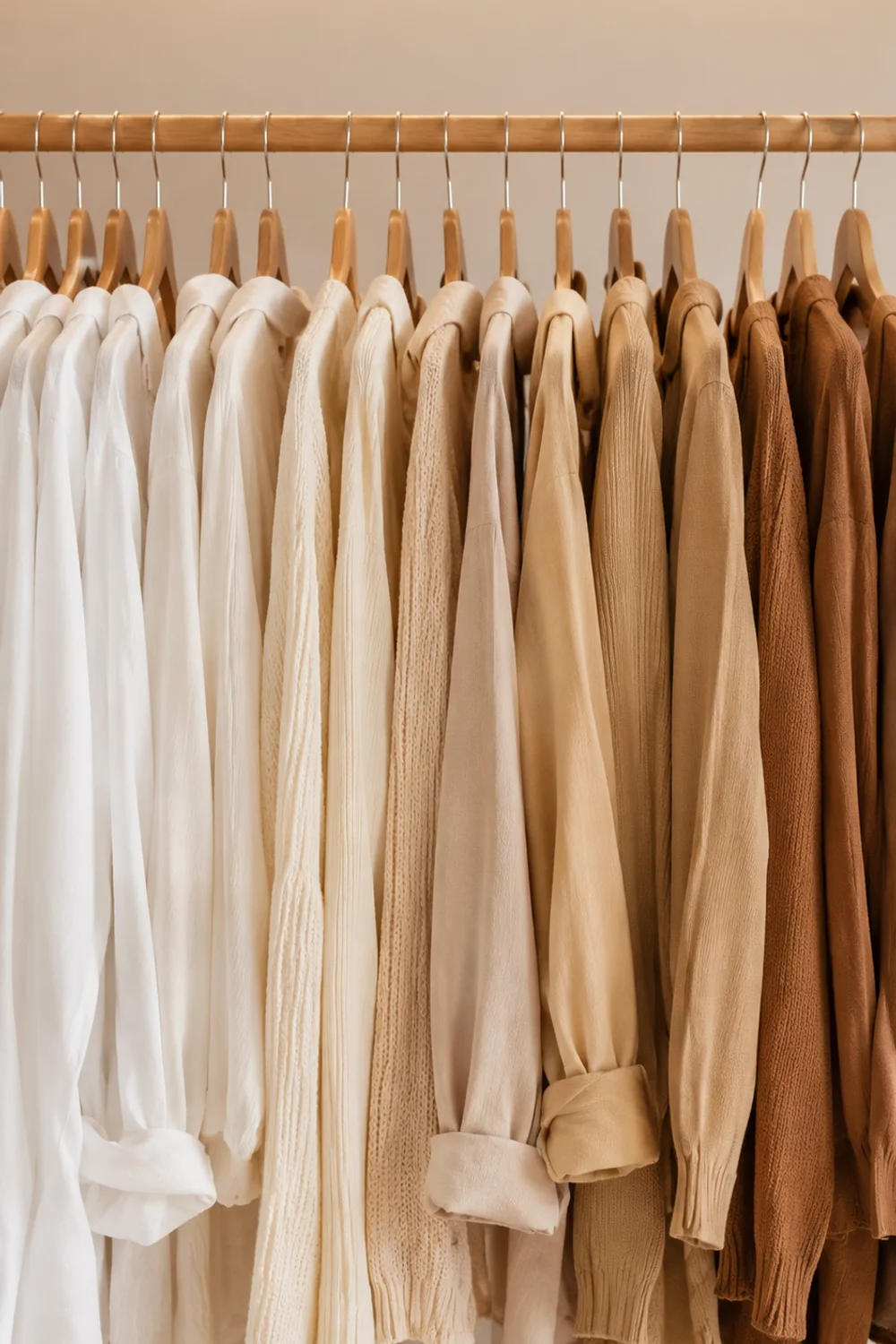
Most people organize their closets by category — all shirts together, all trousers in one place, dresses arranged by season. It’s logical, and it works functionally. But there is another approach that has gained significant traction within the neutral closet aesthetic, and it changes the visual experience of the space entirely: organizing by color tone rather than by garment type. The color-gradient hang — where clothing moves from lightest to darkest, or from warm to cool, regardless of whether a blouse is next to a cardigan — produces a visual effect that feels intentionally designed rather than simply stored.
The reason this approach works so beautifully in a neutral wardrobe is that the tonal transitions are subtle and gradual. When your clothing palette is already limited to neutrals, creams, and muted tones, arranging by gradient creates something that resembles a composed still life more than a clothing rail. The eye moves across the hang without disruption — there are no jarring color breaks or inconsistencies. The gradient hang reads as curated even when it contains a hundred garments, because the visual logic is immediately apparent and pleasing.
The practical application requires a small initial investment of time but very little maintenance once established. Start by removing everything from the rail and sorting by the lightest tone — white, off-white, ivory — progressing through cream, sand, warm taupe, mushroom, and finally into deeper tones like camel, warm brown, or charcoal. For a wardrobe that includes some color, the gradient still works — simply group the neutrals together and treat the color as its own section, organized internally by the same light-to-dark logic. The result is a closet that looks like it was professionally styled, regardless of what’s inside it.
For anyone who has invested time in building a neutral aesthetic throughout the rest of the space, the gradient hang is the moment the clothing and the closet design begin to feel like a single unified decision rather than two separate projects. The architectural elements — the shelving, the hardware, the materials — provide the container. The tonal gradient of the clothing provides the content. When both speak the same visual language, the closet stops feeling like a utility space and starts feeling like a considered extension of the home itself, which connects naturally to the broader aspiration explored in Luxury Walk-In Closet Inspiration Ideas You Will Absolutely Love.
6. Texture as the Only Variable: Woven, Matte, and Brushed in an All-Neutral Palette
 Save it
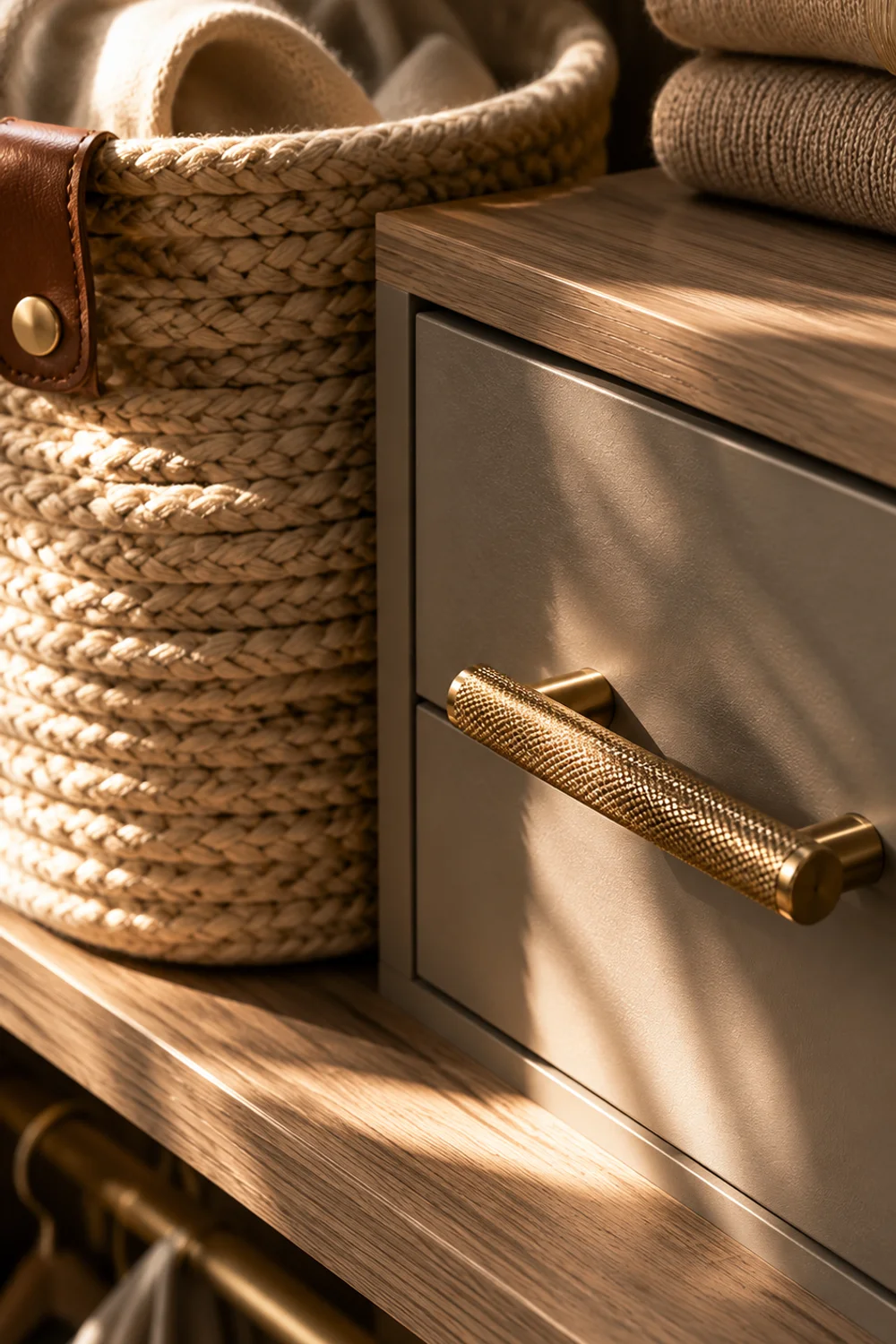
When color is removed from the equation, texture becomes the primary design variable. This is one of the most important principles underlying the neutral closet aesthetic, and it’s also one of the least explicitly discussed. People gravitate toward neutral palettes instinctively but then flatten the result by choosing textures that are too similar — smooth on smooth on smooth, or matte on matte throughout. A truly sophisticated neutral closet is built from deliberate textural contrast, where different surface qualities create visual rhythm and prevent the space from reading as simply beige.
The three textures that tend to work most cohesively within a neutral closet palette are woven, matte, and brushed. Woven elements — natural rattan, seagrass, chunky-knit storage baskets, open-weave fabric bins — introduce organic irregularity that the eye reads as warmth. They suggest handcraft and natural origin, which softens the inherent hardness of shelving and cabinetry. Matte surfaces — painted wood shelves, flat-finish drawer fronts, non-reflective hardware — create a visual quietness that allows the woven textures to stand out without competition. Brushed elements, most typically seen in metal hardware, add a fine-grain texture that catches light differently depending on the angle, creating subtle movement within an otherwise static composition.
What makes this three-texture framework particularly effective is that it’s self-limiting. Because all three textures are required to exist within the same neutral tonal family, the result never tips into pattern or complexity. The contrast remains tactile rather than visual — something you notice when you look closely, but that reads as calm and cohesive from a distance. This distinction is what separates a professionally styled neutral space from one that simply lacks color but hasn’t considered what fills the void that color leaves behind.
Texture is also the element most accessible to renters or those working within existing storage systems. You don’t need to change the architecture of a closet to introduce textural variety. Replacing plastic bins with woven baskets, swapping wire hanging dividers for matte-painted wooden ones, or draping a rough-woven throw over an open shelf edge are all low-commitment interventions that shift the textural register of a space significantly. The investment is small, but the change in atmosphere is disproportionate to the effort involved — which is exactly the kind of practical insight that makes the neutral closet aesthetic so adaptable and so enduringly popular.
7. The Hardware Edit: Metal Tones That Disappear Into a Neutral Closet
 Save it
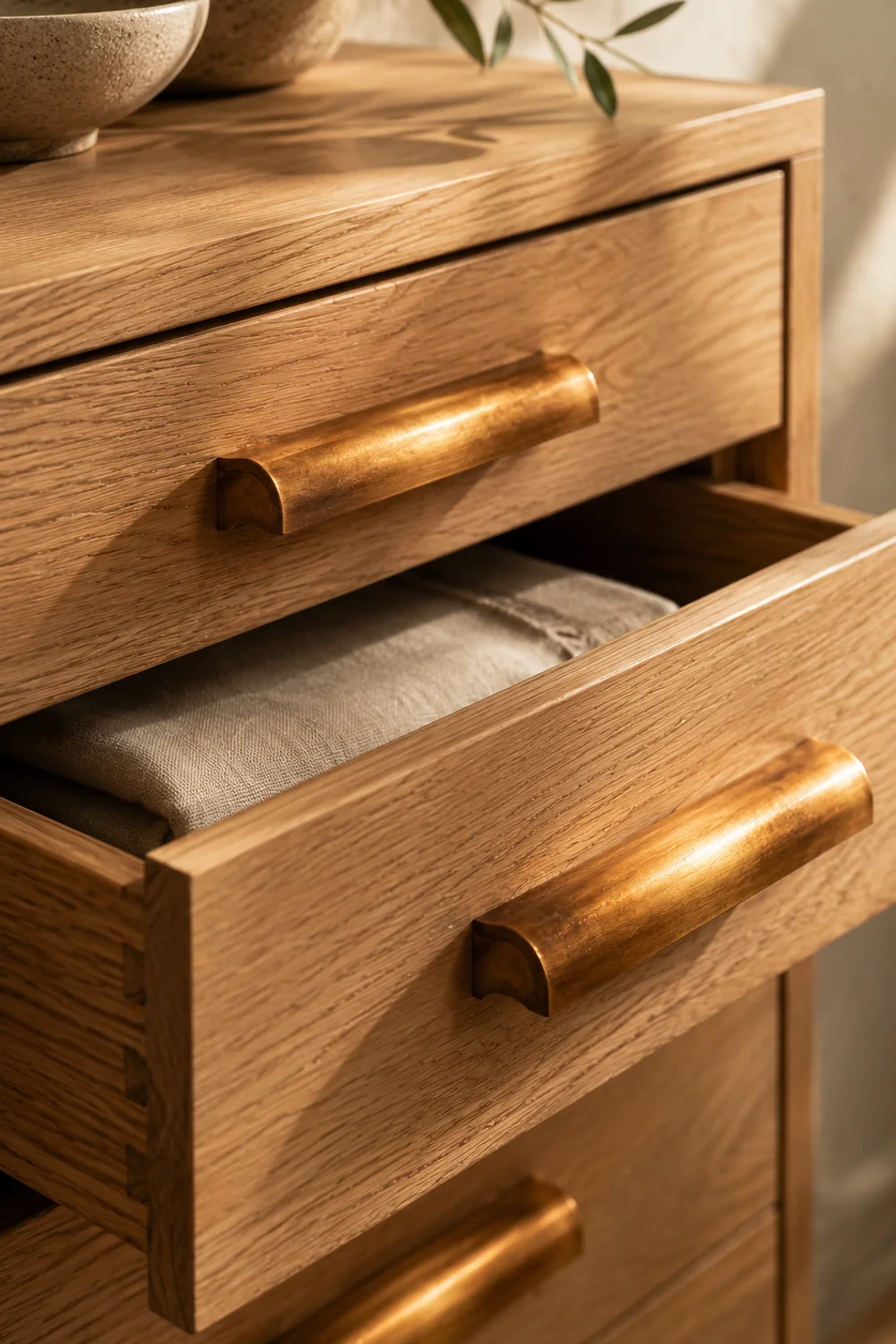
Hardware is one of those closet design elements that rarely gets the attention it deserves until something goes wrong. A single drawer pull in the wrong finish — too shiny, too cold, too dramatically contrasting — can disrupt the entire tonal logic of an otherwise beautifully considered neutral space. Conversely, hardware that’s chosen with the same care as every other element tends to disappear into the composition in the best possible way: present, considered, functional, but never competing for attention with the atmosphere it’s meant to support.
The finishes that work most consistently within a neutral closet aesthetic are those with a low reflective quality and a naturally warm undertone. Brushed brass has become the most popular choice because it sits perfectly at the intersection of warm and architectural — present enough to register as a deliberate choice, but quiet enough not to dominate. Antique brass and unlacquered brass take this a step further, allowing the finish to develop a slight patina over time that actually deepens the warmth of the space as the closet ages. For those drawn to cooler neutrals, matte black hardware achieves a similar disappearing act from the opposite tonal direction — it’s visible but not loud, and it anchors the composition without pulling focus.
Chrome and polished nickel are the finishes most likely to disrupt a neutral closet aesthetic, not because they’re inherently unattractive but because their reflective quality introduces a brightness and precision that reads as contemporary in a way that can feel at odds with the softer, more organic character of most neutral closet designs. If your existing hardware is already chrome, the most practical intervention is to replace only the most visible elements — the drawer pulls and the hanging rail end brackets — rather than attempting a complete overhaul. Two well-chosen brushed metal details in the right finish can shift the tonal register of the space significantly without requiring a full renovation.
Hardware is also where the neutral closet aesthetic intersects most directly with shoe storage — an area where the visual logic of a unified tonal palette becomes especially important. Open shoe storage in particular benefits from the same hardware restraint: a shoe shelf with brushed metal edge strips or a pale wood frame reads as part of the closet composition rather than as a separate insert. For approaches to shoe storage that maintain this visual consistency, Stunning Shoe Storage Ideas for Small Spaces That Look Amazing explores several solutions that integrate naturally into a neutral aesthetic without disrupting the tonal flow.
8. The Floor Layer and What Grounds a Neutral Closet
 Save it
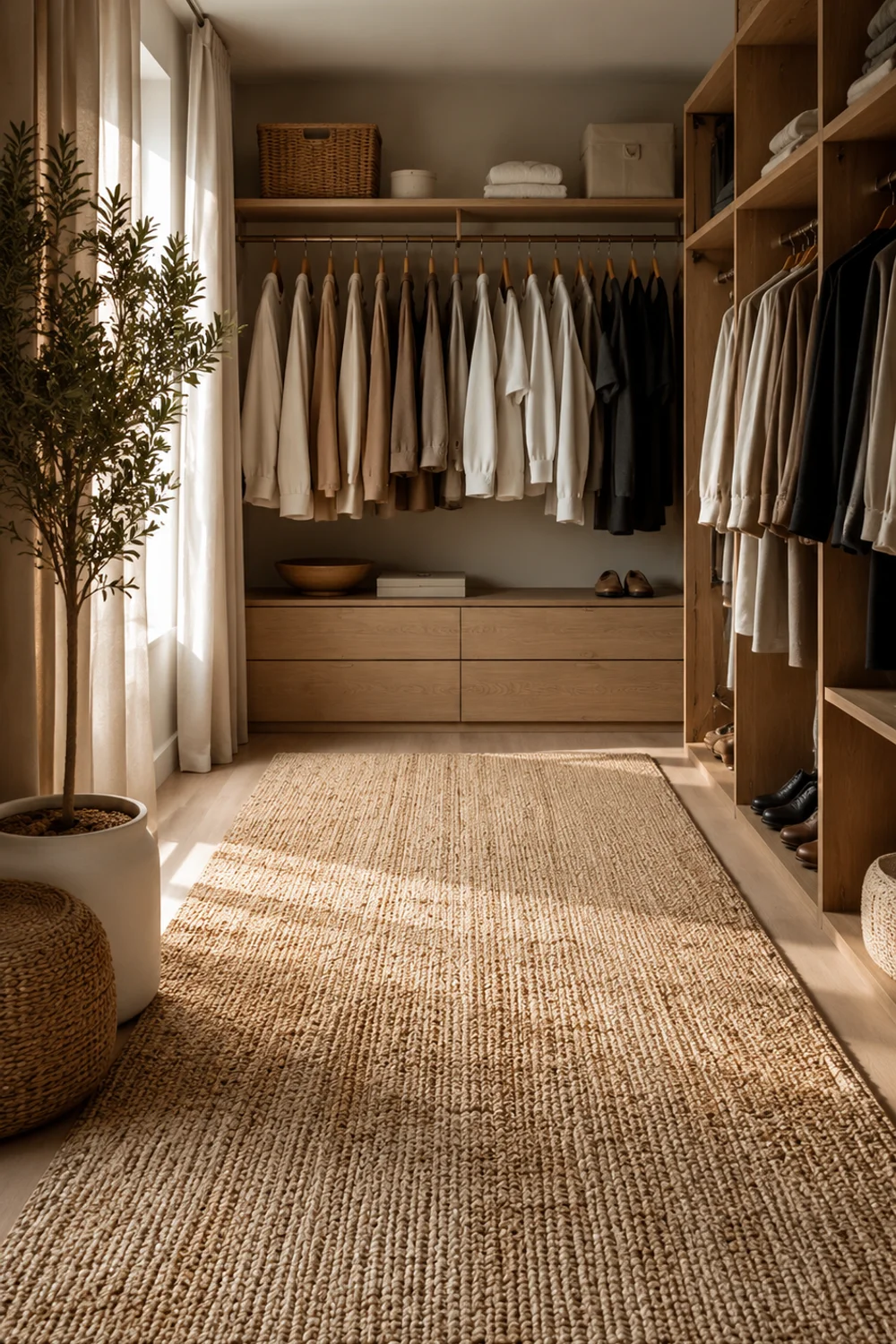
The floor is the element most frequently overlooked in closet design, and it’s the one that does the most invisible work. A closet’s atmosphere is significantly shaped by what happens at foot level — the texture underfoot, the reflectivity of the surface, the warmth or coolness of the material. Most built-in closets default to whatever flooring exists in the broader room, which is often a reasonable choice. But when you’re building a neutral aesthetic with intention, the floor becomes an active design decision rather than an inherited condition, and the distinction matters more than most people expect.
In a walk-in closet with enough square footage to feel like a proper room, a natural fiber area rug placed at the center of the space is one of the single most effective ways to ground the composition and shift the atmosphere from utilitarian to intentional. A jute, sisal, or wool flatweave in a warm natural tone introduces the same organic material quality as the linen-and-wood pairing discussed earlier, but at a different spatial level. It adds a layer between the architectural shell of the closet and the softness of the clothing and textiles above it, completing a material story that begins at ceiling height and resolves at the floor.
For smaller reach-in closets or spaces where a rug isn’t practical, the floor layer can be introduced through other means. A cedar shoe tray in natural wood tones, placed on the floor of the closet, provides both functional shoe storage and a material anchor that warms the base of the composition. Similarly, a low, open-weave storage bench placed at the foot of a hanging section serves double duty — it offers a surface for setting down bags or folded garments while also grounding the eye and creating a visual resting point within a space that is otherwise dominated by hanging and stacked items. For organized, aesthetically consistent solutions at this scale, the principles explored in Small Closet Organization Ideas That Actually Work and Look Stunningly Beautiful apply directly.
What the floor layer ultimately provides is a sense of completion. A neutral closet without a considered floor element tends to float visually — the walls and shelving and clothing all occupy the upper portion of the field of vision, while the base remains undefined. That undefined quality makes the space feel unfinished regardless of how carefully everything else has been considered. The floor doesn’t need to be dramatic. It simply needs to be part of the same considered conversation as every other element in the space — tonal, textural, warm, and deliberate — and when it is, the closet stops reading as a room with nice storage and starts reading as a room that someone cared about.
Common Mistakes to Avoid
1. Choosing a neutral tone without testing it in the actual light of the space
Neutrals are among the most light-sensitive colors in the entire palette, and this is the mistake that catches people most off guard. A warm ivory that looks perfect on a paint chip in natural daylight can pull distinctly yellow under warm artificial light, and a cool greige that reads as sophisticated in a brightly lit showroom can feel cold and slightly gray in a closet with limited windows or overhead-only lighting. Before committing to any wall color, shelf liner, or dominant material tone, test it in the specific light conditions of the closet — both in daylight and under artificial light in the evening. The few days spent testing will save months of dissatisfaction.
2. Treating the neutral palette as an invitation to stop editing
The neutral closet works because it is edited — because the visual calm is the result of thoughtful reduction rather than simply the absence of color. Many people adopt the palette but not the discipline, filling neutral baskets with the same visual clutter that existed before, hanging disorganized clothing on a beautiful wooden rail, or stacking mismatched items on pale shelves. The tone of the materials cannot do the organizational work that only decluttering and systems can accomplish. If the closet doesn’t feel calm after the palette shift, the problem is almost always volume, not tone.
3. Over-matching every element to exactly the same neutral
Ironically, one of the most common mistakes in building a neutral closet is making everything too similar. When the baskets, the wall, the shelf liner, the clothing, and the hardware all exist in exactly the same tone with no variation, the result reads as flat and slightly institutional rather than layered and warm. The three-tone rule exists precisely to prevent this. Build in deliberate tonal movement — light, mid, and anchor — even within a palette of ostensibly similar neutrals, and the space will gain the depth and dimensionality that separates a styled neutral room from a simply beige one.
4. Ignoring the back wall of the closet
In a reach-in closet in particular, the back wall is the primary visual surface — it’s what the eye lands on when the door opens, and it sets the immediate tonal impression of the entire space. Many people leave it unaddressed, assuming that the clothing covering it will handle the visual work. But the sections of the back wall that are visible — above a hanging rail, between sections of shelving, or beneath the lowest shelf — contribute enormously to the atmosphere of the space. A soft, warm neutral on that back wall, even if the rest of the closet remains white or stock, will lift the entire composition immediately.
5. Prioritizing photography over daily usability
The neutral closet aesthetic photographs beautifully, and this has created a version of it that is aspirational without being livable — perfectly styled with curated objects, empty space between garments, and not a single item that suggests daily use. Real closets don’t work like this, and attempting to maintain a Pinterest-ready version of a neutral closet in a fully functioning wardrobe leads quickly to frustration. Design the space for how you actually live: adequate storage for the volume of clothing you own, practical systems for the categories you use most, and enough breathing room to make the aesthetic feel natural rather than staged.
Frequently Asked Questions
What exactly is the neutral closet aesthetic, and where did it come from?
The neutral closet aesthetic refers to a design approach in which a wardrobe or closet space is built entirely from a palette of soft, muted tones — whites, creams, beiges, warm grays, and natural material tones — with an emphasis on texture, material quality, and tonal layering rather than color or pattern. It emerged most visibly in the mid-2010s alongside the broader rise of Scandinavian and Japandi-influenced interior design, but it gained significant mainstream traction during the early 2020s as homeowners began investing more attention in their daily living spaces. It continues to grow in searchability because it sits at a rare intersection of aesthetically aspirational and practically achievable.
Do I need a large closet for this aesthetic to work, or does it translate to small spaces?
The neutral closet aesthetic translates exceptionally well to small spaces — in some ways, it works better in a compact reach-in closet than in a large walk-in. The tonal cohesion of a neutral palette is particularly effective at making small spaces feel more resolved and less visually fragmented. In a small closet, every element is more visible, which means the benefits of a considered palette are immediately and fully apparent. The key adjustments for smaller spaces are keeping the tone slightly lighter to maximize the sense of airiness, keeping hardware minimal and slim, and ensuring that every storage solution does double duty — both functional and visually integrated.
How do I keep a neutral closet feeling calm when my wardrobe includes non-neutral pieces?
The most practical approach is to contain the non-neutral pieces within a specific section of the closet and treat that section as its own visual zone. Group any color pieces together — rather than distributing them throughout the hang — so that the neutral sections remain visually uninterrupted. If possible, use closed storage for the most visually disruptive items: a fabric storage box, a closed drawer, or a hanging garment cover in a neutral linen tone. The neutral closet doesn’t require a neutral-only wardrobe. It requires a neutral-first approach to organization — prioritizing the calm tonal sections visually and containing the exceptions rather than letting them distribute throughout the composition.
Is the neutral closet aesthetic expensive to achieve?
It can be, but it doesn’t need to be. The most significant cost driver in this aesthetic is the quality of natural materials — undyed linen, solid wood, natural fiber storage. These tend to cost more than their synthetic alternatives, and the difference is visible. However, the neutral closet aesthetic also benefits from restraint and reduction, which means that achieving it often involves removing or replacing existing items rather than purchasing many new ones. A small number of well-chosen, genuinely beautiful storage pieces in the right material and tone will always outperform a larger number of cheaper items, even from a purely aesthetic perspective. Start with one or two high-quality additions rather than attempting a complete overhaul at once.
Can I incorporate the neutral closet aesthetic within a rental, or does it require structural changes?
Many of the most effective interventions in the neutral closet aesthetic require no structural changes at all. Replacing plastic or wire storage with woven or linen alternatives, introducing a natural fiber rug on the closet floor, swapping existing hardware for brushed brass or matte black versions, and organizing clothing by tonal gradient are all completely reversible and require no permission from a landlord. The elements that do require more permanent installation — shelving systems, painted walls, recessed lighting — can be addressed through temporary solutions: freestanding shelf units in natural wood tones, removable wallpaper in soft neutral patterns, and battery-powered warm LED lighting that sits on existing surfaces rather than being hardwired into the wall.
Final Thoughts
The neutral closet aesthetic endures not because it’s fashionable but because it’s grounded in something real — the genuine value of starting each day in a space that feels composed rather than chaotic, considered rather than accidental. The choices outlined here don’t require a renovation or a large budget or a perfectly proportioned room. They require attention: to tone, to texture, to the relationship between materials, and to the quiet logic of a space designed to support daily life rather than perform for an audience.
Build it gradually if that’s what makes sense. Start with the tonal direction. Add the materials in the right layering order. Let the hardware and the floor and the gradient hang follow as the space develops. The neutral closet isn’t a project you complete — it’s a sensibility you develop, and it tends to improve with each small, deliberate decision. The mornings it creates, the sense of order and quiet it offers before the day begins, are worth every careful choice.
This post contains affiliate links. I may earn a small commission at no extra cost to you.
Get cozy inspiration delivered to your inbox.
✓ 14-page beautifully designed ebook
✓ Cozy decorating ideas
✓ Practical room-by-room inspiration
You’re in! 🎉
Thanks for joining the NestFlowHome community!
Your free ebook is already on its way to your inbox. If you don’t see it within a few minutes, please check your Promotions or Spam folder.
Join the NestFlowHome community for weekly decorating inspiration.

Timeless home decor ideas and slow living inspiration for a calm, beautiful life.