
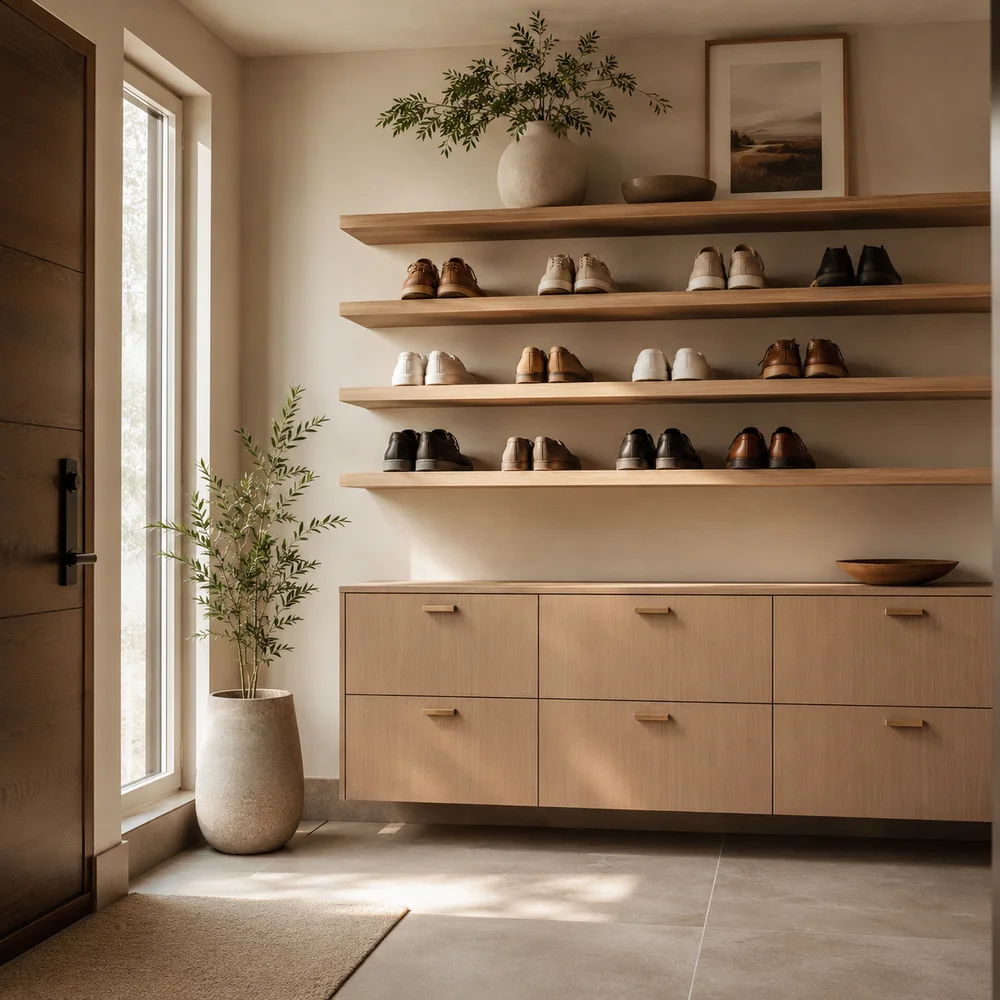
Stunning Shoe Storage Ideas for Small Spaces That Look Amazing
By Emily | June 22, 2026
There’s a specific kind of frustration that comes from a home that feels pulled together in every room except one. The living room is calm. The bedroom is considered. And then there’s the entryway — or the closet floor — where shoes pile up in a way that feels almost deliberate in its chaos. If this sounds familiar, the problem isn’t a lack of space. It’s a lack of structure.
Shoe storage is one of those categories where most people either overcomplicate it or underinvest in it entirely. They buy a cheap rack that wobbles, or they assume the problem is simply “too many shoes.” But the truth is more interesting than that. The right storage system doesn’t just contain shoes — it changes how a space feels. It transforms a cluttered entryway into something that looks intentional. It makes getting dressed in the morning feel less like a search mission and more like a ritual.
Small spaces, in particular, benefit enormously from thoughtful shoe organization. When square footage is limited, every surface and vertical plane matters. A wall of clear boxes becomes a gallery. A floating ledge becomes an architectural feature. A closed cabinet becomes a piece of furniture. The transformation isn’t just visual — it’s psychological. When your shoes have a home, you feel more at ease in yours.
This article covers everything from entryway systems to under-bed solutions, from tall boot storage to seasonal archiving. The ideas here aren’t just aesthetically pleasing — they’re grounded in how real people actually live, move, and get out the door in the morning.
1. Why the Entryway Becomes a Shoe Graveyard — and the One Structural Fix
 Save it
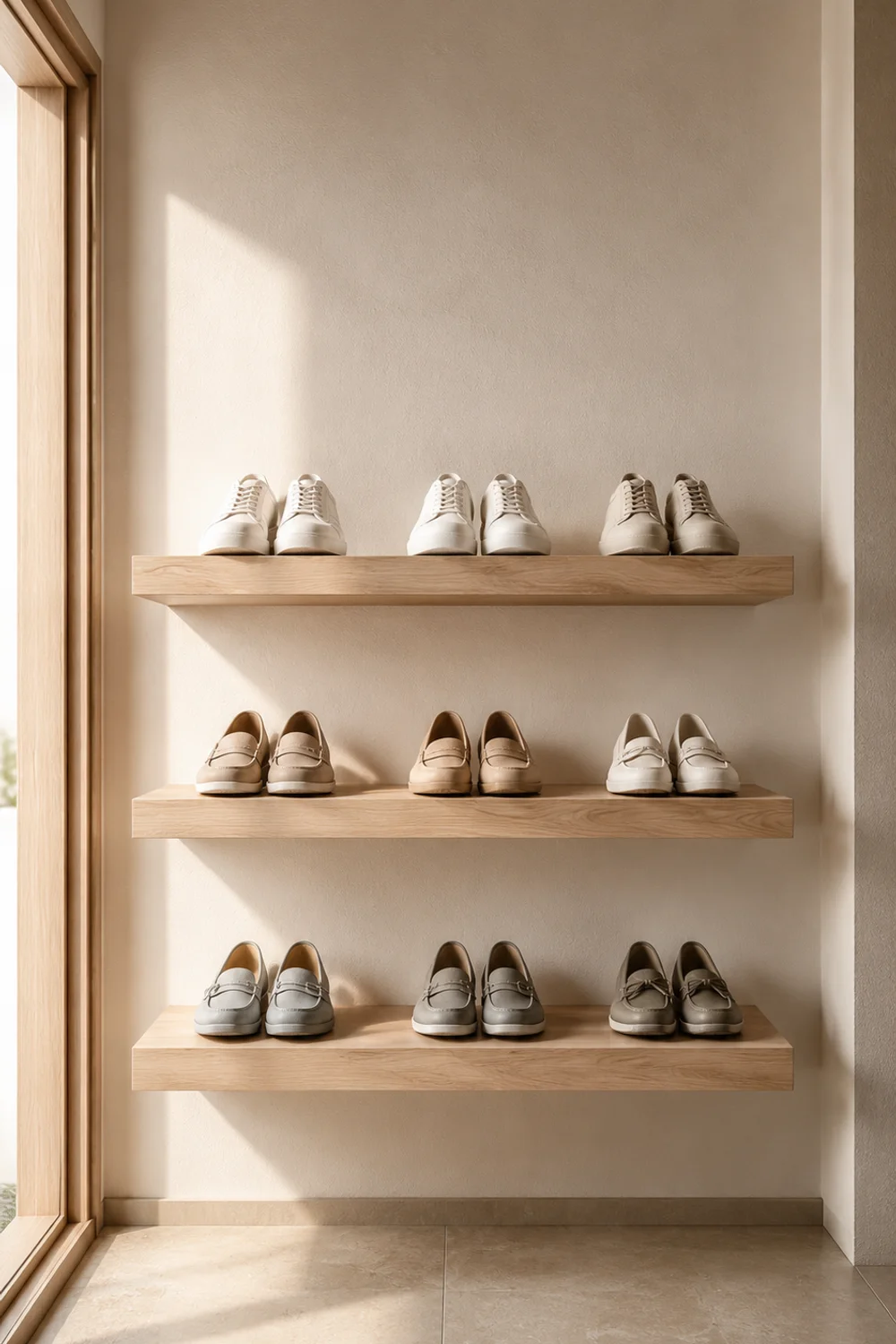
Every entryway starts with good intentions. Shoes come off at the door — which is actually the right instinct, both hygienically and spatially. The problem isn’t the behavior. The problem is that most entryways offer no dedicated place for shoes to land, which means they land everywhere. On the floor beside the door, kicked under a bench, pushed against the baseboard. Within a week, even the most tidy household starts to look like someone left in a hurry.
The structural fix isn’t a larger shoe rack or a stern household policy about putting things away. It’s friction reduction. When the storage is positioned exactly where shoes naturally come off — within arm’s reach of the door, at a natural bending height — the shoes go there automatically. This is the core principle behind well-designed entryway storage: make the correct behavior the easiest behavior. A low, open shoe ledge mounted at shin height beside the front door achieves this almost invisibly. It’s accessible, it’s immediate, and it requires zero effort to use.
What makes this work even better is a defined visual boundary. A small entryway cabinet, a dedicated mat zone, or even a section of the wall marked by floating shelves tells everyone — including visitors — that this is where shoes go. It removes the ambiguity. For households with children, this boundary is particularly powerful: visible, labeled, and low enough to be used without help. Everything You Need to Know About Organizing a Small Apartment Closet goes deeper into how entry zones connect to the broader organization logic of small-space living.
The broader principle here is one that applies to every area of the home: storage only works when it’s positioned where the behavior already happens. You don’t change the behavior to fit the storage. You design storage around the behavior. This is what separates thoughtful organization from the kind that falls apart by the second week. It’s also what turns an entryway from a stress point into a system you don’t have to think about at all.
2. Floating Shoe Ledges: When Storage Becomes a Wall Composition
 Save it
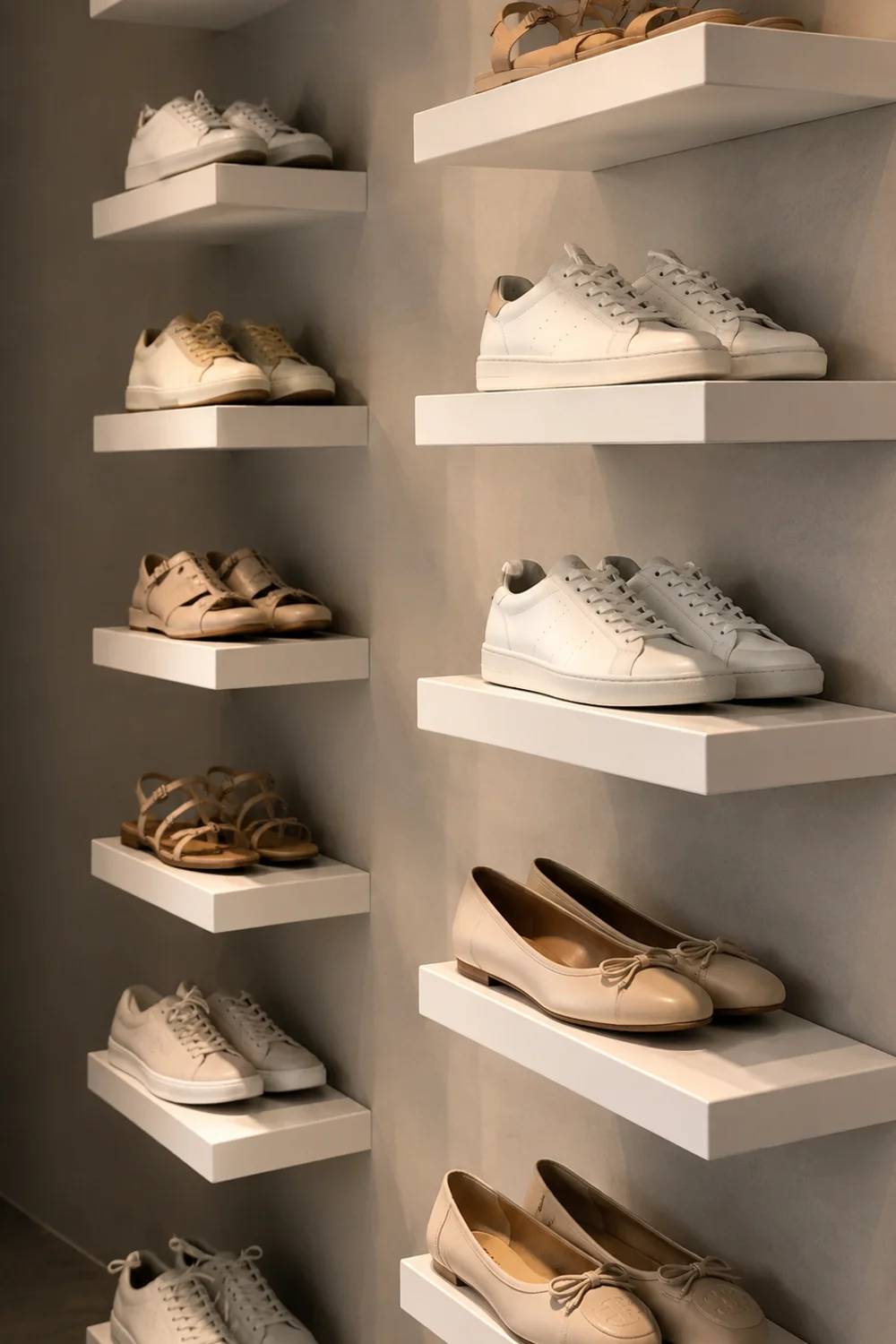
Floating shelves have been a staple of small-space living for years, but most people think of them in the context of books or decorative objects. Applied to shoe storage, they do something genuinely different. A row of floating ledges — mounted at staggered heights, or arranged in a clean grid — transforms the act of storing shoes into a form of display. The wall stops being dead space and becomes a composition. In a narrow entryway especially, this shift is significant.
The mechanics are simple but require some precision. Floating shoe ledges should be mounted approximately 100–120mm deep — deep enough for most shoes but shallow enough to keep the visual profile slim. Spacing between shelves should account for the tallest category of shoe on that ledge: flats need about 100mm of clearance, heels closer to 140mm, and low-profile sneakers sit happily at 120mm. Getting these measurements right before drilling means the finished result looks deliberate rather than improvised. The grid approach, where shelves are evenly spaced and the same width, tends to feel the most architectural and calm.
For renters or anyone hesitant about drilling, adhesive-mounted ledge systems have become genuinely reliable for lighter shoes. The key is weight distribution — spreading the load across multiple ledges rather than concentrating a heavy boot collection on one. A good alternative is a modular shelf unit that sits flush against the wall and mimics the floating effect without the hardware commitment. Small Closet Organization Ideas That Actually Work and Look Stunningly Beautiful covers several of these modular approaches in useful detail.
There’s an aesthetic logic to shoe ledges that goes beyond storage efficiency. When shoes are displayed on a wall — even casually — they become part of the room rather than a problem the room is working around. A pair of clean white sneakers on a narrow white shelf reads differently than the same pair kicked under a bench. Context changes perception. And in a small space, where every visual element affects how the whole room feels, that shift matters more than it might in a larger home.
3. The Case for Clear Boxes — Turning a Collection into a Gallery
 Save it
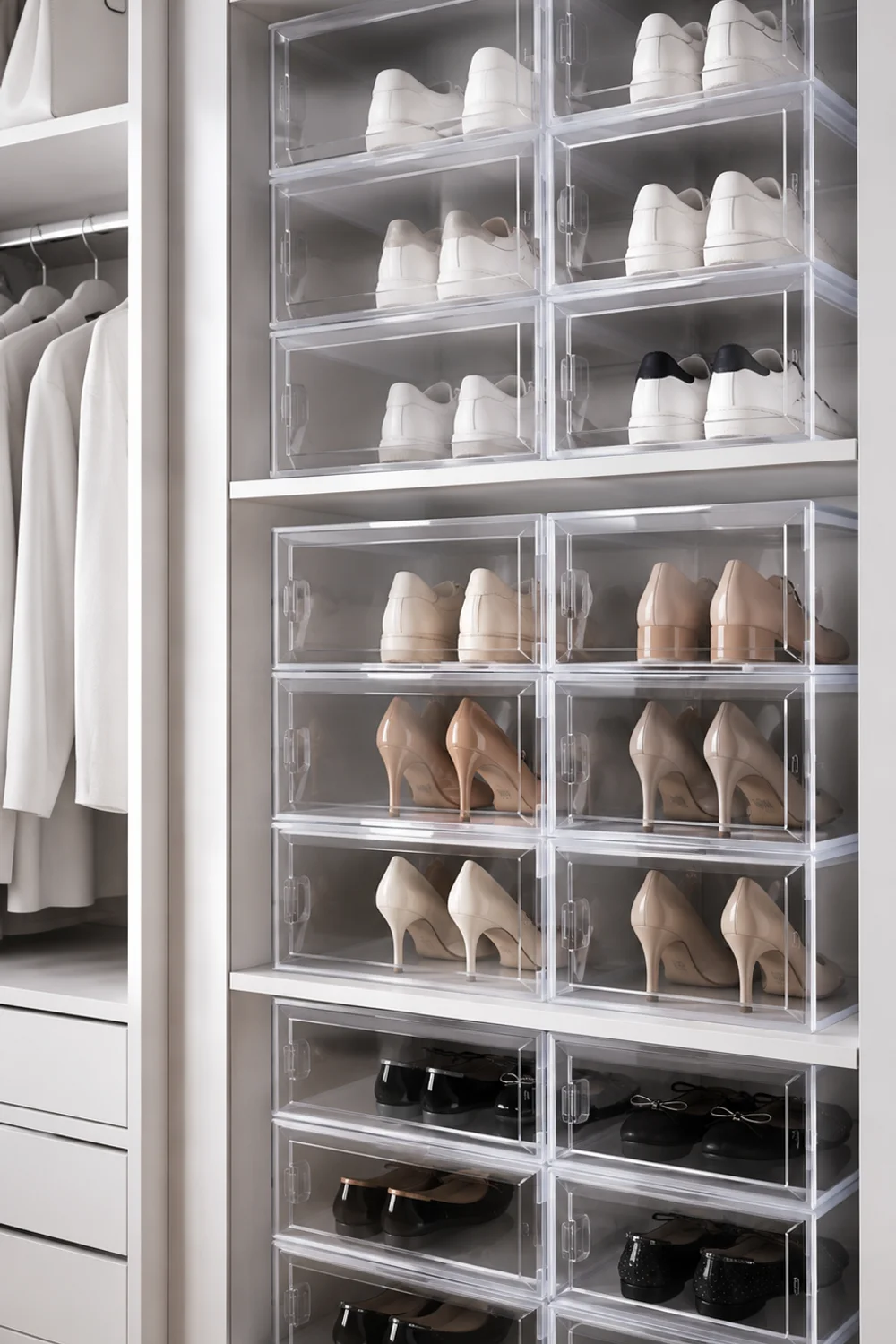
Clear shoe boxes occupy a specific aesthetic territory that most organization systems don’t: they’re simultaneously practical and beautiful. When stacked in a uniform column or arranged across a shelf, a collection of clear boxes with visible shoes inside reads less like storage and more like a curated display. It’s the kind of thing that looks staged in photographs but actually functions brilliantly in real life — because you can see everything at a glance without opening a single lid.
The mechanism is straightforward. Uniform clear boxes — ideally the same brand and size throughout — create visual rhythm. When every box is a different shape or opacity, the stack looks cluttered even when it’s technically organized. Consistency is what makes the difference. The best clear storage boxes for shoes are slightly oversized for average footwear but snug enough that shoes don’t slide around inside. Stackable designs with front-opening or drop-front lids are the most practical for everyday use, since you can access the bottom box without dismantling the whole column.
Labeling adds another layer of usability. Even with clear boxes, a small printed or handwritten label on the front — indicating the shoe type or the occasion — reduces the time spent scanning. For households with multiple people, color-coded label systems work well: one color per person, all boxes uniform in shape and size. It sounds overly systematic, but in practice it makes the morning routine noticeably smoother. This principle — reducing micro-decisions — is one of the most underrated benefits of good organization.
The gallery effect that clear boxes create is also worth considering from a motivational standpoint. When a shoe collection looks beautiful, people are more inclined to maintain it. A stack of mismatched cardboard boxes invites more clutter. A grid of identical clear containers with visible shoes inside creates a standard that most people naturally want to uphold. This is the subtle psychology behind why aesthetic organization tends to last longer than purely functional organization.
4. Closed-Front Shoe Cabinets: The Concealment Move That Reads as Furniture
 Save it
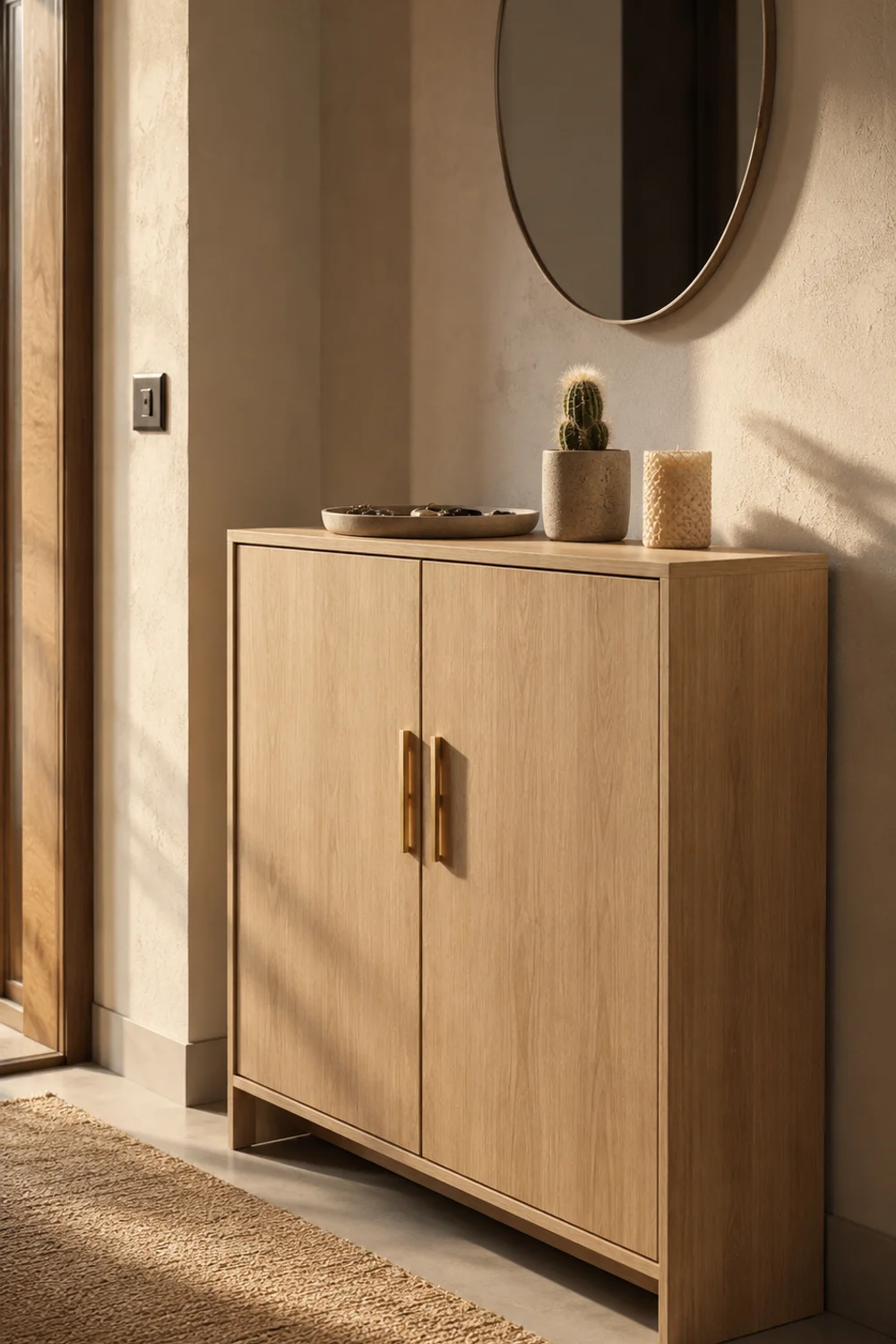
There’s a strong case to be made for hiding shoes entirely. Not because shoes are something to be ashamed of, but because visual calm in a small space is directly linked to how much the eye has to process. An open shoe wall is beautiful when it’s maintained perfectly. A closed cabinet looks organized always — because nothing is visible. For anyone who doesn’t want to think about whether their storage looks good on any given Tuesday morning, a closed-front shoe cabinet is the more honest solution.
The design distinction that matters most here is whether the cabinet reads as furniture or as storage. A cheaply made shoe cabinet with visible hinges and a hollow-sounding door is recognizable from across the room as exactly what it is. A well-constructed cabinet with solid doors, clean hardware, and considered proportions blends into the room. It looks like a sideboard, a credenza, or a console. Guests don’t immediately identify it as a shoe cabinet — which is the entire point. In a small entryway, this visual ambiguity makes the space feel larger and more considered.
Height matters considerably in small spaces. A low cabinet — around 500–600mm tall — doubles as a surface for keys, a small plant, or a tray for daily carry items. A taller cabinet stores more pairs but becomes a visual wall. The sweet spot for most small entryways is a cabinet that reaches approximately mid-chest height: present enough to anchor the space, restrained enough not to dominate it. Depth should be kept to 300mm or less, which accommodates most adult shoes when stored on an angled internal tray.
The broader principle is one of intentional concealment. Not everything in a home needs to be visible or celebrated. Some things are simply tools — functional, important, and better stored out of sight. Shoes belong in this category for most people. The entryway feels more welcoming, more spacious, and more designed when there’s nothing on the floor and nothing visually competing for attention. A good closed cabinet achieves exactly that.
5. Tiered Shoe Towers for Narrow Closet Floors
 Save it
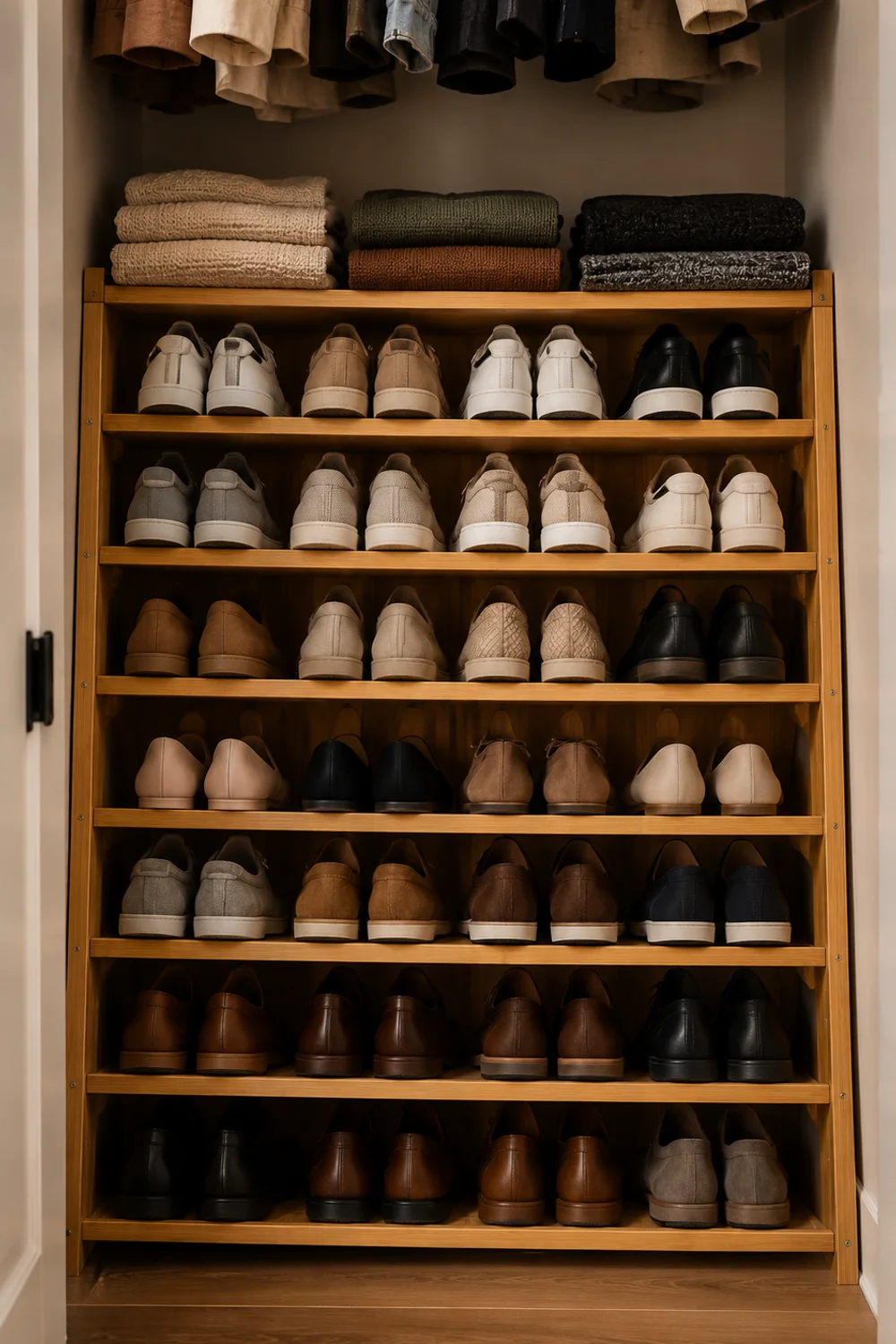
The floor of a small closet is almost always underutilized. Shoes get piled in loosely, two pairs deep and three rows wide, creating a situation where finding the right shoe requires excavating everything around it. The floor space exists — the structure doesn’t. A tiered shoe tower addresses this directly by introducing vertical logic into a horizontal mess, using the full height of the closet floor zone rather than just the bottom centimeters of it.
A well-chosen tiered tower works by angling each shelf so that the heel sits lower than the toe. This serves two purposes: it reduces the depth required per pair, and it displays each shoe at a slight upward tilt that makes identification easier from above. A standard tiered tower with five to seven shelves can hold between fifteen and twenty-five pairs in the same floor footprint that previously held eight pairs piled randomly. That ratio — more than double the capacity in the same space — is what makes tiered towers one of the highest-impact organizational investments for a small closet.
Material choice affects both durability and aesthetics. Metal towers are the most stable and easiest to clean but can feel industrial in a wardrobe context. Bamboo or wood-composite versions are visually warmer and blend more naturally with closet interiors. For renters or anyone who may reconfigure their storage in the future, modular towers — where individual shelves can be added or removed — offer more flexibility than fixed-height units. The Best Aesthetic Closet Storage Ideas for Small Bedrooms explores how tower storage fits into the broader aesthetic logic of small bedroom closets.
The closet floor is genuinely one of the most powerful surfaces in a small home. When it’s organized, everything in the closet feels more intentional — the hanging clothes above look more deliberate, the shelves feel less pressured, and the overall sense of the space shifts from chaotic to controlled. The floor doesn’t need to do everything, but it needs to do its part. A tiered tower is the simplest, most effective way to ensure it does.
6. The Boot Problem: Storage That Keeps Tall Boots Upright and Shapely
 Save it
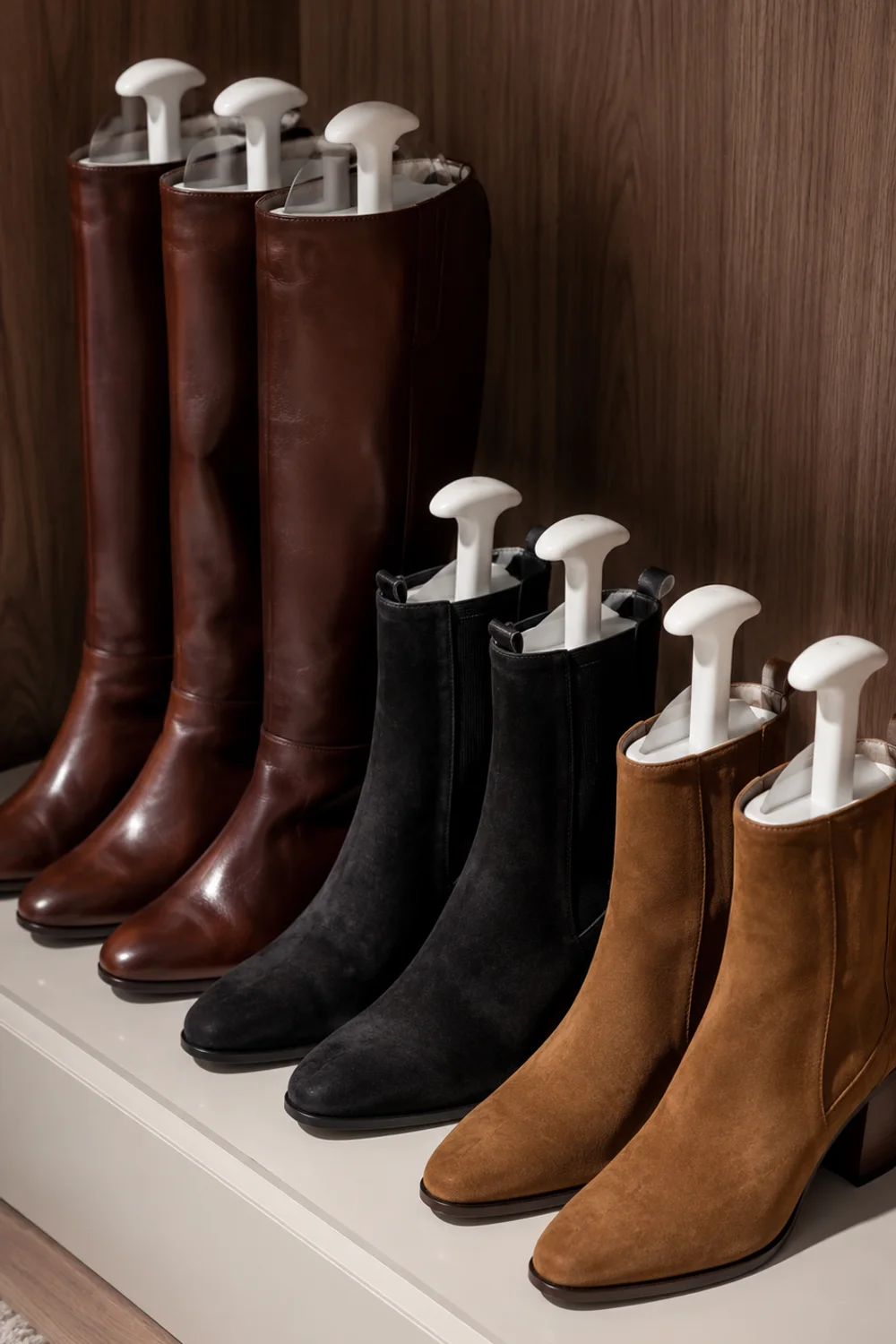
Boots present a storage challenge that no standard shoe rack was designed to solve. They’re tall, they’re often soft enough to collapse under their own weight, and they take up dramatically more space than flat shoes or sneakers. When stored lying on their side or shoved upright against each other without support, they crease, lose their shape, and become genuinely difficult to put on. The solution isn’t more space — it’s the right structure for this specific category of footwear.
Boot shapers are the most immediate intervention, and they’re worth using even for inexpensive boots. A rolled magazine inside a boot is a functional version of the same principle — but a proper boot shaper, ideally one that extends to the full height of the shaft, keeps tall boots standing without crowding them together. When boots stand independently, they can be stored side by side in a narrow column rather than leaned against each other in a way that distorts the leather and makes retrieval frustrating.
For storage placement, tall boots belong on the floor of a closet or a dedicated lower section of a shoe cabinet — never on a narrow shelf where they’ll inevitably tip over. Some wardrobes include a pull-out boot drawer at floor level, which is an elegant solution that keeps boots flat but accessible. Alternatively, a dedicated boot zone on the closet floor — defined by a low tray or a section of rubberized mat — creates a visual boundary that prevents other items from encroaching on the space boots need.
The broader point is that boots are the category where storage failures become visible fastest. A collapsed knee-high boot doesn’t just look bad — it affects how the boot wears over time. Treating boot storage as a distinct problem with a distinct solution, rather than lumping boots in with the rest of the shoe collection, is the kind of category thinking that makes a real long-term difference to both the storage system and the footwear itself.
7. Under-Bed Shoe Storage — the Floor Plane Almost Everyone Ignores
 Save it
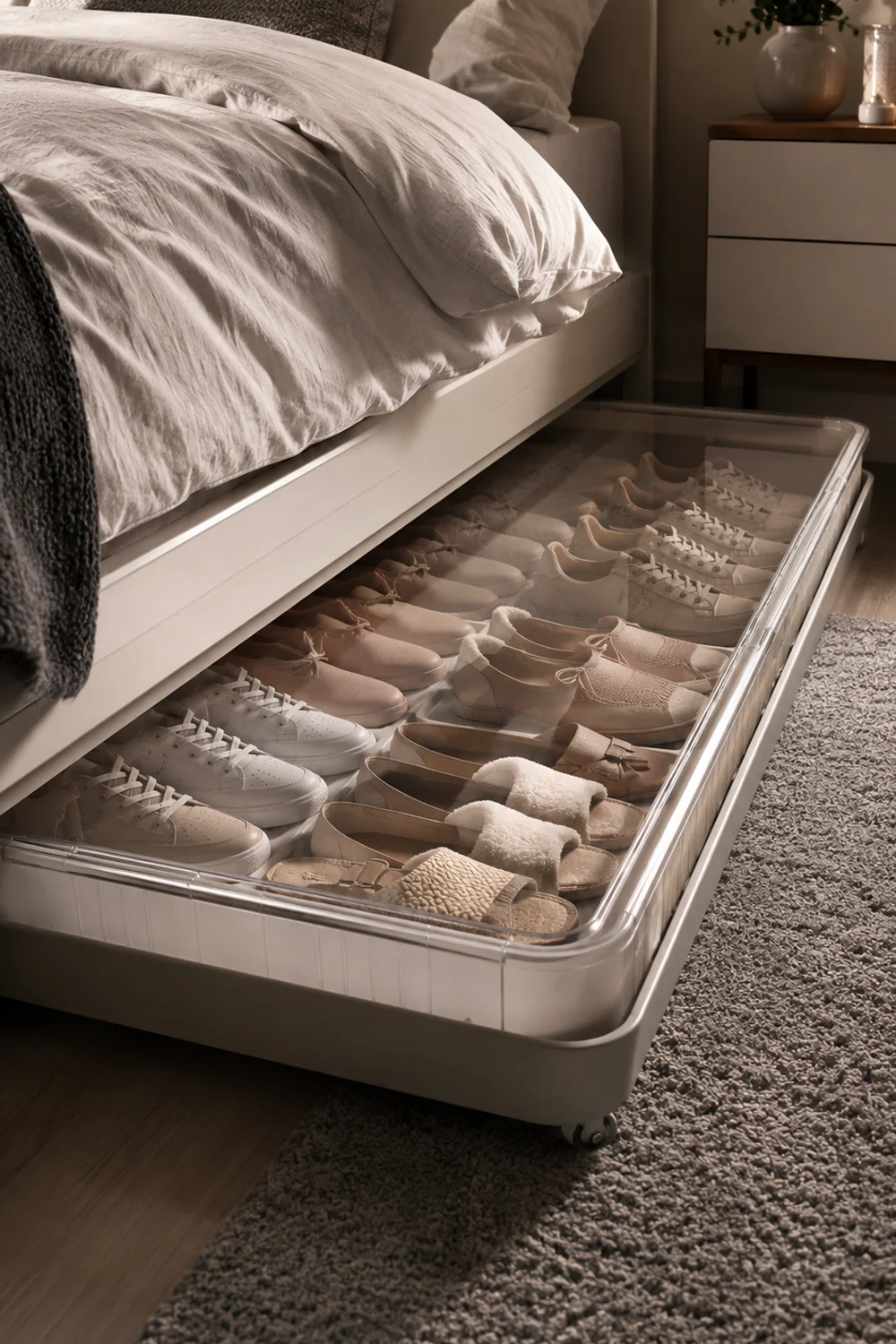
The space beneath a bed is one of the most overlooked storage opportunities in a small home. Most people use it, if at all, for seasonal textiles or items they rarely need — which makes it poorly matched to shoes, which are a daily-access category. But with the right system, under-bed shoe storage works remarkably well, particularly for the overflow pairs that don’t fit elsewhere or the seasonal shoes that rotate in and out of active use throughout the year.
The distinction between good and poor under-bed shoe storage comes down almost entirely to the container. Loose shoes shoved under a bed collect dust, get pushed to the back corner where they’re impossible to retrieve, and rarely come out in good condition. Flat, wheeled under-bed drawers — purpose-designed for shoe storage with a clear or mesh top — solve all three problems at once. They roll out smoothly, protect the shoes from dust, and allow you to see the contents without bending or digging. The visual access is the critical feature.
For beds with limited clearance, slim profile boxes — approximately 120mm in height — fit beneath most standard bed frames and work well for flat shoes, sandals, and sneakers. Boots and heeled shoes generally need more height, so under-bed storage works best for the flatter categories. 15 Small Bedroom Ideas for Better Storage and Smart Layouts explores how under-bed storage integrates with broader small bedroom organization strategies, including bed frame choices that affect clearance.
There’s a practical rhythm to under-bed storage that, once established, becomes genuinely useful. The front section of the drawer — most easily accessible when pulled out — holds the shoes worn most frequently. The back section becomes seasonal storage without requiring the boxes to be moved elsewhere. This zoning within a single container is the kind of micro-organization that takes five minutes to set up and saves time every single morning.
8. The Entryway Bench — Seating That Earns Its Place Twice
 Save it
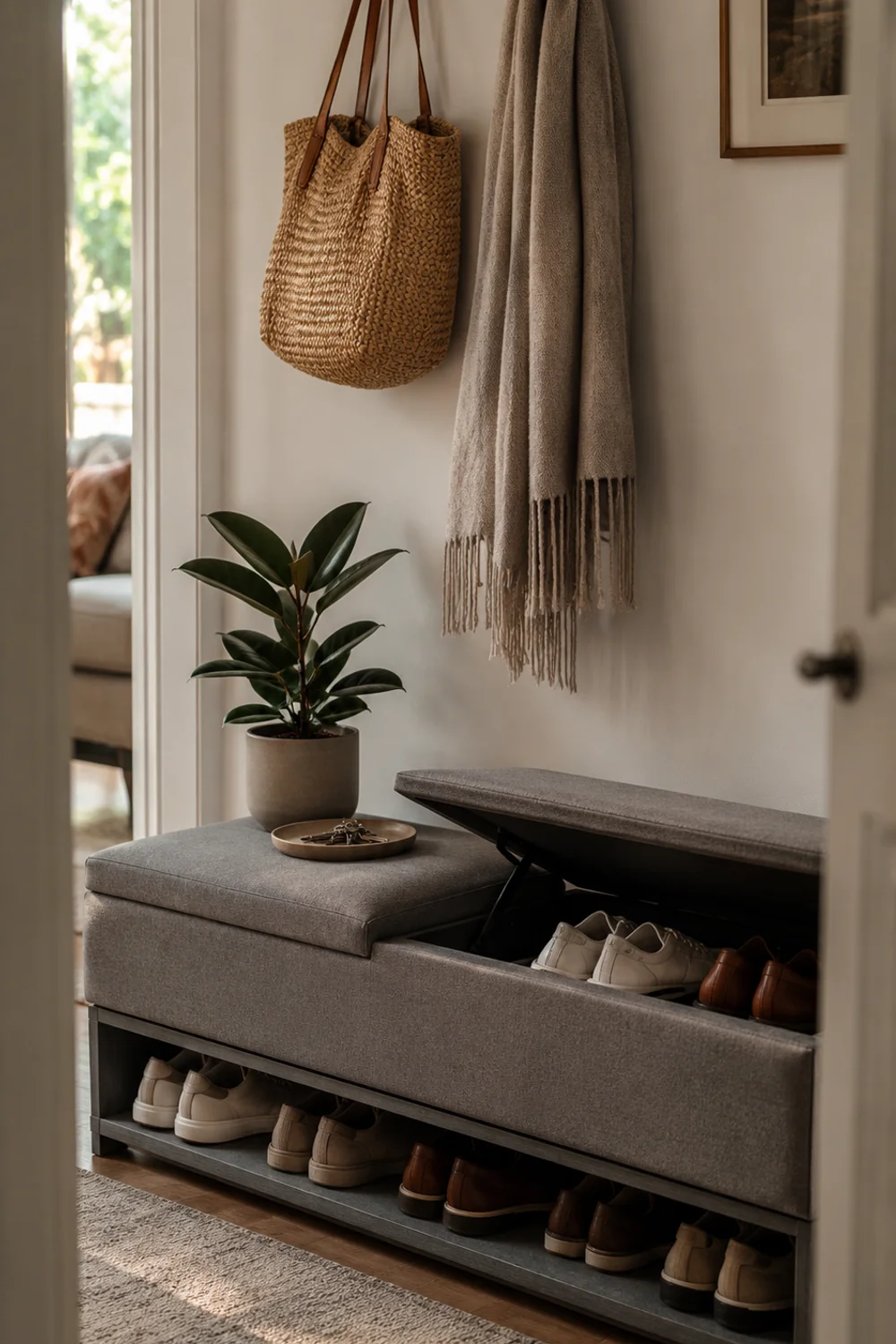
An entryway bench is one of those pieces of furniture that earns its place twice: once as functional seating for putting shoes on and taking them off, and once as an organizational anchor for everything that enters and leaves the home with you. In a small entryway, every piece needs to justify its footprint. A bench that only provides seating is a luxury. A bench that also stores shoes — and holds a basket for accessories or a tray for daily carry items — is a structural necessity.
The storage logic of a bench depends on what’s beneath and beside it. A bench with an integrated lower shelf holds approximately four to six pairs of shoes in an open, easily accessible arrangement. A bench with a hinged seat and hollow interior conceals more — typically eight to twelve pairs — while keeping the visual profile clean. The hinged version requires slightly more effort to access but results in a completely clear floor, which makes the entryway feel significantly larger. The open-shelf version is better for households where speed of access matters more than concealment.
Proportions matter enormously in a small entryway. A bench that’s too large dominates the space and makes it feel narrower. The ideal length for most small entryways is between 900mm and 1100mm — long enough to sit comfortably and store multiple pairs, but short enough to leave visual breathing room on either side. Depth should stay under 400mm. Anything wider begins to feel like an obstacle rather than a feature. Closet Organization Ideas You’ll Fall in Love With explores how entryway organization connects to the broader organizational logic of the home.
The psychological value of a well-placed bench is worth noting. Putting on shoes while seated is more composed and more pleasant than hopping on one foot near the door. It slows the exit ritual by just enough to reduce the stress of leaving. And when the bench also holds today’s shoes neatly, the entryway stops being the chaotic threshold between home and outside world and becomes something closer to a considered transition space — which is exactly what a good entry should feel like.
9. How to Edit Your Collection Before You Store It
 Save it
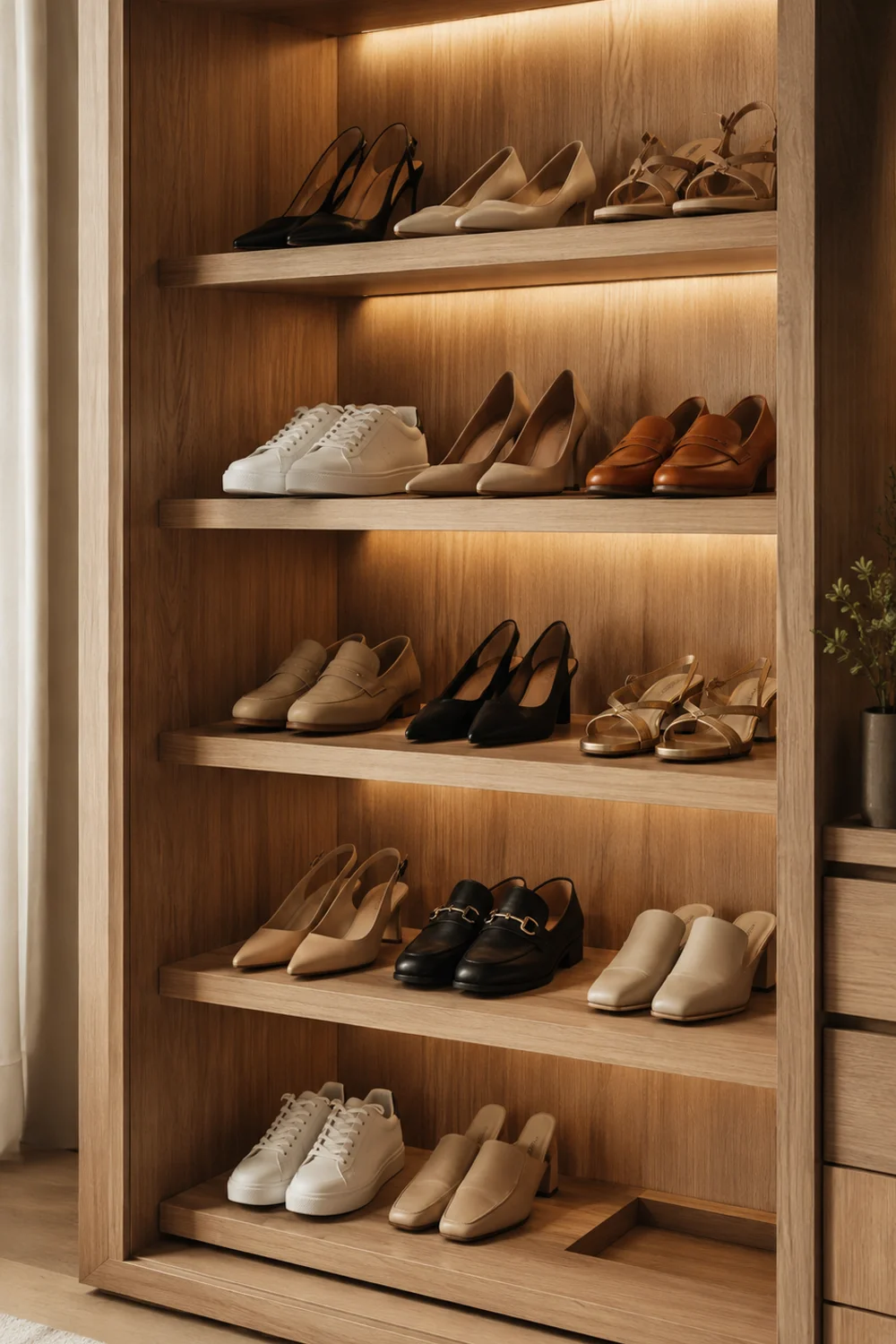
No storage system — however beautiful, however precisely sized — works well when the collection it’s meant to hold is too large for the space. This is the organizing truth that most people resist, because editing a shoe collection feels more like loss than like gain. But the physical reality is simple: a curated collection of thirty pairs, well stored, is both easier to navigate and more visually pleasing than fifty pairs shoved into the same space. Editing is not deprivation. It’s the thing that makes the system work.
The most effective editing method is category rotation. Divide the collection by season and store only the current season within primary reach — the entryway, the main closet floor, the accessible shelves. Off-season pairs move to secondary storage: a high closet shelf, an under-bed container, a labeled box in a storage room. This single habit reduces the active collection by thirty to fifty percent without requiring anyone to permanently part with shoes they love. The storage system immediately feels more spacious, and retrieval becomes meaningfully faster.
For pairs that genuinely need to leave the collection — worn beyond reasonable repair, the wrong size, or simply never worn despite good intentions — the most useful framing is one of purposeful release. A shoe that’s sat unworn for two full seasons has already made its exit from the active collection. The only step remaining is physical removal. Donation, resale platforms, or textile recycling services all provide a destination that feels less final than the bin, which makes the decision easier for most people to act on.
The principle beneath all of this is that storage is a finite resource, and the collection must fit the resource — not the other way around. Buying a larger cabinet to hold more shoes is sometimes the right answer. But more often, the better answer is deciding which shoes deserve the cabinet space you already have. This is the kind of clarity that storage systems alone cannot provide, but that makes every storage system work better once it’s established.
10. Pegboard and Wall Systems for Shoes and Accessories Side by Side
 Save it
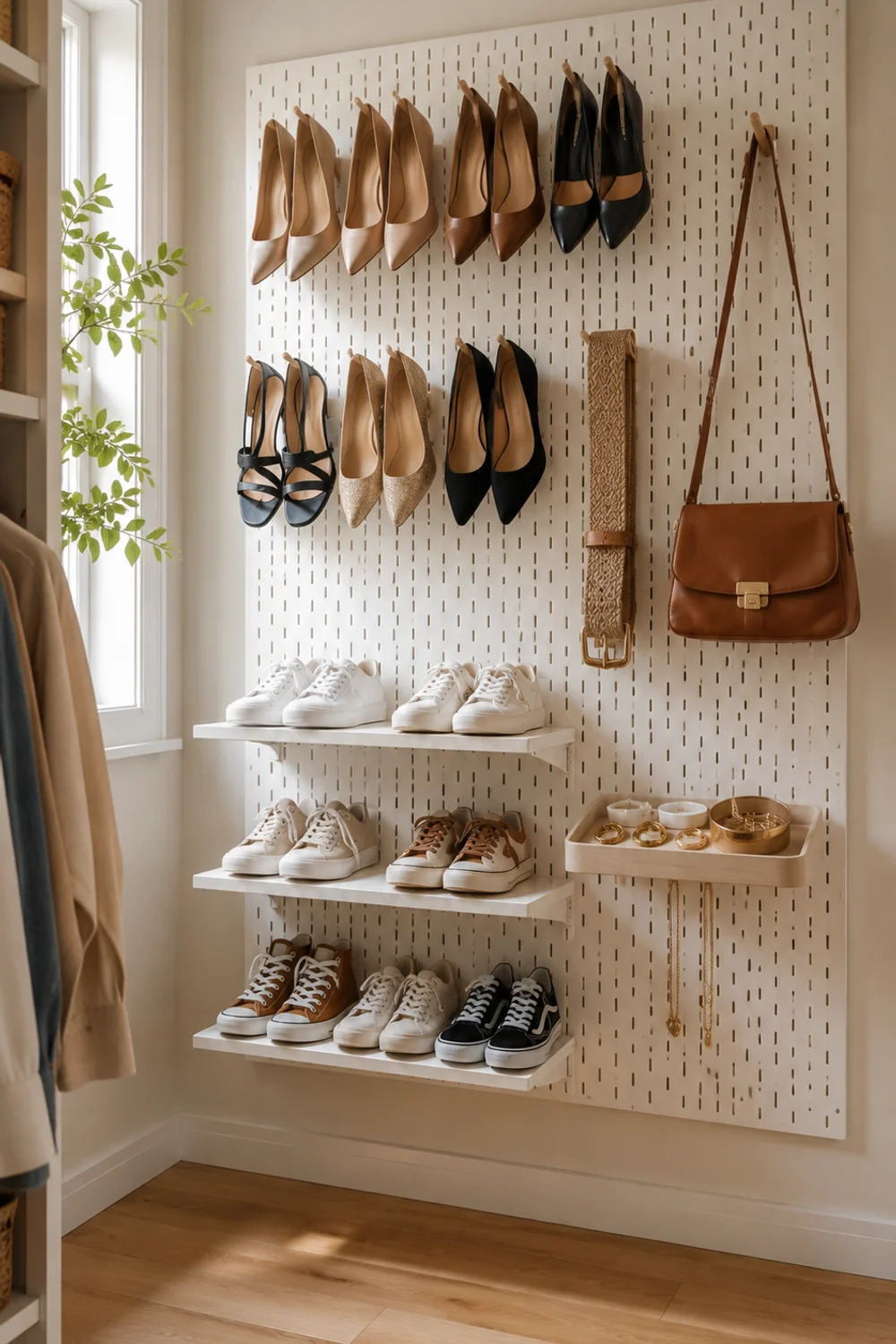
Pegboard has a reputation for garages and craft rooms, but in a well-styled small space — particularly a bedroom closet or dressing area — it functions as one of the most flexible wall storage systems available. The appeal is customization: hooks, shelves, and holders can be repositioned at any point without new hardware, which means the system evolves as the collection changes. For someone who rotates accessories seasonally or reorganizes periodically, this adaptability is worth more than a fixed built-in.
For shoes specifically, pegboard hooks designed for heels hold pairs by the heel cup, displaying them face-forward at a slight downward angle. This works beautifully for heeled shoes and sandals and creates a visual effect closer to a boutique display than a storage solution. Flat shoes and sneakers require a small ledge shelf rather than a hook, but these slot into the same pegboard system using the same peg spacing. The result is a wall that holds both shoes and accessories — bags, belts, jewelry trays — in a single organized plane.
The visual styling of a pegboard wall matters enormously in a domestic context. A raw plywood pegboard with mismatched hooks reads as utilitarian. The same pegboard painted in a matte tone that matches the wall — or a complementary color — reads as intentional design. Framing the pegboard with a thin border or mounting it within a defined wall zone gives it a more finished, editorial quality. These are small details, but they determine whether the system feels like a solution or like an afterthought.
The broader value of wall-mounted systems is that they keep the floor clear. In a small dressing area or closet, floor space is often the most precious — and most cluttered — surface. When accessories and shoes migrate to the wall, the floor opens up, which makes the whole space feel larger and more workable. This vertical thinking is one of the core strategies for small-space organization, and pegboard is one of the most accessible ways to implement it without a full renovation.
11. Rotating Seasonal Pairs — the Archive Strategy
 Save it
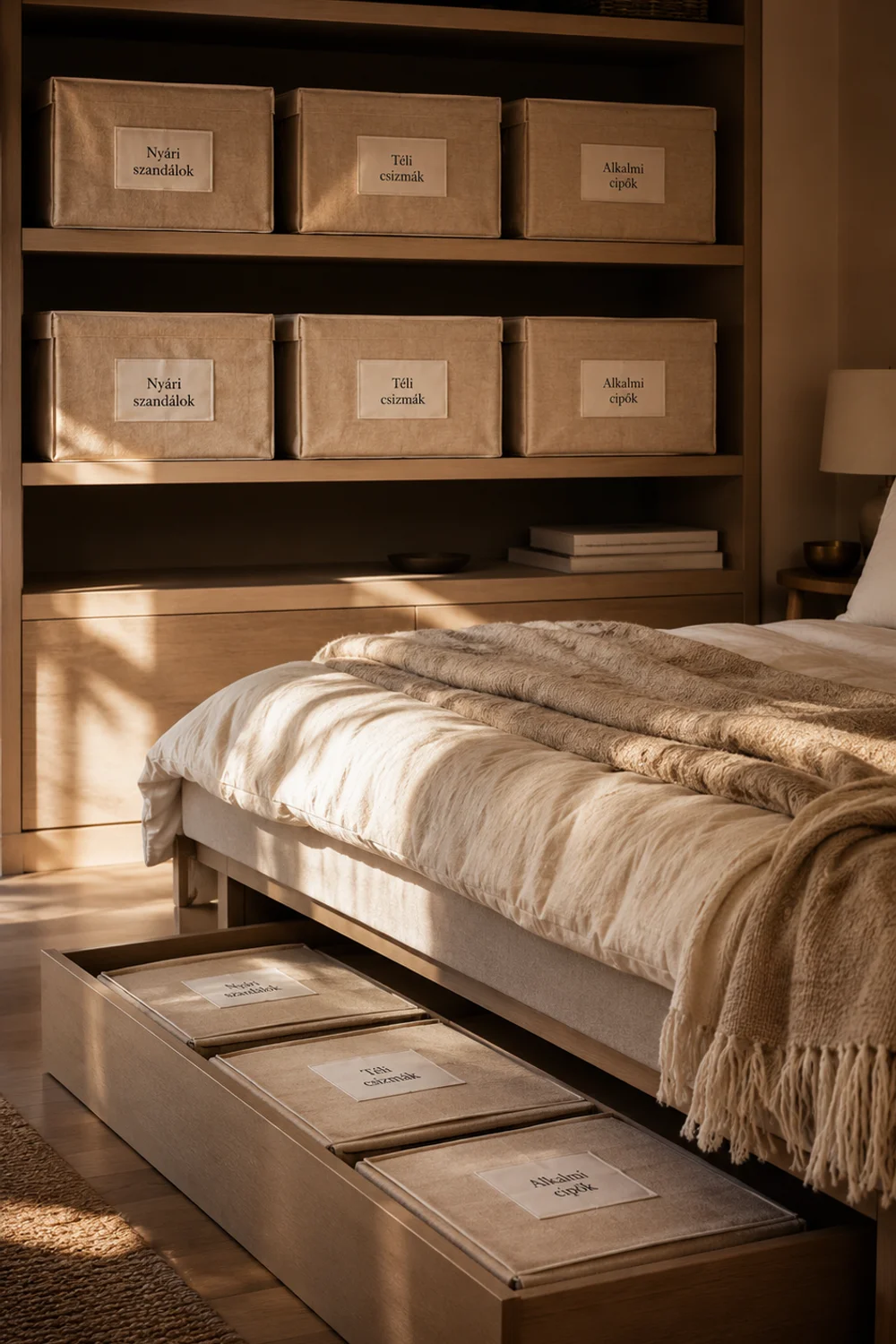
The concept of an archive applies to shoes in the same way it applies to a wardrobe. The active collection — the shoes worn regularly within the current season — deserves prime storage space: eye-level, easily accessible, clearly visible. The archive — off-season pairs, occasion shoes worn rarely, and sentimental items not in regular rotation — deserves secondary storage: out of the way, protected, and clearly labeled. The distinction between these two categories is the foundation of a sustainable shoe organization system.
In practice, the archive strategy involves two storage tiers. The first tier is the primary storage zone: the entryway shelf, the main closet floor, the accessible clear boxes at eye level. This holds the current season’s active pairs — typically twelve to twenty pairs for most people. The second tier is the archive zone: high shelves, under-bed containers, or a secondary closet. This holds everything else, organized by category and clearly labeled so retrieval is straightforward when the season changes. The seasonal rotation itself — swapping the active and archived collections twice a year — takes under an hour and transforms the way the primary storage zone functions.
The archive also provides a natural editing moment. When off-season shoes come out of storage for the swap, each pair gets briefly assessed: Is it still wearable? Does it still fit the current wardrobe? Has it been worn in the past year? This annual or biannual check prevents the archive from becoming a permanent holding zone for shoes that have effectively left the active collection but haven’t been formally released. The rotation keeps the archive honest.
What the archive strategy ultimately provides is permission — permission to keep more shoes without feeling overwhelmed, because the collection is always appropriately sized for the space. Only the relevant season is visible and accessible. Everything else is stored with intention. This is the organizational logic that allows a significant shoe collection to coexist comfortably with a small living space, without the system constantly feeling at capacity.
12. How the Right Storage Changes the Way Getting Dressed Feels
 Save it
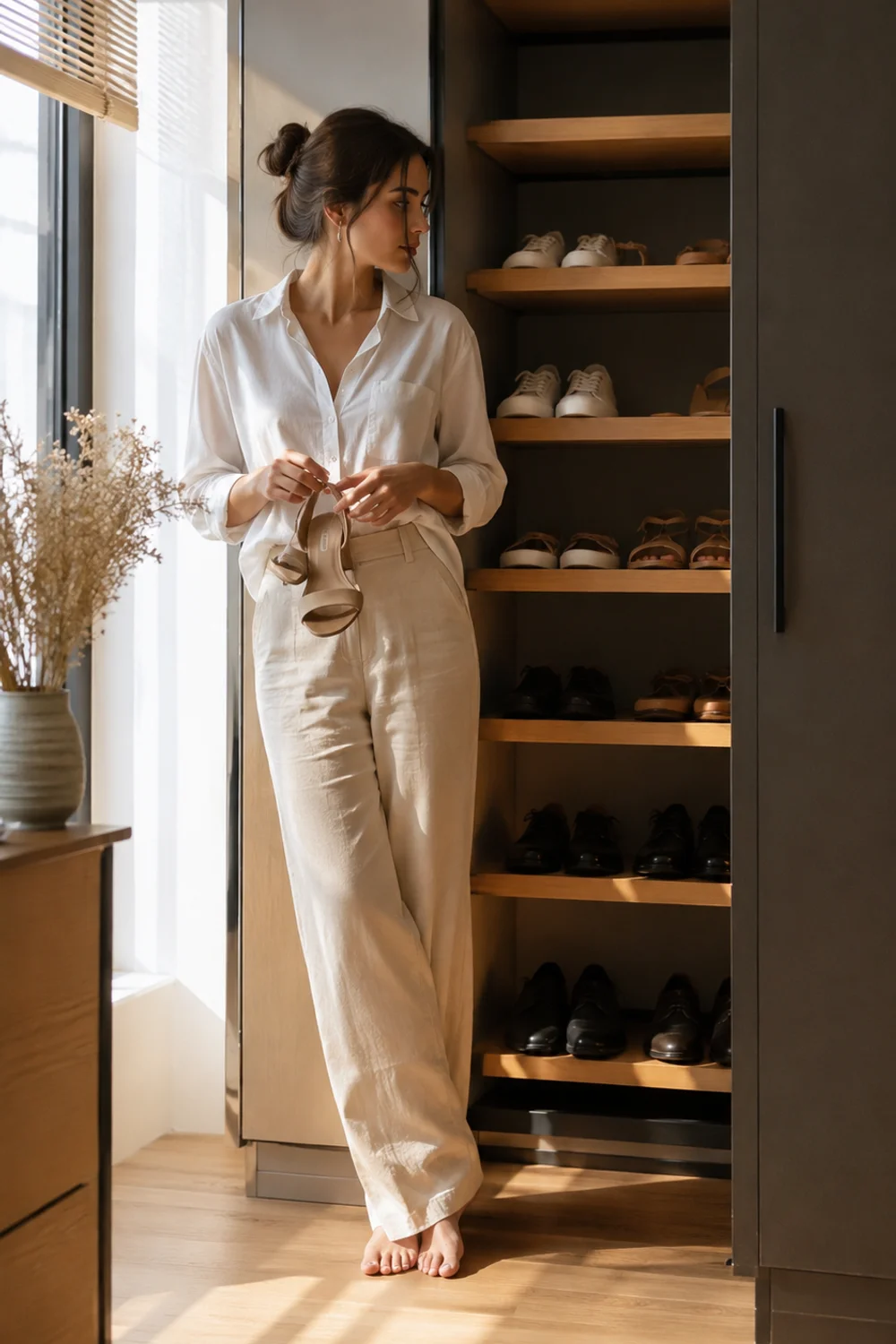
There’s a version of getting dressed that most people know well: scanning a pile of shoes with mild frustration, not seeing the pair you wanted, pulling out several others in the process of finding it, and leaving the closet with the floor in worse shape than when you arrived. It’s a small irritation, but it happens daily — and daily small irritations have a cumulative effect on how a home feels to live in. The right shoe storage eliminates this friction almost completely.
When shoes have a system — a fixed place for each category, clear visual access to every pair, and a structure that makes returning shoes as easy as taking them out — the morning routine becomes meaningfully different. The pair you want is where you expect it to be. The floor stays clear. Putting shoes away after wearing them takes seconds because the system accommodates the behavior naturally. This kind of friction-free daily experience is what separates organizational systems that last from those that deteriorate within weeks.
The emotional dimension of a well-organized dressing space is real and underappreciated. A closet that looks calm and considered, where everything has a place and the visual field is clean, creates a different internal state than a closet that feels like a problem to be managed. It explores how this extends to the broader dressing experience — and why aesthetic organization is not a vanity project but a practical one. The way a space looks in the morning affects the way you feel leaving it.
The deepest principle here is one worth returning to: storage is not a destination. You don’t organize a closet once and consider it finished. You build a system that fits how you actually live, and then you maintain it with habits that require almost no effort because the system is designed to support them. That’s what all the strategies in this article point toward — not a perfect closet, but a functional one that makes daily life a little more composed, a little more considered, and a little more yours.
Common Mistakes to Avoid
1. Buying storage before editing the collection
This is the single most common shoe organization mistake, and it costs both money and effort. People purchase beautiful tiered towers, clear box sets, or closed cabinets without first assessing how many pairs they actually have and how many they actually use. The storage fills up immediately — often with shoes that should have been donated — and the system feels overcrowded before it’s even properly established. The correct sequence is always: edit first, measure second, buy third.
2. Choosing a system that doesn’t match daily behavior
A beautiful pegboard wall display works brilliantly for someone who naturally hangs things up after use. It fails immediately for someone who tosses shoes toward the door and deals with it later. Before investing in any storage system, be honest about the actual daily habits in your household — not the idealized version of those habits, but the real ones. The best storage system is the one that fits the behavior, not the one that requires the behavior to change.
3. Storing boots without shapers
This is a slow-motion mistake that many people don’t notice until it’s too late. Tall boots stored without internal support collapse at the shaft, crease at the ankle, and gradually lose their shape in ways that are difficult to reverse. Boot shapers — or even rolled magazines as a temporary alternative — cost very little relative to the boots themselves and extend their usable life significantly. This applies to both expensive and inexpensive boots equally.
4. Ignoring vertical space
In a small space, the floor is never enough. Most people store shoes only at floor level — which wastes the wall planes, the door backs, and the high shelves that could accommodate archived or seasonal pairs. A tiered tower that reaches 1400mm holds twice the pairs of one that reaches 700mm, in the same footprint. Floating ledges on a bare wall add capacity without affecting floor space at all. Thinking vertically is the single most effective way to increase shoe storage in a small home.
5. Using inconsistent containers
A mix of different box sizes, opacities, and brands creates visual noise even when the contents are technically organized. The eye registers inconsistency as chaos. Committing to one container system — the same clear box, the same canvas bin, the same basket type — throughout the storage zone makes the result feel coherent and calm. This applies regardless of budget: a consistent set of inexpensive matching boxes looks more organized than an eclectic mix of expensive ones.
6. Not labeling archive storage
Off-season shoes stored in opaque boxes or canvas bags without labels become effectively invisible. When the season changes and it’s time to rotate, you’re left opening every container to find what you’re looking for — which is exactly the frustration that good organization is meant to eliminate. A simple label on the front of every archive container, indicating the category and season, takes thirty seconds and saves considerable time at every rotation.
Frequently Asked Questions
What is the best shoe storage solution for a very small entryway?
For a genuinely compact entryway — under 1200mm wide — the most effective options are either a slim closed cabinet with angled internal trays, or a wall-mounted floating ledge system that keeps the floor entirely clear. The key is choosing one solution and committing to it rather than combining multiple pieces that compete for the limited space. A single well-chosen piece that addresses both storage and visual calm will outperform two smaller pieces that collectively create more clutter than they resolve. If the entryway also lacks natural light, a closed cabinet in a light finish — white, off-white, or pale wood — keeps the space from feeling even smaller.
How many pairs of shoes should a small closet system realistically hold?
This depends on the storage method, but as a general benchmark: a standard tiered tower at approximately 1400mm height holds fifteen to twenty pairs; a section of floating ledges across a 1200mm wall holds eight to twelve pairs at varying heights; a set of twenty-four clear stackable boxes holds up to twenty-four pairs in a clean column. Most small closets can accommodate thirty to forty active pairs comfortably when the storage is properly structured. Beyond that, the archive strategy — rotating seasonal pairs in and out of primary storage — allows a larger total collection to coexist with a smaller active display.
Is it better to store shoes in open or closed storage?
Both approaches work well, but they suit different households and different aesthetics. Open storage — floating ledges, tiered towers, pegboard displays — requires consistent maintenance to look good, because everything is always visible. It works best for people who naturally return shoes to their designated spot and who enjoy the display quality of an organized collection. Closed storage — cabinets, hinged benches, opaque boxes — looks organized regardless of what’s inside, which makes it more forgiving for busier households. Many well-organized homes use both: closed storage in the entryway for everyday pairs, and open or clear storage inside the closet where daily visibility is more useful.
How do you store shoes in a bedroom with no closet?
Without a closet, the most effective options are under-bed storage for the bulk of the collection, a freestanding narrow shoe tower positioned beside or behind a door, and wall-mounted ledges in any available wall zone. A dedicated shoe storage piece — a slim cabinet, a storage bench, or a pegboard wall — can also serve as a room feature when styled intentionally. The key is defining a specific zone for shoes rather than allowing them to spread across the floor. One considered storage piece that holds the entire collection is always preferable to several improvised solutions that collectively take up more space and create more visual noise.
Can shoe storage look genuinely stylish in a small space?
Yes — and the most stylish results almost always come from consistency and restraint rather than from expensive pieces. A uniform set of clear boxes, a row of matching floating ledges, or a single well-proportioned closed cabinet all read as designed and intentional. What makes shoe storage look unstylish is inconsistency: mismatched containers, overcrowded surfaces, and systems that have clearly been outgrown. When the storage fits the collection, the collection fits the space, and the containers are visually consistent, shoe storage stops looking like a problem and starts looking like a considered part of the room.
Final Thoughts
A home that feels organized doesn’t necessarily have less in it. It simply has everything in the right place. Shoes are one of the categories that most visibly reveal whether a home has that structure — because they’re large, they’re numerous, and they live at the threshold between outside and inside, where the visual stakes are highest.
The strategies in this article aren’t about achieving a perfect, magazine-ready closet that requires daily effort to maintain. They’re about building systems that match how you actually live: systems that reduce friction, reward good habits, and make the daily ritual of getting dressed feel composed rather than chaotic. Whether that means a floating ledge by the front door, a row of clear boxes in the closet, or a hinged bench in the entryway, the right solution is always the one that fits the specific space, the specific collection, and the specific habits of the people who live there.
Start with one area. Fix the thing that bothers you most. Then let the clarity of that one system motivate the next. Organization rarely happens all at once — and it doesn’t need to. What it needs is a starting point and a structure that makes continuing feel natural. That’s what thoughtful shoe storage gives you: not just a tidier closet, but a slightly more considered version of home.
This post contains affiliate links. I may earn a small commission at no extra cost to you.
Get cozy inspiration delivered to your inbox.
✓ 14-page beautifully designed ebook
✓ Cozy decorating ideas
✓ Practical room-by-room inspiration
You’re in! 🎉
Thanks for joining the NestFlowHome community!
Your free ebook is already on its way to your inbox. If you don’t see it within a few minutes, please check your Promotions or Spam folder.
Join the NestFlowHome community for weekly decorating inspiration.

Timeless home decor ideas and slow living inspiration for a calm, beautiful life.