

The Ultimate Healthy Night Routine for Better Sleep and Productivity
By Emily | February 24, 2026
For a long time, I believed that the quality of my life was determined solely by what I did in the morning. Waking up early, starting the day productively, getting in a quick workout, following a structured schedule — that’s what I kept hearing everywhere. And yes, mornings matter. But what no one told me soon enough is this: truly good mornings begin the night before.
For years, my evenings were complete chaos. Laptop in bed, mindless scrolling through social media, late-night emails, “just one more episode” on Netflix – this was my default. Then I wondered why I woke up exhausted, why I couldn’t maintain focus, why I constantly felt like I was falling behind despite my “productive” mornings. The problem wasn’t my mornings. The problem was my evenings had never given my body or mind the chance to genuinely rest.
In this article, I’ll show you how to build an evening system that genuinely works, which specific habits create the biggest changes, what tools support consistency, and how to integrate everything in a way that feels like a ritual you look forward to – not another mandatory task.
If you wake up feeling scattered, if your mind keeps racing before bed, or if you simply want to live more calmly — this is for you.
1. Understand Evening's True Purpose

 Save it
The first mental shift happened when I realized that an evening routine isn’t some optional “wellness extra” – it’s a strategic, foundational decision. One of the main causes of daytime stress is decision fatigue. All day long, you make countless decisions: what to respond to, what to postpone, what to prioritize, what to worry about. By evening, your brain is literally exhausted from making choices. Your prefrontal cortex is depleted. When there’s no structure at that point, you automatically reach for the easiest sources of dopamine and stimulation: your phone, junk content, late-night snacking, endless scrolling.
When I started using a fixed but flexible evening system, the floating “what should I do now?” feeling disappeared entirely. I didn’t need motivation on tired evenings. I just followed my own predetermined protocol. The system made the decisions so my exhausted brain didn’t have to. This is the real power of an evening routine: it’s not about rest – it’s about regaining control. It’s about having a framework that supports you when motivation is lowest and your decision-making capacity is most depleted.
This understanding connects deeply to morning routines. If your evening doesn’t close well, your morning can never start well. Your nervous system carries unresolved stress into sleep.
As I explored in detail in How to Build a 5AM Morning Routine That Actually Works, the most effective mornings are built on the foundation of the previous evening. You can’t separate them. Your evening creates the conditions for your morning.
2. Implement a Digital Sunset: Why I Turn Off the World at 9 PM

 Save it
One of the biggest game-changers was introducing a “digital sunset” – a non-negotiable boundary when digital engagement simply stops. After 9:00 PM in my home, there is no email checking, no social media scrolling, no YouTube, no news consumption, no digital distraction of any kind. My phone literally leaves my bedroom and enters another room. A simple phone lock box or even a digital alarm clock became surprisingly valuable tools, ensuring my phone wouldn’t be the first and last thing in my hands.
I also use blue light blocking glasses if I’m still reading on a Kindle in the final hour before sleep. The transition feels marked and intentional: at this point, I’m no longer digitally available. The world can wait. Notifications can accumulate. Messages can arrive. None of it reaches me because I’ve created a genuine barrier.
The first three days of digital sunset were genuinely brutal. The first two weeks felt strange – an almost phantom limb sensation missing my phone. But from the third week onward, everything changed. I fell asleep faster. My sleep became deeper. I woke up less frequently during the night. My nervous system, no longer receiving constant stimulation and novel information until the moment I tried to sleep, could actually power down. The quality of sleep improvement was remarkable – not because I was doing anything additional, but because I’d removed a major obstacle to rest.
3. Let Go of Mental Clutter with a 10-minute Brain-Clearing Ritual

 Save it
One of my biggest realizations was that my insomnia wasn’t caused by not being tired enough — it was caused by my brain simply not receiving the signal that the day was over. My body was in bed, but my thoughts were still sitting in meetings, drafting emails, and rehearsing future conversations. Do you know that feeling when you’re physically exhausted but mentally still sprinting? That used to be my default evening state.
The brain dump offers a solution for exactly this. Every night, before starting any relaxing activity, I sit down with a notebook and begin writing out everything that’s circulating in my mind as mental noise. I don’t beautify it, structure it, or categorize it. It’s not a gratitude journal, not goal planning, not a productivity tool. It’s more like a mental trash bag where I pour out all my open loops.
I write down what remained unfinished that day, what I’m worried about, what I don’t want to forget tomorrow, or even a completely random idea that came to me in the shower. The point is not to organize my thoughts, but to physically move them out of my head onto an external surface.
For me, this evening ritual dramatically reduced the time it took to fall asleep. I used to toss and turn for 30–40 minutes; now I often fall asleep within 10. Not because I sleep better — but because I close the day better beforehand.
4. Optimize Your Physical Environment

 Save it
For years, I believed sleep quality was purely a matter of willpower – that with enough discipline, I could simply “sleep better” regardless of conditions. The truth is much simpler and more humbling: your body’s biology is completely indifferent to your intentions but extremely responsive to your environment. You cannot willpower your way to good sleep. But you can engineer your environment to support it.
When I consciously transformed my bedroom, I didn’t buy new furniture or renovate. I introduced new environmental stimuli strategically. The first change was complete darkness. A blackout curtain may not be a visible design upgrade, but it sends a clear biological message to your nervous system: there is no daytime here. Minimizing artificial lights, especially blue-toned light in evening hours, supports your body’s natural melatonin production – the hormone that signals sleep.
Next, I introduced scents. A lavender or cedarwood essential oil diffuser doesn’t just create pleasant atmosphere – it conditions your nervous system. After a few weeks, my brain literally associated that specific scent with sleep. The moment I smelled it, my body automatically began to slow down. Finally, I adjusted temperature slightly downward, because core body temperature drops during sleep. A slightly cool room supports this biological process. My bedroom became more than just a place where I sleep. It became a space that actively helps me fall asleep – an environment so aligned with sleep biology that rest becomes the natural response.
5. Prepare Your Next Day: 15 Minutes That Give Hours Back

 Save it
My mornings used to start with rushing and micro-stress. What should I wear? Where are my keys? What was I supposed to do today? These seem like small things, but mentally they create stress at the very beginning of the day. More importantly, they require decisions at a time when your prefrontal cortex isn’t yet functioning at full capacity. You’re starting your day already behind, already making suboptimal choices.
When I started preparing for the next day in the evening, my goal wasn’t to be more efficient – it was to be calmer. The 10 to 15 minutes I spend setting out clothes, reviewing my calendar, preparing my bag, even setting up the coffee maker became a kind of mental safety net. The morning no longer starts with decisions and scrambling. It starts with action. Everything is already in place.
This becomes especially important if you’re building an early wake-up routine. When I began establishing a 5:00 AM routine, I discovered it only works sustainably if the previous evening has already prepared the ground. As I discussed in Small Daily Habits That Lead to Big Life Changes, these small evening favors for your future self don’t just save time – they build confidence. In the morning, it feels like someone has already taken care of you. You’re starting from a position of support and care. This psychological foundation changes everything about how the morning unfolds.
6. Slow Down Your Body with Physical Practices for Evening Calm

 Save it
Most evening routines emphasize mental calming while your body continues operating in “daytime mode.” Your nervous system doesn’t switch off just because you decide it’s time to rest. It needs physical signals that clearly communicate: the day is over, it’s safe to slow down now. Your body must participate in the transition, not just your mind.
For me, a warm shower became one of those powerful signals. Not a long luxurious spa experience – more of a transitional ritual between day and night. The slight increase in body temperature followed by the cooling effect afterward supports the biological processes necessary for sleep onset. Your body naturally cools to sleep, and a warm shower initiates this cascade.
This is followed by a few minutes of gentle stretching on a yoga mat – not a workout, just releasing the tension that accumulated during the day in shoulders, hips, and lower back. It’s surprising how much a tight hip flexor or overworked trapezius can unconsciously prevent sleep. Finally, I practice a few minutes of slow, conscious breathing. The 4-7-8 technique – 4 seconds inhale, 7 seconds hold, 8 seconds exhale – works as a physiological brake on your nervous system. Not meditation, not spiritual, just neurobiology: conscious slow breathing activates your parasympathetic nervous system, literally resetting your physiology toward rest.
7. Build Identity Through Systems Instead of Motivation
 Save it
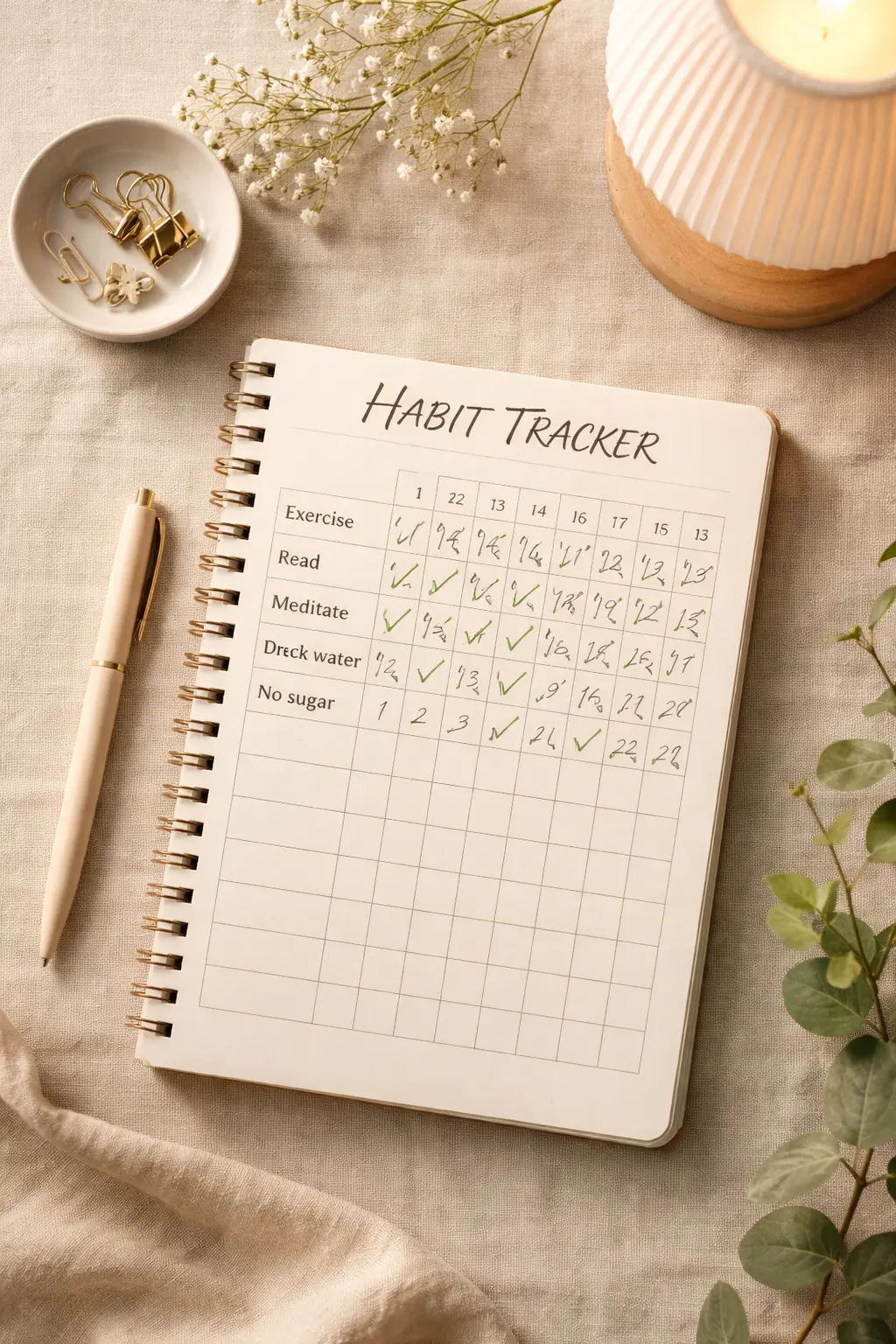
My evening routine doesn’t work because I’m enthusiastic every single night. It works because I don’t wait for enthusiasm. Motivation is unpredictable and unreliable. After a long, depleting day, you’ll rarely feel like journaling or stretching or doing anything remotely difficult. This is precisely why routines are so powerful. When your evening consists of a predetermined sequence that you follow even when tired, the system replaces decision-making and motivation.
A simple habit tracker provides visual feedback. Perfection isn’t the goal. Continuity is. When you see consecutive days where you’ve stuck to your routine, something shifts at the identity level. You’re no longer someone who “sometimes tries.” You become someone who closes the day intentionally every single evening. This identity shift is where real transformation happens. You’re no longer relying on motivation. You’re relying on who you’ve become through consistent action.
How to Build Your Own Night Routine?
The biggest mistake people make is reading an inspiring article and then attempting to implement everything simultaneously the next evening. Digital detox, journaling, tea, stretching, meditation, reading – it sounds wonderful in theory, but in practice it leads to quick burnout and abandonment. Sustainable change requires a different approach. When I built my own routine, I started by observing my current evenings objectively. When do I naturally begin to feel tired? At what point am I no longer productive but not truly resting either? Which activities leave me wired versus genuinely relaxed? After which behaviors do I sleep worse?
Based on these observations, I chose exactly two elements to start: a digital sunset and a brain dump ritual. Nothing more. For two full weeks, I focused only on maintaining these two. Once they became automatic – requiring minimal willpower or effort – I added preparing for the next day. Only after that addition felt natural did I introduce stretching and breathing work. This gradual, sequential approach meant each new element built on a foundation of established habits rather than competing with fragile new routines.
Track your routine visually. Use a simple calendar or habit tracker. Mark each day you complete your evening ritual. Don’t aim for perfection – 70% consistency is sustainable; 100% is often unsustainable. Observe which elements genuinely serve you versus which you’re maintaining because they sound good in theory. Remove what doesn’t work. Keep what does. The goal isn’t perfection or matching someone else’s routine. The goal is that your evening clearly feels like yours – designed for your specific nervous system, your specific schedule, your specific needs. When an evening routine feels personal rather than imposed, consistency becomes natural rather than forced. Understanding where people commonly struggle with evening routines helps you anticipate and avoid these pitfalls in your own practice.
Common Mistakes – What Ruins Your Night Routine
1. Attempting Too Many Changes Simultaneously
Starting with a complete evening overhaul leads to burnout. Choose one or two elements and master them before adding others. Gradual addition beats comprehensive overwhelm.
2. Ignoring Your Specific Body and Schedule
Not everyone feels tired at 10PM or needs identical elements. Design your routine around when you actually become tired, what genuinely relaxes you, and what your schedule actually allows.
3. Keeping Your Phone in Your Bedroom
This single mistake undermines everything else. Your phone’s presence alone – even off – creates anticipation and prevents genuine rest. It must leave your bedroom entirely.
4. Skipping the Preparation Step
Preparing tomorrow evening saves significant morning stress. This 15-minute investment pays dividends immediately, improving both sleep and morning ease.
5. Treating Your Routine as Optional
Consistency beats perfection. Missing days trains your brain that the routine isn’t important. Commit to showing up even when unmotivated, and the routine compounds.
Frequently Asked Questions
How long does it take to build a working night routine?
Realistically, it takes 2–4 weeks for a new habit to begin feeling automatic. The key is not trying to adapt to the entire system at once — build it modularly.
What happens if one evening completely disrupts my routine?
Nothing catastrophic. The purpose of a routine isn’t flawless execution — it’s maintaining direction. Simply return to it the following evening — even if you only do the minimum version.
I work in the evenings. Can this still work?
Yes — but in this case, a shortened “closing sequence” becomes even more important. It can be as simple as 10 minutes of journaling and 5 minutes of stretching. The key is having a clear boundary between work and sleep.
What if my mind races even more after journaling?
This can happen at the beginning. In that case, a short breathing exercise or a warm shower can help signal physical and mental slowdown.
Conclusion
For me, an evening routine didn’t become another productivity tool, but a kind of safety net. A space for transitioning from a constant state of readiness into genuine rest. Since I started consciously closing my days, I not only sleep better — I make calmer decisions, respond more patiently, and far less often feel that subtle, underlying tension that used to be constant.
It didn’t happen overnight. There was no dramatic turning point. Rather, it was a series of small, repeated evenings that slowly created a new baseline.
If you give yourself time and aim not for perfection but for continuity, your evenings will quietly begin to rewrite the quality of your days. Real change often doesn’t happen where you can see it — but where you finally slow down.
This post contains affiliate links. I may earn a small commission at no extra cost to you.

Get cozy inspiration delivered to your inbox.
✓ 14-page beautifully designed ebook
✓ Cozy decorating ideas
✓ Practical room-by-room inspiration
You’re in! 🎉
Thanks for joining the NestFlowHome community!
Your free ebook is already on its way to your inbox. If you don’t see it within a few minutes, please check your Promotions or Spam folder.
Join the NestFlowHome community for weekly decorating inspiration.

Timeless home decor ideas and slow living inspiration for a calm, beautiful life.