
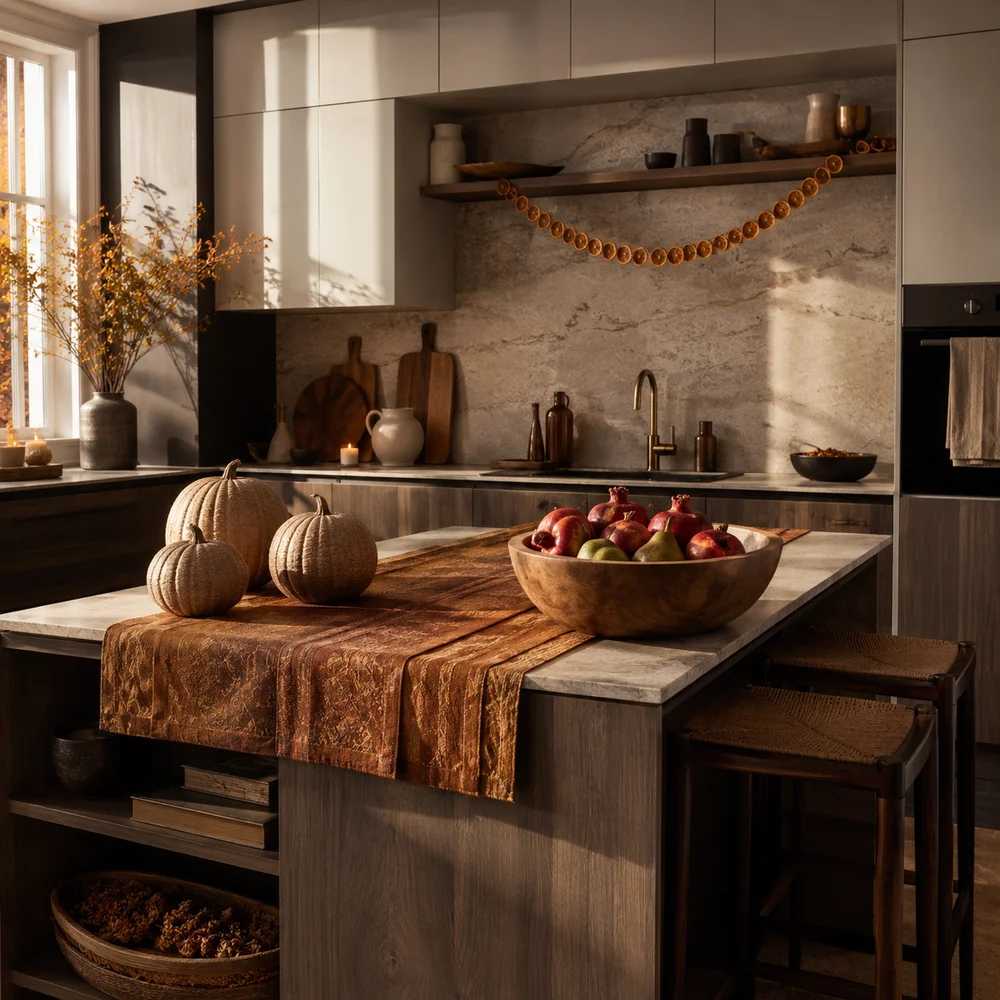
How to Create a Cozy Fall Kitchen in a Weekend
By Emily | August 18, 2026
There is a particular smell that means the season has changed before you’ve consciously noticed the light doing it — something warm and spiced drifting from a pot on the stove, catching you off guard on your way to the coffee maker. That smell is the fastest route into a room’s atmosphere, faster than any object you could set on a shelf, and it costs almost nothing to create. Most people wait until their kitchen feels flatly, stubbornly summer-neutral before deciding something needs to change, and then they imagine the fix requires weeks: a full palette overhaul, new hardware, a shopping list as long as a renovation.
It doesn’t. A kitchen can go from bright and bare to genuinely autumnal in two focused days, without touching a single cabinet or wall. This guide is built as a real weekend, not a vague list of ideas to get to eventually. Saturday is for the anchor moves — the handful of choices that do the most work and set the tone for everything smaller that follows. Sunday is for the layer of finishing touches that most people skip entirely, the details that make a kitchen feel considered rather than seasonally sprinkled. By Sunday evening, nothing will look temporary, and nothing will have required a single trip to a hardware store.
What follows is nine concrete, sequential moves — four for Saturday, five for Sunday — each chosen specifically because it reads as unmistakably fall, not as a slightly warmer version of whatever was already there.
1. Start With Scent, Not Objects: A Stovetop Simmer Pot as Your Kitchen's Fall Signature

 Save it
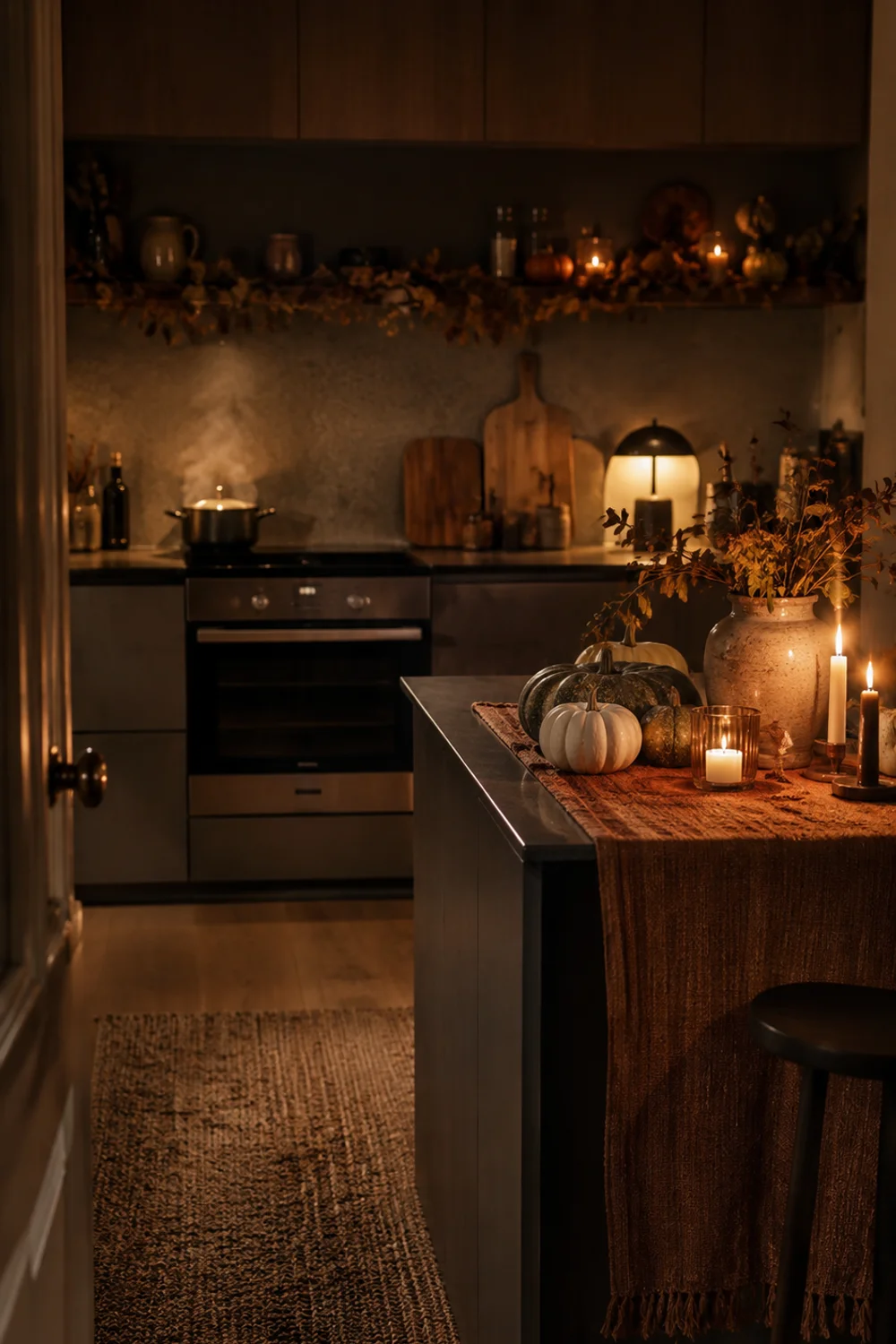
Before you buy a single decorative object, put something on the stove. This is the one move that changes how the entire room feels within twenty minutes, and it’s the reason to do it first, on Saturday morning, before anything else arrives. A stovetop simmer pot — a shallow saucepan of water with citrus peel, whole spices like cinnamon and clove, and a few bruised herbs kept at a bare simmer — fills a kitchen with the exact scent people associate with fall interiors, and it does it ambiently, without a diffuser humming somewhere or a candle burning down while you’re not in the room.
A candle can’t do what this does, because it’s static — the same scent, the same intensity, from the moment it’s lit to the moment it’s blown out. The simmer pot shifts subtly as the water reduces, growing more concentrated toward the end of the afternoon, so the room never smells quite the same at four o’clock as it did at ten. It’s also genuinely functional: the steam adds a little humidity back into a space that heating systems dry out once the weather turns, which matters more than people realize once the furnace starts running daily.
Keep a dedicated vessel for this rather than pulling out an everyday saucepan each time — a heavier enamel pot holds heat more evenly at a low simmer and won’t scorch as easily if the water runs a little low while your attention is elsewhere. Refresh the water and spices every two to three days rather than letting the same batch sit for a week; the scent fades faster than you’d expect, and a tired simmer pot smells more like boiled water than autumn. Let this run in the background while you move through the rest of Saturday’s tasks. The scent will do more to convince a visitor it’s fall than any object you set on the counter, and it’s the one element of this whole weekend that costs pennies rather than a purchase.
2. The One Table Runner That Sets the Whole Season
 Save it
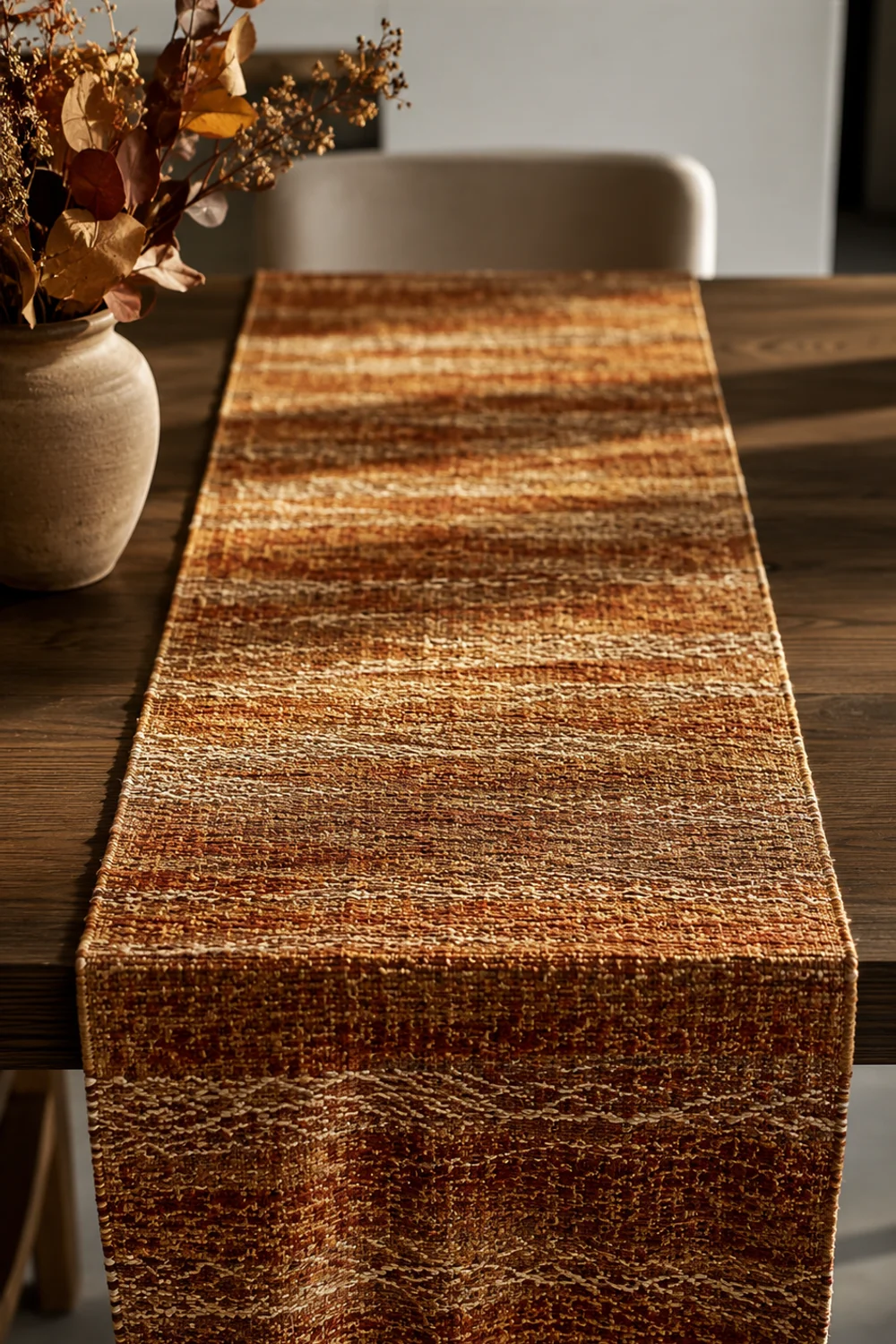
If your kitchen table or island runner has stayed the same since spring, this is the second Saturday move, and it’s the one with the most visual leverage per minute spent. A single length of fabric across a table does something a dozen small objects can’t: it announces a season the instant someone walks into the room, before they’ve registered anything else on the counters or shelves.
Choose a runner with genuine pattern and warmth — a jacquard weave in rust and gold reads as considered rather than themed, the way a plain orange table runner with a printed leaf motif tends to. The weave itself catches light differently than a flat cotton print, which matters more than people expect; texture is what separates a runner that looks like a seasonal purchase from one that looks like it belongs in the room year-round, just swapped for its autumn version. Hold it up to the window before you commit — a runner with actual dimension in its weave will show subtle shadow and shine as you turn it, while a flat print stays uniformly matte from every angle.
Length matters as much as pattern. A runner that stops several inches short of the table edge on either side looks like an afterthought, while one with six to eight inches of overhang on each end reads as deliberately chosen for that exact surface. If your kitchen currently runs on a fully neutral palette and you’re nervous about introducing this much color in one move, it helps to understand how a palette absorbs a single strong accent without feeling disrupted; Simple Kitchen Color Palettes That Work in Any Home walks through exactly how much saturation a neutral kitchen can hold before it stops reading as intentional. A runner is the lowest-risk way to test that threshold, since it comes off the table in five seconds if you change your mind, and it’s a mistake fewer people make than you’d think — most just never try.
3. A Stoneware Pumpkin Trio Instead of Real Ones That Rot by Week Two
 Save it
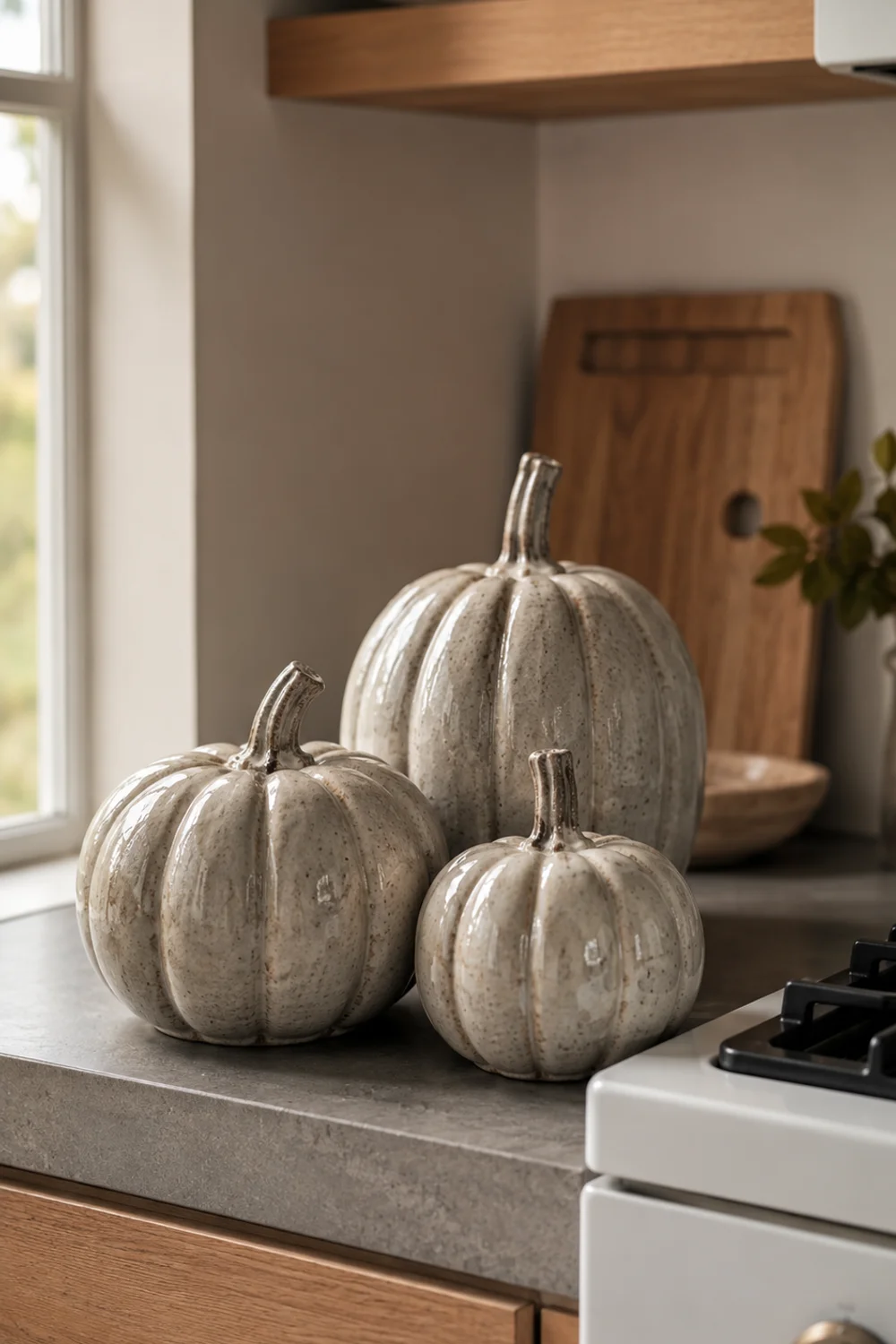
Real pumpkins are lovely for exactly ten to fourteen days before they start to soften at the base, and nobody wants to be checking the underside of a gourd every morning for the rest of October. A small stoneware pumpkin trio — three sizes, matte glaze, the kind of quiet interpretation that reads as sculpture rather than seasonal prop — solves the same visual craving without the maintenance, and it can stay out through Thanksgiving without a second thought or a single soft spot developing on a counter you’d rather not have to clean.
The placement matters more than the object itself. Cluster the three at varying heights rather than lining them up in a row; an uneven grouping reads as if it happened naturally, while a straight line reads as staged and slightly stiff, the way a display case looks rather than a lived-in counter. Set them where the counter naturally narrows — beside the stove, at the end of a run of cabinets — rather than in the dead center of an open expanse, where they’ll look stranded with nothing anchoring them to the architecture around them.
The matte glaze is worth insisting on over a glossy finish. A shiny ceramic pumpkin catches overhead light in a way that reads as slightly plastic from across the room, while a matte surface absorbs light the way an actual gourd’s skin does, which is most of what convinces the eye it belongs. Notice, too, how a genuine pumpkin’s ridges catch shadow unevenly along its curve, and look for a glaze that mimics that same soft variation rather than a perfectly smooth, uniform surface. If you’re rethinking how objects sit on your counters more broadly and want the underlying logic behind grouping and negative space, The Secret to Beautiful Yet Functional Kitchen Counter Decor covers the principles that make any counter vignette — seasonal or not — feel intentional rather than cluttered, and worth applying to this trio the same way you would to any other grouped display.
4. Hanging a Dried Citrus-and-Cinnamon Garland Along the Open Shelf
 Save it
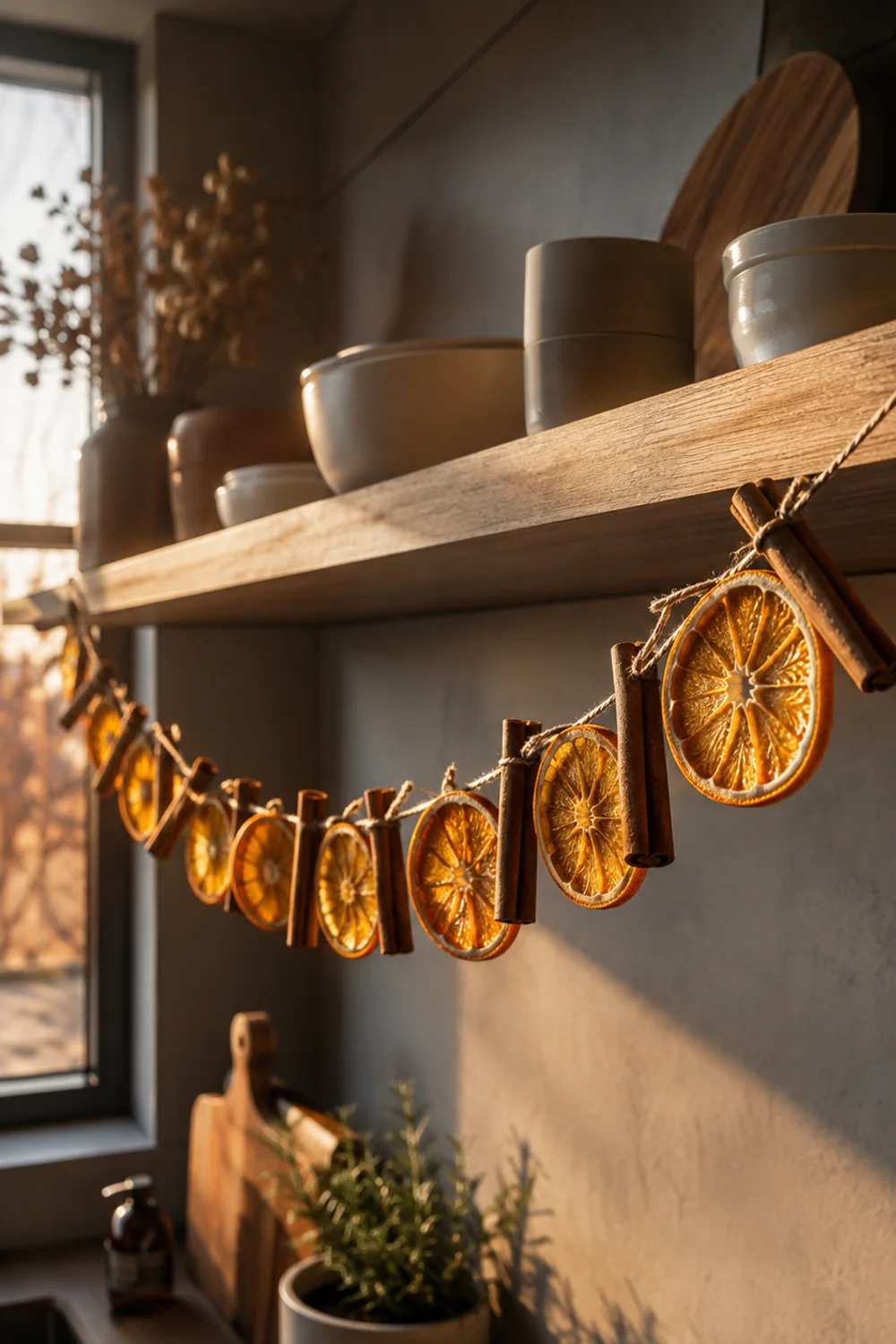
This is the last of Saturday’s anchor moves, and it’s the one that turns a functional shelf into something a little more theatrical. A dried orange slice and cinnamon stick garland, strung loosely along the front edge of an open shelf or draped across the top of a cabinet run, brings texture and dimension to a surface that’s usually flat and utilitarian. Unlike fresh greenery, it needs no water and won’t wilt by the second week of the season — it will, if anything, smell faintly warmer and more concentrated as the weeks pass and the citrus continues to dry.
Let it drape rather than pulling it taut. A garland stretched perfectly straight looks like a party decoration; one left with a gentle sag in the middle, the way it would naturally hang under its own slight weight, looks like it’s always belonged there. Anchor each end with a small hook or a loop of twine around something already fixed to the shelf, so it holds its curve without needing to be re-hung every time someone reaches for a mug.
If your shelves are already doing a lot of storage work, this is a good moment to think about how much visual weight an upper surface can hold before it competes with what’s below it — Above Fridge Styling Ideas for a Beautiful and Organized Kitchen covers that exact balance for the vertical space most kitchens waste or overload without realizing it. A single garland is rarely too much for even a busy shelf, but two decorative layers stacked on the same surface usually is, so resist the urge to add greenery or a second string of anything alongside it. If the dried orange slices start to darken slightly at the edges after a few weeks, that’s expected rather than a flaw — a little deepening in color only adds to the sense that it’s been hanging there all season, gathering warmth rather than fading.
That’s Saturday finished. Step back before you start Sunday’s list — the room should already feel unmistakably different by dinner, on scent and color alone, and that difference is worth sitting with for a night before adding anything more.
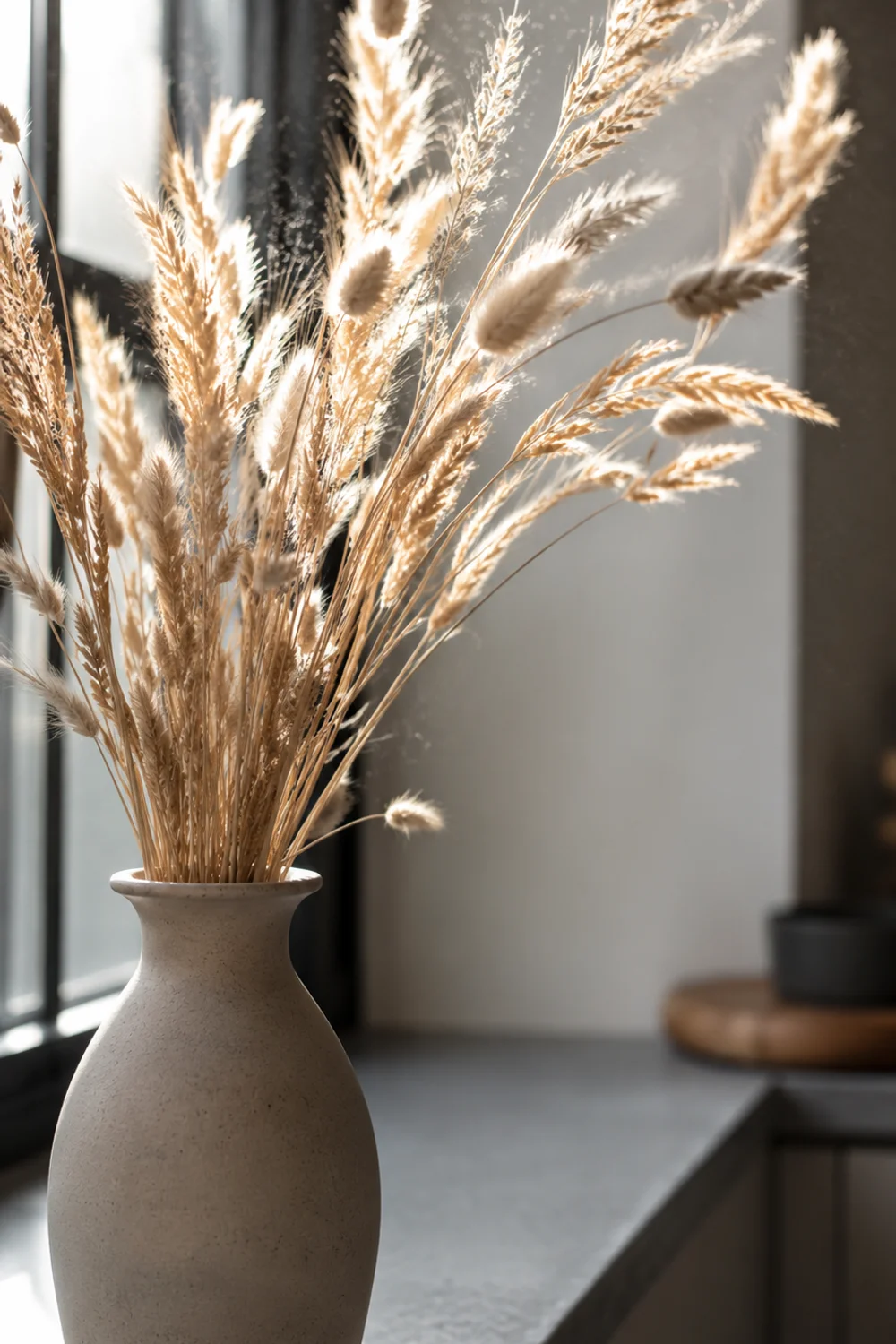
5. A Dried Wheat Bundle to Replace Your Everyday Vase Flowers
 Save it
Sunday morning, and the kitchen already smells and looks like a different room than it did Friday night. Today’s five moves are smaller individually, but they’re the layer most people skip, and skipping them is exactly why a fall refresh can end up looking like four big purchases sitting in an otherwise unchanged room rather than a genuinely cohesive shift.
Start by pulling whatever’s currently in your everyday vase — likely something green, likely something that’s been there since summer — and replacing it with a dried wheat and bunny-tail grass bundle. The color alone does most of the work: pale gold and soft cream instead of green, immediately reading as harvest rather than garden. It also solves a real problem fresh stems create in fall, which is that cut flowers wilt faster once the heating comes on and the air dries out; dried material simply doesn’t have that clock running against it, so it can sit on the same counter for the entire season without a single wilted stem to trim away.
Keep the bundle a little asymmetric rather than fanned out evenly on all sides — a slight lean in one direction, as if it were cut and gathered by hand rather than arranged with a protractor, is what keeps it from looking like a static prop. Trim any stems that extend well past the others; a bundle with one or two pieces towering over the rest reads as unedited rather than intentionally varied, and a few extra seconds with kitchen shears is the entire fix. Place the vase somewhere it catches a little natural light during the day — a windowsill or the end of the island nearest the window — since dried wheat has a subtle sheen that only really shows itself when the light moves across it, the way it would on real stalks in a field at the end of summer.
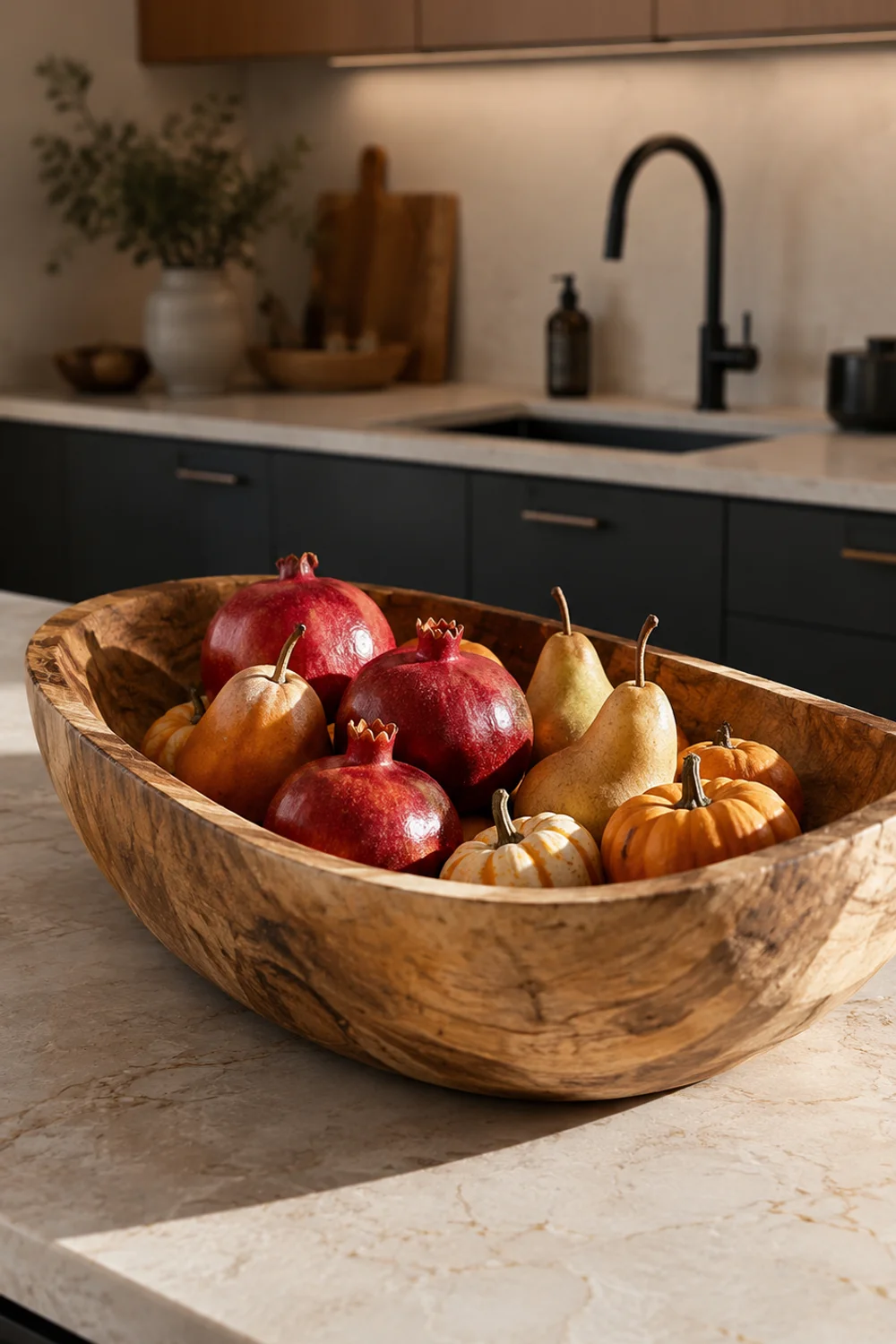
6. Restocking the Fruit Bowl With Fall's Actual Colors
 Save it
Most kitchens have a fruit bowl that never really changes character — bananas, apples, whatever’s on rotation, sitting in whatever vessel has always held them. This is the moment to actually notice what’s in season and let the bowl do double duty as decor: pomegranates for their deep garnet skin, a few small sugar pumpkins if you want an edible echo of the stoneware trio from Saturday, pears in their softer ochre tones, and a couple of fresh figs if your grocery store carries them this time of year. The color story does the work here, not the vessel — though the vessel still matters quite a bit once the produce is actually in it.
Swap a plain ceramic or plastic bowl for a hand-carved mango wood dough bowl, the wide, shallow, slightly irregular shape traditionally used for kneading bread. Its grain and warmth read as harvest-table rather than kitchenware, and its scale means it can hold a genuinely generous pile of produce without looking overstuffed, which a smaller round bowl rarely manages once you’ve added more than an apple or two.
Rotate what’s inside it every few days rather than letting the same pieces sit until they’re overripe — this is a display you actually eat from, and that turnover is part of what keeps it looking fresh rather than staged. If the wood grain runs a shade lighter or darker than the rest of your kitchen’s existing wood tones, don’t worry about matching exactly; a slight variation between pieces reads as gathered over time rather than bought as a coordinated set. Set the bowl somewhere it earns its keep, within arm’s reach of where you actually grab fruit during the day, rather than tucked onto a shelf as a purely decorative object nobody touches — a harvest bowl that never gets emptied and refilled starts to look like a still life instead of a working part of the kitchen.
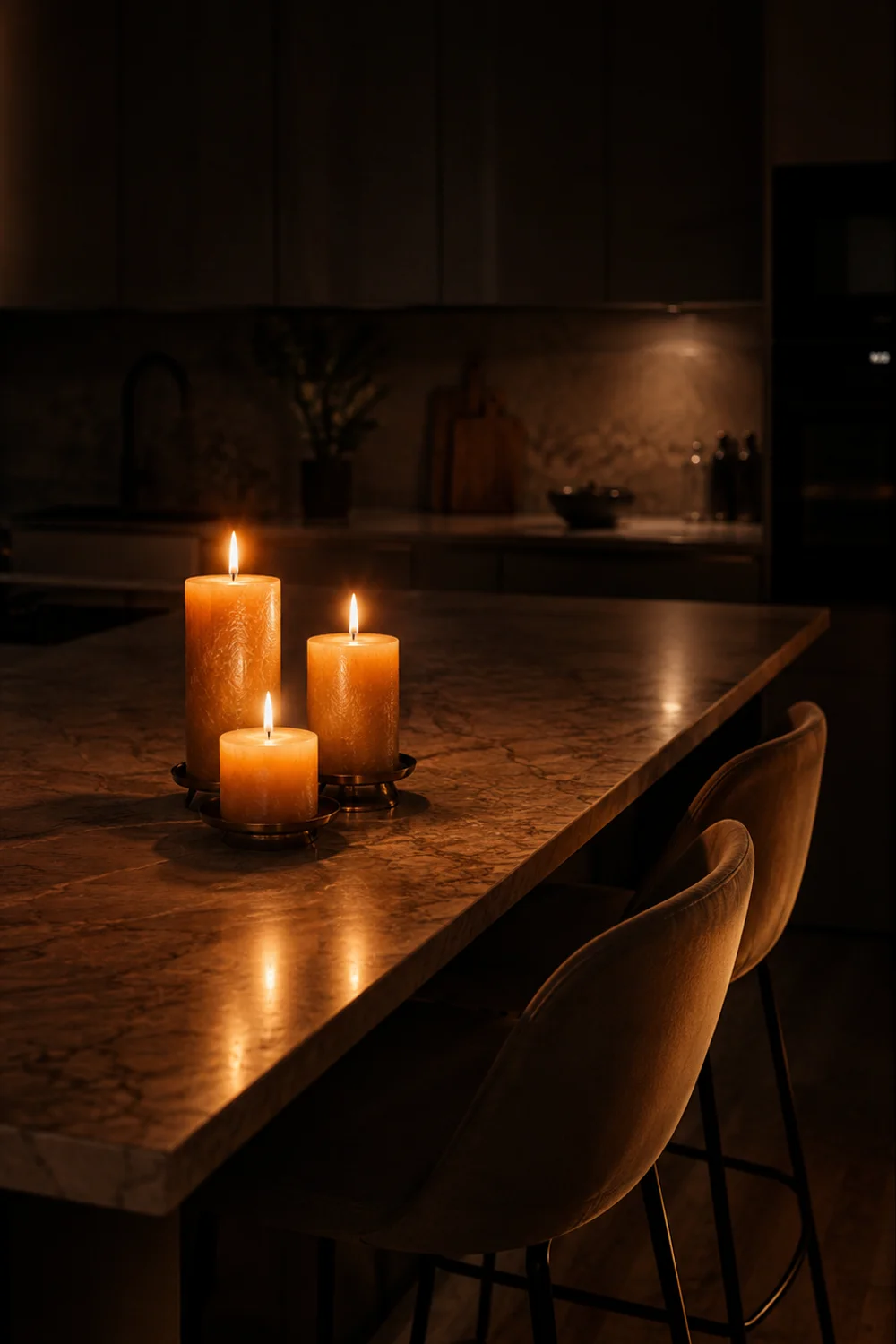
7. Candlelight at the Counter: Making the Kitchen Worth Lingering In
 Save it
Kitchens are transit spaces more often than they’re rooms people choose to sit in, and fall is the season that can change that — if the light supports it. Overhead lighting alone will never make a counter or a stool feel like somewhere to stay; it takes a lower, warmer, flickering source at eye or table height to do that, and most kitchens simply don’t have one without a deliberate addition.
A small cluster of hand-poured beeswax taper candles, grouped at slightly staggered heights near wherever you actually sit — a counter stool, a breakfast nook, the end of the island closest to a chair — does more to invite lingering than any cushion or throw could. Beeswax burns with a warmer, more golden flame than paraffin and carries a faint natural honey note instead of an added fragrance, which matters in a room where you’re also cooking and don’t want competing scents fighting with whatever’s on the stove.
Use simple, low holders rather than tall formal candlesticks — the goal is a pool of light at table height, not an eye-level flame you have to talk around during a meal. Light them for the twenty minutes it takes to eat breakfast on a Sunday and you’ll understand immediately why this section exists — the same stool that felt purely functional on Tuesday starts to feel like somewhere worth sitting a little longer, and that shift in how a space is used is worth more than almost anything else on this list. Keep a small dish or tray beneath the holders to catch any drips, and trim the wicks to roughly a quarter inch before each lighting so the flame stays small and steady rather than smoking or guttering unevenly through the meal. Group them in odd numbers rather than pairs — three candles at three slightly different heights reads as a considered arrangement, while two matched candles side by side reads more like a table-setting kit than something you assembled with intention.
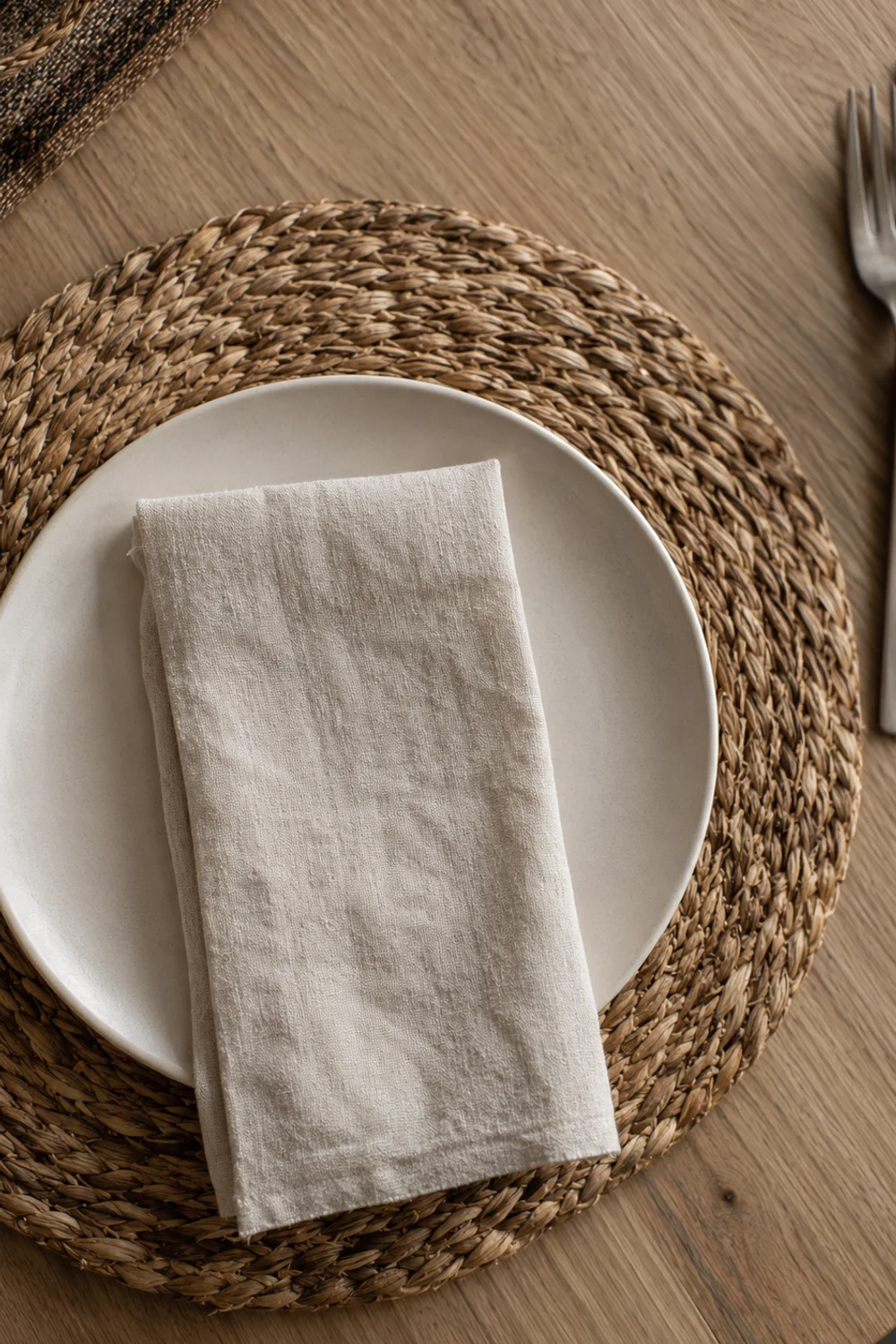
8. Setting the Table With a Literal Harvest Texture
 Save it
Every move so far has leaned on color, scent, or light. This one leans on a material that simply doesn’t exist in a kitchen the rest of the year: dried corn husk, woven into flat, natural-toned placemats that carry an almost basket-like texture under a plate. It’s a raw, literal harvest material rather than an interpretation of one, and precisely because it’s unexpected on a table, it reads as considered rather than decorative-aisle generic the way a printed leaf-pattern placemat tends to.
Use these under everyday dinnerware rather than saving them for a single holiday meal — a set left out through the season earns its place the way the runner from Saturday does, by being lived with daily instead of unwrapped once and packed away. The rough, slightly irregular weave of each mat also does something useful next to smooth stoneware or glass: it gives the table setting the same texture layering that makes a room feel finished, at a fraction of the effort a full redecoration would take.
Wipe them with a barely damp cloth rather than running them through a dishwasher or soaking them, since the woven husk can lose its shape if it gets too wet for too long. Store them flat rather than rolled when the season ends, and they’ll hold their form through next fall without a single crease to steam or press out. Pair them with plain, unpatterned dinnerware if the rest of your table is already busy with the runner and a centerpiece — the placemats carry enough visual interest on their own, and a patterned plate on top of a woven mat can start to feel crowded rather than layered. Set one at each place before guests arrive rather than passing them out mid-meal; the moment someone sits down to a table already dressed this specifically is exactly the impression a weekend of small, deliberate choices is meant to leave.
9. The Sunday-Night Reset: Keeping It Looking Intentional Through Thanksgiving
 Save it
The last task of the weekend isn’t a purchase — it’s a five-minute habit, done Sunday evening once everything else is in place. Walk the kitchen the way a guest would, starting at the doorway: is the simmer pot topped up with water so it doesn’t scorch dry overnight, are the taper candles standing straight rather than leaning in their holders, has the garland slipped from its drape into something closer to a tangle after a few days of daily movement around it, and does the fruit bowl still look like something worth photographing rather than something to be quietly finished off before it turns.
This is the difference between a kitchen that looks freshly styled for one photograph and one that holds its atmosphere for ten weeks straight. Build this walk-through into whatever your existing Sunday routine already is — before groceries, before meal prep for the week — and it takes almost no extra time, because you’re only ever adjusting three or four small things rather than restyling the whole room from scratch each time.
A fall kitchen that’s genuinely lived in will drift slightly out of place every few days; the reset is what keeps it looking chosen rather than neglected. Treat it the same way you’d treat wiping down a counter — a small, unglamorous habit that has an outsized effect on whether a space feels cared for. Skip it for two weeks running and you’ll notice the difference the moment you walk back in; the garland will have slumped, the candles will have burned unevenly, and the whole effect will read as tired rather than seasonal. Keep the habit going right through Thanksgiving, then let it fold naturally into whatever winter routine replaces it — the reset itself is the one part of this weekend that never really ends until the season does.
Common Mistakes
1. Buying every object before testing the scent and color first
The simmer pot and the table runner do more per dollar spent than any other single item on this list, yet they’re often the first things people skip in favor of small trinkets. Start with those two, live with them for a day, and you’ll have a much clearer sense of what the room actually still needs before you commit to anything else.
2. Choosing real pumpkins and gourds for a display meant to last the season
Fresh produce is beautiful for about two weeks and then becomes a maintenance problem nobody wants to deal with. Reserve real pumpkins for the porch, where a little weathering reads as charming, and keep stoneware or wood versions on the counters, where they need to survive well past October without a soft spot forming underneath.
3. Pulling the runner and garland taut instead of letting them fall naturally
A dish towel folded with military precision and a runner stretched drum-tight both signal effort in a way that undercuts the cozy, unstudied feeling fall decor is supposed to create. Let fabric drape and garlands sag slightly — the imperfection is what reads as authentic rather than staged, and it’s an easy adjustment once you notice it.
4. Lighting candles only for photographs instead of actual use
A candle that’s lit once for a picture and never again isn’t decor, it’s a prop. If the point of the taper candles is to make a counter or nook worth lingering in, they need to actually be lit during the moments you’d want to linger — a weekday breakfast, not just a Sunday styling session captured for later.
5. Skipping the Sunday-night reset entirely
Most fall kitchens don’t fail because the initial styling was wrong; they fail because nobody checks on it again until it’s visibly drooping. A five-minute weekly walk-through is the entire difference between a display that lasts one weekend and one that holds through Thanksgiving without a single element looking tired.
Frequently Asked Questions
Do I need to do all nine steps in one weekend, or can I spread them out?
The two-day structure exists because Saturday’s four moves are the ones with the most visual and sensory impact, and doing them together gives you an immediate sense of the room’s new atmosphere. That said, nothing breaks if Sunday’s five moves happen the following weekend instead — the sequence matters more than the exact timing, and each move still works on its own if you’d rather stagger the whole project.
Will the stovetop simmer pot scent linger in fabric or upholstery nearby?
Not meaningfully, since it’s simmering water rather than an oil diffuser or a heavily scented candle, and the scent disperses rather than settling into textiles the way smoke or heavy fragrance oils sometimes do. If your kitchen is very open to a living room with soft furnishings, simmer for shorter stretches rather than leaving it on all day, just to be cautious.
Is it safe to leave the simmer pot unattended while I do other Saturday tasks?
Keep it within earshot and check it every twenty to thirty minutes to top up the water, since the risk is the pot running dry and scorching, not the simmering itself. Setting a phone timer as a reminder is an easy habit to build alongside the ritual, and it becomes automatic after the first weekend.
What if my kitchen is already fairly warm-toned — do I still need all nine ideas?
A kitchen that’s already warm in undertone will need less color correction from the table runner and fruit bowl, so lean harder into the sensory layers instead — scent, candlelight, and texture — which do the most to signal a season change regardless of your existing palette or cabinet color.
How do I store everything when the season ends without it looking abandoned in a closet?
Keep the stoneware pumpkins, dough bowl, and vase together in one labeled bin so the full set moves in and out as a unit rather than as scattered individual pieces you have to hunt for next October. The dried garland and wheat bundle are the two most fragile items — wrap them loosely in tissue rather than compressing them flat, and they’ll hold their shape for years of reuse.
Final Thoughts
None of this required a renovation, a new color on the walls, or even a full day of continuous effort — just two focused afternoons and a handful of objects chosen because they say fall unmistakably rather than vaguely. A kitchen reads as seasonal through specificity, not volume: one scent that fills the room, one runner with real color, one bowl with real texture, all of it maintained rather than set once and forgotten by the second week of the season. Do the nine steps in order, keep Sunday night’s five-minute check going through the rest of autumn, and the room will still feel this considered well past the first week of November, long after a display built in an afternoon would have started to look tired. The whole point was never to make the kitchen look like fall for one weekend — it was to build a set of small, sustainable habits that carry the season through to the moment winter decor takes over instead.
This post contains affiliate links. I may earn a small commission at no extra cost to you.
Get cozy inspiration delivered to your inbox.
✓ 14-page beautifully designed ebook
✓ Cozy decorating ideas
✓ Practical room-by-room inspiration
You’re in! 🎉
Thanks for joining the NestFlowHome community!
Your free ebook is already on its way to your inbox. If you don’t see it within a few minutes, please check your Promotions or Spam folder.
Join the NestFlowHome community for weekly decorating inspiration.

Timeless home decor ideas and slow living inspiration for a calm, beautiful life.