
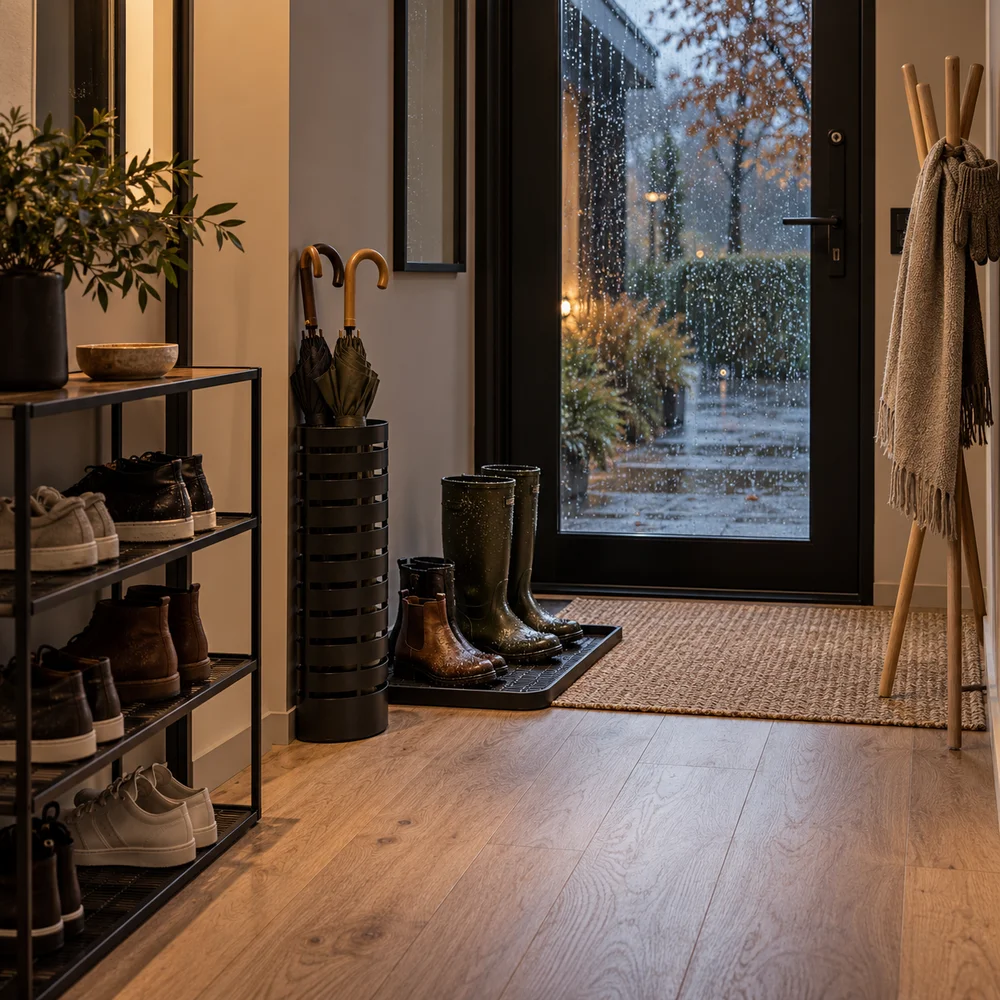
Cozy Rainy Day Entryway Ideas That Are Actually Practical
By Emily | October 27, 2026
You know the moment. It’s a gray Tuesday afternoon, the rain has been steady since lunch, and you push the front door open with a bag on one shoulder and a dripping umbrella in your hand. Within thirty seconds there’s a puddle on the floor, a pair of boots tipped sideways against the wall, and a trail of wet footprints heading toward the kitchen. Nothing about it feels cozy.
Most entryway advice assumes a dry day. It treats the space as a storage problem, meaning where the coats go and where the keys land, and it quietly ignores the fact that for much of the year, the entryway’s real job is managing water. Rain is not an interruption to the design. It is the design brief, and an entry that answers it well feels calm long before it feels decorated.
This guide follows the water. It starts with where wet boots land and how the floor gets reset, moves through the threshold where dirt and rain are stopped, and ends with what dries overnight so the next morning starts ready. Each idea is built around one practical piece, chosen because it works and because it can sit in a visible corner and still look quiet, tidy and intentional.
You don’t need all nine at once. Read it the way you’d walk through your own front door on a wet evening, noticing where the water actually goes and which moment frustrates you most. Start there. A single well-placed tray or mat can change how the whole entry feels by Friday, and the rest can follow as the season shows you what your household genuinely needs.
1. A Waterproof Boot Tray That Gives Wet Boots a Boundary
 Save it
Wet boots have a way of migrating. They’re kicked off near the door and nudged aside by the next person coming in, and by evening they’ve left gray rings on the hardwood and a damp patch on the edge of the rug. The boots being wet isn’t the problem, since that’s unavoidable on a rainy day. The problem is that the water has no defined place to go, so it spreads into every surface the boots happen to touch and lingers long after the rain stops.
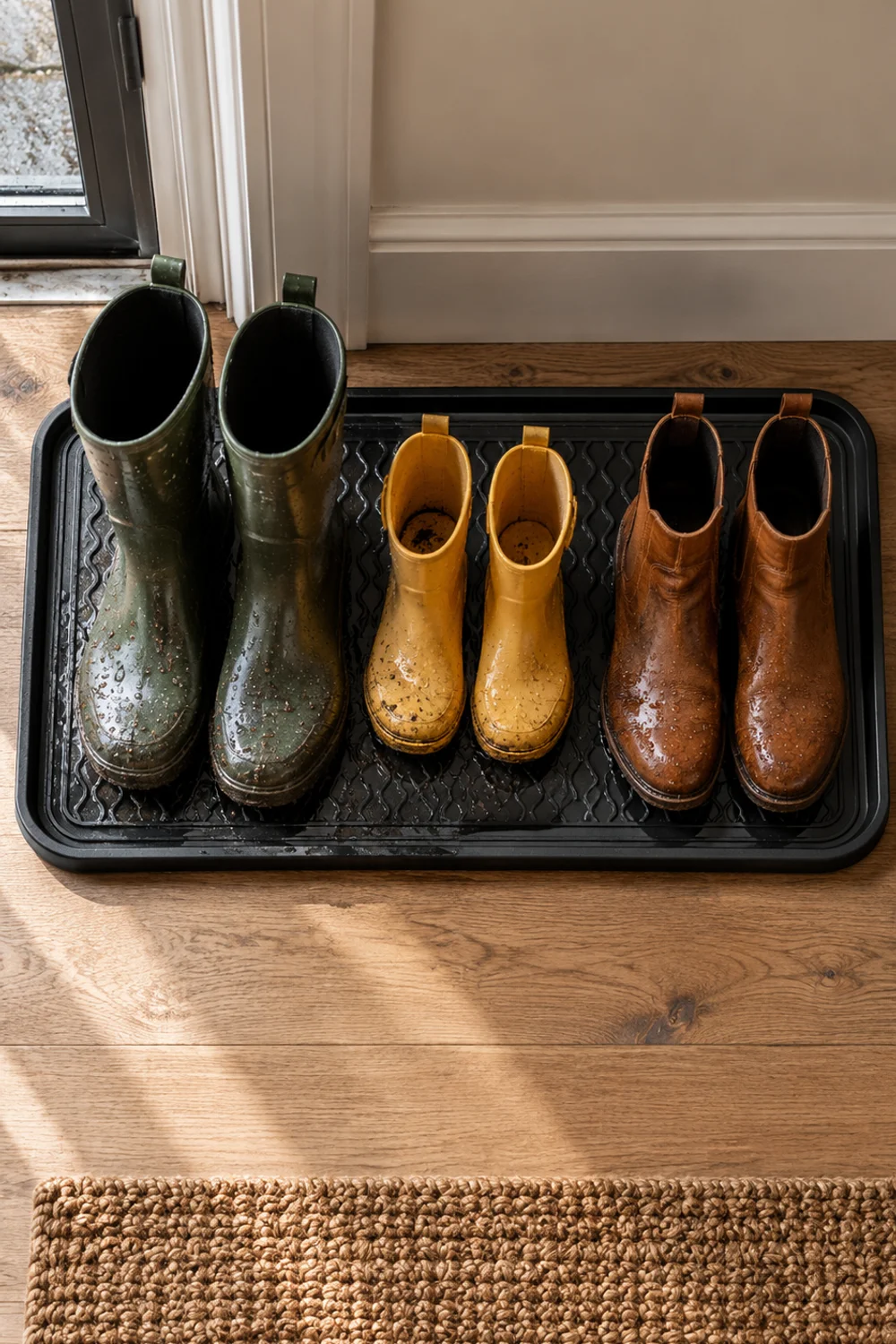
A boot tray works by giving that water a boundary. The multi-purpose boot tray measures 15 by 30 inches with a 1.2-inch raised edge, and that edge is the detail that matters most. The lip contains the runoff from a couple of pairs of boots instead of letting it creep outward across the floor. The waterproof surface means the puddle forms inside the tray rather than on your floor, and once the boots are dry the tray can simply be tipped out and wiped. There’s no scrubbing and no warped boards.
Placement is where most trays go wrong. Pushed flush against the wall beside the door hinge, a tray disappears into the architecture. Left angled in the walkway, it becomes something to trip over. In a narrow entry, the long side should run parallel to the wall so the tray reads as part of the floor plan. A plain black or charcoal finish tends to look most settled, because it echoes the dark tone of wet boots instead of fighting them.
Picture a small apartment entry with oak-look flooring and a family of three. Before the tray, every rainy afternoon ended with someone on their knees with a kitchen towel, blotting gray water out of the seams between the boards. With the tray, the routine is almost invisible. An adult’s rain boots, a child’s rubber boots and a pair of leather ankle boots line up inside the raised edge and drip quietly overnight, and the floor around them stays pale and dry by morning. Nobody has to remind anyone of anything.
There’s a broader lesson in something this simple. Most mess in a home isn’t caused by carelessness. It’s caused by the absence of a clear edge. When a space shows exactly where something belongs, people follow it without being asked. A boot tray is a visible boundary, a quiet instruction built into the floor. That’s why an entry with one feels calmer even on the wettest day, though nothing about the weather outside has changed at all.
2. A Flat Mop That Makes the Rainy-Day Reset Take Two Minutes
 Save it
Even with a tray, some water escapes. A wet dog shakes by the door, a grocery bag drips across the threshold, and someone steps in before taking their shoes off. On a rainy day, the real question isn’t how to prevent every drop. It’s how quickly the floor can be returned to normal. If cleanup means hauling a heavy bucket out of a cupboard, it gets postponed, and the damp patch slowly becomes a muddy one that gets tracked further into the house.
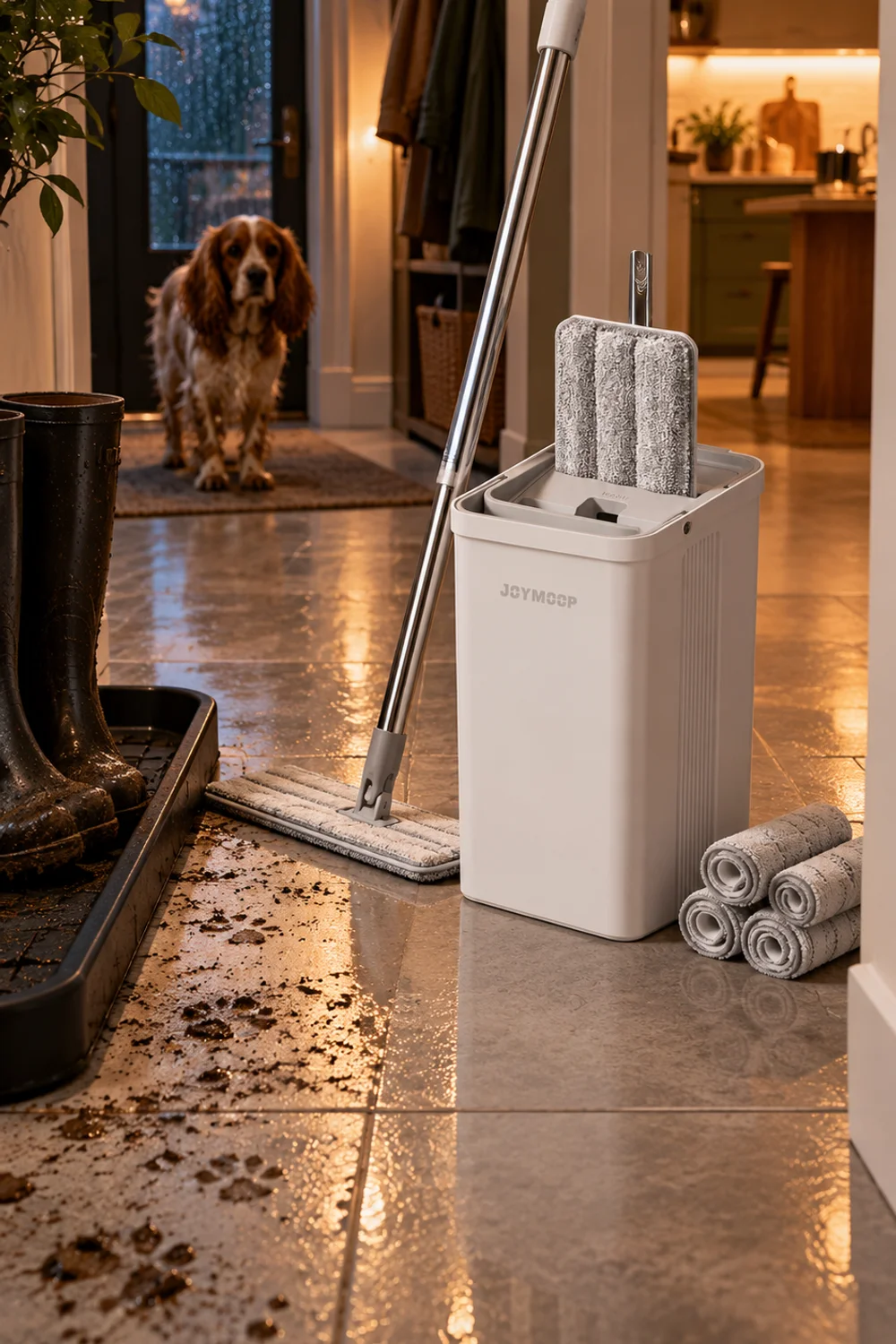
A flat mop system changes the math because it lowers the effort to almost nothing. This set pairs a microfiber mop with a bucket built for rinsing and wringing the pad, so you never press a dirty string mop back onto a clean floor. Microfiber lifts fine grit and muddy film instead of pushing it around. The flat head also slides easily along baseboards and under the edge of a boot tray, which is exactly where water likes to hide.
Where the mop lives matters as much as the mop itself. Tucked in a basement closet, it may as well not exist. Kept in a coat closet or a slim gap beside the entry cabinet, it becomes a two-minute tool rather than a weekend chore. The white finish of this set helps here, because it reads as clean and utilitarian rather than grimy. Even if the handle peeks out of a half-open closet door, it looks tidy rather than forgotten.
Imagine a townhouse with pale gray tile running from the front door to the kitchen. On a stormy evening, two kids and a spaniel come in within ten minutes of each other, and the tile shows every paw print and sole. Instead of waiting until after dinner, someone fills the bucket halfway, makes three passes from the door toward the hall, wrings the pad and rinses it. By the time the pasta water boils, the floor is clear again, and nobody tracks the mess upstairs.
Coziness is usually described in terms of what you add: softness, warmth, texture. On a rainy day, though, much of it comes from what you’re able to remove quickly. A home feels restful when small messes don’t build up into big ones, and that depends less on discipline than on friction. The easier a reset is, the more often it happens, and the more often it happens, the less anyone notices the weather was ever inside. Readiness is its own kind of comfort.
3. An Umbrella Stand With a Tray That Lifts Out to Empty

 Save it
A dripping umbrella is one of the small, irritating rainy-day objects that has no natural home. Leaned against the wall, it leaves a streak on the paint and a puddle on the floor. Hung on a doorknob, it drips onto your shoes. Folded wet and shoved in a bag, it comes out musty the next morning. It needs a place to stand upright and drain, where the water can collect in one spot instead of spreading across the floor.
This umbrella stand solves this with a removable water tray at its base. Umbrellas stand upright inside, water runs down the canopy and collects in the tray, and when the tray is full you lift it out, empty it into the sink and slide it back. At about 23 inches tall, the stand is high enough to hold a full-length umbrella upright, and low enough to sit beside a door without dominating the wall around it.
The black stripe finish lets a practical piece read as deliberate. The pattern adds a little graphic rhythm, and the dark tone hides water spots between emptyings. Position the stand on the hinge side of the door, close enough to reach before you step inside, so the umbrella goes down in the first second instead of being carried across the floor while it drips. If you’re planning the whole landing area together, How to Make a Drop Zone in a Small Entryway shows how one corner can hold every arrival without crowding.
Think of a narrow rowhouse hallway where the front door opens almost directly onto the stairs. Before the stand, umbrellas ended up hooked over the banister, dripping onto the bottom step and leaving a slick, dangerous patch. With a stand tucked between the door frame and the wall, everyone’s umbrella goes straight in, guests included. On a long wet weekend, the tray gets emptied twice, which takes thirty seconds each time, and the stairs stay dry and safe for everyone climbing them.
The satisfaction of this kind of object is that it finishes a sequence. Rain arrives, the umbrella comes down, and there is one obvious place for it to go. Homes feel calm when everyday actions have a clear endpoint, because nothing is left half-done and waiting to be dealt with later. An umbrella leaning somewhere random is a tiny unfinished task. An umbrella standing in its tray is simply put away, and the mind registers the difference even if it never says so.
4. A Boot Dryer That Turns Soaked Footwear Into Tomorrow’s Ready Pair
 Save it
A tray catches the drip, but it doesn’t solve the next morning. Leather boots and work boots that soaked through on Tuesday afternoon are often still clammy on Wednesday, and pulling cold, damp footwear onto dry socks is a miserable way to start a day. Left to air dry in a cool entry, thick boots can take a surprisingly long time. The moisture that lingers inside is exactly what turns them musty over a wet season.
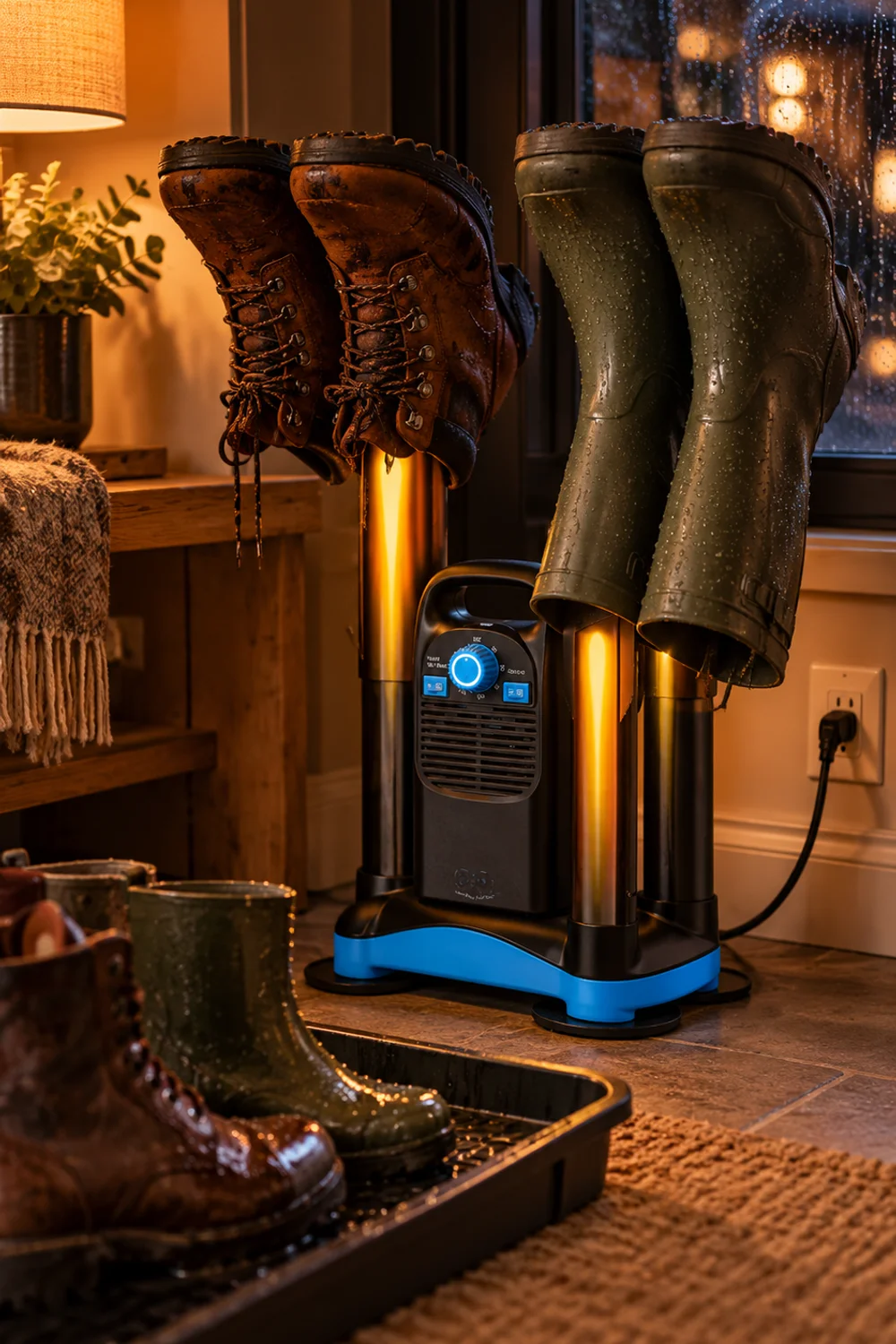
A boot dryer works from the inside out, which is where the dampness actually lives. This upgraded model holds two pairs at once and adds an ozone deodorizer, so it handles both the moisture and the smell that tends to follow it. You don’t have to wait for air to reach the toe box through a narrow opening, because the dryer works directly inside the boot. The lining, insole and seams dry together, instead of the outside drying first while the inside stays wet.
Not every pair should go on the dryer, and that’s worth knowing before you start. Delicate suede, glued soles and anything a manufacturer says to air dry deserve a gentler approach, such as stuffing with newspaper and some patience. For rubber rain boots, sturdy leather and work boots, though, the dryer earns its spot. Place it beside or just behind the boot tray, near an outlet, so wet pairs move directly from one to the other. Keep a few inches clear around it so coats and bags don’t crowd it.
Consider a couple in a small house where one partner works outdoors and the other walks the dog twice a day, whatever the weather. Before the dryer, the work boots spent every wet evening propped by the heating vent and still felt damp at six in the morning. Now both pairs go onto the dryer after dinner. By breakfast they’re ready to wear, the faint sour smell has faded, and the entry no longer hosts a row of boots slowly steaming against the wall.
Coziness has a forward-looking side that’s easy to overlook. Part of what makes an evening feel restful is knowing that tomorrow is already taken care of, and that you won’t be scrambling at the door hunting for dry shoes. A boot dryer is less about the boots themselves than about removing a small dread from the morning. When the next day’s first step is ready and waiting, the evening before can feel like rest instead of postponement, and that’s the cozy part.
5. An Absorbent Khaki Mat for the Inside of the Door

 Save it
The outdoor mat catches most of the mud, but it can’t catch everything. Soles still carry a film of water across the threshold, and the first two steps inside are where it lands. Without something absorbent there, those steps become a damp, slippery strip of floor that collects grit and spreads it further. The inside of the door needs its own surface, one designed to soak up what the outside mat left on every shoe rather than to scrape.
This indoor door mat measures 17 by 29 inches, a size that sits neatly in front of most single doors. It has a non-slip backing, which matters more than it sounds on a wet hard floor, where a sliding mat becomes its own hazard. Because it’s washable, it can absorb a heavy rainy week and then be cleaned. It comes back fresh instead of holding onto the dull smell of trapped damp.
The khaki tone is a quietly smart choice. Pure white or cream mats look beautiful for a day and then show every gray footprint. Very dark mats hide dirt but can make a small entry feel heavy. Khaki sits in between, blending with wood floors, stone tile and warm painted walls while disguising the inevitable mud. Lay the mat with its long edge parallel to the door and centered on the opening, so it reads as a deliberate threshold rather than something dropped wherever it landed.
Take a ground-floor apartment where the front door opens straight onto polished concrete. On rainy days, the first few steps inside were genuinely slick, and the owner had nearly slipped carrying groceries more than once. With the khaki mat in place, soles get a step or two of absorbent surface before they meet the concrete. The floor beyond stays dry, and the mat darkens slightly as it works. On Sunday it gets washed and laid back down, ready for the next wet week.
There’s a reason good hotels place a soft mat just inside the entrance even when a scraper waits outside. The two layers do two different jobs, and expecting one to handle both usually means neither works well. In a home, this two-stage threshold separates an entry that merely tolerates rain from one that’s prepared for it. Each layer is modest on its own. Together they decide whether the weather stops at the door or follows you into the house.
6. An Expandable Rack That Lifts Shoes Off the Wet Floor Zone
 Save it
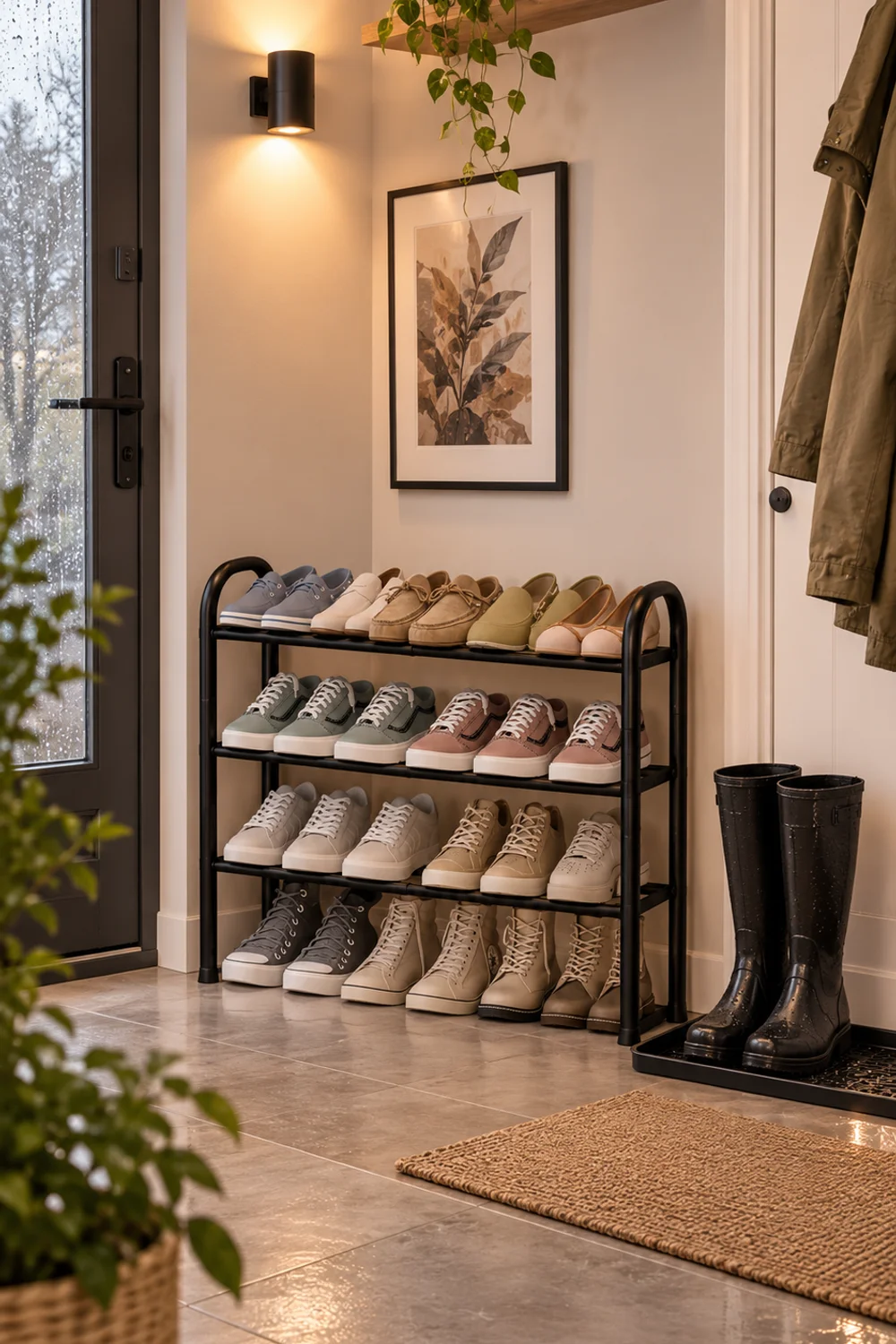
On a rainy day, the floor near the door becomes a wet zone whether you plan for it or not. Shoes that were dry this morning sit in that zone all afternoon, catching splashes from boots coming in and drips from coats being shaken off. Dry sneakers end up damp, suede picks up water marks, and a row of footwear on the floor turns into an obstacle course for anyone trying to reach the tray or the mat. The answer is height, not more floor space.
A 3-tier expandable shoe rack lifts dry shoes off that wet floor zone entirely. This black rack adjusts from 17.7 to 33.1 inches wide and holds up to 16 pairs across its three levels. That means it can be sized to the exact gap you have, whether that’s the space beside a closet door or the stretch of wall between the door and a corner. Shoes on the upper tiers stay clear of splashes, while the lowest tier can hold pairs that are already dry and ready.
Placement is about separation. Set the rack a step away from the boot tray rather than directly beside it, so wet and dry footwear never share the same patch of floor. Keep the tiers for everyday pairs only, because an overfilled rack quickly looks cluttered. For more ways to keep a small entry welcoming while it works this hard, 9 Entryway Ideas That Make Your Home Feel More Welcoming has layouts that pair well with a rack like this one.
Picture a rental entry where the only free wall is a narrow strip, about two feet wide, between the front door and a coat closet. Before the rack, five pairs of shoes sat on the tile there, and every wet arrival splashed them. The rack, pulled out to roughly 24 inches, fits that strip exactly. Sneakers and loafers sit on the top two tiers, slippers on the bottom, and the floor in front stays open for the boot tray and the mat. There’s no drilling and nothing left behind at move-out.
A wet floor is really a zoning problem. Rooms feel orderly when different conditions get different territories: the kitchen keeps raw and cooked food apart, and a bathroom separates wet from dry. The entryway deserves the same logic on a rainy day. Once dry shoes live off the floor and wet ones live in the tray, the space makes sense at a glance. That legibility is a large part of why a well-zoned entry feels calm even when it’s busy.
7. A Rubber Honeycomb Mat That Scrapes the Weather Off at the Door

 Save it
Everything inside the entry gets easier when less weather makes it through the door. Most of the grit, wet leaves and mud on hallway floors arrives stuck in the treads of shoes. A soft decorative mat outside does little more than absorb a bit of water before turning into a soggy sponge. The first line of defense needs to work mechanically, pulling debris off soles before anyone steps over the threshold and onto the absorbent mat waiting inside.
This rubber doormat does exactly that. At 17 by 30 inches, its open honeycomb pattern gives soles plenty of edges to scrape against, and the gaps let water and loosened dirt fall through instead of pooling on the surface. Rubber also stands up to rain in a way that coir and fabric don’t. It doesn’t stay saturated, and when the grit builds up it can be rinsed with a hose or a bucket of water. Nothing about it needs babying.
A practical mat can still look composed from the street. The black finish pairs easily with most door hardware and house numbers, and it reads as clean-lined rather than rustic. Center it on the door with an even margin on each side. If your step is wider than the mat, resist adding a second decorative layer on top, because the rubber needs direct contact with soles to work. Under a deep porch it stays clean longer, and on an exposed stoop you’ll want to rinse it more often.
Imagine a suburban house with a brick path that turns into a stream of mud and wet leaves in every heavy storm. The old coir mat had flattened into a damp brown pad, and dirt reached the hallway anyway. With the rubber mat at the door, everyone gets a couple of deliberate scrapes before stepping in. By the end of a wet week, a small drift of grit has collected beneath the honeycomb instead of in the grout lines of the tile inside.
It’s tempting to think of the doormat as a welcome gesture, but its real role is upstream. Problems solved at the source rarely need fixing later. Every handful of grit stopped outside is a handful that never scratches a floor, darkens a mat or needs mopping. A well-chosen outdoor mat is the cheapest form of cleaning in the whole house, because the work happens in the two seconds it takes to wipe your feet on the way in. The rest of the entry simply benefits.
8. A Wooden-Rod Tripod for Damp Scarves, Gloves and Knits

 Save it
Rain doesn’t only soak boots. Wool scarves, knitted hats, gloves and cardigans come home heavy with water, and they rarely have anywhere sensible to go. Hung on a crowded coat peg, they press against dry coats and stay damp in the folds. Stuffed into a pocket, they stay wet overnight and start to smell. Knits in particular need air circulating around them, and they need to hang loosely so they don’t stretch out of shape under their own soggy weight.
A wooden-rod tripod drying rack handles this in a small footprint. The JOOM clothing stand is foldable, with wooden rods arranged around a freestanding frame, so scarves and gloves can be draped individually with air moving on every side. Nothing overlaps and nothing is crushed against a wall. Gloves dry palm-side out and hats hang by their brims. The rack can stand in a corner near the door through a wet evening, then fold away behind a closet door once the weather clears.
The natural wood keeps this from looking like laundry day in the hallway. The rack reads closer to a ladder than to a metal drying rack, so a scarf draped over it looks almost styled. Reserve it for knits and accessories rather than heavy coats, which need a proper hanger and more support. For ideas on where bulkier outerwear and bags can live, How to Store Coats and Bags in a Small Entryway covers solutions that work alongside a drying corner like this.
Think of a family entry after a weekend walk in drizzle, with two wool scarves, a child’s mittens, a pom-pom hat and a ribbed cardigan, all damp. Before the rack, they ended up in a heap on a shelf or slung over a chair back, and half were still wet on Monday. Now they go straight onto the tripod’s rods, spaced apart, in the corner beside the boot dryer. By the next morning they’re dry, soft and back in shape, ready to grab on the way out.
Damp textiles are one of the quiet reasons a home can feel less cozy in wet weather. You may not consciously notice them, but you notice the faint mustiness, the cold scarf in the morning, and the sense that the house never quite dries out. Giving soft things their own airflow and space is a small act of care, both for the materials and for the people who reach for them. Warm, dry wool on a cold morning is its own kind of comfort.
9. Disposable Shoe Covers for Guests Who Arrive in the Rain
 Save it
Guests are the real test of a rainy-day entry plan. Family members know the routine. A friend arriving for dinner in the middle of a downpour, or a repair technician coming in to check the furnace, may not want to take off their shoes, or may not be able to do it easily. Asking can feel awkward, and saying nothing means wet, muddy footprints across the hallway and into the living room on exactly the evening you wanted the house to feel welcoming.
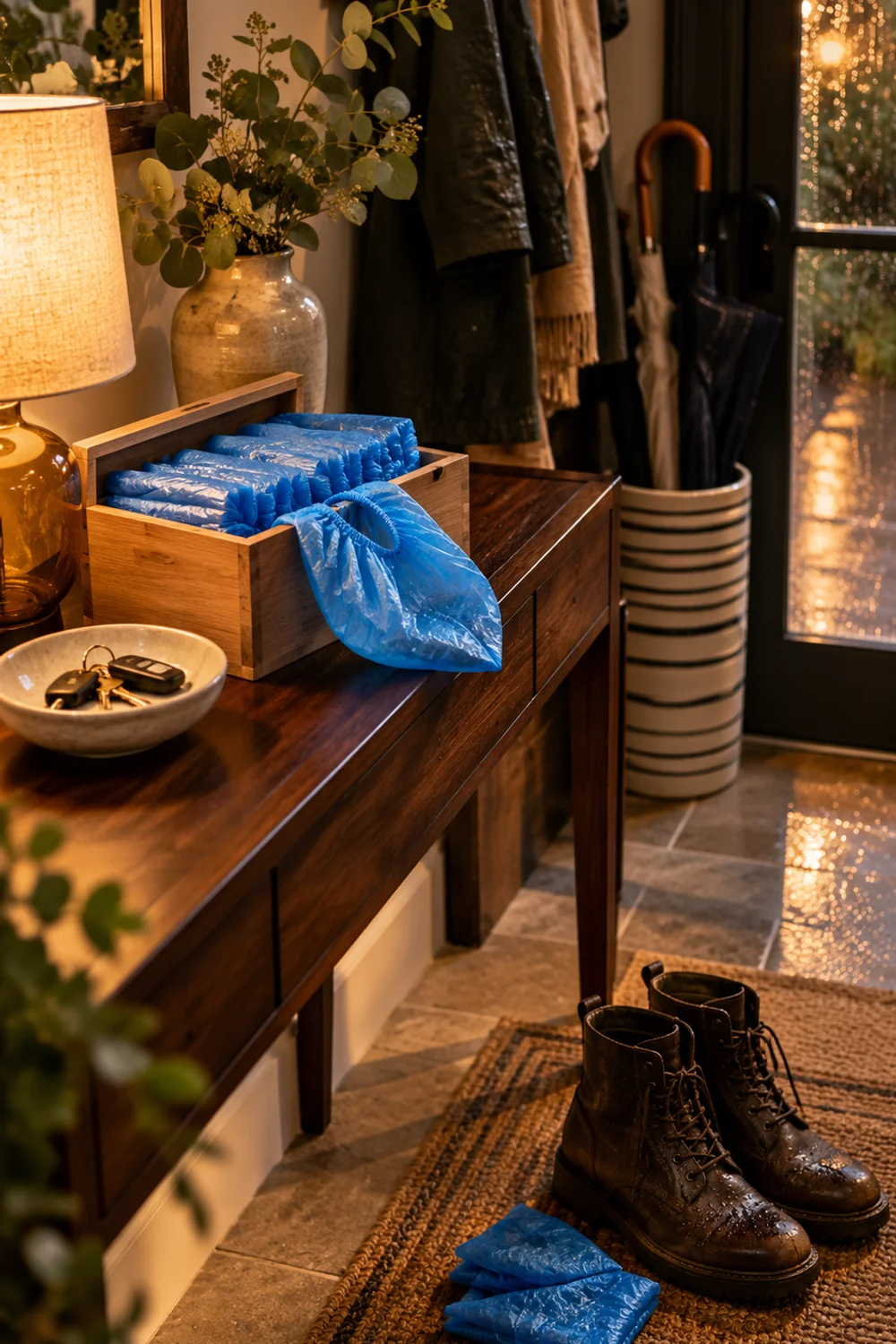
Disposable shoe covers resolve that tension gracefully. The Buself covers come in a pack of 100, or 50 pairs, and they’re non-slip, which matters on a damp floor. A guest slips them over their shoes at the door, keeps their footwear on, and walks through the house without leaving a trace of the weather behind. It’s the same courtesy you’d see in a model home or a freshly cleaned rental, adapted for an ordinary wet Thursday. No one has to hop on one foot.
Presentation turns a utilitarian supply into hospitality. Leave the bulk bag in the closet and put a handful of pairs in a small lidded box or a shallow tray on the entry console or the top of the shoe rack, within easy reach of the door. Pair it with a chair or the edge of a sturdy surface to lean on. Offered quietly, as in “there are covers there if you’d rather keep your shoes on,” the gesture feels thoughtful, never like a rule.
Picture a small dinner party on a stormy Friday. Four friends arrive one after another, umbrellas go into the stand and coats come off, and one guest is wearing laced leather boots that take a minute to remove. Instead of an awkward pause at the door, the host gestures to the little box of covers. Two guests use them, two take their shoes off, and nobody feels singled out. At the end of the night, the hallway floor is still clean and dry.
An entryway is the first and last impression a home makes. On wet days, it’s also where your care for the house meets your care for the people in it, and those two things don’t have to compete. A good rainy-day entry protects the floors without making anyone feel policed, because the solutions are already there, quietly waiting. That’s what readiness looks like when it’s extended to other people: the weather is handled, and the welcome stays warm.
Common Mistakes
1. Putting the absorbent mat outside
Soft, absorbent mats are designed for indoor use. Left outside in steady rain, they become saturated within hours, stop absorbing anything and start tracking moisture back into the house. Keep the rubber scraper outside, where it can shed water through its open pattern, and keep the absorbent mat just inside, where it finishes the job the scraper started.
2. Letting wet and dry footwear share the same floor
When boots drip beside clean sneakers, every rainy arrival quietly ruins a dry pair. Give wet footwear its tray and dry footwear its raised rack, and leave a small gap between the two so splashes don’t cross the line. Keeping the zones separate does more to protect your shoes than any spray or treatment.
3. Waiting for things to air dry in a cold entry
Entryways are often the coolest part of a home, which makes them poor places for passive drying. Thick boots and wool knits can stay damp for a day or more and pick up smells along the way. Active drying for sturdy boots and open airflow for knits shorten that window, so nothing goes back outside still wet.
4. Storing the cleanup tools too far away
A mop kept two floors down gets used on weekends, not on rainy evenings. When a reset takes longer to set up than to do, it gets postponed, and water that could have been wiped in a minute spreads into seams and grout. Keep the mop within a few steps of the door so the floor can be cleared before the damp spreads.
5. Choosing each practical piece in isolation
A tray bought one month, an umbrella stand the next and a mat grabbed on sale can leave a functional corner looking scattered. Before buying, consider how the pieces will sit together: their proportions, how they line up with the wall and the door, and whether their finishes share a calm, consistent tone. Considered together, practical objects read as one arrangement rather than a pile of fixes.
Frequently Asked Questions
How do I keep my entryway floor from getting wet on rainy days?
Think in layers rather than a single fix. A rubber scraper mat outside removes grit and much of the water, an absorbent mat just inside catches what remains on soles, and a raised-edge boot tray gives dripping footwear a defined place to land. Add an umbrella stand with a removable tray so umbrellas stop dripping on the floor, and keep a flat mop nearby for whatever still escapes. Together these layers handle almost every drop before it spreads.
Is a boot dryer safe for all types of shoes?
Not always. Boot dryers suit rubber rain boots, sturdy leather boots and work boots, which tend to hold moisture deep inside. Delicate suede, shoes with glued soles and anything labeled for air drying only deserve gentler treatment, such as stuffing with newspaper and leaving them somewhere with good airflow. Always check both the footwear care label and the dryer’s own instructions before using it, and don’t leave any appliance running unattended longer than recommended.
How can I make practical rainy-day items look nice in the entryway?
Choose them as a set rather than one at a time. Keep finishes within a narrow range, such as black, khaki and warm natural wood, so a tray, a stand and a rack read as a single composed corner. Align pieces with the walls and the door opening instead of angling them, leave a little floor visible between them, and keep supplies like shoe covers in a lidded box. Order and proportion do more for the look than any added decoration.
Do shoe covers feel rude to offer guests?
Not when they’re offered as an option rather than a requirement. Place a few pairs in a small box near the door and mention them lightly as guests arrive, making it clear that taking shoes off is equally welcome. Many people appreciate the choice, especially those wearing laced boots or anyone who has trouble bending down. Framed as a convenience, shoe covers come across as thoughtful hosting, and they spare everyone the awkward pause at the door on a wet evening.
Final Thoughts
A cozy entryway on a rainy day has very little to do with how it looks in a photograph and a great deal to do with how it behaves at five o’clock on a wet Tuesday. When the water has somewhere to go, the boots have somewhere to dry and the floor can be reset in minutes, the whole house exhales. That sense of being ready is where the real comfort lives.
None of this needs to happen in a single weekend. Start with whichever moment frustrates you most, whether it’s the puddle by the door, the damp boots at dawn or the scarf that never dries, and solve that one first. Live with it through a few storms, notice what still feels awkward, then add the next piece. An entry built this way ends up shaped by your household’s real habits rather than by a shopping list.
If one of these ideas fits your front door, save it to your Pinterest board so it’s waiting when the next gray forecast rolls in, and browse the other entryway and small-space guides here for ideas that work alongside it. Season by season, your entry can become the calm, quietly organized place that greets you every time you come home, rain or shine, and makes stepping inside feel like relief.
This post contains affiliate links. I may earn a small commission at no extra cost to you.
Get cozy inspiration delivered to your inbox.
✓ 14-page beautifully designed ebook
✓ Cozy decorating ideas
✓ Practical room-by-room inspiration
You’re in! 🎉
Thanks for joining the NestFlowHome community!
Your free ebook is already on its way to your inbox. If you don’t see it within a few minutes, please check your Promotions or Spam folder.
Join the NestFlowHome community for weekly decorating inspiration.

Timeless home decor ideas and slow living inspiration for a calm, beautiful life.