
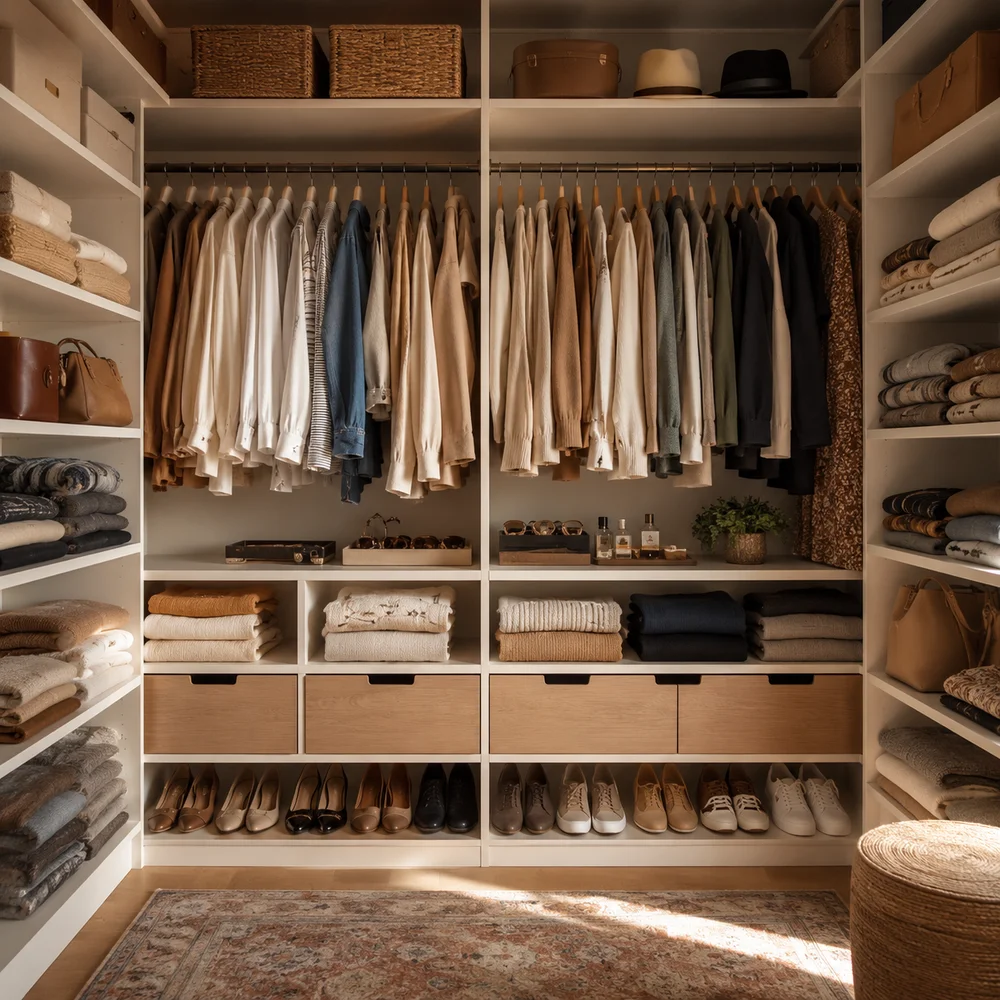
Everything You Need to Know About Organizing a Small Apartment Closet
By Emily | June 17, 2026
There’s a specific kind of frustration that lives in a small apartment closet. You open the door and feel it before you’ve even reached for anything — the density of it, the tangle, the sense that everything you own is somehow competing for the same few inches of space. You close it again. You get dressed from a pile on the chair instead.
This isn’t a storage problem. It’s a systems problem. And it’s one of the most solvable problems in an apartment, once you understand what’s actually going wrong.
The closets that work — the ones that make mornings feel easier and evenings feel calmer — don’t work because they’re bigger. They work because someone thought carefully about what belongs in them, how those things are best stored, and what the daily reality of using the space actually looks like. That thinking is what this guide is about.
A small closet forces a particular kind of clarity. You can’t defer decisions, accumulate doubt, or keep things “just in case” without immediately feeling the consequence. That constraint, properly understood, is not a limitation — it’s an invitation. An invitation to be specific about what you actually need, what you genuinely wear, and what kind of order you can realistically maintain.
What follows covers every layer of closet organization: the philosophy behind it, the systems that hold up over time, the specific solutions for different categories, and the aesthetic layer that transforms a functional space into one you’re genuinely glad to open every morning.
1. Why Most Small Closets Fail Before You Even Start
 Save it
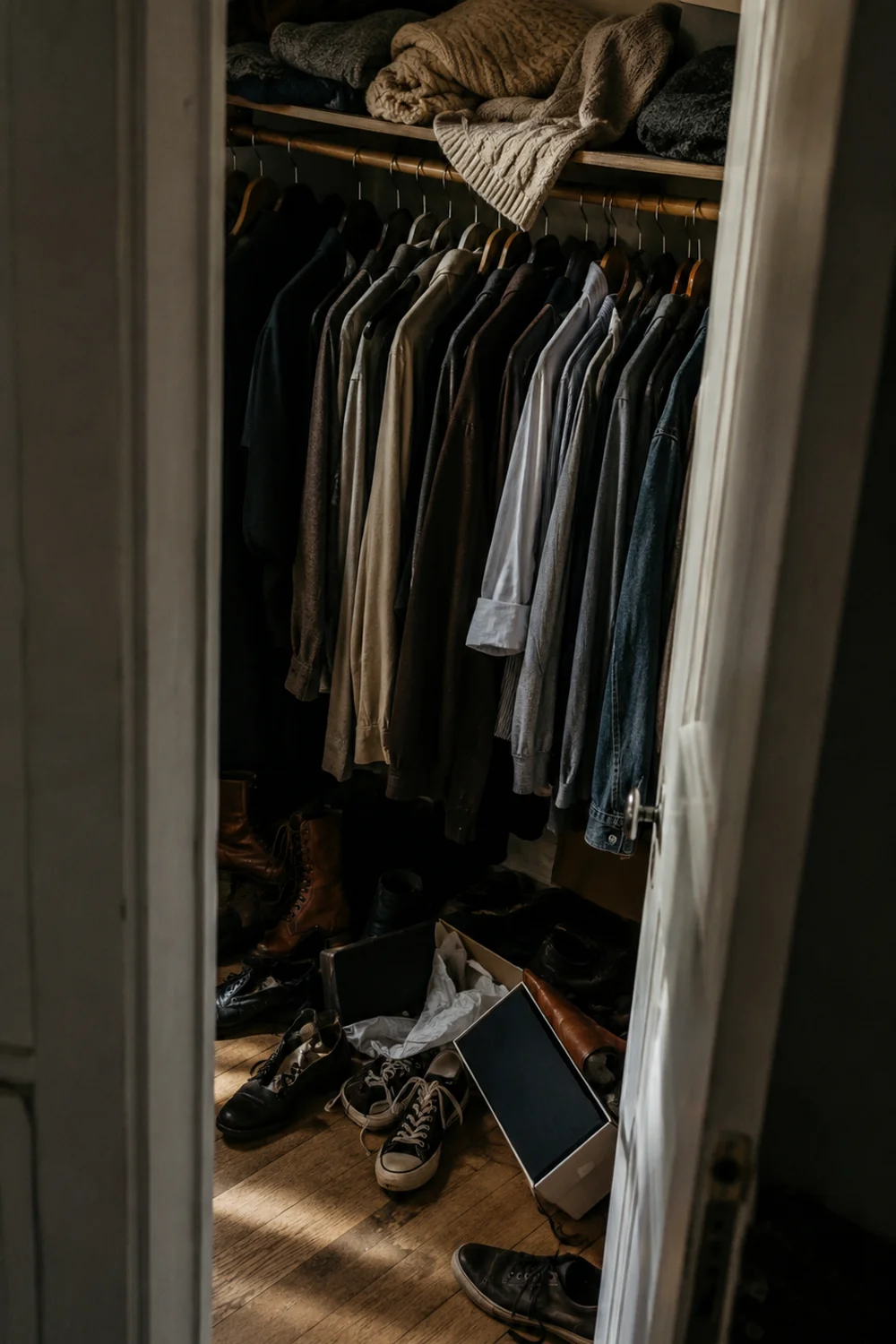
The failure is rarely about size. Most small apartment closets are declared hopeless at roughly half their actual capacity, because the way the space is being used doesn’t match how the person using it actually lives.
The most common pattern: a single hanging rod at standard height, a shelf above it, and everything else stacked on the floor or shoved onto the shelf without much system. This setup was designed for a generic wardrobe that doesn’t belong to anyone in particular. It doesn’t account for how much floor-length versus short hanging you actually own. It doesn’t address shoes, bags, folded clothing, or accessories at all. It just provides a rod and a shelf and leaves the rest to chance.
The result is predictable visual chaos. Everything looks equally important and equally inaccessible. You reach for one thing and three others fall. The shelf becomes a deposit zone for whatever doesn’t fit elsewhere. The floor disappears under shoes and bags that have nowhere specific to live.
Understanding this failure mode matters because it tells you that the solution isn’t just buying more storage — it’s redesigning the logic of the space to match your actual wardrobe and your actual habits. A closet that works for someone with mostly hanging clothes and few shoes will look completely different from one that works for someone with a capsule wardrobe, twenty pairs of shoes, and a collection of folded knits.
Before you move anything or purchase anything, spend time observing how you actually use the space. What are you always reaching for? What’s always getting lost? Which categories — hanging, folded, shoes, bags, accessories — take up the most space, and which take up the most frustration? The answers shape everything that comes next. Small Closet Organization Ideas That Actually Work and Look Stunningly Beautiful approaches the same diagnostic question from a different angle — particularly useful if your closet is a reach-in type where spatial constraints feel even more pronounced.
2. The Declutter That Has to Come First
 Save it
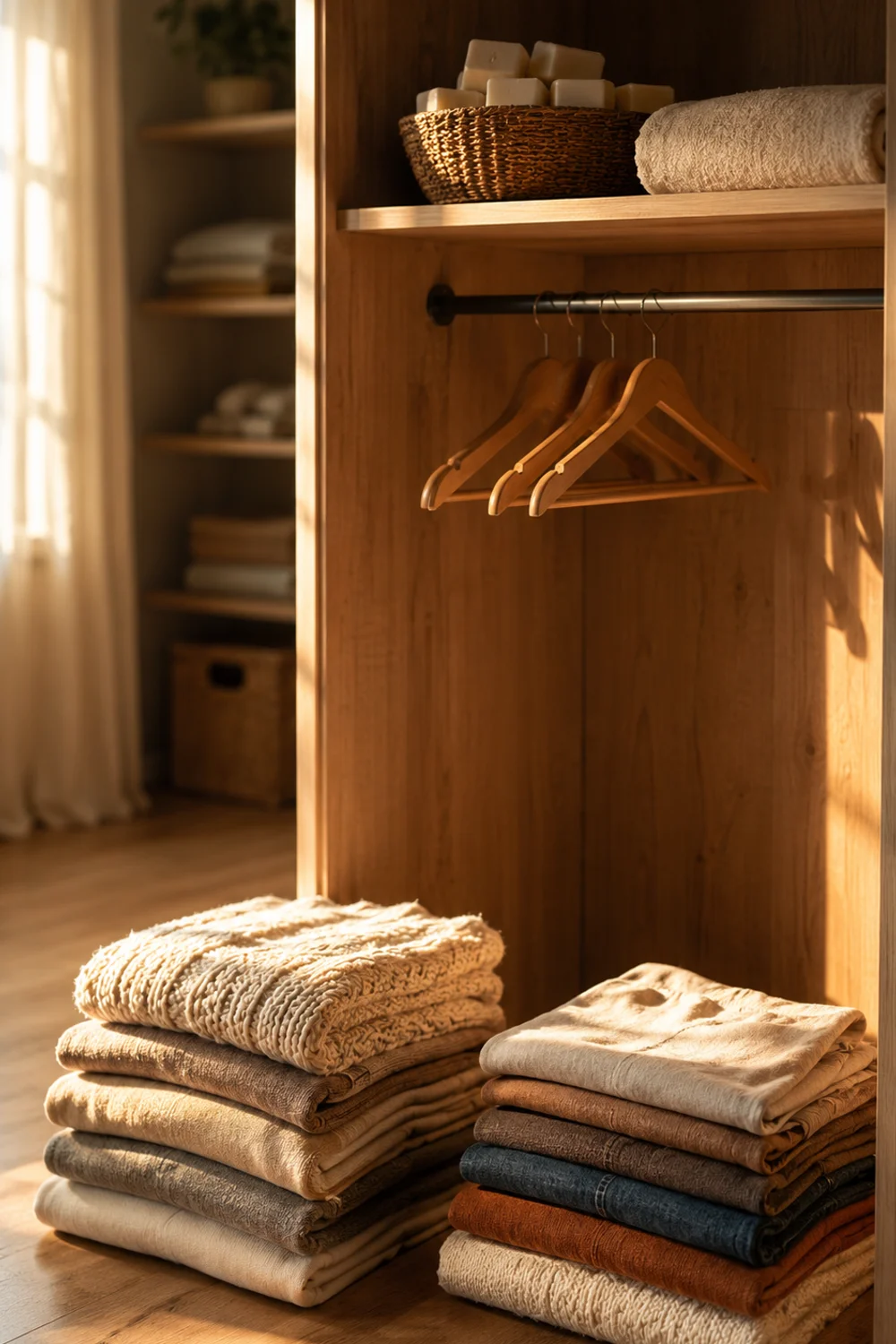
No organizational system can compensate for too much stuff. This is the most fundamental truth in closet organization, and it’s the one people most want to skip. They want to go straight to the bins and the shelf dividers and the satisfying before-and-after photograph. But the photograph is only possible after the editing.
The editing is not about minimalism as an ideology. You don’t need to own fewer things than a certain number or live by a particular philosophy. What you need is a closet that holds only what you actually use — which means making specific, honest decisions about what that includes.
The most useful framework is not “do I love this?” or “does it spark joy?” Those questions are slippery and exhausting. More useful: does this fit the life I’m actually living right now? Not the life I was living three years ago, not the life I aspire to, not the event I’m hypothetically saving it for. The life I’m living today, in this apartment, with these commitments and this body.
Go category by category rather than item by item. Pull out all your trousers. Make decisions on trousers. Then move to tops, then to dresses, then to outerwear. The category approach shows you duplicates and gaps clearly in a way that item-by-item decisions don’t. You may discover you own nine white t-shirts and no casual trousers, or twelve formal blouses and nothing appropriate for your actual daily wardrobe.
What you’re removing isn’t waste — it’s the load that’s been making your closet impossible to maintain. Every item that leaves creates clarity for everything that stays. And the things that stay are now the things that belong to your actual wardrobe, which means you’ll know where to find them and you’ll actually wear them.
A cedar hanger block placed in the closet after decluttering adds a quiet, practical bonus — it naturally repels moths and keeps the space smelling clean without synthetic fragrance.
3. How to Read Your Closet's Actual Dimensions
 Save it
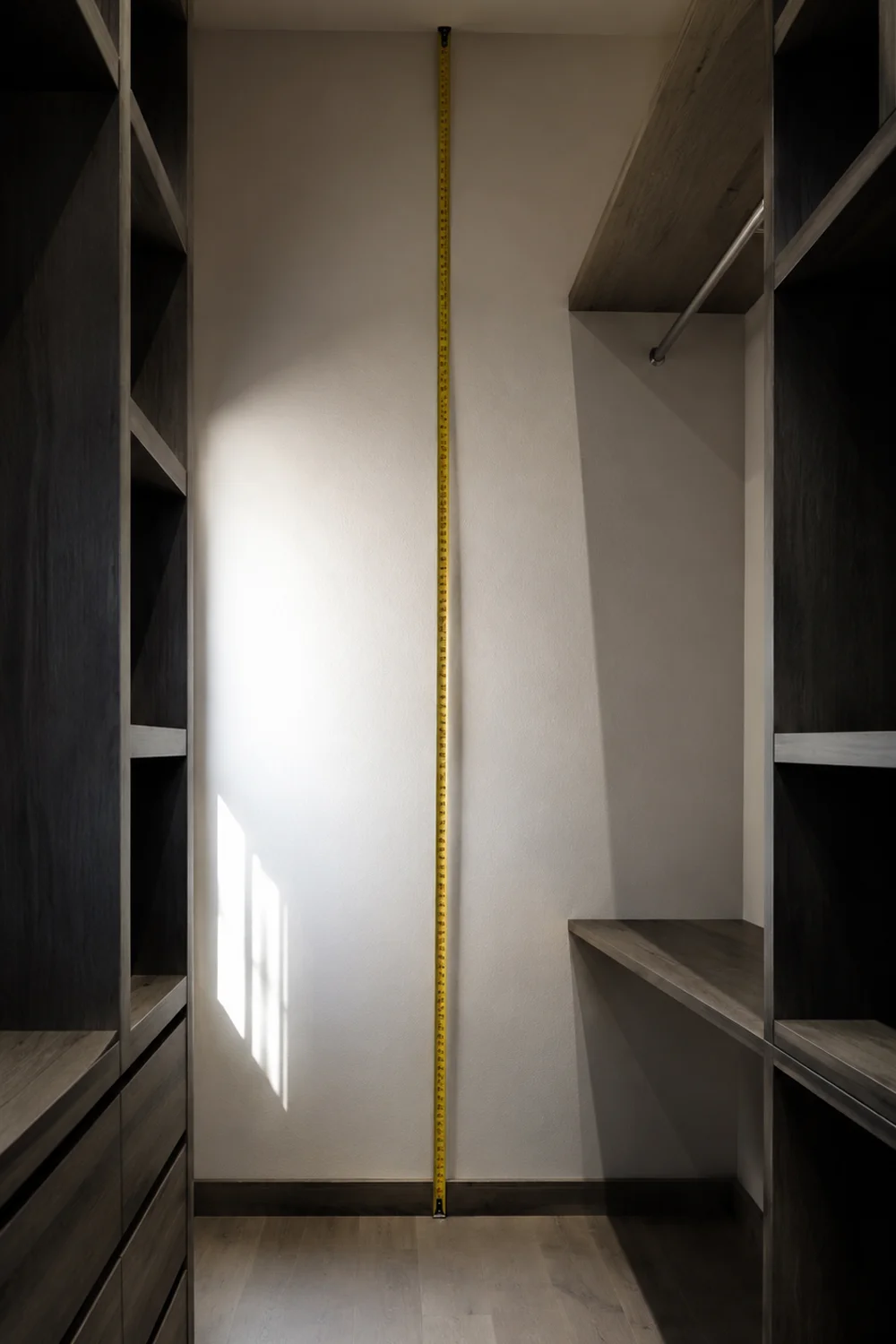
Once you’ve cleared out what doesn’t belong, you’re left with the actual architecture of the space — and it’s worth spending real time with it before you reach for any new products.
Measure everything. Height from floor to ceiling, width across the back wall, depth from door to back. Note where the single rod sits and how much clear vertical space exists above and below it. Check whether there’s dead space at the corners. Identify which walls are fixed and which are free to receive hooks, rails, or mounted shelving.
Most apartment closets have significant wasted vertical real estate. The standard rod hangs at roughly 66–68 inches — comfortable for reaching but leaving a large gap above it and the entire floor zone undefined below. Depending on what you’re hanging, the space below short items — folded blazers, shirts, jackets — may be doing nothing useful at all.
This vertical audit is where the reorganization really begins. If your hanging clothes are predominantly short items — tops, folded trousers, jackets — a double-hung configuration (two rods, one above the other) can effectively double your hanging capacity without adding a single inch of square footage. If you have a significant proportion of floor-length items, you’ll need a full-height zone preserved for those, with the double-hang approach applied to the remaining width.
Measure your actual garments. Know the drop length of your longest dress or coat. Know how many items you have in each hanging category. This information is what determines the right configuration — not a generic system purchased without measuring first.
The floor zone is often the last thing people think about and the first thing that becomes chaotic. Deciding in advance what lives there — shoes in a specific arrangement, a small drawer unit, a laundry bin — means the floor never becomes a default dumping ground.
4. Building the Right Hanging Configuration
 Save it
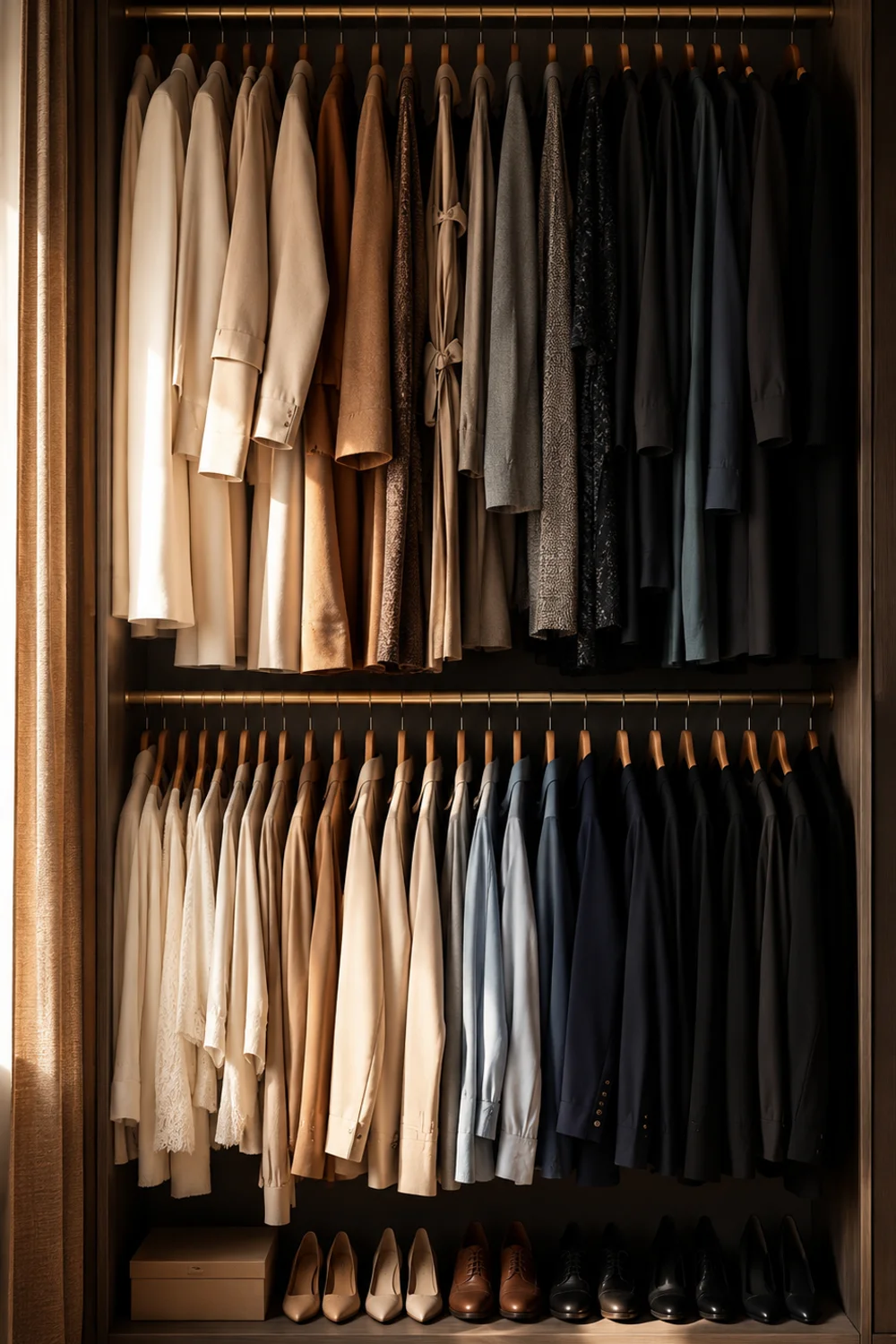
The hanging zone is the heart of most closets, and configuring it correctly changes the entire experience of getting dressed. The goal isn’t simply to fit everything — it’s to make every hanging item visible, accessible, and returned to the same place each time.
Double hanging is the most transformative reconfiguration available to most small closets. The logic is straightforward: two short rows of hanging take the same vertical space as one long row, but deliver twice the linear footage. A closet that had 36 inches of hanging can effectively become 72 inches once you separate short items from longer ones and stack them vertically.
For the upper rod (at standard height, roughly 66–68 inches), hang full-length items: dresses, long coats, anything that needs uninterrupted drop. For the lower rod (positioned at 36–40 inches, depending on what hangs above), hang short items: tops, blouses, blazers, folded trousers on hangers. The space beneath the lower rod becomes usable floor area — ideal for a low shoe rack, a small drawer unit, or a set of stackable boxes.
Within the hanging zone, the question of category arrangement matters more than most people realize. Organizing by color within categories produces a closet that reads as visually calm and makes getting dressed feel more fluid. You’re not scanning through individual items — you’re navigating a spectrum. It takes one afternoon to set up and minutes to maintain, as long as you return items to their color zone consistently.
An adjustable double-hang closet rod that mounts over an existing rod — no tools, no drilling — makes this reconfiguration possible in a rented apartment without modification.
The space above the upper rod — between the rod and the ceiling — is a zone many people underuse. Low-profile bins or boxes here can house out-of-season items, rarely used bags, or bulky accessories that don’t belong in the main rotation. Just ensure they’re labelled and that the contents aren’t things you’ll need to access frequently.
5. The Hanger Question That Changes Everything

 Save it
It sounds minor. It isn’t. The hangers in a closet do more to determine whether it looks organized and functions well than almost any other single element. And yet most closets are a chaotic mix of wire hangers from dry cleaners, thick plastic hangers from retail purchases, wooden hangers from a decade ago, and the occasional velvet hanger that arrived by accident.
Visual noise begins with the hangers. When every item hangs at a different height, swings at a different weight, and occupies a different width, the closet reads as disordered even when the clothes themselves are neatly arranged. The eye can’t settle. The clothing looks crowded even when there’s technically room.
Switching to a single uniform hanger style resolves this immediately and completely. Slim velvet hangers are the near-universal recommendation because they solve multiple problems simultaneously: they’re thin (roughly a third of the width of a standard plastic hanger, which meaningfully increases linear capacity), they’re non-slip (meaning clothes stay in place rather than sliding off), and they maintain consistent hang height so every garment sits at the same level.
The visual effect of a single hanger change is immediate and significant. A closet that looked crowded can suddenly look spacious. The clothes become visible because they’re all hanging at the same height and facing the same direction. The eye travels across the whole wardrobe rather than getting snagged on protruding hangers and bunched fabric.
Velvet slim hangers in a warm neutral — charcoal grey or black — are the most versatile choice, maintaining the visual quiet of the closet without introducing a color that competes with the clothing.
For trousers, a dedicated trouser hanger with horizontal bar eliminates the folded-over look that both creates unwanted creasing and makes items difficult to retrieve. For delicate items, a padded satin hanger in a neutral tone protects shoulder shape without the bulk of a wooden hanger.
6. Making Shelves Work Harder
 Save it
The shelf — usually a single one, positioned above the hanging rod — is simultaneously the most used and most misused surface in a typical small closet. It becomes whatever the space beneath it can’t absorb: bags stacked on bags, a folded sweater with three others piled on top, a box of unknown contents shoved to the back.
The problem isn’t the shelf itself — it’s the absence of defined zones within it. Without zones, the shelf becomes a surface where things accumulate rather than a structure where things live.
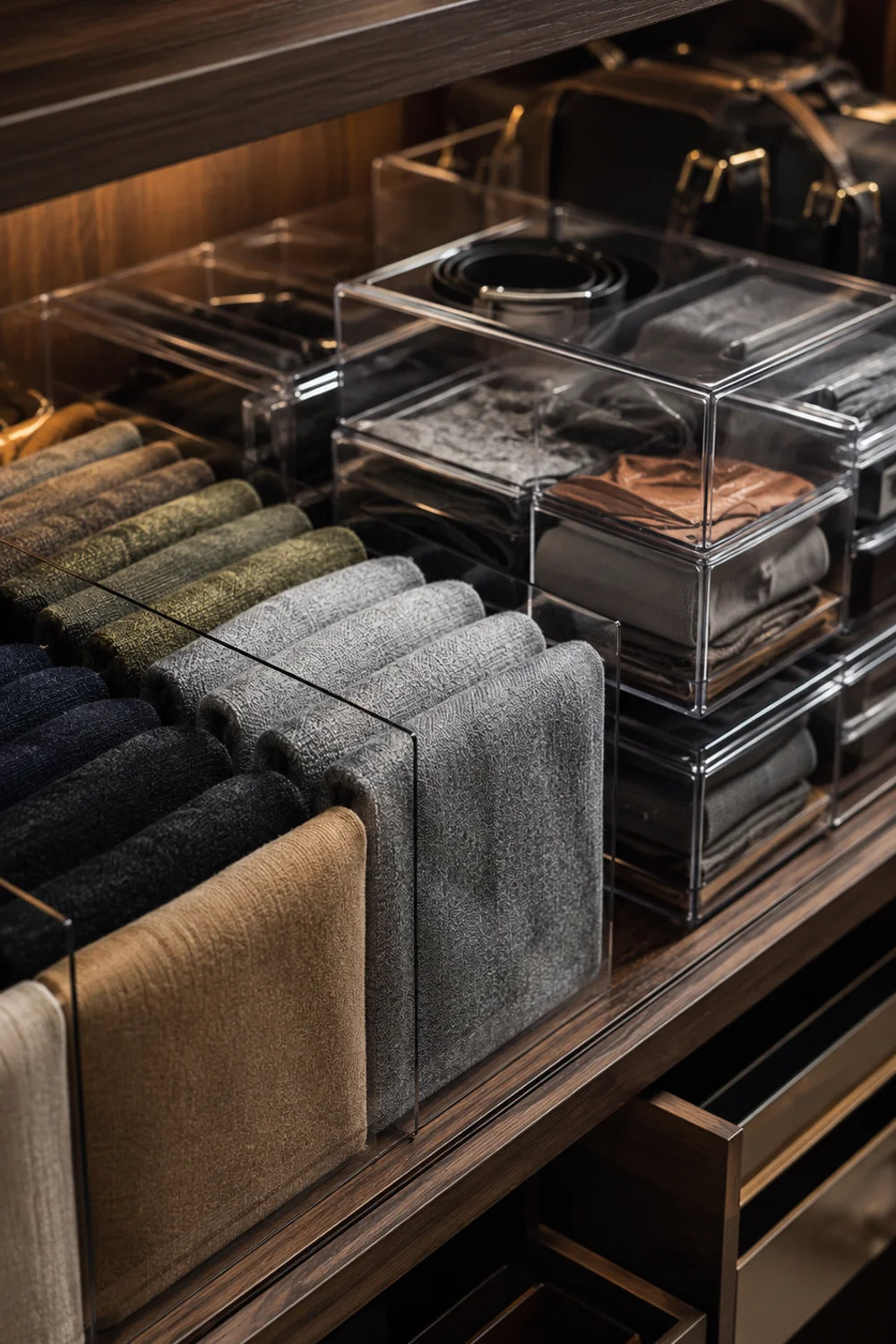
The first principle is depth clarity. A standard closet shelf is deep enough to hide things. Items get pushed to the back and forgotten. The solution is to designate the back third of the shelf for things you access infrequently — rarely worn accessories, event-specific items, backup supplies — and keep the front two-thirds for regular rotation items with clear visual organization.
Shelf dividers transform a single long surface into multiple distinct zones. A knit stack between dividers stays a knit stack; it doesn’t lean into a neighboring category and topple. Dividers also make it possible to see the contents of the shelf at a glance rather than lifting and moving stacks to find what’s underneath.
For folded items, the direction of folding matters more than people expect. File-folding — vertical folding — stores items upright rather than stacked, meaning you can see every item at once without disturbing the others. A row of folded t-shirts in a bin, all standing vertically, gives you the same visual access as a rack of hanging clothes. What was previously a frustrating stack — where the thing you want is always at the bottom — becomes a browse-able collection.
A set of clear stackable shelf bins maintains this system while keeping the shelf surface visually clean and categorized.
For bags stored on shelves, a purse organizer insert that fans bags slightly apart — rather than stacking them flat — keeps the shapes intact and makes grabbing the one you want take two seconds rather than twenty.
7. The Shoe Problem, Properly Solved
 Save it
Shoes are the category that defeats most small closets. They’re heavy, unwieldy, and come in shapes that don’t naturally stack or organize together. The floor of a closet with unorganized shoes feels immediately chaotic — and because shoes are typically at eye level when the door opens, they set the entire visual tone of the space.
The mistake most people make is storing shoes in a way that requires maximum effort to use: piled in a corner, stacked in their boxes with handwritten labels, or arranged across the floor in a single row that still looks cluttered and gets disrupted every time you pull a pair from the middle.
The right system depends on how you access shoes. Shoes you wear regularly need to be immediately visible and retrievable without disturbing anything else. Shoes you wear occasionally can be stored in boxes or bins. Shoes you wear rarely — for events, for specific weather, for a sport — can be stored outside the main closet entirely.
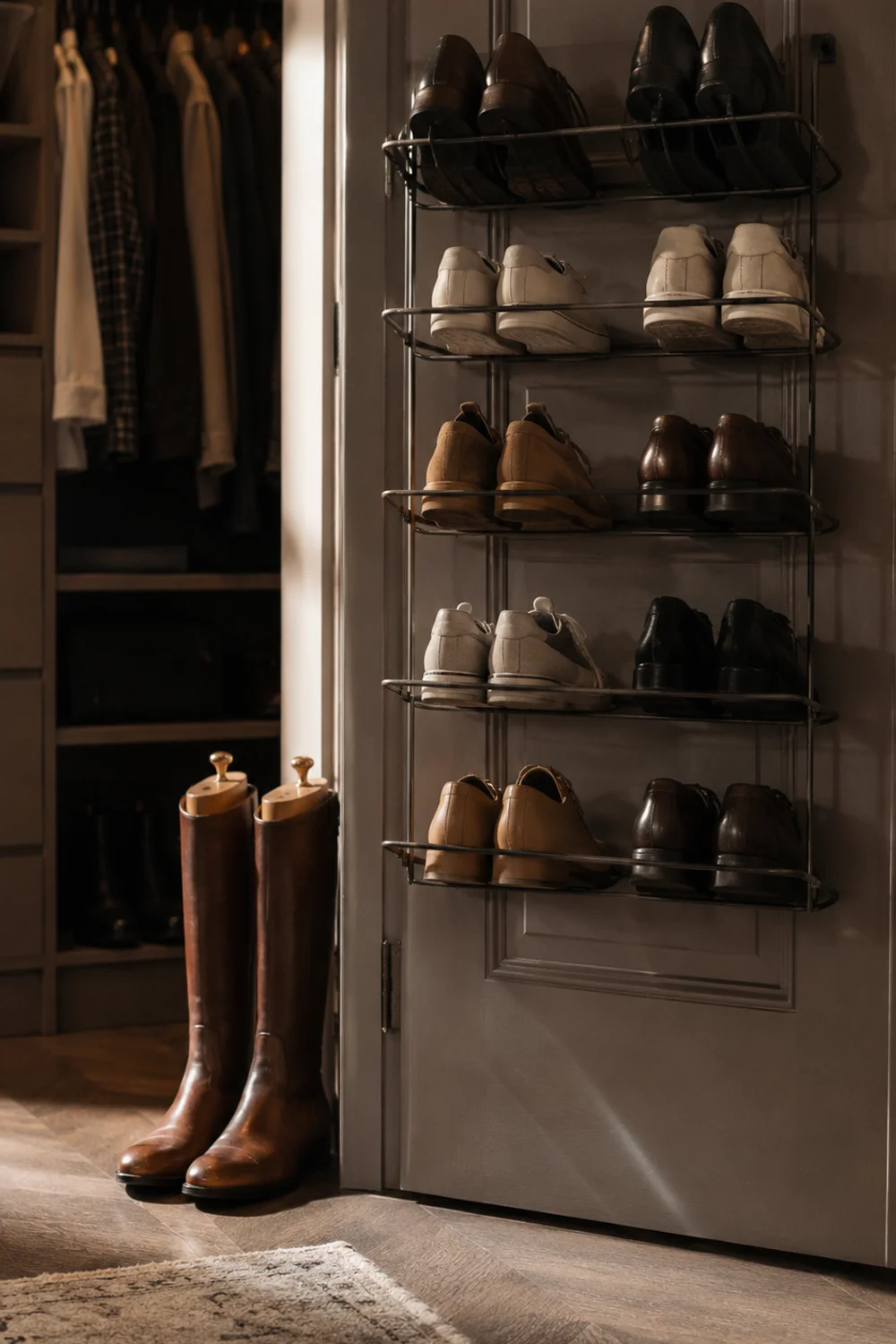
For the regular rotation, a tiered shoe rack that mounts to the back of the closet door is the most space-efficient solution in a small apartment closet. The door is genuine dead space in most closets — it swings open, blocks access to the floor, and holds nothing. Mounting a shoe rack there moves a typically chaotic floor zone off the floor entirely and turns dead space into functional storage.
For occasional shoes stored in their boxes, a labelling system on the box end — a photograph of the shoe taped to the short side facing out — eliminates the guessing-game of stacked identical boxes and makes it possible to grab the right pair without unpacking a tower.
Boots require their own consideration. Tall boots collapse without support, which both damages the leather and makes them nearly impossible to retrieve from storage. Boot shapers — simple cylindrical inserts that keep the shaft upright — solve this cleanly, and a boot stored properly takes up far less floor space than one that’s collapsed sideways.
8. Accessories, Bags, and the Details That Derail Everything
 Save it
There’s a particular closet category that never quite gets solved: the small things. Belts coiled into drawers where they tangle into everything else. Scarves folded into unidentifiable bundles. Bags hung from a single hook that collapses under the weight of three. Jewelry distributed across every flat surface in the apartment because the closet never had a proper place for it.
These small categories are the last five percent of closet organization that creates thirty percent of the frustration. They’re not solved by the main rod configuration or the shelf system — they need their own solutions.
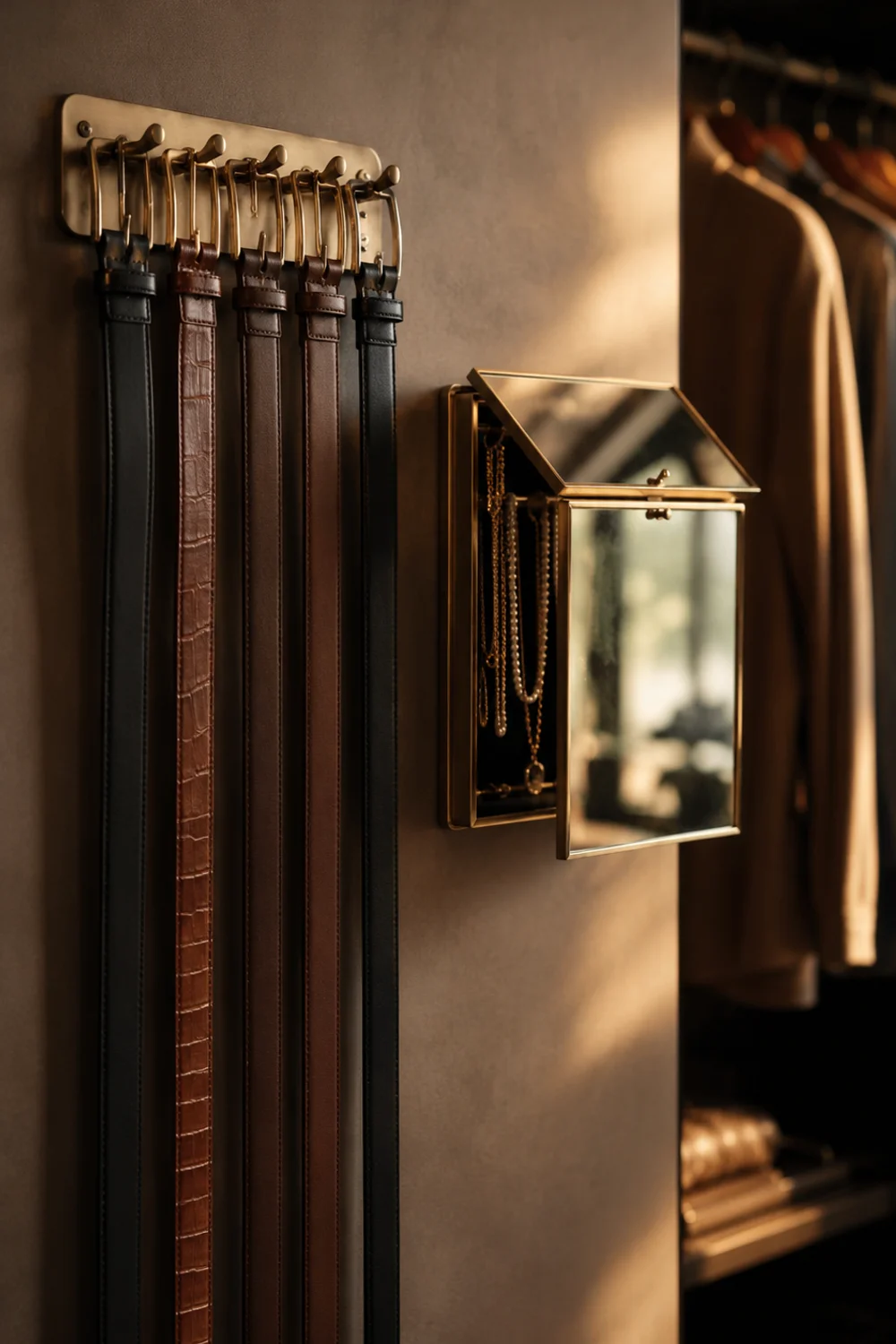
Belts should hang, not coil. A dedicated belt rack mounted to the closet wall or door — simple horizontal pegs from which individual belts hang in a single layer — means you can see every belt at once and grab any one without disturbing the others. The coiled-in-drawer approach creates tangles, damages leather over time, and makes it genuinely difficult to find the right belt quickly.
Bags deserve structure. Each bag should have its own space, not because organization demands hierarchy, but because bags store better when their shape is respected. Smaller bags can hang from individual hooks on the closet wall. Larger bags can sit upright on a shelf with purse pillows or stuffed inside each other. The one thing bags shouldn’t do is pile — piling damages shapes and makes all but the top bag effectively inaccessible.
Scarves and lightweight accessories do well on a multi-hook hanger — one pull-out hanger with several loops — that can hang from a single rod space and fan out in a way that keeps everything visible without tangling.
For jewelry, the question is proximity: jewelry stored at the closet lives closest to the moment of getting dressed, which is when you need it. A compact wall-mounted jewelry organizer with a mirror face — hung on the inside of the closet door or on the closet wall — keeps pieces visible, untangled, and accessible without requiring a separate trip to another room.
9. Drawer Organization and the Interior Logic of a Closet
 Save it
Not every apartment closet has drawers. But for those that do — or for those where a small dresser or drawer unit fits within the floor zone — the interior of the drawers is where closet organization most often quietly fails.
Drawers work beautifully when they’re organized by category and each category has a defined boundary. They become chaotic when items migrate between categories, when folded items aren’t folded consistently, and when the contents settle into an undifferentiated mass that requires excavation to navigate.
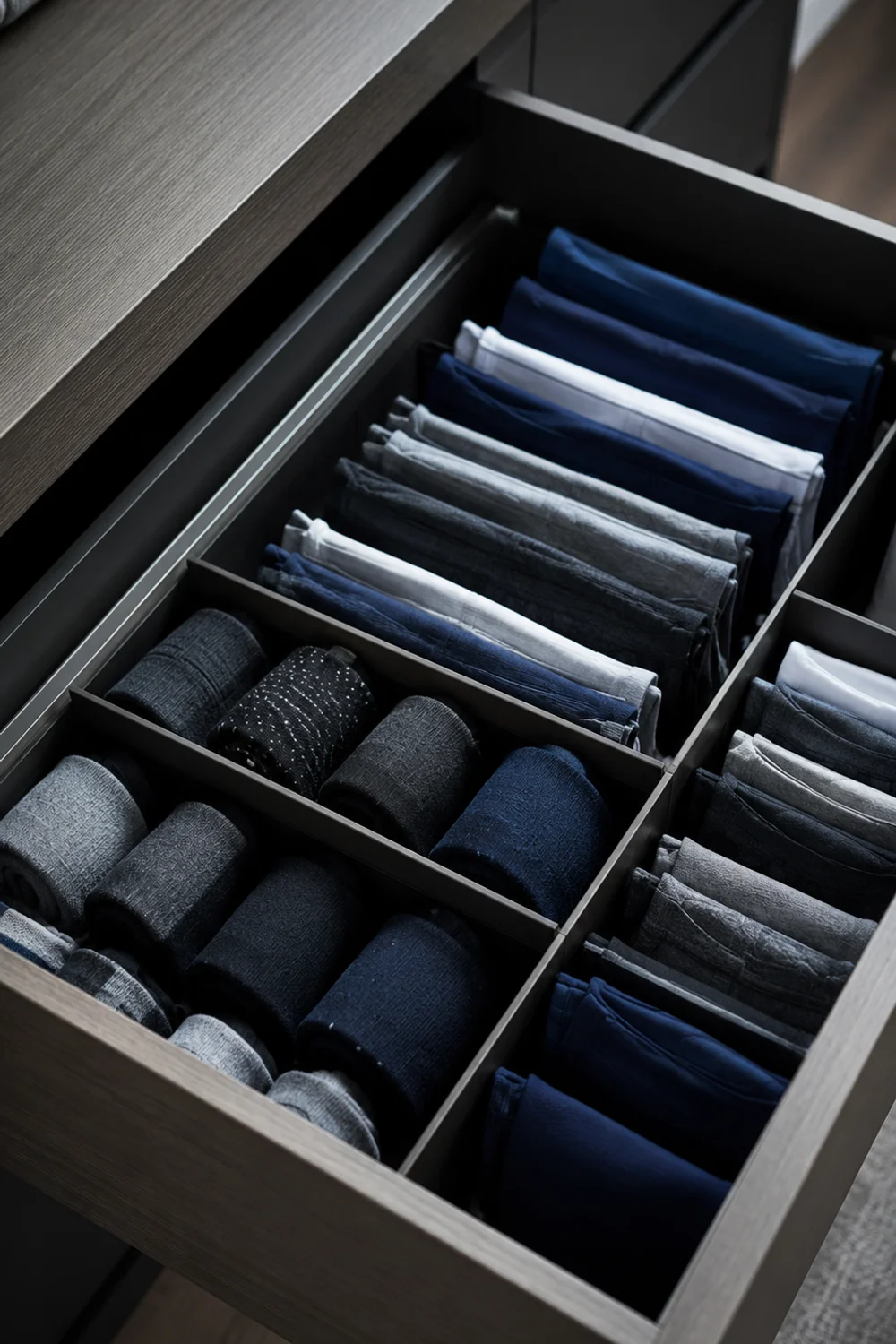
Drawer dividers are non-negotiable for any drawer holding more than one category. Without physical divisions, categories blend. With them, the contents of a drawer are visible at a single glance and stay where they belong even after the inevitable reaches and returns of daily use.
For underwear and socks — the categories that tend to produce the most drawer chaos — the combination of dividers and consistent folding creates a drawer that remains stable over time. Socks paired and rolled sit neatly in compartments. Underwear folded into thirds and stood upright in a file-fold pattern means you can see every pair without moving anything.
An expandable drawer organizer with adjustable dividers accommodates different drawer sizes and can be reconfigured as categories shift seasonally.
For the knits, the question of drawer versus shelf is worth considering. Knitwear folds well and benefits from horizontal support — hanging knits stretches the shoulder — so drawers or shelf bins work better for this category than rods. The key is fold consistency: a knit folded in the same way every time, filed vertically in its bin, takes up a predictable amount of space and is easy to return to its place without disturbing neighboring items. 15 Small Bedroom Ideas for Better Storage and Smart Layouts covers how bedroom storage systems and closet organization work together — particularly relevant if your closet shares a wall with the main bedroom layout.
10. Lighting as the Thing You Don't Realize You're Missing
 Save it
Most apartment closets have no dedicated lighting at all. The light from the room spills in when the door opens, illuminating the first foot of space adequately and leaving everything beyond it in varying degrees of shadow. Finding a specific item at the back, on a lower shelf, or within a drawer becomes a slightly uncertain exercise — which is tolerable once but frustrating as a daily experience.
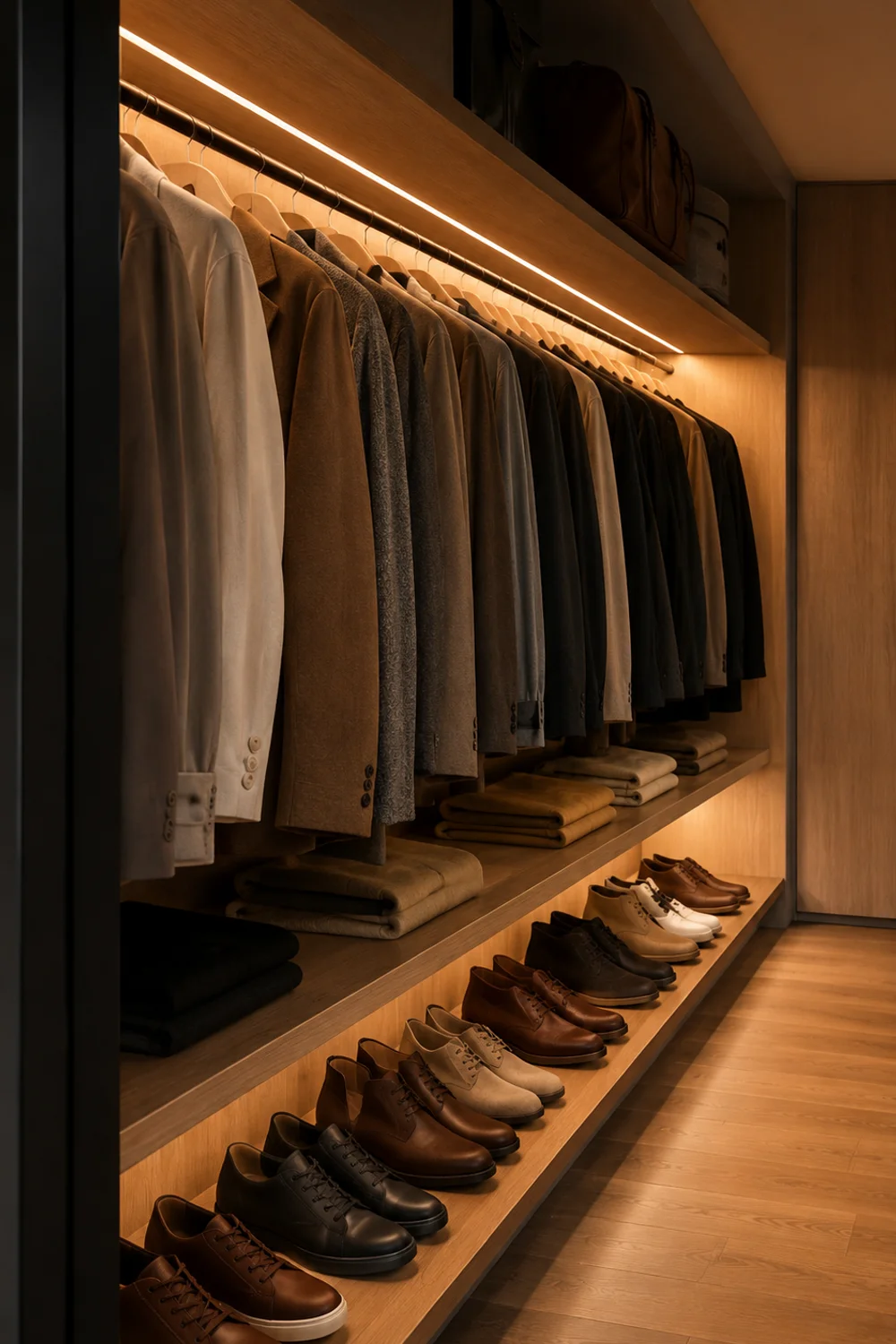
Good closet lighting changes how the space feels to use. A well-lit closet feels more organized than a poorly lit one, even if the arrangement is identical, because you can see everything clearly and retrieve items confidently. The psychological effect of a properly lit closet is surprisingly significant — it feels cared for, considered, and easier.
The most practical solution for a rented apartment is a motion-activated LED strip light. Mounted to the underside of the top shelf or along the ceiling of the closet interior, it activates when the door opens and turns off automatically — no switches, no forgetting, no wasted energy. The light reaches the full depth of the space, illuminates lower shelves and the floor zone, and makes color-matching (the most common morning frustration in a poorly lit closet) finally reliable.
Color temperature matters here in the same way it matters in any room. Warm white (2700–3000K) renders clothing colors accurately and feels comfortable in an enclosed space. Bright cool white (5000K+) is harsh and makes the closet feel clinical rather than pleasant to use. The warmth of the light is worth specifying when choosing a fixture.
For a closet with a deep interior, two short strip lights positioned on opposite sides of the ceiling will eliminate shadows more effectively than a single centered light. The even illumination makes the whole space feel open and accessible.
11. The Aesthetic Layer That Makes You Want to Open the Door
 Save it
There is a version of closet organization that’s purely functional — systems that work, categories that hold, items that are findable. This version is a significant improvement on chaos. But there’s a version beyond it: the closet that you genuinely enjoy opening, that feels considered rather than merely solved, that gives you a moment of calm rather than a moment of decision fatigue every morning.
This is the aesthetic layer. And it matters more than functional organization purists usually admit, because how a space feels to use determines whether you maintain it.
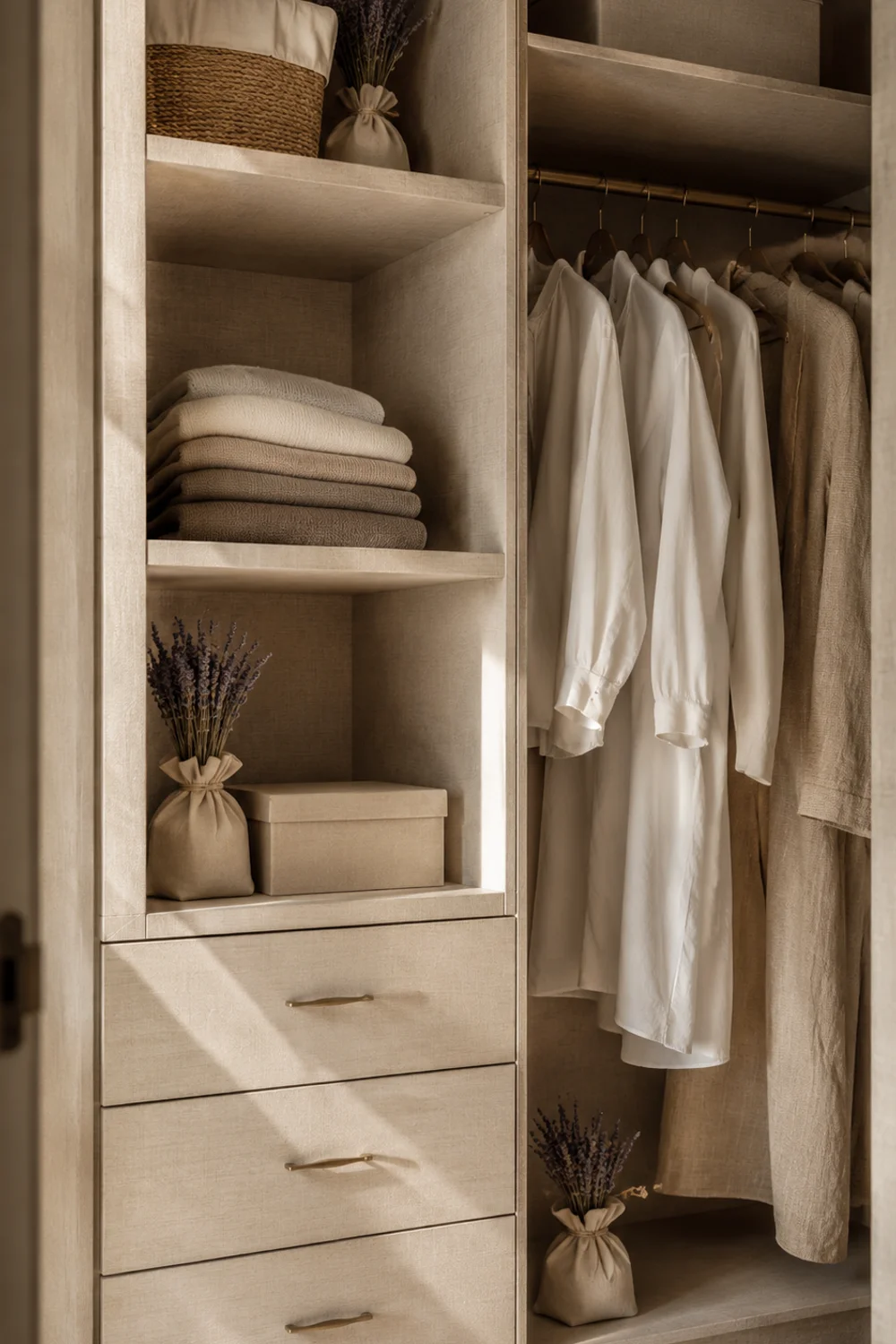
The simplest tool is uniformity. Uniform hangers are the single biggest visual contributor. Beyond that: matching shelf bins, consistent labelling, and a cohesive color palette for the items you store in the open (shoe boxes, drawer bins, shelf containers) contribute an enormous amount to the overall visual calm.
Drawer liners in a soft neutral — linen-effect paper, matte white, a warm stone tone — line the interior of drawers and shelves with a finished quality that changes how the space reads. It’s a small detail with a disproportionate effect.
Scent is part of the closet experience in a way that’s easy to underestimate. A well-organized closet that smells of stale air doesn’t feel pleasant to open. Sachets of dried lavender tucked into corners and drawers maintain a gentle freshness that makes the space feel maintained rather than just organized.
The visual experience of opening the closet — before you reach for anything — is where the aesthetic investment pays off. A closet that looks calm makes you feel calm. And a closet that makes you feel calm will be treated more carefully than one that feels perpetually on the edge of chaos. How to Build a 5AM Morning Routine That Actually Works explores how the quality of your physical environment — including the state of your closet — shapes the tone of the entire morning, which is one of the underappreciated arguments for investing in this kind of organization.
12. Seasonal Editing and the System That Stays Stable
 Save it
The final dimension of closet organization is time. Even the best-designed system will gradually drift back toward disorder if nothing maintains it — and the most effective form of maintenance isn’t constant tidying, it’s scheduled, deliberate seasonal editing.
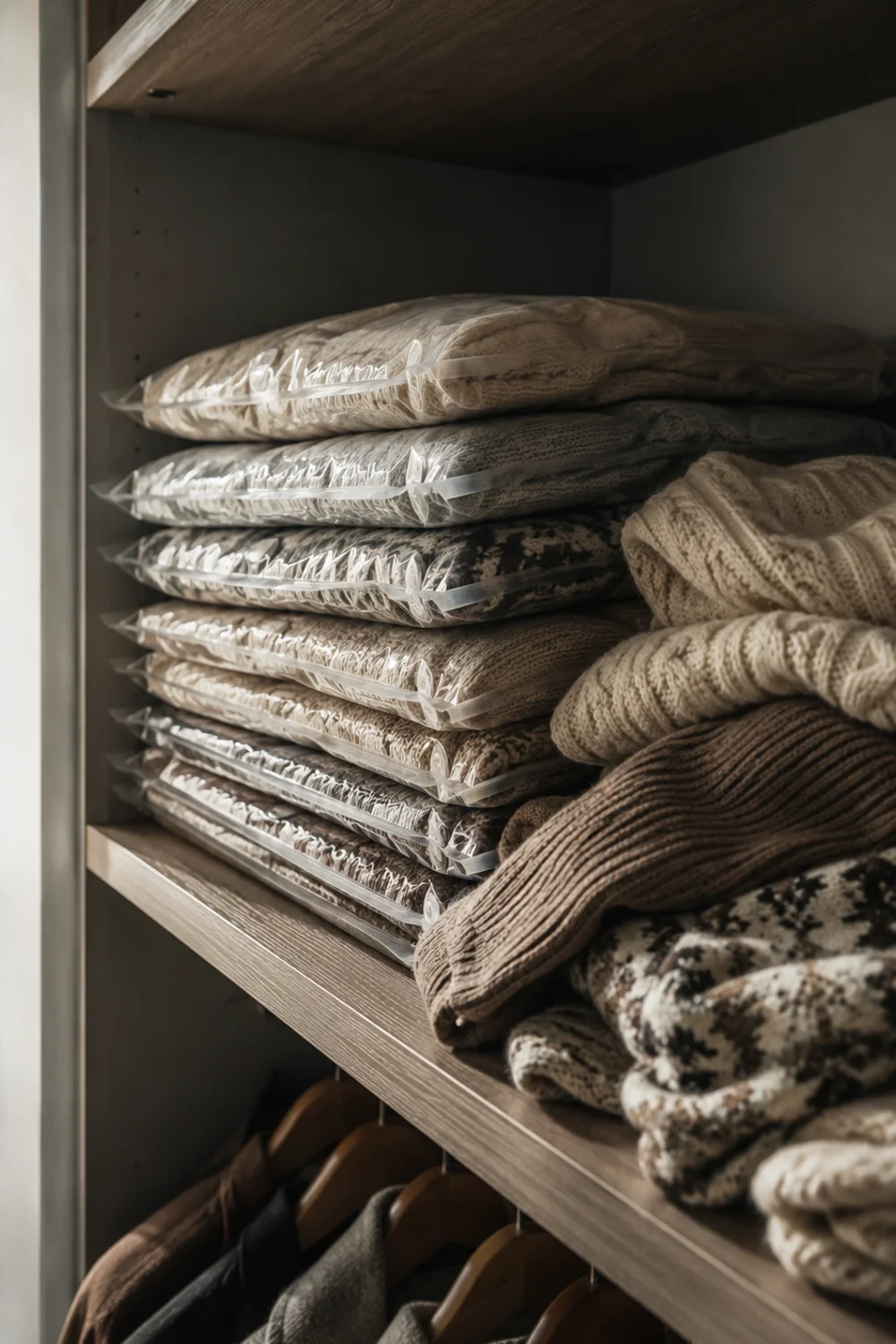
Twice a year — roughly at the transitions between warm and cold seasons — is enough to keep a small apartment closet genuinely functional over time. The spring edit removes heavy knits, coats, and cold-weather accessories from primary positions and moves them to vacuum storage bags or upper-shelf boxes. The autumn edit reverses this, returning winter items to accessible positions and moving lightweight summer pieces into secondary storage.
Vacuum storage bags are the most space-efficient solution for off-season clothing. A sweater that takes up six inches of shelf space compressed into flat storage takes less than one — and the compression also protects against moths and dust during months of non-use.
This seasonal transition is also the natural moment for a secondary declutter. Before an item goes into seasonal storage, the question is worth asking again: did I wear this at all this season? If the answer is no for a second consecutive year, the item has effectively been making decisions for you — it’s taking up space without earning it. Removing it at the transition is less effortful than a dedicated declutter session and more honest, because you’ve just completed a full season of wearing evidence.
The maintenance between seasonal edits is minimal if the system has been designed correctly. Items return to their assigned places. New purchases are evaluated against the existing categories before they enter the closet. The closet remains at roughly the same density all year, rather than gradually accumulating until the next crisis. Small Daily Habits That Lead to Big Life Changes makes the case for this kind of low-effort consistent maintenance far more broadly — the principle that small, regular actions outperform occasional heroic efforts is particularly true for spaces like closets that reward consistency.
For a rented apartment, this seasonal rhythm also gives you a twice-yearly opportunity to assess whether the organizational system itself still fits your life. Wardrobes change. Circumstances change. What worked last year may not be the right configuration this year, and the seasonal edit is the natural moment to adjust. How to Design a Workspace You’ll Actually Love Working In? approaches the same question of system-fitting — designing a functional personal space around how you actually work and live — which translates directly to the closet as a space that should be built around your real habits rather than a generic template.
Common Mistakes
1. Buying storage products before decluttering
This is the most expensive mistake in closet organization, and it’s remarkably common. The impulse is understandable — there’s something psychologically satisfying about the idea of a beautiful set of matching bins, a tiered shoe rack, a set of velvet hangers — and it feels like progress to purchase them. But organizational products added to a closet that still contains the wrong things will simply organize the wrong things more neatly. The underlying problem remains entirely unsolved. The storage products fill, the disorder returns, and the conclusion drawn is that “nothing works” — when the actual problem was sequence. Declutter first, always. Understand what you’re actually keeping before you invest in how to store it.
2. Designing the system for the imagined wardrobe, not the real one
Many people organize their closets around the wardrobe they aspire to have — more formal, more curated — rather than the one that actually exists. They allocate generous hanging space to formal wear they rarely wear and cramped storage to the casual pieces that make up ninety percent of their daily dressing. The result is a system that looks right but doesn’t function right, because the proportions don’t match reality. The honest audit — counting how many items actually live in each category, measuring your longest hanging items, identifying which shoes you reach for most — is the only foundation for a system that holds up under actual use.
3. Ignoring vertical space
The floor-to-ceiling height of a closet is often its most underused dimension. A single rod hung at standard height leaves a large dead zone above and an undefined floor zone below, neither of which is actively solving anything. The correction — double-hang configuration, additional mounted shelves, door-mounted storage — can effectively double the functional capacity of the space without adding a single square inch of footprint. Most apartment closets have far more vertical space than their current configuration uses.
4. Mixing storage types without clear zones
Closets that hold hanging clothes, folded items, shoes, accessories, and bags without clear physical separation between categories become very difficult to maintain. Items migrate. Shoes end up on shelves. Folded items get stacked on top of shoe boxes. Clear category zones — with physical separators, dedicated surfaces, or distinct areas — create the visual and behavioral boundaries that allow a system to stay stable without constant re-sorting.
5. Organizing once and never returning
A closet organized brilliantly in one session will drift toward disorder within months without any follow-up. This isn’t a failure of the original organization — it’s the reality of a living space that absorbs new items, accommodates seasonal changes, and reflects the gradual evolution of a wardrobe. A brief seasonal edit twice a year and the daily habit of returning items to their assigned places immediately are what stable closet organization actually looks like in practice.
Frequently Asked Questions
How do I organize a small closet when I have too many clothes?
The honest answer is that you have two options: create more capacity or reduce the volume. Usually both are needed. The capacity side — double hanging, door storage, vertical shelving, vacuum compression for seasonal items — can meaningfully increase what the closet holds. But no organizational system can infinitely expand to absorb an unlimited wardrobe in a limited space. The most useful framing: ask what the closet realistically holds well, and build your active wardrobe around that number. Everything beyond it moves to seasonal storage or leaves.
Is it worth replacing all my hangers at once?
Yes, and the difference will be immediately visible. A full set of matching slim velvet hangers in a single color transforms the visual experience of the closet almost instantly. Because hangers are uniform in size and height, every garment hangs at the same level and the closet reads as orderly at a glance, even before you’ve changed anything else. It’s one of the highest-impact single changes available for a small closet at a relatively low cost. Do it as one action rather than gradually replacing individual hangers over time — the partial state looks more cluttered than either the before or the after.
What do I do with items that don’t fit in the closet?
Evaluate honestly whether they need to be in the active wardrobe or whether they belong in secondary storage. Seasonal items, special-occasion clothing, sports gear, and rarely-used accessories don’t need prime closet real estate year-round. Vacuum storage bags under the bed, a dedicated storage bin on the top shelf, or a second wardrobe in another room can absorb overflow without the main closet absorbing the organizational cost. The goal of the main closet is to house your active, regular-use wardrobe — everything else can live elsewhere.
How do I maintain a small closet organization over time?
The single most effective maintenance habit is immediate return: every item goes back to its designated place the same day it’s used. A closet that takes thirty seconds to return items to is a closet that stays organized. Beyond this daily habit, a brief seasonal review — at the wardrobe transitions, twice a year — catches the category drift and declutter accumulation before it becomes a crisis. That combination of daily micro-habit and seasonal macro-edit is what stable closet organization actually looks like in practice.
Should I invest in a custom closet system for a rented apartment?
For most renters, the best approach is a modular freestanding system rather than a built-in custom installation. Freestanding systems — a freestanding wardrobe, a modular shelving unit, a standalone drawer tower — move with you when you leave and can be reconfigured as your needs change. They can be assembled specifically for your wardrobe and your space without drilling or permanent modification. The investment pays off quickly, because a well-configured modular system delivers most of the benefit of a custom closet at a fraction of the cost and with full portability.
Final Thoughts
A well-organized small apartment closet doesn’t just solve a practical problem. It changes the quality of a small but recurring moment — the morning, the evening, the daily negotiation between your wardrobe and your day. When the space works with you rather than against you, those moments become easier. You find what you’re looking for. You get dressed without frustration. You close the door behind you feeling, if not quite ready for anything, then at least prepared.
The principles in this guide are not complicated. They reward honest assessment over wishful thinking, systems over impulse purchases, and the willingness to treat a small space as something worth designing carefully rather than just filling pragmatically. None of it requires a renovation or a significant budget. Most of it requires only time, attention, and a willingness to make specific decisions about what belongs and how.
Start with the declutter. It’s unglamorous and most people want to skip it, but everything else — the configuration, the products, the aesthetics — depends on it. Once you know what you’re actually keeping, the system design becomes straightforward. The right hanging configuration for your specific wardrobe becomes obvious. The products you need become clear. The closet that felt impossible starts to feel solvable.
The apartment closet is one of the spaces most worth getting right, precisely because it’s small. Small spaces ask for precision, and precision, applied here, delivers daily returns in the form of mornings that begin a little more smoothly and evenings that end a little more calmly.
This post contains affiliate links. I may earn a small commission at no extra cost to you.
Get cozy inspiration delivered to your inbox.
✓ 14-page beautifully designed ebook
✓ Cozy decorating ideas
✓ Practical room-by-room inspiration
You’re in! 🎉
Thanks for joining the NestFlowHome community!
Your free ebook is already on its way to your inbox. If you don’t see it within a few minutes, please check your Promotions or Spam folder.
Join the NestFlowHome community for weekly decorating inspiration.

Timeless home decor ideas and slow living inspiration for a calm, beautiful life.