
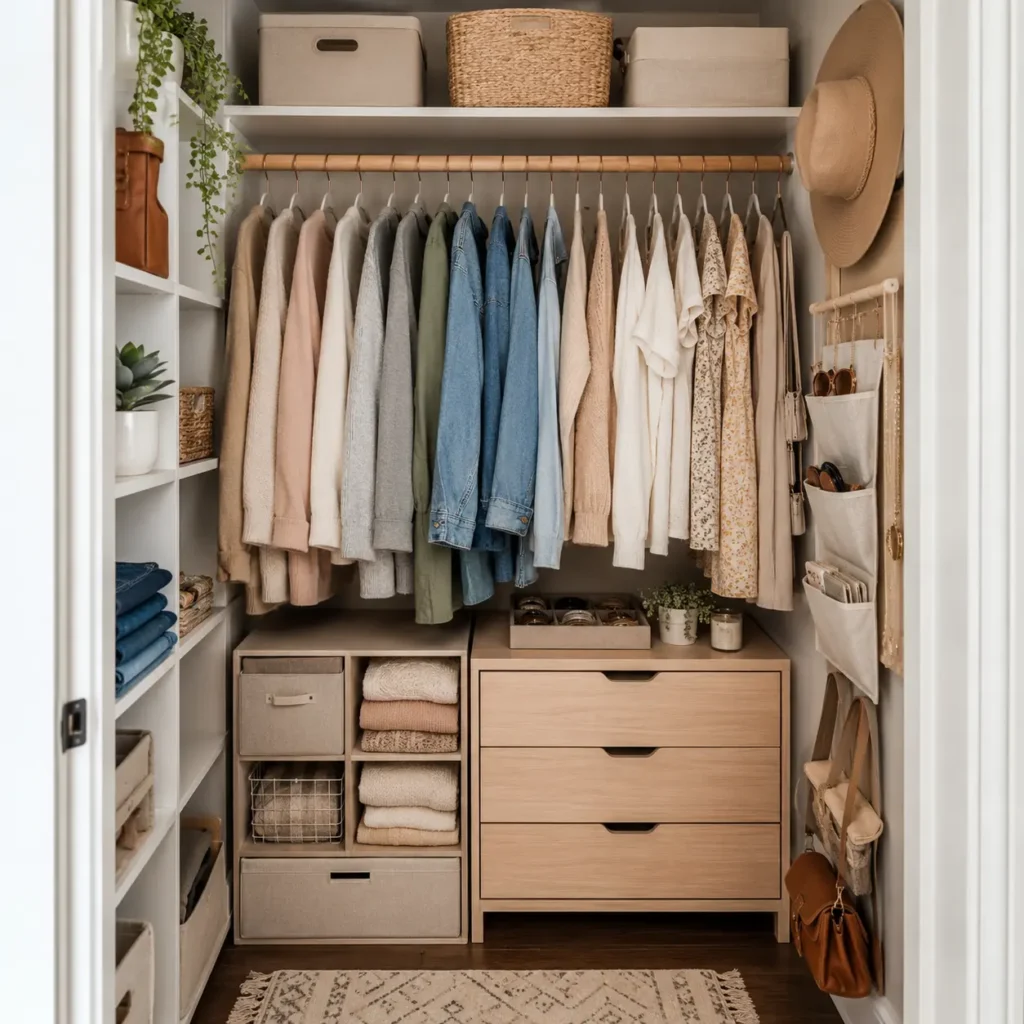
Small Closet Organization Ideas That Actually Work and Look Stunningly Beautiful
By Emily | June 15, 2026
There’s a particular kind of frustration that belongs entirely to a small closet. You open the door first thing in the morning, and instead of calm, you’re met with a wall of things — a jumbled architecture of clothes, bags, shoes, and forgotten items that somehow multiply overnight. You can’t find anything. You can barely see anything. And despite that chaos, you still own the exact right pieces for a beautiful wardrobe.
The problem is almost never the clothes. It’s the space itself — or rather, how the space is being used.
Small closets, when organized with intention, can feel extraordinary. Not just functional, but genuinely beautiful. The kind of space you open every morning and feel a small, quiet satisfaction in. Interior designers have understood this for years: a well-organized closet changes how you start your day. It reduces decision fatigue, creates a sense of control, and subtly shifts your entire relationship with getting dressed.
This article isn’t about buying more storage or hiding more things away. It’s about understanding what makes a small closet feel cramped versus curated — and then applying that understanding in a way that’s realistic, affordable, and genuinely lovely. From drawer systems to vertical shelving, from lighting psychology to the art of the capsule wardrobe rotation, every section here is designed to help you transform what you have into something that works harder and looks better than you thought possible.
The most beautiful closets in the world aren’t always the biggest ones. They’re the most intentional.
1. The Psychology of the Empty Closet
 Save it
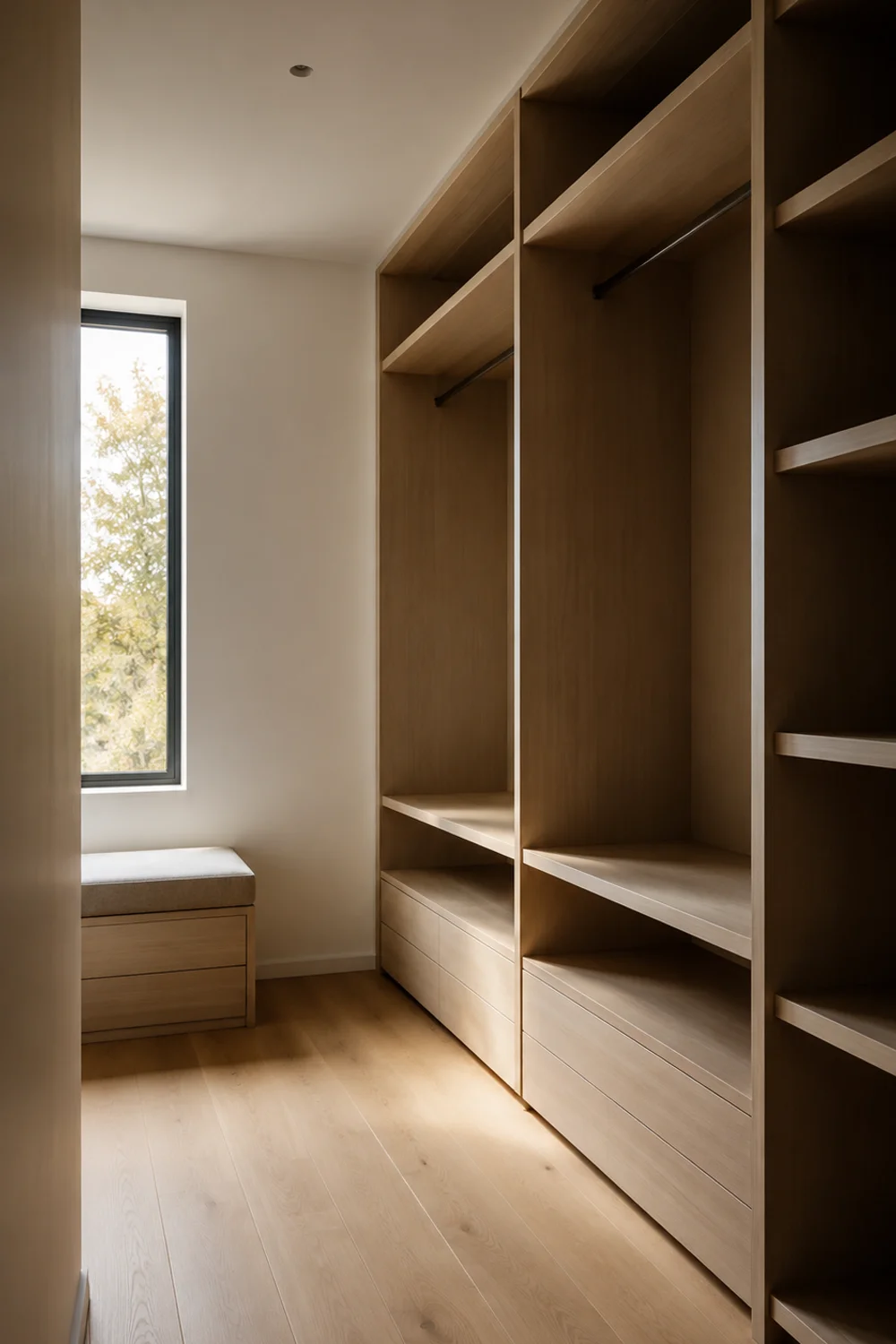
Before any organizing system can work, the closet needs to become empty first. Not metaphorically — literally. Every item removed, every shelf cleared, every rod bare. This is the step most people skip, and it’s the reason most organizing projects fail within three weeks.
The psychology behind this is straightforward but easy to underestimate. When you organize around existing chaos, you’re essentially building structure on top of disorder. You’re accommodating things that shouldn’t be there, making room for items you no longer use, designing a system around the problem rather than solving it first. The result always looks cleaner than before, but it rarely functions cleanly — because the foundational decisions were never made.
Emptying the closet forces a reckoning. Every single item must be held, considered, and actively chosen to come back in. Not tolerated. Not left in out of guilt or inertia. Actively chosen.
This is where the concept of intentional curation begins — and it looks very different from generic decluttering advice. It’s not about ruthlessness or minimalism for its own sake. It’s about asking a different kind of question. Not “should I keep this?” but “does this belong in the space I’m trying to create?” That shift in framing changes everything. You’re not deciding what to eliminate. You’re deciding what deserves to live in the beautiful, functional closet you’re about to build.
During this process, pay attention to categories. How much of each thing do you actually own? Most people discover a surprising imbalance — perhaps far too many casual tops and very few items for formal occasions, or ten pairs of shoes they wear regularly and twelve pairs they’ve touched twice in two years. Seeing the actual numbers removes the fog. It tells you what the closet needs to hold, which determines every decision that follows.
After the edit, before anything goes back in, take a moment simply to stand in the empty space. Notice where the light falls. Notice the dimensions. Notice where the natural eye line lands when you open the door. This is the beginning of designing, not just organizing, and it’s a distinction that makes all the difference.
2. Vertical Space and the Power of Going Up
 Save it
The single most underused resource in a small closet is the space above eye level. Most closets come standard with one rod and one shelf above it — a configuration that was designed for practicality in 1960 and has barely evolved since. And while it functions, it wastes an enormous amount of vertical potential, especially in older homes and apartments where ceiling heights can reach well above the standard shelf placement.
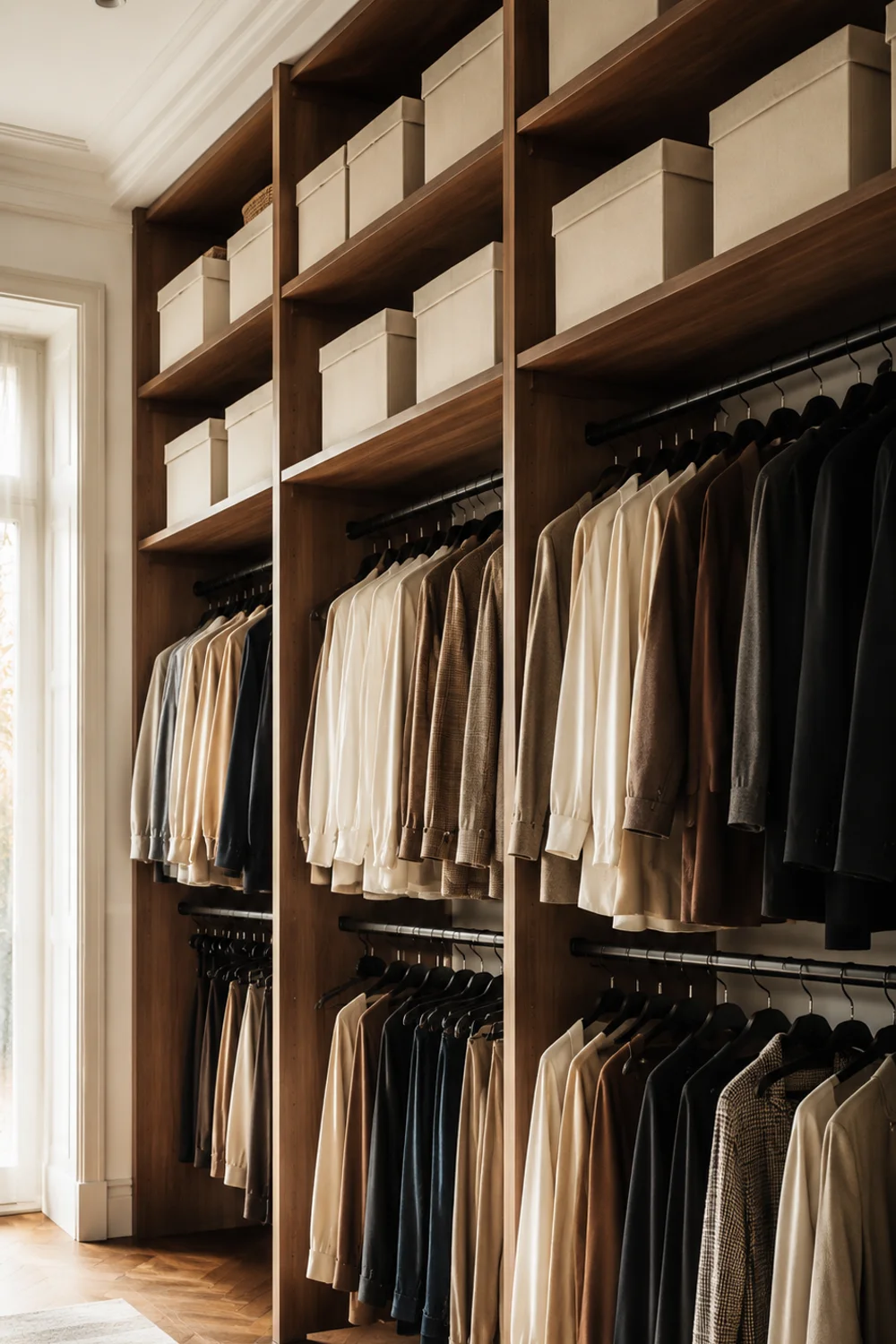
Extending shelves all the way to the ceiling is one of the highest-impact changes you can make in a small closet. That top zone — the 18 to 24 inches between your existing shelf and the ceiling — is ideal for seasonal storage, extra linens, rarely used bags, and anything that doesn’t need to be accessed daily. Matching storage boxes or bins up there create a clean, intentional look rather than a haphazard pile. The visual effect is significant: when storage reaches the ceiling, the eye reads the full height of the room, which makes the space feel taller and more considered.
Below the hanging rod, there’s almost always wasted space too. If most of your wardrobe consists of tops, jackets, and shorter pieces, consider adding a second hanging rod beneath the first to double your hanging capacity without touching the footprint of the closet at all. This works especially well for folded shirts hung on velvet hangers, blazers, and pants folded over a bar — items that rarely need the full vertical drop of a standard single-rod setup. 15 Small Bedroom Ideas for Better Storage and Smart Layouts explores how this same vertical logic applies to the bedroom as a whole, which is worth reading if your closet sits within a compact bedroom where storage decisions need to work in harmony with the rest of the room.
The key to making vertical expansion feel beautiful rather than overwhelming is consistency. Choose a single shelving system with a clean profile — open wood shelves in a warm tone, or white lacquer for a crisper look — and carry it from floor to ceiling. The repetition of the same material and depth creates visual rhythm that reads as intentional rather than improvised.
A beautiful set of matching slim velvet hangers instantly transforms this vertical space — the slim profile alone creates inches of breathing room and the uniform appearance is far more editorial than a mix of plastic and wire.
3. The Art of the Drawer System
 Save it
There is something deeply satisfying about a well-organized drawer. Not just because it functions well, but because it represents a different relationship with your possessions — one where everything has a place precise enough that you know immediately if something is out of order.
For small closets, drawers are often an afterthought. The standard configuration leans heavily on hanging rods and shelves, leaving folded items stacked in precarious piles that collapse the moment you extract something from the middle. The drawer system is the answer to this — and it doesn’t require a custom built-in to work beautifully.
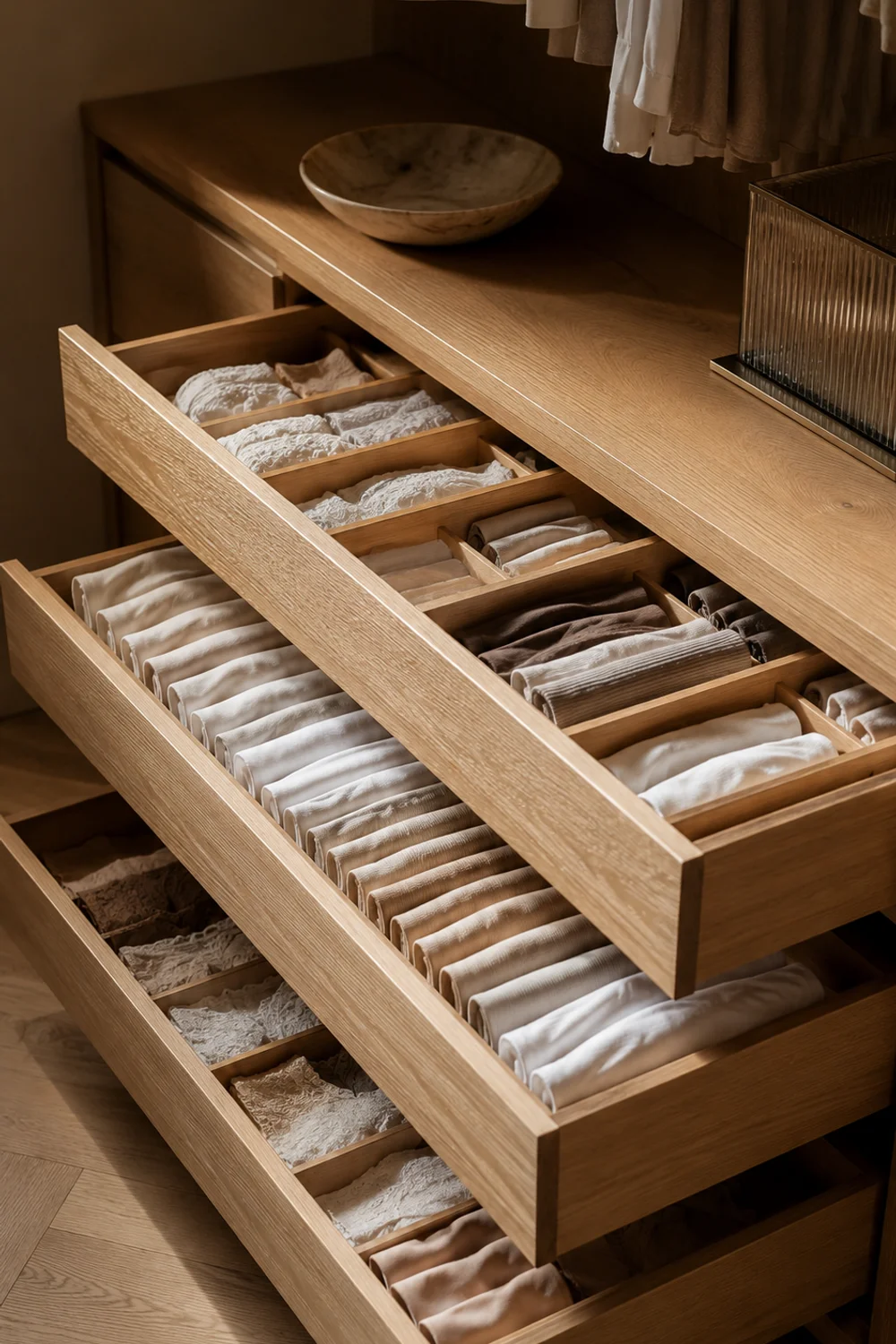
Modular drawer units that sit on the closet floor or on a low shelf can be configured to fit almost any closet width. The advantage of modular systems is flexibility: you can begin with one or two units and expand as the budget allows, adding sections without dismantling what’s already there. Look for units with a slim drawer height for underwear and socks, a medium height for folded t-shirts, and a deeper drawer for heavier knit sweaters. This tiered approach means each category has exactly the depth it needs, which translates directly into how neatly things fold and how easily they’re retrieved.
Inside the drawers, fabric drawer dividers are what separate a functional drawer from a beautiful one. Without them, drawers collapse into a secondary chaos — a pile that simply happens to be hidden. With them, each category stays contained, and the vertical filing method (where items are stored upright rather than stacked in layers) means you can see every piece at a glance without disturbing anything else.
Drawer fronts matter more visually than most people realize. In an open closet or wardrobe with doors left open during daily use, the drawer front is part of the visual composition. Natural wood tones add warmth. A linen-wrapped front adds texture. Even a simple matte white has a crisp elegance that elevates the space considerably above the standard laminate look. This is one of the least expensive changes with the most visible editorial impact.
If your closet is too shallow or small for freestanding drawer units, consider a slim rolling cart that can be tucked alongside hanging sections. These can hold everything from folded scarves to accessories and can be pulled out when needed, then returned to their position within the closet when not in use.
4. Hanging Solutions That Actually Work
 Save it
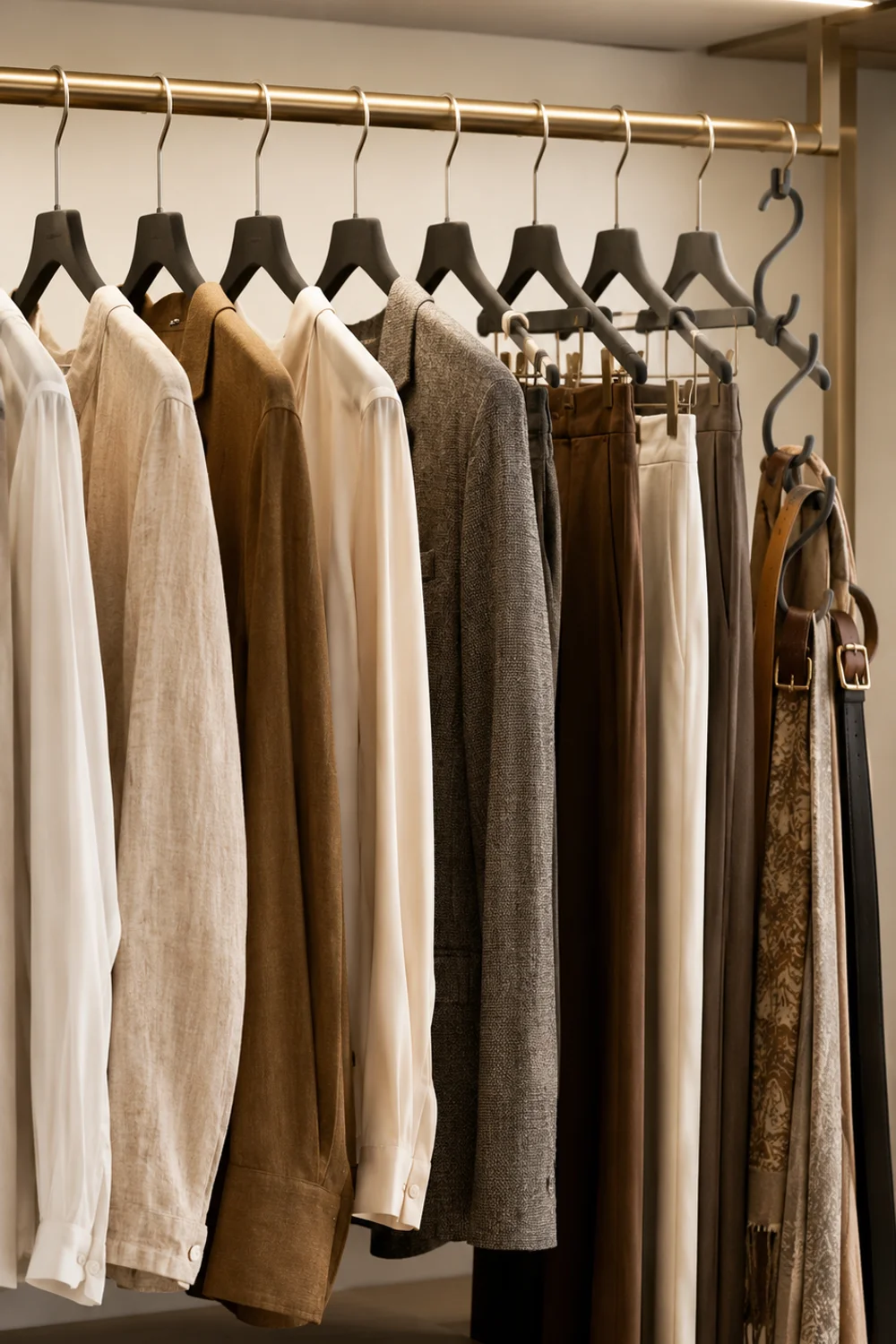
The rod is the oldest and most fundamental element of closet organization — and it’s the one most people use in the least efficient way possible. Items crammed together so tightly that retrieving anything requires force. Hangers of every type and age mixed together. Garments sorted (or not sorted) in no particular sequence. It’s not chaos exactly, but it’s not working.
Rethinking the hanging zone starts with the hangers themselves. Uniform hangers are the single fastest visual transformation available to a small closet. Not because they’re aesthetically precious, but because they reduce the visual noise dramatically. Mixed hangers of varying heights, colors, and widths create a restless, busy appearance even when the clothes themselves are tidy. Replace them with one consistent style — slim velvet for most garments, wooden for heavier coats and blazers — and the difference is immediate.
The spacing between garments matters too. Clothes pressed together can’t breathe, literally or visually. Leave at least a finger’s width of space between each item — enough that you can see the side profile of each garment without pulling anything aside. This is how boutiques display clothes, and it’s why boutiques feel so calm. You can see everything. Nothing is hidden. Nothing requires excavation to find.
Category organization within the hanging zone is a decision worth spending time on. Some people organize by type first (all trousers together, all blouses together), then by color within each type. Others prefer to organize by outfit or occasion. There’s no universal answer — the best system is the one you’ll actually maintain. Closet Organization Ideas You’ll Fall in Love With goes deeper on different organizational philosophies and which work best depending on how you shop and how you dress.
For closets with a single rod, adding S-hooks or tiered hangers to hang multiple items on one hook can double the hanging capacity of a section without requiring any structural change. This works particularly well for scarves, belts, and bags that don’t need to be hung on a rod at all.
5. Shelf Styling for Small Spaces
 Save it
Shelving is where organization and aesthetics meet most visibly. Unlike drawers, which hide their contents, shelves put everything on display — which means the way items are arranged matters as much as what the items are. A beautifully styled shelf in a small closet can feel like the interior of a luxury boutique. A poorly arranged one, even with beautifully folded clothes, will feel cluttered.
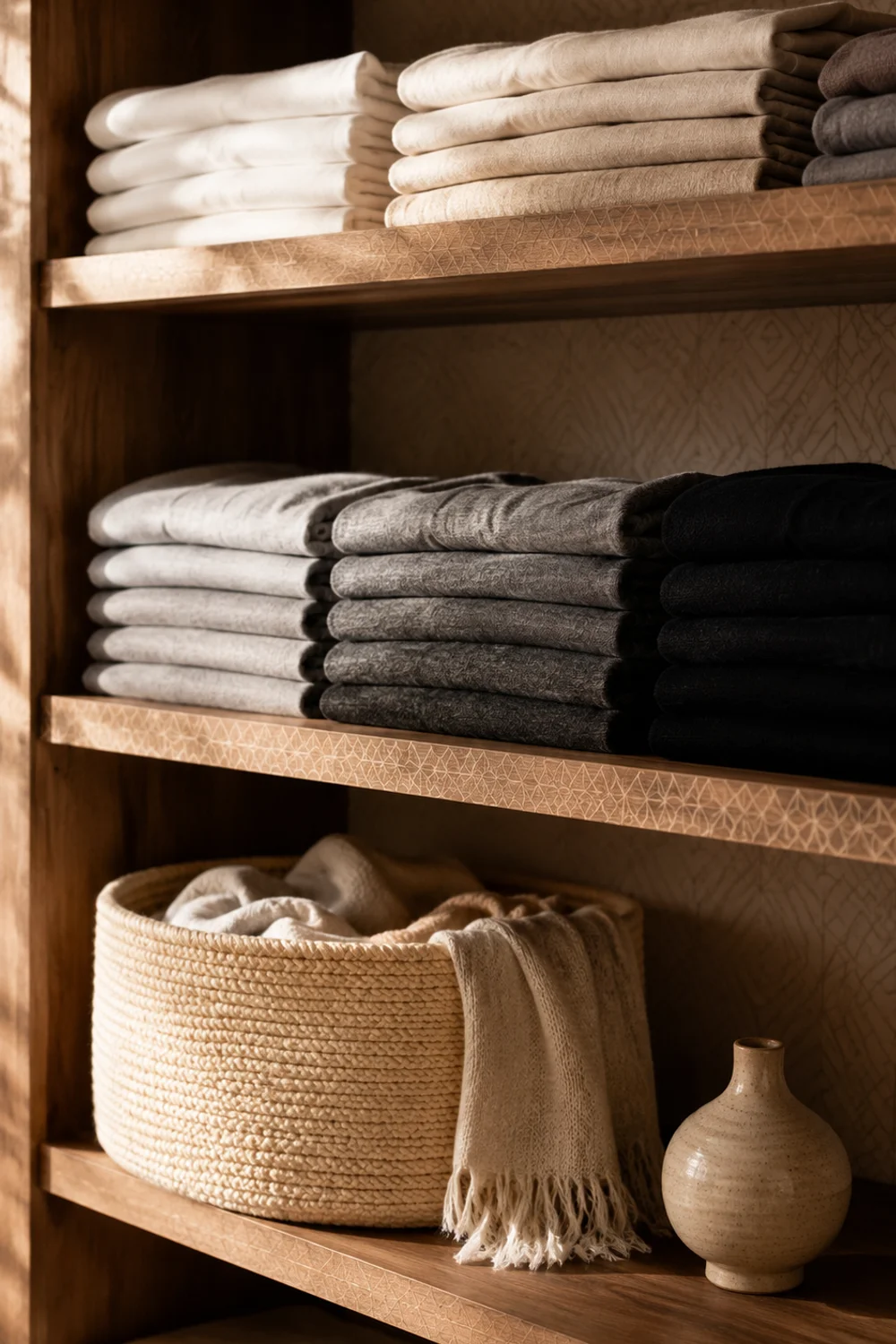
The foundation of good shelf styling is folding consistency. Every item folded to the same width, stacked to a maximum of four or five pieces high, arranged in columns rather than rows. This sounds almost obsessively precise, and in practice it becomes second nature within a week. The visual payoff is remarkable: a shelf of consistently folded t-shirts, arranged by color from light to dark, reads as designed rather than just stored.
Boxes and baskets on shelves serve two purposes simultaneously — containment and visual softness. Open shelves that mix folded clothes with accessories, random items, and containers of varying shapes create visual tension that feels exhausting to look at. Dedicated baskets for specific categories (one for gym wear, one for loungewear, one for accessories) create visual groupings that the eye can read quickly and calmly. The basket becomes the label, not just the container.
For the decorative layer — because even a functional closet benefits from a moment of beauty — a small arrangement of items on an upper shelf can add considerable warmth. A folded cashmere throw in a neutral tone, a single ceramic object, a small tray holding a few rolled scarves. These aren’t surplus items or visual noise; they’re considered editorial touches that elevate the shelf from storage unit to styled space.
Shelf liner in a subtle pattern or a soft solid color is a small investment that dramatically changes the feel of wooden shelving. It protects the surface, adds texture, and gives the impression that the closet has been thoughtfully finished rather than simply assembled.
The color relationship between shelf contents matters greatly in small spaces. Arranging clothes by color on shelves (lighter tones together, deeper tones together) reduces visual complexity and makes individual pieces easier to find. It also produces a quietly beautiful gradient effect when the closet door is open — something that reads as genuinely designed and feels nothing like the average storage solution.
6. Lighting the Closet Interior
 Save it
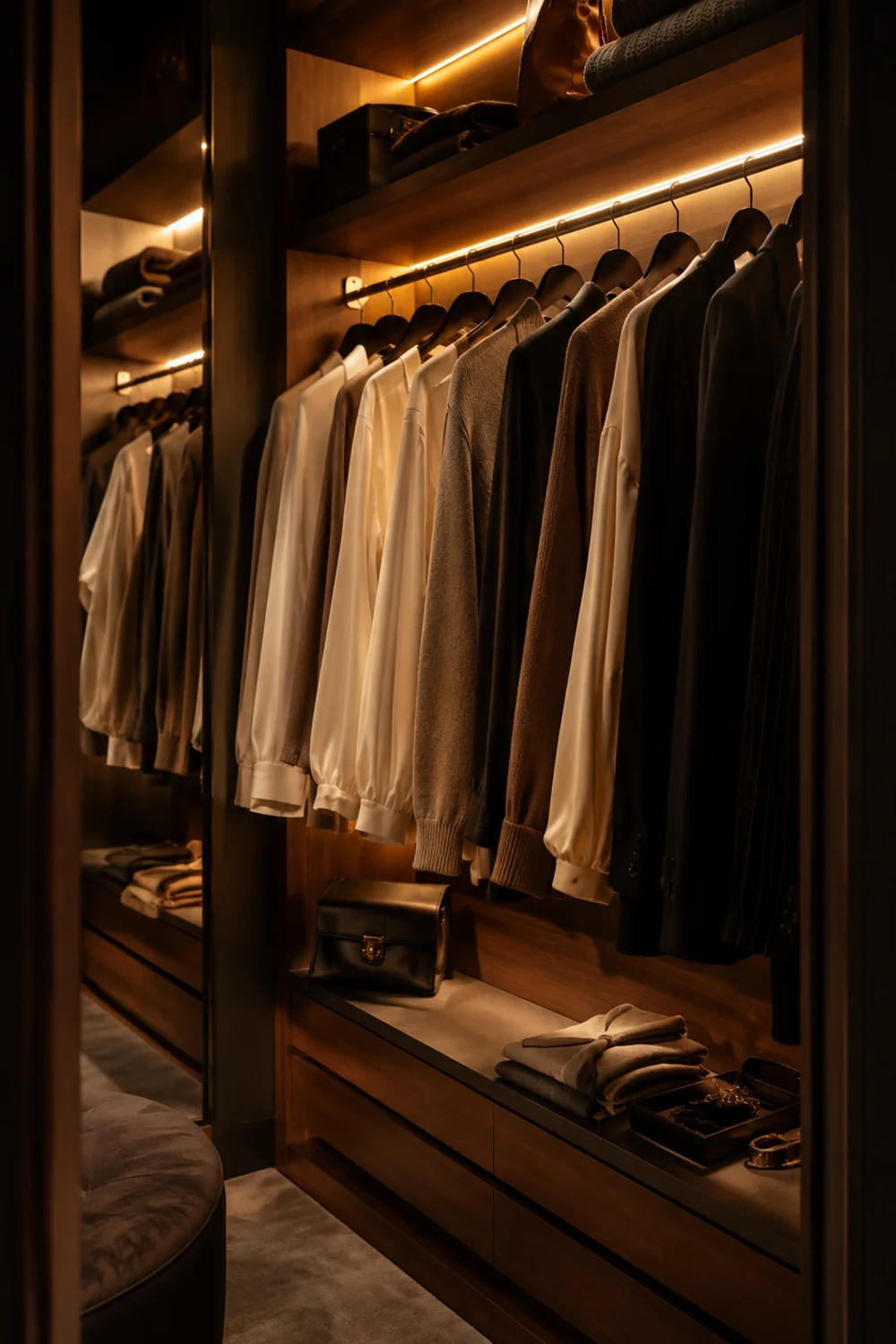
Closet lighting is consistently the most overlooked element of closet design, and its impact is felt every single day. A dark closet is a frustrating closet. Colors appear wrong. Details are invisible. The morning routine becomes a slow, slightly aggravating process of holding things up to exterior light to see what you’re actually looking at.
Good closet lighting changes the experience of the space entirely. When the interior is well-lit, the closet reads as a room within a room — an intentional, considered environment rather than a utilitarian storage cavity. And the practical benefits are immediate: you can see every item clearly, colors read accurately, and the act of choosing what to wear becomes genuinely easier.
LED strip lighting installed beneath shelves or along the ceiling perimeter of a small closet is the most effective and aesthetically versatile solution. The light is diffused, even, and completely eliminates the harsh shadows that traditional overhead bulb lighting creates. Warm white LEDs (between 2700K and 3000K) cast a flattering light that makes the closet feel cozy and editorial rather than clinical. Many systems are battery-operated or plug-in, making them entirely renter-friendly.
For closets with a dedicated ceiling fixture, consider replacing a standard bulb with a warmer temperature equivalent. The color temperature of the light determines the atmosphere of the entire space — cool white reads as fluorescent and slightly institutional; warm white reads as intentional and welcoming.
Beyond the practical layer, lighting has a subtle psychological effect on how the closet makes you feel. A beautifully lit closet communicates care. It signals that this space matters, that it was designed with intention, that morning dressing is meant to be pleasant rather than merely functional. These aren’t small things — they’re the cumulative details that determine whether getting dressed energizes or exhausts you.
For open wardrobes or closets with glass door panels, interior lighting that illuminates when the door opens creates a genuinely boutique-like experience. This is the detail that surprises guests and that owners quietly love every morning.
7. Hooks, Bars, and Door Storage
 Save it
The back of a closet door is one of the most consistently wasted surfaces in any home. In a small closet, it represents a meaningful extension of storage — one that, when used well, can hold an entire category of items that would otherwise compete for interior space.
Over-the-door organizers have evolved considerably beyond the plastic shoe pockets of the early 2000s. Current options include slim bar systems with hooks at varying heights, velvet-covered accessory organizers, and articulated racks designed specifically for bags, belts, and hats. These attach without permanent hardware, making them accessible for renters and easy to reconfigure as needs change.
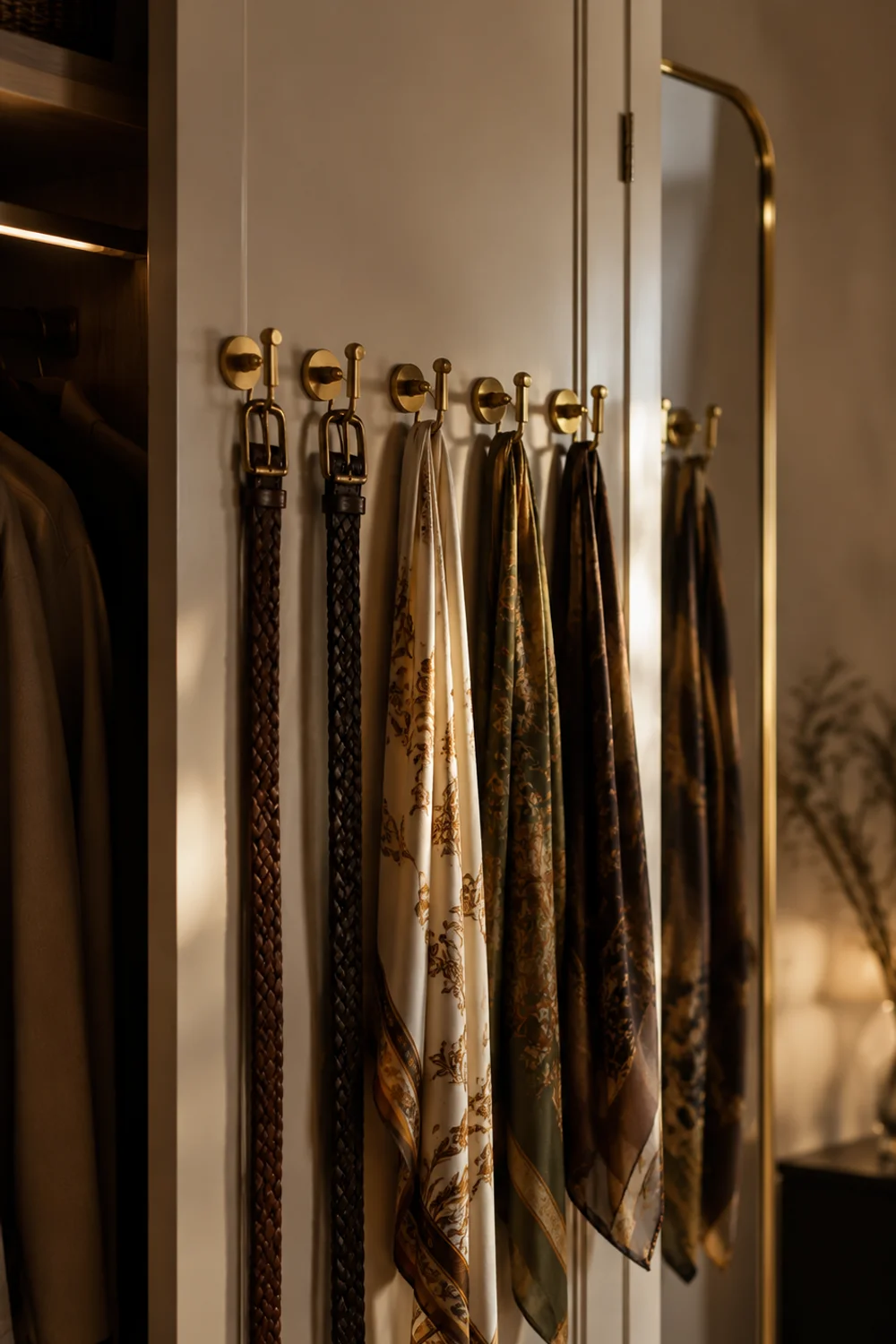
The critical factor in making door storage look beautiful rather than chaotic is category discipline. The door should hold one type of item, or closely related items, rather than becoming a catch-all overflow zone. Scarves and belts together work well — they share a similar form and display beautifully when hung on uniform hooks. Shoes, if the door allows, should be arranged by type or color. Bags hung on a series of matte brass S-hooks look far more considered than bags tossed onto a shelf.
Inside the closet, a small section of wall hooks — installed in a line at the same height, with equal spacing — provides a place for the items that don’t belong on hangers or shelves but still need to be accessible. Tomorrow’s outfit, a frequently worn jacket, a bag in regular rotation. Hooks in a beautiful finish turn a functional necessity into a design detail. A row of unlacquered brass hooks on a painted wall, in a closet otherwise clean and curated, looks genuinely editorial.
The door’s interior surface is also a logical home for a small mirror. A thin, frameless panel mirror installed at full or three-quarter height allows for a complete outfit check from within the closet itself — eliminating the back-and-forth to a bedroom mirror that quietly adds minutes and friction to the morning routine.
8. Color Coordination as an Organizational Tool
 Save it
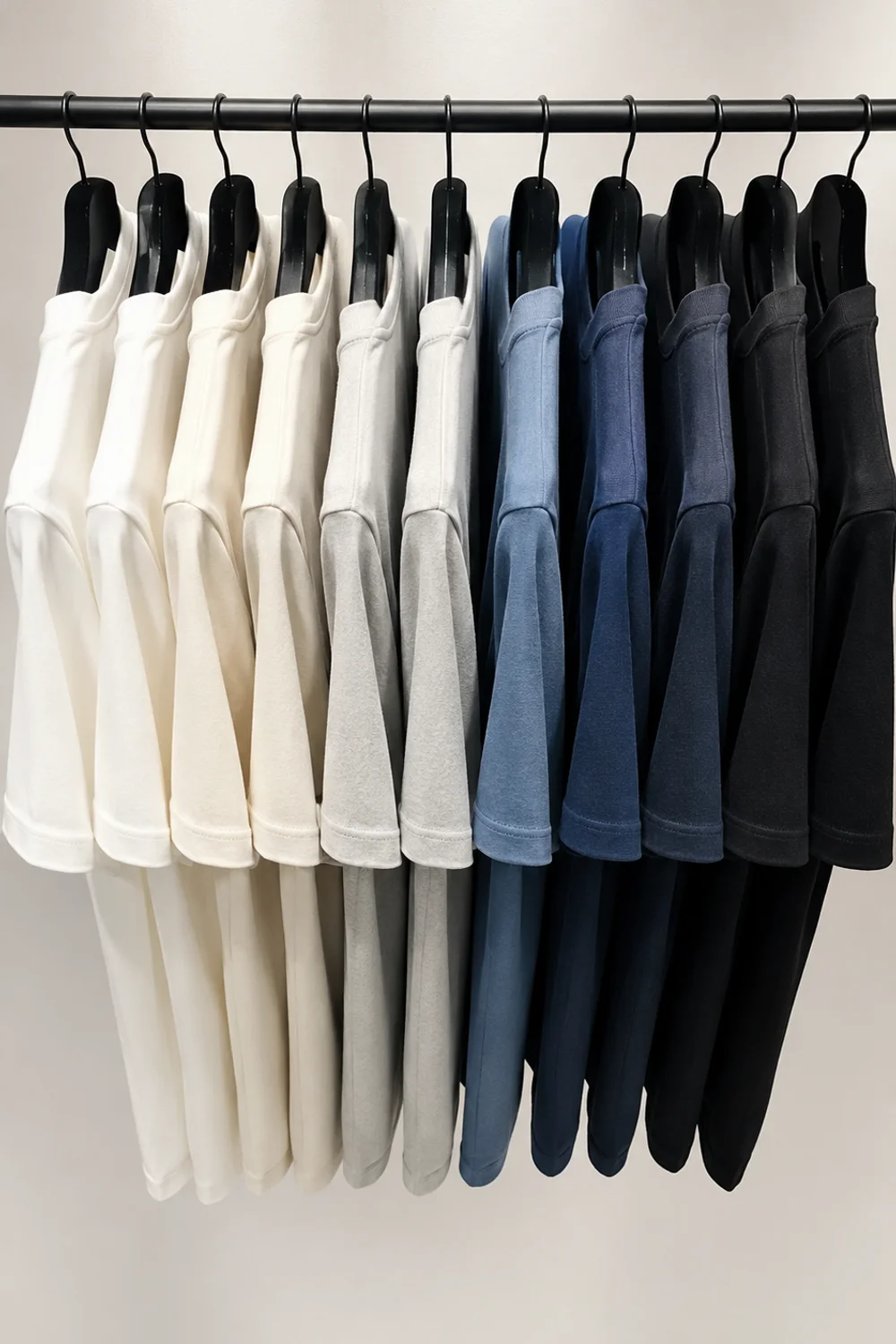
Color is doing organizational work in closets long before anyone consciously notices it. A closet organized by color is easier to navigate than one organized by any other system, including alphabetical order or clothing category. The reason is perceptual: the brain processes color before shape, before label, before any other visual attribute. When you need a grey blazer, your eye goes immediately to the grey section without any conscious searching.
But color coordination does something else in a small closet that’s equally important — it makes the space look significantly larger and more intentional. A closet where clothes transition from white through cream, blush, and grey to navy, brown, and black is quietly stunning. It reads as a gradient, a composition. Even a chaotic collection of garments, arranged this way, takes on the appearance of something considered.
The organizational logic is simple: arrange hanging items from lightest to darkest, moving left to right. Within each color group, organize by clothing type if you prefer — all white tops together, all white bottoms together — or simply let color be the only organizer and allow type to self-sort within each zone. Both approaches work. What matters is consistency.
On shelves, the same principle applies but requires more attention to folding. A stack of t-shirts arranged from white on top to dark charcoal on the bottom reads beautifully from the front of the shelf. A mixed stack of random colors looks busy and slightly accidental even when every item is perfectly folded.
This approach also makes the decision-making process faster in a genuinely useful way. When you’re looking for something to wear that coordinates with olive trousers, you already know to look in the warm neutral and earth-tone section. The visual organization anticipates how you’ll use the closet and structures the space accordingly.
For this system to hold, it requires consistency when putting clothes away. New purchases go to their color zone immediately; clean laundry returns to its original position. How to Create a Clutter-Free Kitchen You Actually Enjoy applies exactly this kind of systematic return-to-place logic to kitchen organization, and the principles translate surprisingly directly.
9. Seasonal Rotation and the Capsule Mindset
 Save it
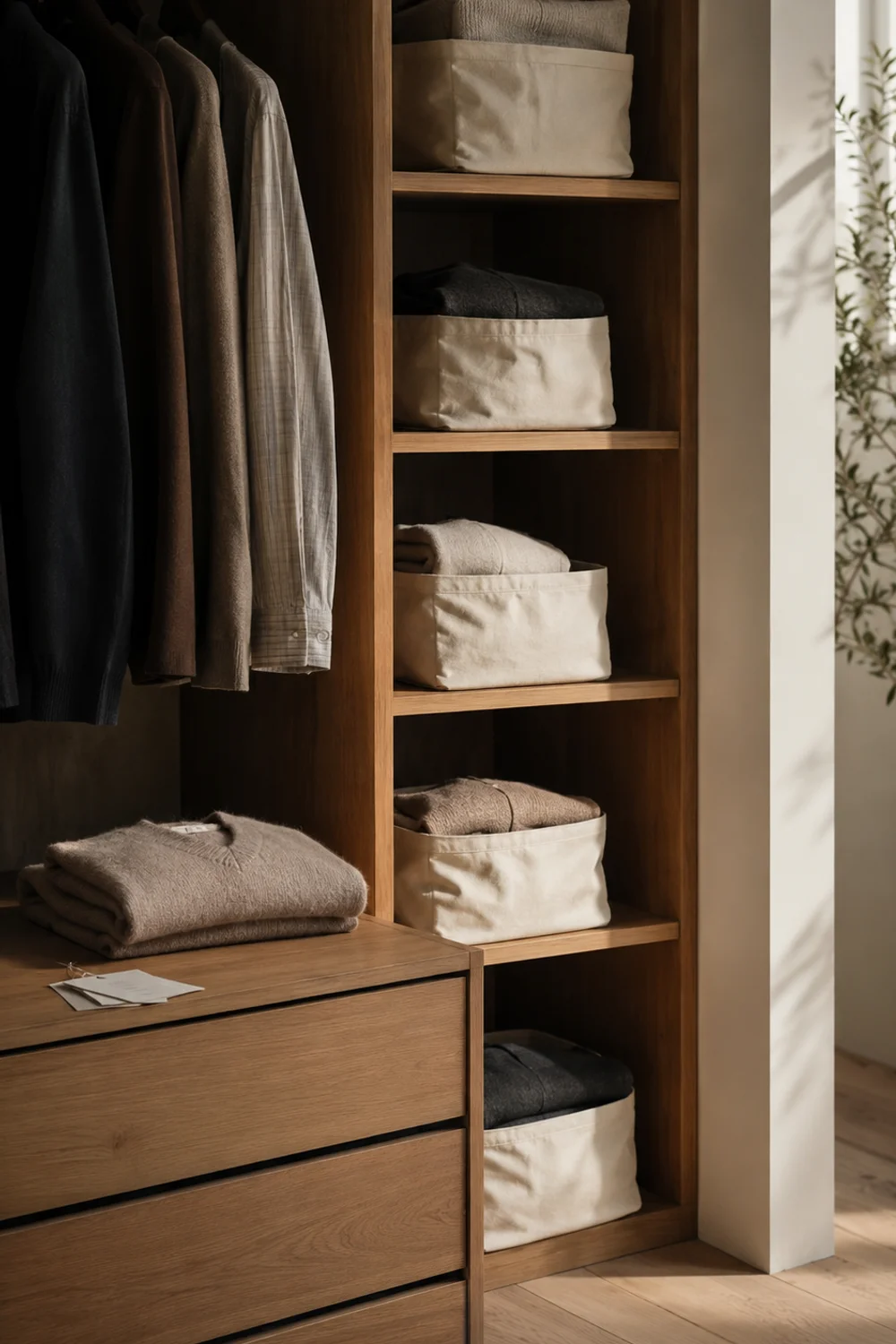
One of the most liberating realizations in closet organization is that a small closet doesn’t need to hold your entire wardrobe all at once. Seasonal rotation — the practice of storing off-season clothing separately and cycling it in and out with the changing seasons — can effectively double your usable closet space without adding a single shelf or drawer.
The mechanics are straightforward. At the shift from warm to cool weather, anything lightweight, linen-based, or summer-specific gets folded carefully and transferred to breathable cotton storage bags or flat under-bed boxes. At the same time, heavier knits, wool coats, and layering pieces come out of storage and take their place in the active closet. The closet never needs to accommodate both simultaneously.
The editing process that happens at each seasonal transition is its own benefit. When you take out summer clothes each spring, you’re naturally encountering everything you didn’t wear last season. That’s the moment to evaluate, not at some hypothetical future “declutter day” that never comes. Seasonal rotation builds reflection directly into the rhythm of the closet.
The capsule mindset takes this idea further. A capsule wardrobe for any given season is a deliberately curated, small collection of pieces that all work together — perhaps 30 to 40 items, each chosen because it fills a specific role. The beauty of a capsule approach in a small closet is that it aligns perfectly with the physical constraint of limited space. You’re not cramming more in; you’re selecting better.
This doesn’t require adopting a rigid minimalist philosophy. It requires being specific about what you actually wear, what fills gaps in your existing wardrobe, and what duplicates a function already served by something you love more. Everything You Need to Organize a Small Bathroom Without Renovating approaches the same principle in a different room — the idea that working within a small space’s actual constraints, rather than against them, produces a better result every time.
The seasonal rotation system also makes visible what you actually need versus what you’ve accumulated. It’s the most honest inventory a closet can produce.
10. Accessories and Small Item Storage
 Save it
Accessories are the category that brings most small closets to their knees. They don’t hang neatly. They don’t fold. They don’t stack. They pile, tangle, disappear into each other, and collectively resist every organizing attempt with a tenacity that feels almost personal.
The solution isn’t a single system — it’s a combination of dedicated, category-specific storage that treats each accessory type as its own organizational challenge.
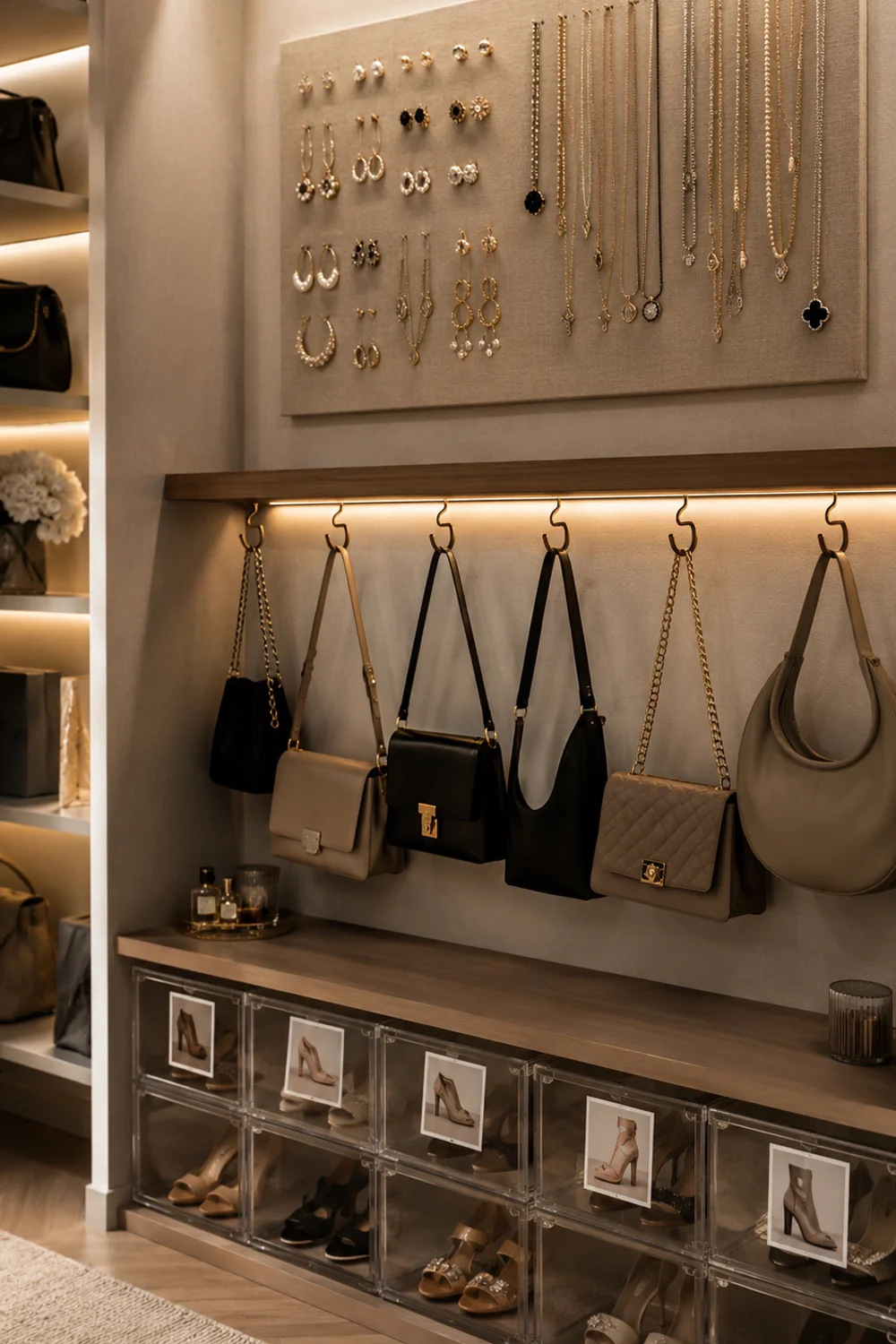
Jewelry deserves a surface display rather than a drawer. When jewelry lives in a drawer, the act of choosing a piece requires excavation — sorting through tangled chains and scattered earrings while running late. A small wall-mounted jewelry organizer, or a standing tray system on a shelf or vanity surface inside the closet, turns selection into a visual, pleasant process. Earrings on hooks, necklaces draped, rings in small ceramic dishes. It functions as well as it looks.
Belts and scarves benefit from their own dedicated bar, ideally positioned on the interior side wall of the closet where they can hang full-length without being compressed by surrounding items. A simple wooden dowel or a matte metal scarf or T-shirt ring is enough — the simplicity of the solution is part of what makes it beautiful.
Handbags are one of the most visually impactful elements to get right in a small closet. A row of bags displayed at consistent heights, either on dedicated shelf hooks or on a dedicated shelf section with clear dividers between them, creates an instant boutique aesthetic. The key is preventing the bags from leaning, collapsing, or stacking, which both damages them structurally and makes retrieval laborious.
Shoes, if they live in the closet, work beautifully on angled shelving that displays the profile of each pair. A clear shoe box system is a strong alternative — the shoes are protected, the boxes stack neatly, and a small photograph or label on the front of each box eliminates the guesswork. This is especially effective for shoes worn infrequently, where having a visual index prevents them from being forgotten entirely.
11. Making a Tiny Closet Feel Like a Boutique
 Save it
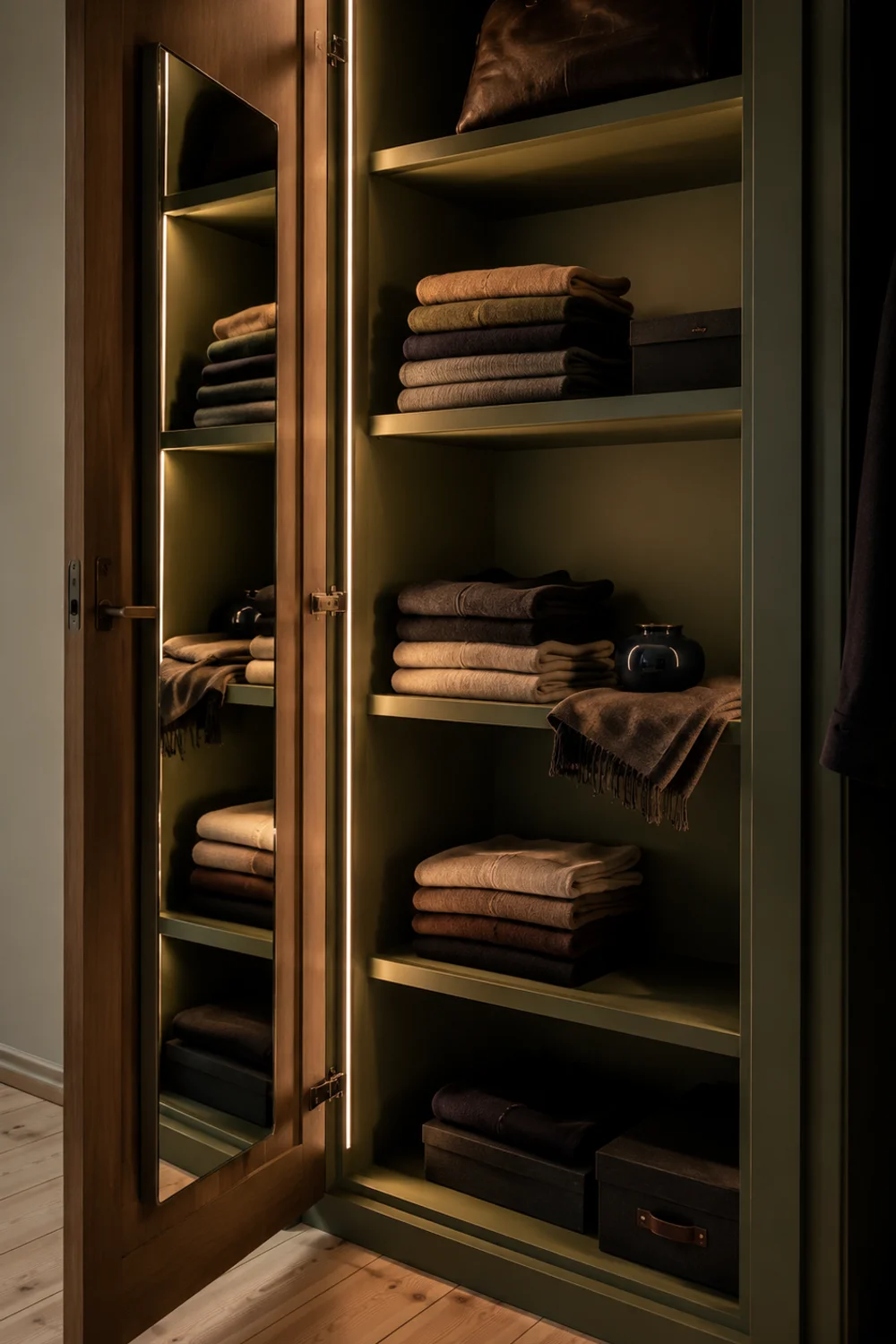
There’s a particular aesthetic quality to a well-designed boutique fitting room — calm, curated, intentional. Everything is visible. Nothing is competing for attention. The light is warm and flattering. The materials feel considered. And crucially, there’s a sense that every item present belongs there.
This is the atmosphere a small closet is capable of producing, and achieving it is less about budget than it is about philosophy. The boutique closet is defined not by what it contains but by how deliberately it contains it.
The finishing details make a disproportionate contribution here. A small tray on a shelf holding a folded silk scarf and a single perfume bottle. A slim bouquet of dried eucalyptus tucked between a hanging section and a shelf. A beautiful, simple mirror leaned against a wall or hung on the interior face of the door. These aren’t organizational tools. They’re editorial choices — the difference between a space that stores clothes and a space that inspires confidence.
Paint is an underused tool in closets. The interior walls of a small closet are often left in a builder-grade white that does nothing for the space aesthetically. A soft, warm paint color — a dusty sage, a greige, a deep terracotta used sparingly on one wall — can transform the feel of the closet entirely. Even if the closet has no natural light, a warm painted interior reads as designed and considered. The painted surface becomes the backdrop against which the organized clothes are displayed. 12 Small Living Room Ideas for a Cozy Apartment explores a similar approach to small-space elevation — how surface choices, light, and deliberate editing work together to make compact spaces feel generous rather than constrained.
Scented closet sachets in a subtle, clean fragrance — cedar, lavender, or a simple linen scent — add a sensory dimension that no amount of visual organization can replicate. A closet that smells beautifully clean and faintly perfumed is a closet that feels genuinely cared for.
The boutique closet isn’t a project you complete once and leave untouched. It’s an ongoing act of curation — returning things to their place, editing out what no longer belongs, refreshing the seasonal rotation, noticing when a system is starting to strain and adjusting before the breakdown becomes chaos. That rhythm of attention is what keeps the space feeling beautiful long after the initial organization is done.
Common Mistakes to Avoid
1. Buying storage before decluttering
This is the most expensive and most common mistake in closet organization, and it defeats the entire purpose before the project even begins. Purchasing baskets, dividers, and organizers before reducing the volume of what needs to be stored means you’re building a beautiful system around the wrong quantity of things. Storage expands to fill whatever you put into it. The first step is always reducing, editing, and making clear decisions about what actually belongs in the closet. Then, and only then, should you measure and purchase.
2. Organizing by vibe rather than logic
A closet that looks beautiful in photographs but doesn’t match how you actually use it will be abandoned within weeks. If you get dressed in the dark, hanging categories by color is impractical. If you reach for shoes first and build outfits around them, the shoe section should be the most accessible zone. The system has to reflect your real daily behavior, not an idealized version of how you might want to behave. Organization that fights your natural instincts always loses.
3. Ignoring the full vertical height
Most people stop at eye level and leave 30 to 40 percent of the closet’s actual volume unused. The space above the standard shelf and below the lowest hanging item represents enormous potential — for seasonal storage, extra folded items, or rarely used accessories. Failing to use this space means the closet will always feel too small, even after a thorough reorganization of the main zones.
4. Mixing hanger types
It seems like a minor detail and it produces a surprisingly large visual impact. A closet with uniform hangers reads as deliberately designed. A closet with four types of plastic hangers, a few wire hangers, and a mix of wooden ones reads as accidental — regardless of how neatly the clothes themselves are arranged. Replacing all hangers with one consistent, slim style is one of the highest-return organizational investments available.
5. Treating the closet as a static system
No closet system remains perfect indefinitely. Life changes, wardrobes evolve, seasons shift. A system that works well in March may be straining by September. The mistake is treating the initial organization as a final state rather than a living system that needs periodic attention. A brief seasonal review — 20 to 30 minutes of editing and adjusting — keeps the system functioning at its best and prevents the slow accumulation of disorder that eventually overwhelms even the most carefully planned organization.
Frequently Asked Questions
How do I organize a closet that’s too small for everything I own?
The honest answer is that a closet that’s too small for everything you own is telling you something important: the volume of possessions and the available space aren’t aligned, and no organizational system will solve that fundamental imbalance. The starting point must be reduction — editing the wardrobe until what remains fits comfortably in the space with room to breathe. This isn’t about deprivation; it’s about the quality of daily life. Once the volume is right, even the smallest closet can be beautifully functional. Seasonal rotation, as discussed earlier, is the most practical tool for managing a larger wardrobe within a small closet without permanent compromise.
What’s the best way to organize a small closet on a limited budget?
The highest-impact, lowest-cost changes in any closet are consistent hangers, deliberate folding, and color organization — none of which require purchasing anything. Beyond that, a single modular shelf unit, a set of drawer dividers, and a strip of LED lighting represent a modest total investment that transforms how a space feels and functions. Avoid buying specialized organizational products until you’ve tried simpler solutions first. Many small closets look dramatically better with nothing more than consistent hangers, carefully folded items, and better lighting.
How often should a closet be reorganized?
A deeply functional closet requires two meaningful reviews per year, aligned with seasonal transitions. These aren’t full reorganizations — they’re editing sessions where off-season items are stored, new pieces are integrated, and anything that no longer serves a purpose is removed. Between these reviews, the daily habit of returning things to their correct place is what keeps the system intact. An organizational system that requires constant full reorganization is a system that doesn’t yet match how you actually live.
Is it worth installing a custom closet system in a rental?
Many custom-closet elements are more portable than they appear. Modular shelving systems that don’t require wall anchoring, freestanding drawer units, over-door organizers, and floor-leaning mirror solutions are all entirely renter-compatible. Even LED strip lighting that attaches with adhesive backing can be removed cleanly. The investment in portable organizational furniture follows you from rental to rental and pays for itself over time in reduced frustration and daily quality of life. The only elements truly worth avoiding in a rental context are recessed shelving, permanent hardware installation, and anything requiring structural changes.
How do I keep a small closet organized long-term?
Long-term organization is a habit problem, not a system problem. The most important habit is returning items to their designated place immediately after use — not eventually, not at the end of the week, but in the moment. The second habit is applying a one-in-one-out approach: when a new item enters the closet, something existing leaves. The third is the seasonal review mentioned above. Together, these three behaviors do more to maintain a beautiful, functional closet than any organizational product ever could.
Final Thoughts
A small closet, organized with care and approached as a design opportunity rather than a storage problem, becomes something genuinely remarkable. Not because it holds more — though it will — but because of how it makes you feel every single morning. That quiet moment of opening the door to a calm, curated, beautiful space sets something in motion that carries through the day in ways that are easy to underestimate until you experience them directly.
The ideas in this article aren’t about achieving a magazine-perfect closet that exists only in photographs. They’re about building a system that actually works for how you live, that looks beautiful in the context of your real daily life, and that holds its quality over time without requiring constant attention.
Start with one section. Empty one shelf, install one set of hooks, replace the hangers in one zone. Organization at this scale is cumulative — each small improvement supports the next, and the momentum builds quickly once the first changes are visible. The perfect closet isn’t something you’ll build in an afternoon, but the first steps toward it can happen today, and the difference they make is immediate.
Save the ideas that resonate most. Return to them when you’re ready for the next step. And know that the closet you’ve been imagining is far closer than it feels right now.
This post contains affiliate links. I may earn a small commission at no extra cost to you.
Get cozy inspiration delivered to your inbox.
✓ 14-page beautifully designed ebook
✓ Cozy decorating ideas
✓ Practical room-by-room inspiration
You’re in! 🎉
Thanks for joining the NestFlowHome community!
Your free ebook is already on its way to your inbox. If you don’t see it within a few minutes, please check your Promotions or Spam folder.
Join the NestFlowHome community for weekly decorating inspiration.

Timeless home decor ideas and slow living inspiration for a calm, beautiful life.