
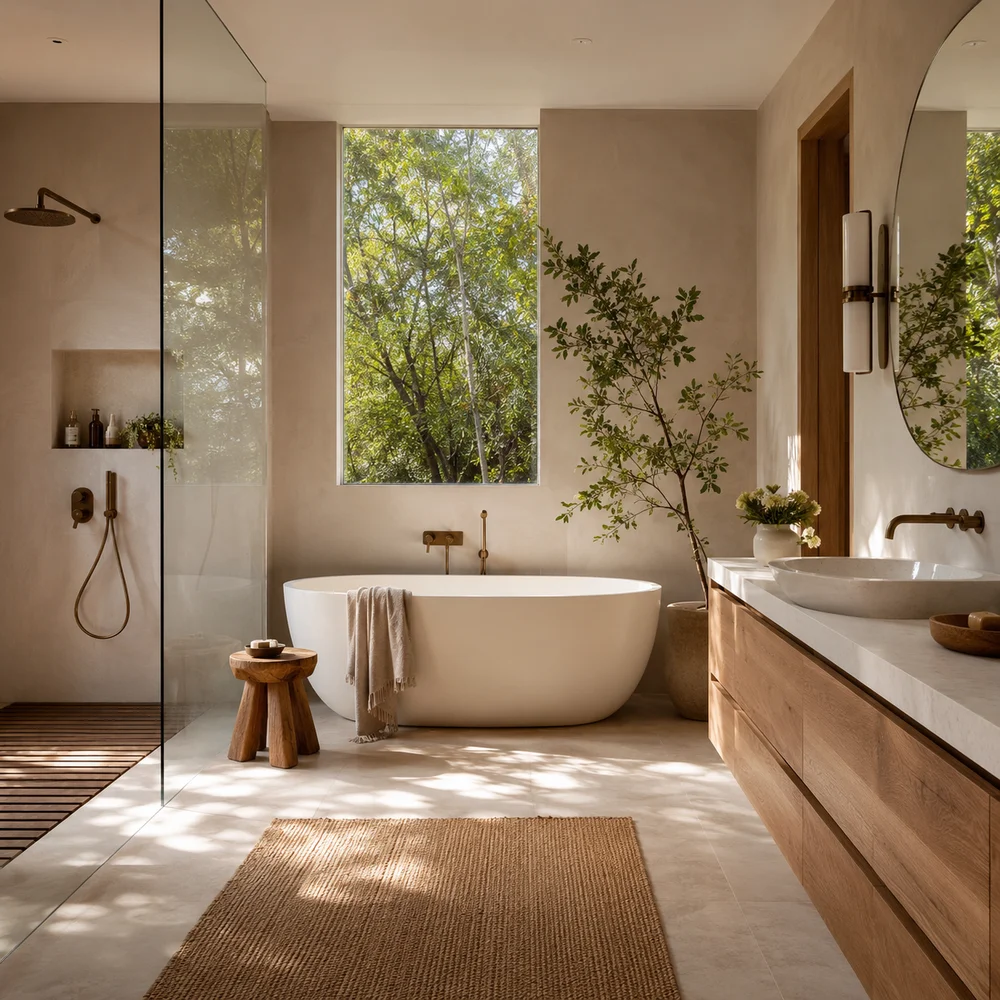
The Ultimate Guide to Scandinavian Bathroom Design Everyone Is Obsessed With
By Emily | June 10, 2026
There’s a reason Scandinavian bathroom design keeps appearing on every mood board, every Pinterest feed, every renovation wish list across the world. It isn’t a trend in the traditional sense — it doesn’t rely on a particular tile pattern, a fashionable color palette, or a style that fades when the seasons change. It’s a philosophy. A quiet, deeply considered approach to how a room should feel when you walk into it at six in the morning, or sink into it at the end of a long evening.
The Scandinavian bathroom is built on restraint. Not the kind of restraint that feels punishing or cold — but the kind that feels like relief. Like a room that finally stopped trying too hard. The surfaces are clean, the palette is calm, the materials are honest. And yet the result never feels empty or sterile. There is warmth in the grain of a wooden bath mat. There is beauty in the weight of a matte ceramic soap dish. There is depth in the way a frosted window filters the afternoon light.
What makes this aesthetic so enduringly compelling is that it serves you. It doesn’t demand to be noticed. It doesn’t compete with your morning routine or your evening rituals. It simply creates the conditions for those moments to feel better — quieter, softer, more intentional.
In this guide, you’ll find everything you need to understand, design, and live inside a Scandinavian bathroom — whether you’re starting from scratch, renting, or simply looking for a few considered upgrades that shift the atmosphere entirely.
1. The Philosophy Behind Scandinavian Bathroom Design
 Save it
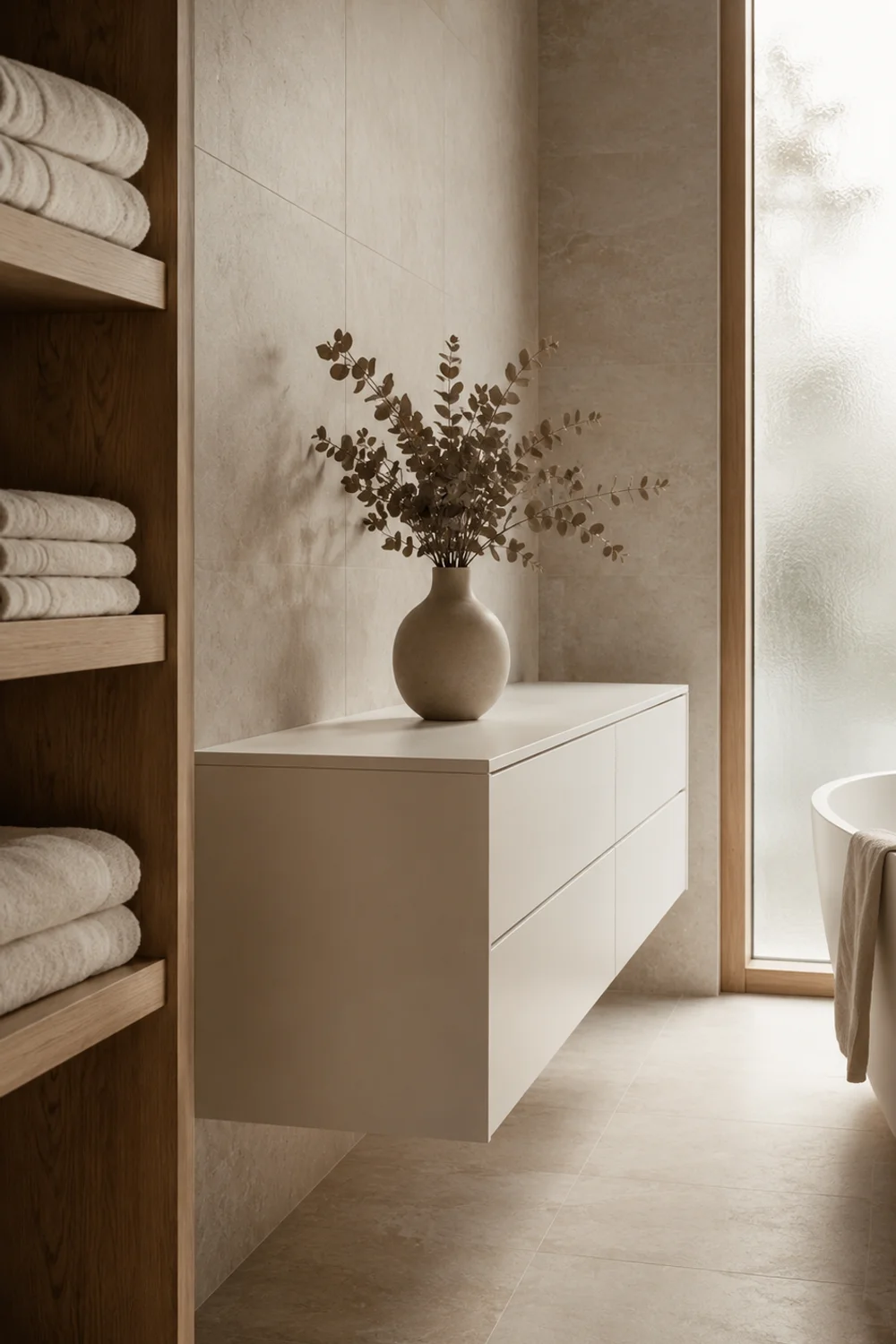
Before choosing a tile or a faucet, it helps to understand what Scandinavian design is actually asking of you. The concept originates in a cultural context where long, dark winters made the quality of interior life not just aesthetically relevant but psychologically necessary. In Scandinavian countries, the home was — and still is — a sanctuary. Every object inside it carried responsibility. It needed to be beautiful, functional, and built to last.
The guiding principle is often described as hygge in Danish and Norwegian culture, or lagom in Swedish: a kind of practiced, unforced balance. Not too much, not too little. Not maximalism, but not austerity either. The bathroom, in this context, isn’t a utility closet you pass through — it’s a room that earns its place by creating a feeling.
In practice, this translates to a very specific design logic. Every object in the room is chosen deliberately. Clutter is absent not because everything has been hidden, but because there simply isn’t anything unnecessary. The palette skews toward white, warm grey, and soft natural tones — not because Scandinavians are afraid of color, but because these tones reflect the limited northern light beautifully and create a sense of spaciousness that darker rooms can’t replicate.
The materials tell the same story. Raw oak, unpolished stone, brushed linen, matte ceramic — these are materials with texture, with honesty, with a quiet beauty that doesn’t require explanation. They age gracefully. They don’t scream for attention. They simply sit in a room and make it feel like it was designed by someone who understood what calm actually looks like.
This philosophy is also profoundly functional. The Scandinavian bathroom doesn’t sacrifice usefulness for aesthetics — it insists that the two are inseparable. A beautiful room that doesn’t work well for daily life isn’t beautiful at all. That’s the standard, and once you understand it, every design decision becomes clearer.
2. White and Light Neutrals as a Foundation
 Save it
White is the most misunderstood color in interior design. People choose it by default, out of indecision, or because it seems safe. The Scandinavian bathroom uses white — and its entire family of soft, warm, quiet relatives — with complete intention.
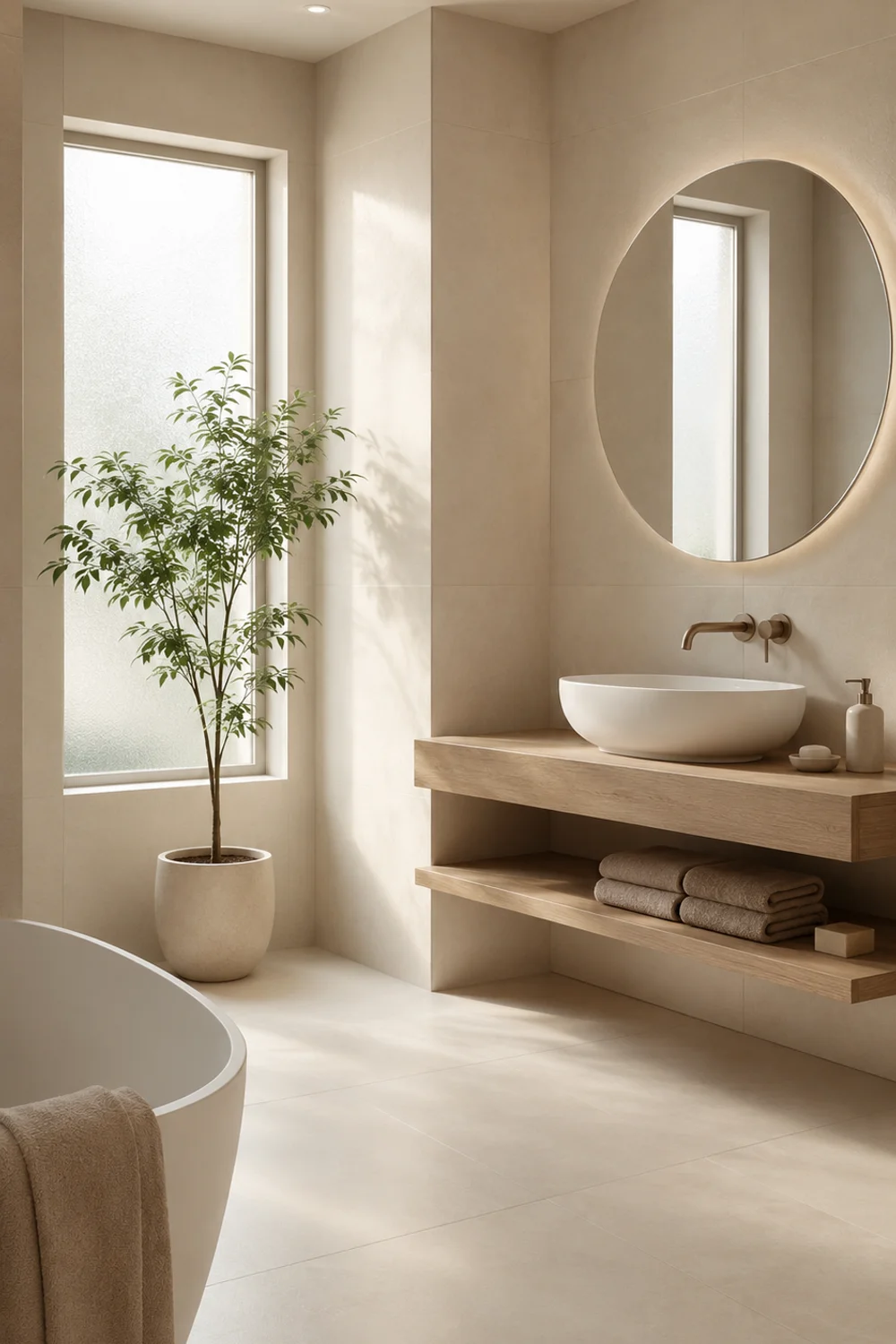
The difference between a cold white bathroom and a warm, luminous one isn’t always the specific shade (though that matters). It’s the way white interacts with everything else in the room. Bright, stark white against chrome fixtures and cool grey tile reads as clinical. The same white softened by a warm-toned oak shelf, a textured linen hand towel, and a matte ceramic vessel reads as elegant, restful, and deeply considered.
When choosing a white or neutral palette for a Scandinavian bathroom, resist the impulse to go purely cool. Warm whites — those with just a trace of cream or blush — respond to natural light in a way that pure bright white never does. They glow softly in the morning. They deepen beautifully in the evening. They make skin look warm rather than washed out.
The palette doesn’t have to be monolithic. A Scandinavian bathroom can move between white walls, a warm greige tile floor, a stone-effect vanity surface, and a ceiling painted the palest shade of taupe. These tones don’t clash — they breathe together. The effect is layered and quiet rather than flat and uniform.
For walls, large-format tiles in matte white or soft plaster finishes carry the aesthetic particularly well. If you prefer painted walls, a mineral or lime-based paint adds the kind of subtle texture that catches light differently at different times of day — something flat emulsion simply can’t replicate.
The floor deserves equal care. Pale stone-look porcelain, matte concrete-effect tiles, or bleached oak-effect planks all ground the space without competing with the walls. Avoid high-gloss finishes on the floor — they reflect too aggressively and break the muted, soft quality that defines the Scandinavian look. A patterned concrete-look floor tile introduced as a quiet detail can add visual interest without disrupting the calm.
One of the most underrated elements in this palette is grout color. White tiles with stark white grout look almost sterile. The same tiles with a warm, light grey grout suddenly have depth, texture, and a handmade quality that elevates the entire room.
3. Natural Materials That Define the Aesthetic
 Save it
If the neutral palette is the canvas, the natural materials are what make a Scandinavian bathroom unmistakably itself. This is where the philosophy becomes tactile. Where the room stops looking good in a photograph and starts feeling extraordinary in person.
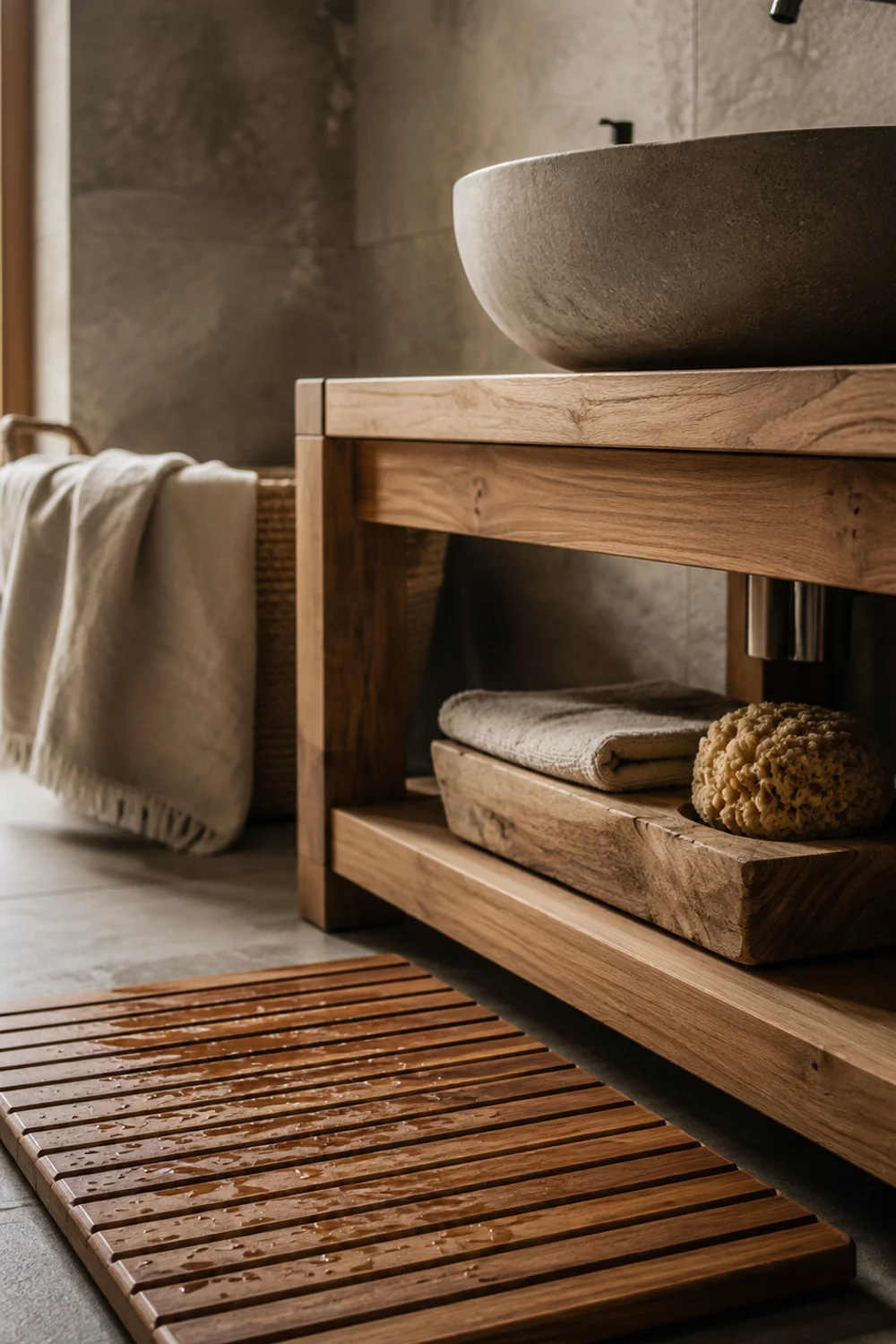
Wood is the defining material. In the bathroom context, it arrives most naturally as a teak or oak bath mat, a floating wooden shelf, a vanity with a warm-toned timber finish, or a small stool placed beside the tub. The presence of wood in a bathroom feels almost subversive — we’re conditioned to keep bathrooms hard, waterproof, impersonal. But wood breaks that logic in the most welcome way. It brings biological warmth into a space that would otherwise feel entirely constructed.
Teak is the most practical choice for direct water contact — it contains natural oils that resist moisture without requiring constant treatment. Oak works beautifully for shelving and cabinetry, especially when sealed appropriately. The grain doesn’t need to be dramatic; in fact, a quieter, more uniform grain reads as more refined in this context.
Stone is the second essential material. Not necessarily real stone — the cost and maintenance of natural stone in a bathroom can be prohibitive — but the visual and textural quality of stone, translated through matte porcelain or concrete surfaces. A stone-effect basin sitting on a simple wooden plinth communicates the Scandinavian aesthetic in a single glance. A concrete-finish feature wall behind a freestanding bath achieves the same without renovation.
For smaller objects, the logic extends to ceramic, linen, and rattan. A handmade ceramic soap dish with a slightly uneven glaze. A rattan storage basket on an open shelf. A waffle-weave linen towel folded over a brushed brass rail.
Each of these materials performs a different sensory function. Wood gives warmth. Stone gives solidity. Linen gives softness. Rattan gives texture and a faint reference to the natural world beyond the bathroom window. Together, they create the layered material richness that distinguishes a genuinely Scandinavian bathroom from a simply minimalist one.
The interaction between these materials matters as much as the materials themselves. A room where everything is stone feels cold. A room where everything is wood feels rustic. But stone beside wood, beside linen, beside ceramic — that balance is where the magic lives.
4. The Role of Lighting in a Scandinavian Bathroom
 Save it
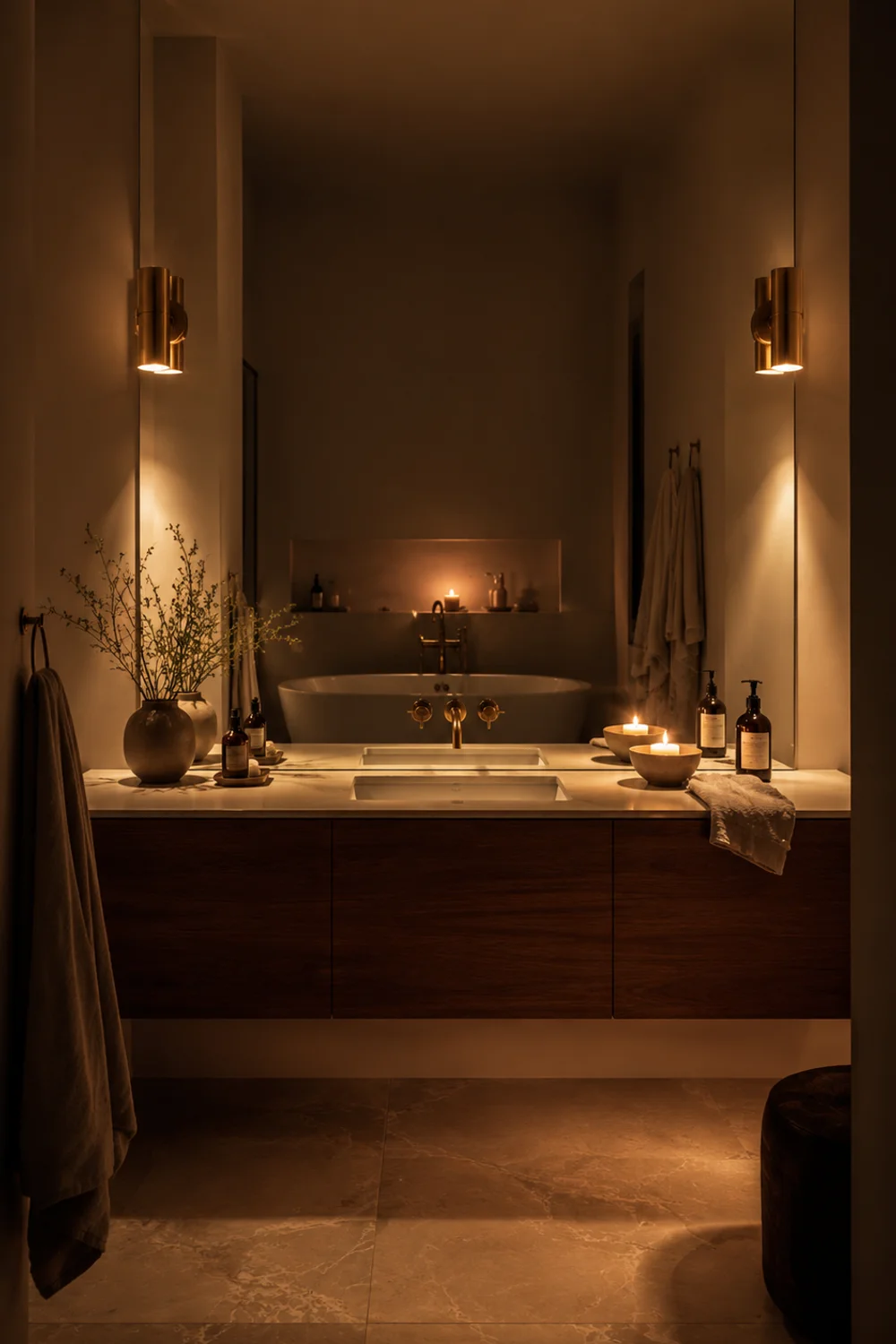
Nowhere is the Scandinavian sensitivity to light more tangible than in how a bathroom is lit. In a region where winter daylight can last only a handful of hours, the quality of artificial light becomes almost existential. The Scandinavian bathroom doesn’t just illuminate — it creates atmosphere through light, deliberately and thoughtfully.
The biggest mistake in bathroom lighting is treating it as a single source. A ceiling fixture alone produces flat, shadowless light that erases texture, flatters no one, and feels institutional. The Scandinavian approach layers light — a main source paired with secondary, warmer sources that work at different times of day and for different purposes.
Natural light comes first, whenever possible. Frosted glass windows are preferred over heavy blinds or curtains — they diffuse light beautifully, creating a soft, even glow that floods the room without sacrificing privacy. If the window is small or poorly positioned, a mirror placed strategically opposite the light source can double its effect significantly.
For artificial lighting, wall sconces placed on either side of the mirror are far more flattering than overhead lighting alone. They eliminate the shadows that single ceiling sources cast downward — across the eyes, under the nose, along the jaw. Side-lit, a face is more evenly illuminated, more honestly reflected. A bathroom mirror paired with flanking sconces in brushed brass or matte black reads as both functional and deeply elegant.
Task lighting at the vanity should use warm white bulbs — in the range of 2700K to 3000K. This temperature mirrors the quality of golden-hour daylight, flatters skin tones, and creates the kind of ambient warmth that makes a bathroom feel like a retreat rather than a functional space. Anything cooler moves toward clinical; anything much warmer moves toward amber and loses accuracy for grooming.
Dimmer switches are non-negotiable in a Scandinavian bathroom. The ability to soften the light in the evening — to move from task-level brightness to something candle-adjacent — transforms how the room functions after dark. For those exploring comprehensive mirror and lighting combinations, 16 Stylish Bathroom Mirror Ideas for a Luxurious Look offers detailed guidance on pairing mirror types with lighting approaches that work beautifully within this aesthetic.
A candle on the rim of the bath, a small sculptural lantern on a shelf — these aren’t decorative afterthoughts. In Scandinavian design, they are considered light sources with legitimate atmospheric function.
5. Minimalist Storage and Intentional Organization
 Save it
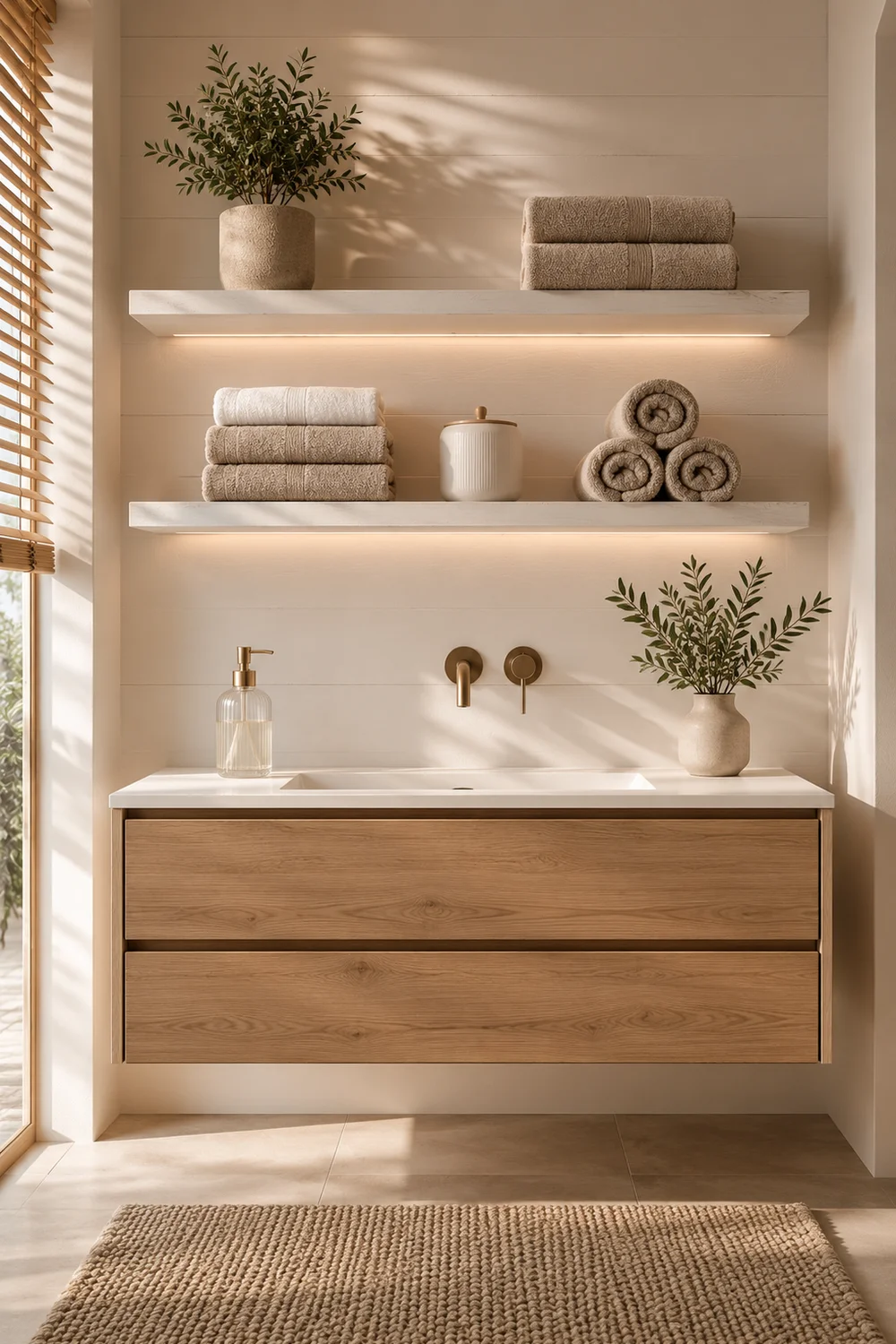
Minimalism in storage doesn’t mean owning fewer things — though that helps. It means designing a system where everything has an exact, considered place, and where that system is invisible enough not to disturb the room’s visual calm.
The Scandinavian bathroom solves the storage problem not by hiding everything behind doors (though that has its place), but by being highly selective about what is allowed to exist in the space at all. The products on the countertop are the ones you use daily — decanted into matching containers, or chosen because their packaging is beautiful enough to deserve display. Everything else lives behind a door, inside a drawer, or not in the bathroom at all.
Floating vanities are one of the most effective storage decisions in a Scandinavian bathroom. The gap between the base of the vanity and the floor is visually lightweight — it makes the floor continuous, the room larger, and the furniture feel deliberately chosen rather than placed. Below-vanity storage in shallow drawers keeps daily essentials organized without becoming chaotic.
Open shelving, when used, operates under strict visual discipline. A single shelf of white-painted pine, carrying three or four carefully curated objects — a folded towel, a small plant, a ceramic cup of cotton rounds — is a design statement. The same shelf carrying fifteen different shampoo bottles and a collection of half-used products is visual noise. The difference is entirely editorial.
A medicine cabinet mirror that opens to reveal storage is the Scandinavian bathroom’s quiet genius — functional depth concealed behind a surface that reads as pure and simple. This approach, discussed extensively in relation to styling a vanity area, dovetails naturally with the kind of considered counter curation explored in Affordable Bathroom Counter Decor Ideas That Look High-End.
Labels, if used at all, should be handwritten or printed in a clean, minimal typeface — not decorative, not elaborate. The goal is legibility without decoration. Matching glass or ceramic canisters replace product packaging wherever possible, maintaining visual coherence across the shelf.
What Scandinavian storage most resists is the impulse to accumulate. The discipline of the aesthetic is partly a discipline of consumption — buying fewer, better things, and maintaining the room with the same intentionality that designed it.
6. Bringing Nature Indoors with Plants and Organic Textures
 Save it
There is something in the Scandinavian relationship with nature that goes beyond aesthetics. In cultures where the landscape is defined by forest, coast, and seasonal extremes, the indoors isn’t understood as separate from nature — it’s understood as a continuation of it. Bringing organic elements into the bathroom isn’t a styling trend. It’s an expression of something older and more instinctive.
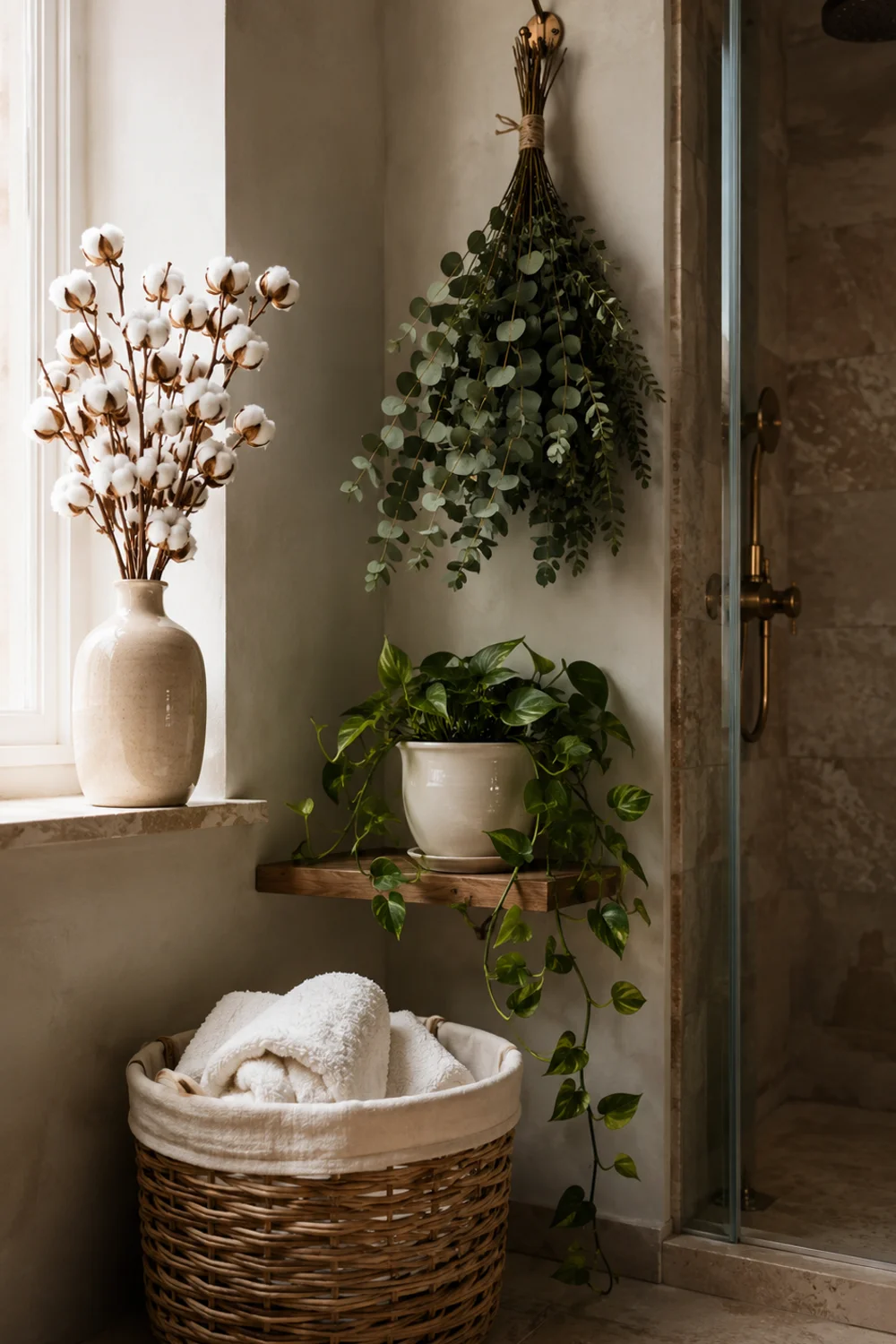
Plants are the most immediate way to introduce life into a Scandinavian bathroom, and the species that thrive here are also the ones that read most elegantly. Eucalyptus bundles hung from the shower head release a faint, clean scent with steam and add a sculptural quality to the space. A single trailing pothos in a matte white planter on a corner shelf grows quietly and demands very little. A snake plant beside the vanity stands architectural and still, like a piece of living sculpture.
The choice of planter matters as much as the plant. Terracotta — left unpainted, or whitewashed — fits the palette perfectly. Matte ceramic in white or soft grey maintains the color story. Woven rattan baskets as planter covers add texture and warmth simultaneously.
Beyond plants, the organic texture story continues in smaller details. A rough-textured sea sponge in a ceramic dish beside the bath. A bundle of dried pampas grass or cotton stems in a simple bud vase on the windowsill. A small driftwood object propped against the back of a shelf. None of these elements is essential on its own. Together, they create a room that feels curated and alive rather than staged and static.
The textures chosen for soft furnishings follow the same logic. Rough-weave linen, waffle cotton, loosely woven rattan — these surfaces have irregular, handmade qualities that contrast beautifully with the smooth tile and polished stone of the bathroom’s harder surfaces. This contrast is the visual engine of the Scandinavian interior: smooth against rough, light against shadow, still against organic.
For those looking to extend this sensibility to the area around the toilet — often the most visually neglected zone in a bathroom — 18 trending above toilet decor ideas for a beautiful bathroom offers thoughtful approaches to bringing organic styling into even the most utilitarian corners.
7. Freestanding Bathtubs and Sculptural Fixtures
 Save it
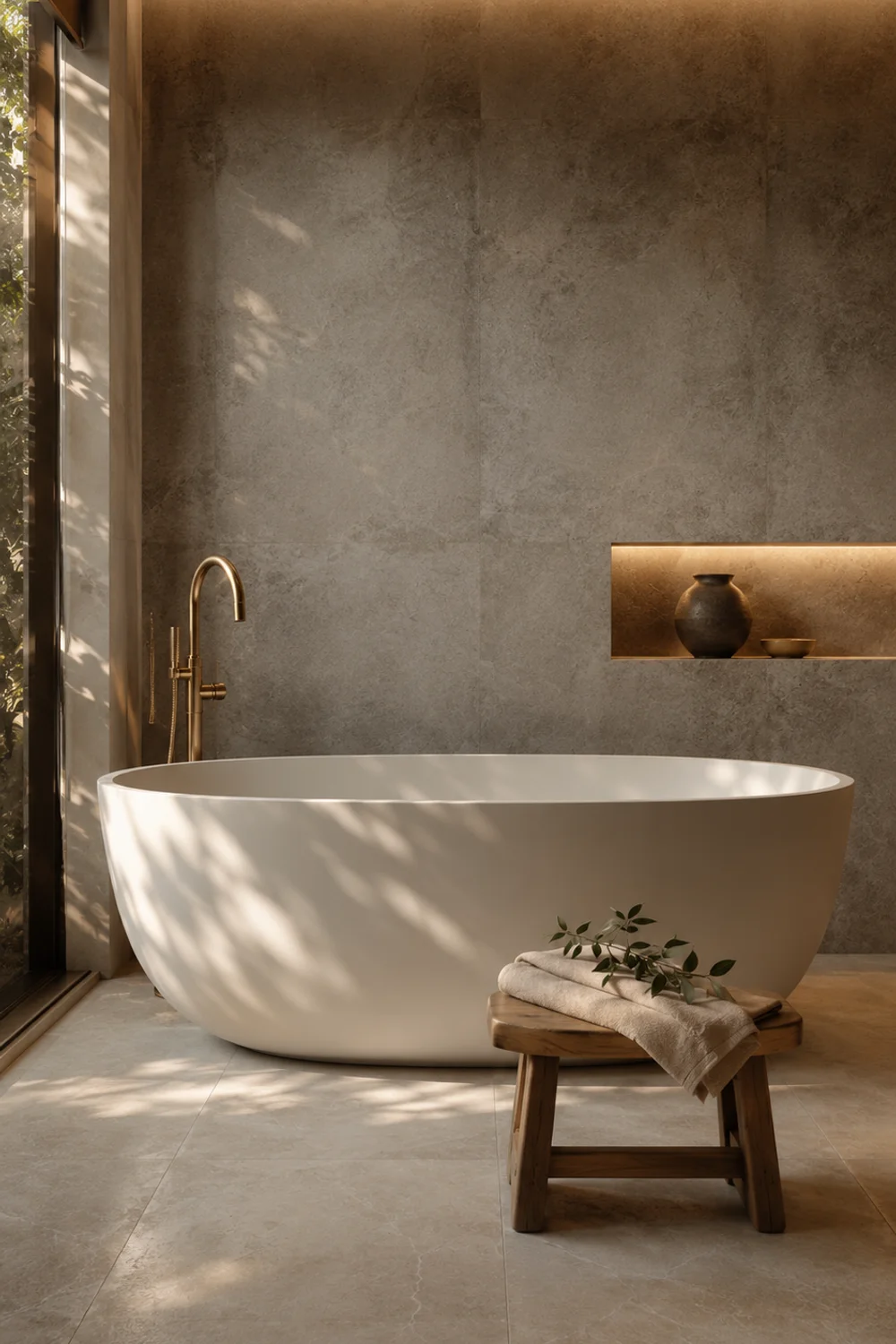
If there’s a single element that elevates a Scandinavian bathroom from quietly beautiful to genuinely extraordinary, it’s the presence of a freestanding bathtub. Not every bathroom can accommodate one — and this aesthetic works perfectly without one — but where space allows, a freestanding tub transforms the room’s entire character.
The freestanding bath is the Scandinavian bathroom’s closest thing to sculpture. It sits in the room rather than against a wall. It has volume, presence, and a silhouette that reads clearly from every angle. In a restrained, neutral space, it becomes the room’s single dominant visual statement — and because everything else is quiet, it doesn’t have to compete.
The most natural silhouettes for this aesthetic are the slipper tub — with its gently curved, asymmetrical profile — and the oval freestanding tub, which is simpler and more architectural. Both work. The oval tends to read as more contemporary; the slipper slightly warmer and more traditional. Both benefit from matte finishes. A matte white freestanding bath in a pale stone-effect bathroom looks like it was cast from the same material as the room itself.
Placement matters enormously. A freestanding bath centered beneath a window — especially one that lets in natural light — creates a bathing experience that verges on the ceremonial. Positioned against a raw concrete-look feature wall, it reads as architectural and bold. Placed in a corner with a small wooden stool beside it and a single plant on the floor, it becomes intimate and personal.
The faucet and tap combination should be chosen with the same care as the bath itself. A floor-mounted freestanding tap in brushed brass or matte black gives the bath a finished, deliberate quality. The hardware should be the same finish as every other metal in the room — this consistency is what makes the space feel designed rather than assembled.
For bathrooms without the space or budget for a freestanding tub, the same sculptural quality can be achieved through a basin. A round, vessel-style basin in matte stone or ceramic, placed on a simple wooden or concrete vanity, delivers a similar sense of designed presence on a much smaller scale.
8. Mirrors and Reflective Surfaces in Scandinavian Spaces
 Save it
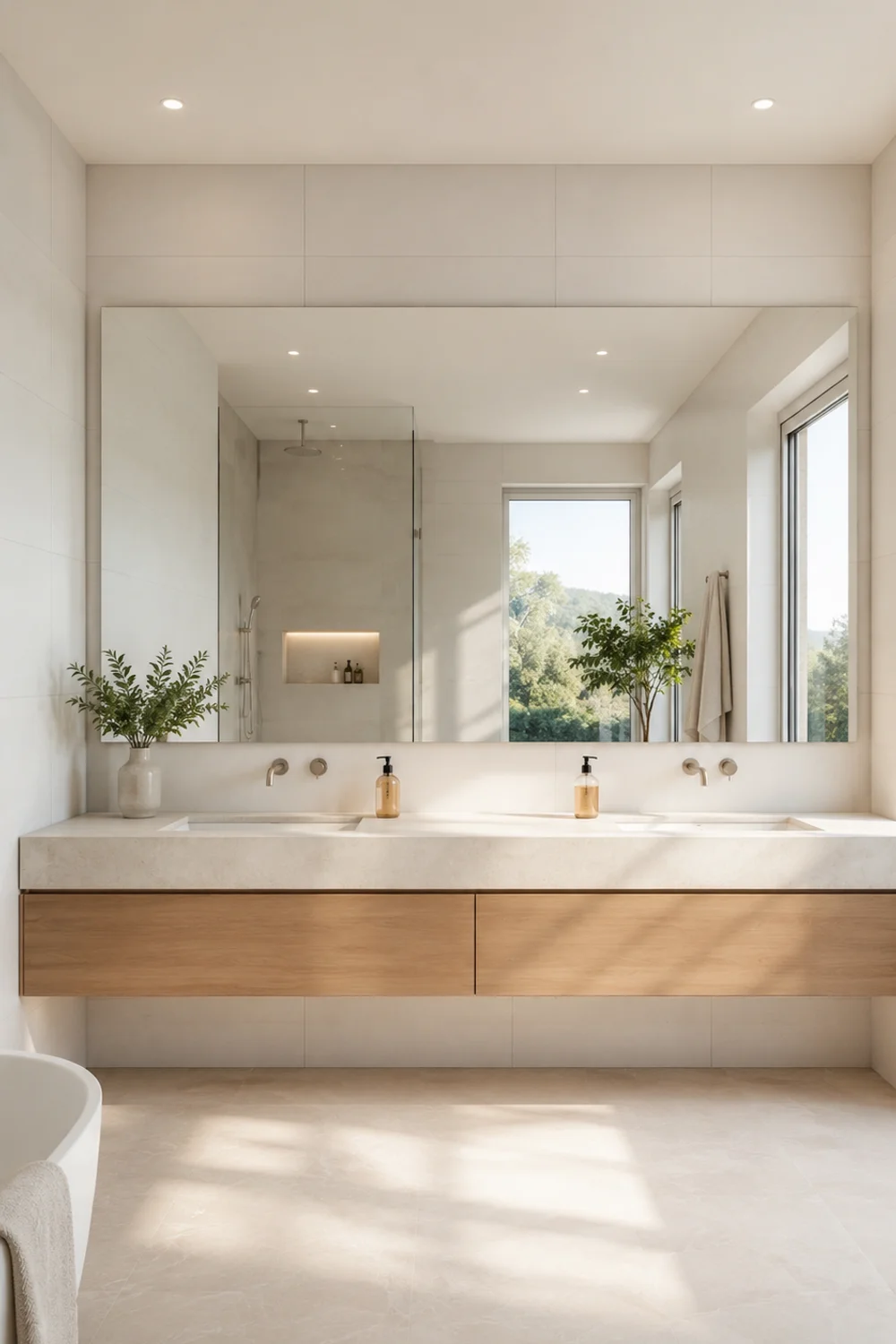
The mirror in a Scandinavian bathroom carries a different weight than in many other design traditions. It isn’t primarily decorative — though it can be beautiful. It isn’t primarily functional — though it must work perfectly. Its most important role is light. A well-placed mirror can double the room’s perceived brightness, deepen its apparent depth, and make even a compact space feel open and considered.
In terms of shape, the Scandinavian bathroom tends toward simplicity. Frameless circular mirrors are perhaps the most frequently seen — their soft geometry breaking the hard angles of tile and vanity without introducing unnecessary decoration. An arched mirror adds a quiet architectural reference that reads as refined without being ornate. A wide, horizontal frameless mirror above a double vanity creates hotel-level polish and reflects the maximum amount of light back into the room.
The finish and framing logic follows the room’s material palette. If the hardware is brushed brass, a thin brass-framed mirror coheres the story. If the fixtures are matte black, a slim black-framed mirror maintains that visual grammar. A frameless mirror works in almost every configuration — its absence of frame makes the room feel cleaner and more minimal.
What the Scandinavian bathroom generally avoids is the heavily ornate, the baroque, or the decoratively overdressed mirror. The mirror is a tool that also happens to be beautiful. Its beauty lies in its honesty — in the quality of its glass, the precision of its edge, the simplicity of its form.
9. Textiles and the Art of Layered Softness
 Save it
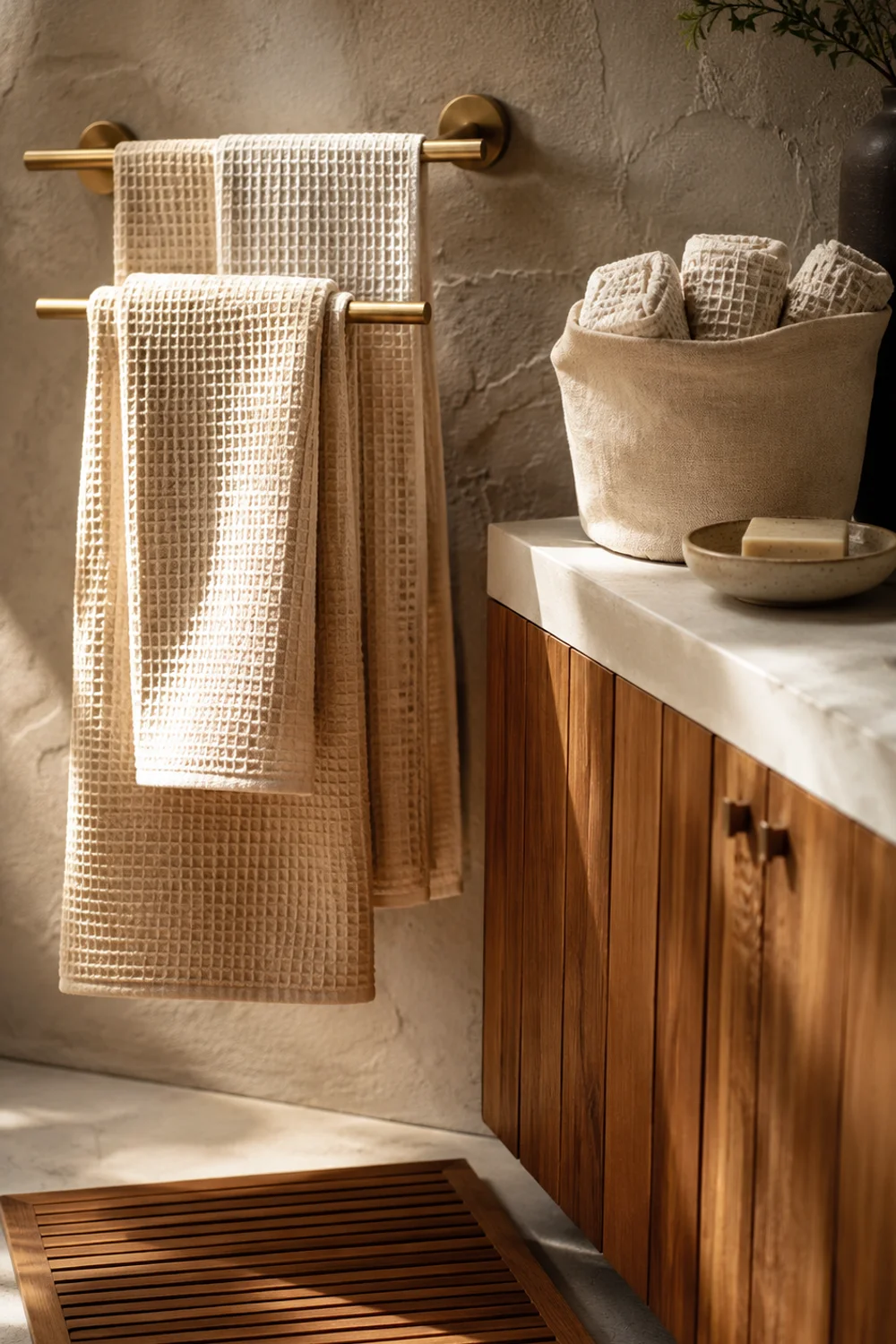
The Scandinavian bathroom’s relationship with textiles is one of its most quietly important design decisions. In a room defined by hard surfaces — tile, stone, ceramic, glass — the textiles are what introduce physical warmth. They are the room’s softest layer, and in the Scandinavian tradition, they are chosen with the same rigor as the architecture itself.
Towels are the most visible textile decision. In a Scandinavian bathroom, they are typically displayed rather than stored — folded over a rail, stacked on a shelf, or hanging loose from a hook. This means their color and texture are always part of the room’s visual composition. Warm white, oatmeal, and soft stone tones are the natural choices — they align with the palette and photograph beautifully. Linen-waffle weave, and Turkish cotton all carry the right kind of texture: slightly irregular, slightly soft, suggesting quality without being ostentatious.
A bath mat, in this context, is not a purely functional object. A natural cotton tufted mat in off-white or pale grey, placed beside the tub or shower on a clean stone floor, reads as intentional. A wooden bath mat — teak, slatted, simply constructed — is one of the most enduringly elegant Scandinavian choices for high-moisture zones directly outside the shower.
Beyond towels and mats, the textile story extends to smaller touches. A linen shower curtain in a neutral tone — for those whose bathroom design calls for one — carries far more visual elegance than a plastic alternative. A small woven basket, holding extra rolls of cotton or a few folded face cloths, adds both texture and function to an open shelf.
For the vanity tray itself, the textile element often arrives as a hand towel folded with precision, or a small cloth liner beneath ceramic containers. These are micro-details, but they represent the Scandinavian commitment to thoughtfulness at every scale. Every surface is considered. No detail is random. And together, the textiles ensure that a room made of hard materials never feels hard to be inside.
10. The Scandinavian Approach to Color Accents
 Save it
The common perception of Scandinavian design as purely white and neutral misses one of its most nuanced and interesting dimensions. The Scandinavian bathroom does use color — but it uses it with a precision and restraint that makes each appearance feel deliberate rather than decorative.
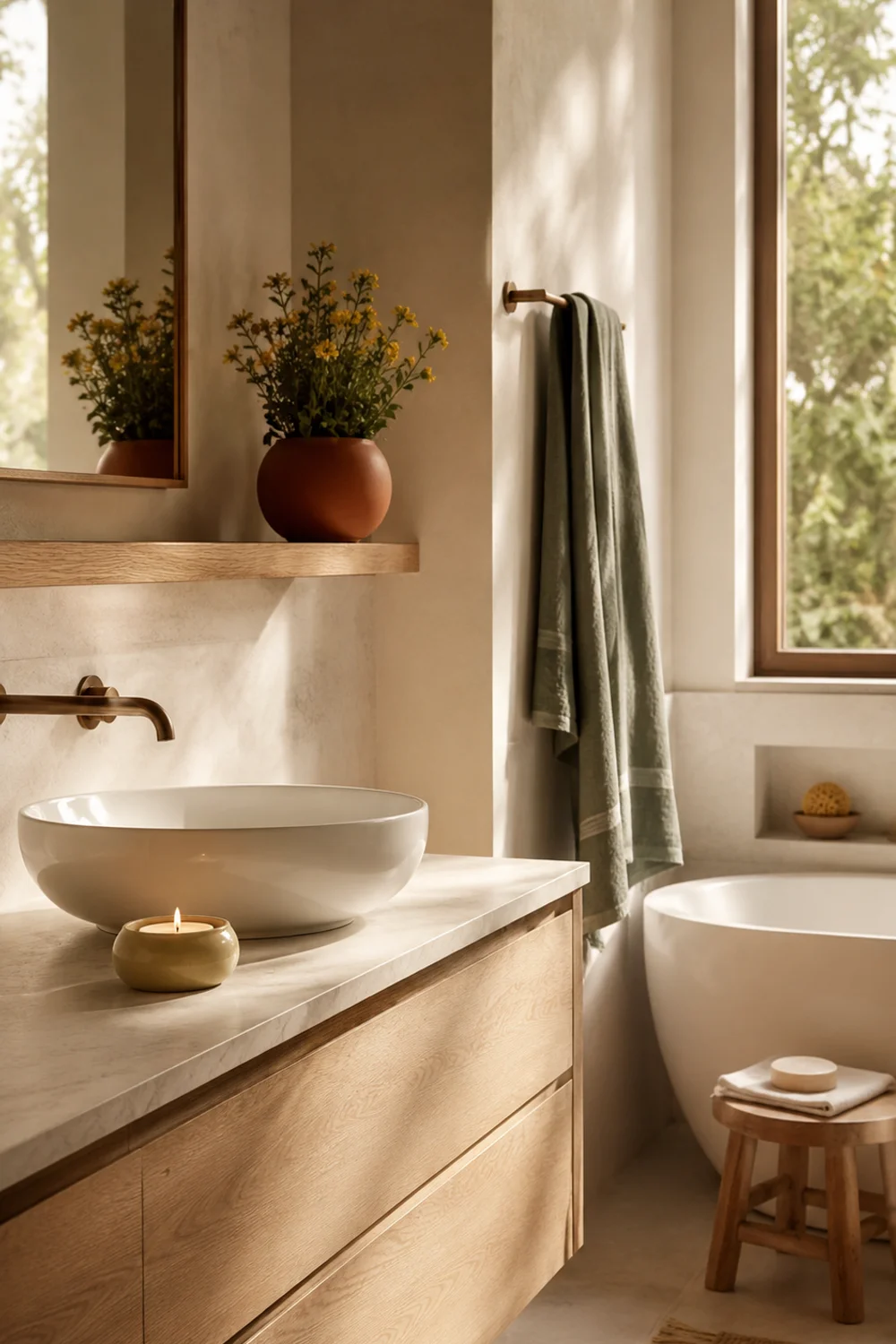
Color in this context isn’t decoration for its own sake. It’s punctuation. A single terracotta planter in an otherwise entirely white and oak bathroom doesn’t decorate the room — it anchors it. It gives the eye a place to rest. It creates a relationship between all the neutral tones around it. This is why so many Scandinavian-influenced interiors feel not just calm, but visually complete: the color presence, however subtle, provides closure.
The palette of accent colors that works most naturally within this aesthetic skews toward the earth and the organic. Dusty sage, muted clay, pale terracotta, soft slate blue, warm charcoal — these are colors drawn from the landscape itself. They feel at home beside oak, beside stone, beside linen. They don’t compete; they participate.
The most elegant application of color in a Scandinavian bathroom is through objects rather than surfaces. A sage-green candle in a ceramic vessel. A slate-blue towel folded over a natural oak rail. A single dark charcoal vase holding a spray of dried eucalyptus. The object carries the color; the surfaces remain neutral. This approach means the room can evolve — a single swap in the accent object shifts the entire emotional temperature of the space.
For those drawn toward a slightly more graphic approach, the black-and-white contrast popular in contemporary Scandinavian interiors can be introduced through a single feature — a matte black faucet, a dark grout line in an otherwise pale tile, or a framed print with strong linear forms. For deeper exploration of how this high-contrast direction can be refined and styled, 13 Modern Black and White Bathroom Decor Ideas Right Now presents specific ideas that sit comfortably within the Scandinavian sensibility.
The test for any color decision in this room is simple: does it belong to nature, or does it belong to a trend? Nature-derived colors have a kind of permanence that trend colors don’t. They return, they endure, and they age beautifully alongside the materials they live beside.
11. Small Scandinavian Bathrooms Done Right
 Save it
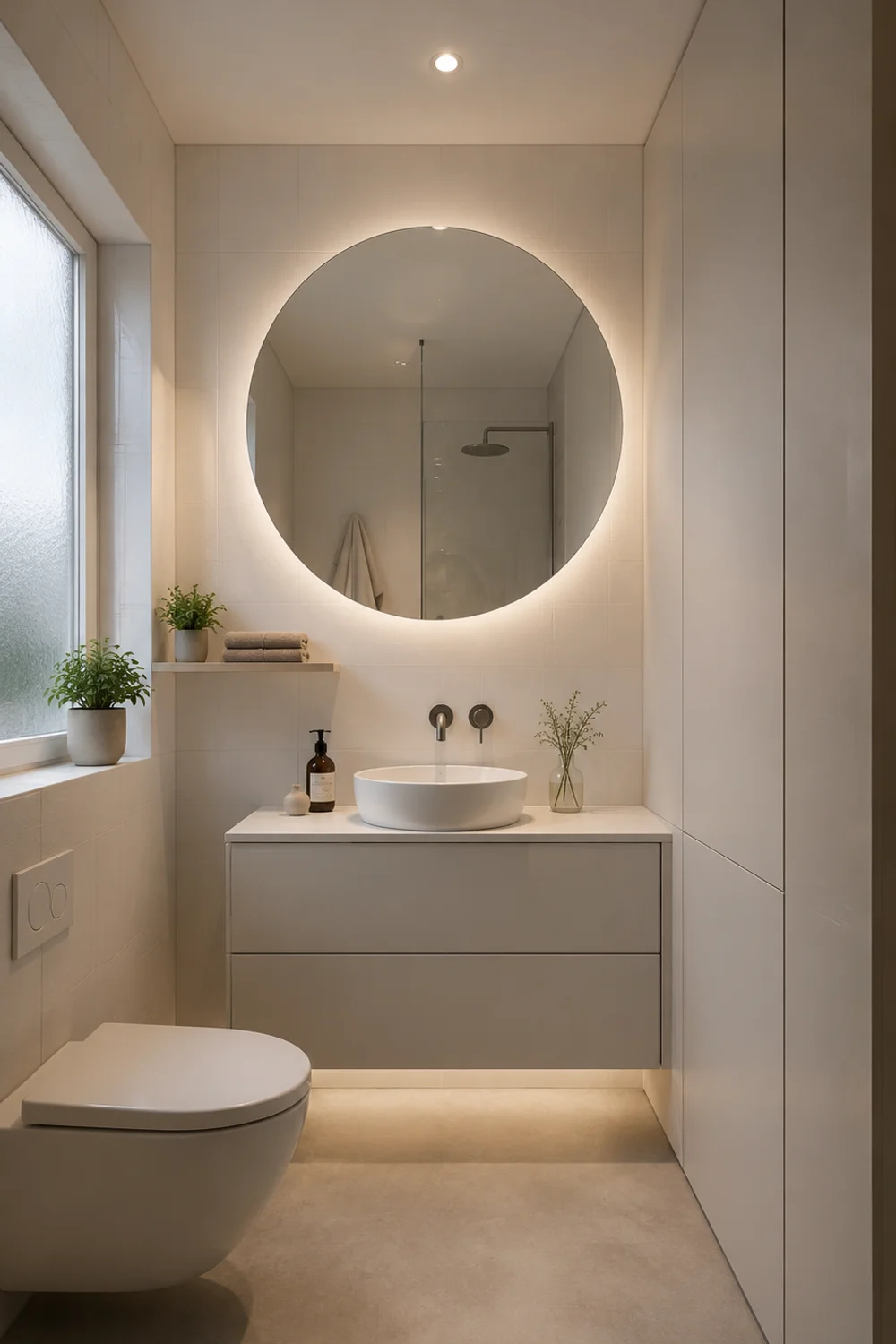
The Scandinavian aesthetic is arguably at its most powerful in a small bathroom. There is a particular paradox at work here: a design philosophy built on restraint, simplicity, and the careful editing of possessions is perfectly equipped to make a compact room feel generous rather than cramped.
The first principle is radical commitment to the palette. In a small bathroom, any departure from the neutral foundation is amplified. A bold tile choice that might feel grounded in a larger room can overwhelm in a small one. Staying with warm white, pale stone, and soft greige across walls, floor, and ceiling creates a visual continuity that dissolves the room’s edges and makes the space feel larger than it is.
Ceiling-height cabinetry is one of the most powerful tools in a small Scandinavian bathroom. A floor-to-ceiling vanity unit or narrow tower cabinet in matte white with integrated handles draws the eye upward, makes the room feel taller, and provides storage without the visual heaviness of chunky, mid-height furniture. The absence of visible handles — a touch-latch or recessed groove instead — keeps the surface clean and uninterrupted.
A single, generously sized mirror amplifies the effect considerably. In a small bathroom, the instinct is to use a small mirror — it feels proportional. The opposite is almost always more effective. A large, frameless circular mirror or a wide horizontal mirror above the vanity reflects the room back into itself, effectively doubling its visual footprint. For small-space mirror strategies specifically, 20 Beautiful Bathroom Tray Styling Ideas to Elevate Your Vanity touches on how tray and counter styling within compact vanity areas can support a clean, open aesthetic.
The small Scandinavian bathroom also benefits from a disciplined approach to what’s displayed. One plant, not three. One beautiful soap dispenser, not a collection of product bottles. Two neatly folded towels in the same tone, not four different colors competing for attention. The discipline is the design — and in a small space, it’s the most powerful tool available.
Natural light, wherever it exists, should be maximized and never blocked. A frosted glass window treatment, a small skylight left uncovered, a mirror placed directly opposite a light source — these choices cost nothing structurally but transform the quality of the space.
12. Hardware and Details That Make Everything Cohere
 Save it
There is a moment in every well-designed Scandinavian bathroom when everything suddenly reads as one — when the space stops looking like a collection of individual decisions and starts feeling like a single, considered whole. That moment is almost always produced by the hardware.
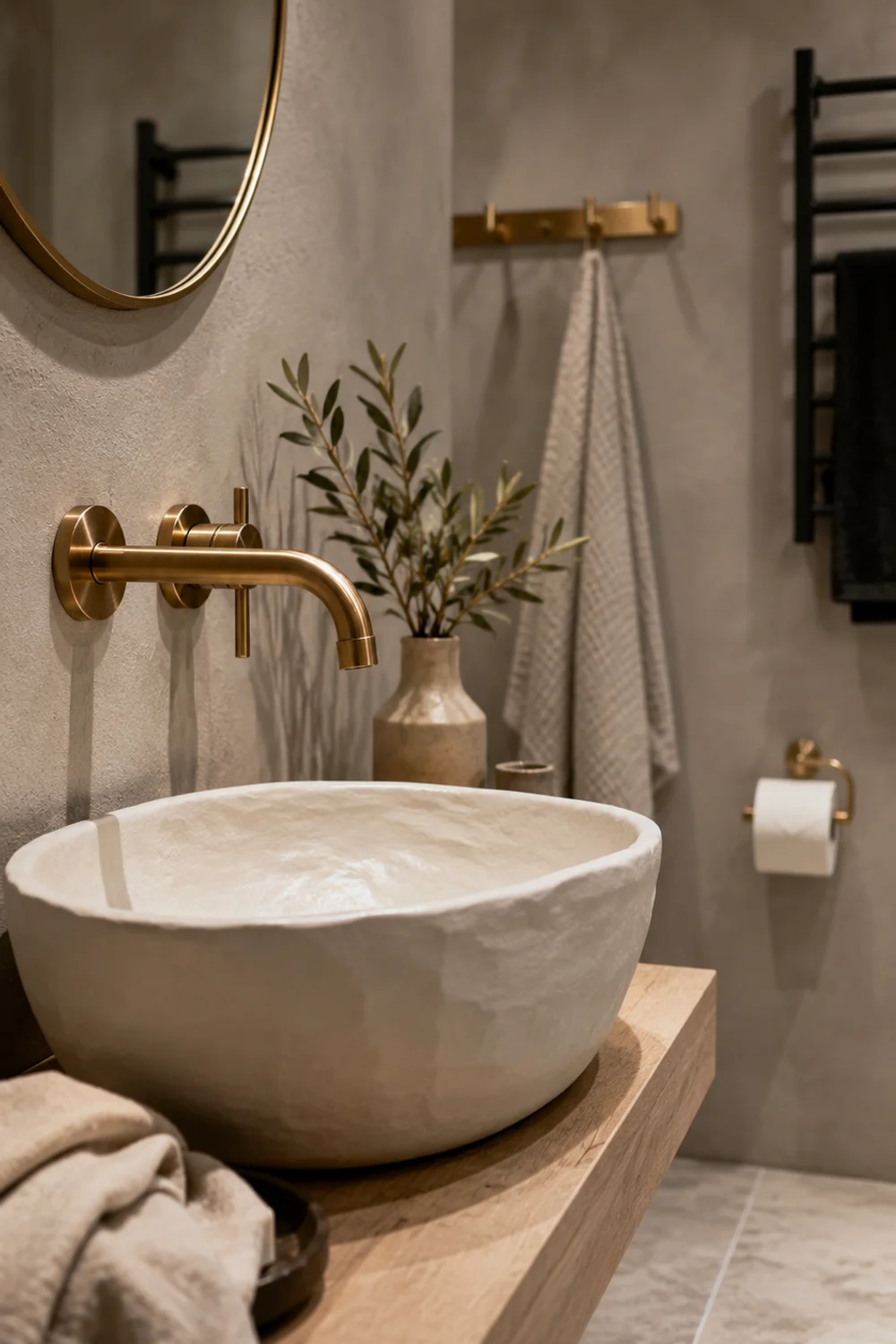
Hardware is the room’s punctuation. It’s what the eye moves across after taking in the larger surfaces and forms. And in a room as restrained as a Scandinavian bathroom, where nothing is competing for attention, the hardware has unusual visibility. A brushed brass tap, a matte black towel bar, a pair of satin nickel hooks behind the door — these are small objects with enormous compositional importance.
The central rule is consistency of finish across every metal element in the room. The faucet, the shower head, the towel rail, the toilet paper holder, the door handle, the mirror frame if there is one — all in the same family. This doesn’t have to be monotonous: brushed gold and matte brass sit comfortably together because they belong to the same warm, soft family of tones. Matte black and satin black similarly harmonize. What doesn’t work is mixing warm and cool metals without intention — gold beside chrome, for instance, creates a tension that reads as accidental rather than designed.
For tile choices, the grout line and grout color function as hardware in a different sense — they are the grid that gives the tile pattern its graphic quality. A wide grout line in a warm grey on large-format white tile creates beautiful, subtle geometry. A very fine, almost invisible grout line on small subway tile creates a smoother, more textured impression. Neither is wrong; both require conscious intention.
The most overlooked hardware detail in a bathroom is the toilet paper holder. In a Scandinavian bathroom, it is never the standard chrome spring holder. It’s a wall-mounted rod in the room’s dominant hardware finish, or a small free-standing floor holder in matte black or natural wood. This single swap — available at minimal cost — transforms the most utilitarian corner of the room into something considered.
Hooks over a towel bar are a similarly small but effective choice. Four individual matte brass hooks arranged at consistent intervals along a wall are more visually interesting and more practically useful than a single long bar. They invite the room’s textiles to be displayed as if arranged by choice rather than necessity. It’s the hardware version of the Scandinavian insistence that beauty and function are always the same decision.
Common Mistakes to Avoid
1. Choosing stark, cool-toned white throughout
The most common mistake in attempting a Scandinavian bathroom is selecting a pure, blue-toned white for every surface and expecting the result to feel warm and luminous. Cool white in a bathroom reads as clinical unless it’s specifically balanced by warm materials, warm lighting, and organic textures. If the tile is cool white, the oak shelf and the warm brass fixture are doing critical work to counterbalance it. When everything is cool — white tile, chrome hardware, pale grey grout, white cabinetry — the room has no warmth sources at all, and the Scandinavian feel collapses into something closer to a hospital corridor. The solution is to audit every surface for temperature and ensure that warm and cool elements are in intentional dialogue.
2. Overcrowding open shelves with product packaging
Open shelving in a Scandinavian bathroom is a commitment, not an invitation to store everything in view. A shelf carrying a row of different shampoo bottles, a candle, a collection of half-used skincare products, and a succulent is not minimalist — it’s a cluttered shelf with a plant on it. The discipline of open display requires decanting products into consistent, beautiful vessels, limiting the number of objects per shelf, and treating the space between objects as part of the composition. If you’re not ready to maintain that level of editorial control, closed storage is the more honest and more elegant choice.
3. Using the wrong scale of mirror
In a Scandinavian bathroom, a mirror that is too small for the vanity is one of the most visually damaging decisions available. The mirror should at minimum match the vanity’s width, and ideally extend a few inches beyond it on either side. A small, centered mirror above a wide vanity creates a disproportionate focal point that makes the room feel unresolved. Scale generously — a mirror that feels almost too large in isolation almost always reads correctly in a finished room.
4. Mixing metal finishes without intention
A bathroom with three different metal finishes — chrome faucet, gold towel bar, brushed nickel hooks — doesn’t feel curated. It feels unfinished. In a restrained, detail-sensitive aesthetic like Scandinavian design, this kind of inconsistency is immediately visible and immediately disruptive. The solution is simple: decide on a single metal finish before purchasing any hardware, and hold to it across every element in the room, including the less obvious ones like the toilet roll holder and the drain cover.
5. Over-planting the space
A Scandinavian bathroom with seven plants is not more natural than one with two — it’s simply more complicated. The plants in this aesthetic should feel considered and deliberate, not abundant. One architectural plant, one trailing plant, perhaps one small vessel with dried stems. Each plant should have space to breathe visually. When plants compete with one another for surface area and attention, the room loses the quality of calm that the entire aesthetic is constructed around.
Frequently Asked Questions
What is the difference between Scandinavian and Japanese minimalism in a bathroom?
Both aesthetics prioritize restraint, clean surfaces, and a careful relationship with materials, but they arrive at those values from different cultural directions. Scandinavian design is fundamentally about warmth within simplicity — the presence of natural materials, soft light, and comfortable textiles ensures that the minimal room still feels welcoming and livable. The Japanese approach, particularly the wabi-sabi and ma traditions, leans further into imperfection, asymmetry, and deliberate emptiness. A Scandinavian bathroom will typically feel softer and more domestic. A Japanese-influenced bathroom might feel more austere, more meditative, more architecturally severe. In practice, many beautiful bathrooms blend the two philosophies — taking warmth from Scandinavian design and spatial stillness from the Japanese tradition.
Can I create a Scandinavian bathroom in a rental?
Entirely. The Scandinavian aesthetic is less about architecture and construction than about the quality and character of the objects inside the room. In a rental, the most transformative moves are replacing generic accessories with considered ones: swapping the plastic soap dish for ceramic, replacing mismatched towels with a set in coordinated neutral tones, introducing a teak bath mat, adding a plant, and choosing a beautiful round mirror to hang above the vanity without drilling. Paint, if permitted, transforms the room’s color story at minimal cost. Adhesive hooks in matte brass or matte black replace inconsistent chrome originals. The structural bones of the room remain untouched; the atmosphere shifts entirely.
Do I need to spend a lot to achieve this look?
No — but intentionality is non-negotiable. The Scandinavian bathroom is not defined by luxury price points. It is defined by considered choices. A single beautiful ceramic soap dish chosen carefully costs less than a collection of mediocre bathroom accessories purchased without thought. The discipline is to buy fewer things, buy them slowly, and buy them because they are genuinely beautiful and well-made. Over time, this approach builds a room of real quality without requiring a large budget spent all at once. The most expensive element of the Scandinavian bathroom is not the objects themselves — it is the patience and clarity of vision needed to build it correctly.
What flooring works best for a Scandinavian bathroom?
Matte large-format porcelain in warm white, pale stone, or concrete grey is the most versatile choice — it works in any size bathroom, requires minimal maintenance, and creates the sense of uninterrupted visual calm that the aesthetic requires. For smaller bathrooms, hexagonal or encaustic tiles in pale tones add quiet pattern without breaking the palette. High-gloss tiles should generally be avoided — they reflect aggressively and introduce a sharpness that cuts against the softness of the Scandinavian atmosphere. If budget allows, natural limestone or tumbled marble brings extraordinary material quality, though both require more careful sealing and maintenance than porcelain alternatives.
How do I keep a white Scandinavian bathroom from looking dirty or dated?
The key is material quality and grout choice. High-quality matte white tiles that are slightly textured hold their appearance far better than cheap, flat white tiles, which show every smear. A warm grey grout rather than brilliant white makes marks less visible and gives the tile installation visual depth. Regular — but minimal — maintenance is also part of the Scandinavian bathroom philosophy: wiping surfaces after use, keeping products stored rather than displayed, and treating the room with the same intentionality that designed it. A bathroom that is genuinely cared for doesn’t look dated; it develops character.
Final Thoughts
A Scandinavian bathroom is not a style you execute once and never think about again. It’s a relationship with a room — a commitment to choosing carefully, editing honestly, and maintaining the space with the same attention that created it. The philosophy isn’t complicated: quality over quantity, warmth over sterility, intention over impulse. But living by those principles, especially in a bathroom that sees daily use, requires a certain kind of discipline and clarity.
What makes this aesthetic worth the effort is what it gives back. Walking into a room that is calm, warm, and honest — that doesn’t ask anything of you before your first cup of coffee — is an almost physical relief. The Scandinavian bathroom earns its reputation not through visual drama but through daily experience. Through mornings that feel softer and evenings that feel quieter.
Start with one decision. A mirror that is the right scale. A pair of towels in the right tone. A wooden bath mat that makes the floor feel warmer underfoot. A single plant that gives the room something alive. Each choice is small, but each one changes the room’s temperature by a degree. And eventually, the accumulation of right choices creates something that feels not designed at all, but simply right.
Take your time. Save images that resonate. Return to the room regularly with fresh eyes. The best Scandinavian bathrooms were not finished in a weekend — they were shaped gradually, through patience and growing clarity, into rooms that feel entirely, quietly, irreplaceably like home.
This post contains affiliate links. I may earn a small commission at no extra cost to you.
Get cozy inspiration delivered to your inbox.
✓ 14-page beautifully designed ebook
✓ Cozy decorating ideas
✓ Practical room-by-room inspiration
You’re in! 🎉
Thanks for joining the NestFlowHome community!
Your free ebook is already on its way to your inbox. If you don’t see it within a few minutes, please check your Promotions or Spam folder.
Join the NestFlowHome community for weekly decorating inspiration.

Timeless home decor ideas and slow living inspiration for a calm, beautiful life.