
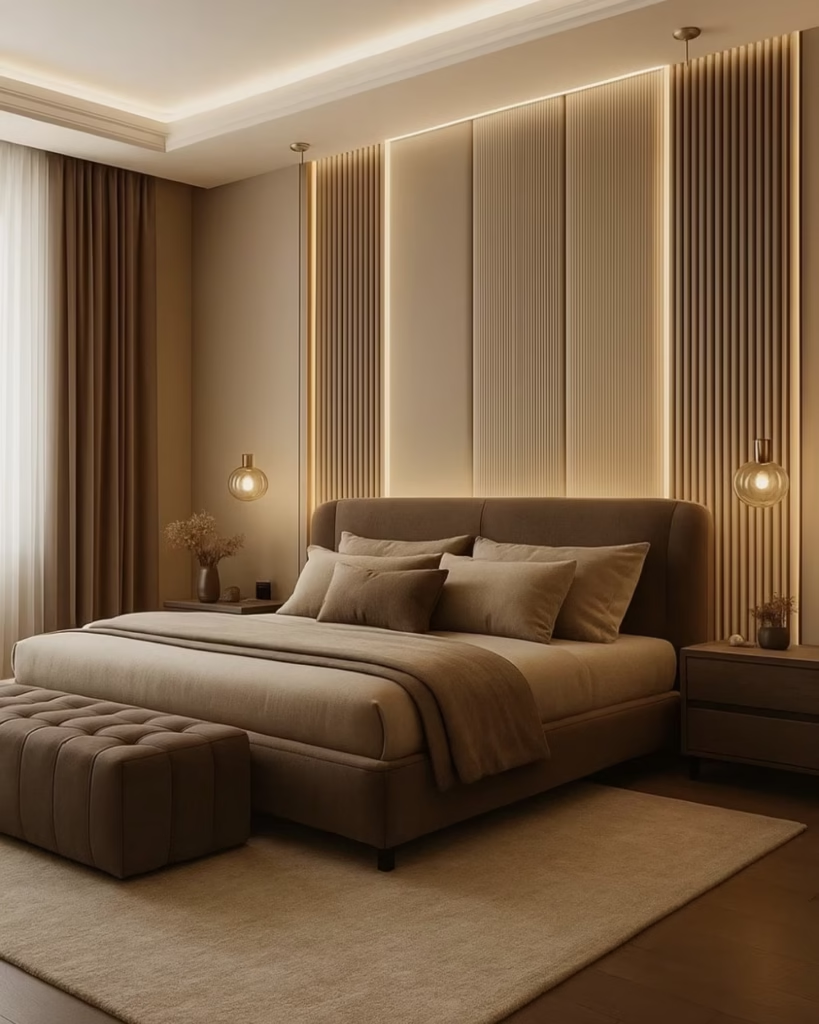
Transform Your Space: The Best Bedroom Essentials You’ll Love
By Emily | August 15, 2025
Your bedroom is perhaps the most personal space in your home, yet it’s often the most neglected from a design and functional perspective. We invest in living room furniture, we curate kitchen aesthetics, we style our entryways – but the bedroom, the one place where we spend roughly a third of our lives, is frequently treated as an afterthought. This is a missed opportunity. Your bedroom isn’t just where you sleep; it’s where your body recovers, where your mind processes the day, where your nervous system finds rest. Everything in this space either supports that recovery or sabotages it.
The problem is that most bedroom design advice focuses on aesthetics – what looks beautiful, what’s trendy, what photographs well. But a truly functional, restorative bedroom operates on a different principle: it’s designed around sleep science. It’s built on understanding how your environment affects your nervous system, your circadian rhythm, and your ability to enter deep, restorative sleep. This isn’t about creating an Instagram-perfect space. It’s about creating a space that actively supports your physical and mental health.
The transformation I discovered in my own bedroom came when I stopped asking “What looks beautiful?” and started asking “What helps me sleep better?” These two questions often lead in opposite directions. A beautiful bedroom might have lots of visual interest, multiple textures, decorative objects, ambient color. But a bedroom optimized for sleep needs simplicity, intention, and functional elements that work together as a system. The good news is that these don’t have to be mutually exclusive. You can create a bedroom that is both beautiful and deeply functional – a space that supports rest while also reflecting who you are.
The essentials explored in this article – from minimizing visual clutter to understanding how lighting affects your circadian rhythm, from textile choices to scent and storage – work together as an integrated system. No single element alone will transform your sleep. But when these principles work together, the change is remarkable. You’ll notice it in how quickly you fall asleep, how deeply you rest, and how much more refreshed you feel in the morning.
Step 1: Declutter & Reframe
 Save it
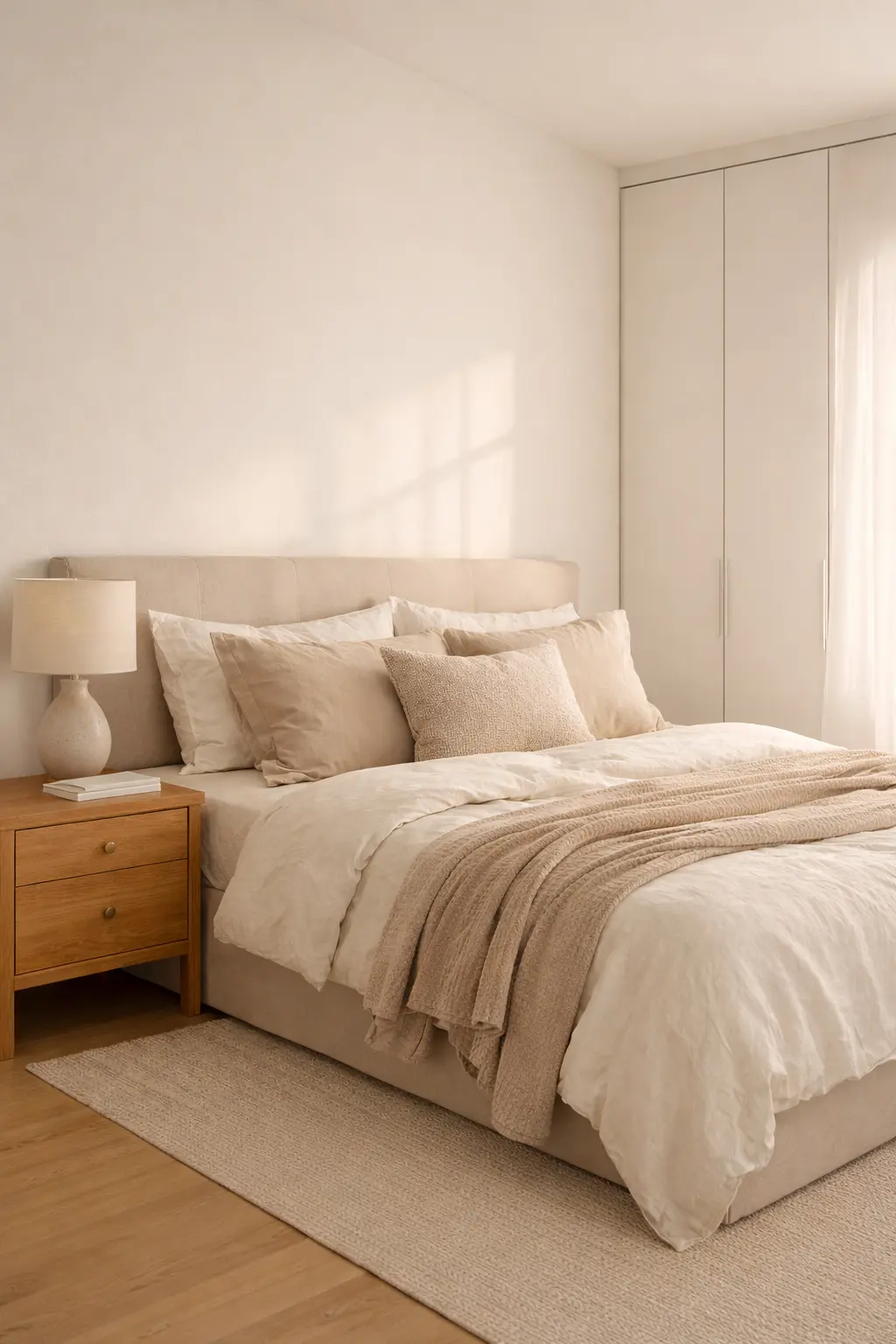
The first – and perhaps least “Pinterest-compatible” – step in creating a truly restful bedroom is radically reducing the number of objects in your space. But I’m not talking about decluttering in the Marie Kondo sense, where you keep what “sparks joy.” This is more fundamental: it’s about redefining the actual function of your bedroom. Your bedroom is not a multifunctional room. It’s not a workspace. Not a workout zone. Not an overflow wardrobe closet. Not a catch-all for things you haven’t dealt with. It’s a sleep space, and every object in it should support that single purpose.
Here’s what I did to apply this principle: I removed all open storage near the bed – shelves with books, decorative items, anything that creates visual stimulation. I limited my nightstand to a maximum of three items – a lamp, a book I’m currently reading, and a glass of water. I visually “hid” technology by using cable management solutions and closed docking stations so that charging devices and their cables weren’t creating visual noise. I stored seasonal clothing elsewhere. I removed excess throw pillows from the bed, keeping only what was functionally necessary.
This is critical because your brain is constantly processing your environment – even when you’re trying to rest. You’re not consciously registering every object, but your nervous system is. Every item in your visual field requires a tiny amount of cognitive processing. The more visual stimuli present, the harder it is to activate your parasympathetic nervous system – what you might think of as achieving true relaxation. This is why hotel rooms feel so restful: they have minimal objects, clear surfaces, and nothing competing for your attention. You can recreate this feeling in your own bedroom by applying the same principle: keep only what’s necessary, hide everything else, and let your brain genuinely rest.
Step 2: Add Warm Textures

 Save it
Most people try to create a premium bedroom atmosphere with color – they paint walls, they choose colored bedding, they introduce color through textiles. When in reality, texture is what makes the biggest difference in how a space feels and functions. A bedroom feels premium not because of what you see, but because of what you feel when you touch it, when you lie in it, when your body interacts with it. These two elements – visual and tactile – work together to create that subtle, hotel-level comfort that isn’t flashy or loud, yet instantly calming and deeply restorative.
I treat bedroom textiles as a kind of “textile architecture” – a system of layering where each layer serves a function. The base should always be breathable, natural bedding like washed linen or densely woven cotton. These materials allow for temperature regulation and have a naturally calming quality. Then comes a heavier, contrasting layer: perhaps a wool throw, a quilted bedspread, or a structured bed runner at the foot of the bed. The key principle here is that you don’t want everything soft and smooth. You need rougher, matte surfaces too – like bouclé, tweed, or waffle weave – because these textures absorb light and add visual depth. They prevent the bed from feeling flat or one-dimensional.
The rug is equally important in this system. A thick, large-weave piece under the bed not only makes getting up in the morning more comfortable – you’re not stepping directly onto cold flooring – but also visually anchors the bed in the room and adds another layer of texture. If the rug is too thin or too small, the entire composition feels ungrounded and disconnected. An extra tip that many people overlook: combine materials with different thermal properties. Cool linen sheets paired with warm wool create a dynamic sensory experience – they work visually together and help regulate your body temperature throughout the night, preventing the overheating that causes sleep disruption.
Step 3: Lighting That Supports Your Rhythm
 Save it
Lighting is something most people treat as purely aesthetic – they choose pretty lamps or trendy fixtures and assume the job is done. In reality, lighting is one of the most important regulators of sleep quality and circadian rhythm. Poor lighting can completely disrupt your sleep cycle, even if everything else in your bedroom is perfectly set up. This is because light directly affects melatonin production, the hormone that tells your body it’s time to sleep.
The goal is for your bedroom lighting to actively support your evening wind-down. That requires layered lighting – not a single strong overhead light that you turn on and off.
Here’s the system I use:
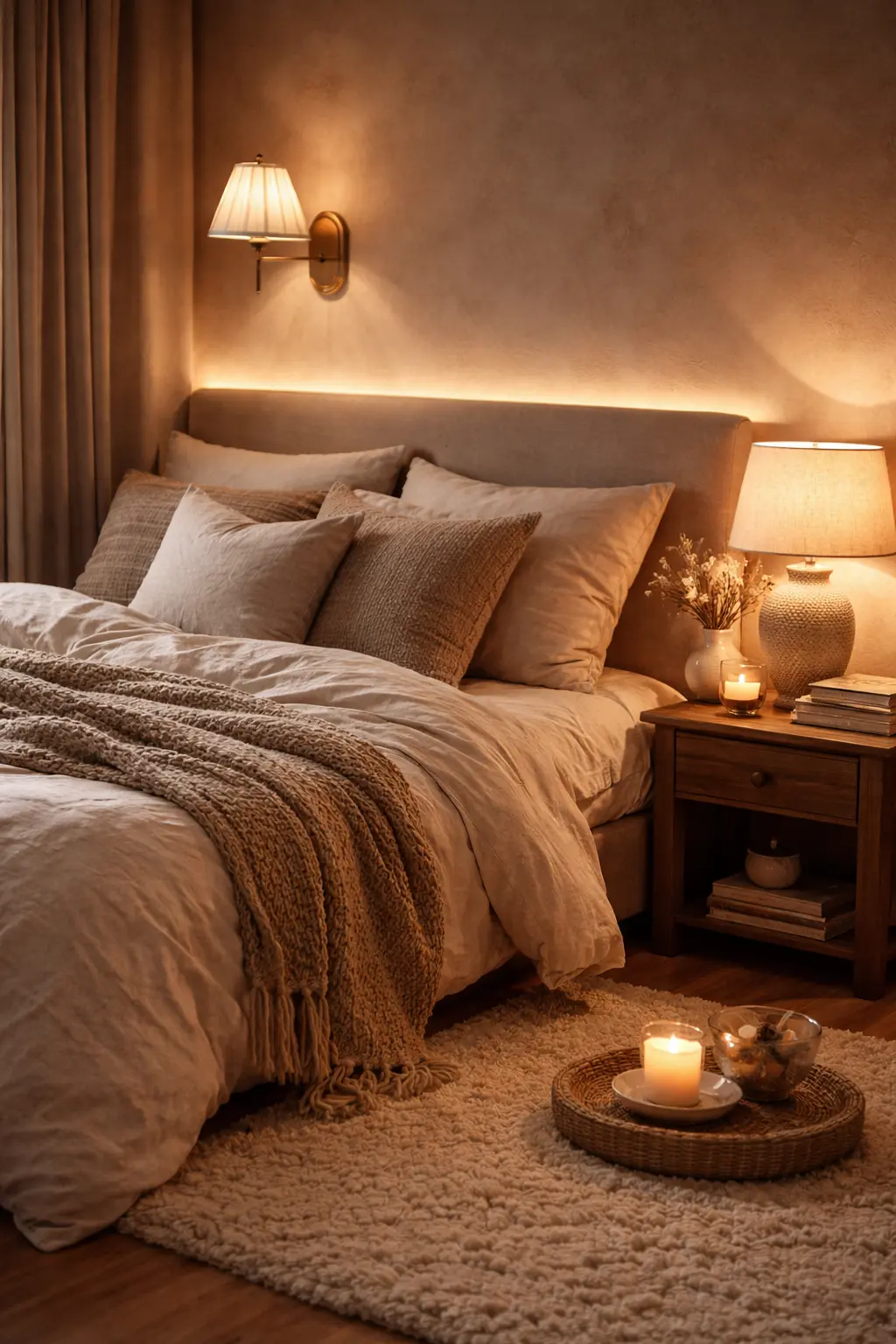
- First, ambient light – warm-toned (maximum 2700K color temperature), diffused ceiling lighting that doesn’t cast harsh shadows. This provides general illumination without being stimulating.
- Second, mood light – perhaps a fabric-shaded table lamp or wall sconce that provides soft, scattered light for evening routines like reading or preparing for bed. This should be even warmer and dimmer than the ambient light.
- Third, task light – a directional reading lamp with a separate switch so you can read without disturbing your partner, then turn it off independently.
Dimmable bulbs are a game-changer in this system. They allow you to gradually reduce brightness before bed, which signals to your brain that daylight is ending and it’s time to produce melatonin. The transition from bright to dim is crucial – sudden darkness can be jarring, but gradual reduction is soothing. The color temperature matters as much as the intensity. Warm light (2700K or lower) is calming because it doesn’t suppress melatonin the way cool, blue-toned light does.
If you’re interested in exploring this in more detail, I’ve covered bedroom lighting comprehensively in Brighten Your Bedroom the Modern Minimalist Way: Expert Lighting Ideas, which explores how to optimize both function and aesthetics.
Step 4: Anchor the Bed
 Save it
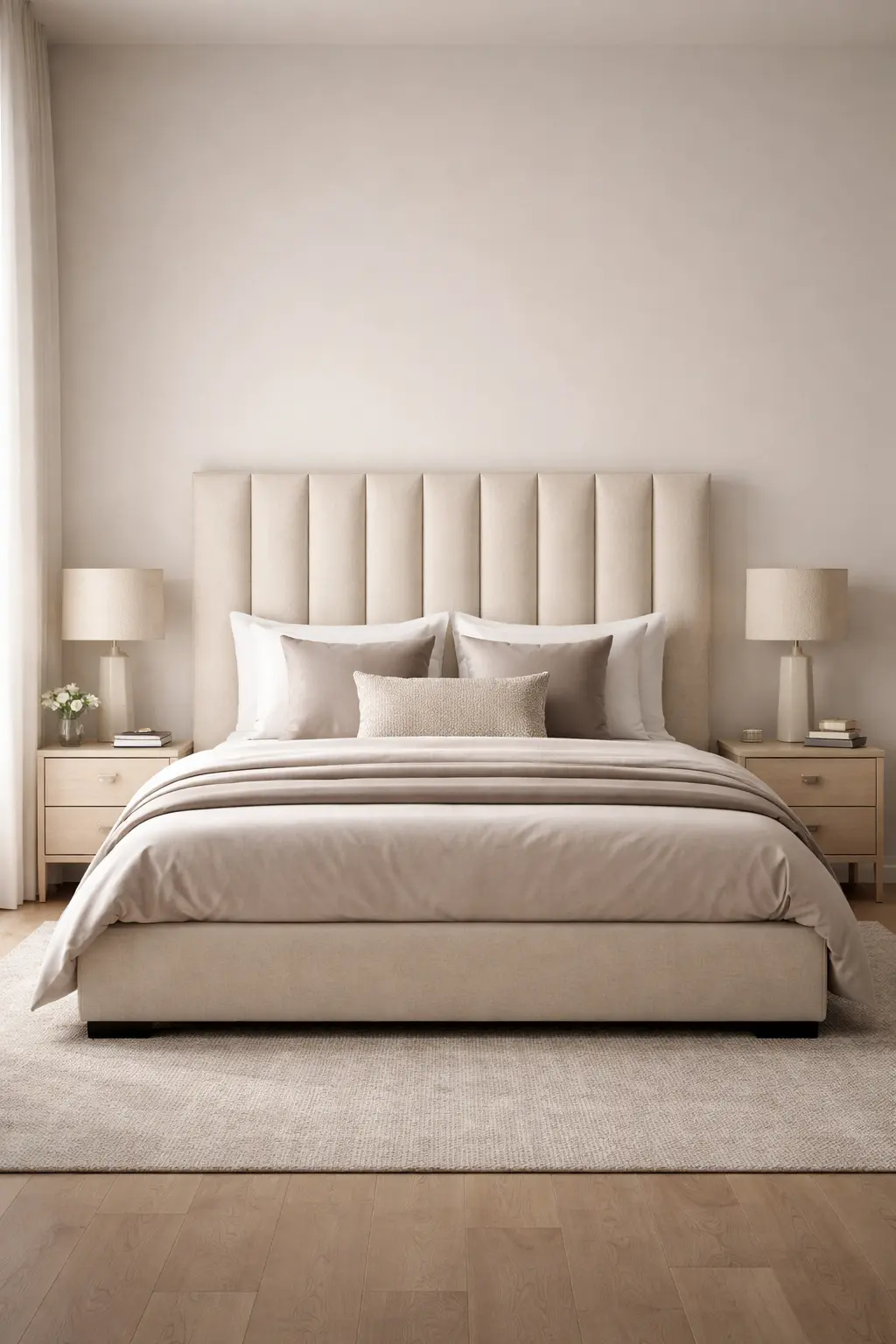
Many people think of a headboard as purely decorative – something you add if you like the look, skip if you don’t. But a headboard is actually a functional element that improves how your bedroom works on multiple levels simultaneously. An upholstered headboard, for example, helps absorb sound – especially in rooms with hard wall finishes like plaster or tile – reducing echo and making the space feel acoustically quieter. This might seem minor, but it has a real impact on sleep quality. Ambient noise and echoes keep your nervous system slightly activated.
Beyond acoustics, a headboard visually frames the bed, and this matters more than most people realize. Without a headboard, the bed often gets lost against the wall, floating without anchor or definition. The space lacks a focal point that ties the composition together. A taller, fabric-covered headboard adds verticality, resulting in more elegant proportions that make the entire room feel more intentional and designed. You’re not just putting a bed in a room – you’re creating a focal point that the room is organized around.
When choosing a headboard, fabric choice is critical. You want something matte and structured – not glossy. Glossy faux leather or silk-like materials tend to be more visually distracting and stimulating than calming. They catch light in ways that create visual noise. A matte, textured fabric like linen, cotton, or a structured weave absorbs light and creates a calm, grounding effect. The headboard should recede slightly into the background while still providing definition. Color matters too – neutral, warm tones work better than bright or cool colors, which can feel stimulating to your nervous system, especially in the evening.
Step 5: Control the Light
 Save it
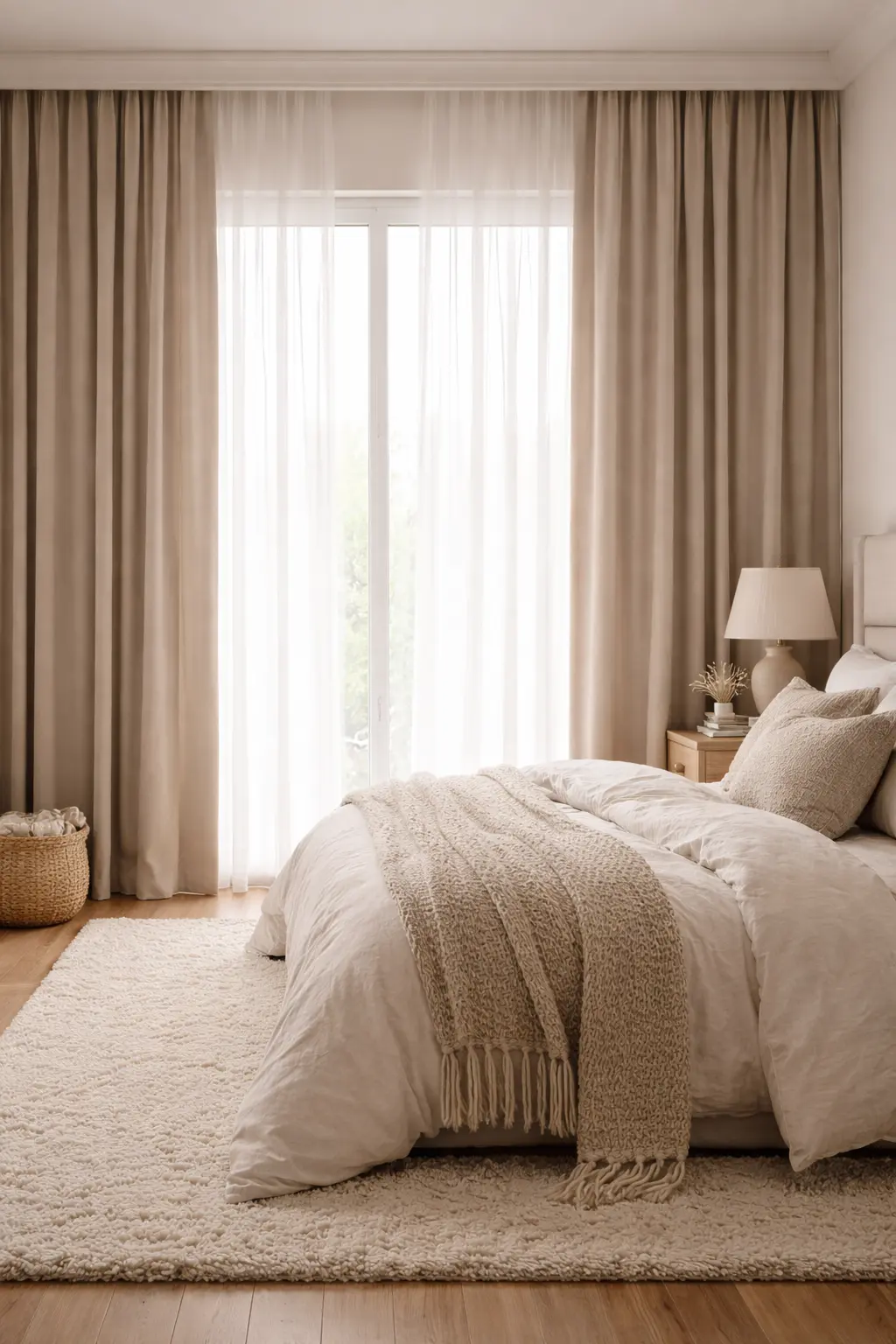
One of the most underestimated factors in sleep quality is light – more specifically, how well you control it. Even if your room feels “dark enough” when you’re getting ready for bed, other light sources can disrupt sleep throughout the night. Streetlights, light spilling in from a neighbor’s balcony, passing car headlights, or early morning sunrise can all cause micro-awakenings. You may not remember them consciously, but your body does. Each micro-awakening interrupts your sleep cycle, decreases your time in deep sleep, and you wake up feeling more tired and less restored.
Blackout curtains aren’t a luxury here – they’re a sleep hygiene tool, as essential to sleep quality as a good mattress. What I recommend: choose multi-layered, lined curtains that not only darken the room but also insulate against heat and sound. Combine them with a sheer voile layer so you can regulate natural light during the day – getting bright light in the morning actually helps set your circadian rhythm correctly. Avoid thin, purely decorative fabrics. They may look nice, but functionally they add almost nothing in terms of light blocking.
Layered window treatments allow you to shape the room’s atmosphere throughout the day. In the morning, you can let in soft, diffused light to support waking up naturally and setting your circadian rhythm. In the evening, you can create complete darkness to promote melatonin production. An extra tip: your curtain rod should extend at least 20-30 centimeters beyond the window frame on both sides. This allows you to fully pull the curtains away from the glass during the day, maximizing natural light exposure – essential for maintaining a healthy circadian rhythm. It also creates a more finished, intentional appearance.
Step 6: Upgrade the Sleep Surface

 Save it
Many people assume that better sleep requires investing in a completely new mattress – which often means a significant financial investment and the hassle of disposal and delivery. But here’s what many don’t realize: a well-chosen mattress topper alone can make a noticeable, measurable difference in sleep quality without the major expense. Memory foam or latex toppers help distribute body weight more evenly across the surface, reduce pressure points at the shoulders and hips, and provide more stable spinal support throughout the night.
This is especially important if you sleep on your side, if you toss and turn at night, or if you wake up with lower back or neck pain. These are all signs that your current sleep surface isn’t supporting your body properly. A topper creates a kind of “comfort zone” between your mattress and your body. It can correct a surface that’s too firm or too soft without requiring a full bed replacement. The investment is modest, but the impact on sleep quality is often significant.
The same principle applies to pillows – and this is where most people go wrong. A pillow that’s too high pushes your head forward, straining your neck. One that’s too flat fails to support your neck properly, leading to morning stiffness and tension headaches. The ideal solution is an adjustable, ergonomic pillow that you can tailor to your specific sleeping position. Higher loft for side sleepers, medium loft for back sleepers, low-profile for stomach sleepers. A properly adjusted pillow-topper combination not only improves comfort immediately, but also reduces muscle tension and enhances overnight recovery over the long term. You’re investing in your physical health every single night.
Step 7: Introduce Scent Zoning

 Save it
Scents don’t just create atmosphere – they have a direct neurological impact on your body and mind. Smell is the only sense directly linked to the limbic system, the part of your brain responsible for emotional processing and memory. This means a familiar, calming scent can instantly signal to your body that it’s time to slow down, that safety is present, that rest is appropriate. I call this scent zoning – intentionally using fragrance within a space to support specific mental and physical states.
In the bedroom, it’s worth choosing essential oils that lower heart rate (like lavender), stabilize breathing (cedarwood), or support mental relaxation (sandalwood, bergamot). These aren’t just pleasant-smelling – they have documented physiological effects. An ultrasonic diffuser produces a fine, even mist, so the scent isn’t overwhelming or cloying. The goal isn’t to strongly notice it – it’s to let it subtly influence your nervous system. If it’s too intense, it can become stimulating, which defeats the purpose. You want it to be almost subliminal, something your body registers without your conscious mind fixating on it.
Make scent part of your evening routine: turn the diffuser on at the same time every night, use the same scent consistently before bed, and combine it with warm lighting and a quiet environment. Over time – usually within two to three weeks – your brain will begin to associate that specific scent with rest. This becomes a powerful sleep cue. Your body will start producing melatonin faster, you’ll fall asleep more easily, and you’ll sleep more deeply. It’s a simple tool that has profound effects when used consistently.
Step 8: Hide the Storage
 Save it
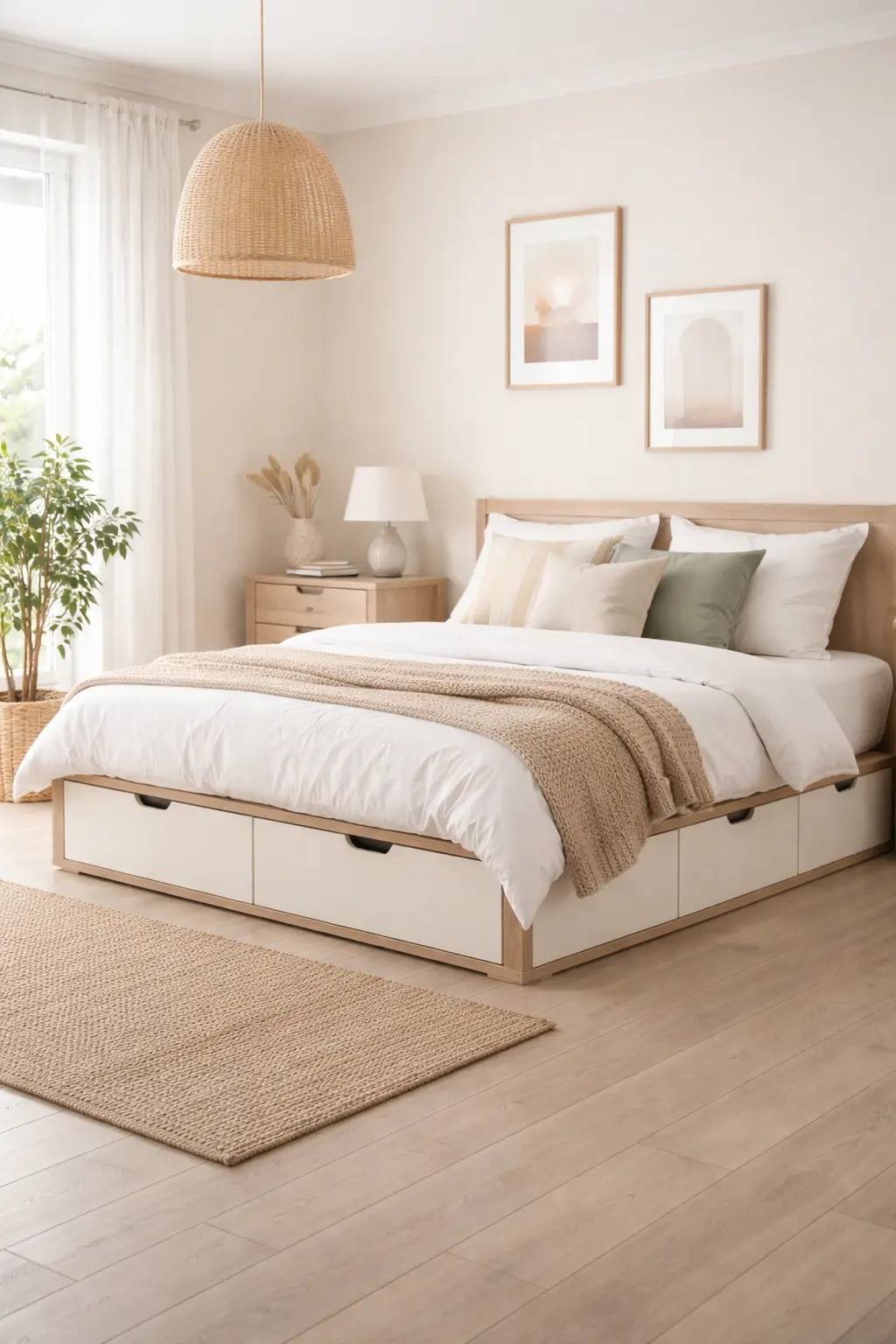
Clutter isn’t just an aesthetic issue – it’s a cognitive load. Objects left on open shelves, clothes draped over a chair, or books piling up beside the bed all create constant visual stimulation for your brain. Even if you don’t consciously focus on them, their presence activates alertness. Your brain registers them, processes them, and allocates mental resources to them. This is why hidden storage is essential in a bedroom designed for sleep. Closed under-bed drawers or storage boxes are perfect for seasonal clothing, extra bedding, and rarely used items.
It’s also worth investing in a closed nightstand instead of one with open shelving – this keeps the area near your head visually simple. Use cable management solutions for electronic devices so cables and chargers aren’t creating visual chaos. Avoid too many decorative items on horizontal surfaces. Every object takes up cognitive space. The goal isn’t sterile, cold minimalism – but to create a space that doesn’t demand attention. A well-organized bedroom fades into the background, allowing your nervous system to truly switch off. When you’re not constantly processing your visual environment, your brain can fully relax, and deep sleep becomes possible.
Common Mistakes to Avoid When Redesigning Your Bedroom
1. Overlighting the Bedroom
The biggest mistake is installing too many light sources or using overly bright bulbs. A bedroom should feel cozy and dim, not bright like an office. Choose fewer fixtures with warm, dimmable lighting. Remove overhead lights if possible – they’re rarely restful.
2. Using Blue-Toned Light in the Evening
Blue light suppresses melatonin production. Avoid cool-toned bulbs, avoid screens, and avoid blue nightlights. Stick to warm amber tones (2700K or lower) after sunset. This single change can dramatically improve sleep quality.
3. Ignoring Temperature Control
Many people don’t realize that room temperature affects sleep. A bedroom that’s too warm or too cold disrupts sleep cycles. Aim for 65-68°F (18-20°C). Add or remove blankets to find your personal comfort zone, and consider breathable bedding that helps regulate heat.
4. Keeping Too Much Visible Clutter
Every visible object creates cognitive load. If you can see it, your brain is processing it. Store everything possible in closed drawers, closets, or under-bed storage. Keep surfaces bare except for a few essential items.
5. Neglecting Blackout Solutions
Many people underestimate how much ambient light disrupts sleep. Even small light sources – alarm clocks, phone screens, streetlight leaks – can cause micro-awakenings. Invest in proper blackout curtains or a sleep mask. This is one of the highest-impact changes you can make.
FAQ
Do I really need to spend a lot of money on bedroom essentials to improve sleep?
No. The most impactful changes – reducing clutter, optimizing lighting, adding blackout curtains, and using a mattress topper – are relatively affordable. Quality sleep comes from smart choices, not expensive purchases. Start with free changes (organizing, adjusting lighting) and then invest gradually in quality basics.
How long does it take to notice improvements in sleep after making these changes?
You may notice subtle improvements within a few days, but the real transformation usually takes 2-3 weeks. Your body needs time to adjust to new cues (lighting, scent, etc.). Consistency matters more than immediate results. Stick with the changes for at least a month before evaluating.
Can I optimize my sleep if I share a bed with a partner?
Absolutely. Many of these principles work even better with shared sleep. Separate task lighting lets your partner read without disturbing you. A quality mattress topper benefits both of you. Communication about temperature, darkness, and sound is key. A shared bedroom can actually be more restful if both partners prioritize sleep quality.
What if I can’t install blackout curtains (rental apartment)?
Use a sleep mask instead. A high-quality silk or cotton sleep mask blocks light effectively, is portable, and works in any bedroom. You can also use adhesive blackout panels or hang dark fabric temporarily. Some people use room-darkening shades that don’t require permanent installation.
Conclusion
Transforming your bedroom isn’t the result of one big decision, but many small, intentional choices. Every texture, every light source, every hidden storage solution contributes to what you feel when you go to bed—or what you don’t feel.
If your bedroom doesn’t help you slow down, it’s actually working against you. The good news is that you don’t have to replace everything at once. Start with just one layer—like lighting or bedding—and you’ll already notice the difference.
The goal isn’t for the room to be “beautiful,” but to support sleep, recovery, and mental reset. A well-designed bedroom isn’t just an aesthetic experience—it’s a daily investment in your well-being, your focus, and your energy levels. And when you wake up well-rested in a space that truly works for you, that’s when you realize every small change was worth it.
This post contains affiliate links. I may earn a small commission at no extra cost to you.

Get cozy inspiration delivered to your inbox.
✓ 14-page beautifully designed ebook
✓ Cozy decorating ideas
✓ Practical room-by-room inspiration
You’re in! 🎉
Thanks for joining the NestFlowHome community!
Your free ebook is already on its way to your inbox. If you don’t see it within a few minutes, please check your Promotions or Spam folder.
Join the NestFlowHome community for weekly decorating inspiration.

Timeless home decor ideas and slow living inspiration for a calm, beautiful life.