
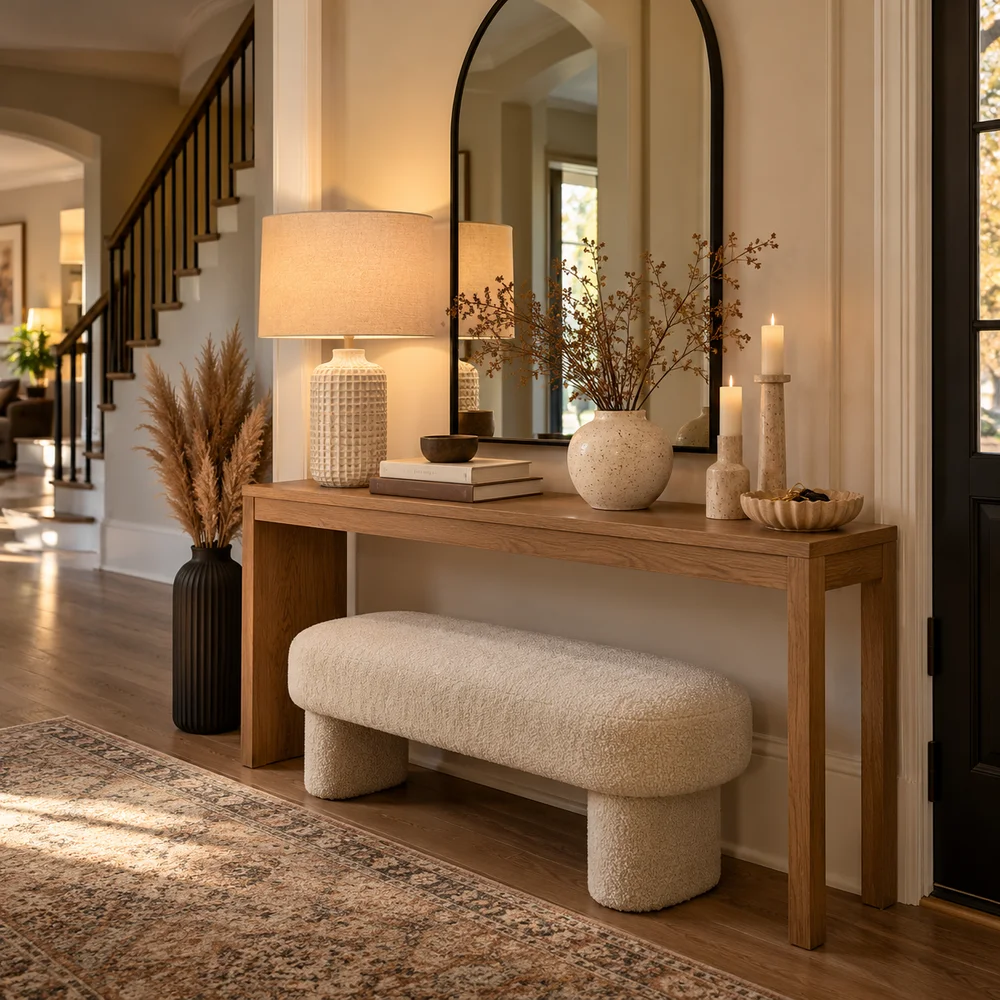
How to Make Your Console Table Look Pulled Together
By Emily | October 22, 2026
Some console tables look like a landing strip. Mail from last Tuesday, a candle that was a gift, a vase that was never quite the right size, a lamp bought for a different room. Every object is perfectly nice on its own, and yet the surface reads as a pile that happens to be neatly arranged. Then there is the other kind of console, the one you slow down for in a friend’s hallway. Nothing on it is expensive or rare, but it feels decided. The eye knows where to go first, where to rest and where to leave.
The difference is almost never about buying better things. It is about composition: a wall that frames the table, a source of warm light, a few heights that step up and down instead of marching in a row, a repeated tone that quietly ties the objects together, and one honest place for the practical things you actually carry. A console is a narrow stage, usually only twelve to fifteen inches deep, so every inch of that stage is visible, and small decisions carry real weight.
This guide builds the look one layer at a time, from the mirror on the wall down to the floor beside the table. Each step uses a single piece, chosen so the whole group can be assembled without matching sets or a designer’s budget. You do not need to copy every layer. Start with the one that feels most missing from your own table, live with it for a few days, and add the next. By the end, the surface that used to collect things should feel like something you composed.
1. Hang an Arched Black Mirror Before You Style a Single Object
 Save it
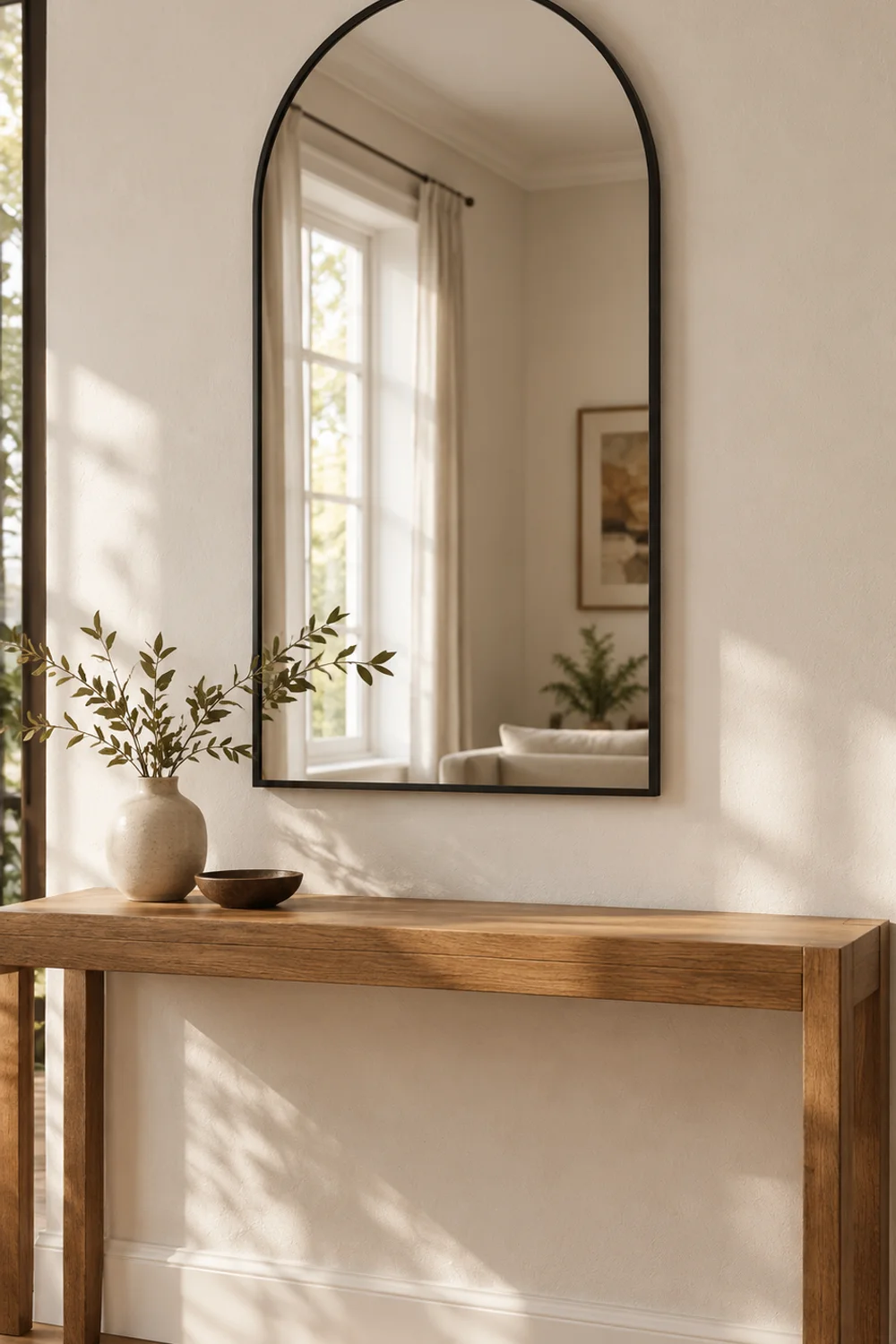
Decorators tend to start with the objects and end with the wall. Reverse that order. The wall above a console decides how large the whole arrangement is allowed to feel, and until something occupies it, even a beautifully styled table looks as though it is waiting for a purpose. A mirror is the most forgiving anchor because it borrows light from the room, gives the narrow table the illusion of depth and works in a hallway, an entry or behind a sofa.
An arched shape suits a console particularly well. The rounded crown softens the hard horizontal line of the tabletop and gives the eye a gentle path upward, where a rectangle would simply stop. One example is this 20 by 30 inch arch mirror, which has a slim black metal frame and a clear glass face, listed as aluminum alloy with shatter-proof glass and designed to hang on the wall in an entry or living room.
Scale is where most walls go wrong. A mirror about two thirds the width of the console is the classic proportion, so a 20 inch mirror sits most comfortably over a table of roughly 30 inches, or over one end of a longer table if you want a deliberately asymmetrical grouping with the lamp on the opposite side. Hang the bottom edge six to eight inches above the tabletop, close enough that the table and the mirror read as one unit rather than two separate things. Centered on the table, a mirror looks formal. Pushed a few inches to one side, it looks relaxed.
Think about what it will reflect before you drill. A mirror facing a window doubles the daylight, while one facing a closed door or a coat closet doubles the clutter. If a mirror does not suit the wall, Wall Art Ideas That Make Your Home Feel Finished walks through framed pieces that can play the same anchoring role. Whichever you choose, the thin black frame here also gives the arrangement its first dark accent, which is useful later when a second black note appears near the floor.
2. Let a Ceramic Lamp Set the Height and the Mood
 Save it
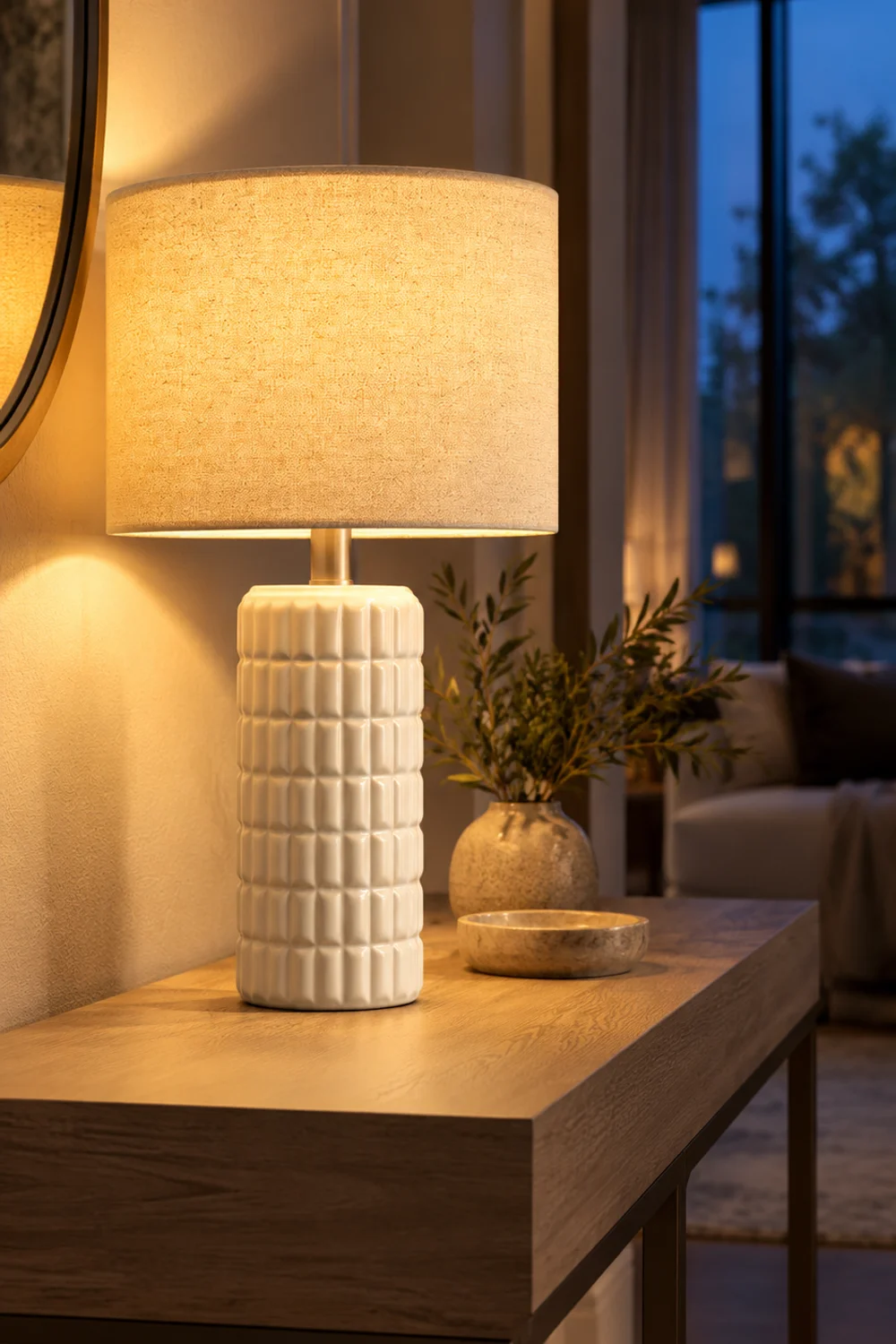
A console without a lamp is lit by whatever the ceiling happens to provide, and overhead light is flat. A lamp on the table does something no other object can: it lowers the light source to the level where you actually look, throws a warm pool across the tabletop and turns the objects beside it into a lit scene rather than a storage surface. It is also the tallest thing on the table, so it sets the height every other object will answer to.
Choose a lamp whose base is quiet enough to stand next to other decor. This 23 inch table lamp has a cylindrical white ceramic base with a raised grid texture, a slim metal neck and a natural linen drum shade, a combination that stays calm in daylight and glows in the evening. The relief catches light along its ridges, so the base has interest without color, which keeps it from competing with the mirror above.
Position matters more than most people expect. Place the lamp in the left or right third of the table rather than the exact center, and let the shade top land somewhere below the middle of the mirror so the two shapes overlap slightly in your line of sight and look intentional. If the lamp’s shade rises above the mirror’s lower edge by a few inches, the layers feel stacked together instead of floating at separate levels. Keep the shade at least a hand’s width from the wall so the glow can wash upward.
Treat the cord as part of the design. Run it straight down the back of the table, secure it with a couple of adhesive clips and tuck any slack behind the leg, because a loose loop of white cable can undo an otherwise tailored surface. A warm-white bulb gives the linen shade its amber glow, and a plug-in dimmer lets you drop the light to a low evening level. Plan to turn the lamp on in the evening, not only when you need it. A console lit at dusk is the first thing that welcomes you home.
3. Build a Linen Book Plinth for Your Best Object
 Save it
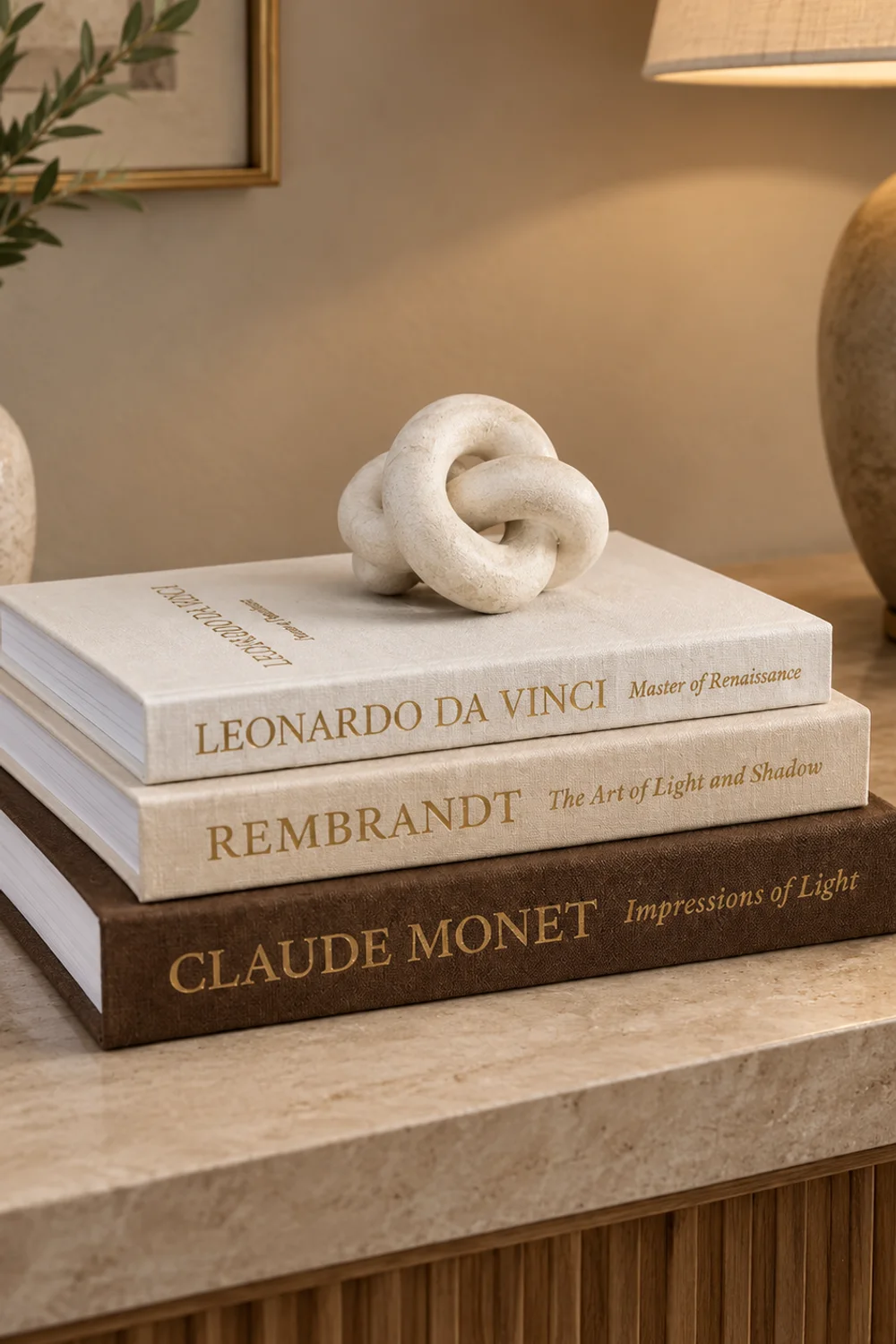
A flat tabletop makes every object sit at the same height, and sameness is what makes a surface look unstyled. Books fix that in the simplest possible way. Stack two or three, set one object on top and you have built a plinth: a small step that lifts the object, gives it a frame and introduces a second level without any additional furniture.
The effect depends on the books themselves. This set of three linen-covered decorative books comes in white, cream and chocolate brown with gold-foil lettering on the spines, in graduated sizes with the largest at 7.87 by 11 inches. The listing describes them as faux books with hidden storage, which means the stack can quietly hold a spare set of keys or a remote while looking like a considered art-book collection.
Stack from largest to smallest, with the brown book at the bottom and the pale one on top, so the visual weight sits low and the stack tapers upward. Turn the spines outward and slide each book a half inch off the one beneath it, because a perfectly square tower looks like a store display while a slightly offset one looks lived in. Then give the top of the stack a single job, perhaps a small bowl, a ceramic object or a candlestick, and nothing more.
Keep the stack on the side of the table opposite the lamp. That one decision balances the table without making it symmetrical: the tall lit shape on one side and the low, solid shape on the other. If the books are going to share their end of the table with a vase, set the vase beside the stack instead of on it, so the plinth stays an uncluttered platform. One stack is enough. Two stacks of the same size create a pair that reads as a set, and a pair is a different design move that we will come to later.
4. Give One Sandstone Vase Room to Be the Soft Curve
 Save it
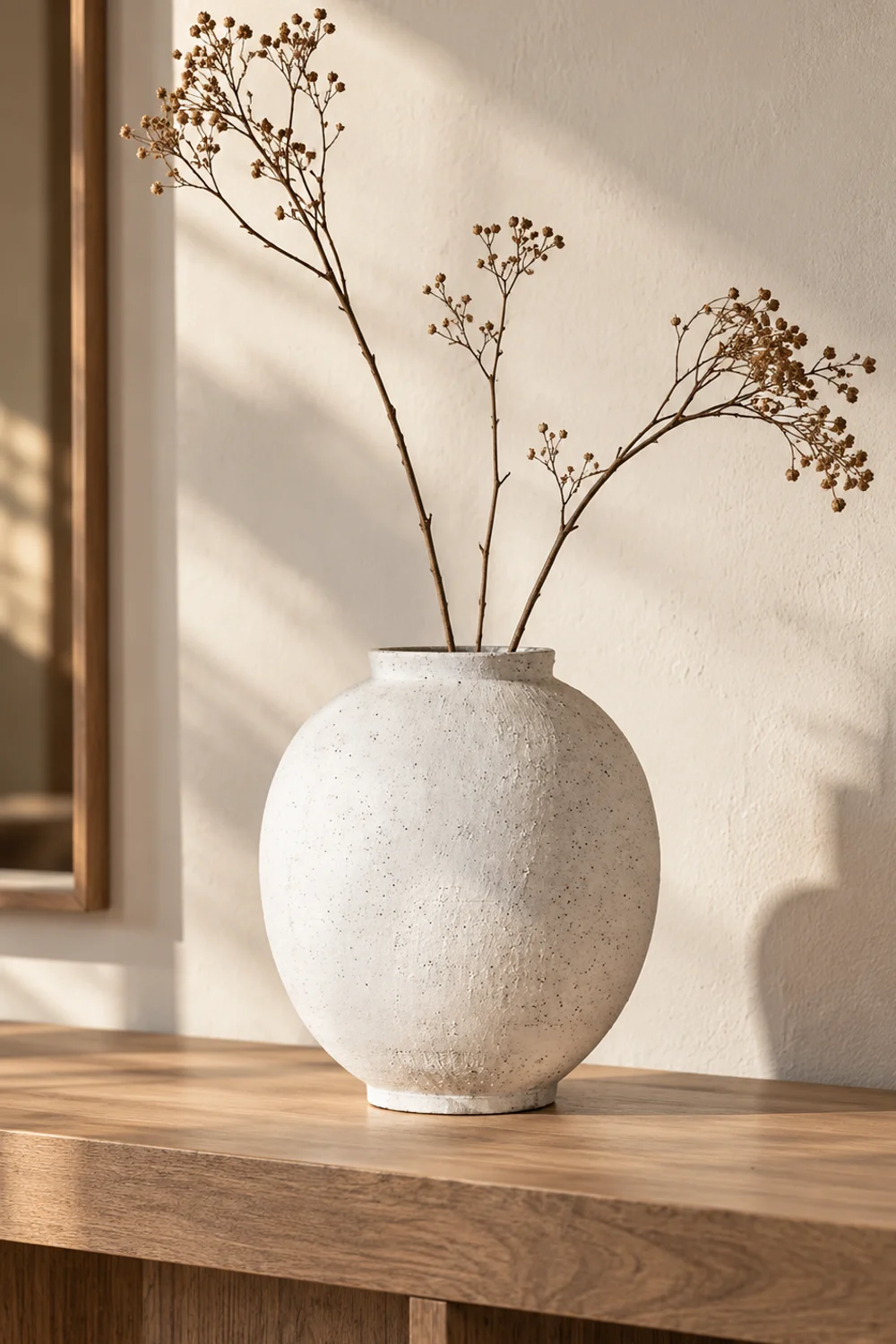
Every console needs one rounded, organic form to soften the straight lines of the table, the books and the frame. A vase is the obvious candidate, but the mistake is to treat it like a delivery vehicle for flowers. On a console, the vase is a sculpture first. The stems are a bonus.
This 9.8 inch vase is a good example of how little you need. It has a round, ovoid body, a short narrow neck and a small foot ring, finished in a speckled matte sandstone white that looks unglazed and hand-formed. The listing gives a mouth diameter of about four inches and describes it as natural clay ceramic, so it holds a few stems comfortably without needing a bouquet to look complete.
The most reliable way to style it is restraint. Use one to three branches, either dried or faux, and cut them so the tallest stem is about one and a half times the height of the vase. That proportion gives the arrangement a shape that echoes the lamp without competing with it. Let one stem lean slightly outward rather than standing perfectly straight, since a rigid vertical reads as stiff against a round vessel. For more ways to arrange stems and vessels beyond this single-branch approach, From Simple to Stunning: Vase Decor Ideas You’ll Love is a useful companion.
Position the vase toward the front half of the table and slightly off the line of the lamp, so the two forms create a gentle diagonal, a low curve at one level and a tall glow at another. If you want to push the look further, remember the third point of the triangle: lamp tall, vase medium, book stack low. The eye travels along that triangle and settles, which is what we mean when we say a composition feels pulled together. Leave a few inches of empty tabletop on either side of the vase, because the space around a round object is part of what makes it look sculptural.
5. Repeat One Cream Tone in a Pair of Travertine Candlesticks
 Save it
By now the table holds a lamp, a stack of books and a vase. What tends to separate a composed surface from a collected one is repetition, and the easiest repetition to manage is tone. When the same warm cream appears in three or four places, the eye reads the table as one family even if every object has a different shape, a different texture and a different origin.
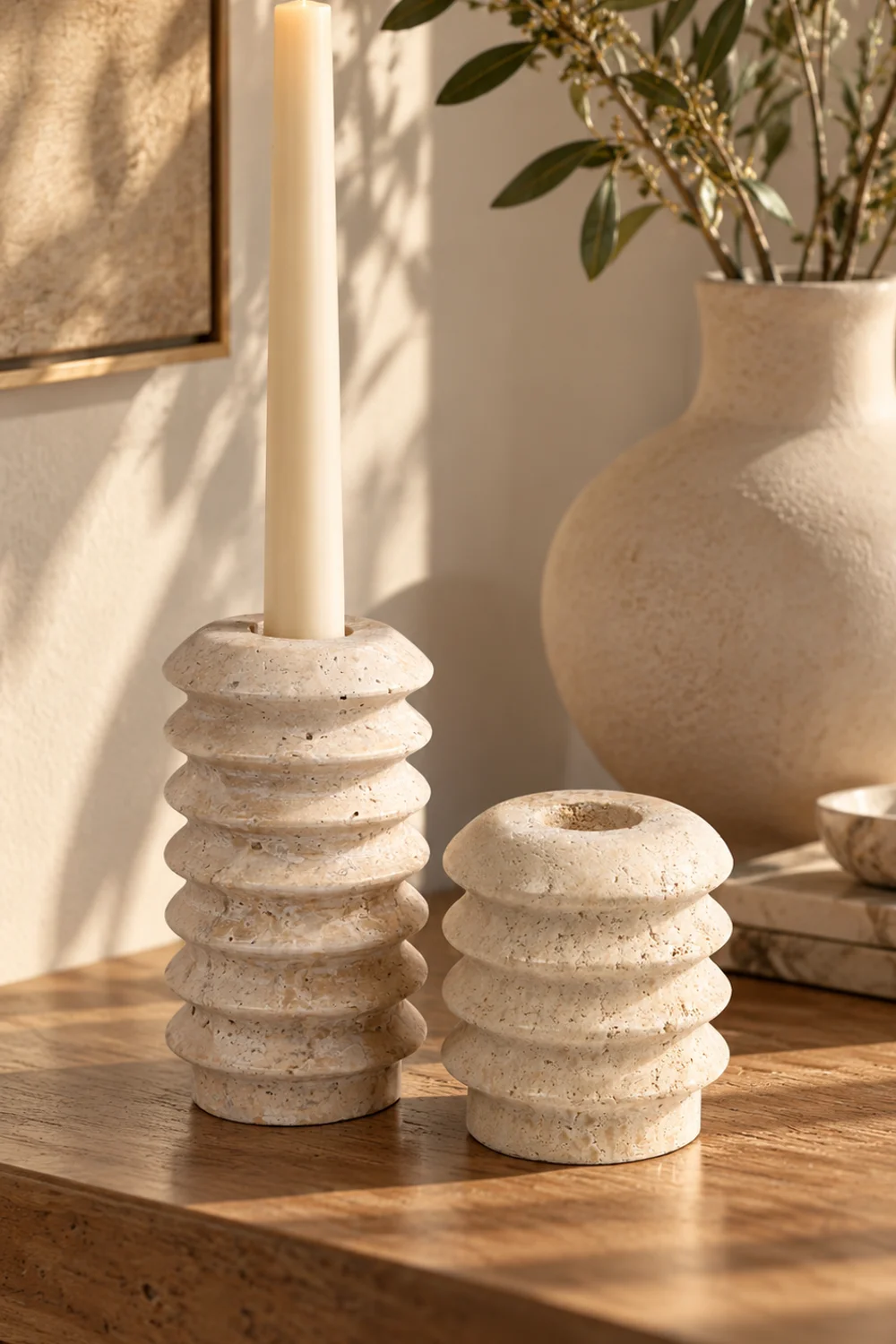
A pair of candlesticks does this quietly. These two travertine holders come in two heights, about 4.35 and 2.6 inches, each carved as stacked, ribbed discs with a wide flared top. The listing describes natural pitting and says each piece varies in color and veining, which is exactly what you want against the smooth ceramic of the lamp and the speckled vase. The hole is 0.82 inches in diameter and fits standard three-quarter inch taper candles.
Resist the urge to line them up like soldiers. Set the taller one near the book stack and the shorter one a hand’s width away, a little forward, so the pair forms a loose conversation rather than a formal line. Add tapers in one color only. A pair of ivory candles keeps the cream tone going upward, while a dark taper in one holder gives you a sharp vertical accent that echoes the black mirror frame.
Keep fire safety simple. Never place a lit taper beneath the lamp’s shade or within a few inches of the wall and mirror, and snuff the candles when you leave the room. If you prefer to avoid flame entirely, the holders still look finished with unlit candles, and they bring weight and texture to the table in a way plastic or glass never does. Their stone surface also repeats the sandstone quality of the vase, which is the real work they do here: three different objects now share one tone.
6. Gather Keys and Small Things in One Fluted Bowl
 Save it
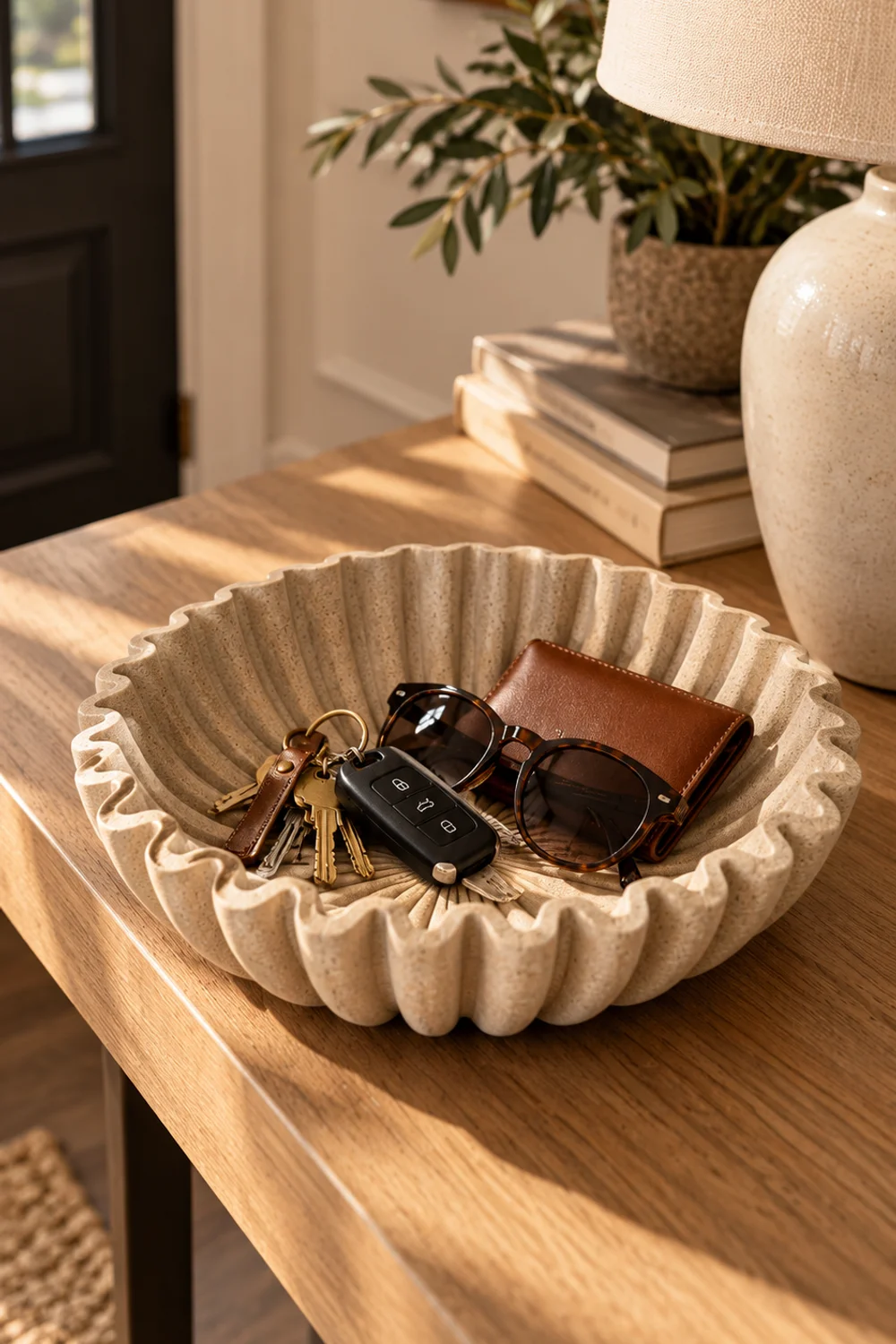
A console that works as furniture has to take what you carry, and keys, sunglasses, a wallet and a few loose coins have a way of scattering themselves across any open surface. A bowl turns that scatter into a still life. One vessel, one purpose, and everything that would otherwise wander has an obvious place to land.
The bowl needs to be handsome enough to stay out all the time. This 10 inch bowl is cast in solid resin with a wavy, scalloped rim and deep radiating flutes inside, finished in a speckled beige that reads like sandstone. The listing describes it as heavy and stone-like, and it is sized to hold keys, a wallet and sunglasses, so it can sit at the front of the table and handle real daily use rather than only looking pretty.
Place it on the end closest to the door, where your hand naturally drops what it is carrying. At ten inches across, the bowl fits a table of twelve inches or deeper with room to spare, and on a slimmer table it should sit squarely on the surface with its rim well clear of the edge. Fill it to about two thirds, because a bowl crammed to the brim looks like a junk drawer. A light felt pad under it protects a wooden console from scratches, a small touch that matters over years of daily use.
Edit it weekly. The same bowl that holds keys quietly collects receipts, pens and loose change, and the fastest way to keep a styled surface from drifting is a thirty-second sweep every Sunday. For more ideas on entryway surfaces that carry the day-to-day without losing their polish, 9 Entryway Ideas That Make Your Home Feel More Welcoming has a useful range of approaches. The fluted rim also adds the last bit of curve to the table, so the surface now has two soft shapes to counter the straight edges.
7. Slide a Soft Oval Bench Underneath
 Save it
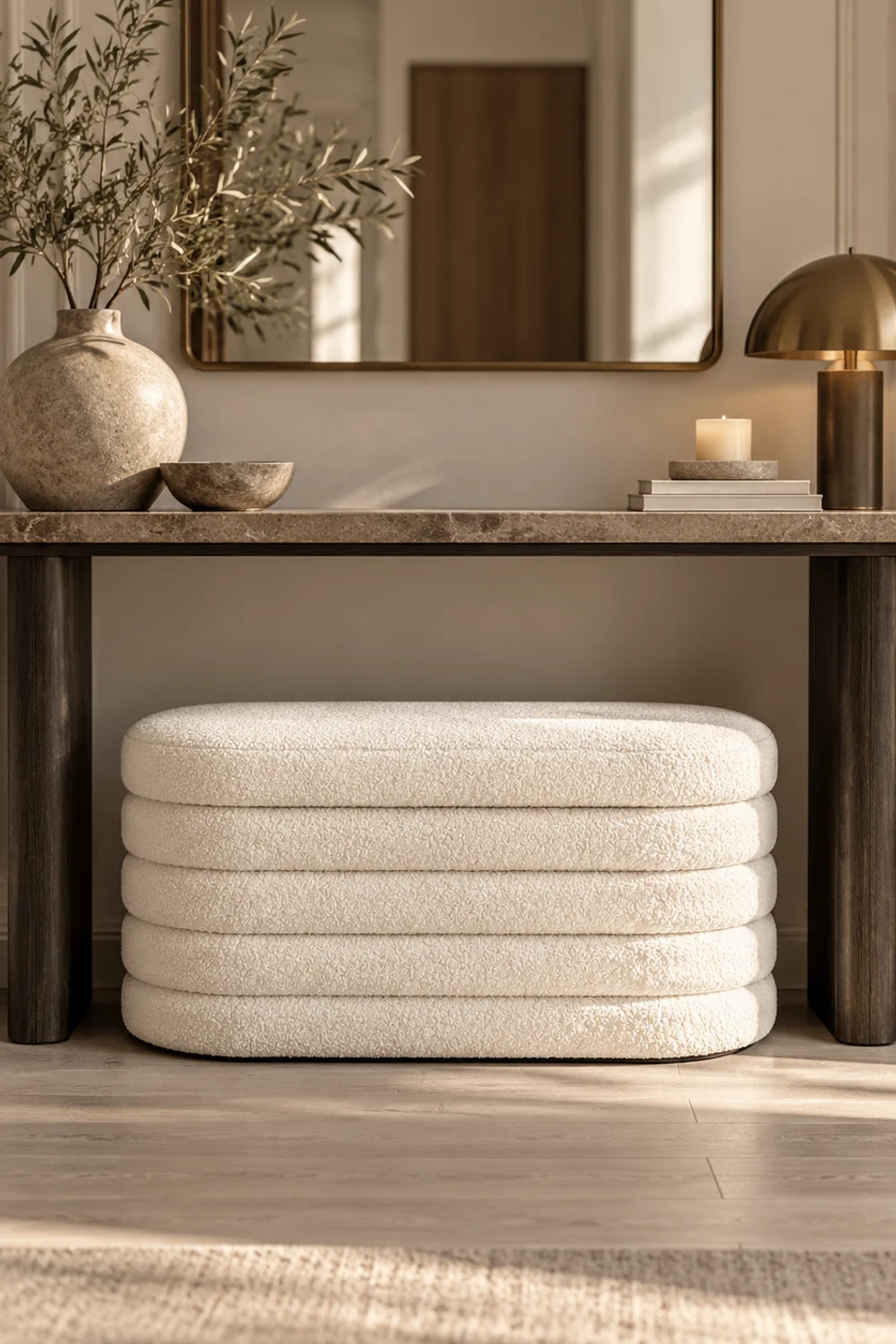
The space below a console is the most overlooked part of the whole arrangement. Left empty, it can look like a gap, a dark rectangle that makes the table seem as though it is floating on thin legs without anything to anchor it. A low piece underneath fills that gap, adds a layer of softness against the hard table and makes the console feel like part of a built group rather than a lone piece against the wall.
An oval bench does this elegantly. This one measures about 30.7 inches long, 15 inches wide and 15 inches high, upholstered in a white teddy-style fabric with horizontal rounded channels around the sides and a padded top. The listing describes it as an ottoman bench with storage, and it folds flat, so it is easy to move and assemble. Its soft white texture is a foil for the cooler materials above: the metal of the mirror frame, the ceramic of the lamp, the stone of the candlesticks.
Check the clearance first. The bench is 15 inches tall, and most consoles stand between 30 and 34 inches, so it will fit comfortably under almost any standard table, with about a hand’s width to spare above it. Measure the leg gap, too: the bench is 30.7 inches long, which means the table should be at least that wide between its legs, or you can pull the bench halfway out and let it sit in front of the console as a seat for putting on shoes.
Use the storage for what you would otherwise pile onto the table: a folded scarf, a spare throw, a pair of slippers. That small act of hiding keeps the surface above lighter. Choose a bench in a color that already appears elsewhere, such as the cream of the books or the white of the lamp, so it joins the palette instead of introducing a new one. Because the fabric is a light shade, place it somewhere it will not catch muddy shoes, and brush it with a soft brush now and then to keep the nap even.
8. Balance the Floor With a Tall Black Ribbed Vase
 Save it
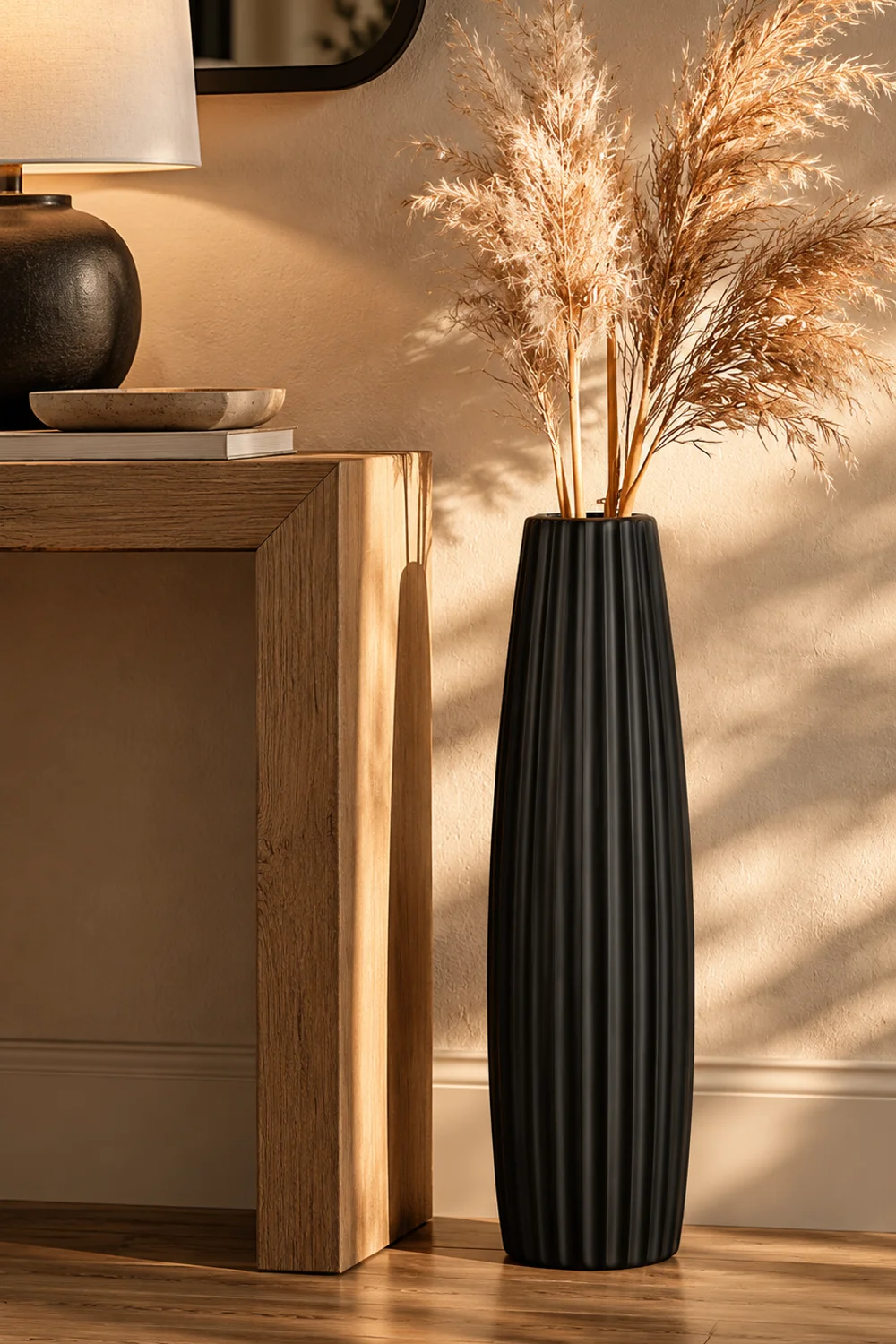
The last decision on a console happens at the edge, where the table meets the room. A single tall vase on the floor beside the table extends the composition outward, gives the whole vignette a vertical edge and catches the eye before it drifts away from the arrangement. It is also the moment where you bring back the dark accent from the mirror, so the whole group feels bookended: a thin black line at the top of the wall, a black column at the bottom.
The vase for the job is tall, slim and ribbed. This one stands 23.6 inches high with a belly about five inches wide and a narrow 2.3 inch opening, in matte black resin with fine vertical ribbing around the body. The listing says it weighs about 6.6 pounds, which is heavy enough to stay put, and describes it as designed for pampas grass and dried botanicals, which is exactly the kind of airy filler you want in a dark vessel.
Place it on the side opposite the book stack, or beside the lamp end if you want the black column to echo the lamp’s height. At 23.6 inches it stands below the tabletop, so it supports the console rather than competing with it, and the dried stems rise to meet the lamp’s glow. Fill it generously but loosely. A handful of pampas or reeds in one color looks cleaner than a mixed bundle, and three tall stems of varying height give a sense of movement, as if the table is slightly alive.
Keep it a hand’s width away from the wall and a comfortable distance from any door swing, since a tall vase in a high-traffic hallway is easy to knock. If the console sits in an entry, tuck the vase just beyond the bench so that the two floor-level objects look like a pair. A soft white oval and a dark ribbed column seem opposites, but together they give the base of the table the same light-and-dark balance as the wall above it.
Common Mistakes
1. Hanging the mirror too high
A mirror that floats a foot or more above the table stops reading as part of the arrangement. Lower it until the bottom edge sits six to eight inches above the surface, and the table and wall become one composition.
2. Lining everything up in a row
Objects set in a straight line along the back of the table look like a shelf display. Stagger the depth, push one piece forward and let the heights climb and fall in a triangle.
3. Choosing a lamp that is too tall or too short
A lamp should be roughly a third of the combined height of the table surface and the art or mirror above. Anything much taller crowds the wall, and anything much shorter disappears.
4. Mixing too many finishes
Brass, chrome, glass, painted wood and black metal in equal measure leave the eye nowhere to rest. Pick one dominant tone, repeat it three times and let a single contrasting accent do the rest.
5. Letting the practical things take over
Keys, mail and chargers on the open surface will always overpower the decor. Give them one bowl or one hidden box, and keep the rest of the tabletop for the composed objects.
6. Ignoring what lives beneath the table
An empty gap under a console makes the whole piece look thinner. A bench, a basket or a floor vase gives the table roots and lets the arrangement feel anchored.
Frequently Asked Questions
How many objects should I put on a console table?
Four to six is a comfortable range for a table that is twelve to fifteen inches deep: a lamp, a stack of books, a vase, a pair of candlesticks and a bowl. Count a pair as one object, since it reads as one unit. If the table feels busy, remove one piece before adding another.
How high should I hang the mirror or art above a console?
Place the bottom edge six to eight inches above the tabletop. This keeps the wall and the table visually connected. If the console is very low, you can go up to ten inches, but any higher and the two start to look unrelated.
Can I style a console that sits behind a sofa?
Yes, but keep everything lower and lighter. Behind a sofa, the table is seen from the side and from above, so skip tall stems and place the lamp at one end. Use the same principles of height, repetition and a single tone, and make sure nothing blocks the sofa back.
What if my console is very narrow?
Reduce the number of objects and favor vertical shapes. A slim lamp, one vase and a small stack of books will look more composed than a longer collection. Put the floor vase and the bench to work, since they add presence without using any tabletop space.
Final Thoughts
A console table looks pulled together when each thing on it has a reason to be there. The mirror frames the wall, the lamp lights the evening, the books lift one object, the vase softens the lines, the candlesticks repeat a tone, the bowl catches what you carry and the pieces beneath the table root the whole group to the floor. None of those decisions is difficult on its own, and none of them requires a perfect match.
Build it in layers and leave it alone for a few days before judging it. Notice which side feels heavy, which part of the table you reach for first and what keeps drifting out of place. Then edit. A styled console is not a finished picture so much as a surface you keep tending, and the tending is where the calm comes from.
If one of these layers suits your own hallway, save it to a Pinterest board so it is waiting when you are ready to measure and place the first object. The console is one of the few surfaces in a home that both greets you and says goodbye, and with a little thought it can do both beautifully.
This post contains affiliate links. I may earn a small commission at no extra cost to you.
Get cozy inspiration delivered to your inbox.
✓ 14-page beautifully designed ebook
✓ Cozy decorating ideas
✓ Practical room-by-room inspiration
You’re in! 🎉
Thanks for joining the NestFlowHome community!
Your free ebook is already on its way to your inbox. If you don’t see it within a few minutes, please check your Promotions or Spam folder.
Join the NestFlowHome community for weekly decorating inspiration.

Timeless home decor ideas and slow living inspiration for a calm, beautiful life.