
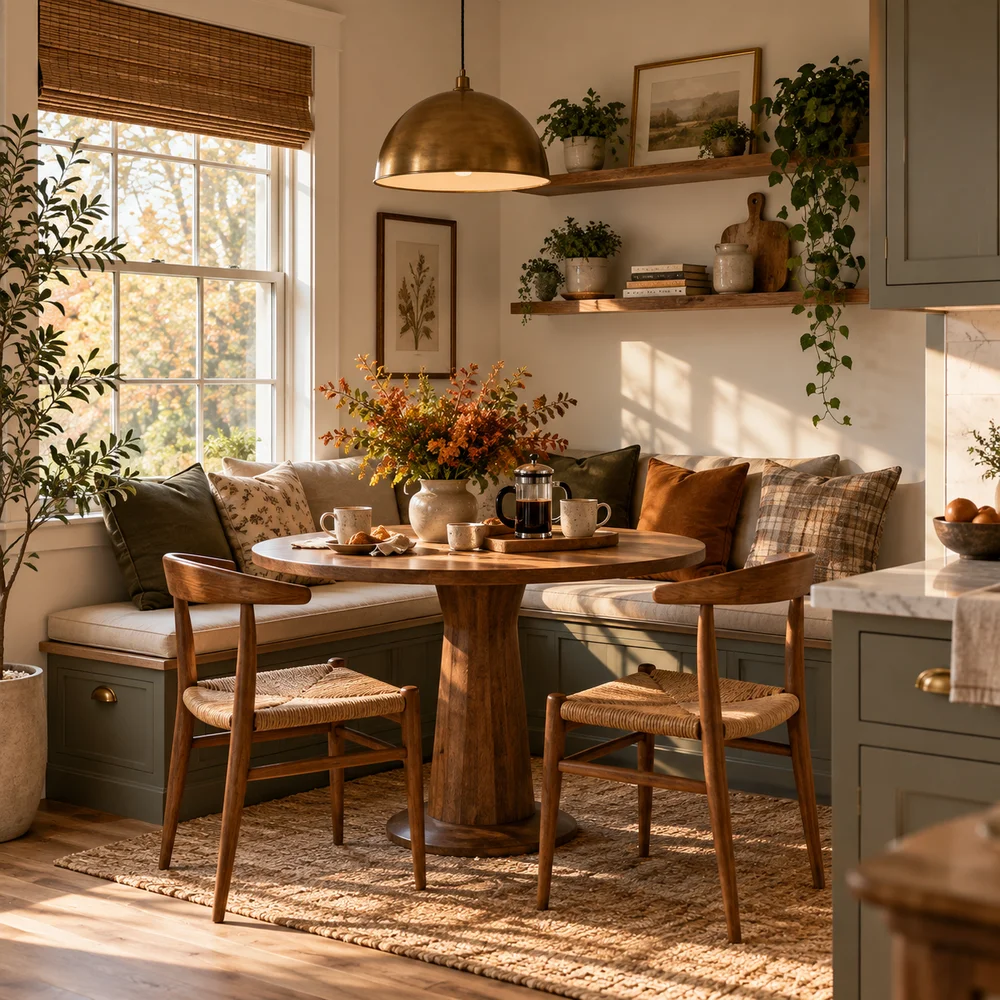
How to Make a Small Breakfast Nook Without Renovating
By Emily | October 8, 2026
Most people assume a breakfast nook requires a bay window, a built-in banquette, and a contractor’s quote that makes the whole idea quietly disappear. So the morning coffee ends up balanced on the counter edge, toast is eaten standing beside the toaster, and the one corner of the kitchen that could hold a small table stays empty. The nook feels like something other people’s houses have, not something you can simply decide to make.
Yet a breakfast nook is not an architectural feature. It is a set of decisions: where a table sits, what you sit on, how the corner is lit, and what tells your eye that this patch of floor has a purpose. Built-ins are only one way to make those decisions permanent. Freestanding furniture, removable surfaces, and plug-in light can make the same decisions, and they leave you free to change your mind later.
This guide walks through those decisions in the order they matter. It starts with the table, because every other choice depends on its footprint, and compares three routes: a compact fixed table, an expandable one, and a complete matching set. From there it moves to seating that feels like a banquette, wall storage, a removable backdrop, a rug that zones the space, a plug-in pendant, and the restrained styling that keeps the table usable.
Treat the products mentioned along the way as examples rather than a shopping list. Each one illustrates a strategy, and the strategy matters more than the specific listing. Keep a tape measure nearby, because nearly every recommendation comes back to the same habit: measuring your real space, including the room people need to walk past, before buying anything. Build the nook in stages. A table and a light alone can already change your mornings.
1. Start with a Table That Fits the Space
 Save it
The most common way a breakfast nook fails happens before anything is styled: the table is chosen by price or by photo, then forced into a corner that cannot support it. Chairs bump the counter, the dishwasher door stops halfway, and everyone squeezes sideways to reach the fridge. A nook should feel like an invitation to sit down, and that feeling depends far less on decoration than on whether the table respects the space around it, not just the space beneath it.
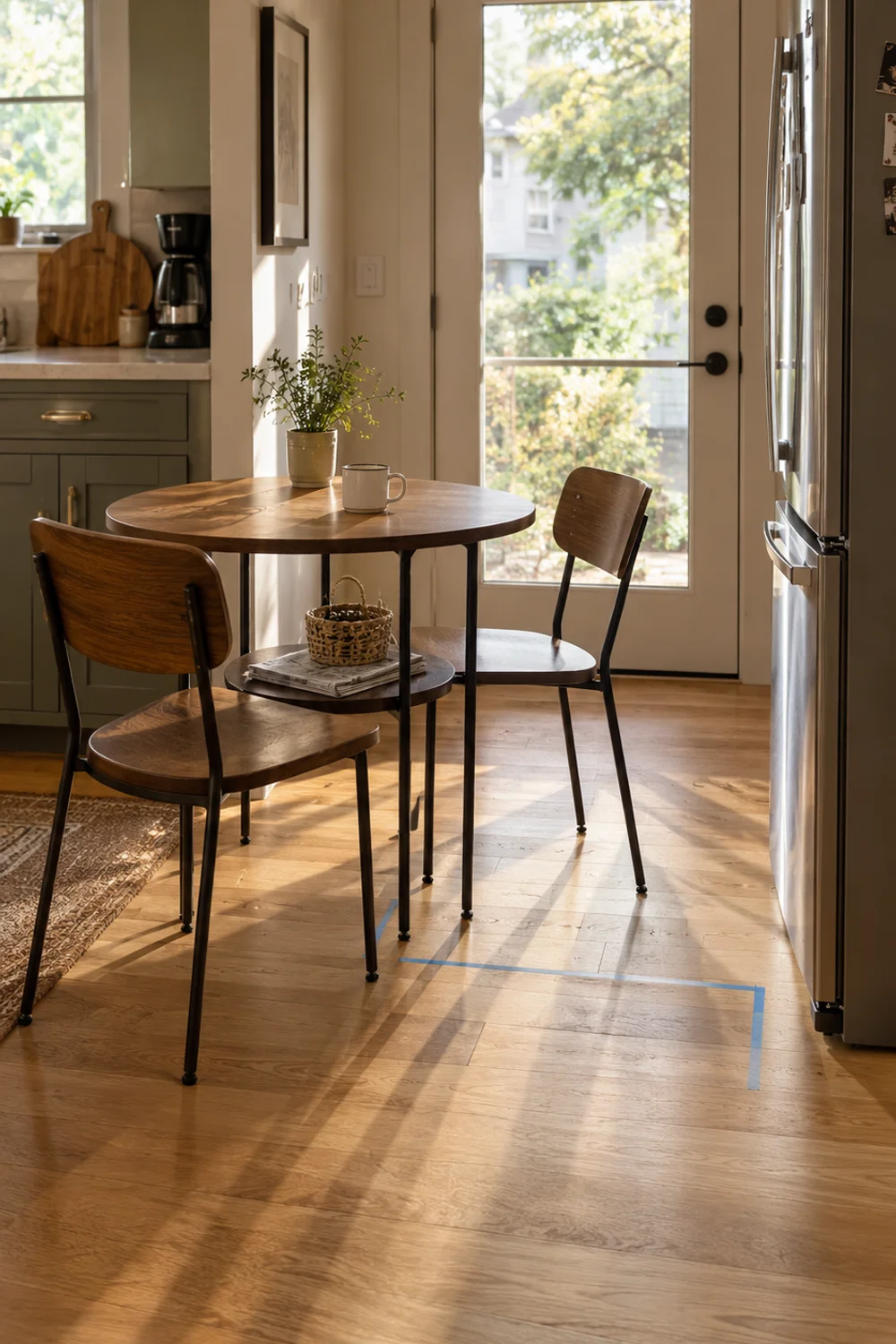
Start by measuring the open floor, then subtract circulation rather than measuring only where the tabletop goes. A pulled-out chair needs room behind it, and any path people walk regularly, especially between the sink, stove, and refrigerator, should stay comfortably clear. Mark the intended footprint with painter’s tape on the floor and live with it for a day or two. If you keep stepping on the tape while cooking, the table is too large for that spot, no matter how good it looked online.
Smallest is not automatically best, though. A table that is too tiny leaves no room for two plates and a coffee pot, so the nook ends up feeling like a waiting area instead of a place to linger. What usually helps is a compact footprint paired with a shape that looks light from across the room, with no sharp corner jutting into a walkway. One example of that balance is a 31.5-inch round top with a storage shelf underneath, listed for two to four people, the 31.5″ Round Kitchen Table with Storage.
Picture a galley-adjacent kitchen in a rental apartment with an awkward empty corner beside the back door. A rectangular table there would point a corner straight into the doorway, and every trip outside would mean turning sideways. A round top in the same spot lets people drift around it rather than navigate it, and the low shelf can hold the napkin basket and the morning newspaper. In another kitchen, a narrow rectangle pushed against a wall might be the smarter fit.
That last point matters, because no shape wins everywhere. The right table is the one that answers the specific questions your floor is asking: where people walk, where doors swing, where light falls in the morning. It is tempting to begin with the pretty part of a nook, the cushions and the pendant, but those details only feel good when the footprint underneath them works. Get the table right first, and every later decision has a stable anchor to build around.
2. Choose an Expandable Table When You Need More Flexibility
 Save it
A compact fixed table is perfect for a household whose mornings look the same every day. Many households do not live that way. Weekdays might mean one person with a mug and a laptop, while Sunday brings pancakes for four or a friend who stays for brunch. Sizing the nook for the busiest morning makes it oversized for the other six, and sizing it for the quietest morning leaves you balancing plates on your knees when company arrives.
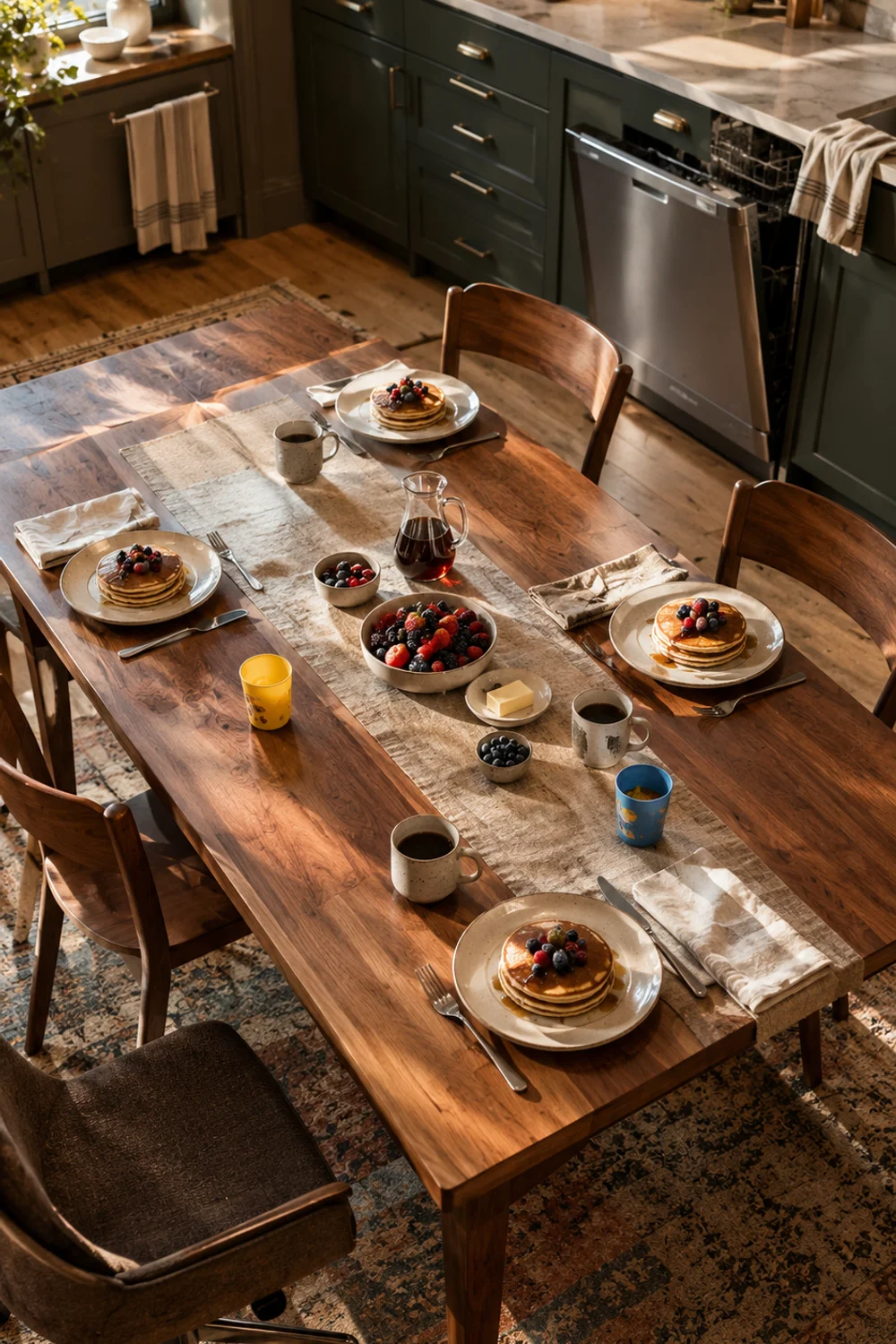
An expandable table solves that mismatch by letting the nook live at two sizes. Day to day, it stays closed and compact, leaving the walkway open and the corner calm. When more surface is genuinely needed, it opens, and the extra length is borrowed from floor space you were not using for anything that morning anyway. The important part is planning for both states: measure the closed footprint for everyday circulation, then confirm the extended length still clears doors and appliances.
Look closely at how an expandable table changes size, and how easily. A mechanism that feels stiff will simply never get used, and the table becomes a permanently large one. It also helps to know the exact range before buying, since that tells you what the nook will look like at its fullest. One example is listed as solid wood, designed for small spaces, and expanding from 23.6 inches to 47.2 inches long, the Solid Wood Small Dining Table for 2-6, 23.6″L-47.2″L Expandable Kitchen Table (Walnut).
Imagine a couple in a small condo kitchen who eat breakfast at the closed table almost every day: two bowls, a fruit plate, a phone propped against the sugar jar. On the last weekend of the month, her sister visits with the kids, and the table opens toward the middle of the kitchen while one chair is borrowed from the desk in the hallway. By Monday morning the table is closed again, and the kitchen returns to its usual open path.
The broader lesson is that a small room does not have to commit to one version of itself. Furniture that changes shape lets a kitchen behave differently on different days, which is exactly what most real households need. A fixed table forces the room to be either generous or compact. An expandable one lets it be compact by default and generous by choice, and that distinction is often the difference between a nook that gets used and one that gets resented.
3. Use a Dining Set If You Need the Whole Nook at Once
 Save it
Sometimes the kitchen corner you have in mind is completely empty, with no table, no chairs, and no existing piece to work around. Starting from zero sounds liberating, but it often produces the most mismatched nooks, because each purchase is made separately. The table arrives first, the seating a few weeks later from a different store, and suddenly the seat heights are wrong, the finishes argue with each other, and nothing tucks under the table the way you pictured.
A compact matching set removes most of that guesswork. The pieces were designed to work together, so proportions, seat height, and visual weight are already resolved before anything reaches your door. That makes a set the simplest route for a first nook, especially if you would rather spend your decision-making energy on the backdrop and lighting. It also arrives as a complete scene, which means the corner feels finished on day one instead of slowly assembling itself over months.
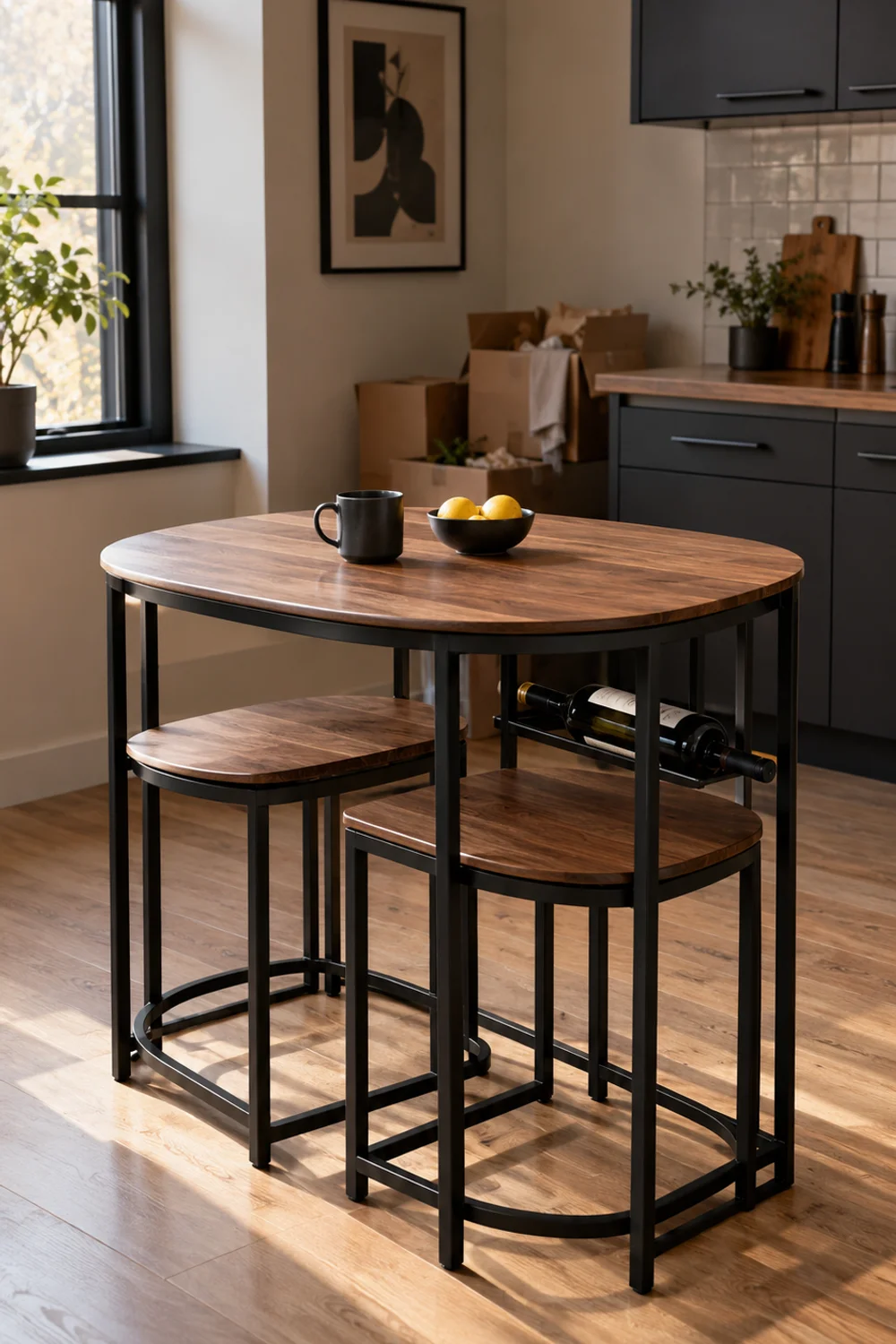
Before looking at listings, decide what the set needs to agree with. The right set should echo something already in your kitchen, whether that is dark cabinet hardware, a warm wood floor, or a black window frame, so treat any color you see in a photo as an illustration rather than a rule. One example of the format is a three-piece set in black with an oval wood-grain tabletop, a metal frame, and a built-in wine rack, marketed specifically for breakfast nooks: this 3-Piece Dining Table Set for Kitchen Breakfast Nook.
Consider someone who has just moved into a first apartment with a kitchen that includes a small empty wall but no dining furniture at all. Instead of hunting for a table and seating separately, a single set fills the corner in one delivery, and the wine rack holds a couple of bottles that would otherwise crowd the counter. For the surrounding kitchen, The Best Small Kitchen Decor Ideas for Apartments offers renter-minded ideas that pair well with a freshly furnished nook.
The first three sections of this guide are easy to misread as three competing recommendations, but they really describe three different starting points. A compact fixed table suits a stable routine, an expandable one suits a shifting routine, and a complete set suits an empty corner and a wish to stop deliberating. Knowing which situation you are actually in is more useful than any single product, because the right format depends on what already exists and how your mornings genuinely unfold.
4. Let the Seating Define the Nook
 Save it
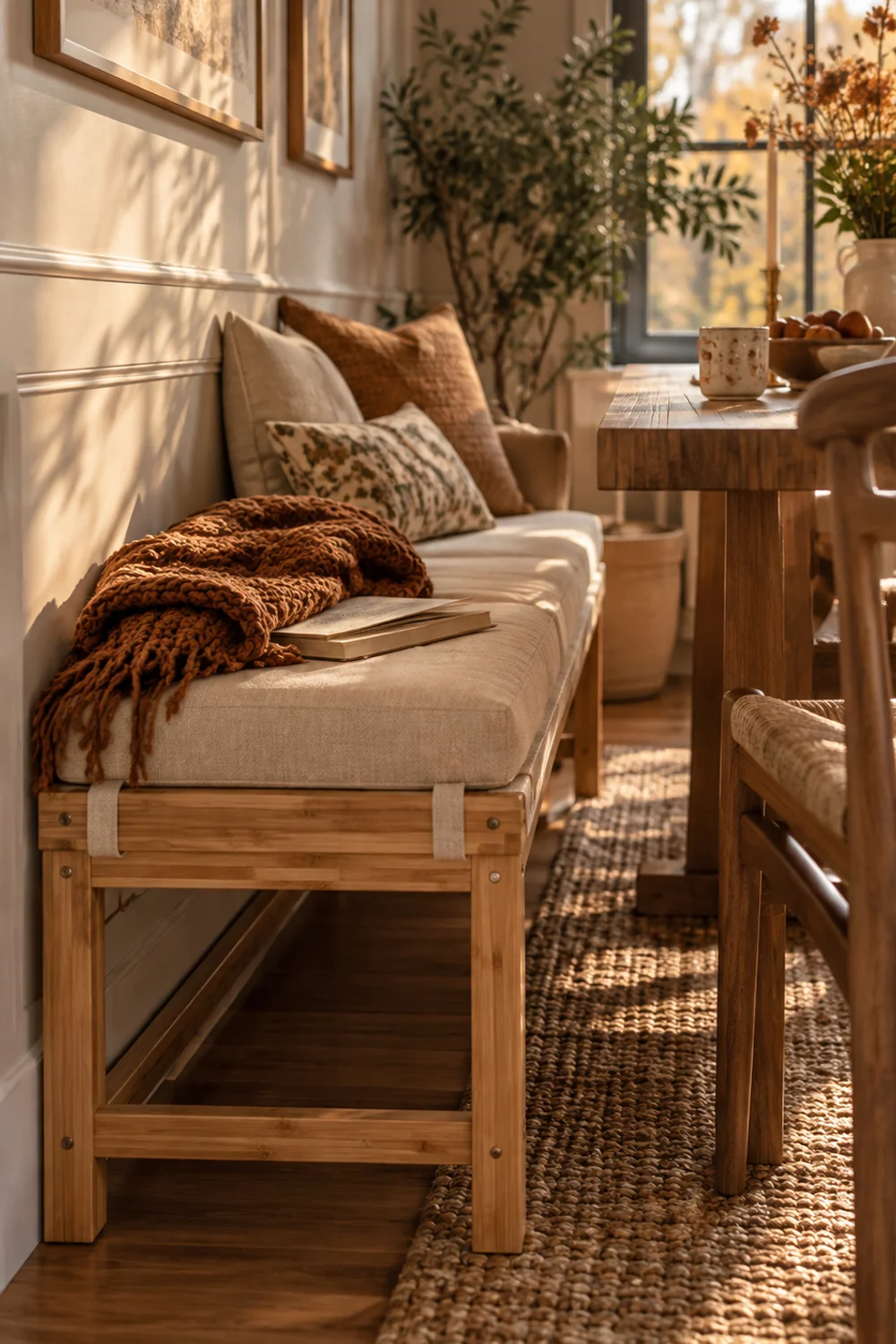
Built-in banquettes are the image most people carry of a breakfast nook: a cushioned bench running along the wall, a table pulled close, everyone tucked in shoulder to shoulder. The appeal is real. Bench seating needs no pull-out room on the wall side, it lets the table sit closer to the wall, and it signals clearly that this corner is meant for lingering. The problem is that a true banquette means carpentry, and carpentry is exactly what this guide avoids.
A freestanding bench placed against the wall can deliver most of that feeling with no construction at all. Seating sets the nook’s mood more than any decorative object, because it determines how people sit, how long they stay, and how close the table can come to the wall. A narrow bench along one side and one or two chairs on the other creates the classic banquette arrangement, and because nothing is attached to the wall, the whole layout can move whenever you want.
Choose a long, narrow bench that sits close to the table without stealing the walkway. One example of that shape is a natural bamboo bench about 35.4 inches long, this Bamboo Dining Bench.
A cushion is what makes a plain bench feel like a banquette; one option is a 36 x 15 x 3 inch beige dual-layer memory foam pad with a non-slip base, ties, and a removable, machine-washable cover.
Here is where measuring matters. The bench in this example is listed at about 35.4 inches long and the cushion at 36 inches, so the pairing may work, but a listed length is not the same as a verified fit, and seat depth matters too. Measure your bench’s actual seat length and depth, compare them to the cushion’s dimensions, and decide whether a slight overhang bothers you. In a narrow rental kitchen, that half inch could be invisible or could catch a passing hip.
There is a quieter benefit to bench seating, too. Chairs scattered around a table tend to look like temporary furniture, while a bench lined up against the wall makes the arrangement read as planned. That sense of intention is what most people actually love about built-in nooks, more than the cabinetry itself. You can borrow it with a freestanding bench and a well-sized cushion, then take both with you when you move, which no built-in banquette has ever managed.
5. Use the Wall Instead of the Floor for Storage
 Save it
Small nooks run out of floor almost immediately. Once the table and seating are in place, there is rarely room for a sideboard or even a narrow cabinet, yet a breakfast corner still generates its own small inventory: mugs, napkins, a jar of honey, a cookbook you actually use, the bowl that holds clementines. Without a home, those things drift onto the table itself, and a surface meant for eating slowly turns into a staging area for everything else.
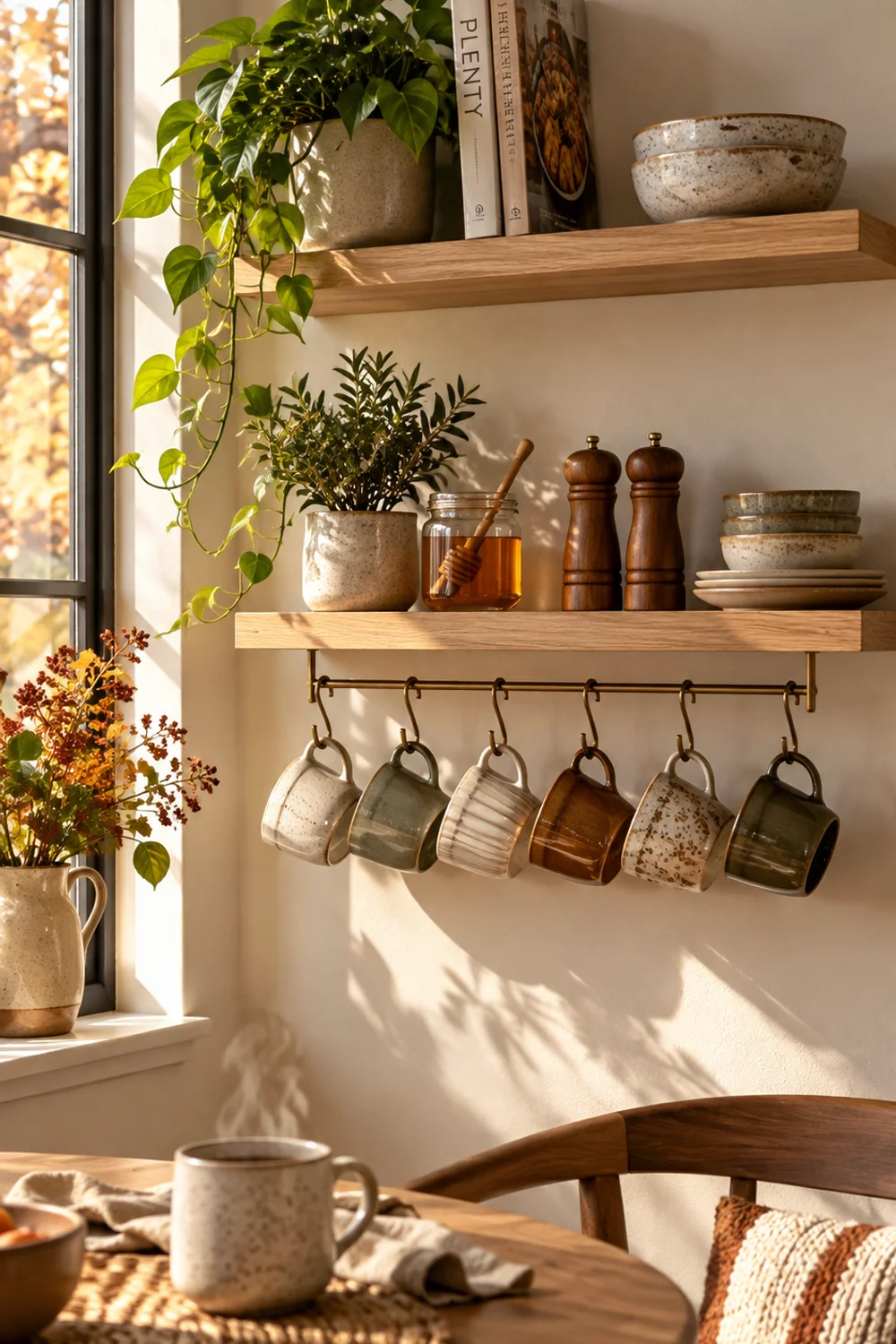
The wall above and beside the table is the answer most people overlook. Storage mounted there keeps the floor clear for chairs and feet, and it keeps the tabletop clear for plates. Hang shelves high enough that a seated person will not bump their head, low enough that a mug can be reached without standing on a chair, and centered on the nook rather than the whole wall so they visually belong to it. Keeping the floor open keeps the corner feeling breathable.
Shelves with hooks earn their place twice, because the underside becomes storage too. Mugs hung from hooks stay visible and within reach, while the shelf above holds jars, a small stack of cookbooks, or a single decorative piece. Before drilling, check what your wall is made of and whether your lease allows mounting. One example of the format is a set of two wall-mounted shelves with ten adjustable mug hooks.
Take a small kitchen where the breakfast table sits beneath a blank stretch of wall next to the window. Two shelves go up, one slightly above the other. The lower one holds the everyday mugs on its hooks, a honey jar, and the salt and pepper; the upper one holds two cookbooks and a small ceramic bowl. If that mug collection eventually grows into a full brewing setup, 15 Coffee Station Decor Ideas Worth Copying Now is a better guide for giving it a separate home.
The principle underneath this is simple: in a small space, floor area is the most precious surface you have, because it is what lets people move. Walls ask nothing of circulation. Every object that lives on the wall instead of the floor is one less thing to step around, and every object that lives on a shelf instead of the table is one more inch of room for breakfast. Edit what goes up, though, because a crowded shelf reads as clutter at eye level.
6. Create a Visual Backdrop Without Changing the Kitchen
 Save it
Even with a good table and seating in place, a nook can still look like furniture parked in a kitchen corner rather than a destination of its own. The missing piece is usually the wall behind it. Without some visual change, the eye reads the corner as just more kitchen, continuous with the cabinets and the backsplash. A defined backdrop tells you, before you sit down, that this patch of wall belongs to the table and not to the stove.
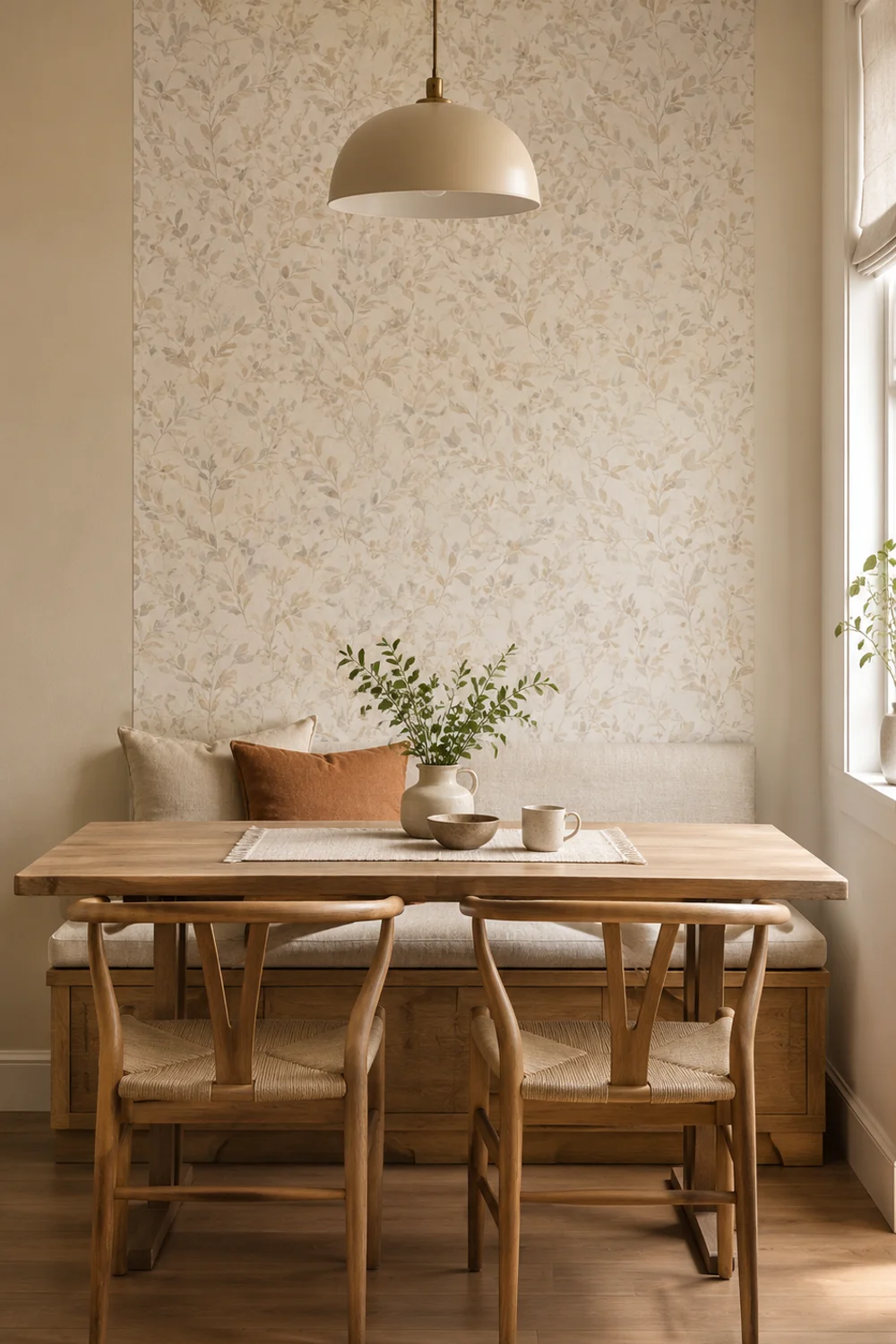
Paint and tile are the obvious ways to create that backdrop, and both are permanent enough to be off the table for many renters. Removable wallpaper offers another route. Cover only the section of wall behind the nook, roughly the width of the table plus seating, rather than the whole room. The contained rectangle frames the table like a picture mat frames a print, and because the area is small, a pattern that would overwhelm a full wall becomes a quiet, intentional accent.
Removable does not automatically mean damage-free on every surface. Fresh paint, textured walls, and older finishes can all respond differently when a product is peeled away, so test a small piece in a hidden spot first and leave it for several days before committing. Choose a pattern light enough to keep the corner bright. One example is a peel-and-stick paper described as removable, with a neutral, light decorative pattern.
Imagine a rental kitchen painted builder-beige, with the breakfast table pushed against the one wall that has no cabinets. A narrow section of light boho-patterned paper goes up behind the bench, stopping cleanly at the window trim. Suddenly the corner has a personality the rest of the kitchen does not, yet the palette stays soft enough to sit beside the existing cabinets. For keeping that softness consistent across the room, How to Style a Cozy Neutral Kitchen on Any Budget explores the wider palette.
Backdrops work because people judge spaces by their edges as much as their contents. A table in an undefined corner feels provisional, as if it might be moved tomorrow. A table against its own wall treatment feels placed, and that perception changes behavior: people sit longer, set the table more carefully, and treat the nook as a room within a room. The beauty of a removable backdrop is that the identity is real but the commitment is not, which suits anyone still learning their kitchen.
7. Make the Nook Feel Separate with a Round Rug
 Save it
Open kitchens and small apartments share a particular problem: there are no walls to tell one activity from another. The table sits a few steps from the stove, the stove a few steps from the sofa, and everything blurs into one long room. Without boundaries, a breakfast nook can feel exposed, as though you are eating in a hallway. Floor coverings solve this more gently than any partition or bulky screen, because they mark territory without blocking light or sightlines.
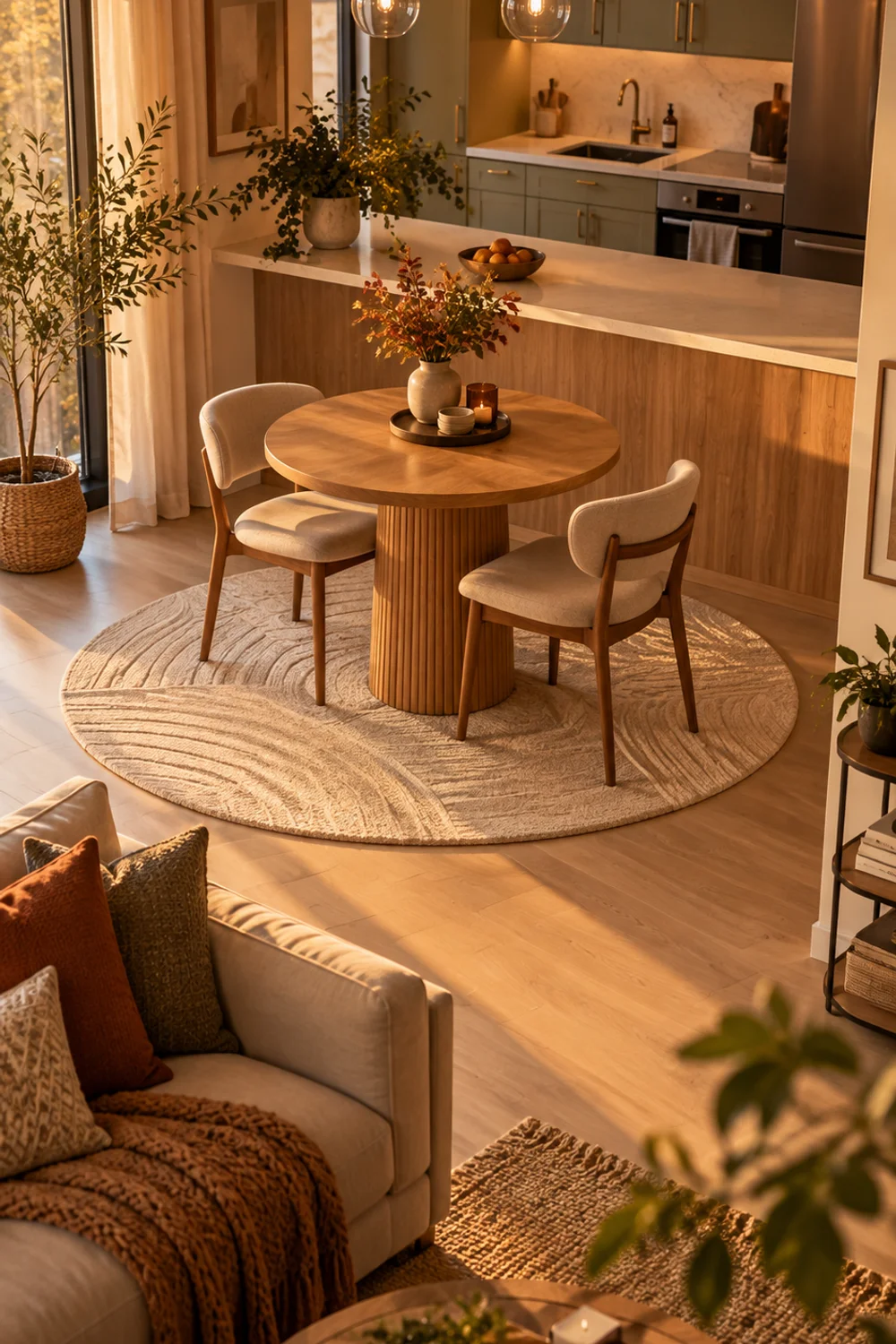
Scale decides whether the rug zones the nook or simply decorates the floor. A rug sized only to the tabletop looks like a stray mat, and chairs pulled back for sitting will catch its edge. Judge size by the whole seating arrangement instead: the table, the chairs or bench, and the room people need to push back from the table. When the rug comfortably holds that whole arrangement, the nook reads as a contained island instead of furniture floating on bare floor.
Shape is a secondary choice. A round rug can echo a round table pleasantly, but that echo is optional; the main job is defining the zone, and a rectangle can do that equally well under a rectangular table. In a kitchen, practical qualities matter more than usual, because crumbs and spilled coffee are guaranteed. One example is a 4-foot round rug listed as washable and non-slip, with a neutral beige arch pattern.
Picture a studio apartment where the kitchen counter ends and the living area begins with nothing in between. The compact round table from earlier sits right at that seam. Before measuring, the plan was a small rug under the table alone; after pulling the chairs out and taping the outline on the floor, it became clear the rug needed to reach beyond the chair legs. Check whether a 4-foot rug does that in your space, because a smaller table may fit while a larger one will not.
Zoning matters because the mind sorts rooms by their surfaces. When the flooring under the table changes, even slightly, your brain registers a new place, the same way it registers stepping from a hallway into a bedroom. That small shift is what gives an open-plan nook its sense of privacy. The rug creates the room that the architecture never provided, and unlike a wall, it can be rolled up, washed, or moved when the layout changes again next year.
8. Add a Plug-In Pendant to Define the Nook
 Save it
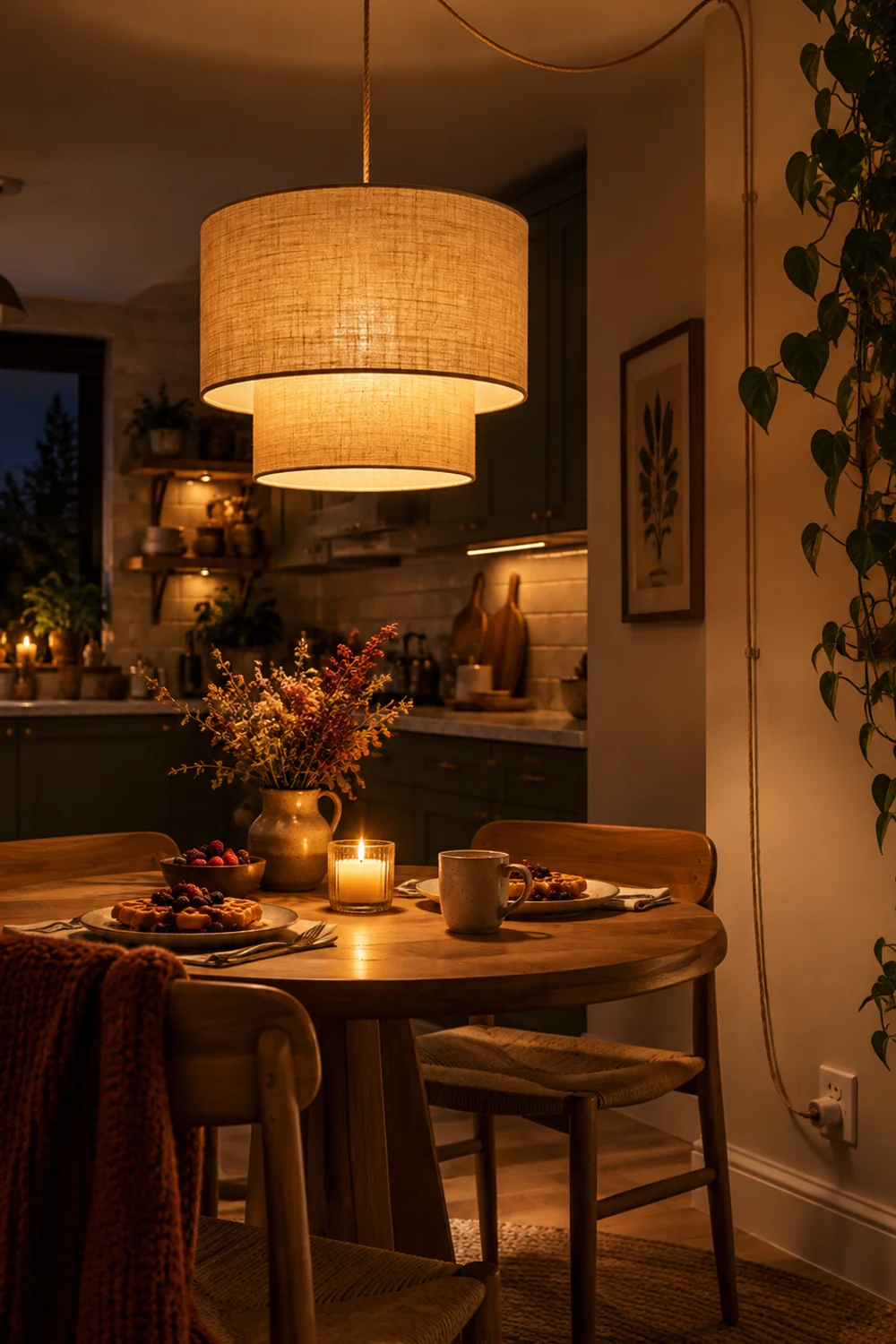
Most kitchens are lit for working, not for sitting. Recessed cans or a central ceiling fixture spread even light across counters, which is ideal for chopping onions and less ideal for a slow cup of coffee. A breakfast nook lit only by that general wash feels like part of the workspace. What it needs is light that belongs to the table, a source that marks the nook as its own place and draws the eye toward it from across the room.
A pendant hanging over the table does that more decisively than any lamp on a counter. It creates a visual vertical line from ceiling to tabletop, anchoring the table in place the way a rug anchors it from below. The pool of light it casts pulls people inward and makes the table the brightest, warmest point in the corner. Hang it low enough to feel intimate but high enough that nobody’s view across the table is blocked when seated.
Plug-in pendants are designed for exactly this situation, when there is no ceiling box above the table and you would rather not alter the existing electrical setup. They can add pendant-style lighting without hardwiring a new fixture, with the cord running toward a nearby outlet. Follow the manufacturer’s instructions for mounting and cord routing.
Think of a kitchen where the table sits beneath a ceiling with no fixture at all, just a flat expanse of drywall. At night the nook falls into shadow, and breakfast-for-dinner happens under the harsh glare of the main overhead light. With a plug-in pendant hanging above the table, the corner gets its own warm center, and the woven cord traveling toward the outlet becomes part of the look rather than something to hide. Evenings at the table change completely.
Dedicated lighting works because light is one of the few design elements that changes how a space feels at different hours. A nook that glows at seven in the evening invites you back after the morning rush is over, and that second life is what makes it worth creating. If the rest of the kitchen could use the same attention, How to Upgrade Kitchen Lighting Without a Full Renovation looks at layering light across the whole room without starting over.
9. Keep the Table Decor Simple and Functional
 Save it
Once a nook looks finished, the urge to decorate it further is strong. A large centerpiece, a tray of candles, a stack of coasters, a bowl of decorative spheres: each addition seems small, but on a compact tabletop they quickly claim the space meant for plates. A breakfast nook is a working surface, used every day for coffee, cereal, homework, and bills, and its styling has to survive being moved aside dozens of times a week without becoming a chore.
The goal of table decor in a small nook is narrow and specific: add a little personality, make the table look finished between meals, and leave nearly all of the surface usable. The simplest way to meet all three is a compact grouping placed off-center or toward the wall side, never in the middle where elbows and plates naturally land. Choose pieces with a small footprint and some height, so they read clearly without spreading outward across the table.
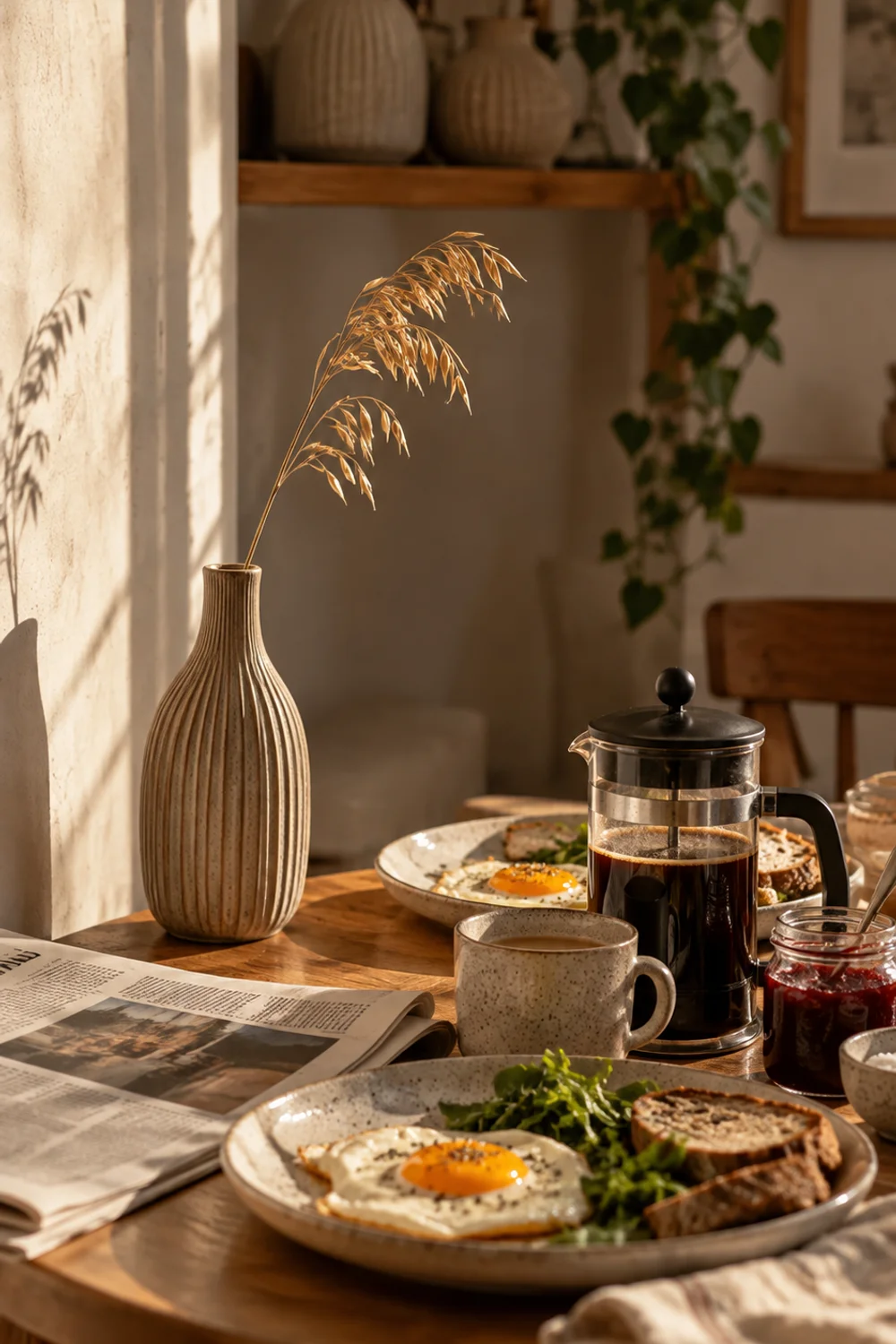
Slim vases suit this job well, because their height gives presence while they take up very little of the table. A single dried stem, or nothing at all, is enough. A set lets you rotate rather than crowd: use one vase on the table on busy weekdays, and keep the others on the wall shelf, ready to swap in.
Imagine a Saturday morning at a small round table: two plates of eggs, a French press, a jam jar, and a newspaper spread across one side. A single ribbed vase sits near the wall edge, holding one dried stem, and nothing has to be moved to make room. On Monday, the table becomes a laptop desk for an hour, and the vase stays exactly where it is. On Friday evening, two more vases come down from the shelf for friends.
The principle here applies far beyond breakfast nooks: styling should serve the way a space is used, not the way it looks in a single photograph. A beautifully set table that must be cleared before anyone can eat at it is a display, not a nook. The best small dining corners look composed when empty and still work perfectly when full, and that balance comes from restraint, from choosing one meaningful object over five decorative ones and letting the meals themselves supply the rest.
Common Mistakes
1. Measuring the table but not the chairs
Most people check whether the tabletop fits the corner and stop there. The problem appears when someone sits down and pushes back, and the chair hits a cabinet or blocks the path to the refrigerator. Always measure the full seating envelope, including the space a person needs to stand up comfortably, before choosing a table, a bench, or a rug.
2. Assuming listed dimensions guarantee a fit
A cushion listed at nearly the same length as a bench, or a rug that seems large enough on paper, can still disappoint in a real room. Product listings describe the item, not your kitchen. Compare actual measurements, check seat depth as well as length, and tape outlines on the floor so you can see proportions before anything arrives.
3. Treating removable products as risk-free
Peel-and-stick wallpaper and other removable solutions are designed to come off cleanly, but wall surfaces vary widely. Freshly painted, textured, or older walls can react unpredictably. Testing a small hidden section first, and reading your lease before mounting anything, is far cheaper than repairing paint when you move out. A day of patience at the start protects your deposit at the end.
4. Letting the nook become a drop zone
Without clear storage, the breakfast table becomes the default landing spot for mail, keys, grocery bags, and school papers. Within a week it stops feeling like a nook at all. Give those items a home somewhere else in the kitchen, and keep the wall shelves above the table reserved for breakfast-related things only.
5. Over-styling a small surface
Large centerpieces, layered trays, and too many objects make a compact table look curated in photos but frustrating in daily use. If decor has to be moved every time someone eats, there is too much of it. Keep one small grouping toward the wall and let the table’s main job remain obvious.
Frequently Asked Questions
How much space do I need for a small breakfast nook?
There is no universal minimum, because the answer depends on your table, your seating, and how people move through the kitchen. Rather than starting with a number, start with circulation: someone should be able to pull a chair out, sit, and stand up again without blocking a major walkway or an appliance door. Taping the footprint on the floor, including pulled-out chairs, is the most reliable test. If daily traffic keeps crossing the tape, choose a smaller or expandable table.
Can I create a breakfast nook in a rental kitchen?
Yes, and most of the ideas in this guide were chosen with renters in mind. Freestanding tables and benches, a washable rug, removable wallpaper, and a plug-in pendant can all create a defined nook without permanent changes to the kitchen. Wall shelves usually involve small holes, so check your lease and talk to your landlord if you are unsure. For removable wallpaper, test a hidden spot first, since results vary depending on the wall surface and paint.
Is a bench or chairs better for a small nook?
Neither is automatically better, but a bench placed against the wall often helps a small nook in two ways. It lets the table sit closer to the wall, and it creates the cozy, banquette-like feeling many people want without any built-in construction. Chairs are easier to pull out individually and can work better when everyone needs to get up often. Many small nooks use both: a bench along the wall side and one or two chairs opposite.
How do I make a breakfast nook feel separate in an open kitchen?
Separation in an open space comes from layering a few cues rather than adding walls. A rug sized to the whole seating arrangement marks the floor, a pendant over the table marks the space above, and a small backdrop on the wall behind the table marks the vertical plane. Together, those three signals tell the eye that the nook is its own place. Even one of them helps, but combining two or three usually makes the strongest impression.
Final Thoughts
A breakfast nook was never about built-ins or bay windows. It is about giving one corner of the kitchen a clear purpose, then protecting that purpose with good decisions: a table sized for the room, seating that invites you to stay, a light that belongs to the table, and a surface left open enough to use. Each of those choices can be made with freestanding, movable pieces, which means the nook grows with you instead of locking you in.
There is no need to do everything at once. Start with the table and its circulation, live with it for a couple of weeks, and notice what the corner is still missing. Maybe it is light in the evenings, maybe a softer seat, maybe a backdrop that makes it feel like its own place. Adding one layer at a time lets each decision respond to how you actually use the nook, rather than how you imagined using it.
If one of these ideas fits your kitchen, save it to your Pinterest board so it is waiting when you are ready to measure, and browse the related articles for ideas that carry the same feeling into the rest of the room. Small improvements, made thoughtfully and over time, add up to a home that works better every morning. The best nooks are rarely finished in a weekend; they settle into place, one cup of coffee at a time.
This post contains affiliate links. I may earn a small commission at no extra cost to you.
Get cozy inspiration delivered to your inbox.
✓ 14-page beautifully designed ebook
✓ Cozy decorating ideas
✓ Practical room-by-room inspiration
You’re in! 🎉
Thanks for joining the NestFlowHome community!
Your free ebook is already on its way to your inbox. If you don’t see it within a few minutes, please check your Promotions or Spam folder.
Join the NestFlowHome community for weekly decorating inspiration.

Timeless home decor ideas and slow living inspiration for a calm, beautiful life.