
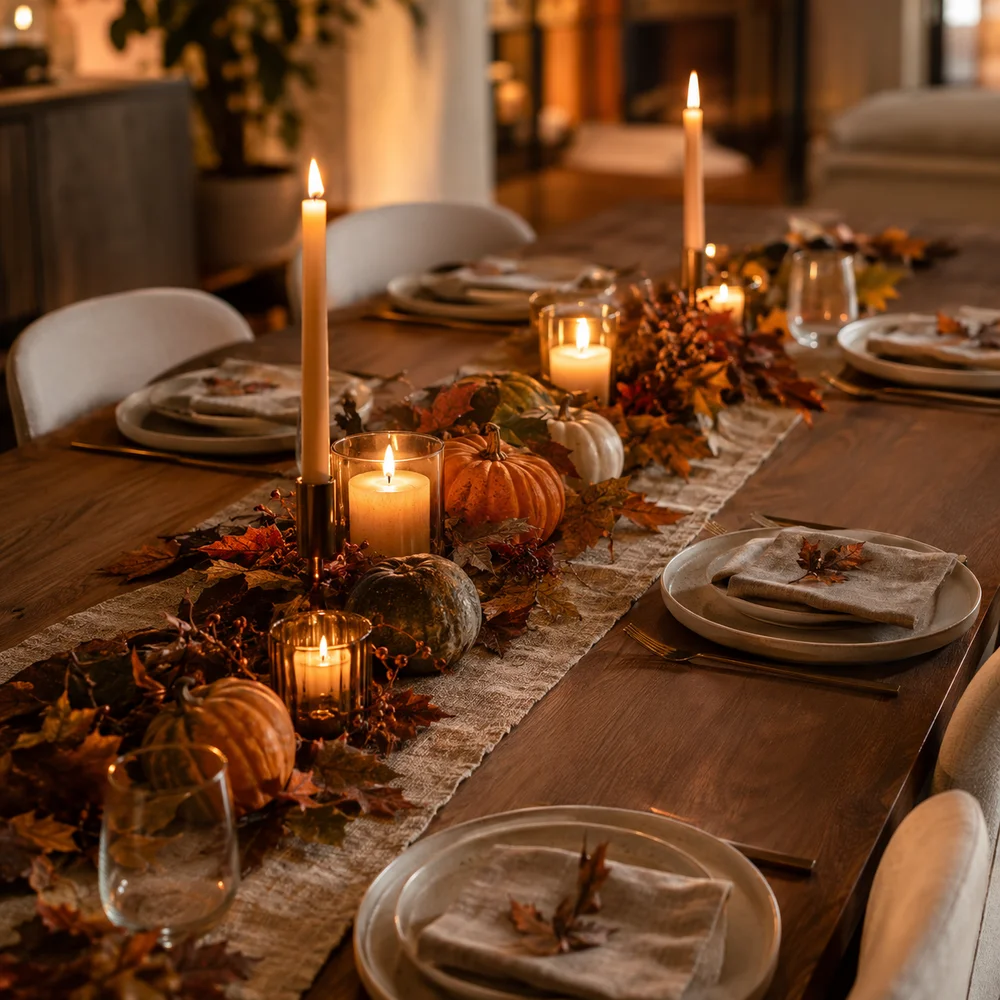
Beautiful Fall Dining Table Centerpiece Ideas for Thanksgiving
By Emily | September 16, 2026
There is a particular kind of quiet that settles over a dining room in the hour before guests arrive — the oven humming somewhere in the background, the light going gold and low through the windows, and the table still bare except for the idea of what it could become. That blank stretch of wood or linen is the most honest moment in the whole holiday: no amount of cooking will matter if the table itself doesn’t say welcome. This is the year to skip the last-minute scramble for whatever gourds are left at the grocery store and instead build a centerpiece that actually looks considered — the kind guests photograph before they sit down.
What follows isn’t a single formula stretched fifteen ways. It’s a curated edit of fifteen genuinely different centerpiece looks, each built around one specific piece you can buy today and have on your table before the holiday arrives — a candlelit pumpkin here, a woven rattan glow there, an elegant sweep of garland light to close the evening. Some lean rustic and abundant, some are restrained and editorial, a few are quiet supporting players rather than showstoppers. Pick the one that matches your table, your guest list, and the mood you’re actually going for this year — not the one that photographs best on someone else’s table in someone else’s house. Fall’s richest textures and a little intention are really all a Thanksgiving table needs.
1. A Harvest Bounty Table Runner
 Save it
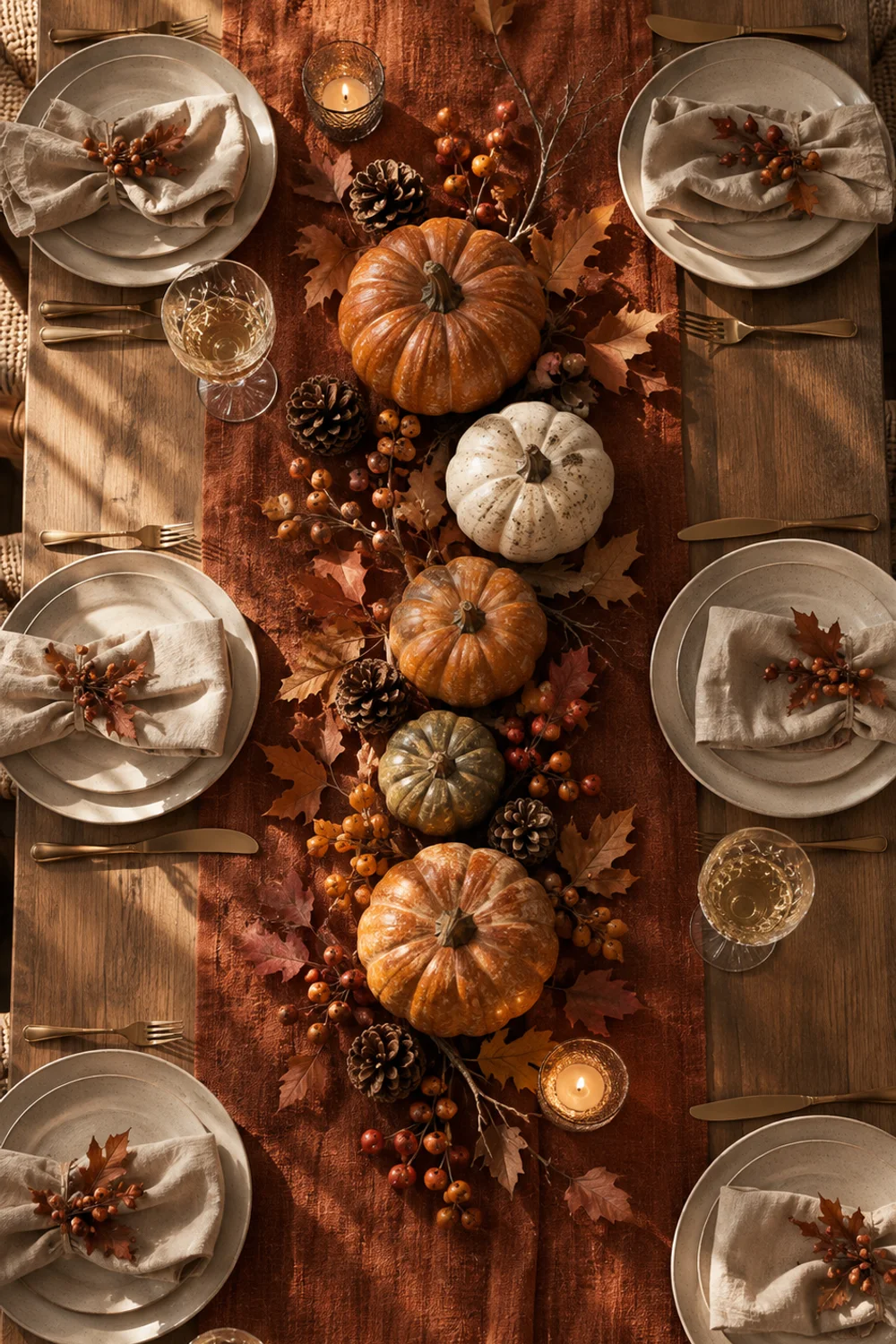
Before you reach for a single vase or bowl, consider skipping the vessel altogether. A loose, produce-based runner laid directly down the table’s length reads as effortless abundance in a way that a tightly arranged centerpiece never quite manages — it looks like it grew there rather than like it was assembled. Artificial vegetables and gourds, scattered with intentional irregularity rather than lined up like soldiers, let the eye wander the whole length of the table instead of snapping to one fixed point, which matters enormously once you’re also trying to fit serving platters, gravy boats, and everyone’s water glasses into the same real estate.
The trick to keeping this look modern rather than county-fair is restraint in everything except the runner itself: keep your dinnerware plain, your linens a single warm neutral, and let the produce carry all the visual texture. Tuck a few sprigs of real or faux foliage into the gaps so nothing reads as a straight row of objects, and let the runner spill slightly past the edges of your serving pieces rather than staying tidily contained. Because the pieces are lightweight and artificial, you can build this look the night before without worrying about wilting or spoilage, which is one less thing to manage on the day itself.
If you’re hosting a table long enough to feel a little empty down the middle, this is often the fastest fix — a runner naturally fills length in a way that a single centerpiece object can’t, without requiring you to buy more of any one thing. It’s a low-effort, high-impact opener for a table that will be doing a lot of other work this year, and it sets a warm, harvest-forward tone before a single dish even reaches the table.
2. A Classic Candlelit Pumpkin Centerpiece
 Save it
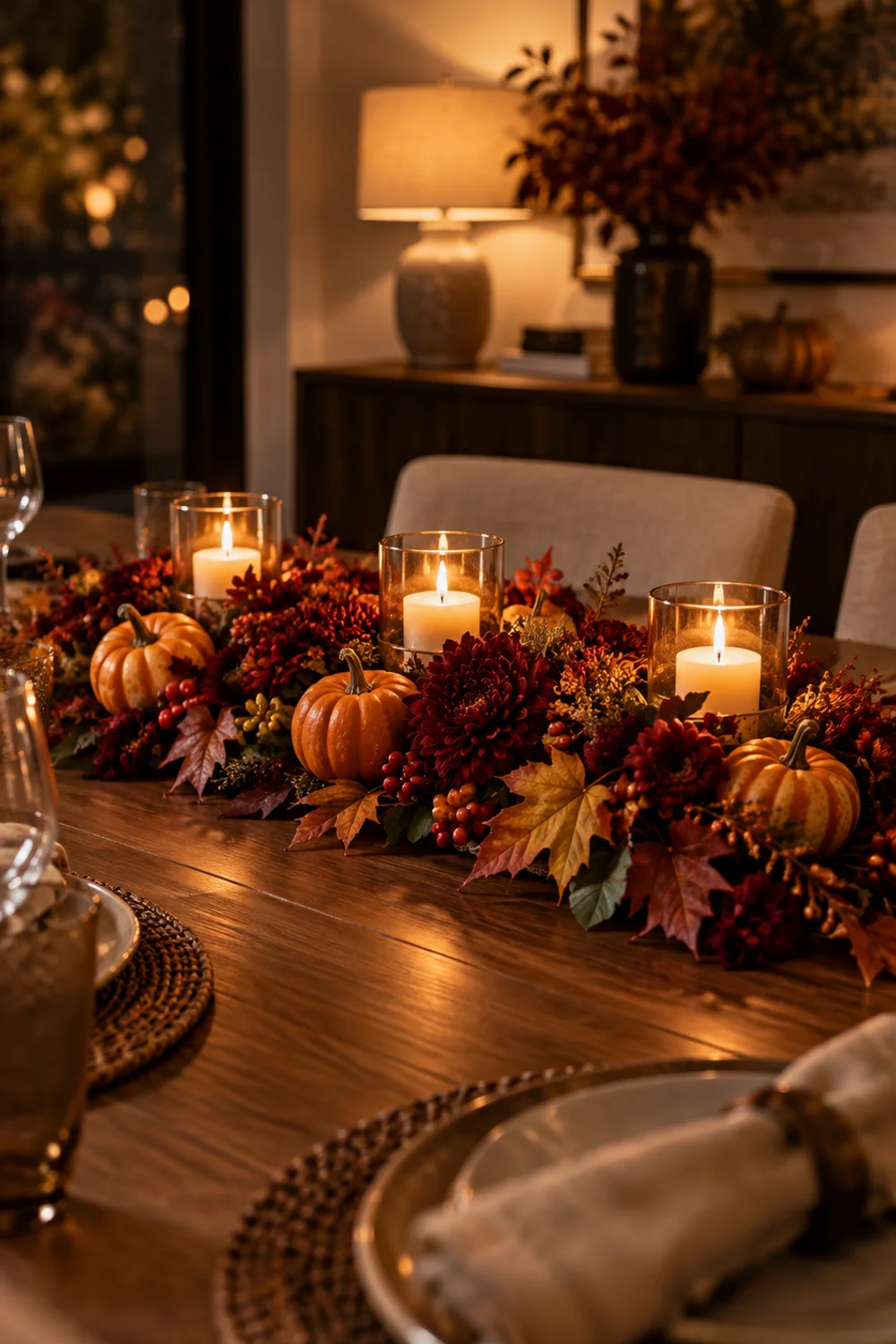
Some looks earn their place by being exactly what people expect — done well. A pumpkin paired with candlelight is the single most recognizable Thanksgiving image there is, and there’s a reason it hasn’t gone out of style: the warm glow does something a daylight photo of a bare pumpkin simply can’t. This is the centerpiece for the table that wants to feel unmistakably like the holiday, not like an abstraction of it, and it works whether your table seats four or fourteen.
The difference between a charming version of this look and a dated one comes down almost entirely to what surrounds it. Style it on a simple surface underneath — a plain tray or table runner rather than a doily — and let the candlelight itself do the decorating as the room dims toward dinner. Resist the instinct to add extra seasonal props right beside it; the pumpkin-and-candle pairing is already a complete visual statement, and crowding it with additional gourds or leaves tends to dilute rather than enhance the effect.
If you want to understand the deeper logic behind why a candlelit vessel like this works as a focal point regardless of what room it’s in, Here Is How to Arrange Fall Centerpieces Like a Pro walks through the exact method professional stylists use to build one from scratch, vessel choice and all. For tonight, though, this pairing needs almost nothing else to read as finished — light it about twenty minutes before guests sit down so the glow has time to settle in before the table is full.
3. A Lantern-Lit Cozy Fall Corner
 Save it
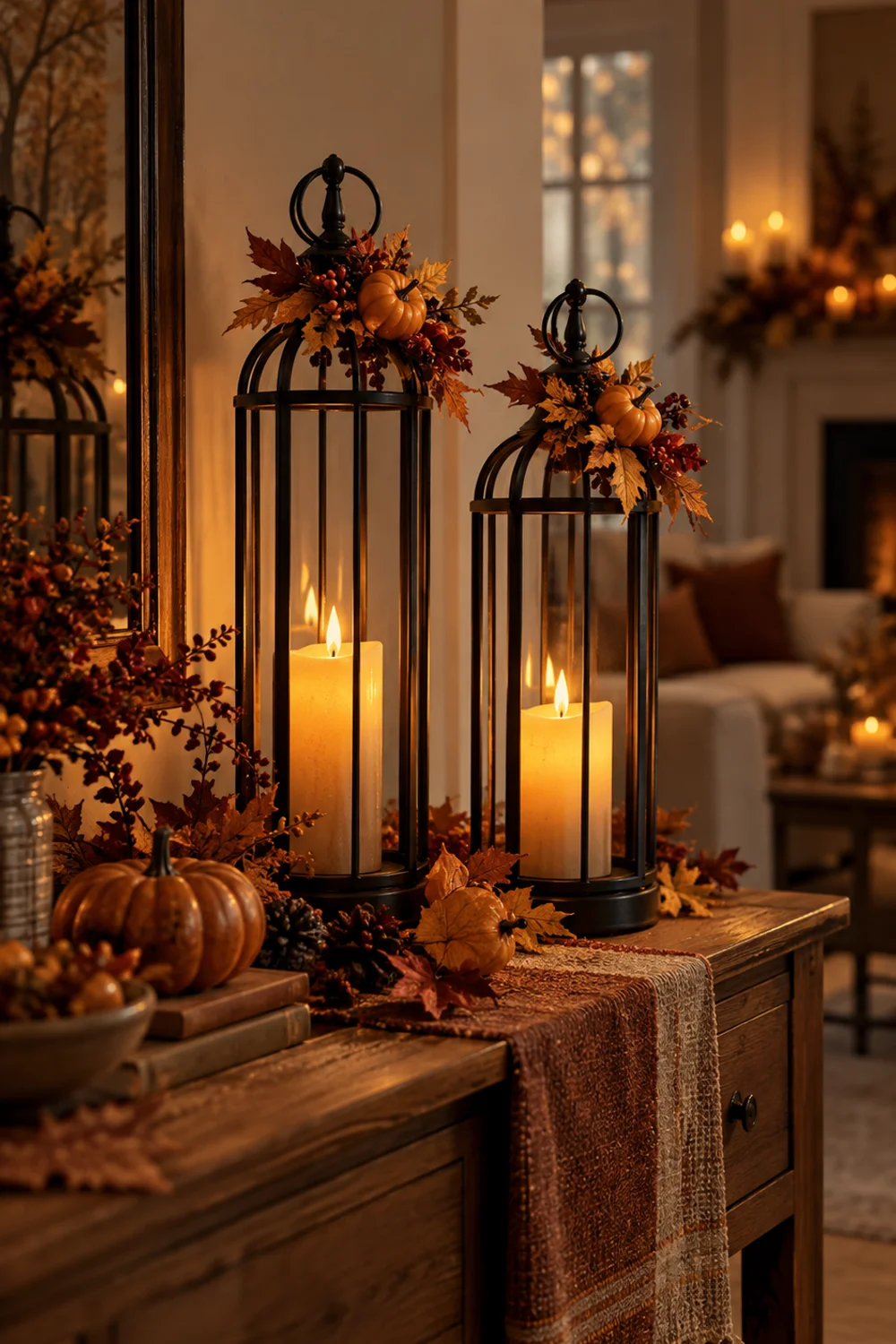
Not every centerpiece has to sit dead center. A cluster of lanterns, grouped at one end of the table or along a sideboard that flows into the dining space, creates a warm secondary glow that makes the whole room feel gathered rather than just the table itself. This is the look for a host who wants ambiance more than a single showpiece object, and it tends to work especially well in rooms where the dining table opens directly onto a living or entry space.
Because lantern sets like this one are often styled generically rather than for one specific season, the fall identity here comes entirely from what you build around them: cluster the lanterns at varying heights, tuck in a few dried leaves or small gourds between them, and choose a rust-and-cream linen underneath rather than anything cool-toned. A handful of cinnamon sticks or dried orange slices scattered near the base adds warmth without adding clutter, and it costs almost nothing.
Lit at dusk, the effect is closer to candlelight spilling across a harvest table than to a generic decor accent — the staging is doing the seasonal work here, and it does it convincingly. Group an odd number of lanterns rather than an even one; three or five reads as intentionally arranged in a way that two or four rarely does, and it’s a trick worth remembering for almost any grouped display on this list.
4. An Abundant Harvest Pumpkin Display
 Save it
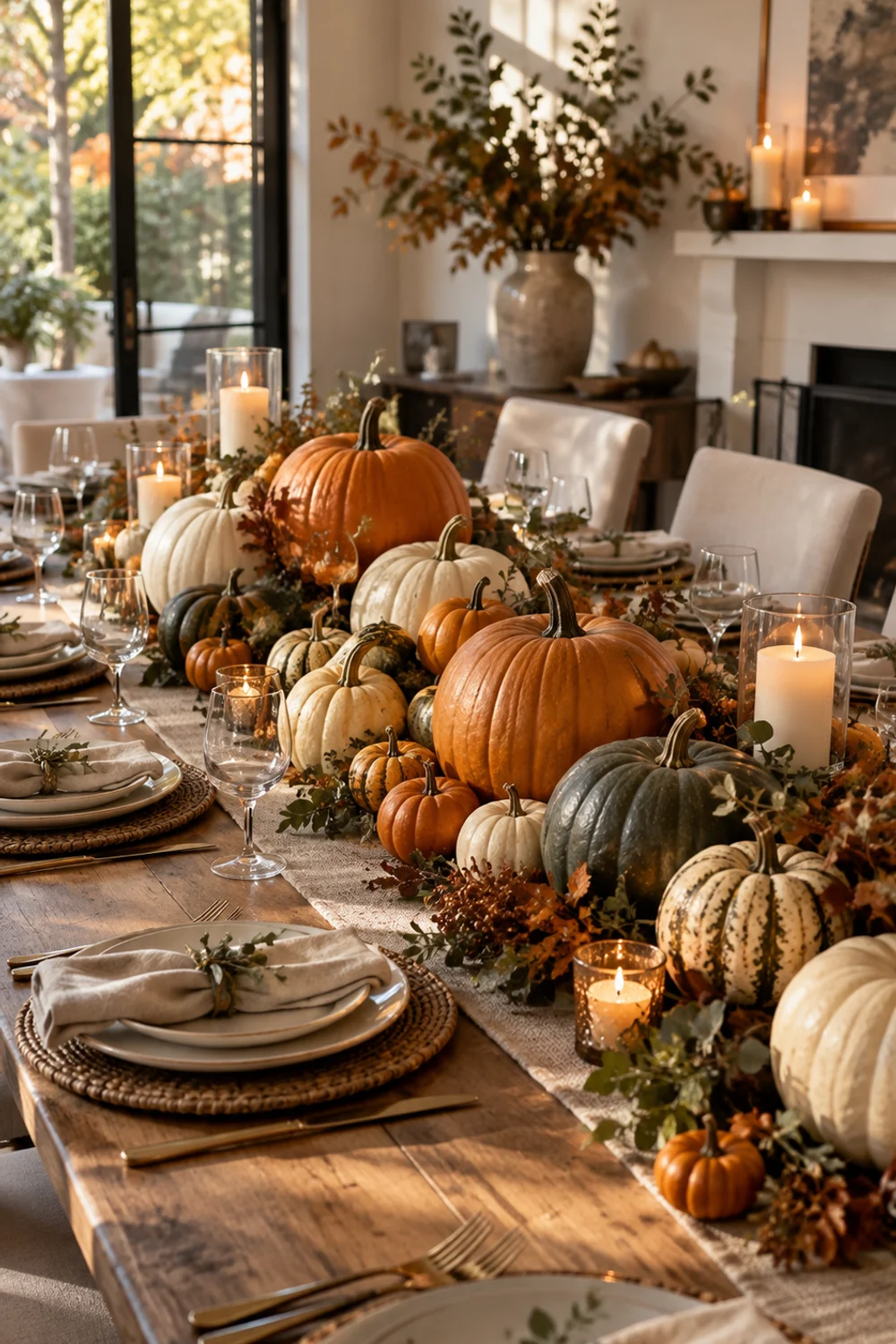
Where the earlier candlelit pumpkin moment is about a single intimate glow, this section is about generous scale — a genuine pile of pumpkins meant for a table hosting a full extended family rather than a quiet dinner for four. Group them unevenly rather than by size, let some nestle against each other, and resist the urge to arrange them in a perfect pyramid, which almost always ends up looking more like a store display than a lived-in table.
This is a display built for volume and texture rather than precision, and it earns its keep by filling a long table without disappearing visually the way a single small object would. Add height variation with a low stack of books or a cake stand hidden beneath a few of the pumpkins, and keep everything else on the table — glassware, napkins — deliberately plain so the display itself stays the obvious star. A little unevenness here reads as more gathered than a perfectly symmetrical pile.
It’s the centerpiece equivalent of a big, warm hug, and it holds up beautifully through a long, multi-course meal since there’s nothing delicate that needs replacing or refreshing partway through.
5. A Refined Floral Hurricane Accent
 Save it
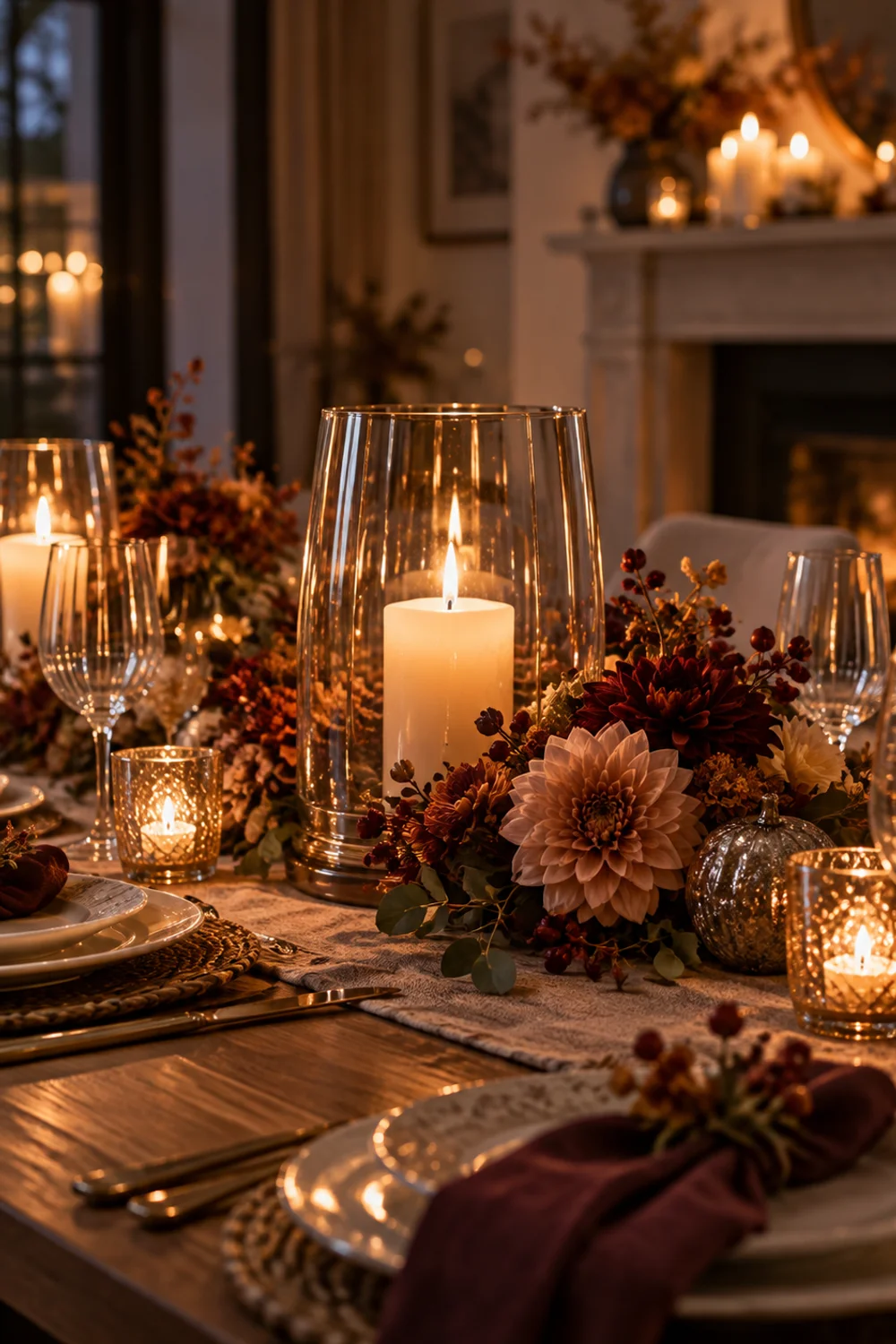
If the previous two sections lean rustic, this one is the table’s moment of quiet polish. A glass hurricane holding a candle, surrounded by dahlias and berries, brings a formality that pure produce-based looks don’t — glass reads as considered in a way that raw gourds simply don’t, no matter how well they’re arranged, and it’s the piece to reach for when the occasion calls for something a little more formal.
Place it at the center of a more formally set table, ideally where the candlelight can catch the glass at eye level once the sun goes down and the flame’s reflection starts doing half the styling work for you. Dahlias and berries already carry enough autumnal richness on their own — resist adding pumpkins or gourds nearby, since the whole appeal of this look is its restraint, and mixing in a second seasonal motif tends to muddy rather than reinforce it.
One hurricane, one cluster of florals, and enough negative space around it to let it breathe is the entire formula.
6. A Full Thanksgiving Table Setting for a Big Gathering
 Save it
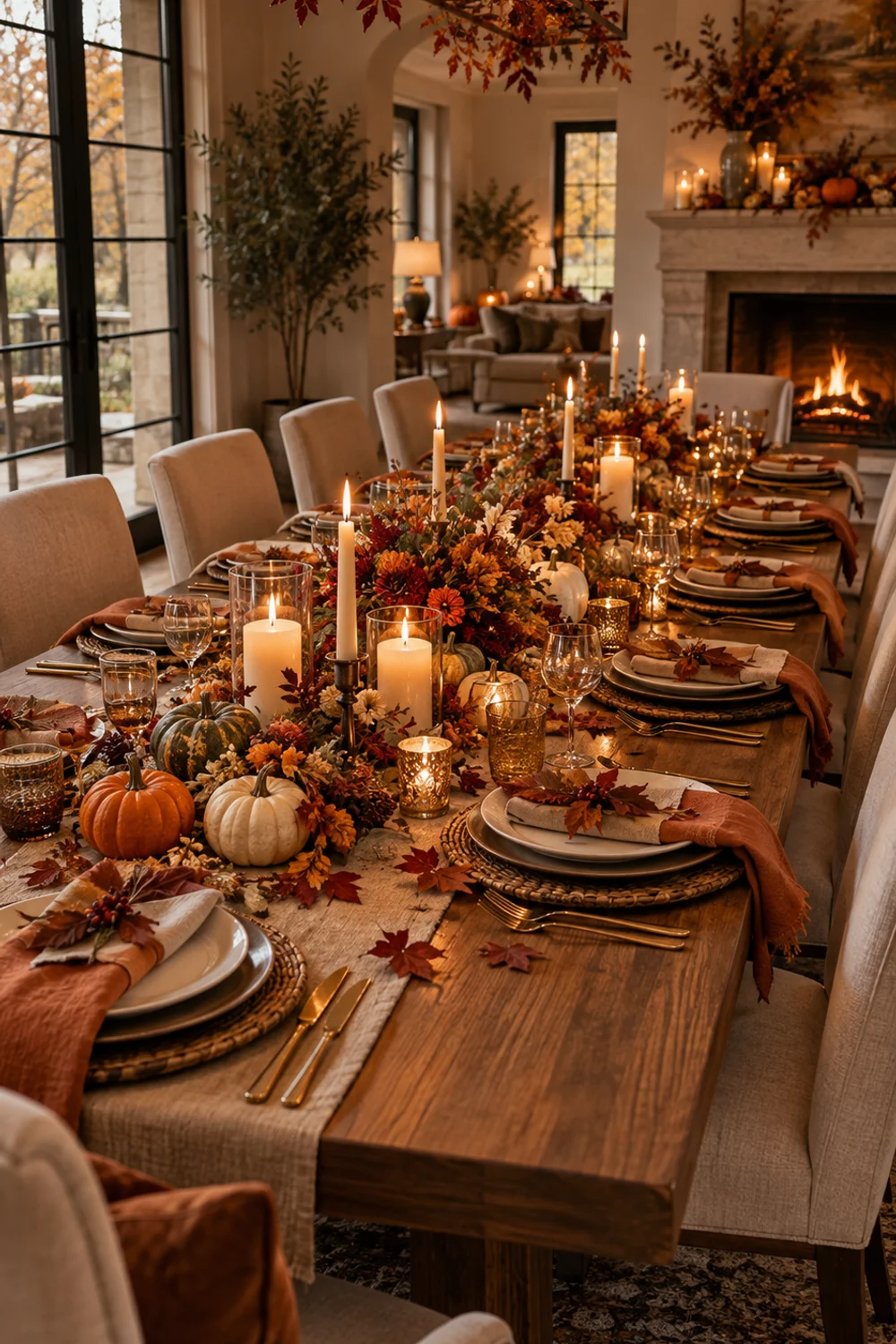
Some years call for one hero object. Other years — the ones with three generations of family and a table extended to its absolute limit — call for a full, layered setting where the centerpiece is just one piece of a larger picture. This section is built for that second kind of year, when the goal is scale, not a single Instagram-ready object, and when a dozen or more place settings need to feel considered without any one of them fighting for attention.
Anchor a Thanksgiving-themed centerpiece arrangement at the table’s midpoint and build outward from there: linens first, then place settings, then candles at staggered heights, then the smaller seasonal touches — a few loose leaves, a scattering of mini gourds — tucked between plates rather than piled in the center. Working in layers this way, starting broad and narrowing in on detail, keeps a large table from feeling like it was decorated all at once and forgotten.
If you want a broader well of ideas for pulling a whole tablescape together rather than just one anchor piece, Beautiful Thanksgiving Tablescape Ideas You Can Copy Today is worth a look before you start setting the table. The goal here isn’t restraint — it’s generosity, applied evenly across the whole surface, so that a guest seated at either end feels equally considered rather than closest to or farthest from the “good part” of the table.
Plan for this look a little earlier than the others on this list, simply because there’s more table to cover. Set aside a full afternoon rather than a rushed hour beforehand, and enlist a second pair of hands if you can — laying linens and place settings across an extended table is genuinely a two-person job, and rushing it tends to show in small, uneven details that a guest will notice even if they can’t say exactly why.
7. A Modern Minimalist Fall Table Accent
 Save it
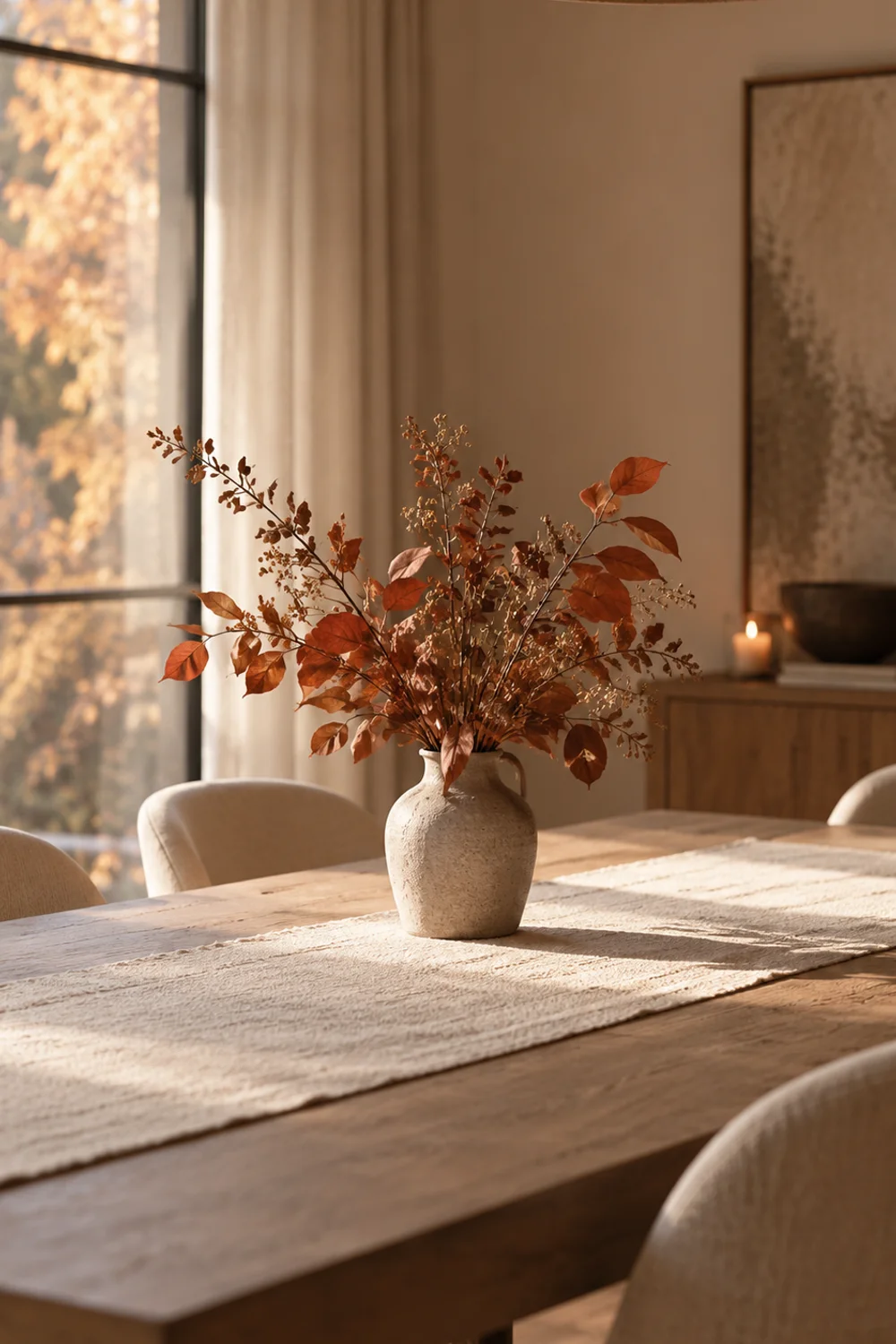
After several sections built on abundance, this one is a deliberate exhale. A single restrained accent piece, given plenty of negative space around it, can carry a fall table just as convincingly as a full arrangement — sometimes more convincingly, if your dinnerware and glassware are already doing visual work of their own and don’t need competition from the centerpiece.
Let the piece sit slightly off-center rather than dead-middle, keep the surrounding table setting monochromatic — think warm white, oat, and a single muted rust accent — and avoid the instinct to add “just one more thing” beside it. Minimalist styling fails almost exclusively through addition, never through restraint, so if you’re unsure whether the table needs another element, the answer is almost always no.
For a wider look at how neutral, pared-back fall styling can work across an entire home rather than just one table, How to Turn Any Room with Neutral Fall Decor Ideas covers it room by room. This is the section for the reader whose taste runs editorial rather than maximalist, and it proves the point that fall doesn’t require clutter to feel warm — sometimes a single well-chosen object and a lot of breathing room is the more sophisticated choice. If your table already features a striking piece of dinnerware, a bold glassware set, or a statement runner, this restrained approach lets those existing elements shine instead of competing with a busier centerpiece for the same attention.
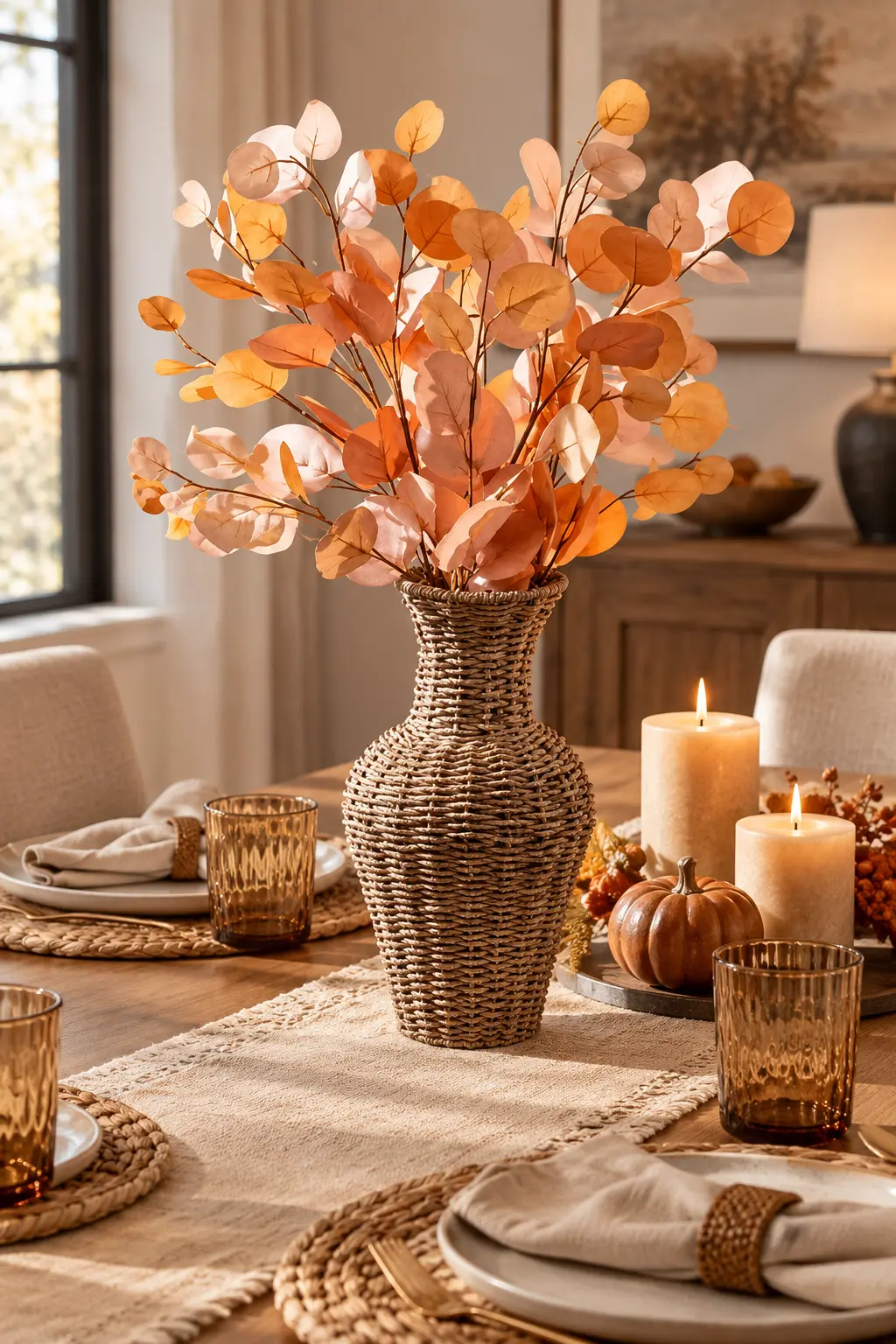
8. A Woven Rattan Glow Centerpiece
 Save it
Texture is doing most of the work in this section. A rattan-woven with light built into it brings a natural, handmade quality that smooth ceramic or plastic pumpkins simply can’t replicate — the shadows the weave casts once it’s lit are half the appeal, throwing soft dappled patterns across the tablecloth that shift as the light source flickers or the room settles into evening.
Because the material itself is the star, keep the surrounding styling equally textural rather than glossy: linen instead of satin, wood instead of glass, a few dried leaves rather than fresh glossy foliage. Placing it near the head of the table, where its shadow pattern has an open stretch of linen to fall across, tends to show off the effect better than tucking it into a crowded center arrangement.
Turned on at dusk, the light glows softly through the weave rather than shining directly, which is exactly the effect that makes this piece feel more like a lit lantern than a decorative object left switched off. It photographs best in the golden hour just before dinner is served, when the ambient light outside is warm enough to match the glow coming from inside the weave itself.
Beyond the visual appeal, a piece like this also solves a real hosting problem: it gives a table ambient light without requiring an open flame anywhere near the food, the tablecloth, or a curious toddler’s reach. That practicality is easy to overlook when you’re focused purely on how a centerpiece looks in photos, but it matters enormously once the table is actually full of people for several hours.
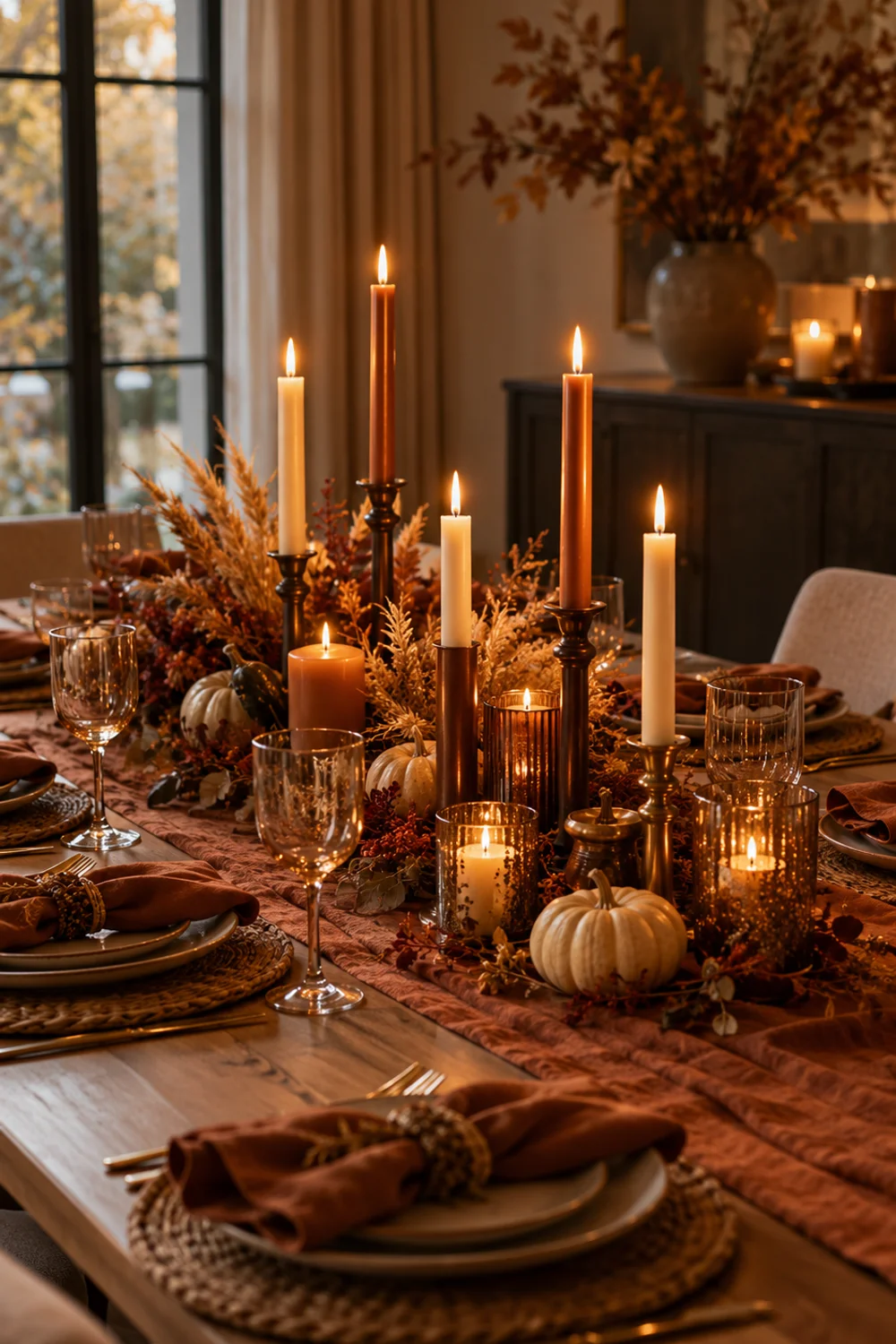
9. An Elegant Fall Candlelight Moment
 Save it
Candlelight is one of the most reliable tools in a host’s kit, and a set of flameless candlesticks gives you that glow without an open flame anywhere near a table full of napkins, sleeves, and small children reaching for the gravy. This section is about building an elegant, formal glow — closer to a dinner-party candelabra moment than a casual votive scatter, and one that stays safe to leave burning for the entire length of a long, multi-course meal.
Group the candlesticks at slightly varied heights along the table’s centerline, and lean hard into a warm, autumnal palette around them — deep rust, amber glass, dried wheat or small gourds nearby — so the whole vignette reads unmistakably as fall and Thanksgiving rather than anything else. The styling around the candlesticks is doing the seasonal storytelling here, and it’s worth being deliberate about it.
Skip any orange-and-black pairing or novelty shapes nearby; the goal is refined warmth, not a costume-party glow, and steering the palette firmly toward rust, amber, and cream keeps the whole vignette reading as elegant autumn rather than anything more playful. Done this way, flameless candlesticks read as pure, elegant evening ambiance, and they’re just as at home lit for a quiet Friday dinner the week after the holiday as they are on Thanksgiving itself.
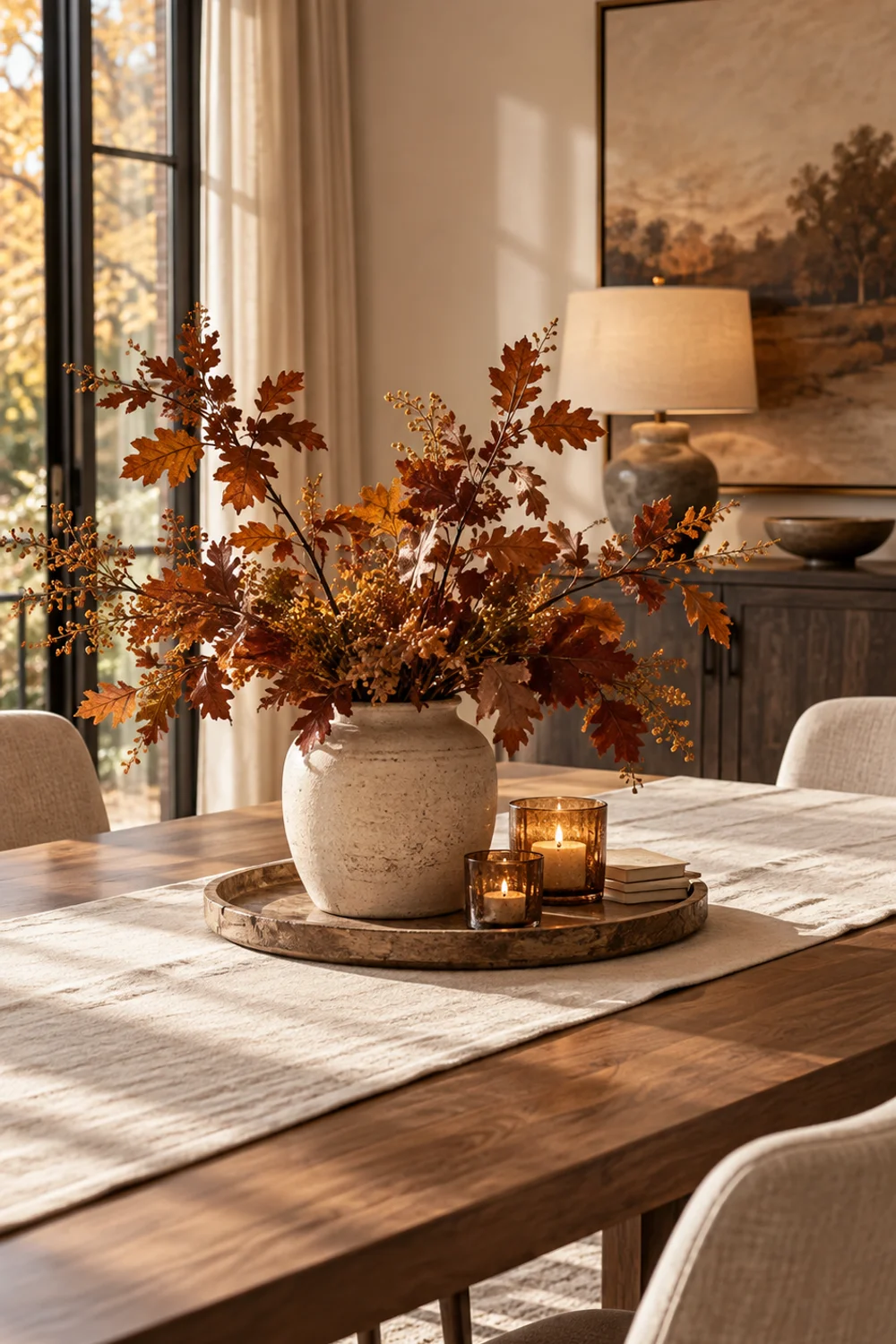
10. An Elevated Modern-Farmhouse Centerpiece
 Save it
Farmhouse style has a reputation problem it doesn’t entirely deserve — done well, it’s warm and materially honest rather than dated or overly precious. This section is for the reader who loves farmhouse texture but wants it to look current, not like a decade-old Pinterest board, and it’s a reminder that the aesthetic itself was never the problem, only the overcrowded execution of it.
The key to keeping farmhouse elevated rather than shabby is editing hard: one piece, given room to stand on its own and styled cleanly, reads as considered; five mismatched rustic objects read as clutter. Pair it with crisp, ironed linen rather than anything distressed, and keep your florals or foliage minimal and current rather than piled high — one clean gesture communicates the style far more convincingly than a dozen small ones competing for the same visual space.
If farmhouse fall styling genuinely speaks to you, 16 Farmhouse Fall Decor Ideas to Try This Year has plenty of ways to bring that same elevated version of the look into the rest of your home, well beyond just the dining table. Treat this piece as the one farmhouse note on an otherwise modern table, rather than the anchor for an entire farmhouse-themed room.
The easiest way to check whether a farmhouse piece has crossed from elevated into dated is to ask whether it would still look intentional in a room with clean, contemporary furniture around it. If the answer is yes — if it would hold its own next to simple modern chairs and unfussy dinnerware — it’s doing exactly what this section asks of it. If it only works surrounded by more rustic props, it’s worth reconsidering how much of that surrounding styling you actually need. A single well-chosen farmhouse piece, given room to stand on its own, almost always reads more current than the same piece crowded by a full supporting cast of rustic accessories.
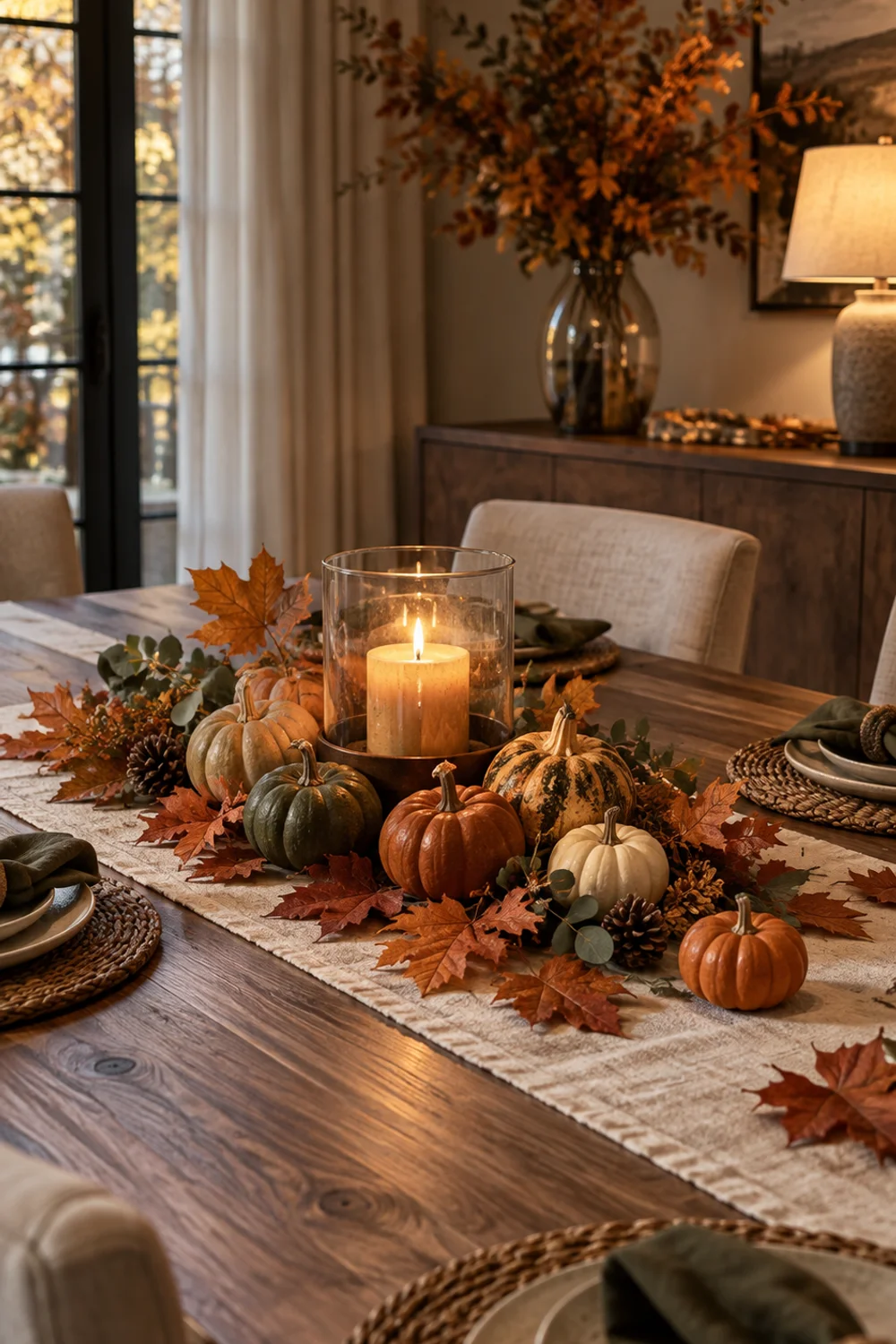
11. A Gourd-and-Leaf Harvest Table Accent
 Save it
Some of the best centerpieces borrow their material logic straight from the outdoors: gourds, maple leaves, and small candle holder elements, arranged with the kind of loose, unstyled quality that makes a table feel like it grew out of the season rather than being decorated for it. This is a genuinely foraged-feeling look, even when every piece came from the same box, and it tends to appeal most to hosts who want their table to feel gathered rather than purchased.
Because a piece built around gourds, foliage, and a candle element like this one is genuinely versatile enough to move between a mantel and a table, we’re featuring it here at the center of the dining table, where the candlelight and the layered leaves have room to spread rather than being confined to a narrow shelf. The same piece that works beautifully on a mantel throughout the season translates just as well to a single evening at the center of a set table.
Scatter the leaves loosely rather than fanning them symmetrically, and let one or two gourds sit slightly outside the main cluster for a more natural, gathered look. Once dinner is over, the same piece packs away easily and moves right back to the mantel for the rest of the season, which makes it one of the more practical choices on this whole list.
12. A Compact Fall Centerpiece for Small Tables
 Save it
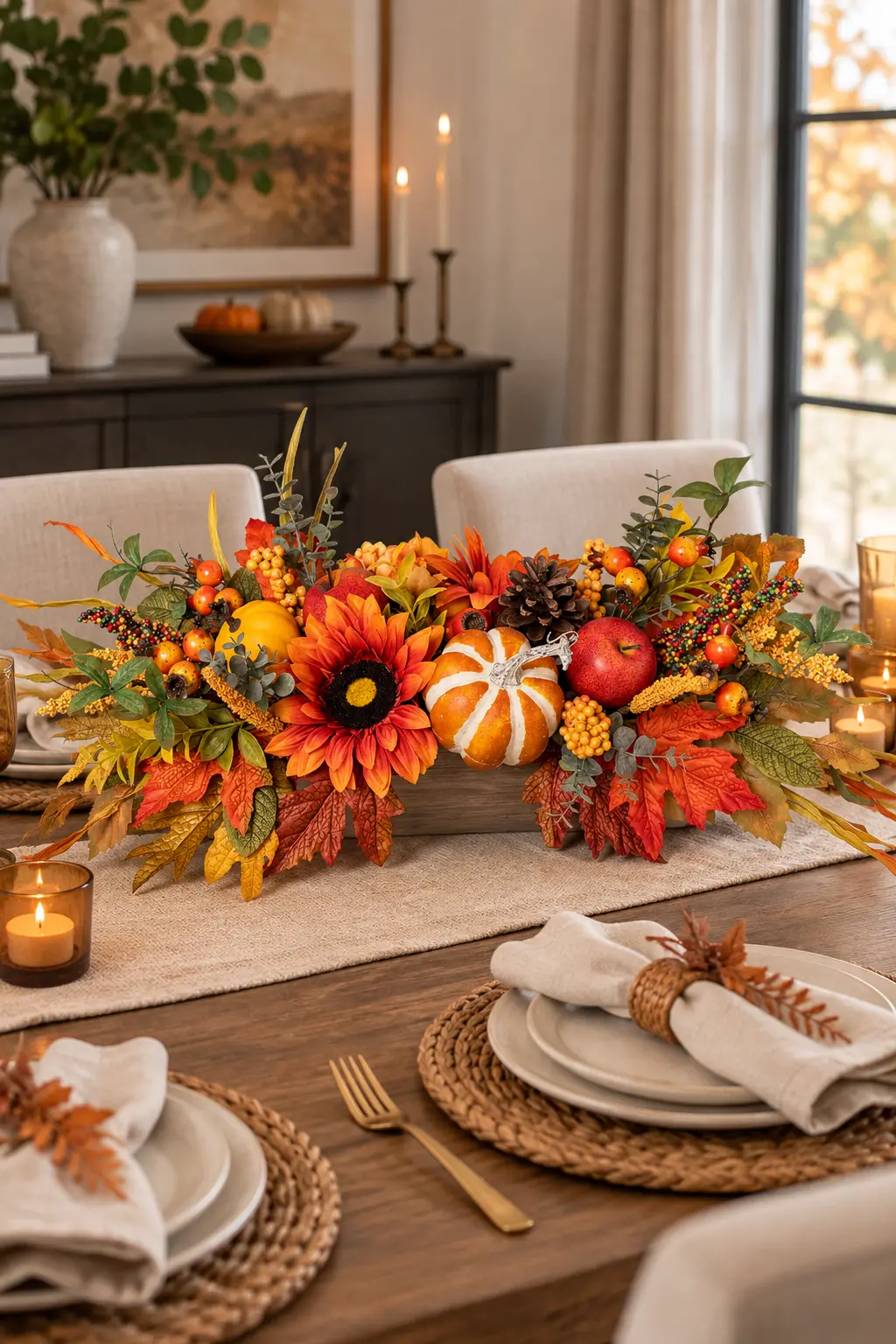
Not everyone is hosting twelve people around a fully extended table, and a lot of the boldest centerpiece ideas simply don’t scale down gracefully. This section is for the apartment dining nook, the two-top by the window, the small table doing its very best on a big holiday — proof that a smaller footprint doesn’t mean a smaller impact, and that some of the most photogenic tables on this list are also the most modestly sized.
Keep the piece itself compact and let a few smaller supporting touches — a single taper candle, a folded linen napkin, one small gourd — fill in the space around it rather than competing with it. On a small table, every object earns its place by necessity, so choose each supporting piece with the same care you’d give the centerpiece itself, rather than treating it as an afterthought.
Tight, close-in styling photographs beautifully on a small table in a way that a scaled-down version of a large arrangement never quite manages; the goal is a table that looks intentionally sized, not like an apology for not being bigger. A small table set with confidence almost always reads warmer than a large one set with hesitation.
Small tables also benefit from a slightly lower centerpiece profile than a large table would need, simply because everyone seated is already so close to the middle. A piece that would look perfectly proportioned in the center of a long table can feel unexpectedly tall and obstructive at close range, so err toward something you can comfortably see over even from the nearest seat.
13. A Floral-and-Gourd Blended Arrangement
 Save it
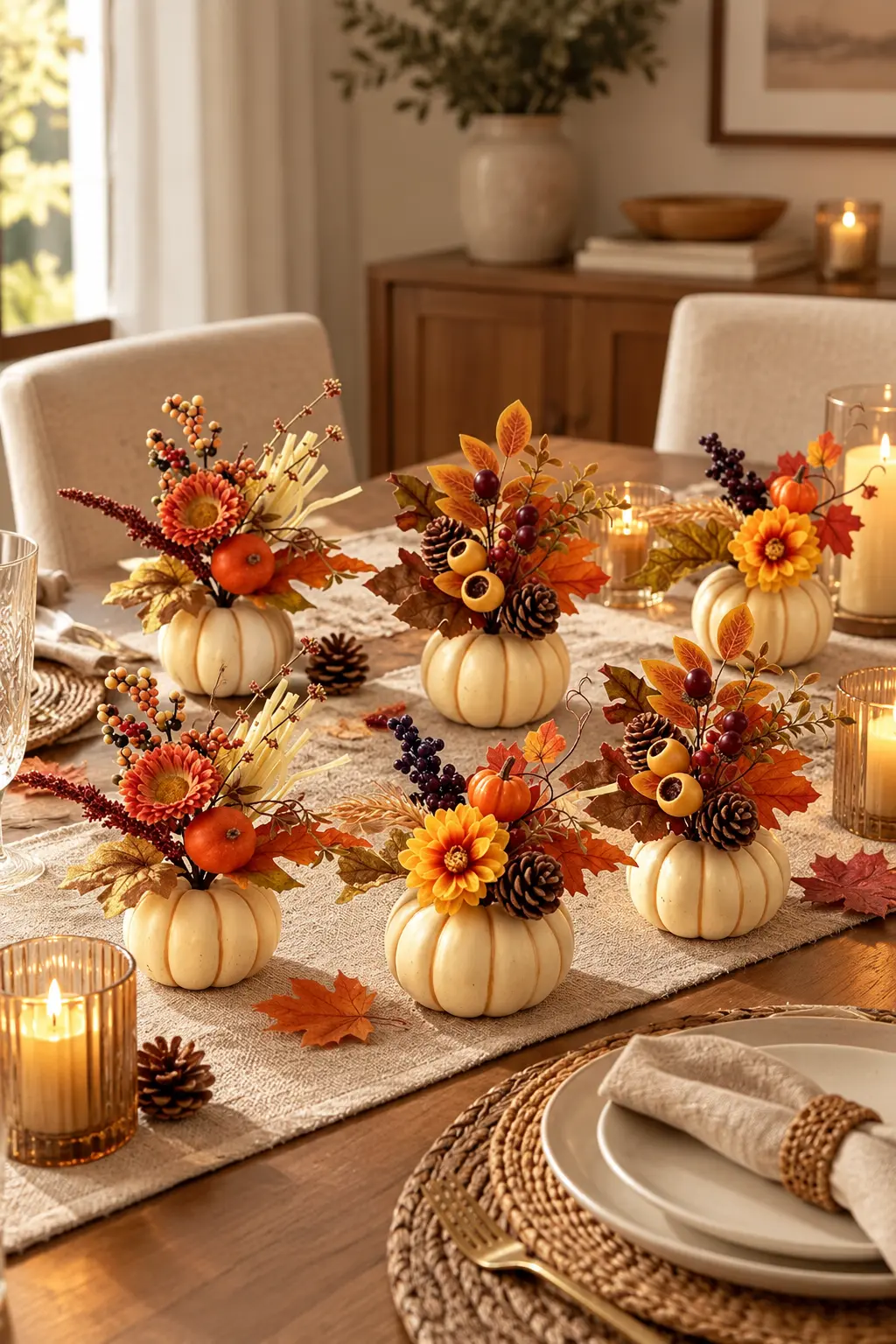
Pumpkins alone can start to feel like the only note this list is playing, so this section deliberately softens the palette with florals blended directly into a gourd-based arrangement. The result feels less rustic, more romantic — a hybrid that borrows warmth from the produce and softness from the blooms, and it tends to suit a table that wants seasonal richness without leaning fully into harvest-bin imagery.
Let the florals peek out from between the gourds rather than sitting on top of them, so the arrangement reads as one cohesive piece instead of two separate elements pushed together. Taking a few minutes to tuck stems into the gaps between gourds, rather than simply resting them alongside, is the small adjustment that makes the whole arrangement look integrated rather than assembled at the last minute.
This is a strong middle-ground option for a host torn between a fully rustic produce display and a fully formal floral one — it borrows just enough from each side to feel considered rather than indecisive, and it pairs comfortably with almost any dinnerware style already on your table.
Try it first with your existing dinnerware before buying anything new — more often than not, what you already own will tell you which direction, rustic or romantic, the rest of the table wants to lean.
14. A Minimalist Fall Candle Accent
 Save it
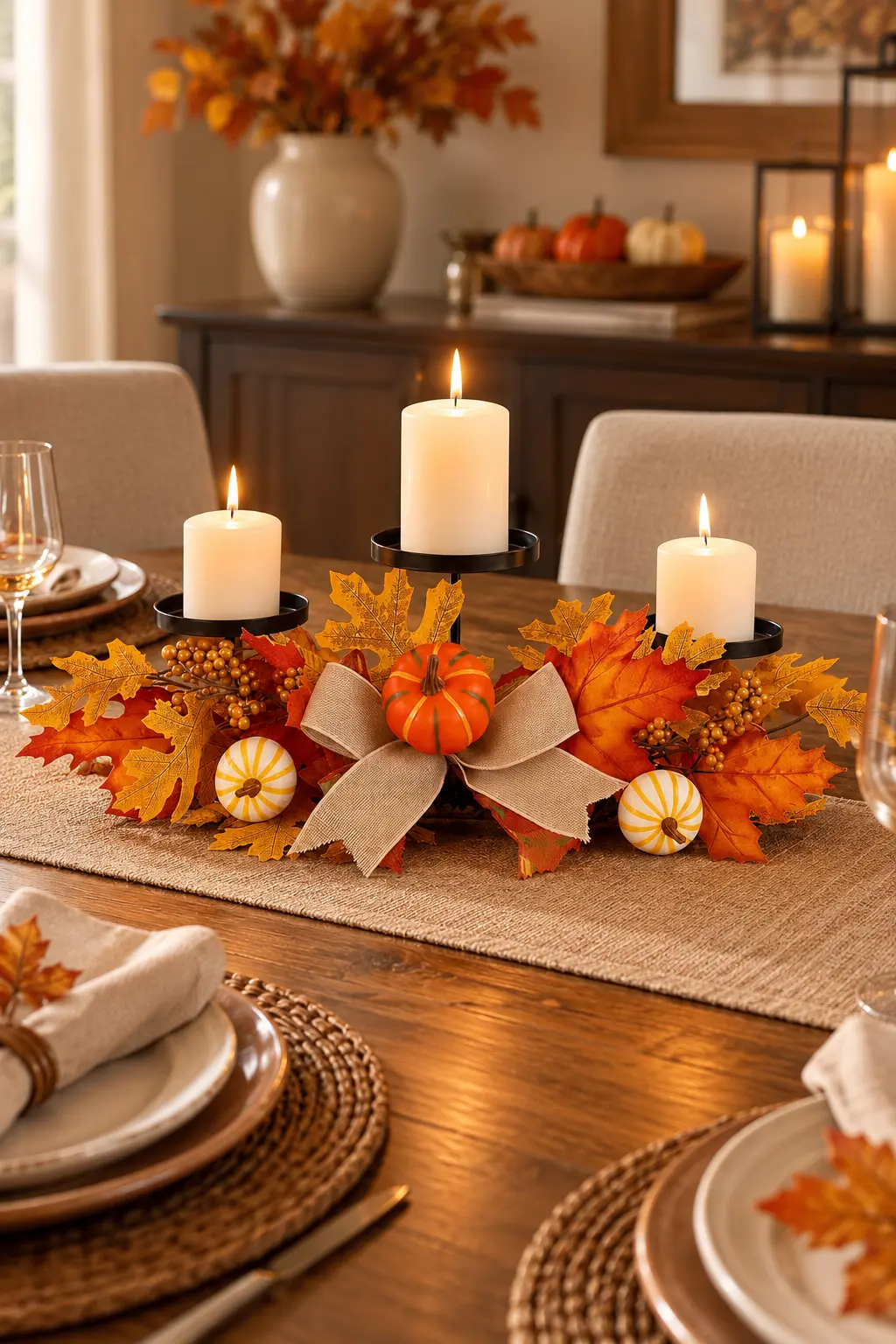
Not every element on the table needs to compete for attention, and sometimes the most useful piece in this whole list is the one that quietly supports everything else. A simple candle holder, placed slightly off from the main centerpiece, rounds out a tablescape without ever trying to be the star of it, and every table on this list could genuinely use one somewhere near its edge.
Because a piece this pared-back carries no built-in seasonal signal on its own, the fall identity here comes entirely from what surrounds it: warm-toned candles, a scattering of small leaves at its base, linen in the same rust-and-cream family as the rest of the table. Placed near a place setting rather than dead-center, it does quiet work without ever pulling focus from whatever the table’s real centerpiece happens to be.
Used this way, it becomes the kind of quiet detail a guest notices on their third look at the table, not their first — and that’s exactly the point. A table full of only showstoppers can feel exhausting; a table with one or two quiet supporting pieces feels considered instead.
15. A Lit Garland Table Runner Finish
 Save it
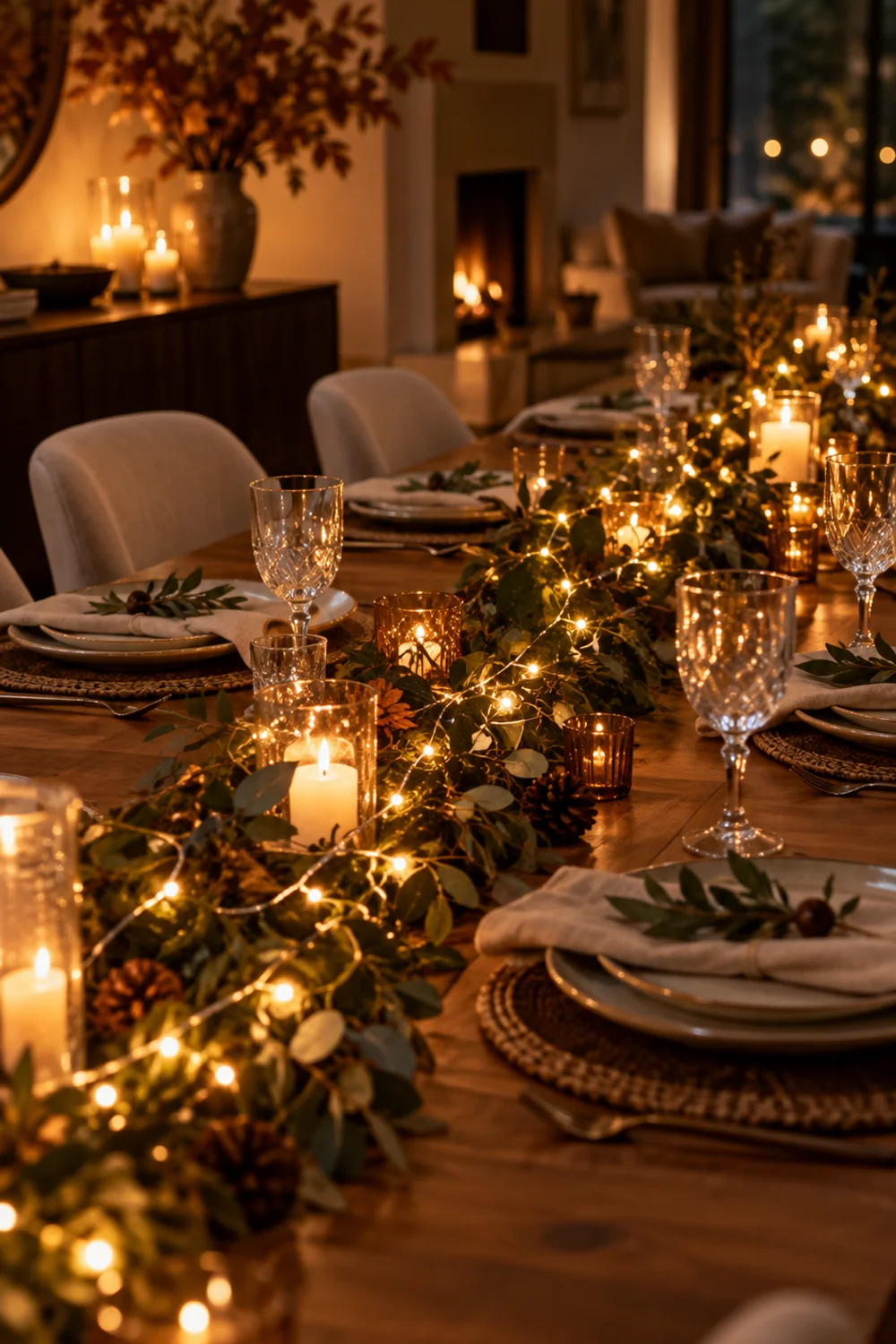
Every good edit needs a closing note, and this one ends the list with a shift in form rather than another vessel-based idea: a lit garland, draped down the table’s length as a glowing alternative to a single centerpiece object. It’s less a centerpiece in the traditional sense and more a finishing touch that ties the whole table together, and it’s the piece most likely to still be glowing long after the last plate has been cleared.
Drape it loosely rather than pulling it taut, letting it dip slightly between place settings so the light catches at different heights along the table — a little slack looks better than a perfectly straight line.
Because it runs the full length rather than sitting in one spot, it works beautifully alongside almost any other look on this list — layered underneath a hurricane candle, threaded near a pumpkin display, or simply left to glow on its own once the last course is cleared and the conversation runs long into the evening. It’s a fitting last note for a table built one considered piece at a time, and because it’s sold as a continuous length rather than a fixed object, it’s easy to adapt shorter or longer for whatever table you end up hosting on.
Common Mistakes
1. Choosing a centerpiece before deciding on scale
It’s tempting to fall in love with one piece before you’ve thought about how many people are actually sitting at the table. A showstopping display built for four can overwhelm a table for twelve, and a delicate accent piece can disappear entirely on a long extended table. Decide on scale first, then choose the look that fits it.
2. Matching every element too literally to “fall”
Not everything on the table needs a leaf, a gourd, or a rust tone stamped on it. When every single object is trying to say “autumn,” the table starts to feel busy rather than warm. Let one or two pieces carry the seasonal signal clearly and allow the rest of the table — linens, dinnerware, glassware — to stay quieter.
3. Ignoring sightlines across the table
A centerpiece that looks beautiful from above can completely block conversation at eye level. Before the meal starts, sit down at a few different seats and check what you can actually see across the table. If a piece blocks faces rather than framing them, it needs a lower profile or a different spot.
4. Styling only for the daytime photo
Many of the pieces in this list are built around candlelight or embedded lighting, and a centerpiece that photographs well in flat daylight can look entirely different — better, usually — once the sun goes down and the lights come on. Do a quick evening check before the day of the holiday so there are no surprises.
5. Treating the centerpiece as separate from the rest of the table
A stunning centerpiece surrounded by mismatched napkins or the wrong glassware never quite reads as finished. The strongest tables on this list work because the centerpiece and the linens, dinnerware, and lighting were considered together, not as an afterthought layered on top of whatever was already set out.
6. Buying everything from a single matching set
It’s an easy shortcut, but a table built entirely from one coordinated set often reads as store-bought rather than styled. Mixing one intentional piece — like a hurricane candle or a woven rattan accent — with simpler, quieter elements around it almost always looks more considered than uniform matching does.
Frequently Asked Questions
How many centerpiece pieces should I use on one table?
For most tables, one clear focal point plus one or two smaller supporting touches is enough. Piling on more than that tends to compete for attention rather than build on it — pick your favorite look from this list, let it lead, and add only what genuinely supports it rather than what simply fills empty space.
Can I combine more than one of these ideas on the same table?
Yes, and several of them are built to layer well together — a lit garland runner underneath a candlelit pumpkin, for example, or a minimalist candle accent placed beside a fuller harvest display. Just keep one piece as the clear lead so the table doesn’t feel like it’s competing with itself, and treat everything else as quiet support.
What’s the easiest way to make a centerpiece feel more “Thanksgiving” without buying more items?
Lighting does more of that work than most people expect. Dimming overhead lights and relying on candlelight or embedded lighting instantly shifts almost any of these looks toward a warmer, more autumnal feeling, even without adding a single new object to the table itself.
Do I need real florals and foliage, or is faux fine for a Thanksgiving table?
Faux is entirely fine, especially for a table that needs to look good for more than one evening. The pieces in this list are chosen for how they read visually — texture, color, and form — rather than whether every stem is real, and quality faux material holds up for the whole season in a way fresh-cut stems simply can’t.
Final Thoughts
A great Thanksgiving table doesn’t need fifteen ideas crammed onto one surface — it needs one good idea, chosen deliberately and styled with a little care. Whether that’s the quiet formality of a floral hurricane, the generous sprawl of a harvest pumpkin display, or nothing more than a lit garland tracing the length of the table, the through-line across every look here is the same: let the piece you choose actually suit the gathering you’re hosting, not the one you imagine you should be hosting.
Pick the one that matches your table this year, set it with a little intention, and let the rest of the evening take care of itself. The best centerpieces on this list all share one quality in the end — they make a table feel gathered for, not simply decorated, and that’s a much easier thing to achieve than it might seem the night before guests arrive.
This post contains affiliate links. I may earn a small commission at no extra cost to you.
Get cozy inspiration delivered to your inbox.
✓ 14-page beautifully designed ebook
✓ Cozy decorating ideas
✓ Practical room-by-room inspiration
You’re in! 🎉
Thanks for joining the NestFlowHome community!
Your free ebook is already on its way to your inbox. If you don’t see it within a few minutes, please check your Promotions or Spam folder.
Join the NestFlowHome community for weekly decorating inspiration.

Timeless home decor ideas and slow living inspiration for a calm, beautiful life.