
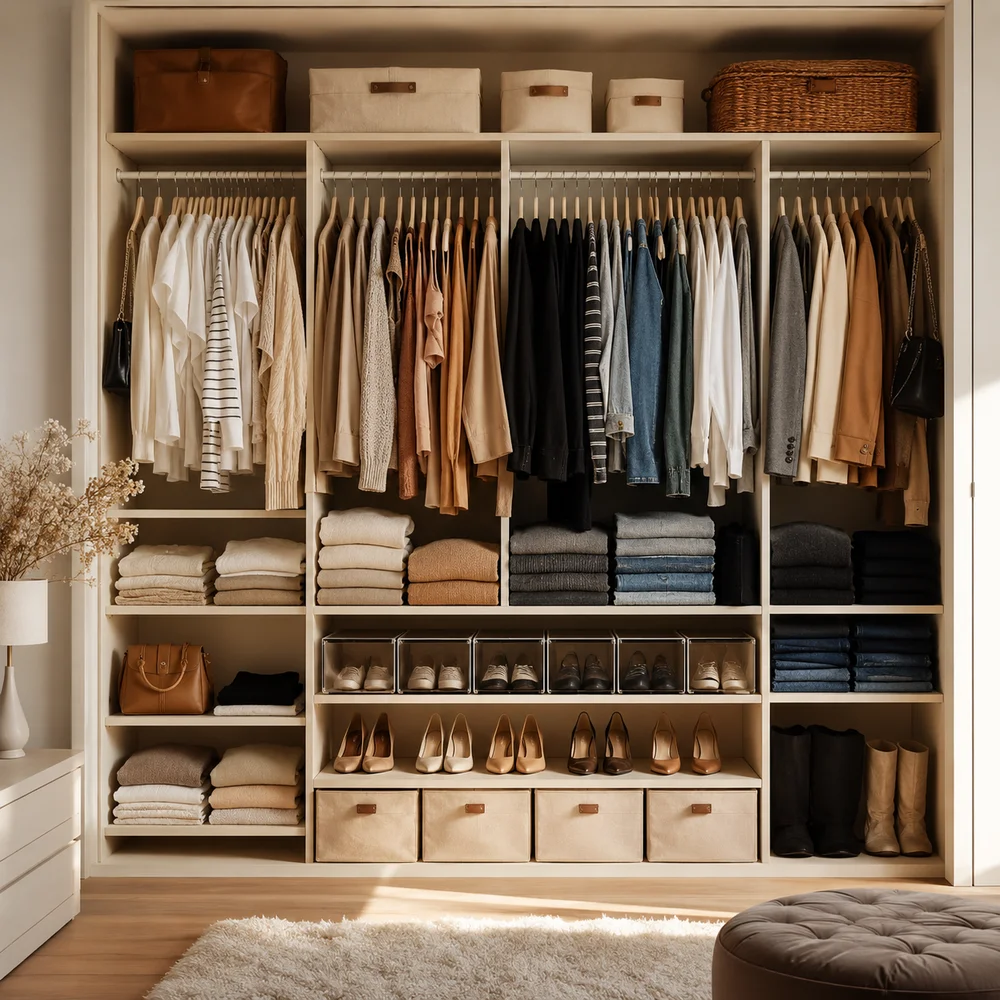
What Professional Organizers Really Use for Seasonal Closet Organization Success
By Emily | July 1, 2026
Every season, the same scene plays out in closets across the country: bins overflowing, hangers tangled, and a vague sense that everything should be working better than it actually is. Professional organizers see this constantly, and what separates their results from the average DIY attempt isn’t talent or taste — it’s a system. The tools they reach for aren’t flashy. They’re chosen because they solve specific, recurring problems that come with rotating wardrobes through changing weather, schedules, and lifestyles.
This article pulls back the curtain on what actually works, not what looks good in a single styled photo. You’ll find the specific categories of products organizers rely on, why each one earns its place, and how to apply the same thinking to your own closet regardless of its size. Some of these solutions are about visibility, some about protection, and some about simply reducing the number of decisions you have to make on a busy morning. Together, they form a framework rather than a shopping list — one that holds up through every seasonal transition, not just the satisfying first week after a fresh organizing session.
If you’ve ever rebuilt your closet only to watch it slide back into chaos by the next changeover, the missing piece probably isn’t more storage. It’s the right system, used consistently.
1. Vacuum-Sealed Storage for Bulk Seasonal Items
 Save it
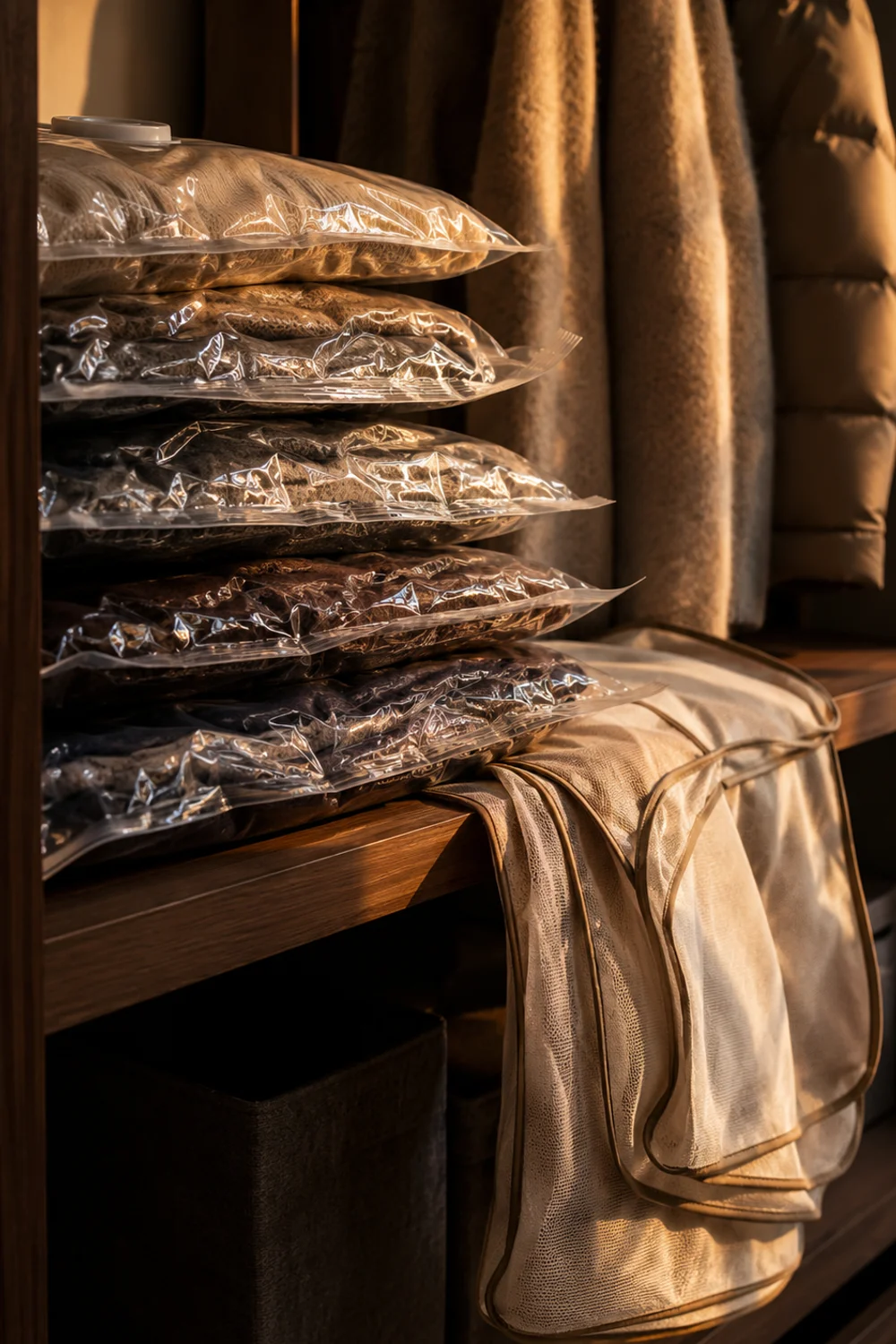
The single biggest space drain in most closets is bulky out-of-season clothing taking up prime real estate year-round. Heavy sweaters, puffer coats, and wool blankets are dense, structurally inefficient items that resist folding into anything compact. Professional organizers almost always address this first, because reclaiming that volume immediately changes how the rest of the closet behaves. Without it, every other system gets built on top of overcrowded shelves, which undermines even the best containers and labeling.
Vacuum-sealed bags work by removing trapped air from soft, compressible textiles, shrinking their footprint by as much as seventy percent. The technique only works on certain materials, though — down, wool, and cotton compress beautifully, while structured items like blazers or anything with stiffening interfacing should never go in. Organizers typically sort by compressibility before sorting by season, because that distinction determines storage method more than the calendar does.
A second-tier product worth pairing here is a set of breathable, non-vacuum garment bags for the items vacuum sealing would damage. This split system — compress what can be compressed, breathe what needs to breathe — is the actual mechanism behind those dramatically “before and after” closet transformations seen online.
What this approach really teaches is a broader principle: storage should match material behavior, not just category labels. A “winter clothes” bin treats a cashmere sweater and a down parka identically, when in reality one wants compression and the other wants structure. Once you start sorting by how an item physically behaves rather than what season it belongs to, every other organizing decision becomes easier.
2. Clear Labeled Bins for Off-Season Rotation
 Save it
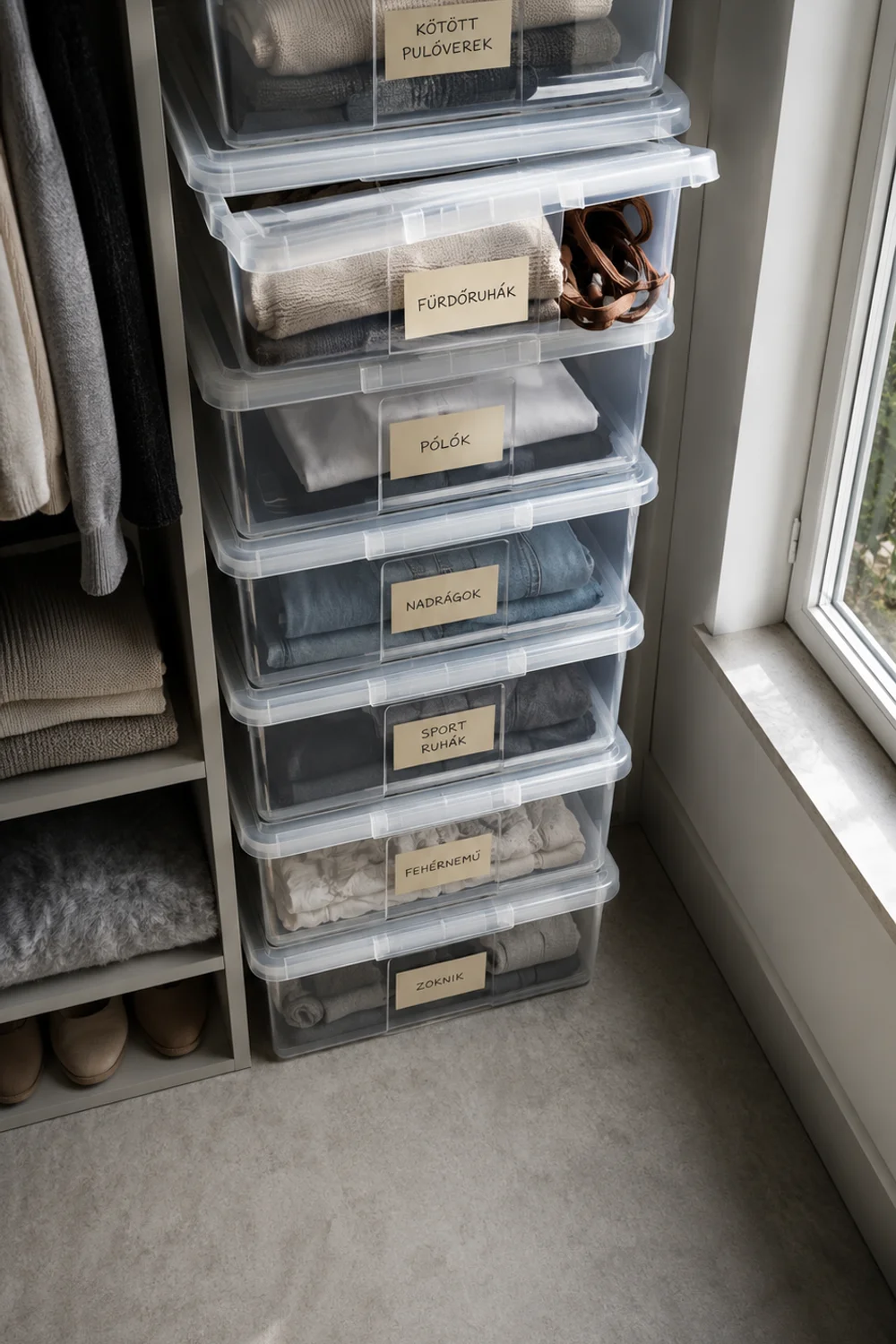
The problem with most seasonal storage isn’t the storage itself — it’s that nobody can remember what’s inside it six months later. Opaque bins stacked in a closet or garage become mystery boxes, and the mental friction of opening four containers just to find swimwear is often enough to make people give up on rotation altogether. Professional organizers treat visibility as a non-negotiable feature, not a nice-to-have, because a system people avoid using isn’t actually a system.
Clear plastic bins with secure, stackable lids solve this directly. The transparency removes the guessing game, and stackability means seasonal storage can live efficiently on a closet’s top shelf or in a hallway linen closet without sacrificing floor space. Organizers typically standardize on one bin size across an entire closet system, since mismatched containers create awkward gaps and unstable stacks that discourage people from accessing them regularly.
Labels add a second layer of clarity beyond what’s visible through the plastic — particularly useful for folded items where only the top layer shows. A simple printed label naming the season and rough category (not an exhaustive inventory) keeps the system fast to use. This pairs naturally with the same compression-bag method described above; for closets layering both shelving and drawer space, The Best Aesthetic Closet Storage Ideas for Small Bedrooms explores how to combine bin storage with limited vertical footprint.
The deeper lesson is that storage only succeeds if retrieval is effortless. A beautifully organized bin nobody wants to open might as well be empty space. Clear containers remove the single biggest barrier to maintaining a rotation system: the friction of not knowing what’s inside.
3. Slim Velvet Hangers for Daily Wardrobe Consolidation
 Save it
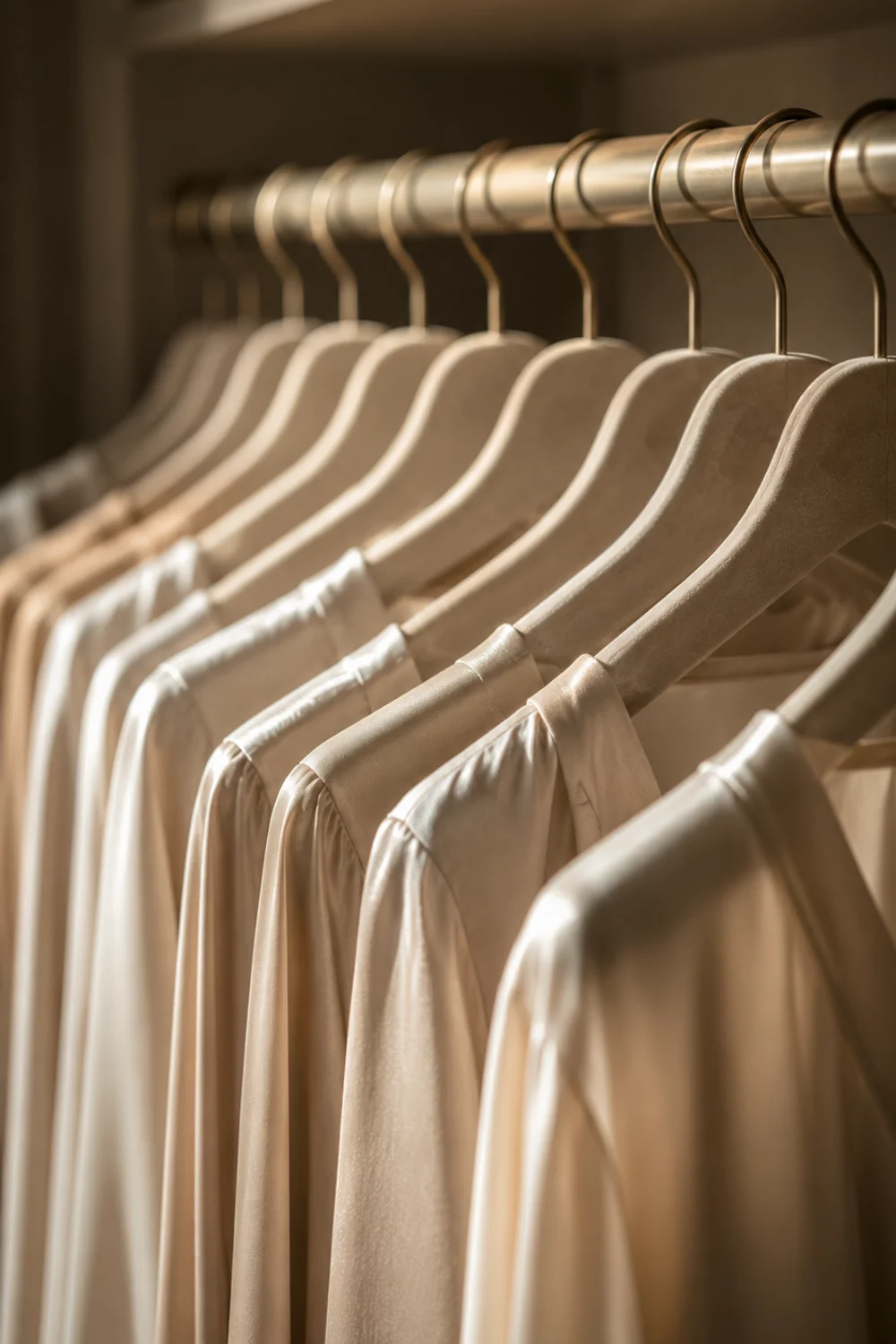
Hanger inconsistency is one of the quietest space-wasters in any closet. A mix of thick plastic hangers, wire hangers from the dry cleaner, and oversized wooden ones creates uneven gaps along the rod and makes a closet look cluttered even when it isn’t overstuffed. Professional organizers consider hanger standardization one of the fastest, highest-impact changes a person can make, often freeing up twenty to thirty percent more rod space without removing a single garment.
Slim velvet hangers achieve this through their thin profile and slightly textured surface, which keeps garments from sliding off — a particularly common issue with silk blouses and satin slip dresses on traditional hangers. Because they’re uniform in width, clothes hang closer together without crowding, and the visual effect is a closet that reads as curated rather than chaotic, even on a busy week.
For structured pieces like blazers or coats, organizers often switch to a slightly wider wooden hanger with a shoulder contour, reserving the slim velvet style for shirts, blouses, and lighter garments. This two-tier hanger system respects the fact that not every item needs — or benefits from — the same support.
What’s really happening here is an exercise in visual rhythm. A closet rod with consistent spacing and matching hanger silhouettes is easier for the eye and the brain to process quickly, which is part of why this single swap shows up in nearly every professional organizer’s starter toolkit, regardless of the client’s overall storage budget.
4. Drawer Dividers for Small, Easily Lost Items
 Save it
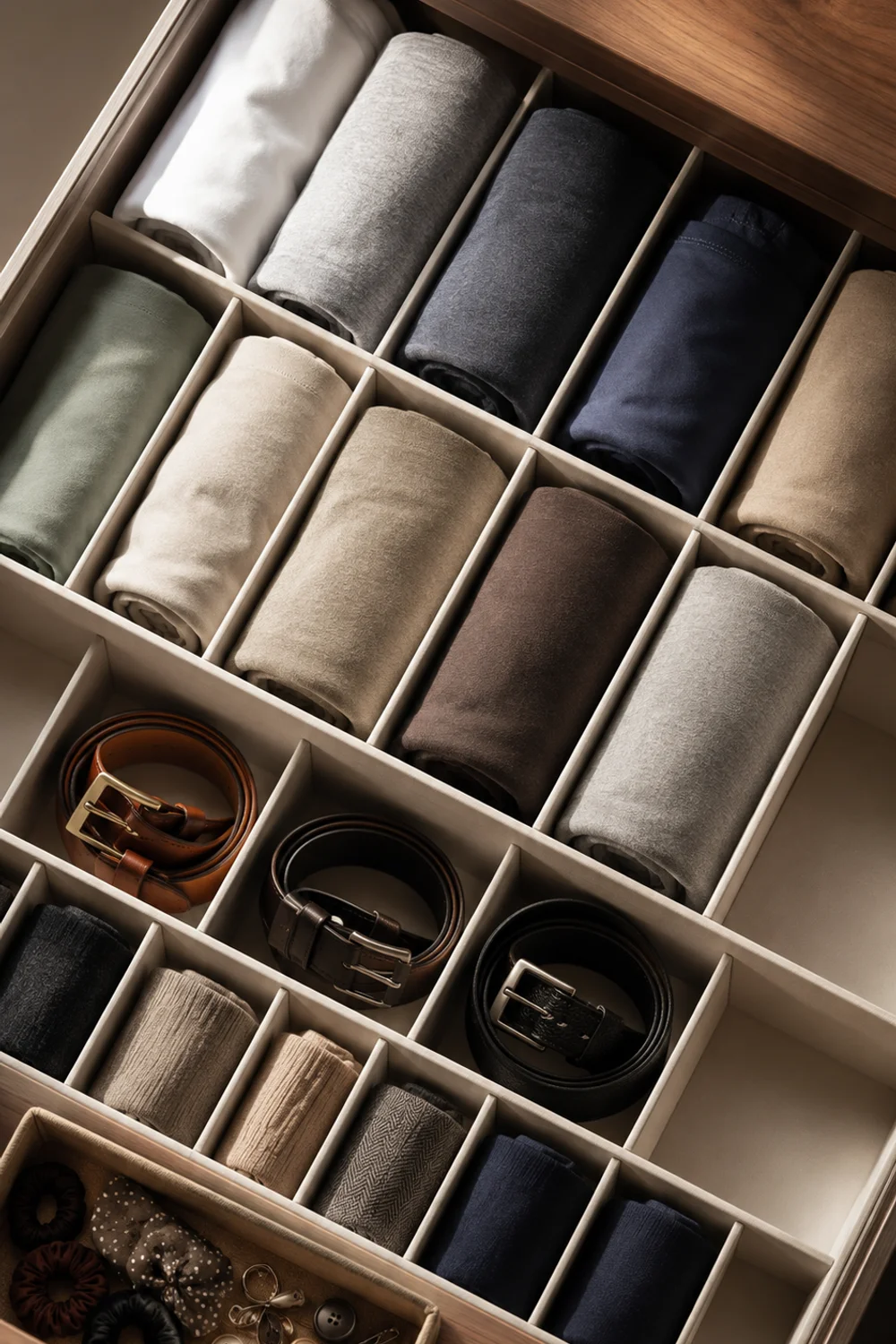
Drawers are where organizing systems quietly fall apart. Socks, belts, scarves, and accessories tend to migrate into loose piles within weeks of being neatly folded, because nothing is physically holding their position. This is less about discipline and more about a structural gap — without dividers, a drawer simply doesn’t have the architecture to maintain order on its own.
Adjustable drawer dividers create individual compartments that hold folded or rolled items upright and in place, preventing the slow slide into a jumbled pile. Organizers favor adjustable versions over fixed ones because drawer sizes vary widely between closets, and a divider system that can be reconfigured adapts as a wardrobe changes across seasons. The rolling method for t-shirts and the upright-fold method for accessories both depend on this kind of compartmentalization to actually hold.
For deeper drawers, a secondary layer of small fabric bins within the divided sections handles loose items like jewelry or hair accessories that don’t fold at all. This nested approach — dividers for structure, bins for the truly small stuff — prevents the catch-all drawer phenomenon almost entirely.
The underlying principle extends well beyond drawers: anything without a defined boundary will eventually become disorganized, regardless of how much space is available. Boundaries, more than space itself, are what keep small items findable.
5. Cedar Blocks and Sachets for Natural Moth Protection

 Save it
Seasonal storage introduces a problem that’s easy to overlook until it’s too late: months of undisturbed fabric sitting in a dark closet is exactly the environment moths prefer. Wool, cashmere, and other natural fibers are particularly vulnerable, and by the time damage is visible, it’s already done. Organizers treat moth prevention as a built-in part of any seasonal system, not an afterthought addressed only after a problem appears.
Cedar blocks work through their natural oils, which moths find repellent, and unlike chemical mothballs, they don’t leave behind a strong synthetic scent on stored garments. The wood does require occasional light sanding to refresh its potency, since the oils fade over time — a small maintenance step that’s easy to build into a seasonal rotation routine.
Lavender sachets offer a complementary, lighter-scented alternative often layered alongside cedar in drawers or garment bags, particularly for items closer to where someone gets dressed daily. Together, these natural deterrents avoid the harsh smell associated with traditional mothballs while still offering meaningful protection for vulnerable fibers.
This is a good example of prevention costing far less than the alternative — both financially and emotionally. Replacing a moth-damaged sweater is rarely simple, especially if it was a well-loved or harder-to-replace piece, which is exactly why this small, low-effort habit shows up consistently in professional closet maintenance plans.
6. Over-the-Door Organizers for Vertical Real Estate
 Save it
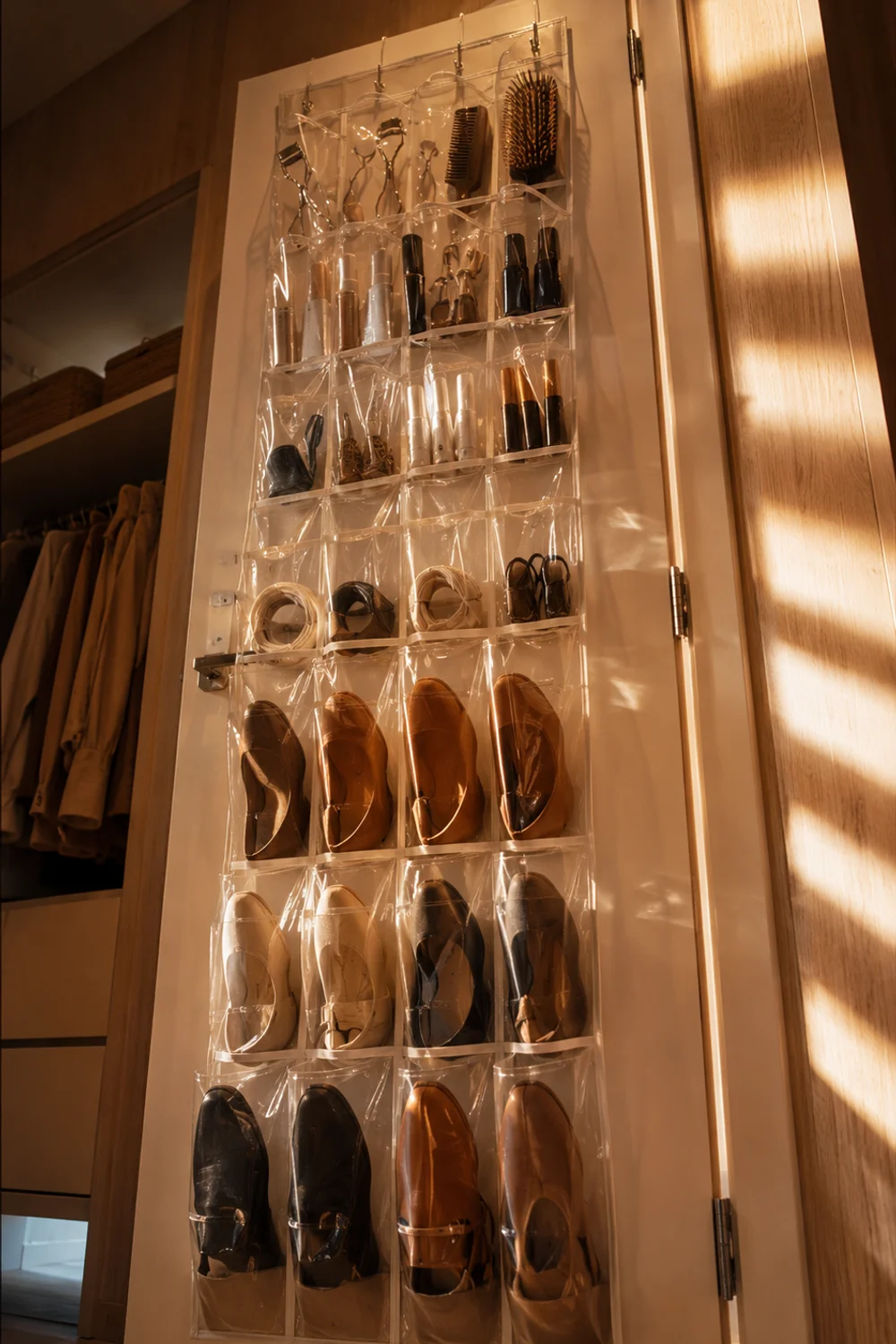
Closets are often judged by floor space and shelf count, but one of the most underused areas is the back of the door itself. It’s vertical, easily accessible, and almost universally empty — which makes it a near-perfect spot for items that don’t need to be folded or hung on the main rod. Professional organizers frequently use this zone for categories that otherwise sprawl across counters and drawers.
Over-the-door organizers with clear pockets work especially well for shoes, accessories, or small grooming items, since the transparency keeps everything visible without requiring a single drawer to be opened. Because they hang on the door rather than mount to a wall, they’re an easy addition for renters who can’t drill into closet surfaces, and they remove an entire category of clutter from shelves without sacrificing any existing storage.
For closets with limited door space or shared rooms, a slimmer canvas-pocket version designed for scarves or belts achieves a similar effect on a smaller scale. The key is matching pocket depth to the item — shallow pockets for flat accessories, deeper ones for bulkier shoes — so nothing feels crammed or falls out when the door swings open.
The broader takeaway is that vertical space is almost always underutilized compared to horizontal surfaces, which tend to fill up first. Looking up and around, rather than only at shelves and floors, often reveals storage capacity that was there the whole time.
7. Acrylic Shoe Boxes for Visible, Protected Footwear

 Save it
Shoes present a unique organizing challenge because they’re bulky, irregularly shaped, and — for many people — an emotionally significant category worth displaying rather than hiding. Tossing them into a pile or a generic bin both wastes space and risks scuffing or dust damage over time. Organizers working with shoe-heavy closets almost always introduce a dedicated, stackable system rather than treating footwear as an afterthought.
Stackable acrylic shoe boxes solve both the visibility and protection problem at once. The clear sides let you identify a pair at a glance, eliminating the need to open multiple boxes during a rushed morning, while the enclosed structure keeps dust and light exposure to a minimum. Because they stack securely, they make full use of vertical shelf space that loose pairs would otherwise waste through awkward, uneven piling.
For closets without dedicated shoe shelving, this stacking method effectively creates a shelf where none existed — a particularly useful workaround in smaller bedroom closets. This idea of generating vertical capacity within an existing footprint overlaps closely with broader space-maximizing strategies, and Small Closet Organization Ideas That Actually Work and Look Stunningly Beautiful covers several other techniques built around the same principle.
What makes this approach sustainable long-term is that it removes the temptation to just kick shoes onto the floor. When the proper storage is as fast to use as the floor, people default to the system — and that single behavioral shift is often what determines whether an organizing project lasts six weeks or six years.
8. Garment Steamers for Quick Seasonal Refreshes

 Save it
Clothes pulled out of seasonal storage rarely look ready to wear immediately. Months of compression or folding leave creases that a quick shake won’t fix, and many people respond by either ignoring the wrinkles or defaulting to an iron — a slower, riskier tool for delicate fabrics. Professional organizers frequently recommend a different approach entirely when reintroducing a seasonal wardrobe.
Handheld garment steamers use heat and moisture rather than direct pressure, which makes them significantly gentler on fabrics like silk, linen, and structured wool that an iron could easily scorch or flatten incorrectly. The process is also faster for most people, since steaming can be done directly on a hanger without setting up an ironing board — a meaningful difference when refreshing an entire closet’s worth of stored clothing at once.
For households without much storage space for equipment, a compact travel-sized steamer offers nearly the same functionality in a smaller footprint, which also makes it useful for quick touch-ups beyond the seasonal changeover itself. Organizers often position the steamer as a tool that lives permanently in the closet rather than tucked away, precisely because regular use keeps garments looking consistently presentable.
This points to a larger truth about maintenance: seasonal organization isn’t a single event, it’s an ongoing rhythm. A steamer kept within easy reach turns garment care into a five-minute habit rather than an occasional chore, which is often the difference between a closet that stays nice and one that slowly drifts back toward disorder.
9. Velvet-Lined Jewelry Trays for Protected Display

 Save it
Jewelry is one of the easiest categories to lose track of, and one of the most frustrating to dig through when tangled. Tossed into a drawer or a generic dish, necklaces knot together and small earrings disappear into corners, turning a thirty-second task into a daily annoyance. Organizers treat jewelry as deserving its own dedicated system, separate from general accessory storage, because its small scale and tangling tendency make generic bins genuinely ineffective.
Velvet-lined jewelry trays with multiple compartments keep each piece physically separated, preventing the tangling that happens when chains and rings share space freely. The soft lining also protects against scratching, which matters more for delicate or sentimental pieces than for everyday costume jewelry, and the shallow, wide format makes everything visible at a glance rather than buried under other items.
These trays work especially well slotted into a drawer rather than left out on a dresser, combining the dividing principle from earlier with jewelry’s specific need for protection. For closets that double as a dressing area, this approach turns jewelry selection into part of the daily routine rather than a separate, disconnected step.
The pattern across this and similar small-item categories is consistent: anything prone to tangling or scattering benefits disproportionately from compartmentalized, soft-lined storage. It’s a small investment that prevents a daily frustration most people simply tolerate rather than solve.
10. Fabric Storage Cubes for Flexible Shelving Systems
 Save it
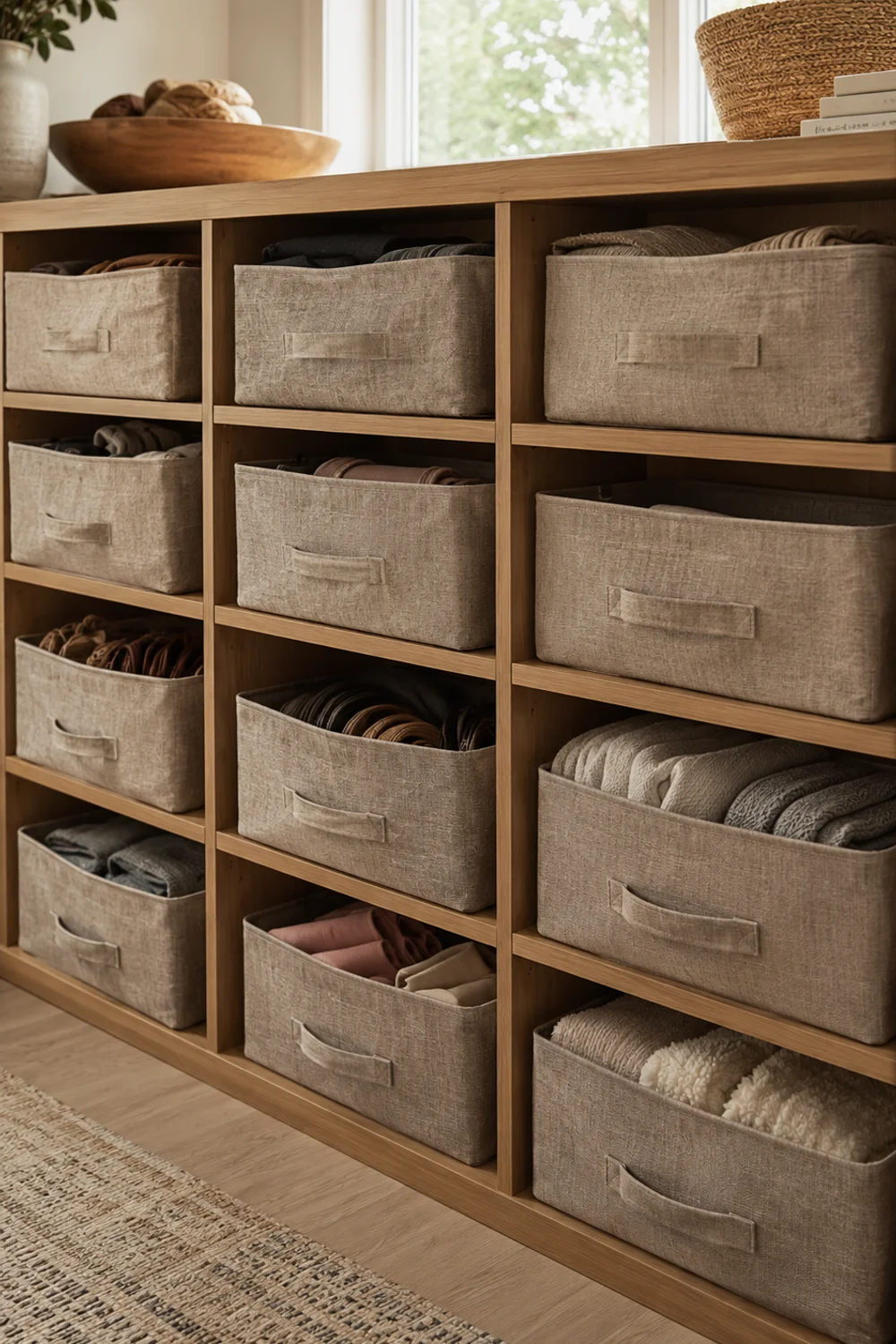
Open shelving offers visual appeal and easy access, but without some kind of internal structure, it quickly becomes a landing zone for loose, mismatched items. Sweaters slump sideways, smaller accessories slide between larger pieces, and the shelf that once looked styled starts looking cluttered within weeks. Professional organizers use this category specifically to bring flexible structure to shelving that would otherwise have none.
Fabric storage cubes slot neatly into standard shelf openings, creating defined sections for categories like workout clothes, off-season accessories, or extra linens without requiring any permanent shelving modification. Their soft sides make them easy to pull out and tuck back in one-handed, and because they’re available in a range of neutral tones, they integrate into a closet’s existing color palette rather than standing out as obvious storage.
For closets where shelving is shallower or narrower than standard, a slimmer cube profile maintains the same compartmentalizing benefit without overhanging the shelf edge — a detail that matters more than it might seem, since overhanging bins tend to look unfinished even when everything inside is tidy. This flexible, modular thinking shares a lot with Luxury Walk-In Closet Inspiration Ideas You Will Absolutely Love, which explores how structured zones create a more curated feel even in larger spaces.
The broader idea here is that shelving alone isn’t storage — it’s just surface area. Cubes, bins, and dividers are what actually convert that surface area into a system, and that distinction is often what separates a closet that photographs well from one that also functions well under daily use.
11. Felt Hanger Liners for Garment Stability and Care

 Save it
A small but persistent annoyance in many closets is clothing that won’t stay put — slipping off hangers, sliding down the rod, or bunching unevenly throughout the day. It seems minor until you notice how often it leads to extra wrinkling, stretched necklines, or garments ending up crumpled on the closet floor by evening. Organizers often address this with one of the simplest fixes available, applied directly to existing hangers rather than replacing them.
Felt hanger liners wrap around the arms of a hanger, adding just enough grip and cushioning to keep garments from sliding while also softening the point of contact where fabric meets the hanger’s edge. This is particularly useful for knitwear, which can stretch out of shape on a sharp-edged hanger over time, and for slippery synthetic blends that otherwise slide off entirely.
Unlike switching to an entirely new hanger system, liners work as a low-cost upgrade to hangers already in use, making them a practical option for anyone not ready for a full closet overhaul. They’re also reusable across hanger styles, so they travel easily if a household later transitions to the slim velvet system described earlier.
This solution illustrates a useful organizing instinct: not every fix requires replacing what you already own. Sometimes the better path is a small, targeted addition that solves the specific friction point — in this case, the gap between a hanger’s hard surface and a garment that needs gentler support.
12. Labeled Garment Bags for Special-Occasion Pieces

 Save it
Formalwear, holiday outfits, and other special-occasion garments present a different challenge than everyday clothing: they’re worn rarely, stored for long stretches, and often more delicate or structurally significant than the rest of a wardrobe. Treating them the same as daily-wear items — crammed onto a rod or folded into a bin — tends to result in damage or, just as often, simply forgetting the piece exists by the time the occasion comes around.
Labeled garment bags, ideally with a clear front panel or a printed label naming the item, keep these pieces both protected and identifiable without requiring an unzip-and-check process every time. Breathable fabric is important here rather than plastic, since trapped moisture can damage delicate fabrics like silk or embellished details over a long storage period between wears.
For households storing multiple occasion pieces, organizers often group bags by season or event type rather than by garment category, since the use case — a holiday party, a summer wedding — is usually what triggers the need to retrieve the item in the first place. This event-based grouping mirrors the same retrieval-first thinking discussed in the seasonal bin system earlier in this article.
The underlying lesson is that rarely-used items deserve a system built around how infrequently they’re accessed, not how often. A garment bag that protects and clearly labels a piece worn once a year prevents both fabric damage and the more common frustration of forgetting a perfectly good outfit was ever there.
Common Mistakes to Avoid
1. Storing items by season instead of by material behavior
This is one of the most common missteps, and it undermines even a well-intentioned system. A “winter” bin that mixes vacuum-sealable sweaters with structured wool coats forces a single storage method onto items that need completely different handling, often damaging the more delicate pieces in the process.
2. Skipping the decluttering step before organizing
Buying beautiful bins and dividers for clothes you no longer wear simply organizes clutter more attractively — it doesn’t remove it. Professional organizers always declutter first, because storage capacity should be allocated to what’s actually staying, not used to justify keeping everything.
3. Using mismatched, inconsistent hangers
A closet rod filled with three or four different hanger types creates visual noise and wastes space through uneven gaps, even when the actual quantity of clothing is reasonable. Standardizing hangers is one of the fastest fixes available, yet it’s frequently overlooked in favor of bigger, more visible projects.
4. Choosing opaque storage for items that need regular access
Storage that hides its contents only works for things you rarely need. Using opaque bins for anything accessed even occasionally creates daily friction, and that friction is usually what causes a system to be abandoned within a few months.
5. Forgetting moth and pest prevention until damage appears
Natural fiber protection is often treated as optional, added only after a sweater turns up with holes. By then, the damage is irreversible. Cedar and lavender solutions are inexpensive enough that building them into the system from day one makes far more sense than reacting after the fact.
Frequently Asked Questions
How often should seasonal closet rotation actually happen?
Most professional organizers recommend a true seasonal swap two to four times a year, depending on climate. In regions with mild winters, a simpler two-rotation system — warm and cool — often works just as well as a strict four-season approach, so the right frequency depends more on your actual wardrobe needs than a fixed calendar rule.
Is vacuum sealing safe for all fabric types?
No. Vacuum sealing works well for compressible, resilient fabrics like cotton, wool, and down, but it can damage structured items, anything with stiff interfacing, and delicate fabrics like silk that don’t recover well from prolonged compression. Structured or delicate pieces are better suited to breathable garment bags instead.
Do I need a different system for a small closet versus a walk-in?
The core principles stay the same, but small closets benefit more from vertical solutions like over-the-door organizers and stackable shoe boxes, since floor and shelf space are limited. For more space-specific guidance, 11 Stunning Open Closet Styling Ideas Worth Copying Right Now and Everything You Need to Know About Organizing a Small Apartment Closet both offer approaches tailored to tighter footprints.
What’s the single highest-impact change for someone just starting out?
Hanger standardization is consistently cited as the fastest, most visible improvement, since it reframes the entire closet without requiring any decluttering or purchasing decisions beyond the hangers themselves. It’s often the entry point that motivates people to tackle the rest of the system.
Final Thoughts
The tools professional organizers actually use aren’t secret or expensive — they’re simply chosen with intention, matched to the specific problem each category of clothing or accessory presents. Compression for bulk, visibility for rotation, dividers for small items, protection for natural fibers: each solution exists because it addresses something a generic bin or empty shelf cannot.
What ties all twelve of these approaches together is a shift away from treating the closet as a single space and toward treating it as a set of distinct micro-systems, each with its own logic. Once that mindset takes hold, seasonal changeovers stop feeling like a chore that has to be relearned every few months and start feeling like a routine your closet was actually built to support.
Start with one or two categories that feel most frustrating right now, save the ideas that resonate, and build the rest of the system gradually as the seasons turn.
This post contains affiliate links. I may earn a small commission at no extra cost to you.

Get cozy inspiration delivered to your inbox.
✓ 14-page beautifully designed ebook
✓ Cozy decorating ideas
✓ Practical room-by-room inspiration
You’re in! 🎉
Thanks for joining the NestFlowHome community!
Your free ebook is already on its way to your inbox. If you don’t see it within a few minutes, please check your Promotions or Spam folder.
Join the NestFlowHome community for weekly decorating inspiration.

Timeless home decor ideas and slow living inspiration for a calm, beautiful life.