
The Best Aesthetic Closet Storage Ideas for Small Bedrooms
By Emily | June 19, 2026
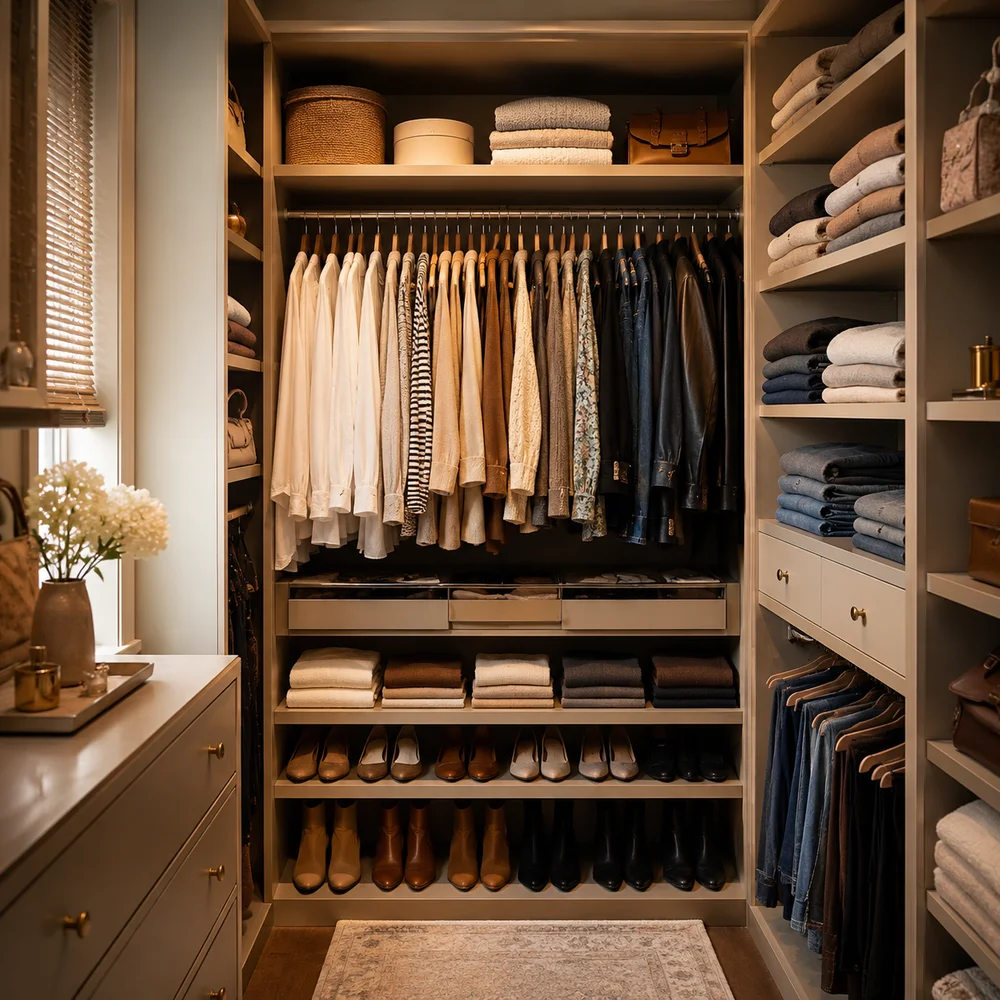
There’s a version of your closet that you’ve probably imagined — one where you open the door in the morning and everything is immediately visible, immediately calm, immediately beautiful. Not a closet you tolerate, but one that makes getting dressed feel like the best part of the day. This isn’t a fantasy reserved for large walk-ins or designer renovations. It’s a specific result that comes from a specific way of thinking about small closet spaces.
Most people approach closet organization as a purely functional problem — how to fit more in less space. But the closets that actually feel good, the ones that hold your attention and make you pause before closing the door, aren’t just efficient. They’re composed. Every element has a visual relationship with the others. The materials speak the same language. The light falls in the right places. And there’s enough breathing room that nothing feels desperate or crammed.
The aesthetic closet and the functional closet are, it turns out, the same closet. Visual calm comes from order. Order comes from intentional systems. And intentional systems, when chosen with even a small amount of attention to material and form, become beautiful almost automatically. You don’t have to choose between a closet that works and a closet that looks like a Pinterest board — those are the same goal, expressed at different stages of the same project.
This article covers ten specific ideas for creating that closet in a small bedroom — from how you arrange open shelves to how the space smells when you open the door. Each one is practical, achievable, and aesthetically meaningful on its own.
1. Why Aesthetic and Functional Are the Same Decision in a Closet
 Save it
The moment most people decide to organize their closet, they separate the project into two categories: practical storage and decoration. One comes first, the other is added later if there’s money or energy left. This is the source of most closet frustration — not limited space, but the assumption that beautiful and useful are different things that must be balanced against each other. In a small closet, they cannot be separated. Every system you choose will be seen. There’s no room to hide the infrastructure behind cabinet doors or decorative trim.
When something works well in a small closet, it usually looks good by design logic. A row of identical containers on a shelf creates visual calm because the eye doesn’t have to negotiate competing shapes — and it also makes items easier to find because the categories are clear. A single hanging rod positioned at the right height creates clarity because the clothes are at the same level and the area beneath is usable — and it also looks composed because there’s a consistent horizon line. Functionality and aesthetics follow the same principles: consistency, proportion, and clarity.
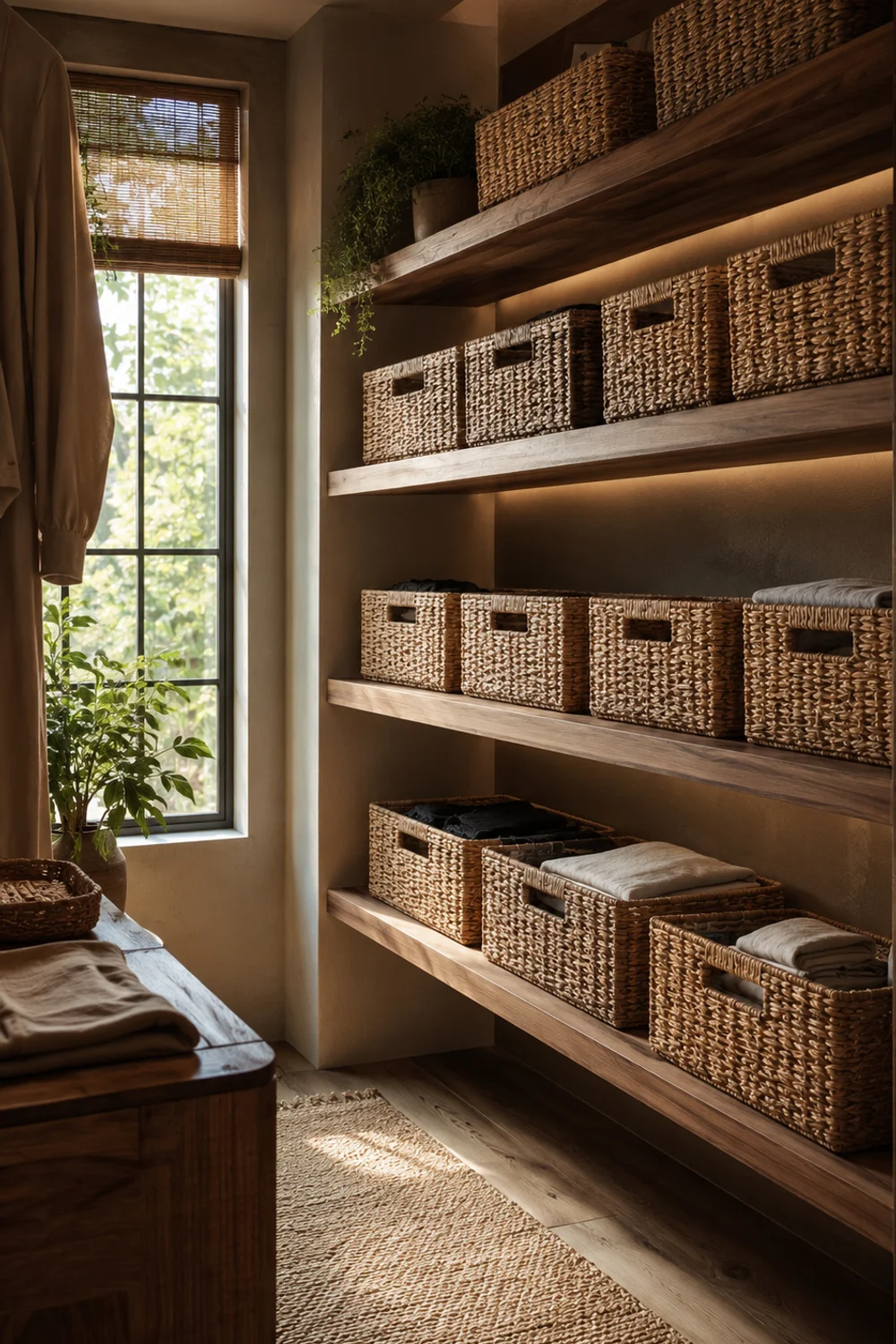
This overlap becomes even more specific when you think about materials. Choosing storage systems that share a material family — wood, woven fiber, linen — creates visual cohesion that reads immediately as intentional and refined. A closet full of mismatched plastic bins from different shopping trips looks chaotic not because it’s disorganized, but because the eye processes too many different surfaces at once. Cohesive materials reduce visual noise, which makes the space feel calmer and larger than it is. That’s both an aesthetic and a functional benefit.
The deeper truth is that the best aesthetic decisions in a small closet are almost always structural decisions disguised as style choices. When you decide how high the shelf sits, where the hanging rod goes, how much space to leave between categories — you’re making spatial decisions that determine both how well it works and how it looks. Getting those decisions right is the real work of closet organization, and it’s the foundation everything else builds on.
2. Open Shelving as Architectural Composition
 Save it
Open shelves in a small closet feel intimidating to many people because they seem to demand perfection — everything will be visible, always. But this visibility, when approached correctly, is actually the quality that makes a small closet feel most sophisticated. Closed storage hides everything, which creates mystery. Open shelving creates transparency, and transparency in a well-organized space becomes elegance. The goal isn’t to hide what you own. It’s to arrange what you own in a way that’s worth looking at.
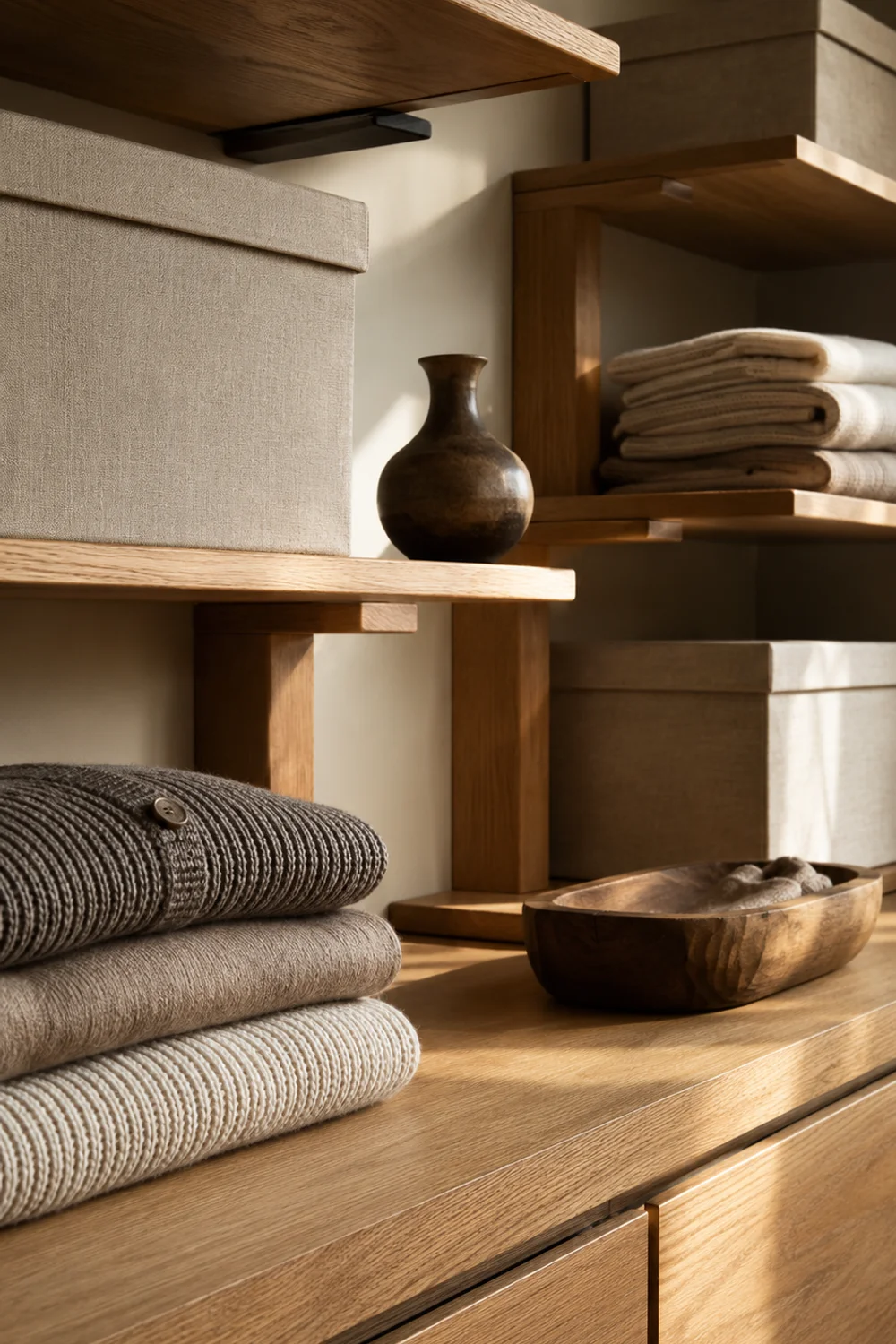
The key to open shelving in a small closet is thinking about it the way an art director thinks about a gallery wall — as a composition. Every shelf is a horizontal layer. Every group of objects is a visual cluster. The space between objects matters as much as the objects themselves. When you arrange items on an open shelf without thinking about negative space, everything compresses into a visual wall of stuff. When you leave intentional gaps — a small empty stretch before a stack of folded sweaters, a single decorative object at the end of a row — the shelf breathes, and the eye moves through it with ease.
Height variation is the technique that transforms a flat shelf into a composition. Shelf risers allow you to create different levels within a single shelf, which adds depth and makes the whole surface feel curated rather than simply filled. A lower platform on the left, the original shelf surface in the middle, a slightly elevated riser on the right — the eye reads this as deliberate, which it is. It’s the same principle that makes a well-styled bookshelf look like interior design instead of storage.
The deeper principle of open shelving in a small closet is that it forces a kind of ongoing editing. Because everything is visible, you notice when something is out of place. This creates a natural maintenance habit — things get put back correctly because the alternative is immediately obvious. Closed storage, paradoxically, allows clutter to accumulate invisibly until it becomes overwhelming. Open shelves, styled as architecture, become their own incentive to stay organized; for ideas on structuring that open system across different closet shapes and proportions, Small Closet Organization Ideas That Actually Work and Look Stunningly Beautiful explores how this visibility principle applies to narrow reach-in configurations specifically.
3. The Container Edit: Material Consistency as Visual Logic
 Save it
There’s a specific visual relief that happens when you open a well-organized closet and see storage containers that all belong to the same material family. It’s the same feeling you get in a hotel room where every surface makes sense together — where the lamp, the tray, the tissue box all feel like they were chosen by someone who was thinking about the room as a whole. That feeling is achievable in any small closet. It comes from a single decision made before you buy anything: choose a material and commit to it.
In practice, this means deciding whether your storage system is built around linen, natural wood, rattan, matte white, or another specific material, and then purchasing only containers that belong to that category. The specific material matters less than the commitment. A closet where every container is woven rattan will feel cohesive and calm. A closet where some containers are rattan, some are clear acrylic, some are fabric, and some are cardboard will feel visually restless even if every item is technically organized. Material consistency is the invisible grammar of an aesthetic closet.
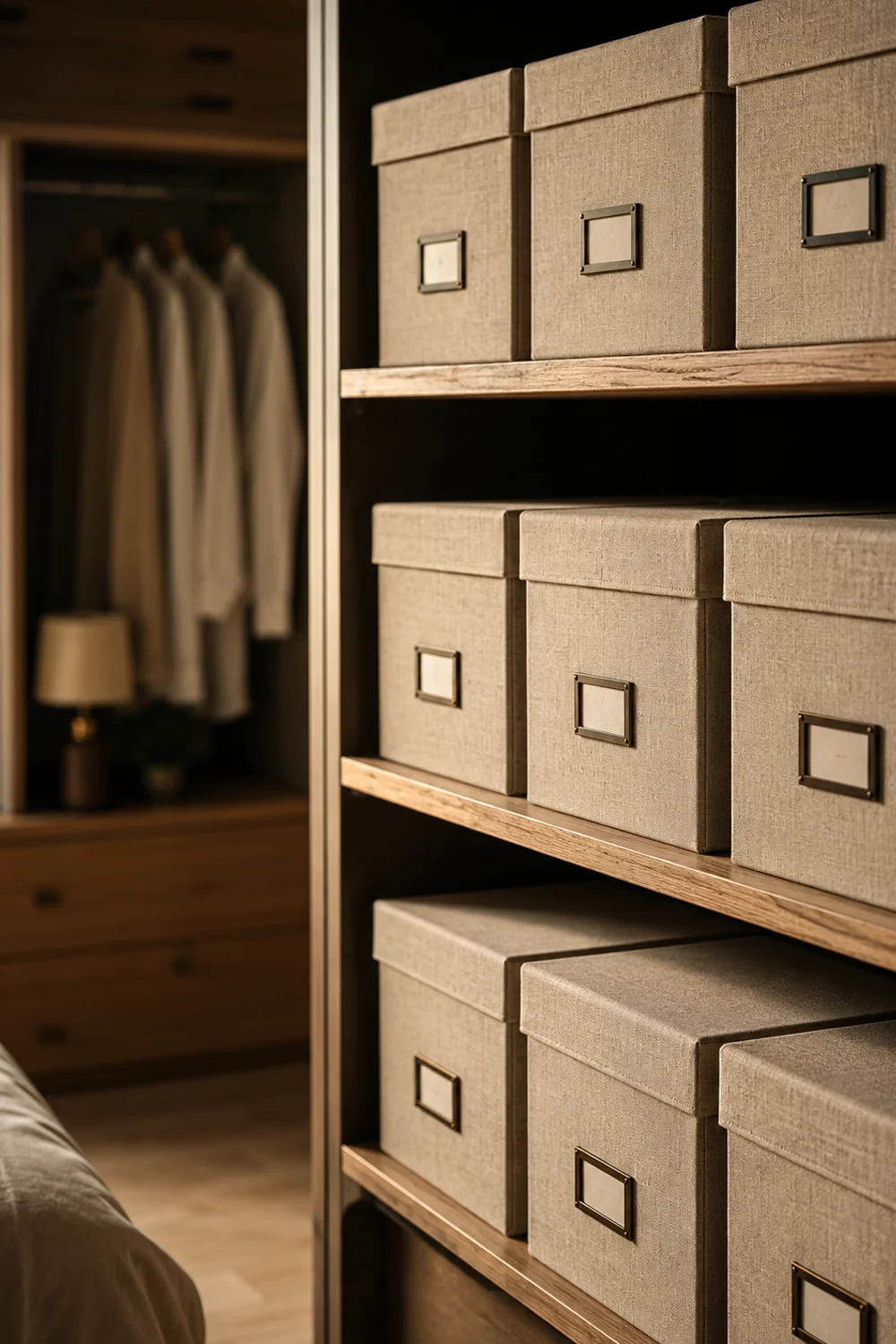
Linen storage boxes with a label window are a particularly useful format for small bedroom closets because they work at multiple scales. They can hold folded items at the top of a shelf, organize smaller accessories at eye level, and stack cleanly on a floor surface when the closet is shallow. The soft texture of linen also introduces warmth — which is especially important in a small closet where hard-edged plastic or acrylic can make the space feel clinical and unwelcoming even when it’s technically tidy.
The label window detail is worth noting not just for function but for the visual logic it creates. When every container has the same font, the same label size, the same position on the box, the closet develops a kind of typographic consistency that reads immediately as designed. This is what separates a container collection from a storage system. The label becomes a small repeated element that ties everything together across different shelves and zones, and that repetition — that visual rhythm — is what gives the closet its editorial quality.
4. Shoe Display as a Curated Grid
 Save it
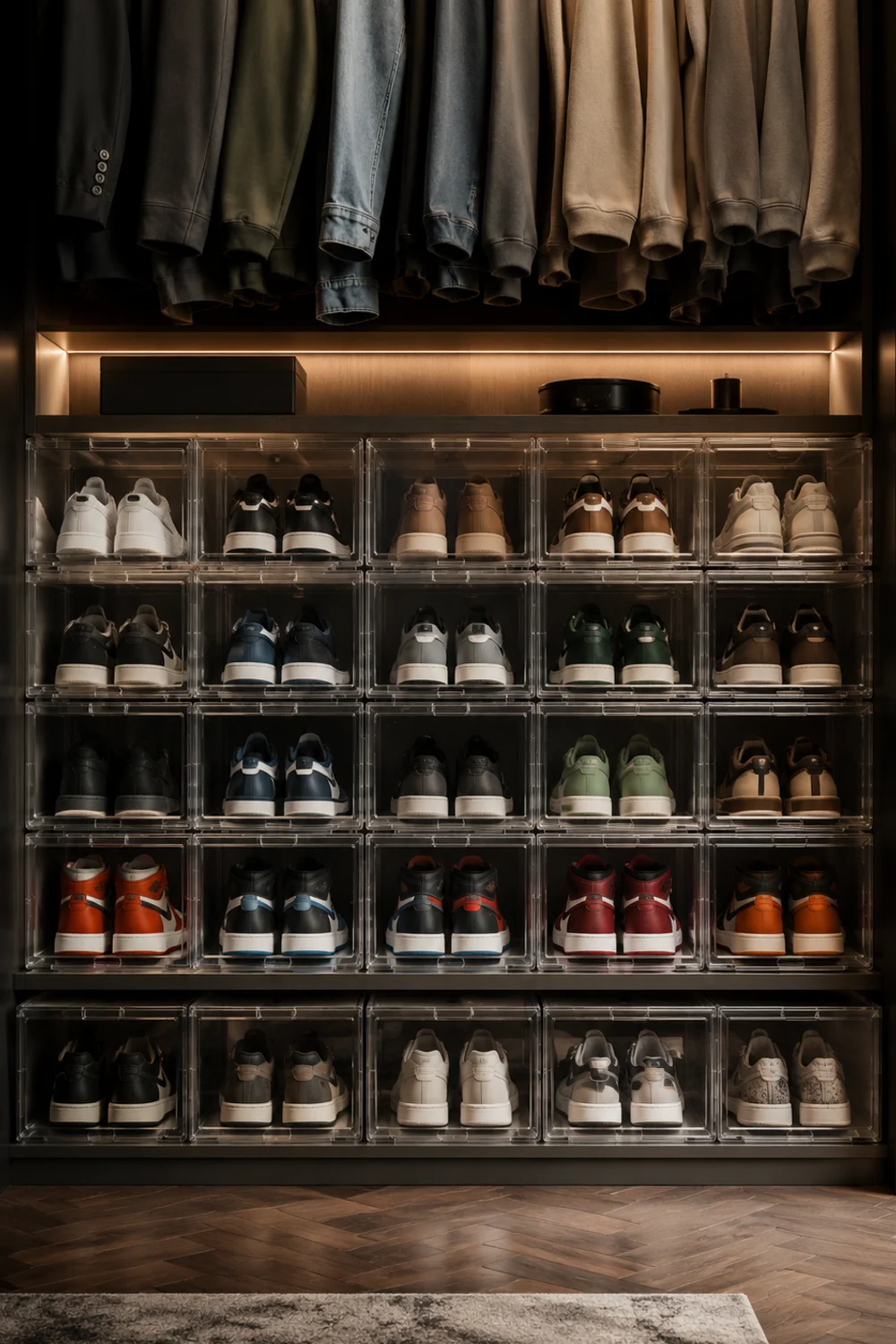
Shoes are often the most visually chaotic element in a small closet — not because they’re difficult to store, but because they exist in many different shapes, heights, and colors. A pile of shoes on a closet floor, or a stack of mismatched shoe boxes, creates immediate visual disorder that undermines the quality of every other organizational choice nearby. The solution isn’t simply to contain them — it’s to display them in a format that has its own visual logic. A curated grid of shoes is the difference between storage and curation.
The clearest expression of this idea is a uniform row of transparent boxes arranged in an even grid. When every shoe is in the same container, the closet floor or shelf surface reads as a composed arrangement rather than an accumulated pile. The shoes themselves — their varied colors and silhouettes — become the visual interest, framed by the identical containers the way artwork is framed on a wall. The grid becomes the architecture, and the shoes fill it the way any curated collection fills a display system.
Magnetic closure shoe boxes are a specific refinement of this approach worth considering in a small space. The magnetic front panel drops open for access without requiring you to lift the entire box — which is particularly useful when boxes are stacked. Being able to see the shoes through the clear panel without opening each box adds another layer of functionality that directly supports the aesthetic: you can find what you need quickly, which means you’re less likely to pull multiple boxes open and disrupt the grid.
The broader principle here connects to how museums think about display. Objects in a collection become more meaningful when the display format recedes — when the container, the lighting, and the arrangement all work together to focus attention on the objects themselves rather than on the storage infrastructure. A well-organized shoe grid in a small closet achieves something similar. The closet stops being a place where shoes are put away, and becomes a place where a collection of shoes is kept. That’s not a semantic difference — it’s a fundamentally different relationship with the space.
5. The Role of Negative Space — What You Don't Fill
 Save it
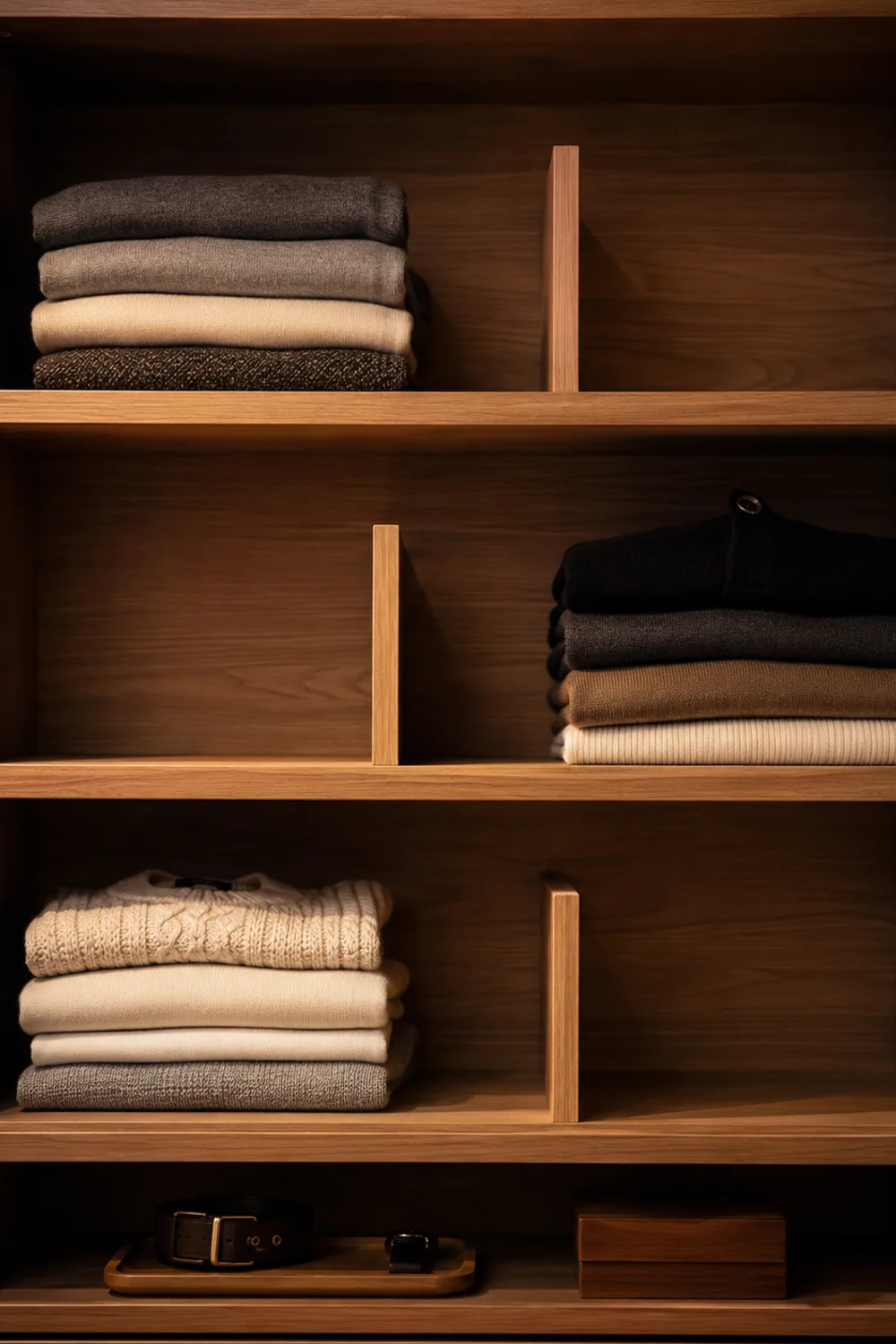
In almost every small closet transformation, the instinct is to use every available inch. Every shelf gets filled. Every corner gets a solution. Every vertical surface gets a hook or a rack. And the result, no matter how carefully chosen the individual elements are, is a closet that feels compressed and anxious — a space that communicates scarcity rather than abundance. This is the paradox of maximizing small storage: the more completely you fill a small space, the smaller it feels. Negative space isn’t wasted space. It’s what makes everything else readable.
Negative space in a closet works on several levels simultaneously. Visually, an empty portion of a shelf draws the eye and creates a moment of rest before it moves to the next cluster of objects. Spatially, a zone without objects makes the closet feel deeper and wider because your eye can move through it without stopping. Practically, negative space leaves room for the closet to absorb new items without immediately becoming overcrowded — which is what makes organization sustainable rather than something that has to be redone every few months.
Shelf dividers are one of the most effective tools for maintaining intentional negative space without sacrificing organization. When a folded stack of sweaters has a divider on each side, it becomes a defined zone rather than a pile that can slowly expand to fill the whole shelf. The divider holds the shape of the category, which means the space beside and above it stays genuinely empty rather than gradually colonized. This is a simple tool, but it changes the relationship between the objects and the shelf in a fundamental way.
The question of what you don’t fill is ultimately a question about how much you own versus how much space you have. The most honest version of aesthetic closet organization acknowledges this directly. If a small closet feels overcrowded, the container system is rarely the issue — it’s the volume of possessions relative to the space. But within whatever volume you have, the deliberate choice to leave some surfaces partially empty, to not fill every corner, to allow the space to breathe, will make a more visible difference than any additional storage product. Negative space is the most underestimated design tool in a small bedroom closet, and for the broader systems thinking that determines how much space each category should occupy in the first place, Everything You Need to Know About Organizing a Small Apartment Closet provides the structural framework that makes this principle work in practice.
6. Fabric Storage That Reads as Furniture
 Save it
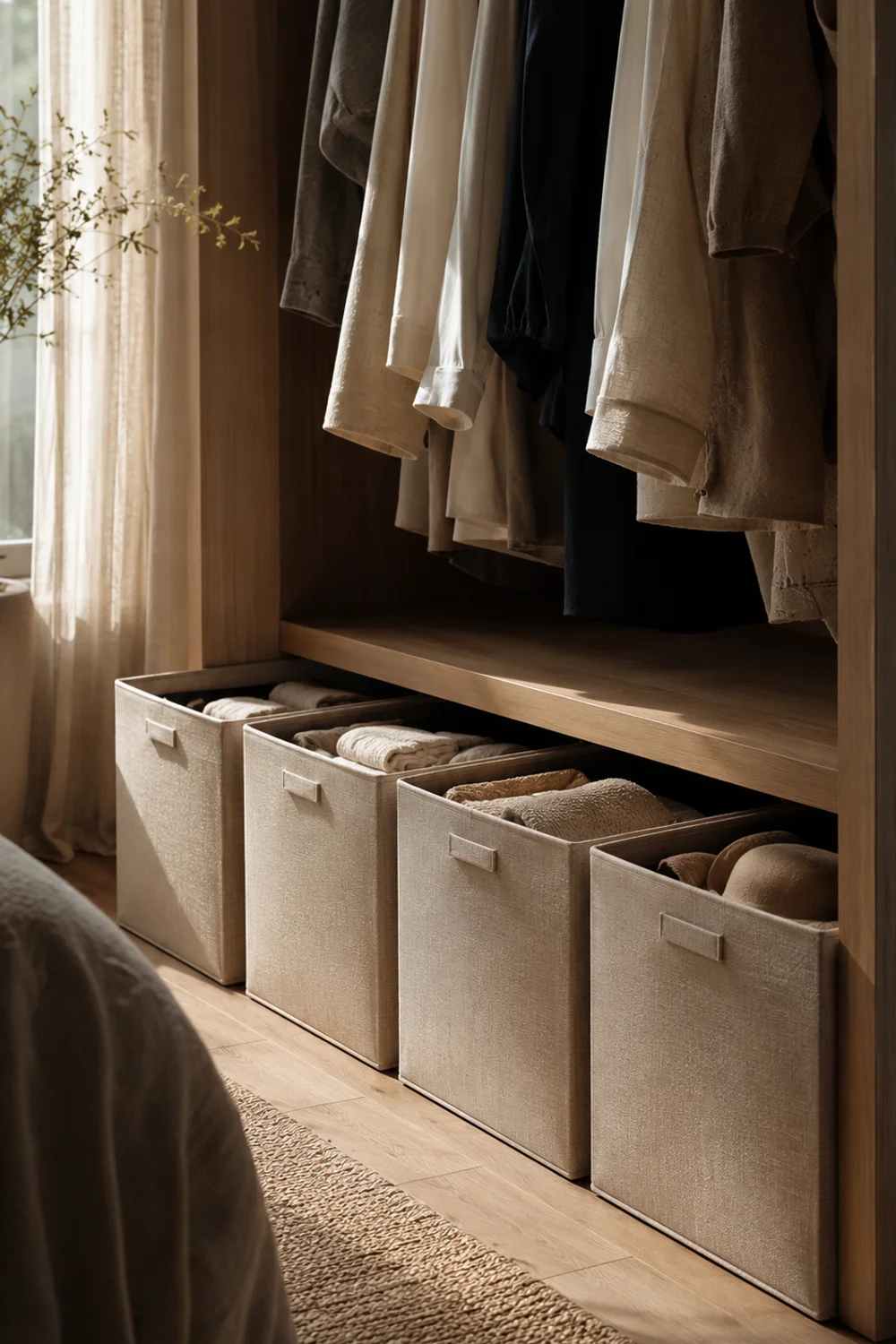
One of the most effective shifts you can make in a small bedroom closet is to choose fabric storage pieces that feel less like organizational products and more like soft furnishings. This isn’t purely an aesthetic preference — it has spatial logic. When storage pieces feel like extensions of the bedroom’s furniture vocabulary — soft, textured, grounded — the closet begins to feel like a continuation of the room rather than a separate utilitarian space hidden behind a door. That continuity, especially in a small bedroom where every design decision is visible from everywhere, has a significant effect on how the whole room feels.
The specific quality to look for in fabric storage is weight and structure. A fabric box that collapses when empty or wrinkles visibly after a few uses reads immediately as a low-cost organizational accessory, regardless of how neatly it’s filled. A fabric cube with firm internal structure, clean corners, and a material that holds its shape — linen, canvas, or structured cotton — reads as something deliberate. The difference in visual quality is significant, and it doesn’t require a large price difference. It requires choosing by material and construction rather than by price and size alone.
Open-face linen fabric cubes scaled for bedroom use — not the oversized versions sold for playrooms or living room media units — are particularly well-suited to small closets because they work both inside and outside the closet itself. On the floor of a small closet, a row of open-face linen cubes creates an organized, visually soft base layer. On a closet shelf, smaller versions can hold folded accessories, rolled scarves, or seasonal items. And if the closet is open or doorless, fabric storage pieces that feel intentional rather than utilitarian make the closet a visual asset to the bedroom rather than a visual liability.
The broader design principle at work here is the idea that storage and furniture exist on the same spectrum, and the best small-space design doesn’t draw a hard line between them. A fabric storage piece that feels like furniture contributes to the overall warmth and softness of the room. It doesn’t ask to be hidden. It functions as part of the room’s material story, which is exactly what you want in a small bedroom where the closet and the sleeping area share the same visual field, often without any architectural separation.
7. The Wall Surface Beyond the Hanging Rod
 Save it
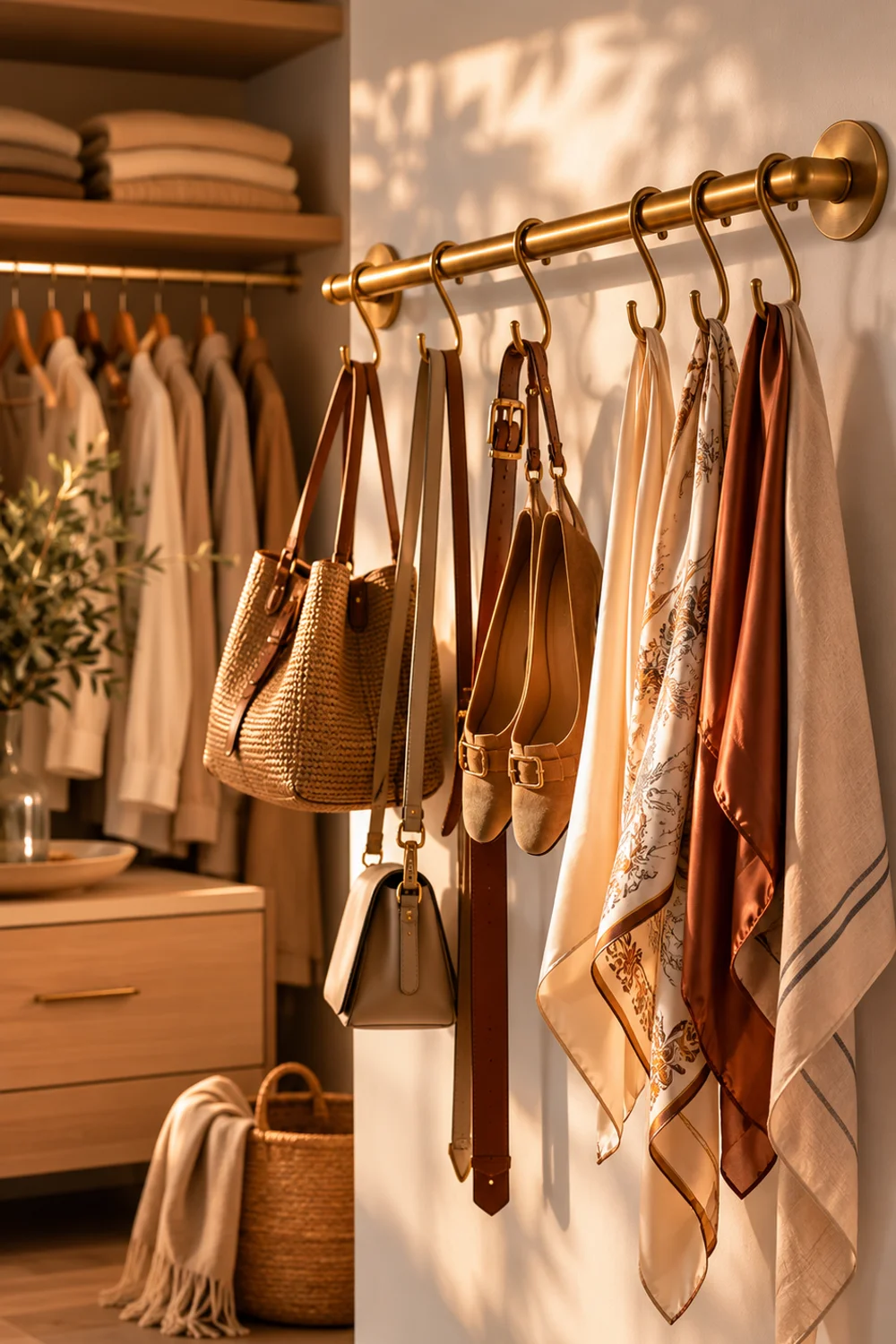
Most small closets are organized exclusively around the hanging rod — everything is planned in relation to it, and the remaining wall surfaces are treated as afterthoughts. The back wall, the side walls, and the area above the rod are often completely blank, or covered with a single generic shelf that was there when you moved in. This is one of the most missed opportunities in small closet design. The wall surfaces beyond the hanging rod are prime organizational real estate, and when used thoughtfully, they contribute significantly to both the function and the visual character of the space.
Wall-mounted hook rails are one of the most elegant solutions for side walls and the back wall of a small closet. Unlike individual hooks, which look scattered and improvised, a hook rail creates a linear element — a horizontal line of hardware that reads as intentional and designed. Bags, belts, scarves, and jewelry chains hung from a brass hook rail form a visible collection rather than a pile. The items are easy to find, easy to access, and the rail itself contributes a material moment — particularly in warm metal tones — that elevates the overall aesthetic of the space.
The area above the hanging rod is another surface that deserves a system rather than an assumption. In many small closets, this space holds a single shelf that’s too high to use comfortably and too shallow to hold much. Reconsidering this zone — replacing a single awkward shelf with a series of intentionally spaced shelves, or adding labeled storage boxes at a reachable height — can significantly increase the usable capacity of the closet without changing its footprint. This is where folded items that aren’t in daily rotation live best: seasonal pieces, occasion wear, spare linens — and 15 Small Bedroom Ideas for Better Storage and Smart Layouts covers several above-rod configurations that work specifically in compact bedroom closets where ceiling height is the main variable.
The closet wall surface is also where lighting decisions have the most impact, because it’s the surface light falls against most directly. A wall-mounted hook rail with a warm brass finish will look completely different under a cool overhead light versus a warm LED bar — not because the rail changed, but because the light changes how the material reads. Thinking about the wall surfaces and the lighting as a single decision, rather than two separate ones, is what makes small closets feel intentionally designed rather than simply organized.
8. Light Inside the Closet as Atmosphere
 Save it
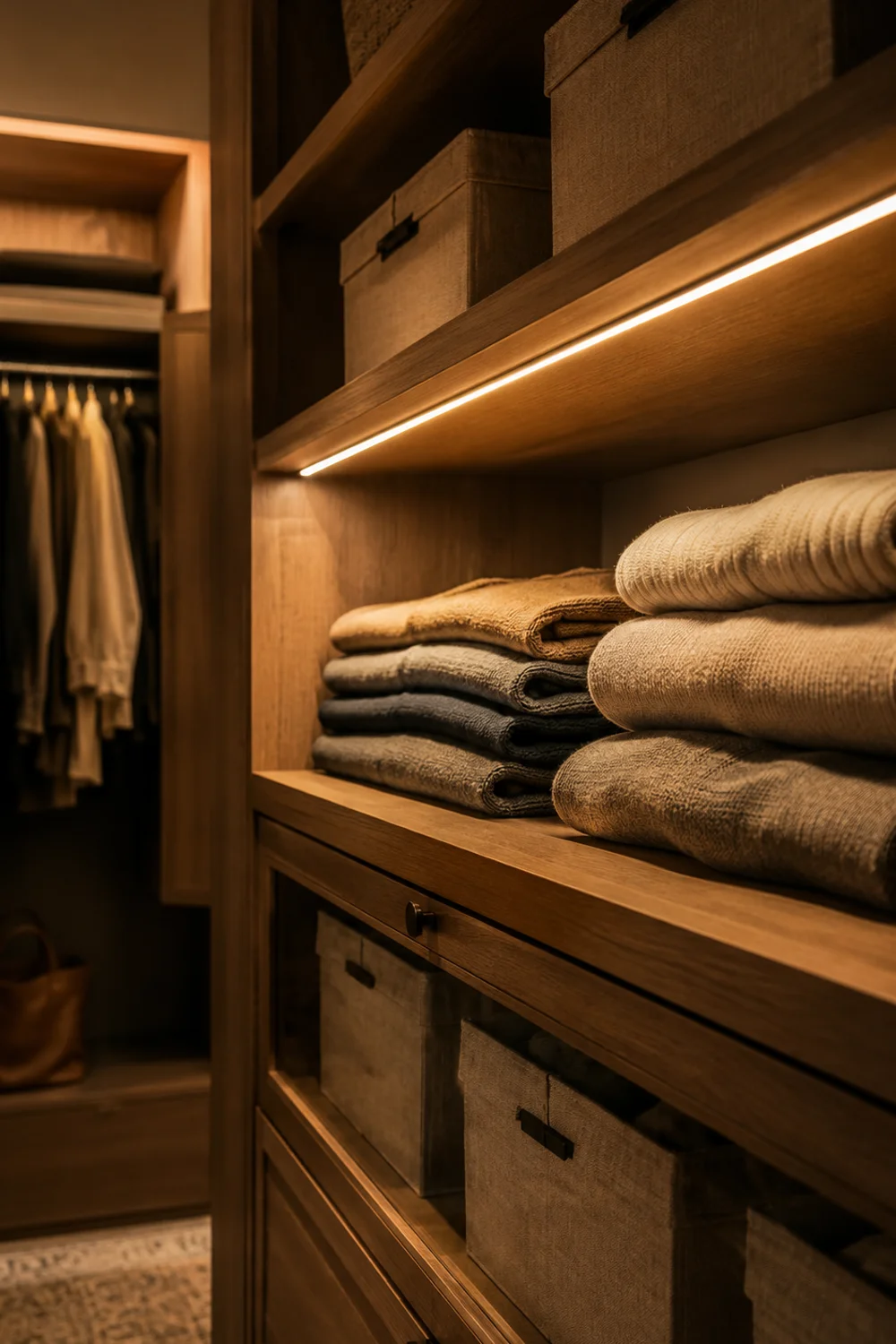
Most small closets have no dedicated lighting, or a single overhead fixture that floods the space with flat, even light that makes everything look equally visible and equally uninspiring. The absence of considered lighting is one of the most common reasons a well-organized closet still feels utilitarian — because light doesn’t just help you see, it creates mood, depth, and warmth. A closet lit with a warm, well-positioned light source feels fundamentally different from the same closet lit with a bare overhead bulb, even if every organizational element is identical.
The most immediate improvement is a rechargeable LED light bar positioned at shelf level, ideally mounted on the underside of a shelf so it washes warm light downward across the clothes and containers below. This directional quality — light coming from a specific angle rather than diffused from above — creates depth. Shadows form behind objects, which gives the space a three-dimensional quality. Items look more considered, more displayed, more intentional. It’s the same principle that makes boutique retail feel different from a department store: targeted light makes objects look better by design.
Color temperature is the specific variable that matters most in closet lighting. Warm white LEDs, around 2700K to 3000K, render fabrics beautifully — they bring out the warmth in neutrals, the depth in earth tones, and the softness in creams and linens. Cool white LEDs above 5000K make everything look sharp and slightly clinical, which is useful in a workshop but actively undermines the atmosphere you’re trying to create in a bedroom closet. When choosing any closet light, check the Kelvin rating before buying. This single number determines more about how the finished space feels than almost any other lighting specification; for how closet color temperature connects to the broader bedroom lighting environment it sits within, Brighten Your Bedroom the Modern Minimalist Way: Expert Lighting Ideas explores that relationship in practical detail.
The rechargeable format has a specific practical advantage in a closet context: no wiring, no electrician, no permanent installation. The light bar adheres to a shelf surface, charges via USB, and can be repositioned if the closet layout changes. For renters especially, this is the most accessible way to add quality light to a space that was never designed for it. For anyone working with a small bedroom closet, the difference between a warm, well-lit interior and a dim or harshly lit one is so significant that lighting deserves to be one of the first decisions made, not one of the last.
9. Scent as the Invisible Layer of a Refined Closet
 Save it
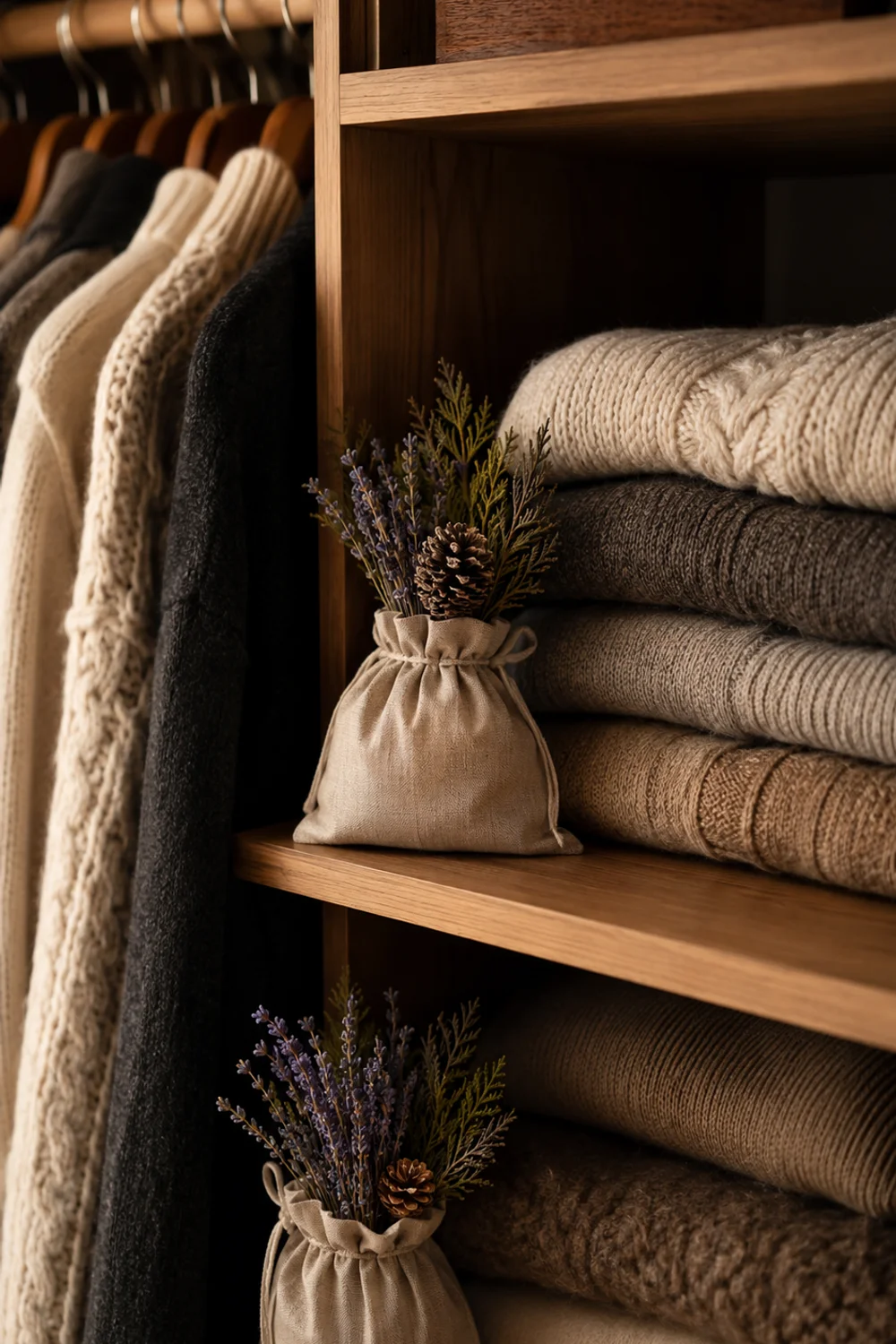
Scent is the organizational detail that nobody talks about and almost everyone overlooks, which makes it one of the most underrated ways to differentiate an aesthetic closet from a merely organized one. A closet that smells beautifully is a different sensory experience from one that smells like nothing — or worse, like plastic storage containers and dust. The moment you open a closet and a gentle cedar and lavender note reaches you, the space communicates refinement before you’ve seen a single shelf. Scent is the invisible layer of atmosphere that completes a closet’s identity.
The psychology of this is straightforward but worth stating clearly. Scent is processed by the brain’s limbic system — the same area associated with memory and emotion — before it’s analyzed consciously. This means a scent impression happens immediately, involuntarily, and attaches itself to the feeling of the whole experience. A closet that smells like lavender becomes associated with calm. Cedar suggests quality and care. The combination of both is specifically associated with wardrobes in higher-end contexts — hotels, boutiques, renovated period homes — because those environments have been using this combination deliberately for a long time.
Cedar and lavender sachets have the additional practical benefit of being natural moth deterrents, which makes them functional in the most literal sense — they protect wool, cashmere, and natural fibers from damage. But the functional argument almost undersells the point. The scent is the contribution that’s most immediately felt. Placed on a shelf near folded knitwear, tucked between hanging pieces, or positioned near the back wall, the sachet diffuses its fragrance gently and continuously without overwhelming. This is the quality to look for: a scent that’s present but not assertive, that you notice when you open the door and then settle into without thinking about.
The connection between scent and the experience of getting dressed is one of those subtly powerful things that shapes your relationship with a space over time. When the act of opening your closet produces a small, consistent sensory pleasure — the warm light, the ordered surfaces, the gentle fragrance — it reinforces the habit of treating the space with care. You’re more likely to put things back correctly, more likely to notice when something is out of place, more likely to appreciate the investment of time and thought that went into creating the system. Scent closes the loop between the visible and the felt, and that’s exactly where the best small-space design lives.
10. Keeping the Aesthetic Cohesive as the Wardrobe Changes

 Save it
An aesthetic closet is not a static installation. It’s a system that has to absorb new purchases, seasonal exchanges, and the natural evolution of a wardrobe over time without losing its visual coherence. This is the challenge that most closet organization guides never address — not how to make it look good once, but how to keep it looking good as real life happens inside it. And in a small bedroom closet, where the system has little tolerance for visual chaos, this question of maintenance is as important as the initial setup.
The most reliable answer is to define the constraints before the contents. A fixed number of containers per category — three linen boxes for folded tops, eight shoe boxes, one basket for accessories — creates a limit that serves as an automatic editing mechanism. When something new comes in, something else has to be assessed. The containers don’t expand to accommodate accumulation; the accumulation has to fit within the containers. This sounds like a restriction, but it actually creates the condition for an aesthetic closet to remain aesthetic: the visual form stays consistent because the quantities are controlled.
Hanger uniformity plays a specific role in maintaining cohesion over time. When every hanging item is on the same hanger — same width, same material, same hook color — the hanging zone retains a composed, linear quality regardless of what clothes occupy it. A wardrobe that evolves seasonally, adding new pieces and retiring others, will look consistently organized on uniform wooden hangers with a warm brass hook in a way that it never will on a collection of wire, plastic, and different-thickness velvet hangers accumulated from different purchases. Uniformity here is not rigidity — it’s the structural grammar that lets the contents change freely.
The longer view is that the effort you invest in setting up a considered, material-consistent closet system pays a dividend that increases over time, and for more ideas on building that kind of lasting organizational clarity, Closet Organization Ideas You’ll Fall in Love With covers several approaches that complement the aesthetic framework developed here. A closet that was designed to evolve gracefully — with defined containers, uniform hardware, and intentional negative space — becomes easier to maintain as the seasons change, not harder. The system does the work of holding the aesthetic together, and the wardrobe changes within it without disrupting it. That’s the goal: not perfection at a single moment, but a structure that makes beauty sustainable.
Common Mistakes
1. Buying containers before establishing a system
This is where most closet projects go wrong before they begin. The impulse to purchase beautiful storage pieces — baskets, boxes, risers — before understanding how the space will be organized produces containers that don’t fit the shelves, overlap in function, or solve problems that don’t exist in your specific closet. The result is usually a collection of mismatched solutions that adds visual clutter rather than reducing it. Before buying anything, measure the closet, identify the specific categories that need containing, and decide on the spatial organization. Then purchase containers that solve those exact problems in those exact dimensions.
2. Choosing a material palette without committing to it
Selecting a linen box here, a rattan basket there, a clear acrylic organizer for a different zone, and a wire rack for the shoes creates a storage system that looks assembled rather than designed. Even if every individual piece is attractive in isolation, the combination produces visual noise because the eye has to negotiate too many different materials simultaneously. Choosing a single material direction — linen, natural woven fiber, matte white, warm wood — and purchasing all storage pieces within that language is the single most efficient aesthetic decision you can make in a small closet.
3. Maximizing capacity at the expense of negative space
The instinct to fill every available inch is understandable in a small bedroom closet, but it consistently produces spaces that feel more cramped after organization than before. Visual calm requires breathing room. A shelf that’s filled from edge to edge communicates pressure. The same shelf with a deliberate empty zone before a well-organized group of containers communicates control. Leaving intentional negative space — even a few inches at the end of a shelf, even a gap between two storage zones — dramatically changes how the overall closet reads.
4. Installing lighting as an afterthought
Closet lighting is almost always the last thing people address, if they address it at all. But the quality of light inside a closet determines how everything else in it is perceived. Containers that look warm and refined under 2700K warm white LEDs can look institutional and flat under a bare overhead bulb. If lighting is added after the system is already in place, the positioning options are limited and the impact is reduced. Considering lighting early — deciding where a light bar would have the most effect before the shelves are installed — produces a significantly better result.
5. Organizing categories by frequency without considering visual logic
A system that’s organized purely by how often things are used — daily items at the most accessible level, occasional items at the top — can still produce a visually incoherent result if the categories themselves are mixed indiscriminately within each zone. An aesthetic closet requires that visual logic and functional logic work together. Items in the same visual family — similar colors, similar materials, similar sizes — should share zones even when that means a slight compromise in access convenience. The visual coherence is what makes the organization sustainable, because a beautiful system is one you’re motivated to maintain.
Frequently Asked Questions
What is the most important first step when organizing a small closet aesthetically?
The most important first step is measurement, followed immediately by category mapping. Measure every shelf, every hanging zone, every floor surface, and every wall. Then list every category of item that will live in the closet and estimate how much physical space each category requires. This process tells you what systems you need before you’ve spent any money, which prevents the common mistake of buying beautiful storage pieces that don’t fit the actual dimensions of the space. The category-to-space mapping this produces is the clearest foundation for effective closet organization.
How do I maintain an aesthetic closet over time as my wardrobe changes?
The most effective maintenance strategy is to define fixed container limits before setting up the system, and to commit to those limits as the wardrobe evolves. When every category has a dedicated container of fixed size, additions require subtractions — new items can’t accumulate without displacing existing ones. This automatic editing mechanism is what keeps a small closet from gradually drifting back toward overcrowding. Uniform hangers, consistent labeling, and seasonal reviews of the system also help. Seasonal reviews of the closet system — reassessing what stays, what moves, and what no longer belongs — are what prevent gradual drift from undoing the initial setup.
Is open shelving practical in a small closet, or does it just look good in photos?
Open shelving is genuinely practical in a small closet when it’s paired with consistent containers and maintained regularly. The visibility that makes open shelves seem risky is actually a maintenance advantage: you see immediately when something is out of place, which creates a natural incentive to restore order. The challenge is the initial commitment to material consistency — open shelving looks disorganized when containers are mismatched, and looks architectural when they’re unified. It also requires slightly more active maintenance than closed storage, but rewards that maintenance with a visual quality that closed storage simply cannot provide.
How do I choose the right lighting for a small closet?
The two variables that matter most are position and color temperature. Position the light at shelf level — on the underside of a shelf, directed downward — rather than at ceiling level, so the light creates depth rather than flooding the space evenly from above. Color temperature should be warm white, between 2700K and 3000K, to render fabrics and natural materials attractively. Rechargeable LED light bars are the most accessible format for renters and anyone who wants to experiment with positioning before committing. The rechargeable format also allows easy repositioning if the closet layout changes after the initial setup — a practical advantage that hardwired fixtures cannot offer.
Can these ideas work in a rented apartment where I can’t make permanent changes?
Yes, with specific product choices. The organizational systems described in this article — containers, shelf risers, fabric cubes, open-face linen boxes — require no installation and can be removed entirely. Hook rails can be installed with removable adhesive hardware in many cases, or replaced with over-door versions that require no fasteners. Rechargeable LED light bars adhere to shelf surfaces and remove cleanly. Leaning mirrors and floor-based elements need no installation at all. The one limitation is wall-to-wall shelving or closet system installations, which usually require holes and are better suited to owned spaces.
Final Thoughts
A beautiful small closet isn’t something that happens to you. It’s the result of a specific way of thinking about space — one that treats visual decisions and functional decisions as the same category rather than separate concerns. When the materials are consistent, the containers are defined, the light is warm, and the space has room to breathe, a small closet becomes something surprisingly affecting: a space that genuinely makes the start of the day feel calmer and more considered.
The ideas in this article don’t require a renovation or a large budget. They require a commitment to choosing things intentionally rather than reactively — to deciding on a material language and staying within it, to defining limits before accumulation, to thinking about light before the shelves are full. These are design decisions in the truest sense, and they produce results that are visible every time you open the closet door.
The small bedroom closet, approached this way, becomes one of the most satisfying spaces in a home to get right — precisely because it’s seen every day, used constantly, and yet so rarely given the level of thought it deserves. Start with the structure, commit to the materials, and let the aesthetic emerge from the logic. The closet you’ve been imagining is a series of specific decisions away.
This post contains affiliate links. I may earn a small commission at no extra cost to you.

Get cozy inspiration delivered to your inbox.
✓ 14-page beautifully designed ebook
✓ Cozy decorating ideas
✓ Practical room-by-room inspiration
You’re in! 🎉
Thanks for joining the NestFlowHome community!
Your free ebook is already on its way to your inbox. If you don’t see it within a few minutes, please check your Promotions or Spam folder.
Join the NestFlowHome community for weekly decorating inspiration.

Timeless home decor ideas and slow living inspiration for a calm, beautiful life.