

Simple Small Bathroom Decor Ideas for a Clutter-Free Look
By Emily | May 15, 2026
Why does a bathroom still feel cluttered even when there’s barely anything in it? The answer is surprisingly simple: it’s not the quantity of items that determines order—it’s how you arrange them. A small bathroom is especially revealing—every bad decision is immediately visible, but so is every good one. If you’ve ever felt like your bathroom looks more like a storage unit than a calm, clean space, I know exactly what you’re going through. For years, I struggled to keep my bathroom looking organized without it feeling cold or sterile.
The problem was never that I had too much stuff. The problem was that I didn’t understand visual balance. I didn’t know why certain items looked chaotic even when they were neatly stored. And what frustrated me most: no matter how many “minimalist bathroom” tips I followed, mine somehow never looked as good as those Pinterest images.
In this article, I’ll show you how I transformed my own small bathroom into a space that’s not just organized, but genuinely calming. You won’t get generic advice—you’ll get concrete, tested solutions that actually work in small spaces. You’ll learn which tiny changes create the biggest visual impact and how to achieve that delicate balance where your bathroom stays personal without feeling cluttered.
1. The Power of White Space – Let Your Space Breathe

 Save it
When I first moved into my current apartment, my initial reaction to the bathroom was: “too small, too empty.” I instinctively started filling it with shelves, cute little boxes, plants, candles—anything that would make it feel more “homey.” Three months later, I realized that “homey” feeling was actually visual chaos.
The breakthrough came one weekend when I took everything down and only put back the absolute essentials. The difference was shocking. The bathroom immediately felt bigger and calmer—not because it was actually larger, but because I let the surfaces breathe. The white tile, the clear shelves, the empty space between walls: these aren’t wasted. They’re visual peace.
An elegant dispenser by the sink looks far more refined when there’s nothing else around it than when ten other items are crowding the space. White space isn’t emptiness—it’s context. It creates a frame for the things you consider important.
In practice, this means if you have a small shelf above your mirror, don’t put five things on it. Put one or two—something truly beautiful or functional. If you have a corner in your shower, don’t fill it with every shampoo you’ve ever purchased. Keep a minimalist shower organizer there with only what you actually use.
2. The Grouping Method – The Art of Organizing Chaos

 Save it
There’s an interesting psychological principle in design called the “grouping effect.” The human brain processes grouped items much more easily than scattered ones. This doesn’t mean everything needs to go in boxes—it means similar items should be visually unified.
When I looked at my bathroom counter a few years ago, I saw: toothpaste, hand cream, a small essential oil bottle, a hair tie, a perfume bottle. All useful, all attractive. Yet somehow the overall effect felt messy. The solution was a simple marble-effect tray on which I placed these items. Suddenly, instead of five random objects, there was one composed arrangement. My brain no longer saw five separate elements—it saw one curated, intentional display.
Grouping also works with materials. When every cream had a different design, I transferred them into uniform, simple dispenser set. Not because I’m obsessive, but because three white bottles are visually calmer than three different brand logos, colors, and fonts.
The same principle works in the shower. Instead of five different shampoos, body washes, and conditioners sitting on the shelf, I transferred them into matching pump bottles. Three identical bottles create an entirely different feeling than three random containers. Yes, I know: it’s an extra step. But once you do it, you’ll enjoy the organized view for weeks, even months, without having to do anything else.
3. Vertical Thinking – Use Walls, Not Floors

 Save it
In a small bathroom, every square inch counts, but there’s one space almost everyone neglects: the walls. For years, I stressed about not having enough room for my things while empty wall surfaces surrounded me. When I started thinking vertically, everything changed.
The first addition was a simple wall shelf above the toilet. Before, that entire wall was dead space. After: extra storage for toilet paper, folded towels, and a few decorative items that also add height to the room. Important: don’t overload these shelves—as I emphasized in my 18 Trending Above Toilet Decor Ideas for a Beautiful Bathroom article, the less-is-more rule is especially true here.
Wall hooks are also game-changers. A minimalist bathrobe hook beside the sink doesn’t take up space but immediately creates order. Instead of the towel hanging on a door handle or lying on the floor, it has a dedicated place. This might seem minor, but these small details are precisely what distinguish an organized bathroom from a chaotic one.
Mirrors can be multifunctional too. A medicine cabinet combined with a mirror doesn’t steal visual space because when closed, you only see a plain mirror, yet it provides massive storage capacity. I go deeper into this in my 16 Stylish Bathroom Mirror Ideas for a Luxurious Look article, exploring how to maximize mirrors both functionally and aesthetically.
4. Hidden Storage – What You Don't See Won't Bother You

 Save it
The biggest turning point in organizing my bathroom came when I understood: not everything needs to be visible. There are things you use daily, and there are things you only need occasionally. The failure to distinguish between the two causes most visual clutter.
I’ll admit, I used to keep every cosmetic, shampoo, and cream on the counter or in the shower corner—”just in case.” But statistically? I used the same three or four products daily. The rest was just visual noise. When I started hiding everything I didn’t use daily in the cabinet under the sink, the bathroom atmosphere changed immediately.
The trick is maintaining order even in hidden storage. It’s not enough to toss everything into a box—because three months later, you’ll have the same chaos, just invisible. Use clear containers where you group items by category: hair care, skincare, backups, cleaning supplies. When you need them, you’ll find them in seconds, but meanwhile, they won’t occupy visual space.
The area behind the toilet is also an excellent hidden storage spot. A slim, tall cabinet fits perfectly here and looks like a design piece while providing massive storage capacity for toilet paper, towels, and cleaning supplies.
5. Color and Material Coherence – A Unified Visual Language

 Save it
If professional designers’ bathrooms look so special, it’s not because they buy more expensive items. It’s because they’re consistent. They have a color palette, a material world, and they stick to it.
In my own bathroom, I used to have a gold soap dispenser, a silver towel holder, a bronze toilet brush, and a black showerhead. Each was beautiful individually. Together? Visual mess. When I simplified—everything to chrome or matte white—suddenly everything “matched.”
The same rule applies to colors. In a small bathroom, it’s best to use a maximum of three colors: one neutral base (white, beige, gray), one accent color (like sand, sage green, or soft blue), and maybe one natural texture (wood, rattan, marble effect). More than that—and it’s no longer design, it’s confusion.
Textiles matter too. If your towel is bright blue and your bath mat is pink with flowers, no matter how much you love both, they won’t work together. Choose a color scheme and stick with it. For me, it’s currently white, beige, and pastel green—and every textile, every tray, every accessory fits into this palette.
It’s worth checking out my Beautiful Bathroom Decor Ideas to Refresh Your Space article, where I discuss in more detail how to build a coherent color world that’s not only beautiful but timeless.
6. The One In, One Out Rule – The Secret to Sustainable Order

 Save it
The biggest problem isn’t organizing—it’s maintaining it. It’s easy to do a thorough clean and organize once, but three months later, you’re back where you started. Why? Because new things keep coming in, but nothing goes out.
When I started applying the “one in, one out” rule, the entire dynamic changed. If I buy a new face cream, I toss or give away the one I was using (or at least put it in hidden storage if there’s still some left). If I buy a new candle, I move the old one to the living room or give it away. I never allow myself to have more copies of something in the bathroom than what actually functions.
This rule doesn’t just maintain order—it forces me to shop more consciously. Before buying another essential oil diffuser or fancy soap holder, I ask myself: “What will come out in its place?” If the answer is “nothing, because I love and use every current item,” then I probably don’t need the new one.
7. Optimizing Your Eye-Level – What You Actually See

 Save it
There’s a simple truth I didn’t notice for a long time: 80% of the time you spend in the bathroom, you’re looking at the same surfaces. Standing in front of the mirror, you see the counter and the area around the mirror. Showering, you see the shower stall. Sitting on the toilet, you see the opposite wall and the floor.
When I realized this, my priorities changed. I didn’t have to polish every corner to perfection—just the zones I actually saw. The corner behind the counter that no one ever sees? I could put a plastic basket with random stuff there. But the counter surface where my eyes rest multiple times daily—that needs to be flawless.
This means the area around the mirror, the front third of the counter, and the first line of sight in the shower get the most attention. This is where the beautiful items go, the careful details. The rest can be practical but less visually striking.
A minimalist basket with handles behind the toilet doesn’t need to be a designer piece—because it’s barely visible. But the candle on the shelf next to the mirror does matter because that’s what you see multiple times every day.
8. The Psychology of Fresh Plants – Life in the Bathroom

 Save it
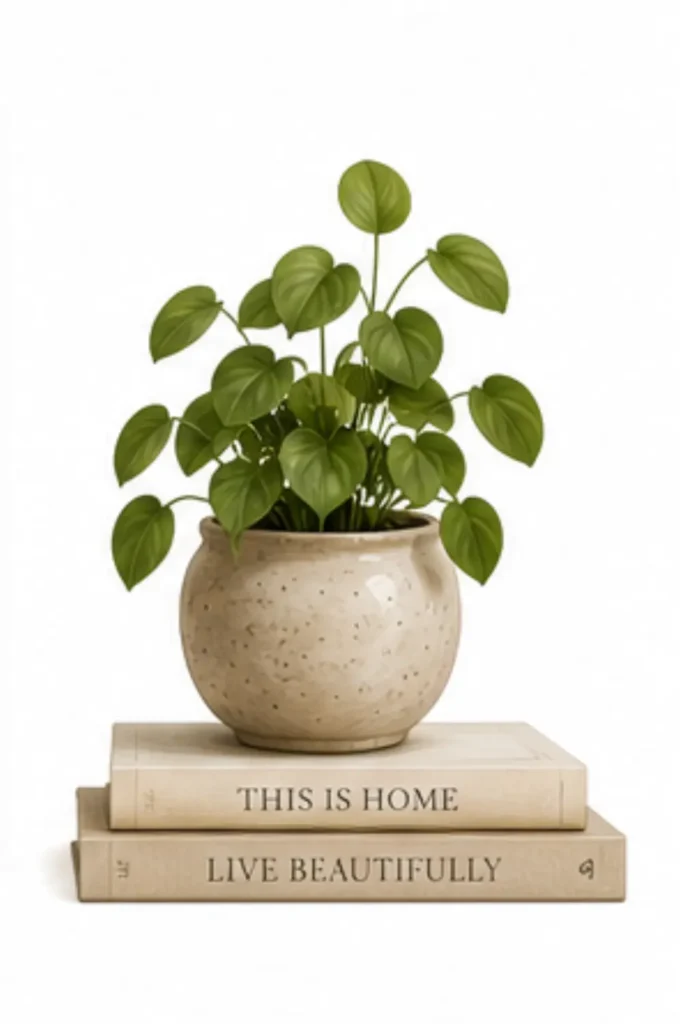
For a long time, I resisted plants in the bathroom. “Not enough light,” “not enough space,” “just another thing to organize”—that was my narrative. Then once, as an experiment, I bought a small pothos that I hung in a plant holder next to the mirror. This single decision changed the bathroom atmosphere more than perhaps anything else.
Plants aren’t decoration—they’re presence. They live, breathe, change. This dynamism prevents the bathroom from feeling sterile or artificial. But—and this is key—they only work if there aren’t too many.
One or two well-placed plants are enough. Too many, and suddenly everything feels cluttered. Pothos, sansevieria, ZZ plant—these are all low-light, hard-to-kill, and love humidity. A small ceramic pot is minimalist, clean, and doesn’t distract from the plant.
Remember: the plant becomes part of the visual rhythm. If everything else is white and clean, a green plant adds just the right amount of life. But if there’s already lots of color and texture, the plant becomes just another distracting element.
9. Personality in Control – You Can Be You, But Not Everything Needs to Be Here

 Save it
One of my biggest fears when organizing my bathroom was that if I went minimalist, it would also become impersonal. That it would look like an Airbnb or hotel room—clean but cold. But over time, I understood: personality isn’t about quantity, it’s about intentionality.
You don’t need ten photo frames or twenty mementos in the bathroom for it to feel “yours.” One well-chosen element is enough: a beautiful, personally scented candle, a vintage soap dish you found at a flea market, or a framed print that means something to you. This one item says more than a shelf full of random stuff.
For me, it’s a small tray on the counter where I put my rings at night. Personal, functional, beautiful. That’s it. Nothing more is needed for it to feel like mine.
The trick is to choose one or two elements that genuinely reflect your personality or style and give them space. The rest can be universal, neutral—because those provide the frame in which personal elements shine.
10. The Towel Dilemma – Where Most Bathrooms Fall Apart

 Save it
If I’m being honest: towels were the biggest source of disorder in my bathroom. They were always hanging somewhere—on a handle, door, radiator—always damp, always in the way. And no matter how hard I tried to arrange them “decoratively” like in Pinterest images, somehow they never looked right.
The breakthrough came when I made two decisions. First: fewer towels should be visible. Instead of seeing four hand towels and three bath sheets, have only one of each in use, with the rest folded on a shelf or in the cabinet. Second: the color and texture of towels should match the bathroom’s other elements.
A wall towel rack next to the shower or above the toilet gives structured space where towels don’t just hang—they “decorate.” But only if the towel is actually beautiful—solid color, quality material, not stained or faded.
If the situation allows, it’s worth investing in a few premium, thicker towels that not only absorb water better but also look better when folded or hanging. Cheap, thin towels—no matter what color—will never look good.
My 20 Beautiful Bathroom Tray Styling Ideas to Elevate Your Vanity article shows many techniques applicable to towels too: how to arrange them so they’re decorative but not cluttered.
Helpful Tips for You
Rental-Friendly Version: If you’re renting and can’t drill into walls or make major changes, you still have plenty of options. Use adhesive hooks and shelves that leave no trace yet are stable. Extra S-hooks draped over a shower rod work wonders—you can hang baskets for shampoos, brushes. A well-chosen bath mat and uniform towels alone can transform the bathroom’s appearance without touching anything permanent.
Small vs Large Bathroom Version: In a small bathroom, every item carries double aesthetic weight—because it’s more visible. Here, less is more isn’t just a mantra, it’s necessity. One well-chosen tray on the counter, one beautiful soap, one plant—done. In a large bathroom, more layering is possible: a shelf above the toilet, a corner stand, more towels decoratively placed. But the basic principle remains: you still must maintain control because space size doesn’t exempt you from visual discipline.
Before we get to the most common mistakes, it’s important to understand: bathroom organization is never “finished.” It’s not like a painting you complete and then it just exists. This is a living space you use daily, so it requires daily attention. But when you have the right systems—grouping, hidden storage, one in-one out—this attention won’t be a burden but will become a natural routine.
Common Mistakes to Avoid
One of the biggest mistakes I made for years: I thought an “organized bathroom” meant everything was in boxes, drawers, or hidden. But the reality is, if you hide everything, the space might be clean but it becomes unusable and frustrating. Every time you need shampoo, you have to open a door. When you brush your teeth, you have to take out toothpaste from a drawer. This is exhausting, and eventually, you’ll give up—and everything lands back on the counter.
The solution is balance. Daily-use items should be in accessible places but organized using the grouping method. Rarely used items—those go into hidden storage.
Another serious mistake: over-decorating with tiny things. I’ve seen this countless times—and I did it too. Five small candles, seven mini plants, four dishes, three little framed quotes. Each is cute individually. Together? A miniature flea market. In a small bathroom especially: choose one or two statement pieces and give them space. Don’t try to fill every shelf, corner, surface.
Another common blunder: we don’t consider function. I once bought a gorgeous, rustic-style mason jar and put bath salts in it. Aesthetically perfect. Practically? Disaster. Every time I wanted to use it, I had to unscrew the lid with wet hands, which was always slippery. Three weeks later, I gave up and put the mason jar back on the shelf as “decoration”—meaning a meaningless object.
Before deciding anything is “pretty, I need it,” ask: “how will I actually use this?” If the answer isn’t clear, you probably don’t need it.
And perhaps the most common mistake: constantly buying new things instead of organizing what you have. We think “if I buy a new organizer” or “if I buy a prettier tray,” everything will be fine. But the problem was never that you didn’t have enough storage boxes. The problem is you have too much unnecessary stuff. Before buying anything, first clear out, organize, decide what you actually need. Then—if something’s still missing—buy it.
Frequently Asked Questions
How do I make my bathroom look expensive?
The answer is surprisingly simple: unity and quality in details. You don’t need expensive brand names—just good materials. A simple, thick towel always looks more expensive than a thin, stained one. A unified color palette—white, beige, chrome—immediately creates a more elegant effect than a cavalcade of random colors. And perhaps most important: less but better. Three beautiful, well-chosen items look more luxurious than ten cheap ones.
What colors make a bathroom feel calm?
Natural, neutral colors: white, cream, soft gray, beige, sand. These are calming because they dominate in nature too—think of sand, stones, wood. If you want an accent color, choose something organic: sage green, soft blue, terracotta. Avoid bright, intense colors—the bathroom is a place for rest, not an attention center.
How do I decorate without clutter?
The key is grouping and white space. Never fill every surface. Always leave empty space between items. Group similar things (for example, on a tray) so they appear visually as one unit. And most important: only keep what you use daily in visible places. The rest goes into hidden storage.
How often should I declutter my bathroom?
Monthly, it’s worth doing a quick review—check if everything’s in place, if there’s anything you’re no longer using. Once a year, do a complete reorganization: empty everything, clean, rearrange. This prevents gradual accumulation, which happens almost imperceptibly.
Can I have a minimalist bathroom and still have it feel warm?
Absolutely yes—and that’s the goal. Minimalist isn’t cold when done right. Use natural materials (wood, bamboo, linen), warm white lights, and textured surfaces. A plant, a candle—these all add warmth without making the space cluttered.
Final Thoughts
If you’ve read this article all the way through, you haven’t just gotten tips—you’ve gotten a system. A method that will work not just now but long-term. Because bathroom organization isn’t a one-time task—it’s a mindset. It’s not about creating a perfectly decorated postcard—it’s about shaping a space where you genuinely feel good, where everything is findable, and where you’re not greeted by chaos every morning.
I know all this advice might seem overwhelming at first. You don’t have to do everything at once. Start by clearing everything out one weekend and only putting back what you actually use. That alone will make a huge difference. Then gradually add the other elements: grouping, hidden storage, coherent colors.
And remember: the goal isn’t for your bathroom to look like a magazine. The goal is for it to work well and provide calm. If when you walk in, you don’t get that sinking feeling of “so much still to do here” but instead feel “how nice to be here”—you’ve done it right.
This space is yours. Shape it into something that works for you—not for Pinterest, not for Instagram, but for you. And believe me: when you finally reach that point where your bathroom isn’t just organized but genuinely calming, it’s a feeling you won’t want to give up.
This post contains affiliate links. I may earn a small commission at no extra cost to you.
READ FOR THE NEXT STEP?
KEEP READING
Continue with another helpful idea.

16 Stylish Bathroom Mirror Ideas for a Luxurious Look
SHOP MY FINDS
Discover my favorite products for this place

My Favorite Bathroom Finds

Get cozy inspiration delivered to your inbox.
✓ 14-page beautifully designed ebook
✓ Cozy decorating ideas
✓ Practical room-by-room inspiration
You’re in! 🎉
Thanks for joining the NestFlowHome community!
Your free ebook is already on its way to your inbox. If you don’t see it within a few minutes, please check your Promotions or Spam folder.
Join the NestFlowHome community for weekly decorating inspiration.

Timeless home decor ideas and slow living inspiration for a calm, beautiful life.