
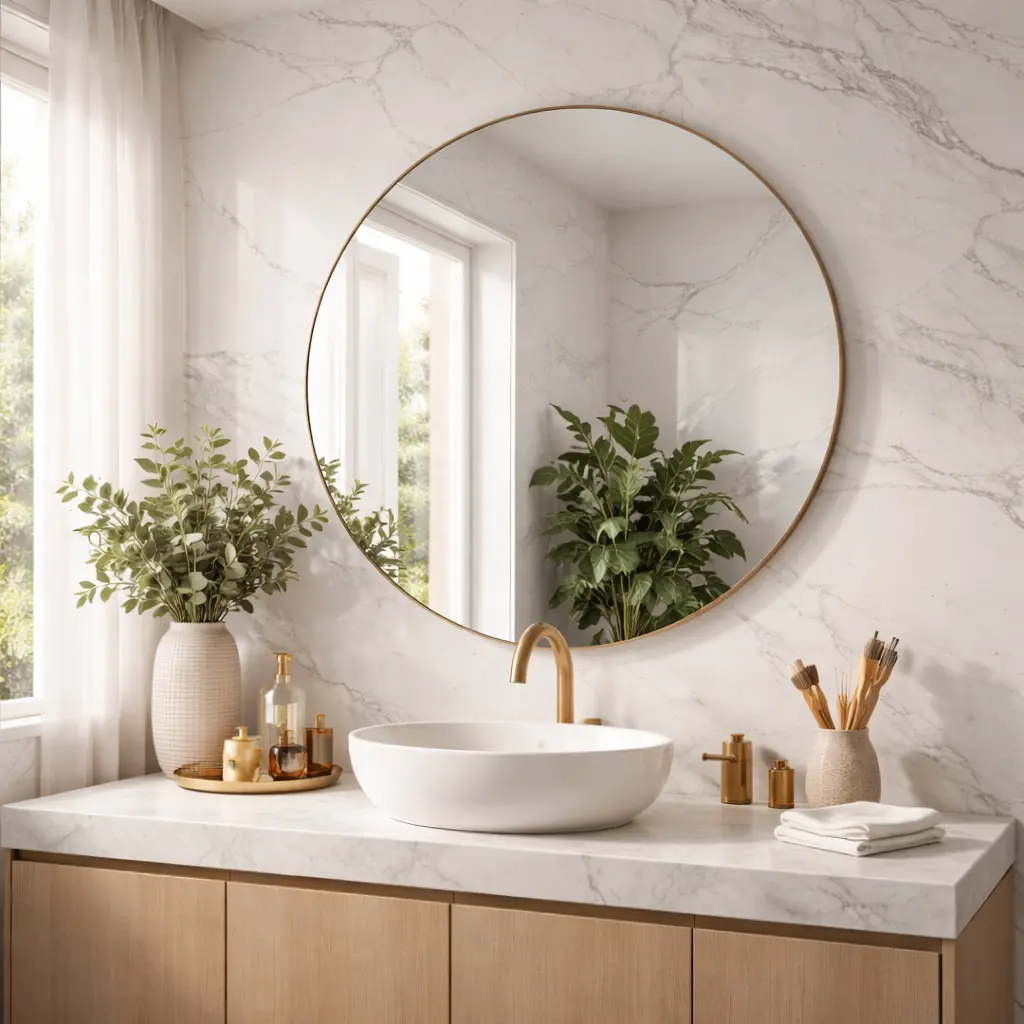
16 Stylish Bathroom Mirror Ideas for a Luxurious Look
By Emily | April 13, 2026
Ever stood in a hotel bathroom and wished you could feel that way at home? The difference often isn’t the size—it’s a single choice: which mirror you pick. An average mirror just gives you function—it shows your face in the morning. But a well-chosen mirror? It transforms the space. It creates light, adds depth, and radiates luxury. And here’s the good news: you don’t have to renovate your entire bathroom to create that feeling.
Most bathrooms look “cheap” because the mirror was slapped on the wall as an afterthought, like it was secondary. But the mirror is the bathroom’s crown jewel. It’s what frames the vanity, reflects natural light, and defines how you feel when you walk in. If you can only change one thing in your bathroom, start with the mirror.
In this article, you won’t get generic Pinterest ideas—you’ll get real, tested solutions for choosing a mirror that makes your bathroom instantly look more expensive, more considered, more personal. I’ll show you which shapes work in small spaces, how to use a mirror without lighting, and which mistakes to avoid because they instantly ruin the whole effect. If you’re ready for your bathroom to be more than just function—keep reading.
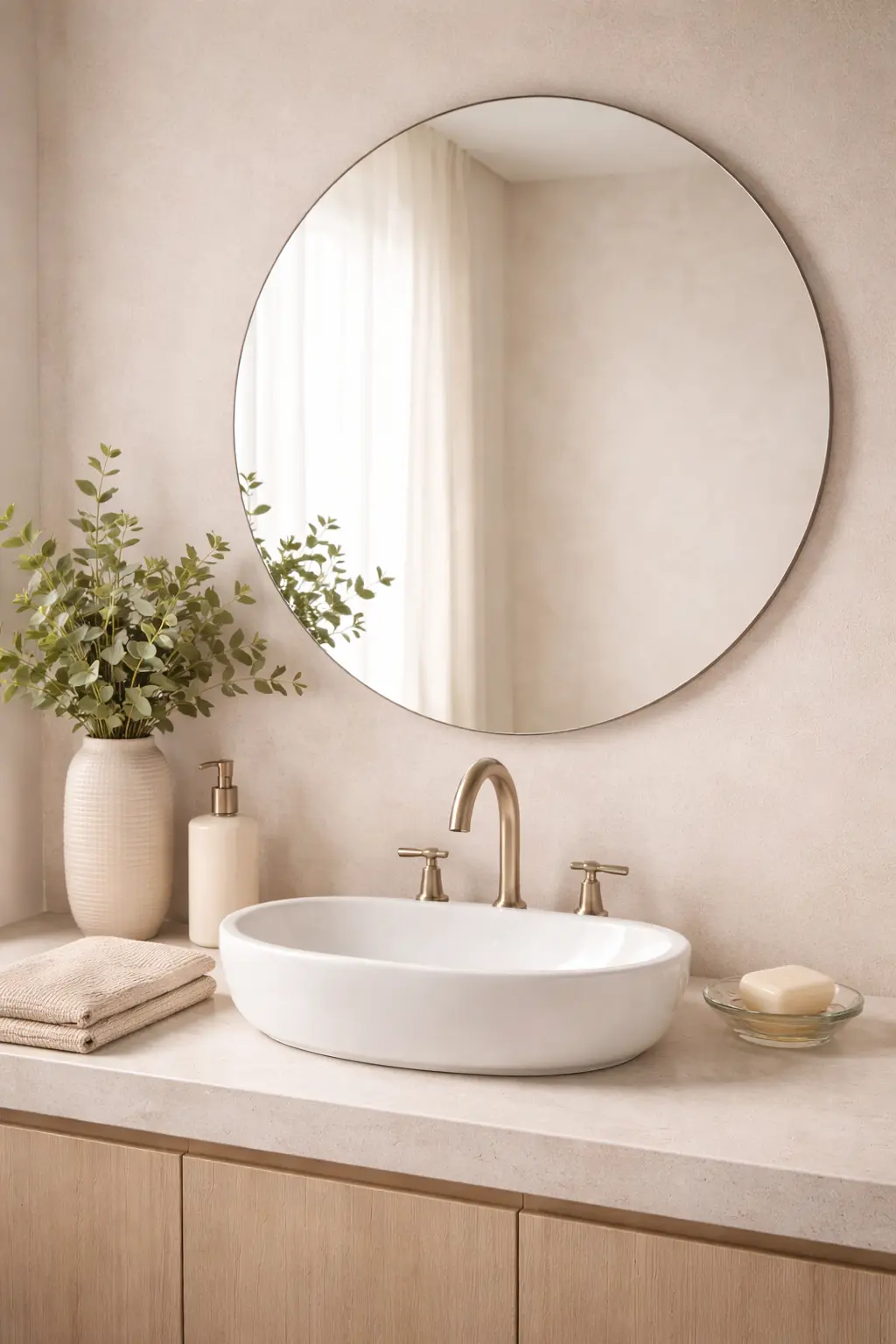
1. Frameless Round Mirror: When Simplicity Becomes Luxury
 Save it
The round mirror isn’t a trend—it’s a timeless choice that works because it softens the bathroom’s straight lines. Tiles, the vanity, the toilet—all rectangular. A round mirror breaks up that rigidity, and instantly the space feels softer, more elegant. But here’s the key: don’t frame it. The frameless, beveled-edge mirror is modern, minimalist, and most importantly—doesn’t distract. It lets the mirror itself be the star, not its decoration.
When I first placed one of these mirrors in my bathroom, I was surprised how much it changed the quality of light. The frameless edges looked cleaner, brighter, like the mirror was floating. This isn’t a coincidence: architectural books say round shapes optically expand space, especially in small bathrooms. If you’re tight on space, this is the best choice. In terms of size, don’t be afraid to think big. A 24-32 inch diameter round mirror is just dominant enough to be a statement piece without overwhelming the space. Avoid anything under 16 inches—those are more guest-bathroom sized and look stingy in a main bath. One thing to remember: if you have a double vanity, two round mirrors placed parallel look far cleaner than one wide rectangle. Symmetry creates instant luxury.
The best thing you can do: choose a round mirror without an aggressive frame, but with a subtle beveled edge (safer and looks higher-quality), but watch out for ones that are too thin—they look cheap.
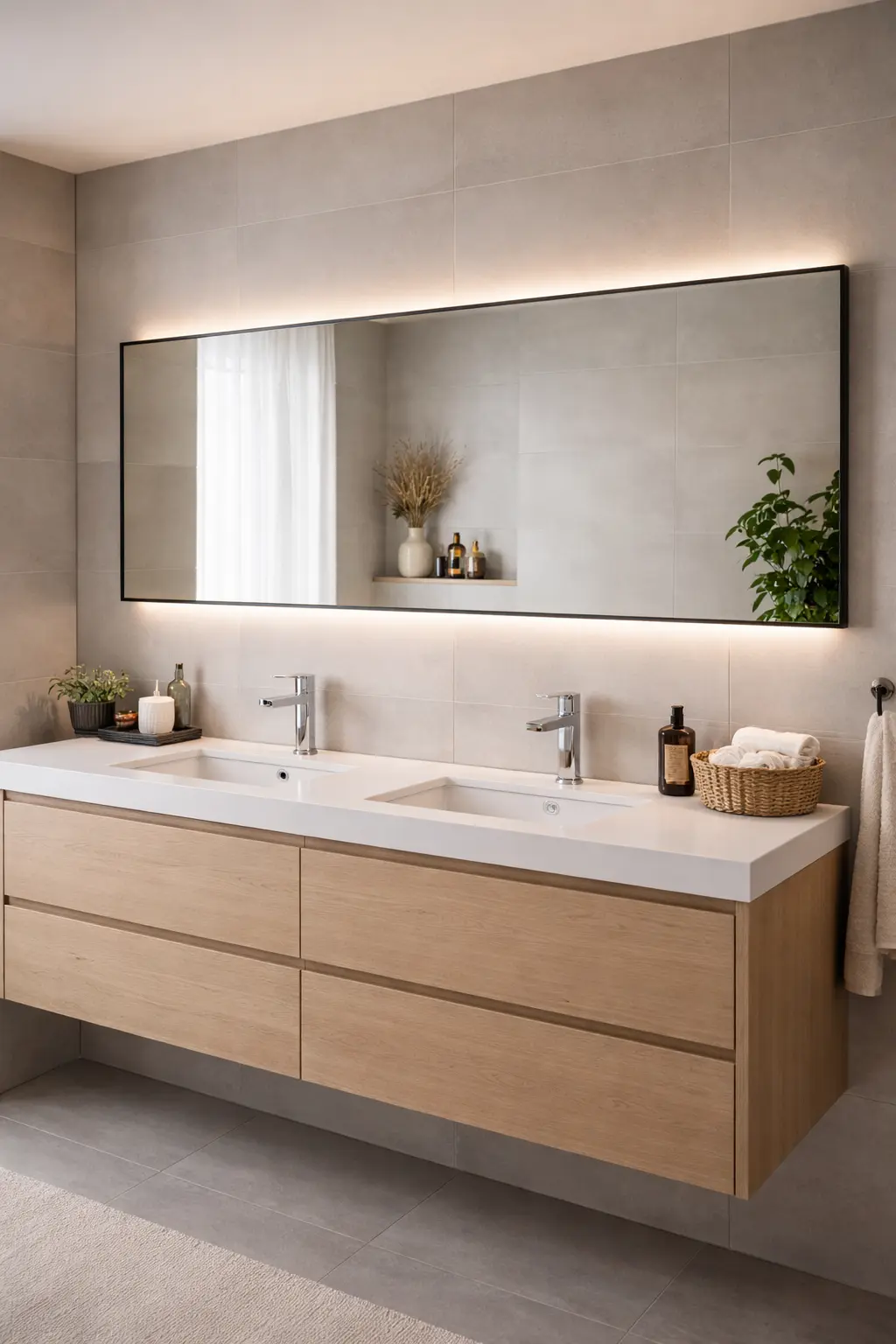
2. Oversized Rectangular Mirror: Drama Through Scale
 Save it
There’s something stunningly elegant about a mirror that doesn’t “fit” above the vanity but intentionally extends beyond it. The oversized rectangular mirror does exactly that: it doesn’t conform to the vanity’s size but instead sets its own rules. This isn’t the “bigger is better” mantra—it’s about making the mirror the wall’s focal point, not the vanity’s accessory.
I’ve tried both versions: once I put a 28-inch wide mirror over a 28-inch wide vanity. It looked sterile, like it stepped out of a catalog. Then I got a 40-inch wide mirror for that same vanity. The feeling completely changed. Suddenly the vanity looked smaller, more comfortable, and the mirror became a statement. When people walk in, they look at the mirror first, not the tile.
But here’s a secret rule. The oversized mirror works if you’re bold vertically too. Don’t settle for 24 inches tall—go at least 36-48 inches so the mirror extends upward as well. This visually raises the ceiling and makes the space feel airier. If your bathroom is narrow, this trick gives instant breathing room.
One thing you shouldn’t do. Don’t let a mirror completely fill a wall—leave 4-6 inches of margin on all sides. This ensures the mirror looks intentional, not like a sizing error. And if you need a rental-friendly solution, look for mirrors that can be hung without screws (heavy-duty adhesive strips), so you can take it with you when you move.
And while we’re here, check out the article [Feeling Stressed? Here’s How to Build a Relaxing Bathroom Retreat] too—because the mirror is just one part of making your bathroom truly a place you love to be.
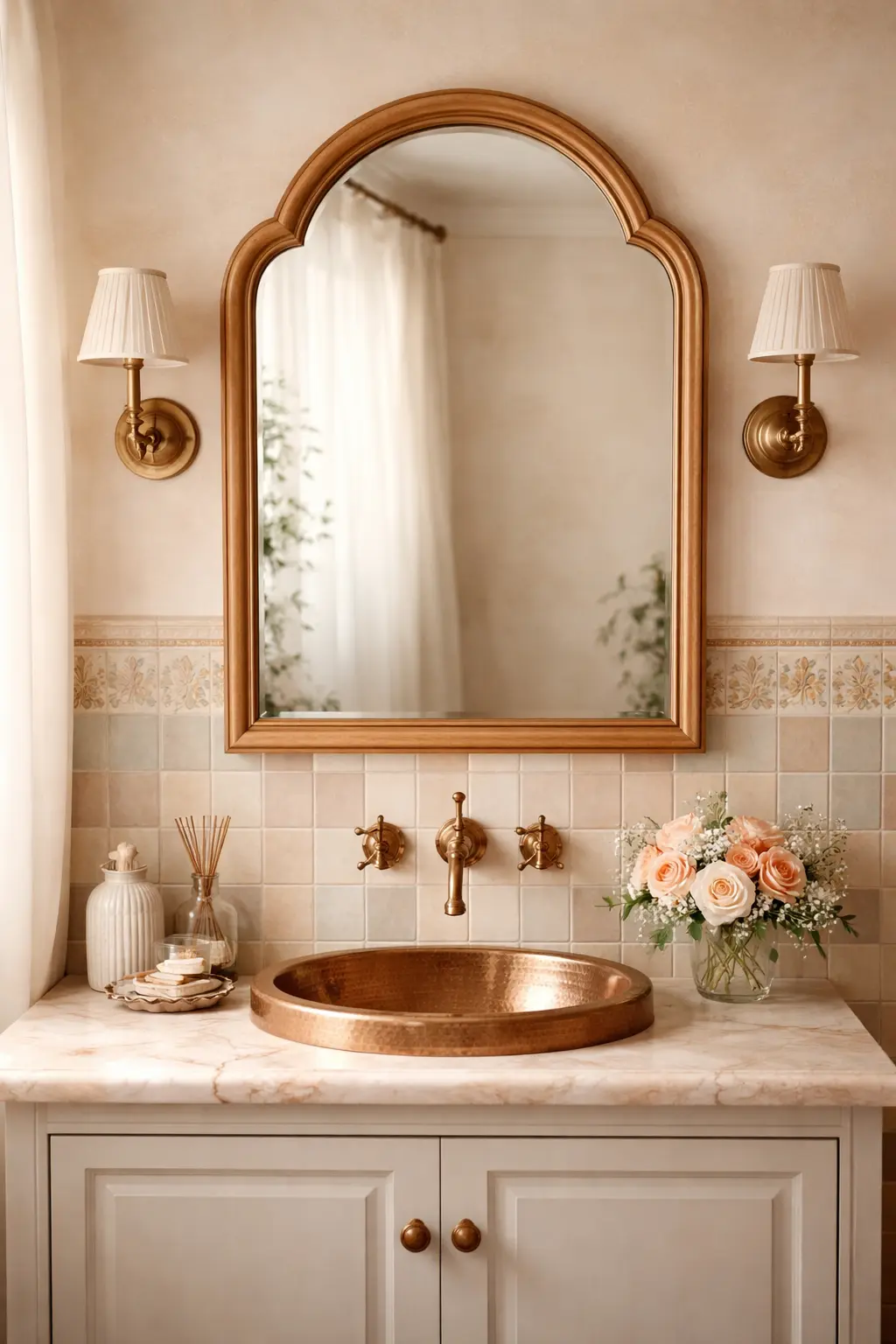
3. Arched Mirror: Architectural Elegance Without Renovation
 Save it
The arched mirror is one of the smartest design tricks of recent years because it brings an architectural element into the space without building anything. An arch gives instant character—like your bathroom is in a 1920s apartment, even if you’re in a 2010 condo. This shape is so strong it doesn’t need anything extra. No wallpaper needed, no fancy tile—the arched mirror itself is the feature wall.
When I first saw this trend, I was skeptical. Then I tried it in a friend’s bathroom: same white tile, same basic vanity, but with an arched mirror the space looked like it stepped out of an interior magazine. The arch softens, but it’s not sweet—it’s not romantic, it’s refined. Modern, but not cold. The trick is not to make the arched mirror too narrow. The arch width should at least match the vanity width, ideally 4-6 inches wider. This way the arch elegantly frames the vanity without looking squeezed in. But with height, you can be bold: a tall, slender arched mirror subtly raises the ceiling.
If you have a small bathroom, the arched mirror optically expands. The arch leads the eye upward, making the space feel taller. This is called architectural psychology: arched forms psychologically make tight spaces feel more open, less claustrophobic.
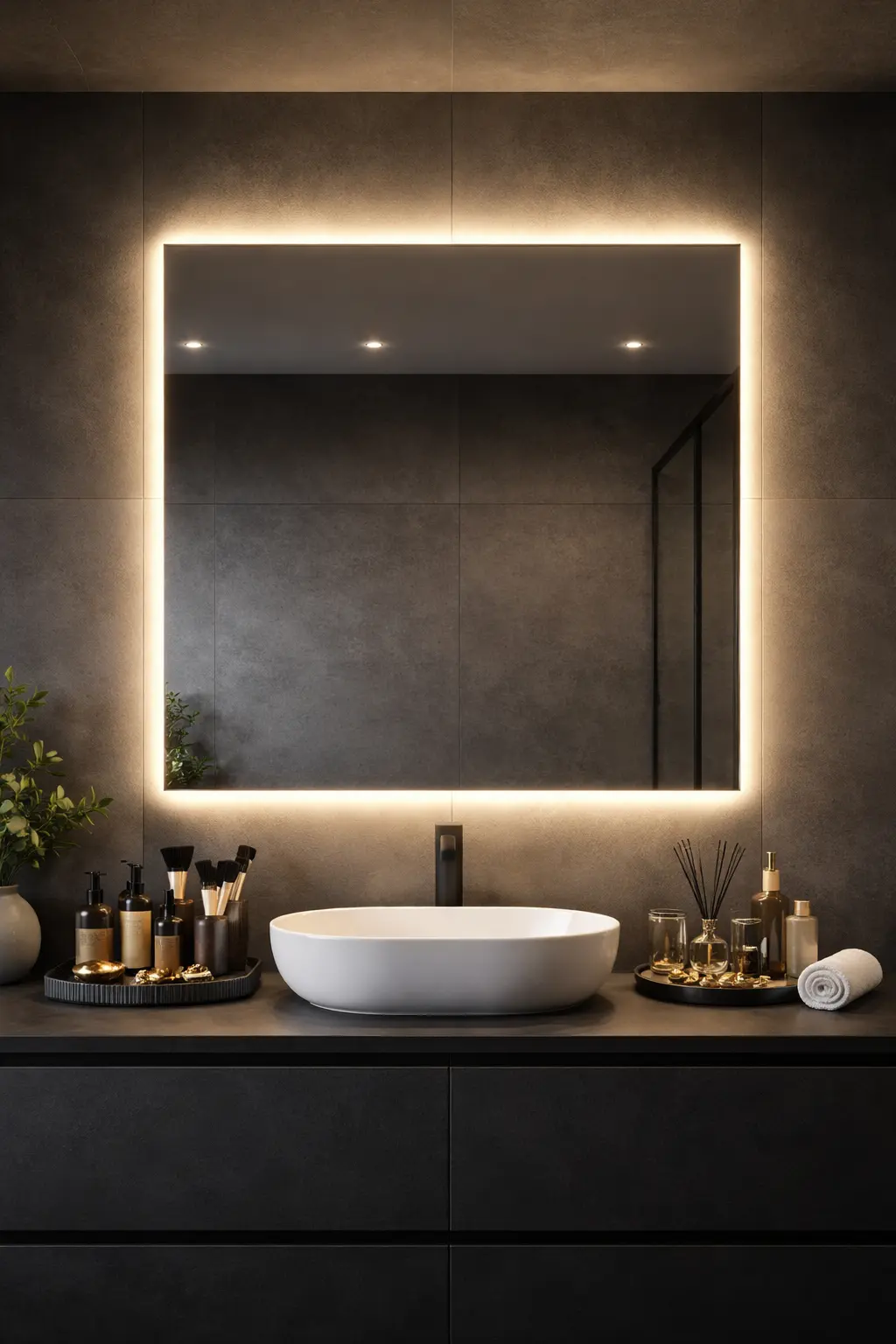
4. Backlit LED Mirror: The Silent Upgrade
 Save it
The LED-backlit mirror is the kind of investment you don’t feel immediately—until you turn it off. That’s when you realize how different everything looks. The backlit mirror doesn’t just illuminate, it creates atmosphere. The LED light glows softly around the mirror’s edge, and this indirect light is far more flattering than harsh overhead lighting. In the morning you don’t see your tired, shadowed face, but a more natural, softer version.
But it’s not just about beauty. The backlit mirror is practical genius because it eliminates shadows. If you’ve ever shaved or applied makeup under overhead lighting, you know how frustrating it is when shadows fall on your face. LED backlighting comes from all directions, so the light is even. This isn’t luxury—it’s convenience. The best backlit mirrors come with a dimmer, so you can control brightness. Bright in the morning, softer at night. For some people, the backlit mirror becomes the nighttime light source too—perfect if you don’t want harsh light at night. One tip: choose warm white LEDs (around 3000K), not cool white—cool LEDs create a hospital vibe, and that flatters no one.
If you need a rental-friendly solution, there are plug-in backlit mirrors (no need to mess with electrical, just plug into an outlet). And if you can, choose one where the LED is built into the mirror, not stuck on—those are far more durable and won’t start peeling at the edges after a few years.
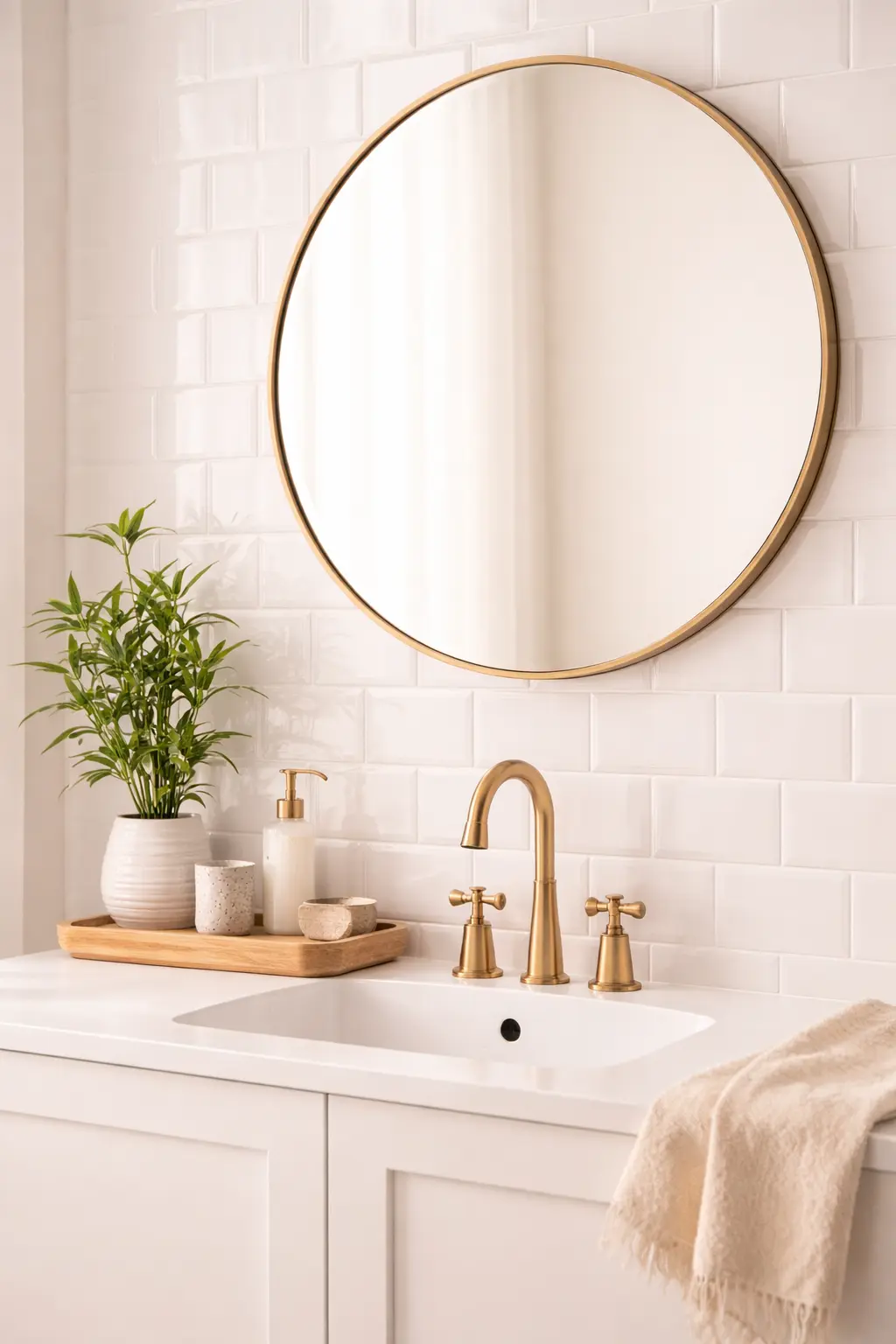
5. Vintage Brass Frame: Warmth That Breaks the Sterile
 Save it
Bathrooms tend to become sterile, cold spaces—white tile, chrome faucet, white vanity. It’s clean, but characterless. And that’s where the vintage brass-framed mirror comes in, giving instant warmth. Brass isn’t cold like chrome, isn’t too modern like matte black—it’s somewhere in between, and that’s why it’s universal. It doesn’t dictate style, it just gently breaks up the white monotony.
There was a time when I swapped everything in my bathroom to chrome because I thought that was the “cohesive” solution. But somehow the space always felt cold. Then I swapped the mirror frame for a thin, round brass frame, and the bathroom instantly felt homier. It’s not a drastic change—it’s like an accent piece on an outfit. You don’t have to change everything to brass, just the mirror bringing that warmth is enough.
The vintage brass frame mirror works especially well if there’s something wooden in the bathroom too—a wood shelf, a bamboo accessory, or even a bathroom tray with plants. Brass and wood give an instant “designed” feeling. You don’t have to be an interior designer for it to work—these elements naturally harmonize.
It’s important that don’t mix metal finishes too much. If you have a brass-framed mirror, try to swap the faucet to gold/brass tones too (if you’re renting, you can’t do this, but a brass soap dispenser or towel holder is enough to make the story cohesive).
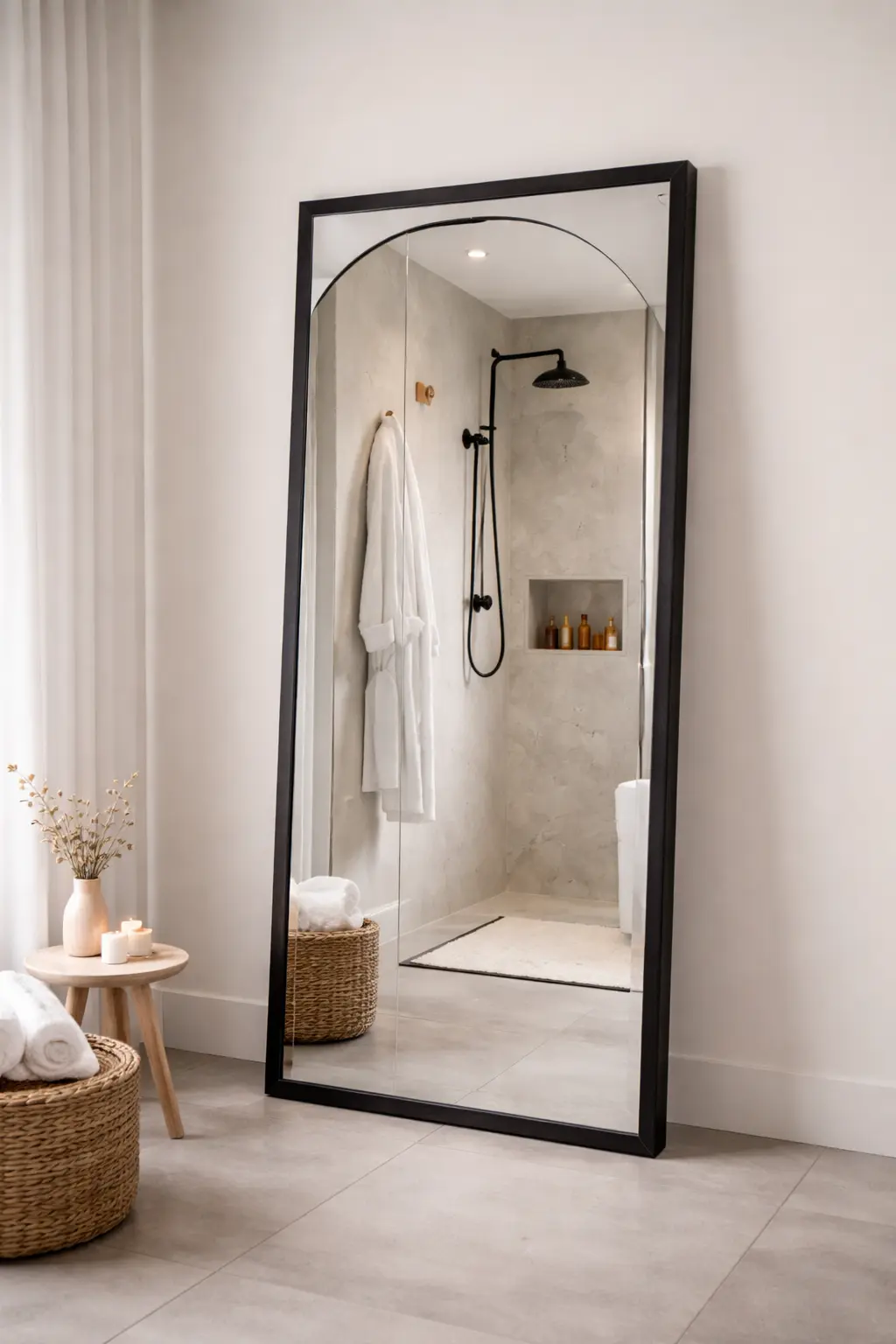
6. Full-Length Leaning Mirror: When Function Meets Statement
 Save it
The full-length leaning mirror isn’t primarily a bathroom piece—but that’s exactly why it works so well. This mirror says: “I’m not just function, I’m a lifestyle element.” The leaning mirror isn’t mounted on the wall, it’s propped on the floor—it’s casual, but intentional. And most importantly: it gives instant depth because it shows the full-body space.
I tried this in a narrow, long bathroom where the toilet-vanity-shower were all in a line. The leaning mirror propped against the wall next to the vanity visually opened the space twice as wide, because the reflection expanded the room horizontally. Suddenly I didn’t feel like I was in a tunnel anymore, but in a properly sized bathroom.
The leaning mirror works best if there’s a bit of space beside it—not much, but at least a 24-inch wide, empty wall is needed. Don’t force it where it’s tight—stick with wall-mounted there. But if you have the space, this is one of the easiest ways to create a high-end feeling in a rental-friendly way. When you move, you just pick it up and take it with you. No drilling, no stress.
It needs to be at least 60 inches tall to be truly full-length. 72 inches is ideal. Width-wise, 20-28 inches is the sweet spot. And though it’s not mandatory, an elegant, thin frame (either matte black or natural wood) looks way better than the completely frameless version—those tend to tip too easily and feel unstable.
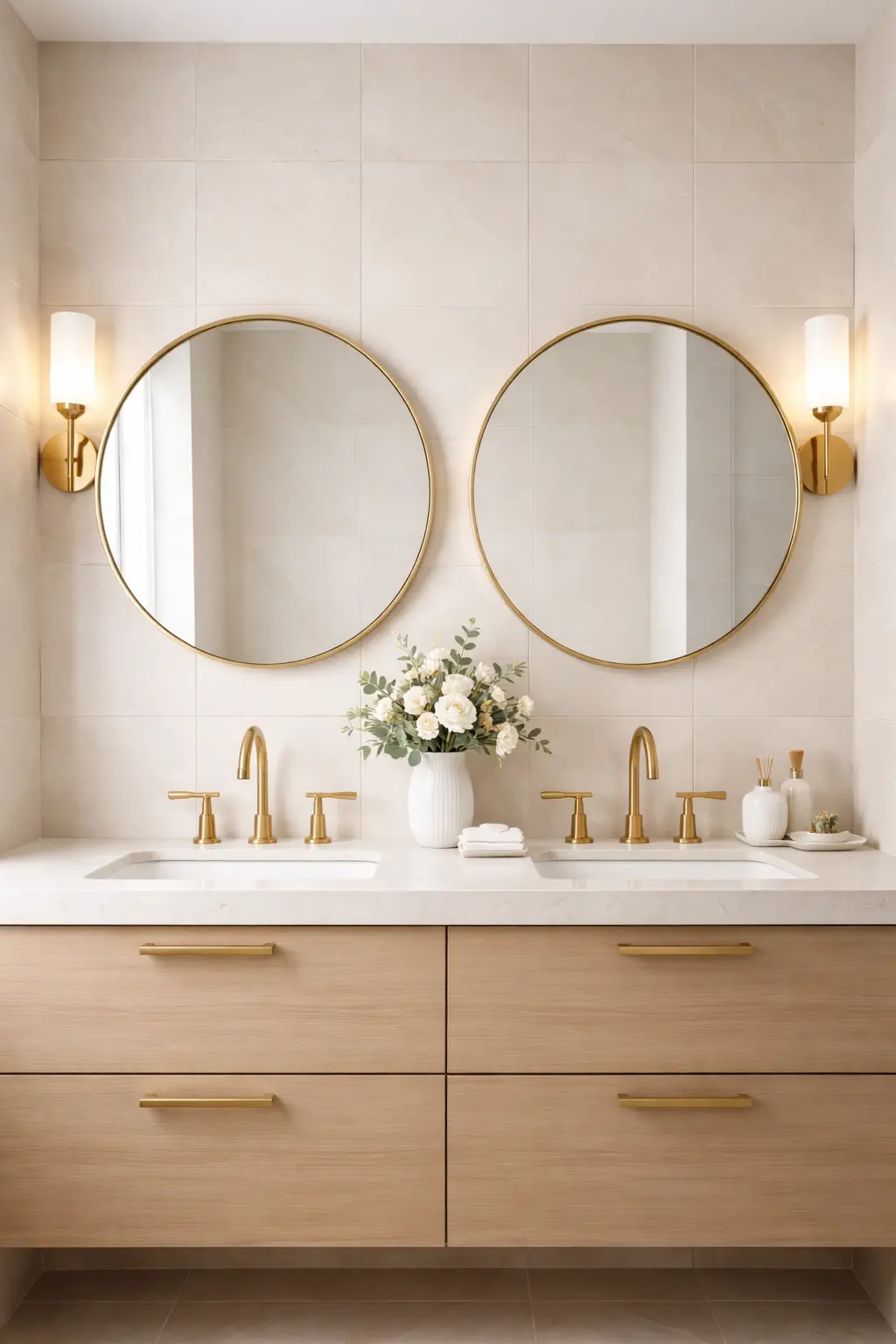
7. Double Mirrors for Double Vanity: Symmetry as a Design Rule
 Save it
If you have a double vanity, using two separate mirrors instead of one wide mirror isn’t just practical, it’s instantly more luxurious. This is what you see in hotels: each vanity gets its own mirror, its own space. It’s not just visually symmetrical—it’s personal. Two people can get ready at the same time without being in each other’s way. It’s a small detail, but these details are what separate a well-designed bathroom from a functional one.
When I first put two mirrors over a double vanity, I thought it would be too much. But the result was the opposite. It looked more organized, more considered. Two mirrors create rhythm, symmetry, which the brain instantly recognizes and feels is harmonious. The only thing you can’t mess up: the distance between the mirrors. They shouldn’t be too close (min. 4-6 inches between them), and not too far (max. 12 inches). Proportion is what matters.
Shape-wise, round or arched mirrors are best—they soften the rigidity of symmetry and make the space more playful. If you want rectangular mirrors, they work too, but then make them vertically oriented, not horizontal. Vertical mirrors raise the space, horizontal ones compress it. If you put two mirrors, everything else needs to be in pairs. Two wall sconces (one on either side of the mirrors or above them), two soap dispensers, two toothbrush holders. If there’s an accessory on only one vanity, the symmetry disappears and the whole thing looks messy. Either both sides have it, or neither—there’s no middle ground.
8. Black Framed Mirror: Modern Edge Without Trying Too Hard
 Save it
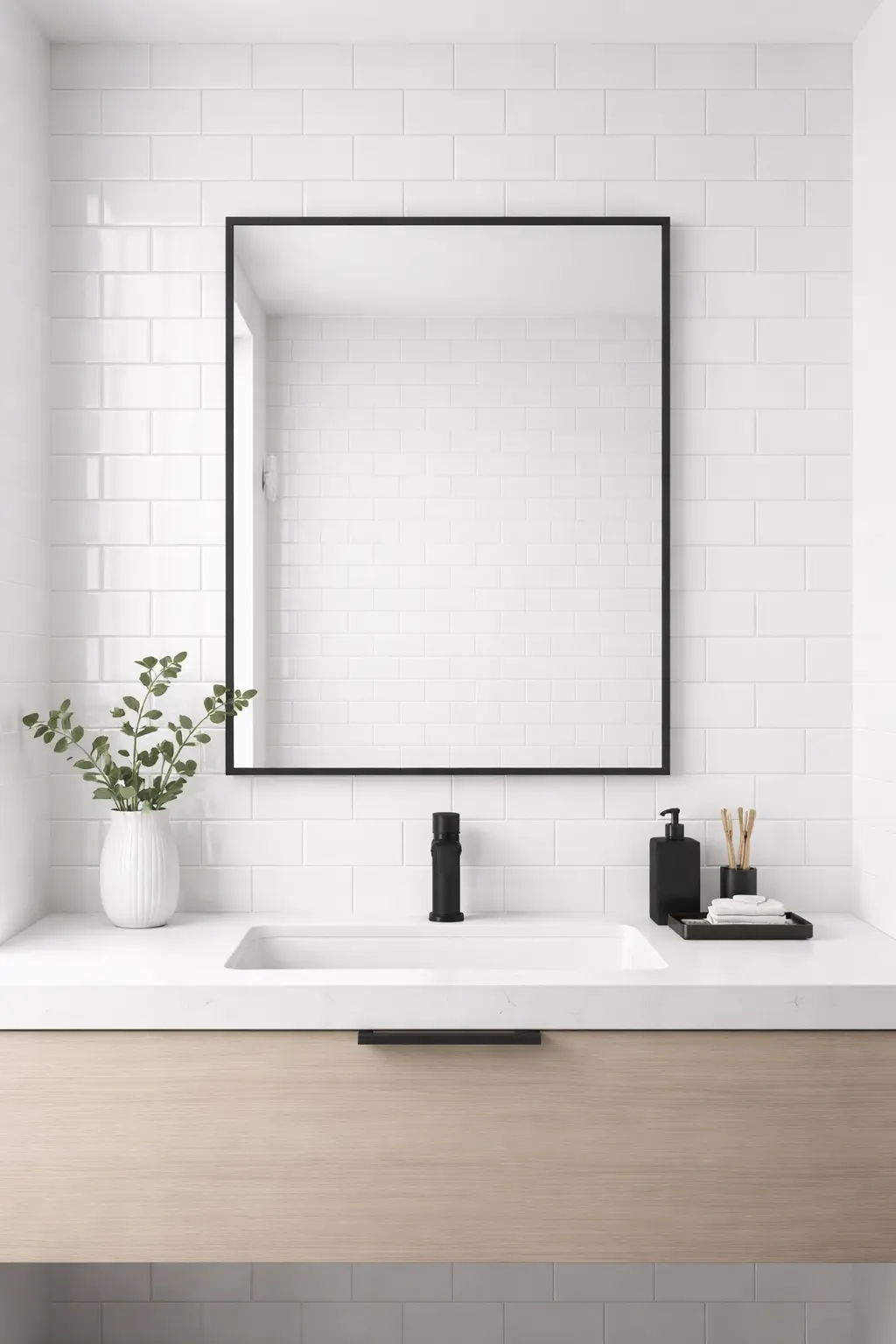
The matte black framed mirror is a staple of modern bathrooms, and it’s no accident. The black frame is clean, sharp, decisive—but not aggressive. This is the choice when you don’t want to overthink it, but you also don’t want it to look like “nothing.” The black frame instantly frames the space without distracting. It’s neutral, but has character.
I’ve tried different frame styles—gold, silver, wood—and matte black is what works with the most setups. It doesn’t fight with the tile color, doesn’t clash with the faucet finish. It’s a safe choice, but not boring. The matte finish is key. Glossy black is too aggressive, too formal. Matte black is softer, more modern, and doesn’t show fingerprints.
The black framed mirror works especially well if there’s another black element in the bathroom—a black faucet, a black towel bar, or even a black window frame. These small repetitions create coherence. But don’t overdo it: everything doesn’t have to be black. If it repeats in 2-3 elements, that’s enough.
The frame thickness don’t make it too thin (that feels fragile), but not too thick (that leans vintage, which we don’t want now). The 0.5-1 inch wide frame is the sweet spot. If you have a small bathroom, choose a thinner frame—it optically makes the mirror look bigger, and the space feels more spacious.
9. Beveled Edge Mirror: Subtle Detail, Major Impact
 Save it
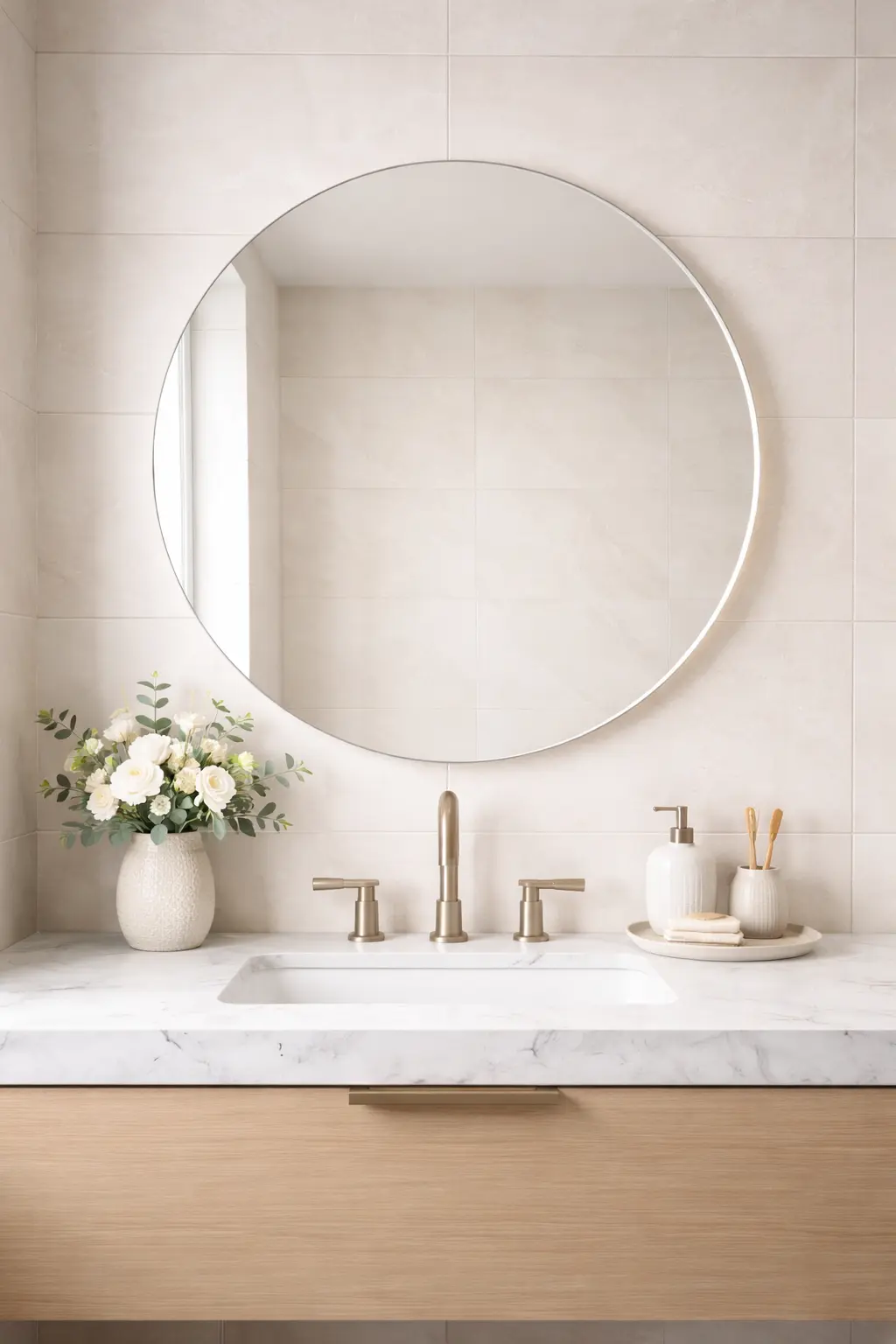
The beveled edge mirror is the kind of detail not everyone notices immediately—but everyone feels its effect. The beveled edge slightly breaks the light at the mirror’s edge, creating a subtle, prismatic light play. It’s not flashy, not showy—but it gives an instantly higher-quality feel. This is the difference that separates a high-end mirror from IKEA.
I had a beveled edge mirror in an old apartment, and when I moved out, I replaced it with a flat-edge mirror. Incredibly, the new mirror looked cheaper, even though it cost more. The beveled edge is what brings that difference. It’s not about “look how fancy my mirror is”—it’s about details mattering, even when they’re not conscious.
The beveled edge mirror works especially well if there’s no frame. Then the beveled edge takes on the frame’s role—it gives a border, but doesn’t isolate. This is a very clean, minimalist look that isn’t overdone. If your bathroom is modern, Scandinavian-style, this is the best choice.
The beveled edge is usually 0.5-1 inch wide at the mirror’s edge—enough to be noticeable, but not so wide that it’s dominant. Don’t choose too wide a beveled edge (like 2 inches), because that gives a vintage, art deco feel, which is hard to place in modern setups.
Try the tips in [Beautiful Bathroom Decor Ideas to Refresh Your Space] too, so your bathroom isn’t just functional, but beautiful.
10. Medicine Cabinet Mirror: Function Hidden in Plain Sight
 Save it
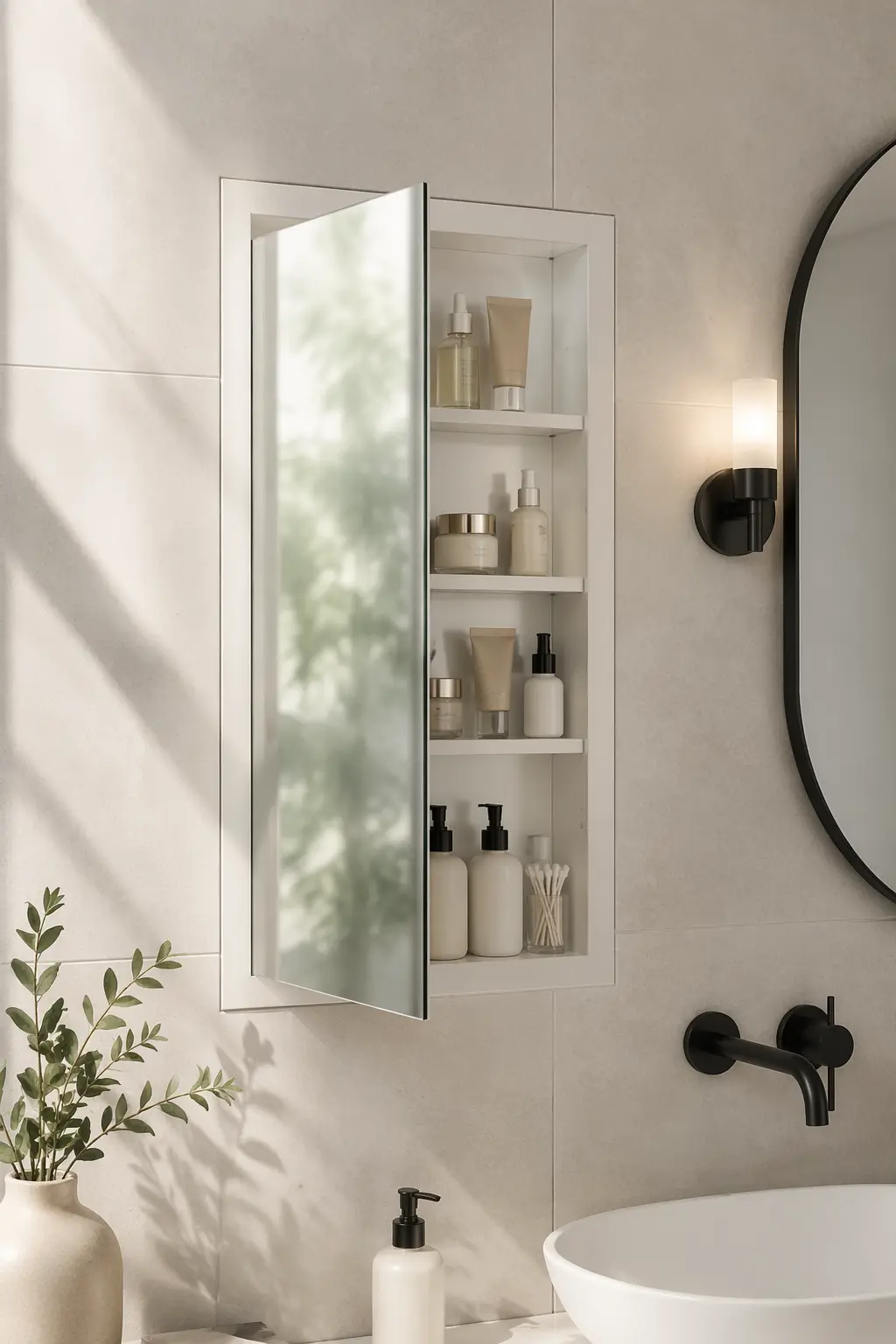
The built-in medicine cabinet mirror is one of the smartest bifunctional solutions—storage and mirror in one. But most people do it wrong: they buy a plastic, white, cheap cabinet, and it instantly downgrades the bathroom. The trick is to choose a medicine cabinet mirror that doesn’t look like a medicine cabinet at all. One that at first glance is just an elegant, frameless mirror—and only reveals it’s openable when you press it.
I tried this solution in a small bathroom where every inch of storage was critical. The recessed medicine cabinet (built into the wall) is genius because it doesn’t stick out from the wall, so it doesn’t take up visual space. But it’s not rental friendly—you have to cut into the wall for it. If you’re renting, look for surface-mounted versions that just go on the wall, but elegant, matte black or matte white framed. These are way more serious than traditional plastic versions.
The medicine cabinet mirror works if you’re minimalist. If you already love the clean, clutter-free bathroom and don’t want shelves, trays, or storage units—this is your solution. Everything’s inside, everything’s hidden, the surface is clean. This is the bathroom version of “everything has its place.” The medicine cabinet shouldn’t be too deep (max. 4-5 inches), because then it sticks out and becomes an obstacle. And choose one with adjustable interior shelves—so you can configure yourself what goes where.
11. Gold-Rimmed Round Mirror: Warmth Meets Geometry
 Save it
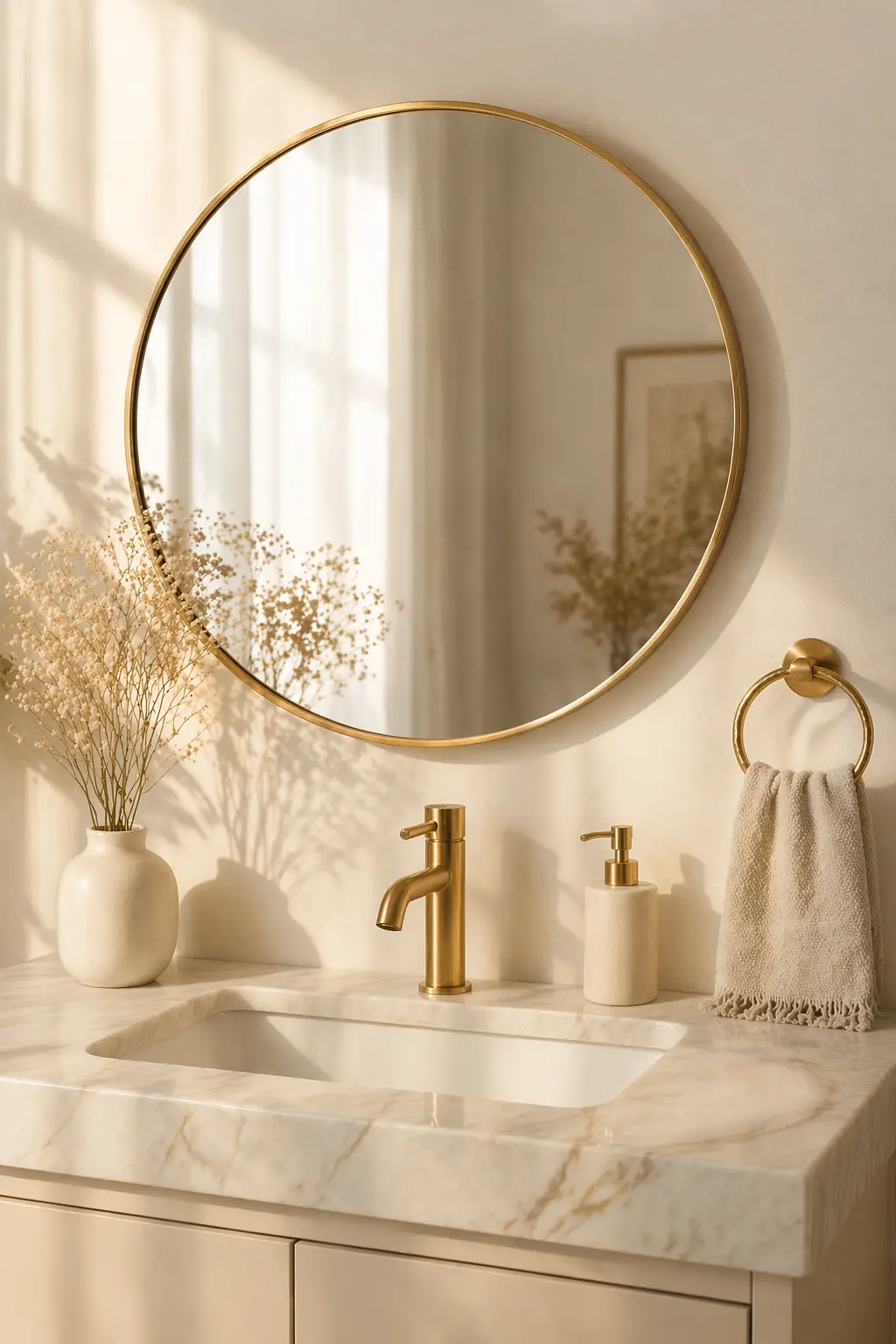
The gold-rimmed round mirror is one of those pieces that instantly brings warmth into the bathroom. Gold—whether brass, rose gold, or brushed gold—isn’t cold like chrome. It’s warm, homey, and somehow suggests a higher category. The round shape ensures this warmth isn’t too formal or heavy—the circle is soft, inviting, not intimidating.
When I first put a gold-framed mirror in a white-tiled bathroom, the space suddenly had personality. Before, everything was clean, but sterile. The gold frame instantly broke up the white without being drastic. It’s not a feature wall—it’s a subtle accent, just enough so the bathroom doesn’t feel like a “doctor’s office.”
The gold-framed mirror works best if there’s something else in gold/brass tones in the bathroom. A gold faucet, a gold towel bar, or even a gold-framed small tray on the vanity. Repetition creates intentionality—if only the mirror is gold, it can be unique, but if 2-3 elements are gold, that’s already a design decision.
Don’t be afraid of different gold shades either. Brushed gold, brass, and rose gold aren’t exactly the same, but they still work together if they’re in the same warm family. This isn’t like mixing chrome and silver—those are cool, and it shows if they’re different. Gold shades blend more softly. If you have a small bathroom, choose a thin gold frame (max. 0.5 inch) so it doesn’t overwhelm the space. In a large bathroom, a thicker, dominant brass frame also works, especially if you want a vintage or transitional style.
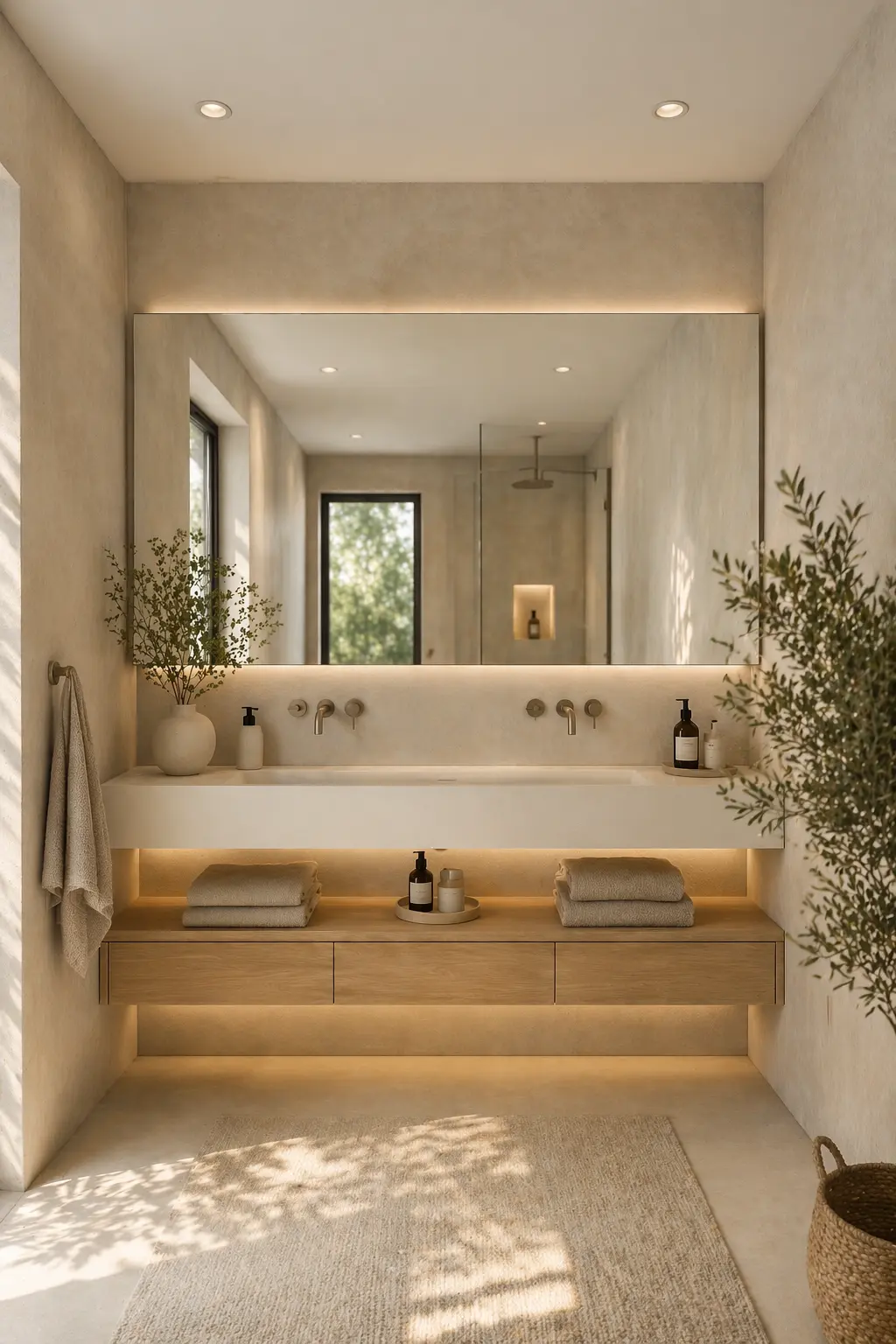
12. Horizontal Wide Mirror: Expanding Narrow Spaces
 Save it
The horizontal, wide mirror is one of the best optical tricks in small bathrooms. If your bathroom is narrow, a tall, vertical mirror only emphasizes that narrowness. But a wide, horizontal mirror visually opens the space sideways—as if it’s wider than it actually is. This isn’t psychology, it’s optics: long, horizontal lines pull the eye sideways, not upward.
I tried this in a very narrow, long bathroom where one wall was basically just the vanity. A traditional mirror there would have been lost—too small. But a 48-inch wide, only 24-inch tall mirror was perfect: it occupied the entire wall horizontally, and the bathroom instantly looked wider. Not drastically, but noticeably.
The horizontal mirror works if the vanity width is proportional. If you have a narrow, 20-inch vanity, don’t put a 60-inch wide mirror over it—it’ll look disproportionate. But if your vanity is at least 28-32 inches, a wide mirror can work really well. And if you have a double vanity? One continuous, wide mirror is way more modern than two separate ones—this is the hotel look.
The horizontal mirror shouldn’t be too thin (min. 20 inches tall, or it becomes a “strip mirror,” which is awkward). And don’t hang it too high—the horizontal mirror’s center should be roughly at eye level, so when you look in the mirror, you don’t have to look up. If you want a modern, minimalist, or industrial style, the horizontal mirror (matte black thin frame or frameless) is the perfect choice. And since it’s rental friendly too (just hang it up), it’s one of the easiest ways to visually open a small bathroom.
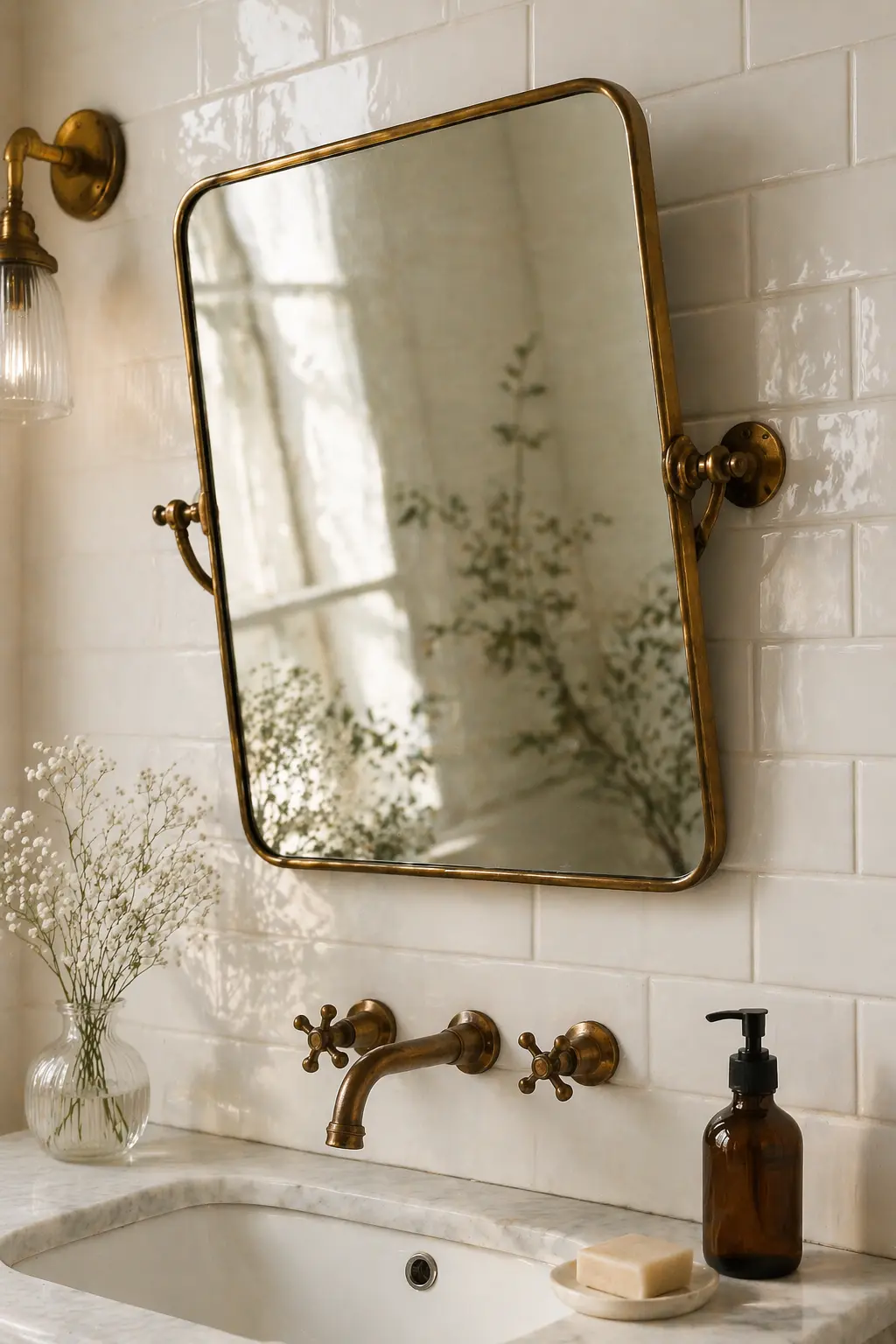
13. Pivot Mirror (Tilting Mirror): Practical Versatility
 Save it
The pivot (tilting) mirror is one of the least-used but most practical types. This is the mirror you don’t mount at a fixed angle, but can adjust—up-down, forward-back. And why is this important? Because not everyone is the same height. If there are two of you at home, and one is 5’3″ and the other is 6’3″, a fixed mirror will never work perfectly for both of you. The pivot mirror solves this: everyone can adjust it for themselves.
I had a rental apartment where the bathroom mirror was mounted too high—I could see my hair, but barely my face. It was annoying every day. When I got a pivot mirror (wall-mounted with brackets), it was a lifesaver. In the morning I could tilt it down a bit for makeup, at night back up—convenient, personal, and it gave an instant high-end feeling because this is the kind of flexibility you usually only see in hotels.
The pivot mirror works especially well in vintage or transitional-style bathrooms. The gold or brass frame around the mirror, and those two support arms on the sides—it’s characterful, but not showy. It also works in modern bathrooms, just choose matte black or matte chrome brackets then.
The pivot mirror is usually smaller than fixed wall mirrors (24-32 inch diameter is typical), but that’s exactly what makes it unique. It’s not a statement piece—it’s a practical, considered choice that shows you pay attention to details. On Amazon you’ll find cheaper versions too, but watch out: the bracket quality is decisive. If it’s cheap, it’ll rust in a year.
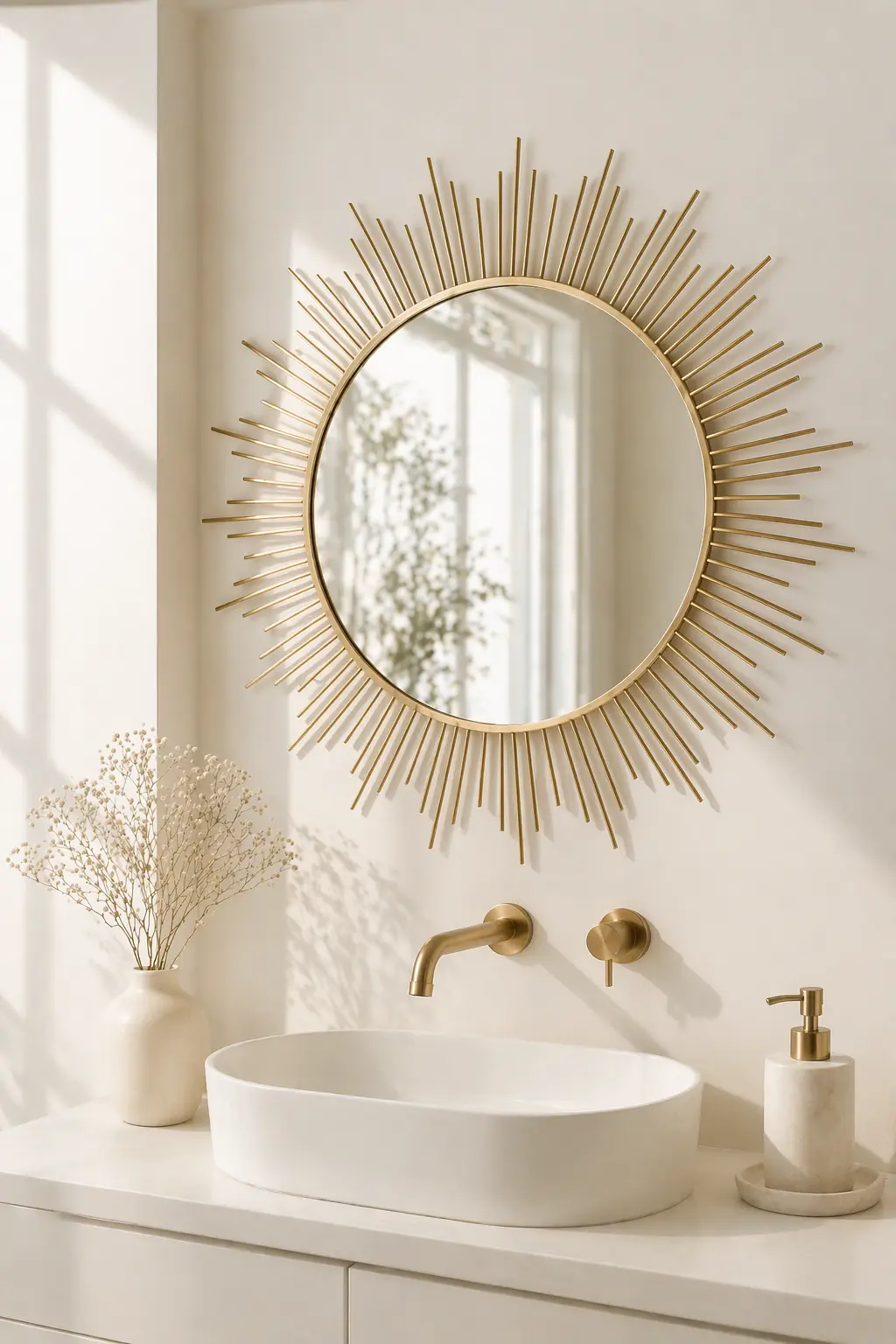
14. Sunburst Mirror: Statement Without Being Loud
 Save it
The sunburst mirror is one of the most decorative options, but it’s not cute—it’s architectural. The sunburst mirror’s ray pattern creates an instant focal point without being showy. It’s not like a floral frame or an over-decorated baroque mirror—it’s geometric, clean, but still playful.
I tried it in a neutral, white bathroom where everything was so clean it was almost impersonal. The sunburst mirror (gold or brass finish) gave instant texture. I didn’t need anything else—the mirror itself was the focal point. And what’s even better: the sunburst shape reflects light everywhere, so if it’s near a window, it creates extra light in the space.
The sunburst mirror works if the bathroom is otherwise restrained. Don’t put it in a maximalist space—there it’ll be too much. But in a minimalist, modern, or mid-century modern bathroom? Genius. The sunburst gives an instant mid-century modern feel, which is trending again now, but won’t go out of style because it’s a timeless shape.
The sunburst mirror is usually bigger than it looks because the rays extend. A 32-inch diameter sunburst actually takes up 40 inches of wall space, so measure well before buying. And important: the sunburst shouldn’t be too “busy”—choose a version with simple, clean rays, not overly complicated, twisted patterns. The latter will be too vintage.
If you have a small bathroom, a smaller sunburst (20-24 inches) works too, but then make it the focal point—don’t have a lot of other stuff on the wall next to it.
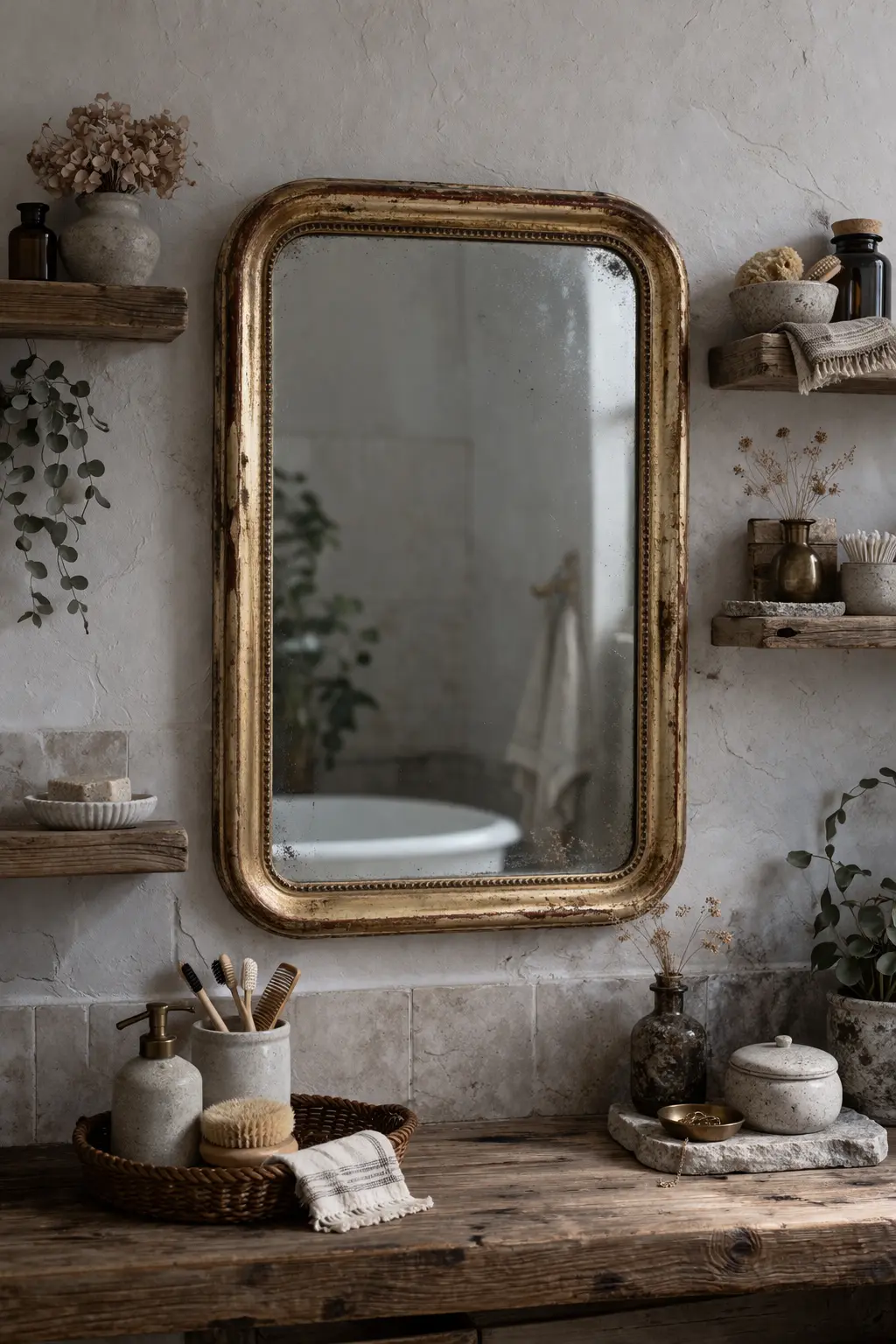
15. Antique Mirror: Lived-In Luxury
 Save it
The antique mirror—or antique-looking, patina mirror—gives instant history to the bathroom. This doesn’t mean it’ll be old school—it means it’ll be characterful, as if it has a story. The antique mirror’s glass isn’t perfect: there are spots, slight wear, “aging” marks. And that’s exactly what makes it special. It says: this bathroom wasn’t just thrown together now, but carefully shaped over time.
I had a mirror I bought from a vintage shop—the mirror edge was slightly spotted, the glass wasn’t completely clear. At first I thought about replacing it, but then I left it. And every visitor who came in asked: “Is this a family heirloom?” That’s the effect the antique mirror brings. Instant authenticity.
The antique mirror works if there’s something else in the bathroom that isn’t brand new. A wood shelf, an old-style faucet, or even a vintage towel holder. If everything else is IKEA-new, the antique mirror loses its meaning—it’ll be incoherent. But if there’s a bit of collected, eclectic vibe, the antique mirror instantly elevates the bathroom.
Don’t be afraid if the mirror isn’t perfect. The patina, the wear—that’s the charm. But important: it shouldn’t be too damaged. A bit spotted is fine, but if half the mirror is dark, it’s unusable.
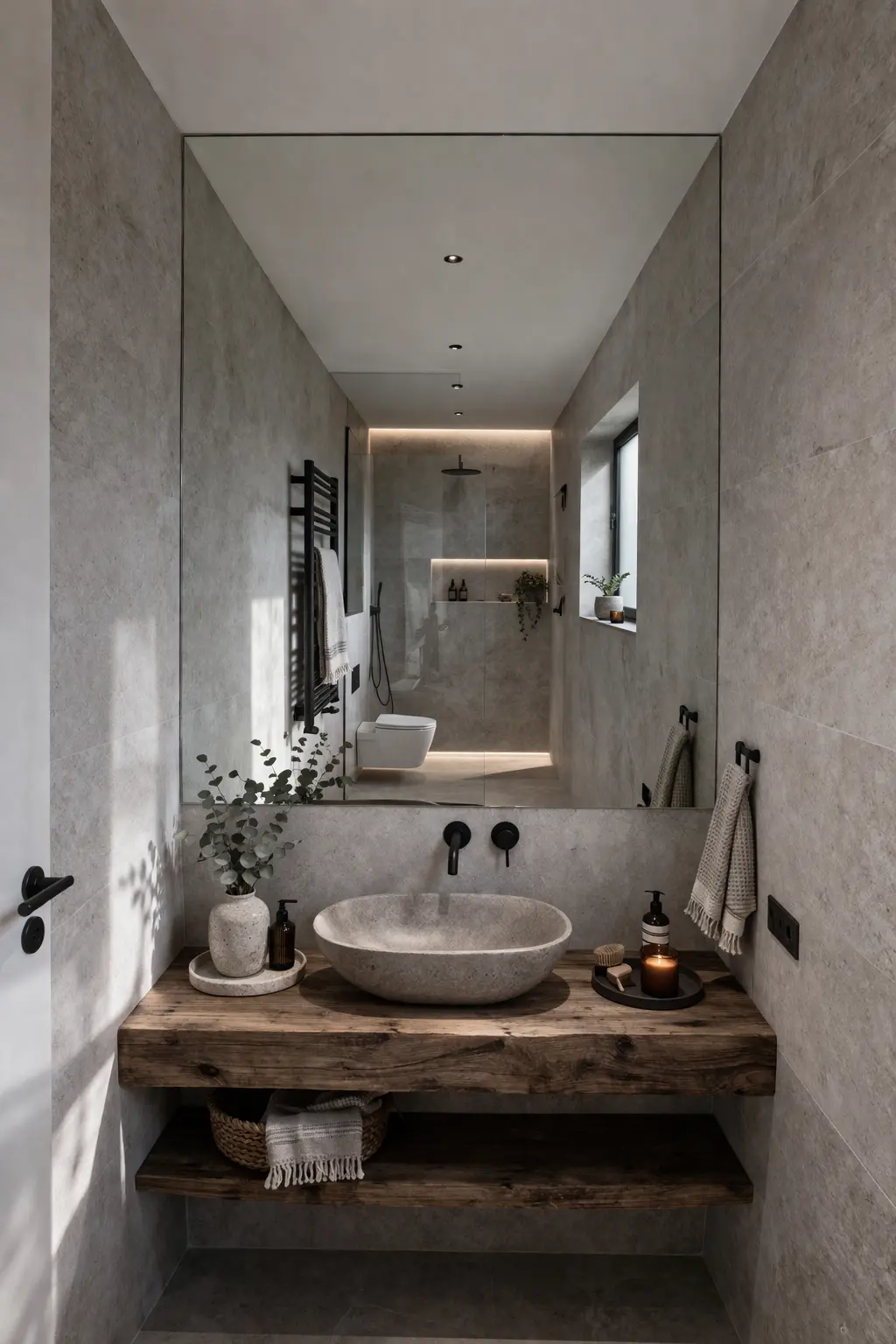
16. Frameless Wall-to-Wall Mirror: Infinite Space Illusion
 Save it
The frameless, wall-to-wall mirror is the most dramatic choice you can make. This isn’t a mirror that’s “there” on the wall—this is a mirror that is the wall. When you walk in, for a moment you think there’s another room behind the bathroom. It’s an optical illusion, but it works. And in small bathrooms, this instantly doubles the feeling of space.
I tried this in a tiny bathroom where you could barely turn around. I put a frameless mirror on the entire back wall, wall-to-wall, floor-to-ceiling. The result was that the bathroom felt twice as big. Not seemingly—actually felt like there was space. This isn’t psychology—it’s visually doubling the space.
The wall-to-wall mirror isn’t rental friendly—you should only do this if you own your place and are planning long-term. But if you can, this is one of the most radical ways to make the bathroom bigger. And what’s interesting: a full wall mirror doesn’t feel like too much—it feels intentional, like a design decision, not “more mirror = better” logic.
The frameless mirror only works if the wall it’s going on is completely smooth and straight. If the wall is curved or uneven, the mirror will distort, and the whole effect is lost. And since there’s no frame to distract, every imperfection will show. So this isn’t a DIY project—you’d have a professional do this.
If you have a small bathroom and are looking for a radical solution, the wall-to-wall mirror is the most effective single upgrade you can make. Instant space, light, luxury—in one step.
Practical Tips for You
Small Bathroom Version: Maximum Impact, Minimum Space
If you have a small bathroom, the first rule: don’t be afraid of a big mirror. People tend to put a small mirror in a small bathroom because they think it’s more proportional. But the opposite is true. A big mirror optically expands the space because it reflects light and space. A small mirror emphasizes that the bathroom is small. Choose a round or arched mirror that’s at least 24 inches in diameter—this is just dominant enough to make the space feel bigger, but doesn’t overwhelm.
Avoid thick frames in small spaces—they visually shrink the mirror. Instead go for frameless or thin matte black/gold frames. And if possible, put the mirror opposite the door or window—this way the mirror instantly creates depth because it reflects the entrance or natural light.
Rental-Friendly Version: No Damage, Movable When You Leave
In a rental, the biggest challenge is not drilling holes in the wall—or at least not making big damage. The best solution: heavy-duty adhesive strips or hangable mirrors that don’t require drilling. The leaning mirror is also genius because you just prop it on the floor, and when you move, you pick it up and take it.
Avoid recessed mirrors or wall-to-wall solutions—those are permanent installations. Instead choose mirrors that are easily removable: round, frameless, or thin-framed versions. And if you want LED backlighting, choose the plug-in version that just plugs into an outlet, not hardwired.
Now that you know which mirror fits your bathroom, one final thought: the mirror isn’t a final decision.
If you get tired of it in a few years, swap it. The mirror is one of the easiest elements to change in a bathroom—and that’s why it’s also one of the safest investments. Experiment, try it, see what works.
And before you bring in the big guns—swapping tile, getting a new vanity—try the tips in [Affordable Bathroom Counter Decor Ideas That Look High-End] too. Often it’s not the mirror that’s the problem, but what’s around it.
Common Mistakes to Avoid
1. Wrong proportion: When the mirror is too small for the vanity
This is the number one mistake. People buy a 20-inch mirror over a 32-inch vanity, then wonder why it looks stingy. The rule is simple: the mirror width should be at least equal to the vanity width, ideally 4-8 inches wider. If it’s smaller, the vanity becomes dominant and the mirror secondary—and the bathroom’s proportion is off.
2. Hanging too high
You don’t align the mirror to the ceiling, but to the vanity and your eye level. The mirror’s bottom edge should be about 4-6 inches above the vanity surface, and the mirror’s center should be roughly 63-67 inches high (average adult eye level). If you put it too high, you only see your hair, not your face—frustrating and unusable.
3. Mirror and faucet metal finish don’t match
If the mirror frame is gold/brass but the faucet is chrome, it’s instantly incoherent. You don’t have to make everything the same, but the main elements’ metal finish should be in harmony. If you can’t swap the faucet (rental), try to compensate with other accessories—gold soap dispenser, gold towel holder. These give instant coherence.
4. Backlit mirror with wrong light temperature
If you buy an LED-backlit mirror and it’s too cool white (above 6000K), the bathroom will feel like a hospital. Choose warm white LEDs (2700-3000K range)—it’s more flattering, softer, and doesn’t make your skin look washed out. And if possible, buy with a dimmer—so you can control brightness morning and evening.
5. Frameless mirror on uneven wall
The frameless mirror only works if the wall it’s going on is perfectly smooth. If it’s curved or uneven, the mirror will distort—and since there’s no frame to distract, every flaw will show. If your wall isn’t perfect, choose a framed mirror that hides the flaws.
Frequently Asked Questions
What size mirror do I need for an average vanity?
The average bathroom vanity is 24-32 inches wide, and ideally you need a 28-36 inch wide mirror for that. The rule: the mirror width should be at least equal to the vanity width, but can even be 4-8 inches wider to be visually dominant. If the mirror is too small, the whole bathroom feels disproportionate. Don’t be afraid to choose bigger—too big a mirror is rarely a problem, but too small instantly downgrades the space’s quality.
How do I choose the mirror’s metal finish?
The mirror’s metal frame finish should match the bathroom’s other metal elements—primarily the faucet. If the faucet is chrome, choose matte black or silver frame. If the faucet is gold/brass, choose gold or brass frame. If you’re renting and can’t swap the faucet, take the mirror toward neutral (matte black, frameless), and bring together the finish coherence with accessories (soap dispenser, towel holder) instead.
LED-backlit mirror or traditional mirror + wall sconce?
Both work, but give different experiences. The LED-backlit mirror is modern, clean, and you don’t have to mount a separate lamp—so the wall is cleaner. The traditional mirror + wall sconce pairing is more flexible: you can swap the lamp, control the light direction, and a beautiful sconce is decorative on its own. If you’re minimalist, LED. If you want a more characterful, vintage, or transitional style, mirror + sconce.
Can I use two different-shaped mirrors in one bathroom?
Technically yes, but it rarely works well. If you have a double vanity, always choose two identical mirrors—symmetry is key. If a bathroom has multiple mirrors (e.g., one over the vanity and one elsewhere), it’s still better if the material or finish is consistent—for example, both frameless, or both matte black framed. Two completely different mirrors (e.g., round gold frame + rectangular silver frame) rarely feel intentional, more like accidental.
Final Thoughts
Your bathroom mirror isn’t just a functional object—it’s what defines how you feel when you walk in. A good mirror creates light, adds depth, and instantly elevates the space’s quality. You don’t need renovation, you don’t need a designer—just a considered choice. And now you know which shapes work in small spaces, how to use light, and which mistakes to avoid.
Don’t forget: the mirror isn’t a final decision. If you don’t like it, swap it. If you get tired of it, try something else. This is one of the easiest elements to change in your bathroom—and that’s why it’s also one of the safest investments. Start with a clear vision: what feeling do you want when you walk in? Modern, clean, minimalist? Warm, vintage, characterful? The mirror choice brings this vision to life.
Decor, color, texture all matter. But if you can only change one thing now, start with the mirror. This is the single upgrade that brings the biggest visual impact.
Now it’s your turn.
This post contains affiliate links. I may earn a small commission at no extra cost to you.
READ FOR THE NEXT STEP?
KEEP READING
Continue with another helpful idea.

The Ultimate Guide to Scandinavian Bathroom Design Everyone Is Obsessed With
SHOP MY FINDS
Discover my favorite products for this place

My Favorite Bathroom Finds

Get cozy inspiration delivered to your inbox.
✓ 14-page beautifully designed ebook
✓ Cozy decorating ideas
✓ Practical room-by-room inspiration
You’re in! 🎉
Thanks for joining the NestFlowHome community!
Your free ebook is already on its way to your inbox. If you don’t see it within a few minutes, please check your Promotions or Spam folder.
Join the NestFlowHome community for weekly decorating inspiration.

Timeless home decor ideas and slow living inspiration for a calm, beautiful life.