
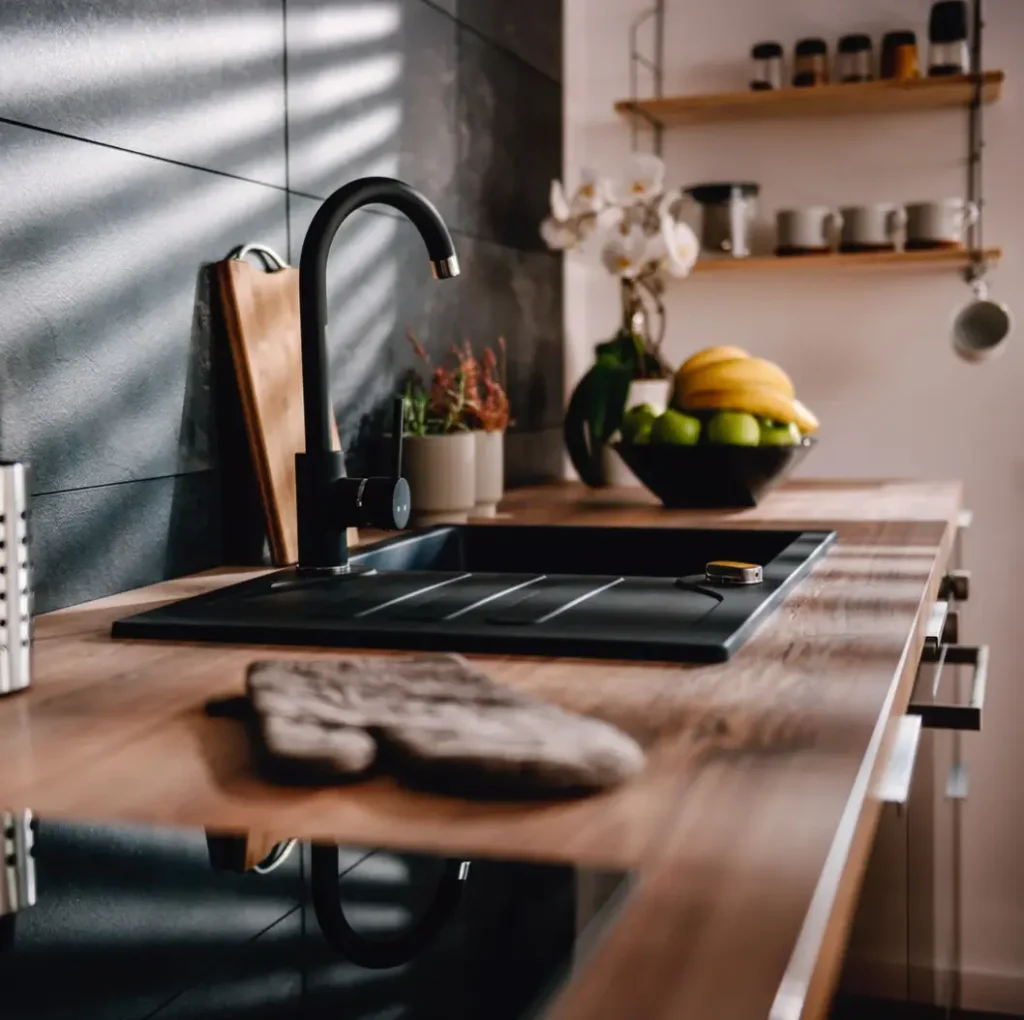
How to Create a Clutter-Free Kitchen You Actually Enjoy
By Emily | November 24, 2025
Have you ever walked into your kitchen in the morning and immediately felt a weight on your chest — not because of the mess, but because of the stuff? Tools piling up on the counter, things stacked on top of cabinets, spatulas hanging out of the drawer because they never quite find their place. There’s always one thing in the way and another you can’t find — even though you technically “put it away.” Most people assume a cluttered kitchen is a sign of laziness. In reality, it’s almost always the result of a poorly designed space — one that lacks the internal logic that makes order feel natural.
This article is about reshaping your kitchen so it actually works for you — instead of the other way around every single day. This is for anyone who feels their kitchen is functional but not livable. Anyone who loves to cook but finds the space itself stressful. Anyone who’s seen gorgeous kitchens on Pinterest and wondered why they can’t seem to get there — even after trying.
What follows is a carefully guided process from diagnosing the problem, to making intentional decisions, all the way to concrete, actionable solutions. You’ll learn how to think about storage the way an interior designer would. You’ll understand what’s worth investing in, and why not every organizer lives up to the promise on the box. You’ll also get style-specific guidance — because a clutter-free kitchen doesn’t have to be a boring one, and a well-chosen storage piece can be just as beautiful as it is functional. Because a clutter-free kitchen isn’t a one-time achievement. It’s a decision — one that a well-designed space makes effortless every single morning.
1. Diagnose Your Kitchen Before You Buy Anything
 Save it
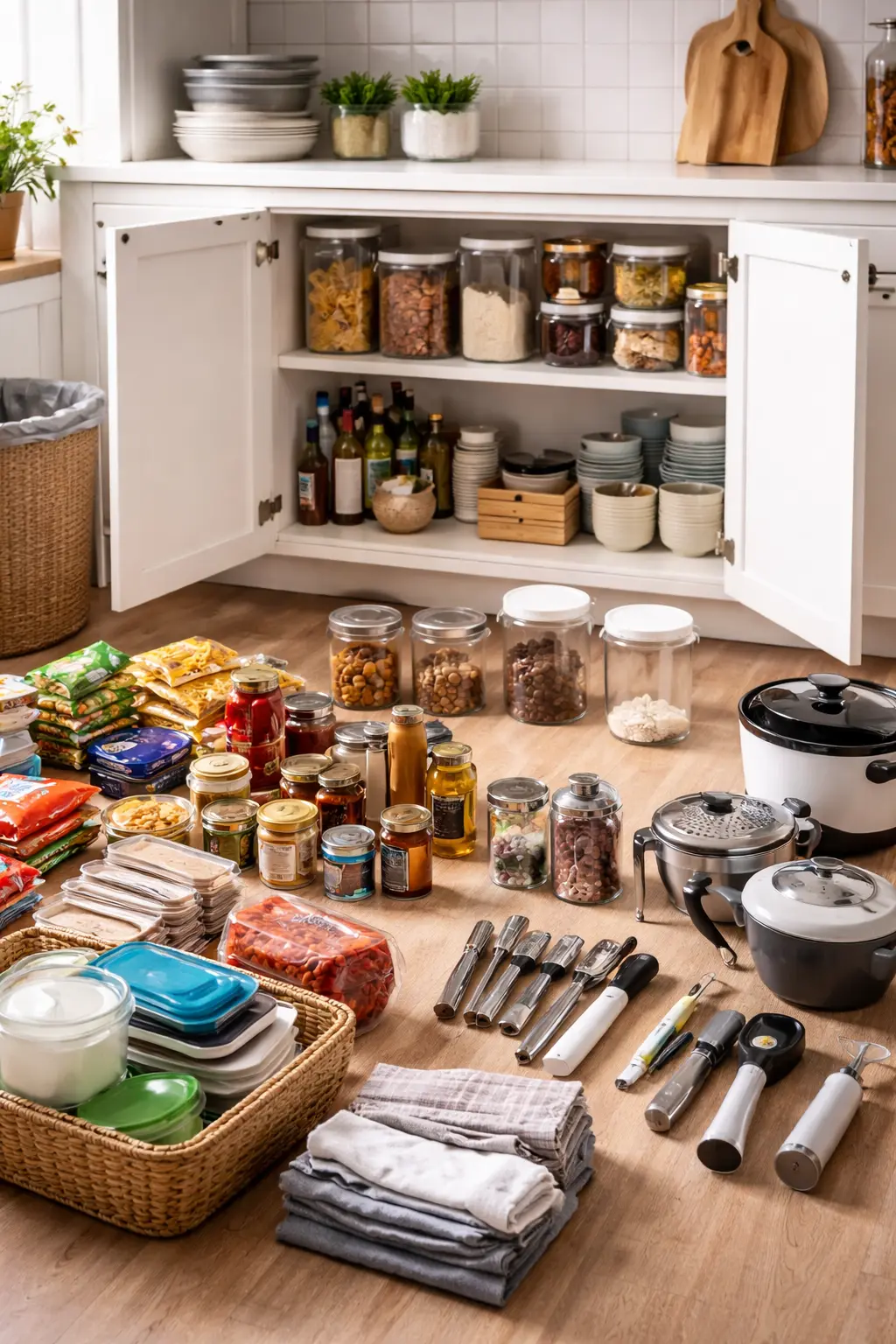
Before you purchase a single product, ask yourself these questions: What do you reach for three times a day? What do you use once a month but store in prime real estate? What has no designated home, so it lands “temporarily” somewhere — and then stays there forever?
The truth is, 80% of kitchen clutter doesn’t come from a lack of space. It comes from rarely used items crowding out the things you actually need daily. A hand mixer you take out three times a year doesn’t deserve counter space. A coffee maker you use every single morning does. That distinction sounds obvious — but applying it consistently rewrites the entire logic of how your kitchen functions.
Try a “probation box”: anything you can’t justify a permanent home for goes into a box. If you haven’t touched it in a month, it doesn’t belong in your kitchen. This single step costs nothing — and it’s remarkable how many items turn out to be pure space occupiers that nobody would ever miss.
Once you genuinely know what stays and what goes, then comes the first real investment: a quality set of clear, airtight food storage containers. They don’t just create order — they show you exactly what you have and what’s running low, which simplifies grocery shopping too. The uniform appearance is visually calming, and this is often the first “aha moment” that motivates you to keep going. Once you make the switch, the idea of going back to a jumble of mismatched bags and boxes becomes genuinely unthinkable.
2. Create a "One-Touch" System for Your Most-Used Tools
 Save it
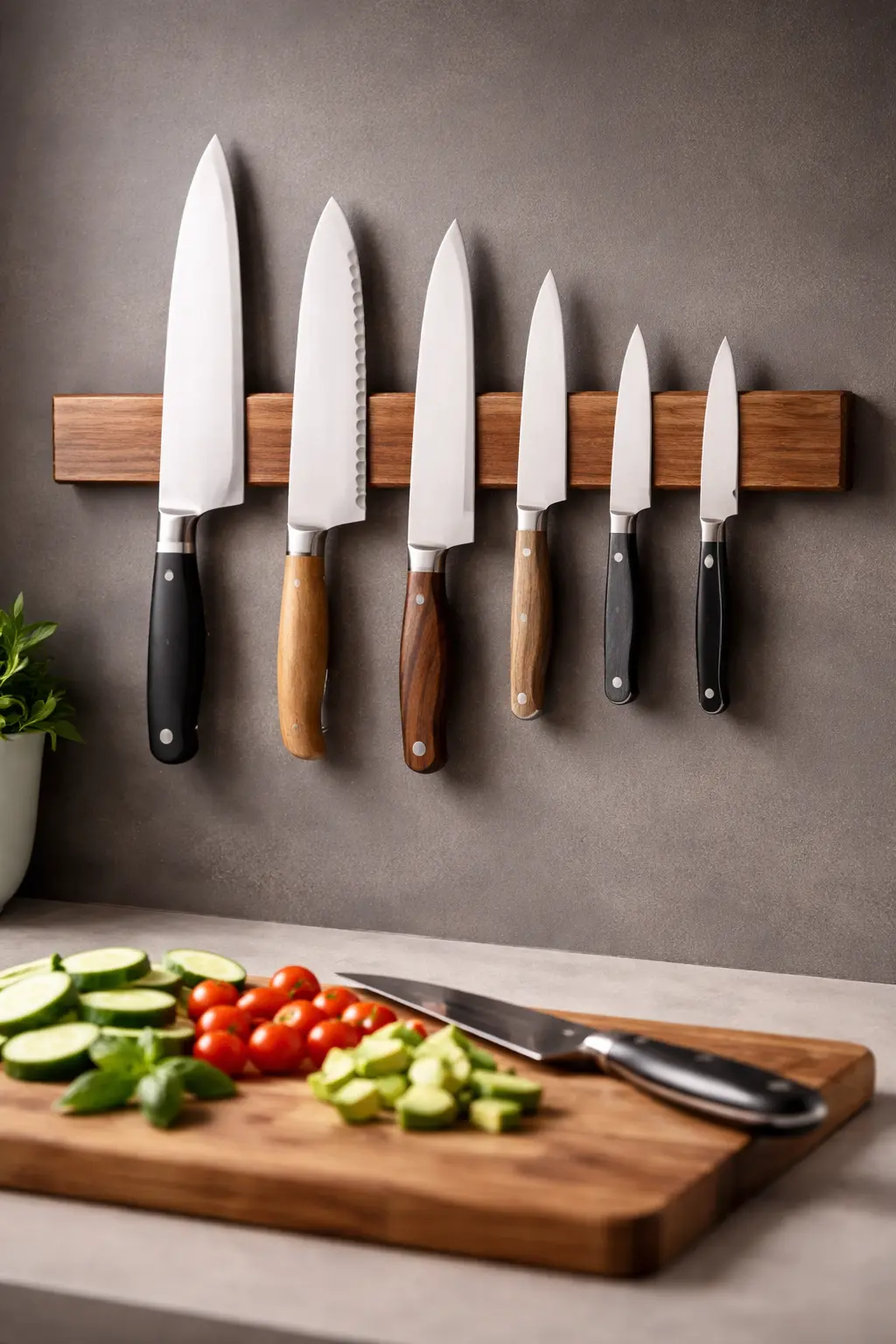
One of the main causes of kitchen clutter is that most people handle items twice: once to take out, once to put back — but not where it belongs. Then comes the next time, and the search begins again. The idea behind a “one-touch” system is simple: every tool goes back exactly where it came from, because putting it back is just as easy — or easier — than taking it out in the first place.
The single most important place to apply this principle is knife storage. When knives live in a cramped drawer, they rarely make it back to where they should be — because getting them there takes effort. A wall-mounted magnetic knife strip changes that dynamic completely: it’s visible, accessible, and putting a knife back means nothing more than a single touch to the strip. As a bonus, it frees up a significant amount of counter and drawer space — two problems solved in one move.
If you’re going for a modern or minimalist look, a magnetic knife strip isn’t just a functional element — it can become a visual focal point on the wall, especially in wood or matte black steel. In a rustic kitchen, the wood version blends naturally into warm, textural surfaces. For industrial-style spaces, brushed steel creates a sharp contrast against raw finishes. The knife shouldn’t be hidden: what you use every day should be the most accessible thing in your kitchen — and returning it should require zero effort. That’s the deeper logic of the one-touch system: if something can be put back in a single motion, it will be.
3. Use Drawer Organizers to Build a Cooking-Ready Kitchen
 Save it
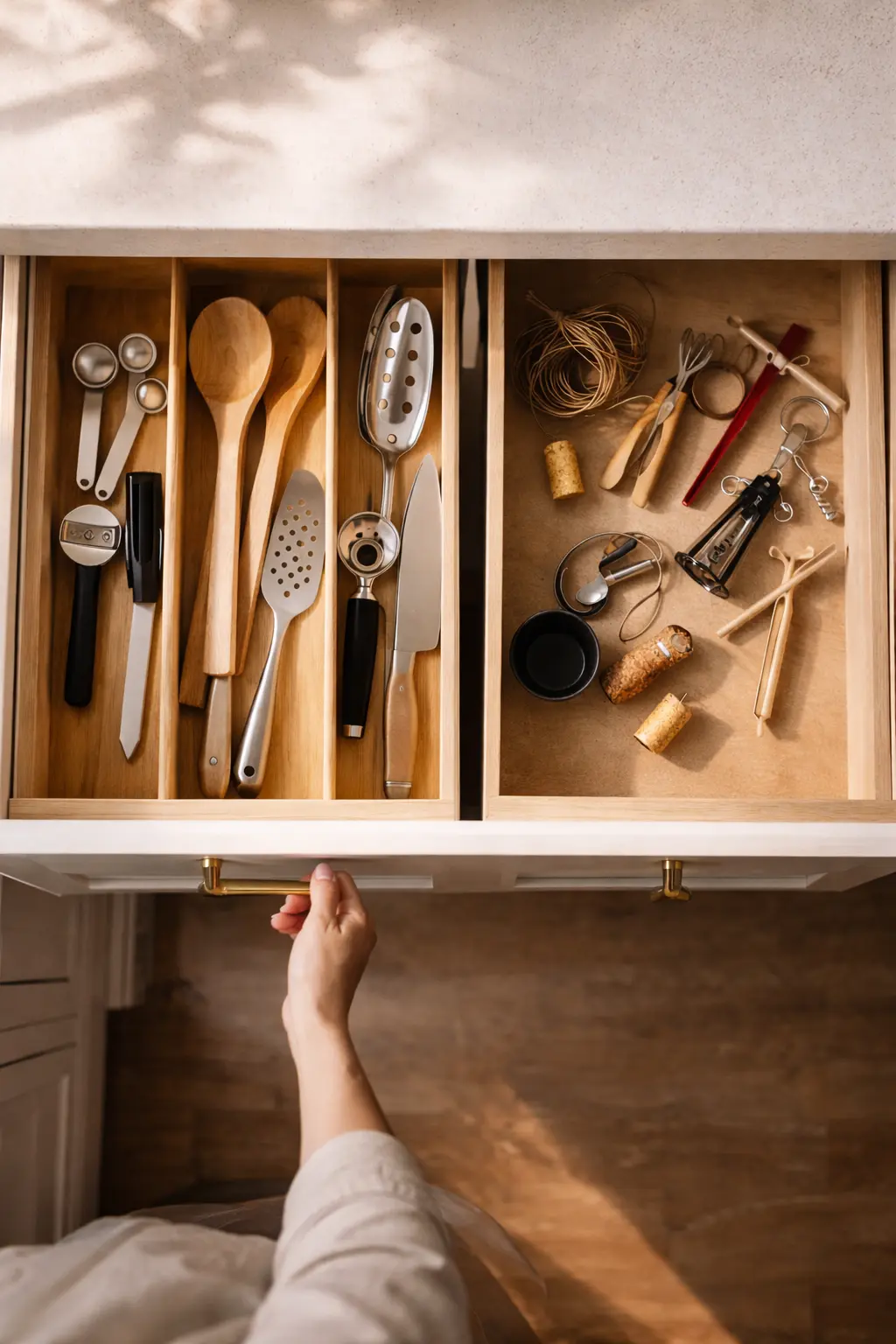
The kitchen junk drawer is one of humanity’s great unsolved mysteries. Everyone has that one catch-all spot — batteries, rubber bands, an unidentified key, and some old receipt living in peaceful chaos. But your tool drawers don’t have to look like that. A kitchen drawer isn’t a dumping ground — it’s a system, and it deserves to be treated like one.
Drawer organizers aren’t a luxury add-on. They’re genuine accelerators of the cooking process. When every tool has its own dedicated slot, the mid-cooking search disappears. That wasted time and attention chips away at the joy of cooking every single time — it creates friction where the kitchen should be doing the opposite.
Bamboo expandable drawer organizers are my top recommendation because they adapt to the exact width of your drawer, hold up over time, and work visually with almost any kitchen style. Plastic versions warp and scratch. Metal is cold and loud. Bamboo holds its shape, stays quiet, and brings a warmth to the space that plastic simply can’t replicate. If your kitchen leans Scandinavian, japandi, or farmhouse, this isn’t a compromise — it’s an intentional aesthetic choice. And remember: order in the hidden spaces matters just as much as what’s visible on the counter.
4. Make Your Pantry Work Like a Grocery Store
 Save it
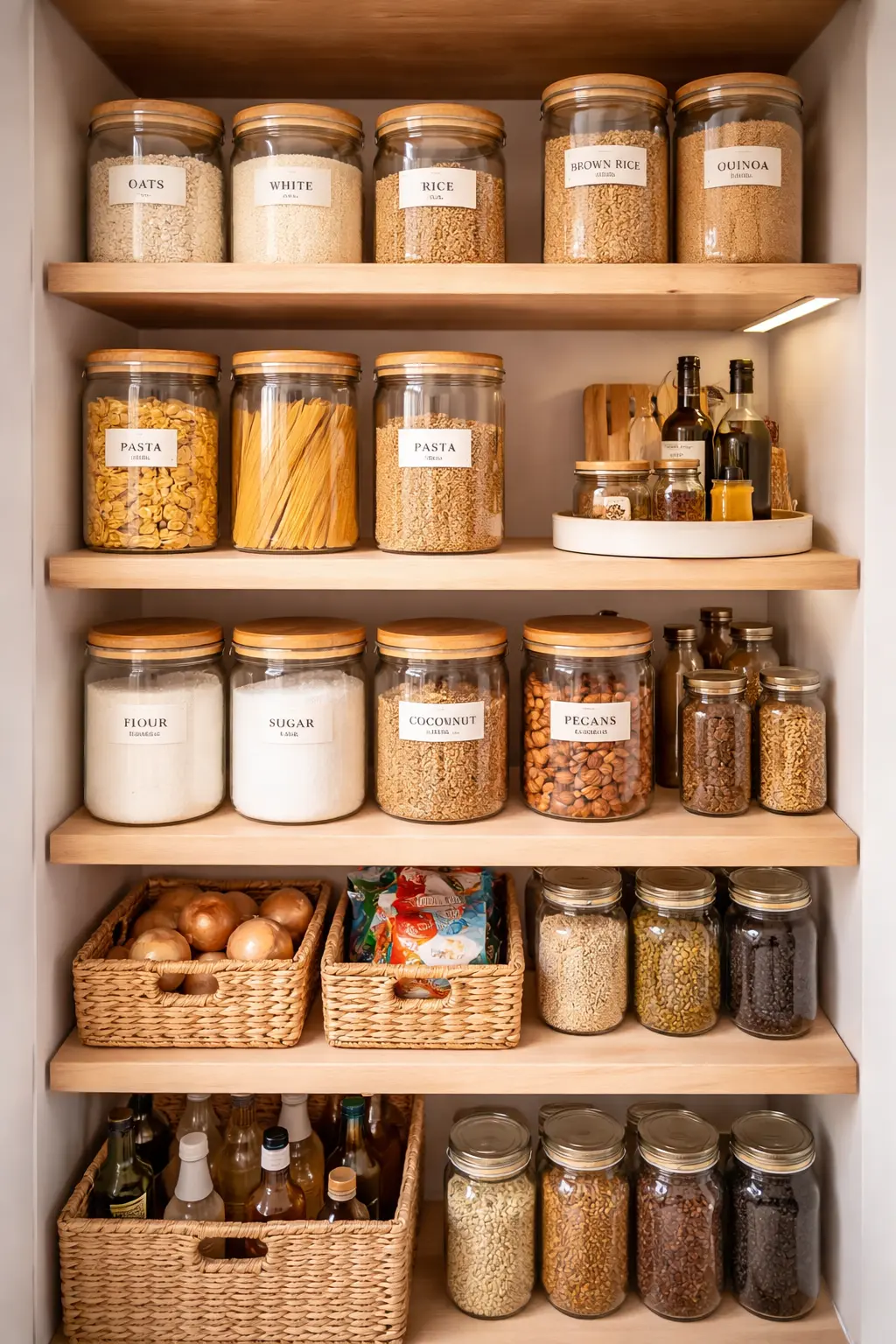
The pantry or deep cabinet is usually where people quietly give up on organization. An intimidating accumulation of ingredients, half-empty bags, expired spices — and you can never find the one thing you actually need. You buy something because you think you’ve run out, come home, and find three of the same jar hiding at the back of the shelf.
The fix is to organize your pantry using the same logic as a grocery store: everything visible, everything reachable, everything grouped by category. This isn’t an exaggeration — it works because the human brain searches by category, not by rummaging through unknown piles.
A lazy Susan turntable is one of the best investments you can make inside a deep cabinet. Just like rotating displays in a store, it brings the things tucked in the back — spices, oils, vinegars — straight to the front without pulling everything out. It’s especially game-changing in corner cabinets and deep shelves, exactly those spots where things disappear and are never seen again. Once you set up your zones (grains, canned goods, spices, oils), the system essentially maintains itself — because putting things back is just as easy as taking them out.
5. Build a Clutter-Free Counter with Intentional Displays
 Save it
The kitchen counter is one of the most vital surfaces in your home — and paradoxically, one of the most vulnerable. Everyone piles things there because they’re “handy,” and slowly a permanent layer forms: the coffee maker next to yesterday’s newspaper, a half-empty bottle of olive oil, and somehow a child’s shoe. This surface deserves a completely intentional, editorial approach.
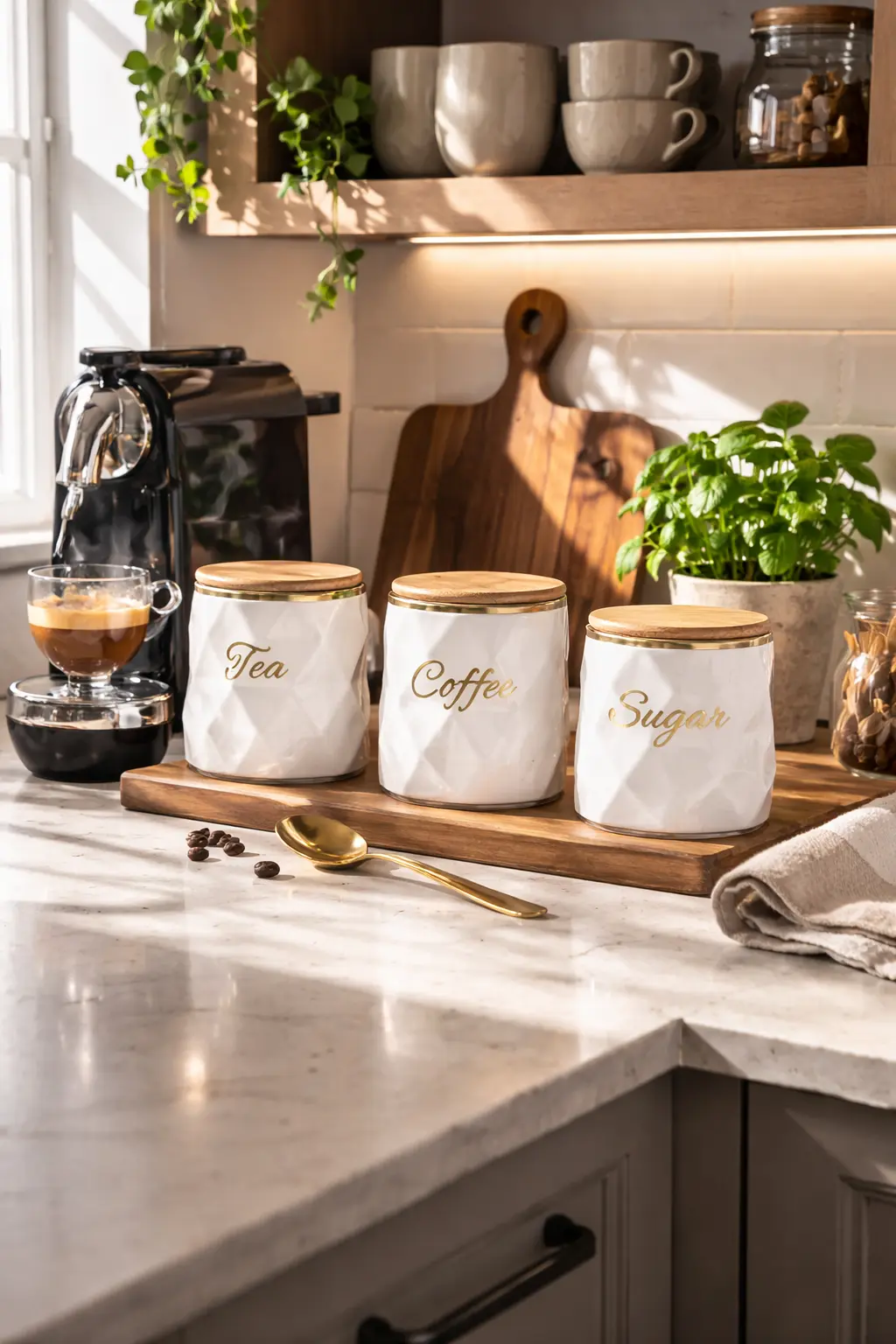
No more than three to five items should live permanently on the counter — and each one should be there by deliberate choice. My suggestion: the coffee maker, a beautiful oil pourer, maybe a small plant or a quality cutting board. Everything else finds a home elsewhere. This isn’t minimalism for its own sake — it’s curation. Think of a restaurant kitchen: only what’s needed is on the counter, and it’s exactly where it makes sense.
If you want the items that do stay on the counter to feel cohesive and styled, a set of ceramic canisters does double duty — it stores and decorates simultaneously. That’s the kind of dual-function worth paying for: your kitchen gains character, not just order. In farmhouse kitchens, painted ceramic canisters bring warmth and a handmade feel. In more minimal spaces, matte single-color versions hold their own quietly and elegantly. If you want a deeper look at how to style what stays visible on your counter, check out my article The Secret to Beautiful Yet Functional Kitchen Counter Decor — that’s exactly what I break down there.
6. Organize Your Spices So You Actually Use Them All
 Save it
Spice storage is one of those areas where almost everyone is living with some kind of compromise. Either they’re in a jumbled drawer where you never know what’s there, or lined up on a shelf where the ones in the back disappear forever. Spices only help when they’re visible and within reach — if you have to hunt for them, they don’t make it into the food, and they quietly expire without ever being properly used.
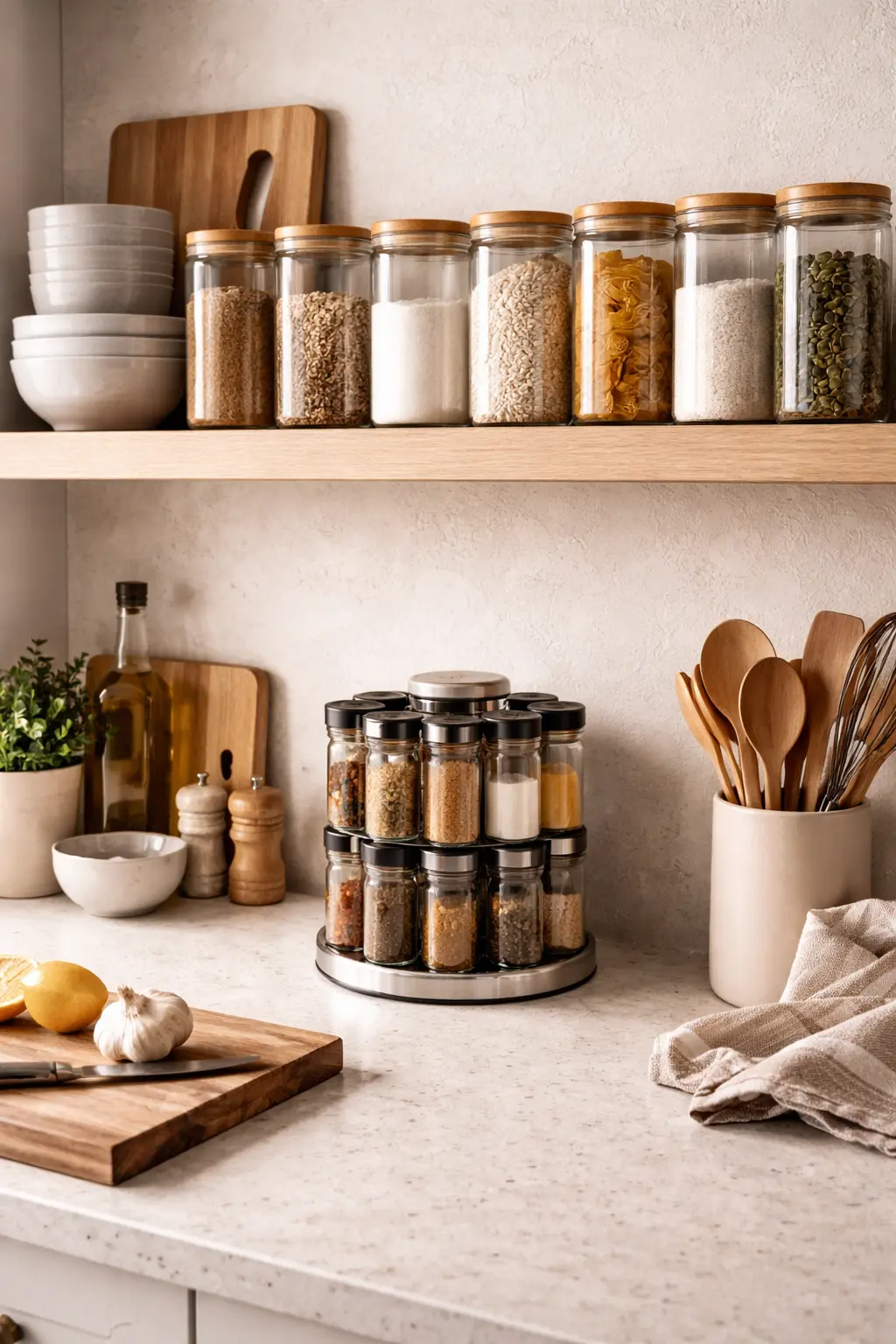
The best solution is a unified spice storage system positioned at eye level, where everything is labeled and scannable in a single glance. A rotating tiered spice rack delivers exactly that: compact, effortless to use, and every spice visible at once without pulling anything out. If you prefer a minimal counter, a smaller version fits neatly inside a cabinet. If the counter is your preferred display, a well-chosen rack becomes a functional décor piece in its own right.
Matching spice jars also do a surprising amount of visual heavy lifting. If you’ve been living with a mismatched collection of different sizes and shapes, switching to a single uniform set immediately makes the whole area feel more deliberate and polished. It’s one of the cheapest and fastest ways to make a kitchen look visually “put together” — low investment, high visible impact, and a change you’ll notice the very first time you reach for a spice.
7. Make the Most of Vertical Space in a Small Kitchen
 Save it
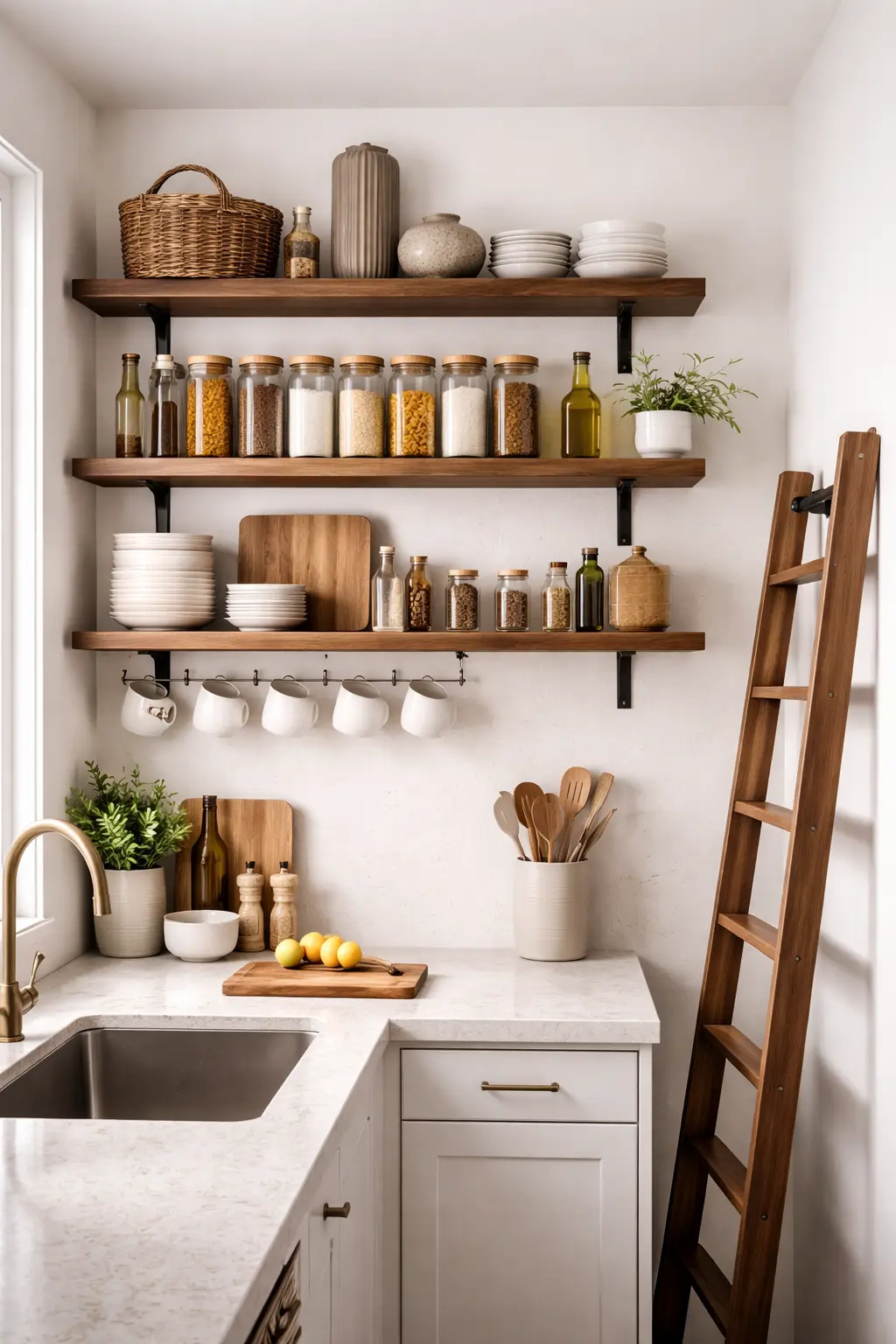
In a small kitchen, every single centimeter from floor to ceiling matters. Most people think only horizontally — shelves, drawers — while entire wall surfaces go completely untouched. This is the fastest way to create extra storage without adding a single new cabinet to the room.
Wall-mounted floating shelves are ideal for moving less frequently used tools, beautiful ceramics, or plants into the upper zones, while everything below eye level stays easily reachable. Floating shelves now come in virtually every style: white MDF for minimalists, solid wood for rustic or japandi kitchens, black metal for industrial-leaning spaces — and they layer beautifully together if you want an eclectic, collected look.
The inside of cabinet doors is another consistently overlooked surface. This is where foil and parchment holders, small lids, and reusable bags can go — all those small things that are rarely needed but always in the way. One focused weekend of vertical thinking can completely transform a cramped kitchen: you gain space, and the room itself starts to feel lighter and more open, because the zones above eye level are organized rather than ignored.
8. Create a Morning Routine Station That Sets the Tone
 Save it
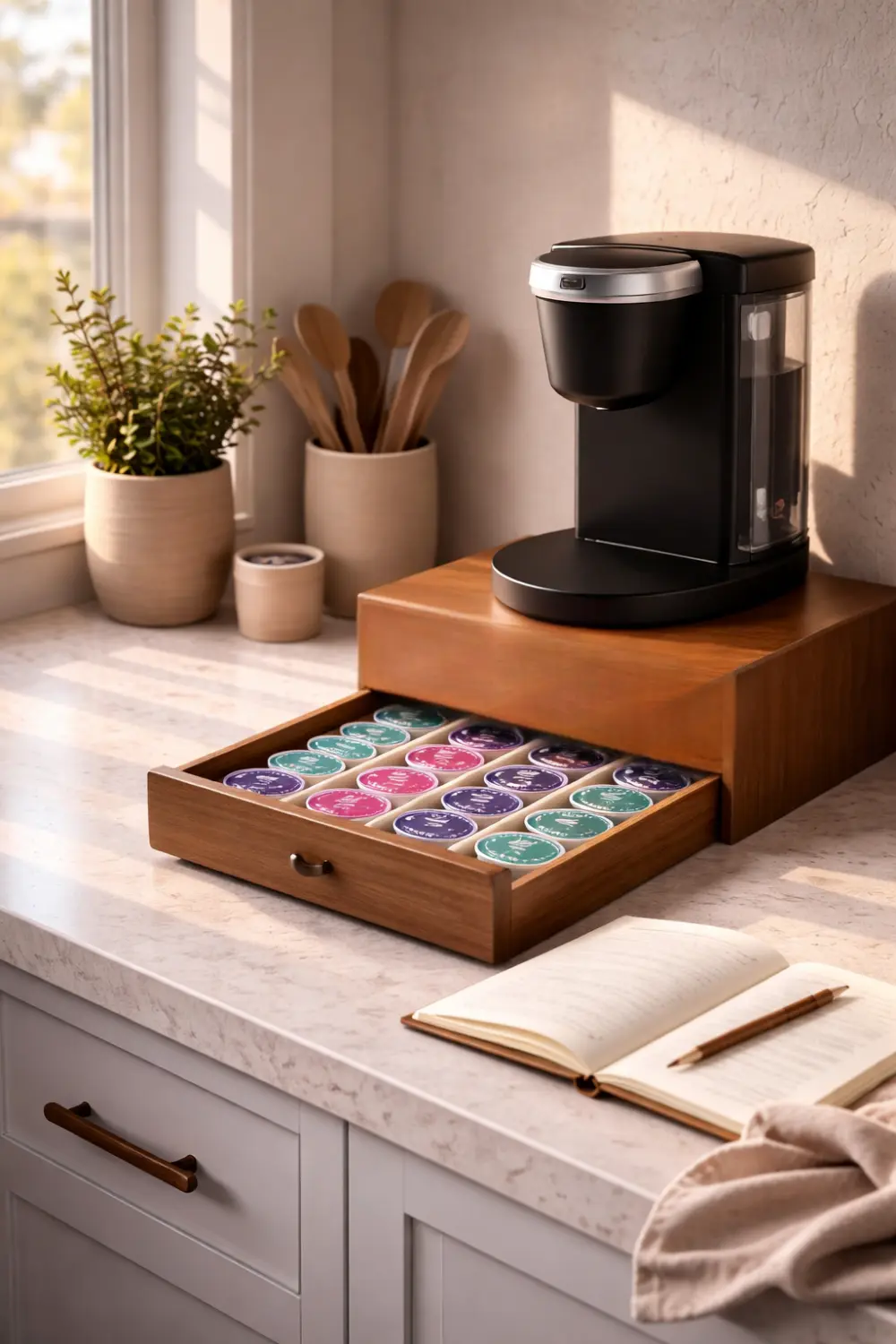
The morning kitchen routine sets the tone for your entire day. If at 7am you’re hunting for a coffee filter, the right mug, a spoon, the sugar — that’s not a good start. But when everything you need for your morning is exactly where it should be and immediately within reach, the whole ritual shifts: calmer, more intentional, actually enjoyable. That’s not a small thing — the mood of your morning embeds itself into the rest of the day.
Create a dedicated “morning station”: a section of shelf or counter where the coffee maker, mugs, tea, and morning accessories all live together. It doesn’t need to be large — but it needs to be self-contained, logically arranged, so that a single loop gets you everything you need without opening three different cabinets.
A quality wood countertop coffee and tea organizer ties this zone together and immediately signals: this space belongs to the morning ritual. These pieces don’t just store — they structure and set a mood. Your morning coffee stops being a scattered search and becomes a small, intentional ceremony you actually look forward to. If you want to build this kind of morning intentionality even deeper — not just at the level of your kitchen but at the level of your habits — my article How to Build a 5AM Morning Routine That Actually Works (No More Wasted Mornings) is worth reading alongside this one.
Helpful Tips That Actually Work
Before we get into the most common mistakes, here are a few pieces of advice that sound deceptively simple — but consistently applied, they genuinely change how you feel in your kitchen every day.
The “one in, one out” rule. Every time you bring a new kitchen tool home, let one go. This doesn’t just prevent accumulation — it forces you to consciously decide whether you truly need the new piece. Most kitchens don’t need less stuff in general. They need better stuff, not more of it.
Measure before you shop. Before buying any drawer insert, basket, or organizer, measure precisely. The most common disappointment is a product that “almost” fits — but doesn’t quite. Get out the measuring tape, write down your dimensions, and only then search for products.
Labels are not optional. The human brain searches by category. An unlabeled container registers as “unknown” — and the hand won’t reach for it automatically. A simple label maker is a modest investment that maintains order for years. The difference is felt fastest in the pantry, on spice shelves, and in the freezer — almost immediately after labeling.
The peak-hour kitchen audit. Once a month, observe yourself cooking as if from the outside: where do you get stuck? Where do you search? What has no home? This self-observation gives you a more accurate diagnosis than any organizing guide — because your kitchen runs on your habits, not on general principles.
If you also want to handle the visible elements on your counter both beautifully and functionally, my article The Secret to Beautiful Yet Functional Kitchen Counter Decor gets into exactly that — how to make what you choose to display both genuinely useful and genuinely beautiful.
Common Mistakes When Creating a Clutter-Free Kitchen
1. Buying too many organizing products at once.
This is one of the most common traps. Full of enthusiasm, you invest in an entire system — baskets, boxes, holders, drawer inserts — bring it all home, and discover that one box is too tall for the shelf, another doesn’t fit the drawer. Be patient. Introduce new elements one at a time, after measuring precisely.
2. The “I’ll put it away later” mindset.
Allow one exception and it quickly becomes the norm. “I don’t have time to put it back” is genuinely 30 seconds in most cases — but the accumulation is measured in weeks. Find the real reason: there’s almost always a friction point that needs to be eliminated, not a principle that needs to be abandoned.
3. Thinking only horizontally.
Many people focus entirely on shelves while the inside of cabinet doors, the side of the fridge, and the back wall of the pantry go completely untapped. Kitchen space is three-dimensional — if you only work in one plane, you’re leaving a lot on the table.
4. Hiding clutter behind decoration.
Many people assume that putting chaos into a pretty basket makes it organized. The eye can be fooled briefly — but the lack of structure remains. A basket isn’t a solution, it’s a frame. The solution is curation: deciding what belongs and what doesn’t.
FAQ
Where do I even start if my kitchen is completely chaotic
Don’t try to solve everything at once. Pick a single drawer or a single shelf and start there. Take everything out, wipe the surface clean, and only put back what genuinely belongs. This takes 20–30 minutes and delivers an immediate, visible result. Motivation comes from the feeling of success, not from the decision alone.
Is a clutter-free kitchen realistic in a small space?
Not only realistic — almost essential. In a small kitchen, clutter shows immediately and stresses the space far faster. Vertical storage and smart use of wall surfaces can genuinely transform quality of life in a small kitchen. And a smaller space is actually easier to maintain once the structure is in place.
Do I need to transfer all my spices and pantry items into matching containers?
Not everything — but wherever you can, it’s worth it. Dry goods benefit most: grains, pasta, seeds, spices. In uniform labeled containers they’re transparent and accessible, with no terrifying mound of half-open bags. Glass containers are also completely style-agnostic — they look equally at home in a modern kitchen and a rustic one.
Conclusion
A clutter-free kitchen isn’t a finished state — it’s a continuously renewed decision. Every day you make small choices: do you put something back where it belongs, or do you set it down “just for now”? The difference between those two habits is measurable over months.
What matters most: don’t chase an impossible standard. Chase the best version of your own kitchen — the one where you don’t have to search for anything, where cooking doesn’t frustrate you, where you genuinely enjoy spending time. That’s not a luxury. That’s quality of life.
If there’s one thing to take away from this article, let it be this: eliminate every single friction point. Each time you notice you’re not putting something back because it’s inconvenient, that’s a signal that the system needs fixing — not your habits. A well-designed space draws out better habits. Not the other way around.
Start today with that one drawer, cabinet, or shelf that bothers you most. In a week, you’ll be surprised how different it feels to open it.
This post contains affiliate links. I may earn a small commission at no extra cost to you.
Get cozy inspiration delivered to your inbox.
✓ 14-page beautifully designed ebook
✓ Cozy decorating ideas
✓ Practical room-by-room inspiration
You’re in! 🎉
Thanks for joining the NestFlowHome community!
Your free ebook is already on its way to your inbox. If you don’t see it within a few minutes, please check your Promotions or Spam folder.
Join the NestFlowHome community for weekly decorating inspiration.

Timeless home decor ideas and slow living inspiration for a calm, beautiful life.