
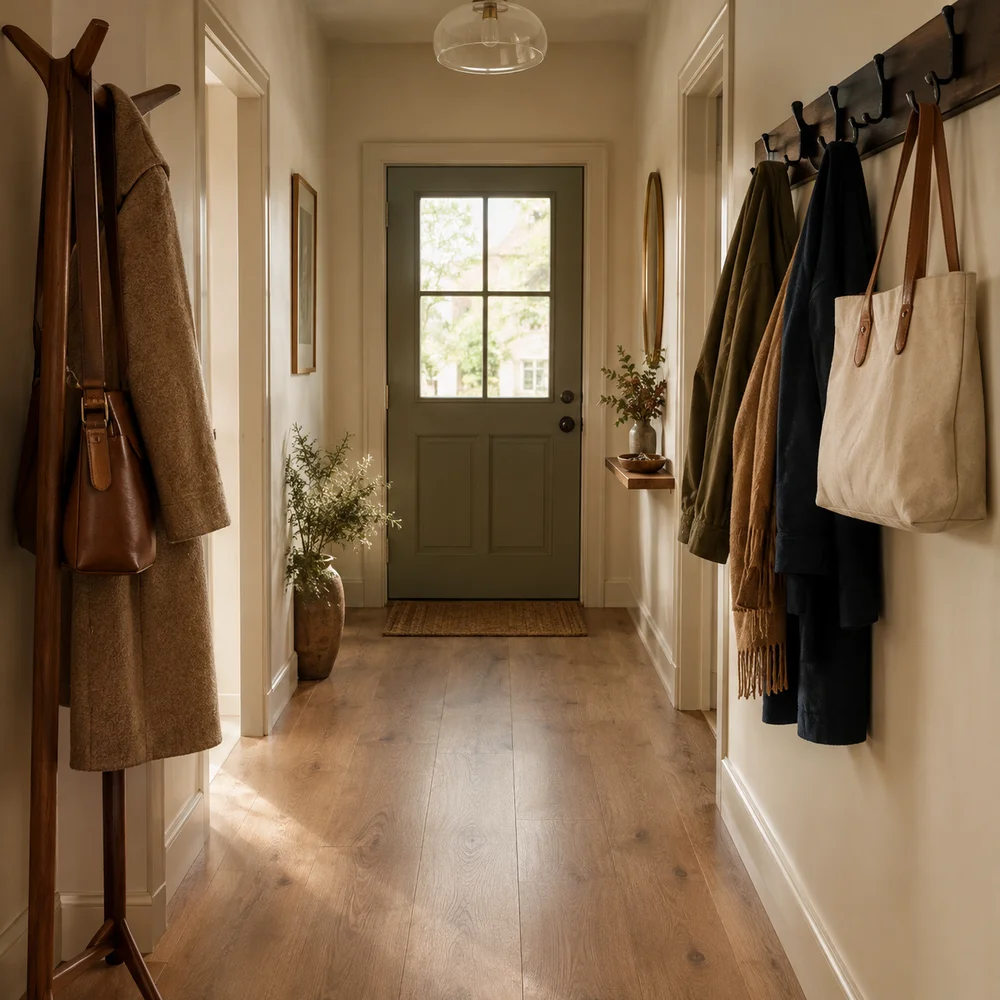
How to Store Coats and Bags in a Small Entryway
By Emily | October 15, 2026
You open the door with a coat half off your shoulders, a tote cutting into one arm and a grocery bag swinging from the other. The coat lands on the back of the nearest chair. The tote slumps against the wall. By Thursday, the chair has disappeared under three jackets and a scarf, and the small entry you walk through a dozen times a day feels less like a welcome and more like a holding pen.
The usual explanation is that the entryway is simply too small. Usually it isn’t. The real problem is that nothing in it was ever assigned a job. Coats and bags are bulky, soft, irregular objects, and when they have no designated home they drift toward whatever flat surface is closest. Give them an address, at the right height and the right scale, and even a two-foot strip of wall can hold a household’s outerwear gracefully.
This guide walks through nine structural answers to the question of where outerwear should live. Some stand freely on the floor, some mount to the wall, and some fold flat or rotate into a forgotten corner. Along the way you’ll find practical numbers for hook height and spacing, notes on visual weight and finish, and a clear look at how much floor each piece consumes, because in a small entry every inch carries a cost.
Read it less like a shopping list and more like a set of floor plans. Measure your entry before you fall for any piece, note which way the door swings, and think about who comes through it and what they carry. A household of two commuters needs something different from a family with school bags and hockey gear. Choose the one or two ideas that genuinely fit your routine, and let the rest of the space settle around them.
1. The Freestanding Coat Tree for an Entry With No Wall to Spare
 Save it
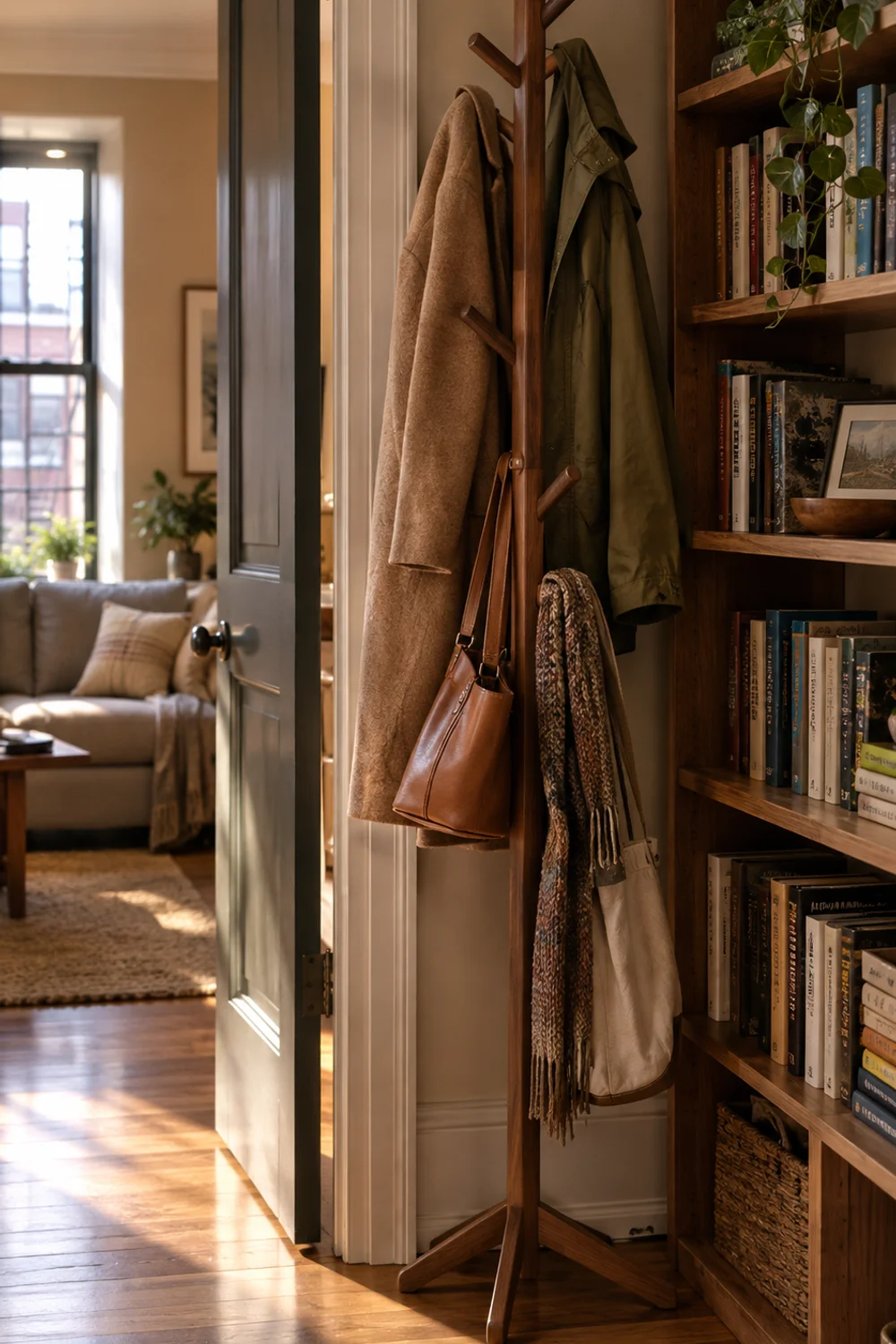
Some entries simply have no wall to give. The door opens against a radiator, a sidelight window takes up one side, and the other is crowded by a light switch panel and the start of a staircase. In apartments like these, wall hooks are not an option, and coats end up draped over the banister. A freestanding coat tree solves the problem by bringing its own vertical structure into the room, claiming a footprint of roughly twenty inches square rather than a stretch of plaster.
Good coat trees work through tiers. The upper hooks, usually set around five and a half to six feet, take long coats and raincoats so their hems clear the floor, while a lower ring, closer to four feet, catches bags, scarves and children’s jackets. Stability matters more than hook count. A weighted or wide cross-base keeps the tree upright when a heavy parka hangs on one side, and placing it on the hinge side of the door keeps it out of the swing path.
Material changes how much space the tree seems to take. A thin metal stand can look spindly once it is loaded, almost as though it is struggling, whereas a solid wood trunk reads as furniture even when it carries five coats. For a warm, grounded look, consider a solid wooden freestanding coat rack with eight hooks in a mid-brown finish, which pairs naturally with oak floors, leather bags and wool outerwear and stands tall enough to keep long hems off the floor.
Picture a third-floor rental where the front door opens straight into the living room, with no hallway at all. The only free spot is a narrow corner between the door frame and a bookcase. Before, two winter coats and a gym bag lived on the arm of the sofa, which meant guests sat on someone’s scarf. With a coat tree tucked into that corner, the sofa returns to being a sofa, and the corner becomes a small, legible threshold that quietly marks where outside ends.
There is a broader idea here about thresholds. In homes without a true foyer, the transition from street to living space happens in a single step, and that abruptness is part of why clutter spreads. A vertical object near the door creates an implied entry, a pause where the body naturally sheds layers. People hang their coats on a coat tree almost without deciding to, because the shape itself suggests the action. Good storage often works that way, by making the right habit the obvious one.
2. A Wall Rack With a Shelf Built Above the Hooks
 Save it
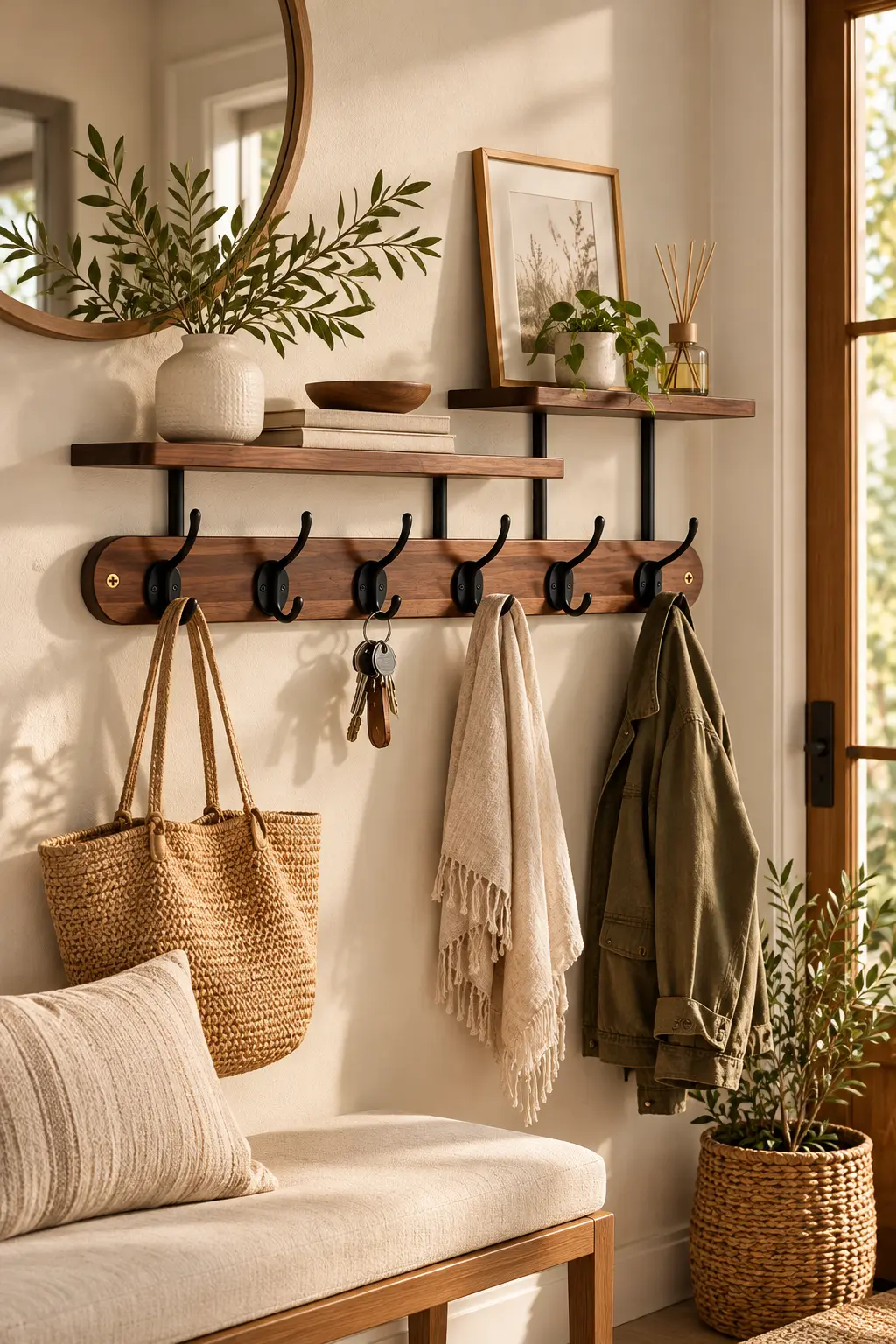
A row of hooks alone handles coats, but it leaves a quieter problem unsolved: hats, gloves, sunglasses and the small pouch that travels between bags have nowhere to rest. They end up stuffed into coat pockets or balanced on a radiator. A wall rack with a shelf above the hooks adds a second plane of storage without asking for a single extra inch of floor. The hooks take the heavy, hanging items, and the shelf above catches everything that would otherwise roll, slide or vanish.
Height decides whether the rack gets used. Mount the hook rail so the hooks sit roughly sixty to sixty-six inches from the floor, which keeps most coats from puddling at the baseboard while staying within easy reach. The shelf then lands at shoulder or eye level, shallow enough not to bump a forehead. Anchor the rail into studs or heavy-duty wall anchors, since a fully loaded rack in January can carry thirty or forty pounds of wool, down and canvas.
Dual hooks are worth seeking out. The upper prong holds a coat by its loop or collar, while the lower one takes a bag strap without the two items wrestling for the same point. A compact option such as a 23-inch solid wood wall rack with a two-tier shelf and six dual metal hooks in a dark stain fits between a door frame and a corner, and its lower tier holds folded beanies while the upper one keeps leather gloves together in pairs.
Consider a narrow townhouse entry with just over two feet of wall between the front door and a coat closet the water heater claimed years ago. A couple lives there, both commuting by bike. Before the rack, helmets sat on the floor, gloves migrated between pockets, and one of them lost a single glove every winter like clockwork. After, the helmets live on the top shelf, gloves rest beside them in pairs, and the two shell jackets hang below, ready for the morning.
The principle underneath is simple: what you can see, you keep track of. Small accessories get lost not because a household is careless but because they have been given storage that hides them. A shelf at eye level turns gloves, hats and helmets into visible inventory, so a glance on the way out tells you whether everything is there. It also adds a slim horizontal line above the hooks, which gives the wall a finished, architectural edge rather than a scatter of hardware.
3. The Hall Tree That Gives Coats, Bags and Shoes One Address
 Save it
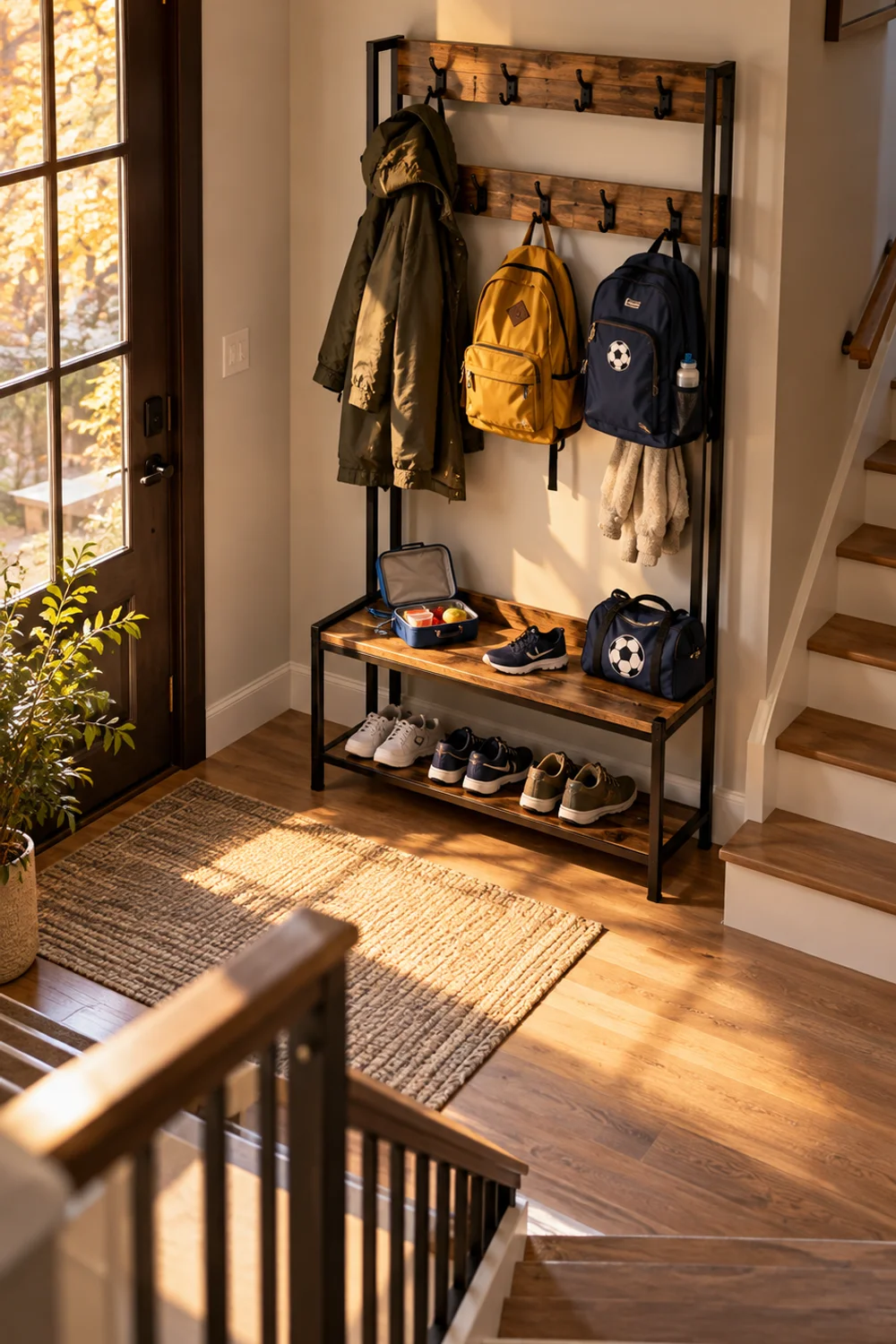
Small entries tend to fragment. Coats go on one hook, bags on a chair, shoes by the door, and the person sitting down to pull on boots has nowhere to sit at all. A 3-in-1 hall tree gathers these scattered routines into a single piece of furniture: hooks above, a bench in the middle and a low shelf beneath. Everything connected to leaving the house now shares one address, and the rest of the entry is free to breathe.
The design works because it follows the order in which people actually leave. You take a coat from the hook, sit to put on shoes, lift a bag from the bench beside you and walk out. Coming home, you reverse it. A bench around eighteen inches high is comfortable for most adults, and a depth of twelve to fourteen inches keeps the piece shallow enough for a tight hallway. Staggered hooks prevent bulky coats from crowding each other across the top rail.
Steel-framed hall trees suit entries where wood would feel heavy. A slim black frame lets light and sightlines pass through, so the piece reads as an outline rather than a block. The lower shelf handles everyday sneakers in passing, and if that layer needs more thought, Stunning Shoe Storage Ideas for Small Spaces That Look Amazing explores it on its own terms. For the frame itself, a steel hall tree with a shoe storage bench that pairs a rustic wood-look top with open metal sides keeps the whole arrangement visually light.
Imagine a split-level house where the front door opens onto a small landing with stairs going both up and down. A family of four comes through it every afternoon, and for years the landing held a mound of backpacks, a soccer bag and whatever coats hadn’t made it upstairs. A hall tree against the one flat wall changes the choreography. Each child gets a hook at their own height, backpacks rest on the bench while lunch boxes are emptied, and the stairs stay clear.
Consolidation has a visual payoff as well as a practical one. Three separate pieces, a hook rail, a stool and a shoe rack, create three silhouettes, three finishes and three sets of edges in a space that may be only four feet wide. A single hall tree replaces that visual noise with one coherent outline. In small rooms, the number of distinct objects matters as much as their size, and reducing that count is often the quickest way to make an entry feel deliberately designed.
4. Pegs That Fold Away and Leave a Clean Wall
 Save it
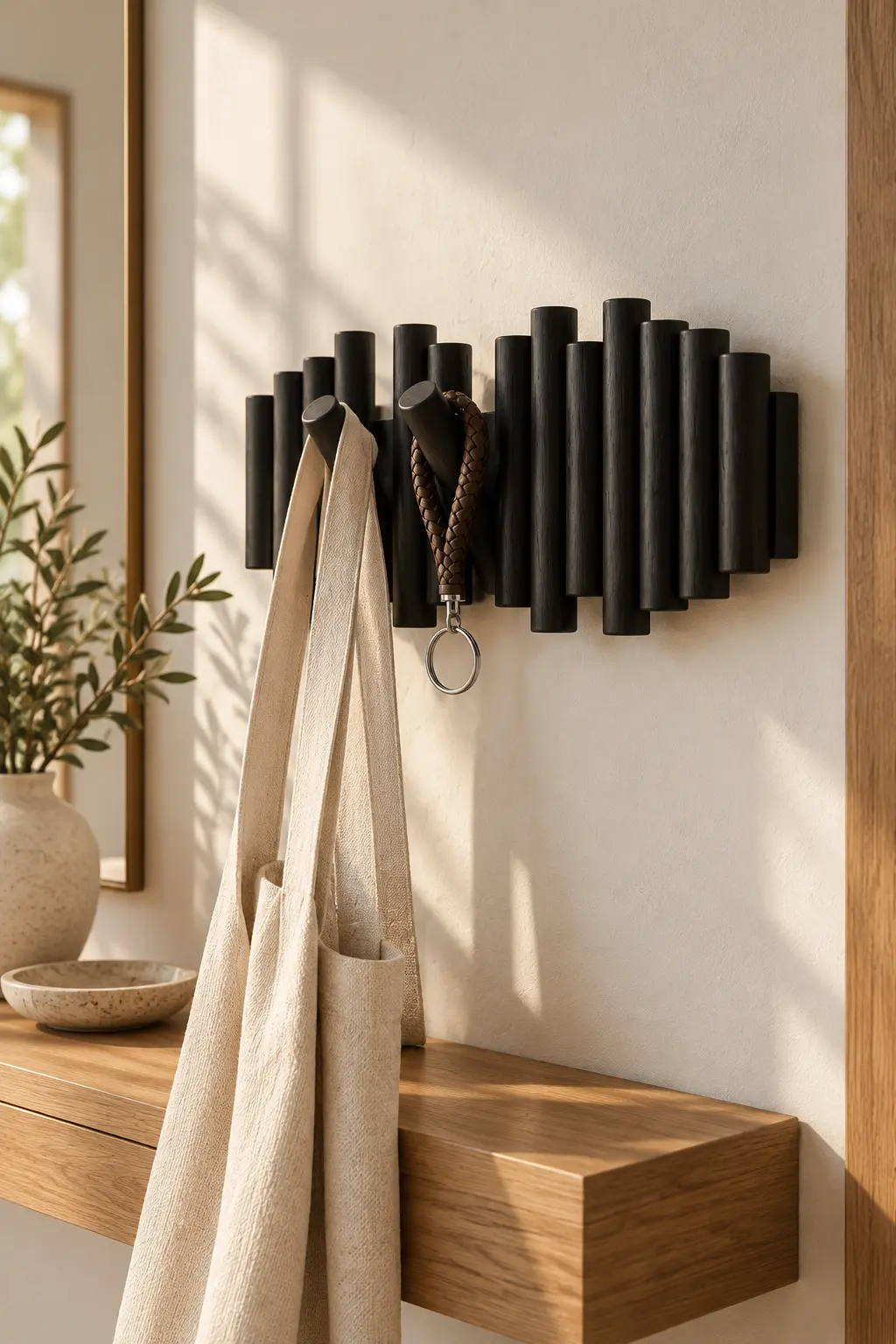
Hooks earn their keep for only part of the year. In summer, when a light jacket is the most anyone wears, a row of empty metal hooks sticks out from the wall like teeth, catching sleeves and shoulders in a narrow hall. Retractable pegs answer that seasonal mismatch. Each peg flips down when you need it and folds flush into its rail when you don’t, so the wall can look like a clean architectural line one day and a working coat station the next.
The mechanism is a simple hinge, but its effect on circulation is real. A standard hook projects three or four inches from the wall, which in a thirty-six-inch hallway steals close to a tenth of the walking width. Folded pegs project barely an inch. The smart habit is to open only as many pegs as the household uses, one per person plus one for a guest, and leave the rest closed. The rail then shows its own quiet rhythm of open and shut.
Not every folding peg is built for a down parka, so check how the pegs are shaped and how the rail mounts. Wood pegs with a slight upward angle hold collars and bag handles more securely than flat ones, and they are gentler on knitwear. A black rail reads as a graphic line, and it looks especially sharp against white or pale grey walls. One clean example is the Umbra Picket wall rail with five retractable wood pegs in black.
Take a prewar apartment with a long, thirty-four-inch hallway leading from the front door to the kitchen. A resident wheels a bicycle down it every evening, and the old fixed hooks used to snag the handlebars and drag a raincoat to the floor at least twice a week. After switching to a folding peg rail, two pegs stay open for daily jackets near the door end, three stay closed, and the bicycle glides past without catching anything. Guests get a peg flipped down on arrival.
Peg rails belong to an older tradition. Shaker communities lined their rooms with them so that chairs, cloaks and tools could be hung up and the floor swept clear, treating storage as part of the architecture rather than something added later. The retractable version simply adds the ability to disappear. A home changes through the day and the year, with guests arriving, seasons turning and coats thickening and thinning, and storage that can expand and contract alongside it feels far less intrusive than storage fixed permanently open.
5. Choosing a Lighter Hall Tree for a Narrow, Dim Entry
 Save it
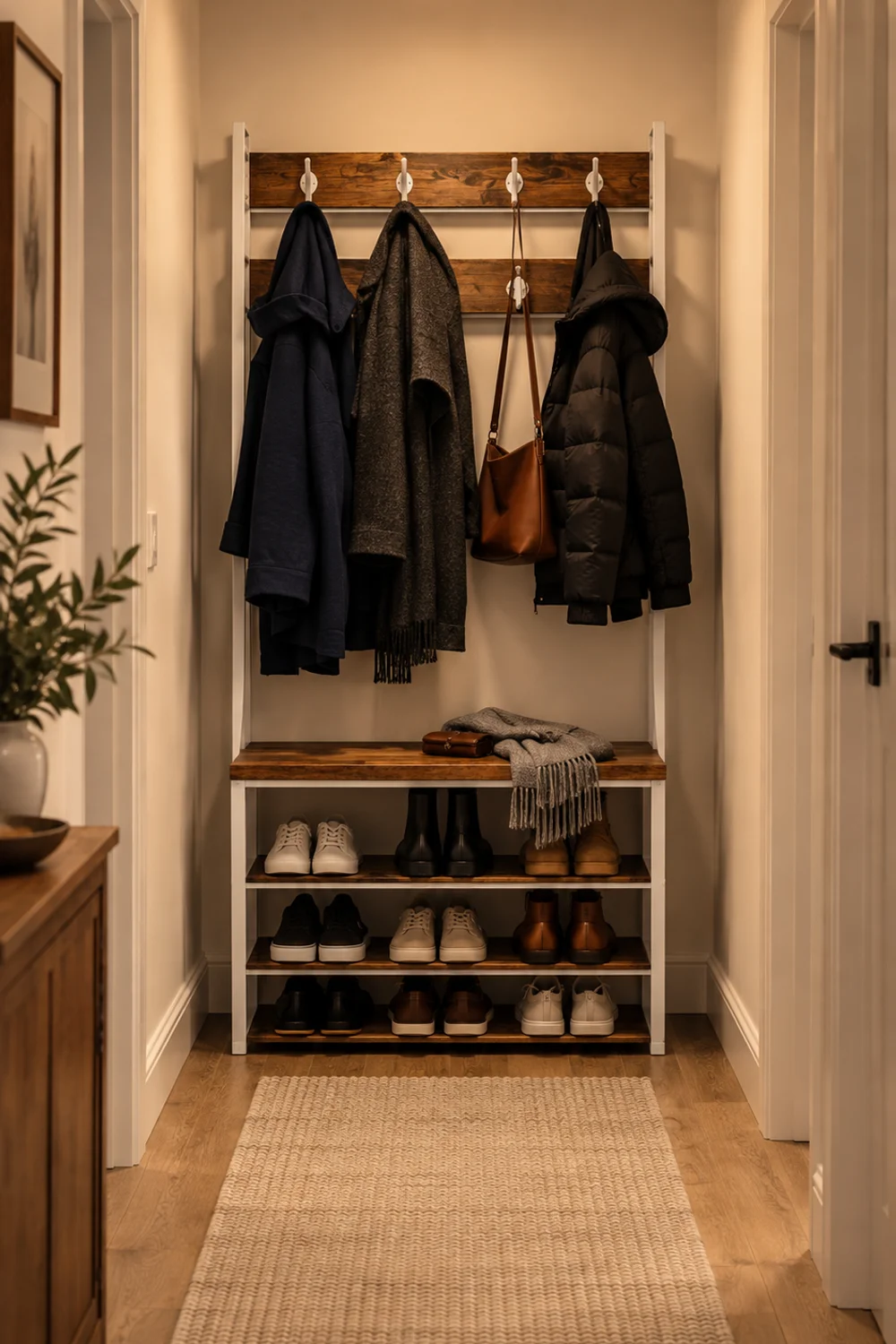
A dark, heavy hall tree in a narrow entry with no window can feel like a wardrobe blocking a tunnel. The furniture absorbs what little light reaches the space, and coats in navy, black and charcoal pile on top of it to deepen the shadow. Choosing a lighter-toned hall tree works on the opposite principle. A white or pale frame reflects ambient light back into the room and lets the piece recede, so the eye registers the coats rather than a dark mass behind them.
Visual weight comes from three things: color, mass and how much of the floor and wall a piece blocks. A pale hall tree placed against a similarly pale wall almost dissolves, because the contrast between object and background is low. Open sides, raised legs or a visible gap beneath the bench let the floor run continuously under the piece, which tricks the eye into reading a wider passage. Solid panels, by contrast, cut the space into sections and make a narrow entry feel even narrower.
All-white furniture can tip into clinical, especially under the cool overhead light many hallways have. A two-tone finish solves that. White structural panels keep the brightness, while a walnut-toned bench seat or top adds a band of warmth at the height where hands and bags actually touch. That walnut band also hides the scuffs a pure white surface would show within weeks. An 3-in-1 hall tree in white and walnut, with a bench and shoe storage, follows exactly this logic.
Think of a garden-level apartment where the entry is a windowless corridor, lit by a single ceiling fixture and painted a soft white years ago. The previous tenant left a dark espresso hall tree, and every winter it disappeared under black puffers until the hallway felt like a cave. Swapping it for a white-and-walnut piece of the same width changed the mood immediately. Nothing about the corridor’s size changed, yet visitors began commenting that the entry seemed bigger, brighter and somehow more welcoming.
There’s a useful rule hiding in that story: a bright room can carry dark furniture, but a dim room rarely can. Daylight gives dark wood depth and richness, while in shadow the same finish flattens into a single heavy shape. When an entry lacks natural light, the furniture inside it has to do some of the work a window would. Choosing finishes by the light the room actually gets, not the light in a product photo, prevents most of the disappointment people feel after delivery.
6. The Landing Shelf for Keys, Mail and the Bag You Drop First
 Save it
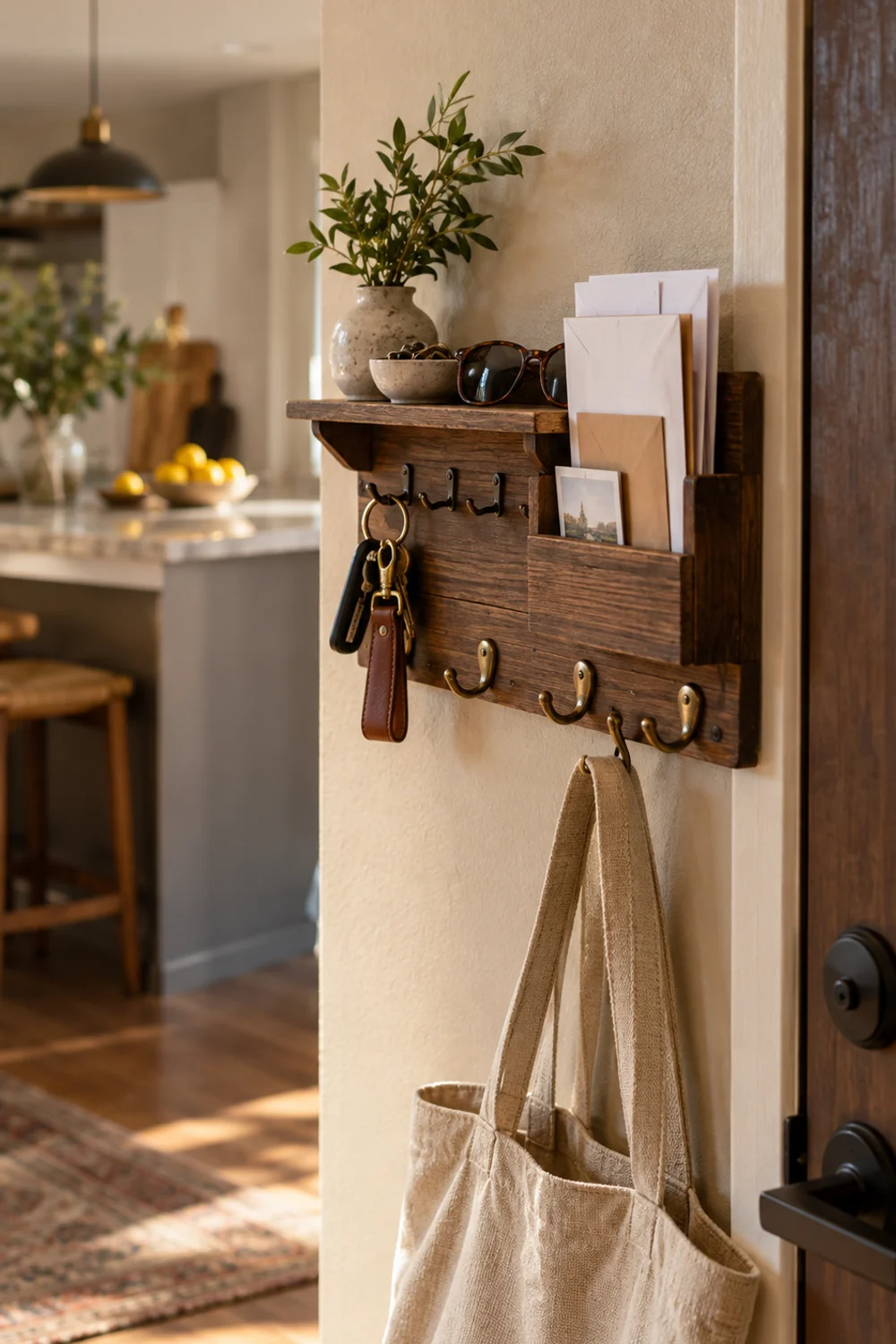
Every household has a bag that gets set down before anything else happens. It might be a work tote, a laptop backpack or a crossbody that holds keys, wallet and phone. When it has no home, it lands on the kitchen counter, and with it come the keys, the mail and the receipts from that morning. A wall-mounted landing shelf near the door intercepts that sequence, giving the first-dropped bag and its small companions a fixed point before they can travel deeper into the house.
Placement does most of the work. Mount the shelf on the latch side of the door, within one step of the threshold, at roughly counter height, around thirty-six to forty-two inches, so you can set something down while your other hand still holds the door. Key hooks belong directly beneath, where they can be reached without looking. A vertical mail slot keeps envelopes upright instead of piling flat, which matters because a flat pile invites more paper, while an upright slot visibly fills and asks to be sorted.
A shallow shelf won’t hold a full laptop bag on its own, and it shouldn’t try. The better arrangement pairs a narrow shelf for small objects with a sturdy hook nearby, so the bag hangs by its strap while its contents sit within reach. Look for an organizer that gathers mail, keys and a small shelf into one compact unit, such as a wall-mount mail organizer with a key holder and shelf, then add a single strong hook beside it for the bag itself.
Picture a studio apartment where the front door sits a few feet from the kitchen island. Its owner, a graphic designer who works from home three days a week, used to find her keys under a pile of mail on the island every morning, and twice she paid a late fee on a bill buried there. Now a landing shelf beside the door holds keys on hooks, outgoing envelopes in the slot and her canvas tote on a hook below. The island stays reserved for cooking.
Clutter almost always migrates inward from the door. Objects that are not caught at the threshold drift toward the nearest flat surface, then the next, until a dining table becomes an inbox. A landing shelf works as a boundary, a small checkpoint where outside things are sorted before they enter the living space. Its modest size is an advantage. Because it can only hold a little, it encourages a quick daily reset, and the rest of the home benefits from that small, repeated act of editing.
7. A Rotating Coat Tree for the Corner Nobody Uses
 Save it
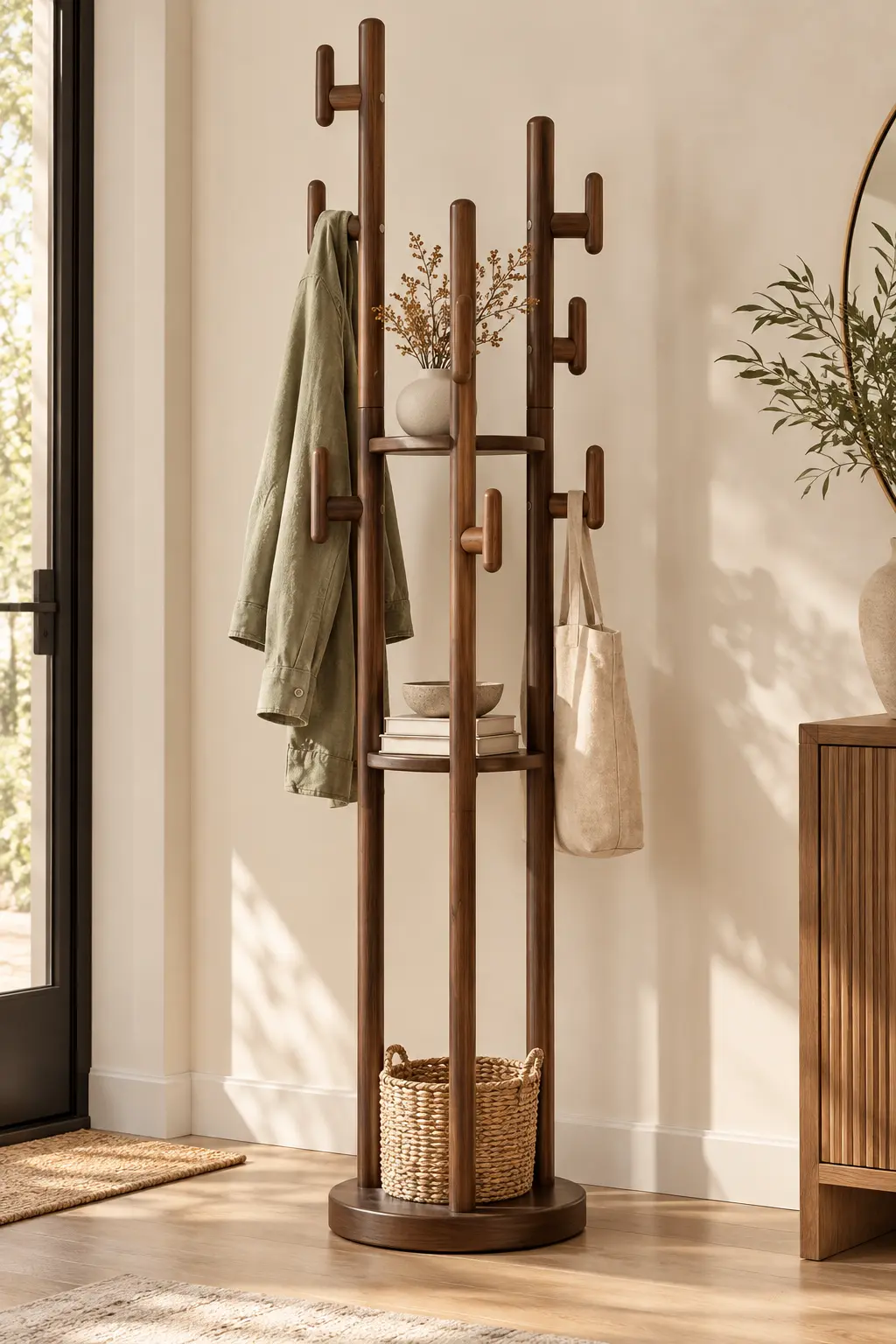
Most small entries have a corner nobody uses, usually the one beyond the door’s reach or where two walls meet at an awkward angle beside a closet. It is too tight for a chair and too deep to reach comfortably, so it collects a stray umbrella and some dust. A rotating coat tree is made for exactly this geometry. Because its hooks and shelves turn on a central post, items stored at the back can be swung around to the front with a light push.
Fixed coat trees waste corners because half of their hooks face the walls and become unreachable once coats are hung. Rotation removes the back of the tree as a concept. Before buying, measure the corner diagonally and leave a few inches of clearance around the full turning radius, including the bulk of hung coats, which can add eight or ten inches on every side. Keep the door’s swing in mind too, since anything placed near a door must still let it open fully.
Shelves turn a rotating tree into something more than a coat hanger. Small shelf tiers between the hook levels can hold folded hats, a pair of gloves, a dog leash or a phone set down while you zip a jacket. A solid wood build tends to feel steadier when loaded unevenly, while thinner metal versions are more likely to wobble. A solid wood rotary coat rack with nine hooks and three shelves offers enough capacity for a couple and their guests without overwhelming the corner.
Consider a small cottage whose front door opens beside an empty corner next to the living room wall. For years that corner held only a doorstop. When the owners, who walk their dog twice a day, placed a rotating coat tree there, it became the dog-walking station: leash and treat pouch on the top shelf, rain jackets on the outer hooks, and a fleece for colder mornings turned to the back until it’s needed. The door still opens fully, clearing the tree by a few inches.
Rotation is a quietly powerful idea in small spaces. When a room cannot get bigger, the objects inside it can become more mobile, bringing storage to the person instead of asking the person to squeeze toward the storage. Lazy Susans in kitchen cabinets and swivel chairs at desks work on the same logic. In an entry, a turning coat tree means nobody has to reach over three coats to find the fourth, and that small reduction in effort is what keeps people using it every day.
8. The Open Wardrobe Rack That Carries Heavy Winter Coats
 Save it
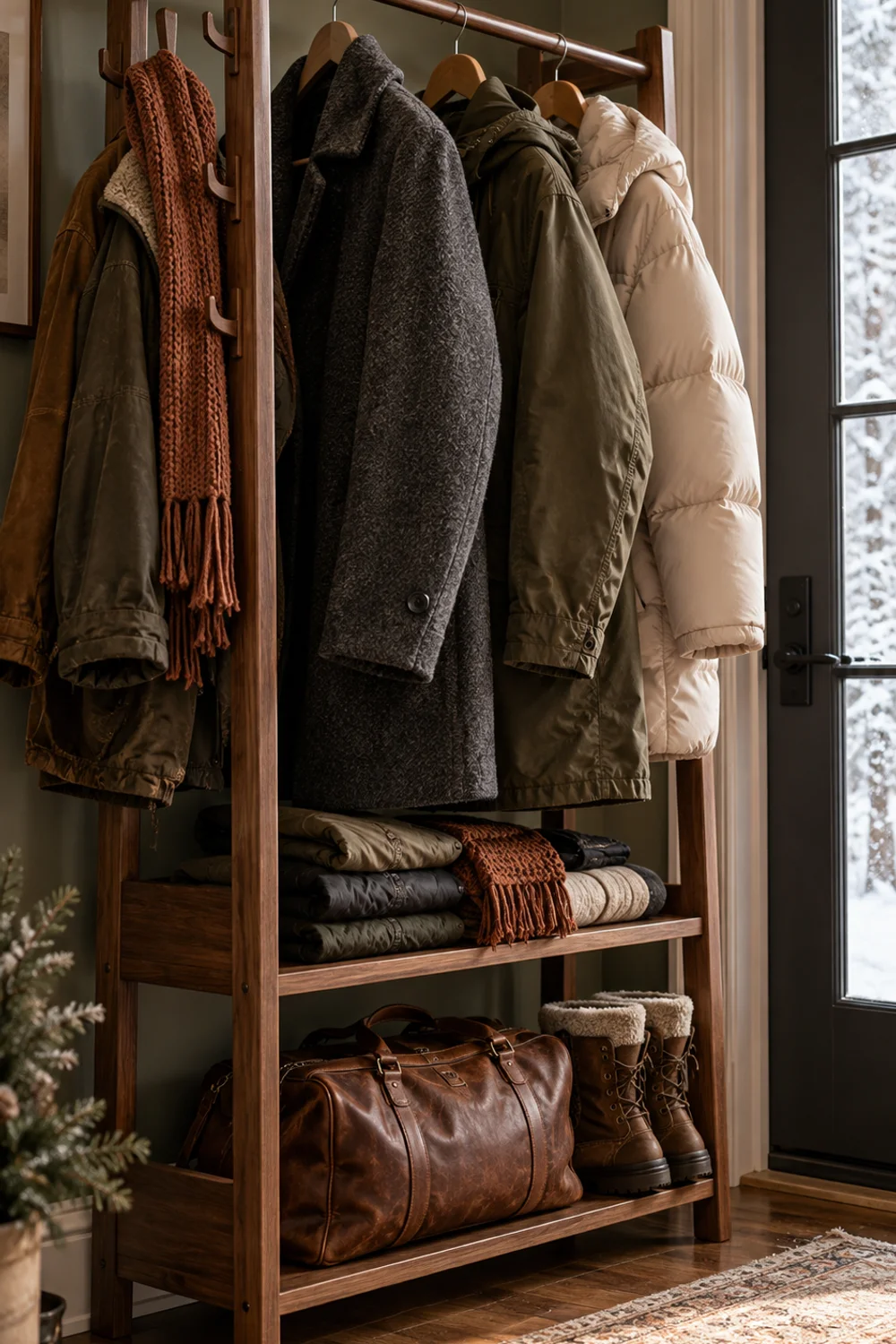
Hooks are hard on heavy coats. A wool overcoat or a long down parka hung by its collar loop all winter will stretch at the neck and develop a dent across the shoulders, and the sheer weight can pull hooks out of drywall over time. An open wardrobe rack lets these coats hang on proper hangers, supported across their full shoulder width. For households in cold climates, where the best coat in the house may also be the most expensive piece of clothing anyone owns, that difference matters.
Planning the rack is a matter of simple arithmetic. A bulky winter coat needs four to six inches of rod width, and its shoulders require roughly twenty inches of depth, so the entry must be able to give up that much floor along one wall. For long coats, the rod should sit at least sixty-six inches high so hems clear the base shelf. Wide wooden hangers with contoured shoulders spread the load better than thin wire, and they keep tailored outerwear holding its shape.
A rack that combines a hanging rod with shelves and a few side hooks handles more than coats. The upper shelf can hold folded scarves and hats in winter, the lower one keeps a weekend bag or a pair of boots off the floor, and the hooks take lighter items that don’t need a hanger. Solid wood is far less likely to sag under several winter coats than thin tubing. The Yoobure solid wood clothing rack with shelves and six hooks brings those three functions together in one frame.
Picture a Minneapolis apartment with no coat closet at all, where three people each own a calf-length parka, a lighter fall jacket and a ski shell. On hooks, the parkas formed a single swollen mass by the door, and one of them developed a permanently warped hood. An open rack along the entry’s longest wall now holds the three parkas on wide hangers, with fall jackets on the side hooks and the ski shells folded on the top shelf until the first weekend on the slopes.
An open rack changes how a coat is treated. Hung on a hanger, a coat is something cared for, brushed off and allowed to air, rather than something thrown on a peg and forgotten until spring. There’s an aesthetic reward too. A row of good coats on matching hangers reads almost like a study in texture and color, wool beside waxed cotton beside quilted nylon. In an entry with little else in it, the outerwear itself becomes the composition, honest and quietly handsome.
9. The Accordion Rack for Hats, Totes and Everyday Bags
 Save it
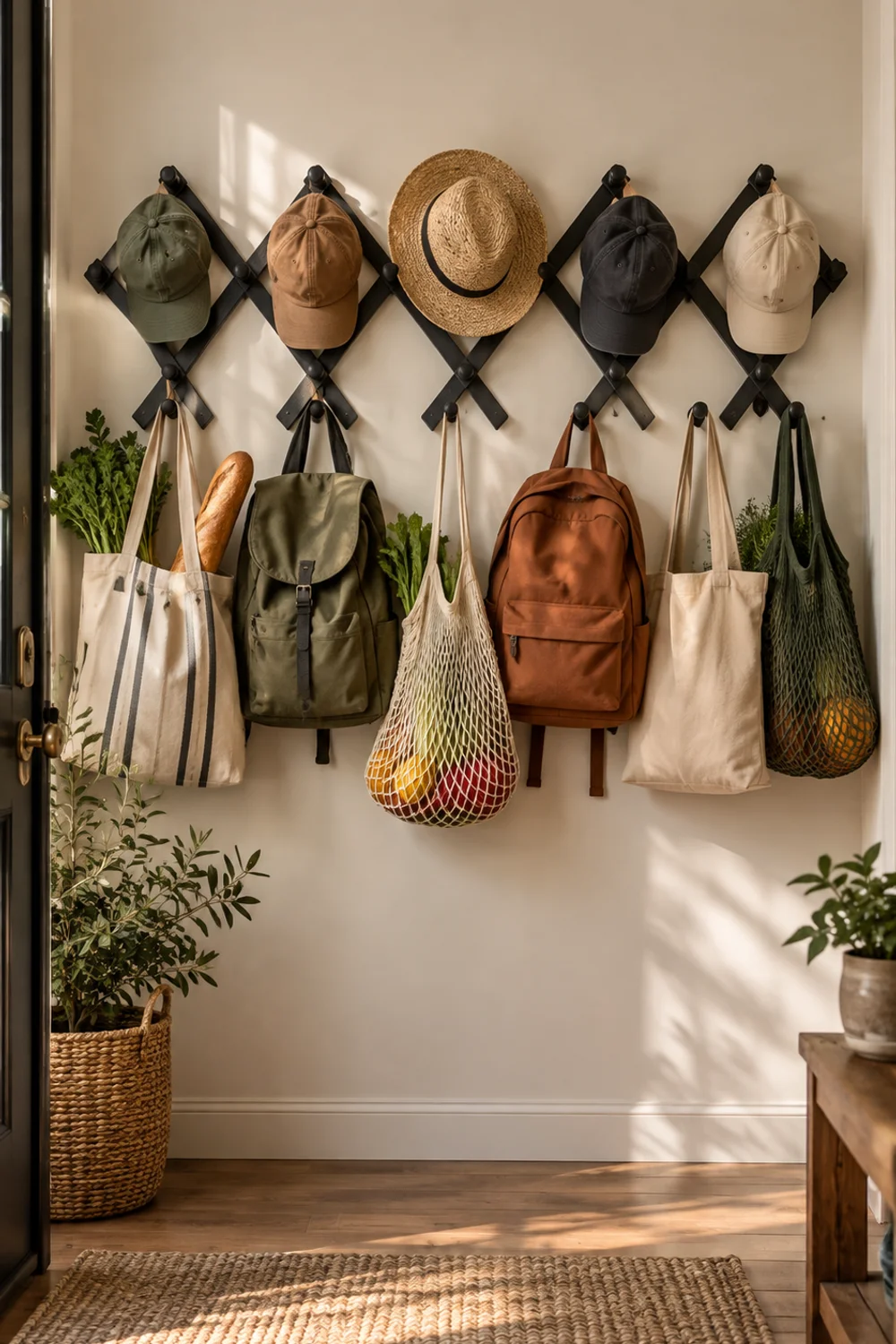
Bags are awkward tenants in a small entry. They don’t hang flat like coats, they come in every size from a cotton tote to a structured leather satchel, and most households own more of them than they realize. A row of hooks spaced for coats leaves them colliding. An expandable accordion rack offers a different spacing logic: its crisscross frame places hooks in two staggered rows, so a tote can hang beside a cap without either one landing on top of the other.
Adjustability is the practical advantage. Pulled wide, the frame spreads its hooks across a longer stretch of wall, giving bulky bags room to hang without bumping. Pushed narrower, it packs more hooks into a short space for caps and light totes. Because the hooks alternate between upper and lower points, items layer instead of overlapping. Mount it higher, around sixty-eight to seventy inches, if it will carry hats, or closer to fifty-five inches if children will hang their own bags.
An accordion rack is best kept for lighter items. Heavy leather bags full of laptops and a stack of wet winter coats will strain the joints over time, so pair it with sturdier storage for those, and let it specialize in hats, totes, reusable shopping bags and scarves. A black finish gives the crisscross pattern a crisp graphic quality against light walls, almost like a line drawing. The Mercurial Trade expandable wooden accordion coat rack with fourteen hooks in black is a good example.
Imagine two roommates sharing a small apartment whose entry is little more than a strip of wall beside the door. Between them they own six canvas totes, two backpacks, a baseball cap collection and a growing pile of farmers market bags that used to live in a heap on the floor. An accordion rack stretched across that strip now holds everything in two neat staggered rows, caps along the top points and totes below, and each roommate can spot their own bag at a glance.
Some storage looks good only when it is full, or only when it is empty. The accordion rack manages both. Its zigzag frame is decorative in its own right, a piece of honest structure that shows exactly how it works, so even on a summer day with a single straw hat hanging from it, the wall still looks considered. That quality matters in a small entry, where every object is seen at close range, every time you come and go, from every angle.
Common Mistakes
Hanging every hook at a single adult height
Mounting all the hooks at one height leaves children dropping backpacks on the floor and shorter adults stretching for their coats. Stagger the heights instead, with a lower row around forty-two to forty-eight inches for kids and everyday bags, and the system works for the whole household rather than just the person who installed it.
Spacing hooks too closely
Hooks set four inches apart look generous on an empty wall, but winter coats need closer to eight or ten inches each. Crowded hooks cause coats to pile on one another, so the bottom layer disappears and nothing is easy to grab. Fewer, well-spaced hooks almost always hold more in practice.
Measuring the furniture but not the coats
A coat tree or hall tree that looks perfect in an empty corner can block the door or the walkway once it is loaded, because outerwear adds several inches of bulk on every side. Always measure with full coats in mind, not with the bare product dimensions from the listing.
Underestimating the weight
A full rail of winter coats and bags weighs far more than most people expect. Wall-mounted racks held only by the small plastic anchors included in the box often loosen within a single season. Find the studs, or use anchors rated well beyond the load you plan to hang.
Leaving too little walking room
An attractive hall tree or open rack that leaves less than about thirty inches of clear path turns the entry into an obstacle course. Measure the depth of the piece plus the coats hanging on it, and make sure someone can still pass comfortably with a bag over one shoulder.
Frequently Asked Questions
How high should coat hooks be in an entryway?
For adults, hooks generally work best around sixty to sixty-six inches from the floor, which keeps most coats from dragging while staying within easy reach. Long coats may need a slightly higher hook or a rod closer to sixty-six or seventy inches. For children, a second row at forty-two to forty-eight inches lets them hang their own jackets and backpacks. If there’s a shelf above the hooks, leave enough clearance that a bulky hood can hang freely without being crushed against it.
What can I use if I’m not allowed to drill into the walls?
Freestanding pieces are the most reliable renter-friendly answer. A coat tree, a rotating coat rack, a hall tree or an open wardrobe rack all stand on the floor and need no wall anchors at all. Some smaller hook rails can be hung with heavy-duty adhesive strips, but check the weight rating carefully and keep heavy coats off them. If your lease allows small holes, a few screws driven into a stud are usually easy to patch and paint over when you move out.
How many hooks does a small entryway really need?
A practical starting point is one or two hooks per person in the household, plus one or two more for guests. Most people have a daily coat and one bag in regular use, and everything else can live in a bedroom closet until the weather calls for it. Installing far more hooks than that tends to invite extra layers to accumulate near the door, and the entry slowly drifts back toward the crowded, chaotic state you were trying to fix in the first place.
Should coats and bags be stored together or separately?
In a very small entry, sharing one piece of furniture is often the most efficient choice, as long as each item type has its own zone within it. Coats belong on the upper hooks or a rod, bags on lower hooks or a bench, and small accessories on a shelf. Separating them by height rather than by location keeps the footprint compact, prevents straps from tangling with sleeves, and stops heavy bags from crushing the shoulders of a good wool coat over a long winter.
Final Thoughts
A small entry asks only one thing of its storage: that coats and bags know where they belong. Whether that answer is a coat tree in a corner, a hall tree against a single flat wall or a row of pegs that folds away in summer, the right choice is the one that fits your door, your floor and your daily rhythm. Once outerwear has a real home, the rest of the space starts to feel calmer almost by itself.
You don’t have to solve everything this weekend. Start with the one item that causes the most friction, usually the bag that lands on the kitchen counter or the coat that hangs from a chair, and give it a proper place. Live with that change for a few weeks, notice what still drifts, and adjust. Entries that work beautifully are rarely designed in a single afternoon; they are refined slowly, one well-placed hook at a time.
If one of these ideas fits your entry, save it to a Pinterest board so it’s waiting when you’re ready to measure, and keep exploring the other small-space guides here as your home evolves. The doorway is the first thing you see coming home and the last thing you see leaving. It deserves the same thoughtful attention as any living room, and with a little care, it can become one of the quietest, most welcoming corners you own.
This post contains affiliate links. I may earn a small commission at no extra cost to you.

Get cozy inspiration delivered to your inbox.
✓ 14-page beautifully designed ebook
✓ Cozy decorating ideas
✓ Practical room-by-room inspiration
You’re in! 🎉
Thanks for joining the NestFlowHome community!
Your free ebook is already on its way to your inbox. If you don’t see it within a few minutes, please check your Promotions or Spam folder.
Join the NestFlowHome community for weekly decorating inspiration.

Timeless home decor ideas and slow living inspiration for a calm, beautiful life.